The Christian Intelligencer favors a revision of sabbath laws. It says:—
We insist upon this, first, because it is right. No community should interfere with the conscientious convictions of any of its people. Secondly, such a regulation would relieve the Seventh-day Baptists. This class of people have feeble logical strength, but are otherwise excellent citizens. They ought to be indulged in their infirmity so long as that indulgence does not interfere with the enjoyment of the Lord’s day by others. Thirdly, the proposed change would free the friends of Sunday from a burden they ought not to carry, the burden of oppressing the consciences of their weak brethren. We are friends of the sabbath laws as both right and expedient, but those laws must not be used to inflict penalties upon conscientious and God-fearing men.
How patronizingly charitable! And what is the evidence of their “feeble logical strength”?—Simply this: they reason that they ought to keep the seventh-day Sabbath because the Lord has so commanded. It might be expected that an Ingersoll or other outright worldling would deem this an evidence of feeble-mindedness, but that one claiming to be an instructor in righteousness should so characterize an act of obedience to God is beyond the pale of even feeble logic. According to the position assumed by the Intelligencer, it is a mark of great logical strength to obey man rather than God; therefore, its stand is precisely that of the infidel.
As to its solicitude for the friends of the Sunday law who assume the burden of oppressing the consciences of their weak brethren, there is indeed cause for such concern. Admitting for the moment the seventh-day observer’s “feeble logical strength,” it might be profitable for those who oppress them to remember the words of Christ: “Whoso shall cause one of these little ones which believe on me to stumble, it is profitable for him that a great millstone should be hanged about his neck, and that he should be sunk in the depth of the sea. Woe unto the world because of occasions of stumbling! for it must needs be that the occasions come; but woe to that man through whom the occasion cometh.” Matt. 18:6, 7, R. V. Surely no greater cause of stumbling could be placed in the way of any simple-minded person, either little child or adult, than to induce or attempt to compel him to turn away from the plain commandment of God.
But the last sentence of the quotation at the beginning of this article is the climax of “feeble logical strength” on the part of the Intelligencer itself. “Sabbath laws” are “both right and expedient,” but they “must not be used to inflict penalties upon conscientious and God-fearing men.” What kind of a sabbath law would it be that could inflict penalties upon such a class? Remember that the “sabbath laws” referred to are those enacted by men, and are always Sunday laws; and the God-fearing men referred to are those who keep the Sabbath ordained by the law of God. Yet the Christian Intelligencer avows friendship for a sabbath law, and deems it “right and expedient,” that is opposed to the Sabbath law given by the Lord, and which is kept by “conscientious and God-fearing men.” Such a sabbath law as is contrary to the Sabbath law of God must be a man-made law. But it “must not be made to inflict penalties upon conscientious and God-fearing men.”
Then upon whom must such laws inflict penalties?—Upon those who are not “conscientious and God-fearing,” of course. But who is to be the judge as to who are “conscientious” and who are not? Let us see. Offenses under all man-made laws must be tried before human courts. Then human judges must be judges of the consciences of all offenders against such “sabbath laws” as the Intelligencer deems “right and expedient.” And that is the obligation thrown upon human courts by all human laws promulgating religious doctrine, or in any way interfering with religious duties of the people.
CHRIST'S COMING.
By Alexander McLaren
THE final personal coming is preceded by the darkening sun, the quenched moon, the falling stars,—portents equally terrible, whether fact or figure. The “parable of the fig tree” bids us think of that coming which has so terrible precursors, and so much which might excite awe, as if it were a glad, bursting summer, and these signs as natural, peaceful, and hopeful as the suppling stem and the swelling buds,—a beautiful and surprising image, which they that “love his appearing” understand. . . . Christ's final word is the strong declaration of ignorance of that day, which he himself shares, and the enforcement of the practical lesson of watchfulness, which is not restless anticipation of his coming, but “loins girt and lamps burning,” strenuous effort and bright Christian character, stimulated and fed by the assurance that he comes and ignorance of the time when he does. The last words of all sufficiently show that he was speaking to future generations, “What I say unto you I say unto all, Watch.” They lay that duty on every age.—Alexander McLaren, D.D.
Speak Good of Others, Keep Silent on Faults
“THINK all you can of the good qualities of others; forget and keep silent concerning their bad qualities.”
Gaining Wisdom by Avoiding Others' Failings
“We gain as much in avoiding the failings of others as we do in imitating that in which they excel.”
GRIEVOUS WORDS.
“‘But grievous words stir up anger’—‘but grievous words stir up anger.’ ‘A soft answer turneth away wrath; but grievous words stir up anger.’”
Little Flossie Latimere was sitting on the calico-covered lounge, busily studying her verse for the Sabbath. Over at the table, Belle, Flossie’s older sister, was wiping the dinner dishes. Belle’s lips were firmly compressed, and there was an angry gleam in the blue eyes that were so like Flossie’s.
There was no sound in the room except the soft, monotonous voice of the child repeating the verse. And the words seemed to Belle to be set to sad, mournful music. The impatient look gradually faded from the young girl’s face, and when she had finished her dishes and swept the floor, she went and stood by Flossie’s side.
“I’ve got it learned,” the child cried triumphantly, pulling Belle down on the lounge and nestling her golden head in her sister’s lap. “Hear me say it.” And once more the childish voice repeated the words.
“What does it mean, Belle?” she asked abruptly. “What are grievous words? and how do they stir up anger?”
“It means cross words, dear,” and Belle smoothed the bright hair. “And they stir up cross feelings in the heart of the person to whom they are spoken, and the result is a quarrel.”
“Like you and Ralph to-day,” Flossie interrupted. “They must have been grievous words you said, weren’t they, Belle?”
Belle did not reply. After a moment she laid the head of the child, who was half asleep, upon the pillow, and went softly up to her room. Flossie’s question had stung her, and as she stood before the glass, brushing her hair, she reviewed the scene to which the child had referred.
Mrs. Latimere was away on a visit, so Belle10was housekeeper. She had gone to the sitting room a half hour after dinner, and found disorder reigning there. Ralph had carried the cushions from the chairs to the couch, scattered the papers over the table, and overturned his sister’s workbasket.
Belle scolded. “I wish you would stay out of here,” she said, by way of conclusion. “You are always making work.”
“Just giving your tongue exercise,” Ralph replied teasingly. “Say, Belle, do you like to scold?”
“That’s all you care. You are the worst boy I know, and I’m ashamed of you.”
Ralph sprang up from the couch at that. “I don’t claim to be a goody-goody like you,” he cried hotly. “You’re a pretty Christian, Belle Latimere!” and Ralph slammed the door after him.
“Yes, Flossie, dear, they were grievous words,” and Belle leaned against the window frame, letting her eyes wander over the gayly-tinted October woods. “I wish I could be a better sister to Ralph. I love him, but, oh, my horrid temper!” And she brushed away the tears.
She finished her simple toilet. As she descended the stairs, she murmured, “I’ve proved the last part of Flossie’s verse, now I’ll try the first,” and a quick prayer winged its way to where no cry for help is ever unheeded.
Belle went straight to the sitting room and began putting it in order. In a few moments Flossie came in, bright and cheery after her nap. “Please, sis, can’t I go out where papa and Ralph are?”
“Papa has gone to town, but you can go to the west barn, where Ralph is packing apples,” Belle said, kissing the pink cheek. “Get your hat, Blossom.”
“I’s hungry, sister, hungry for crullers.”
Belle laughed and hurried to the pantry. Coming back, she gave the child, besides her own crullers, three wrapped in a paper.
“Give them to Ralph, say your verse to him, and tell him Belle said she wished she had studied the first part of it this afternoon.”
“All right,” and Flossie ran away.
An hour later, when she came in, Belle, who was filling the shining copper teakettle preparatory to beginning supper, asked softly, “What did Ralph say?”
“He said to tell you the crullers were jolly, and he’d learn the verse, too. Won’t that be funny, though, for us all to learn it?”
Ralph was washing at the kitchen sink when Belle came from the cellar. She placed the pitcher of cream and the ball of golden butter she carried on the table and hesitated a moment.
You know how hard it is to confess a fault, and it was no easier for Belle than for you or me. But help came to her in that moment of silence—shall we say in answer to the prayer of a few hours before?
“Forgive me, Ralph, for my hasty words;” her voice trembled a little. “I am ashamed of myself for—”
“Now, don’t say anything more, Belle,” and a blush burned its way through the tan on the boyish cheeks. “I was the one to blame, and, sister, I’m sorry I said what I did about—well, you know.”
“Yes, I know, Ralph, and I don’t blame you. I am a faulty Christian, but I am going to try to be a better one. You know I have a dreadful temper.”
“Well, you are not alone there. That is a family possession of the Latimeres’; Belle, we’ll fight it out together after this.”
“Yes,” and a pleasant smile lingered around the girl’s lips. “We’ll prove that ‘a soft answer turneth away wrath,’ as well as ‘grievous words stir up anger.’”—Philadelphia Methodist.
GROWTH OF ROMAN CATHOLICISM.
Monsignor Loubet, a Roman Catholic missionary, has recently published a book, says the Catholic Mirror, on the progress of Roman Catholicism, in which he gives the following statistics:—
“In 1850 there were scarcely 3,258,440 Catholics in all the Protestant European countries; there were 8,000,000 in Ireland, 6,000,000 in Germany, 6,500,000 in Poland, and 350,000 in Switzerland. In Turkey in Europe, Monsignor Loubet tells us that there were only 250,000 Catholics. There were 381,600 in Asiatic Turkey, 475,000 in the Indian Vicariate, 310,000 in Indo-China, 6,000 in Korea, 61,000 in the United States, 120,000 in Canada, 105,000 in the West Indies, 38,000 in Texas and California, 30,000 in South America.
“The Catholics in England have now increased to 1,690,921. There are 1,626 more churches and 2,000 more Catholic schools than in 1850. Germany now counts 16,000,000, instead of only 6,000,000, and Holland 1,488,852, instead of 350,000. Switzerland now counts 1,800,000, and Russia 2,882,891; the Caucasus, 26,815; Siberia, 24,316; and Central Asia, 1,396 Catholics. In Persia and Asiatic Turkey Catholics increased from 400,000 to 659,690. There were 475,000 Catholics in India in 1890; to-day there are more than 1,692,937. Only 5 missions existed in China in 1890; there are now 38, and 576,440 faithful. The United States shows a return of 7,977,278 Catholics in 1890, and Canada 2,000,000. Treating of Africa, Monsignor Loubet says that there are 400,000 Catholics, 260 churches, and 220 schools in Algiers, and he gives other interesting details of other parts of the Dark Continent. An apostolic prefecture was established in the Sahara in 1868, and in Erythrea in 1894. There are numerous flourishing missions in other parts of Africa, and in the east there are now 5 missions, 40 churches, 37 schools, and 23,160 faithful. The above statistics speak for themselves with regard to the state of the church all over the world.”
The Churches in New York.—
The Rev. Thomas Dixon (Baptist), in a lecture on “The Failure of Protestantism in New York City,” declares that in that city there was “in 1840 one church to every 2,000 inhabitants. To-day it has one church for every 4,500 of its inhabitants. There are vast districts in which there are 50,000 people and no church. New York City has 500,000 human beings, who, as regards Christian knowledge, are heathen—not in name and form, but in heart and spirit. The number of men who attend church is not equal to one-half of those who register daily at the hotels of the city.” The Methodist Church, he tells us, with 17,309 members and 86 churches, with an invested capital of $4,100,000, gained 241 last year in membership. The Baptist, with 18,000 members and $4,000,000 invested capital, gained 261 members. The Presbyterian Church, about the same proportion. The average income per member is only about $32. Certainly a poor showing so far as figures go. In the light of the prophetic word we may expect this.
Discerning the Signs of the Times
“AND he said also to the people, When ye see a cloud rise out of the west, straightway ye say, There cometh a shower; and so it is. And when ye see the south wind blow, ye say, There will be heat; and it cometh to pass. Ye hypocrites, ye can discern the face of the sky and of the earth; but how is it that ye do not discern this time?” Luke 12: 54-56.
BE PATIENT.
They are such tiny feet!
They have gone such a little way to meet
The years which are required to break
Their steps to evenness, and make
Them go
More sure and slow!
They are such little hands!
Be kind—things are so new, and life but stands
A step beyond the doorway. All around
New day has found
Such tempting things to shine upon; and so
The hands are tempted oft, you know.
They are such fond, clear eyes,
That widen to surprise
At every turn! They are so often held
To sun or showers—showers soon dispelled
By looking in our face;
Love asks, for such, much grace!
They are such fair, frail gifts!
Uncertain as the rifts
Of light that lie along the sky—
They may not be here by and by;
Give them not love, but more—above
And harder—patience with the love.
—Selected.
EVERY GOOD HOUSEKEEPER SHOULD BE GLAD TO KNOW
That potash put down the rain pipes will prevent a plumber's bill.
That benzine rubbed on the edges of a carpet is a sure preventive of moths.
That to remove peach stains soak in milk for forty-eight hours, or rub with lemon juice and salt.
That tansy is a sure preventive of moths, and that if the leaves are sprinkled freely about woolens and furs, they will never be moth-eaten.
That to renew straw matting, rub all over it a layer of wet fuller's earth; after it has remained for several days, cleanse with salt and water.
That stone jars for bread and cake boxes should be scalded twice a week in summer weather, sunning, if possible, to keep mold from gathering.
That an infant's clothing should always be so arranged as to allow the limbs freedom of motion, and not to compress any portion of the body.
That jellies should always be made in a porcelain kettle, and that the best refined or granulated sugar should be used, and that the fruit, especially currants and grapes, should not be overripe.
That it is a good plan to keep a small dish of powdered charcoal on one of the upper shelves of the refrigerator, as it is an excellent absorbent of odors. It should be changed every few days.
That rolls which have become dry may be freshened by dipping them quickly into water, and placing them in the oven for two or three minutes, until the water has dried. They will taste almost like new rolls.
That an infant's clothing should be studiously adapted to the weather, avoiding at all times exposure to the injurious effects of sudden changes in temperature without proper covering; but nurseries and sleeping apartments should invariably be well ventilated.
That aluminum is becoming a favorite metal for kitchen utensils. It is higher in price than tin and iron, but housewives who have used it are delighted with its satisfactory results. It is less heavy and unwieldy than the other metals, lasts as well, and is easily kept bright.
That in preserving fruits, the syrup used for juicy fruits should be rich, and that for fruits which are rather dry, and require long cooking, should be rather thin. The proportions of a rich syrup are one pint of sugar to half a pint of water, the two ingredients to be boiled together for a quarter of an hour.
That corks that have been steeped in vaseline are an excellent substitute for glass stoppers. Acid in no way affects them, and chemical fumes do not cause decay in them, neither do they become fixed by a blow or long disuse. In short, they have all the utilities of the glass without its disadvantages.
That, having taken too long a walk, or become over-fatigued in any way, it is wiser to go back to bed for an hour or so, and give yourself a complete rest, than drag about for the rest of the day, too tired to do anything. A rather delicate girl found that by adopting this plan she renews her strength and energies in what proves to be the most economical expenditure of time.—N. Y. World.
Bad Thoughts Quickly Ripen Into Bad Actions
“Bad thoughts quickly ripen into bad actions.”
A FLORIDA CRANE.
By Anna R. Henderson
WHEN I was a little girl, my home was in Florida, and one of my friends at school was Annie Hunter. Annie had a pet crane, which had been caught on a Florida prairie, where there are always flocks of them. His color was a light silvery blue. His body was about as large as that of a turkey hen, and his legs and neck were so long that when he stretched himself up, he was almost as tall as a man.
Annie called her crane Stuart. He was fond of her, would come when she called him, and when he saw her coming from school would meet her and walk by her side.
I longed to be friendly with him, but when I walked softly up to him, he would raise his head and look at me with his long bill so close to my face that I was afraid he would pick my eyes out.
He had a fancy for picking at bright buttons. He spent much time in the yard and garden, but would walk into the house like one of the family, and liked to come to the table to eat bread and potatoes.
Now, you will not think that such a pet could be of any use. But he was useful. He filled the place of a watchdog. He slept on the back porch at night, and no one dared enter the yard without first calling some of the family.
No chickens were stolen from that yard. No stray dog came prowling around there. He was fierce and watchful, and fought with his large, strong wings. I am sure that he could have beaten down a large boy.—Anna R. Henderson.
A NOBLE HEART.
A FEW years ago a gentleman, going through a crowded part of the city of Glasgow, noticed a pale-faced little bootblack waiting for hire. Touched by the delicate look of the child, he thought he would give him the blacking of his boots to do. Accordingly he gave the little fellow the signal. The boy at once crept lamely toward the gentleman, and as he pulled himself along, was nimbly supplanted by another little bootblack, who was immediately at the gentleman’s feet and ready to begin.
“What’s this for?” said the gentleman to the intruder, somewhat angrily.
“It’s a’ richt,” said the newcomer brightly. “Jamie’s jist a wee while oot o’ the hospital; and the rest o’ us taks turns aboot o’ brushin’ for him.”
Jamie smiled pleasantly by way of assuring the gentleman that his comrade’s story was true.
The gentleman was so gratified by this act of brotherly kindness that he gave Jamie’s friend a whole shilling for his work, telling him to give sixpence to Jamie and keep the other sixpence himself.
“Na, na, sir,” quickly replied the little hero, giving the shilling to Jamie and hurrying from the spot—“na, na, sir; nane o’ us ever taks ony o’ Jamie’s siller.”—Children’s Record.
Illustrated Tract.
One of the late issues of the Bible Students’ Library, entitled “The Seal of God and the Mark of the Beast.” Contains 4 original illustrations. The subject is one of vital interest to all, and now is an opportune time to circulate this tract widely. Order B. S. L. No. 130. Address your State Tract Society, or PACIFIC PRESS PUBLISHING CO., Oakland, Cal.; Kansas City, Mo.; New York City, N. Y.
LIFE OF WILLIAM MILLER.
WITH PORTRAIT.
This book contains sketches of the Christian experience and public labors of this remarkable man. No other man in this century has been more widely spoken of, and more generally misunderstood. These sketches were prepared by those who were his co-laborers, and are a true presentation of the leading events of his life and labors. In addition to the life and character of the man, the character of the Great Advent Movement, in which he acted so prominent a part, is clearly set forth. It is shown that Mr. Miller was no mere enthusiast, but a man of calm judgment, and his interpretation of the prophecies was mainly correct, his only mistake being in regard to the nature of the event to take place at the close of the 2300 days, in 1844. No one can consider himself well versed in the history of the Advent movement in this country who has not read this book.
Contains 408 pp. Price, $1.00.
Address. PACIFIC PRESS, Oakland, Cal.
SOUTH AFRICA AS A MISSION FIELD.
By S. N. H.
BY S. N. H.
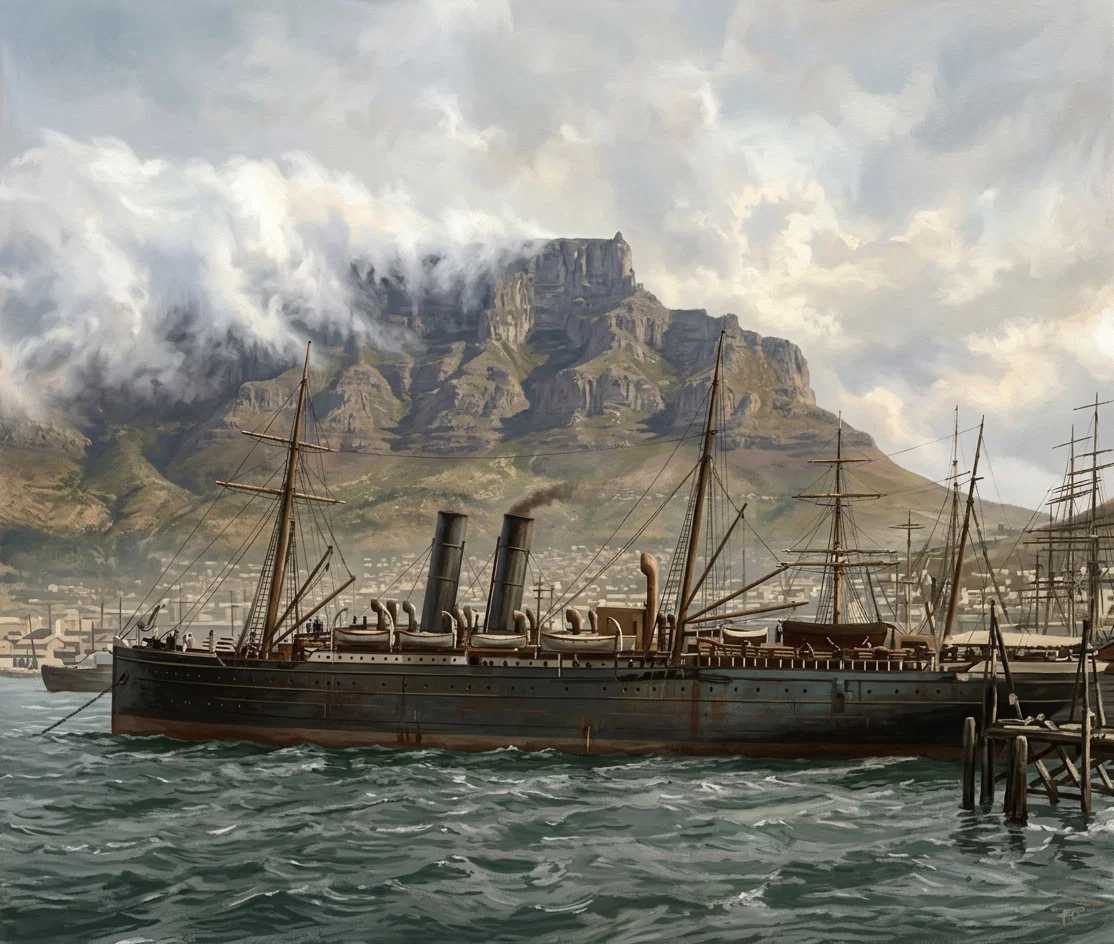
TABLE MOUNTAIN, CAPE COLONY.
Two things are necessary if we would form correct ideas of South Africa as a missionary field. First, a geographical knowledge of the country, and, something of the general character of the various peoples who live in the country. Second, a practical knowledge of the people from personal experience. They differ from the people of Asiatic countries, especially those of China, Japan, and India. In those countries education and an Asiatic civilization exist. But among the natives of Africa where the Gospel has not left its moulding influence there is no religion only that of superstition, nor any civilization. At the present time, however, there is scarcely a tribe to whom the truths of the Gospel have not found way, and there is an open door to the interior of Africa from almost every side. The world is indebted to the Portuguese navigators of the fifteenth century for the discovery of the Cape of Good Hope. The date of the discovery is given as early as 1486 by Bartholomew Dias and Joa Infanta. During a century and a half subsequent to this discovery, the cape was used as a temporary calling place by the Portuguese, English, and Dutch, respectively, who engaged in the Eastern ocean trade. Their ships resorted to Table Bay for water and live stock, which they purchased of the natives. It was not until 1652 that any permanent attempt was made by Europeans to settle the country. Then the Dutch East India Company, under charter granted by the states general of the united provinces of Holland, took possession of Table Bay.
It was not until 1806 that the country virtually became an English colony. Previous to this for a number of years it was in the hands of the Dutch, and at times of the English. In 1815 the colony was definitely ceded to the English by the treaty of Paris. A writer in speaking of these times says, “At the beginning of the century, the cape was still a Dutch colony, but the English, fearing that Napoleon, who had just placed his brother on the throne of Holland, might make use of the cape to possess himself of India, installed themselves there in 1806 to take care of it for the prince of Orange, dethroned by Bonaparte.” Then he adds: “One of John Bull’s mottoes is, ‘Here I am and here I stay.’ He was in the cape and he stayed there. You would more easily withdraw a lump of butter from a dog’s mouth than a John Bull from territory where he has installed himself.”
At the present time South Africa is composed of two English colonies, one of which is Cape Colony on the southwest, and Natal on the southeast; there are also two Independent Dutch republics, which are watched by the English, and several territories, such as Bechuanaland (although steps have been taken by the Parliament now in session to add it to the Cape Colony), Mashonaland, Zululand, Pondoland, Basutuland, Nyassaland, Matabeleland, and a few other lands occupied by the various tribes, are under the protection of the British Government. As the English have taken possession, the active Dutch element, the farmers, have steadily retired northward. These Dutchmen, now known as Boers, have founded the Orange Free State, and the Transvaal, or South African republic, but they can not now well go any farther north, for they are completely surrounded—at the south by the Cape Colony, on the west by Bechuanaland, on the north by Mashonaland and Matabeleland, and on the east by Natal, Zululand, and the Portuguese territory, which the English will never allow them to purchase, even should the Portuguese be willing to sell it, for this territory contains Delagoa Bay, the only harbor of South Africa. All other harbors except Table Bay have a sand bar at the entrance, and Table Bay is small, while Delagoa Bay can inclose an entire fleet.
So it can be seen that the white population of South Africa are the British and the Dutch, and the colored population range from the ebony black of the Zulus to the rich olive of the Malays, Hottentots, Kaffirs, Zulus, Fingoes, Pondos, Basutos, etc. Generally, wherever the English conquer, they give the Bible in exchange for the territory they take, but the Dutch received nothing for South Africa. It is evident the Dutch could get along without the English, and the English without the Dutch, but they submit to the inevitable, living peaceably together.
It is the character of the English to be constantly living low; they give perfect freedom to all, but at the same time there they are. They advance by small but sure steps. By the English language they are gradually gaining an influence over the Dutch in South Africa. The English education makes proselytes for England in a country like this. The Dutch are quite numerous, antiquated, stubborn, but very patriotic. Mr. Krugier, the president of the South African republic, said, upon inquiry if he did not think the English would some day have his country, because of their influx in Johannesburg, “No, I have no fears; we would spill every drop of blood we have before they could take it.” This is much the sentiment of the settlers. They are strictly religious, but not enterprising. Modern improvements of agriculture have no sale with them. Their mode of threshing is with cattle tramping on the prepared threshing floor; their winnowing is shoveling the grain in the air, and the natural wind blows away the chaff.
There is no sympathy between the Dutch Boers and the aborigines. In their estimation, the aborigines “are not human beings to be conciliated, but wild animals to be tracked and exterminated whenever occasion requires.” Their former treatment of their slaves was most cruel. “Capital punishment—especially of slaves and natives—was, according to the Dutch law, carried out by the executioner, who, in the terms of the sentence, had to see that the criminals were ‘bound to a cross and broken thereon alive, from under upwards were the coupe de grace,’ or laid upon a wheel, or hung on the gallows, there to remain a prey to the birds of the air of heaven.”—Official Handbook, 1886. Says a recent writer: “When they did not kill them, they made slaves of them, and drove them to work with great leather whips that they would never have dared to use about the oxen that draw the carts. They never sought to civilize them nor convert them.” The force of circumstances has compelled a change, but how much of the old principle still lives in the hearts of some of the old settlers, only waiting for an opportunity to develop, is an open question. But this never will be as formerly. There are no slaves at present, as in former times. The introduction of English rule has worked reform in many respects. There is a large Dutch element in the Parliament in Cape Colony, and among them are the very best of men, true to their convictions of right, unflinching in their integrity, generous, and hospitable in all their relation to others.
In 1845 the Boers of the Orange Republic undertook to destroy the Griquas, an important tribe living to the west of them, but the English interfered, rescued the natives, and annexed their territory under the plausible pretext that their independence was a continual menace to the tranquillity of South Africa. It is in this country that the diamond fields of the world exist, and which have so bountifully enriched South Africa, and especially Cape Colony. People who have never visited those countries, where they have not had the benefit of Christian civilization,12know not how to appreciate the circumstances of those who settled in this land of darkness, and who like the Huguenots felt the iron heel of oppression and persecution, surrounded by every heathenish custom and system of wickedness for hundreds of years, completely severed from the civilized world. God alone knows how to judge the world and weigh unseen influences that have shaped the character.
As to the different tribes in South Africa, they are like any child of nature without hope and without God in the world. The unprincipled white man who deals in the accursed liquor traffic, and puts the bottle to the lips of his dark-skinned brother who can not control himself when once brought under its influence, those who have introduced vices the natives never knew before, will have much for which to answer in the day of judgment for the existing evils among the natives. They differ in disposition, as does the white man. But those who have given their lives for their salvation declare that the worst difficulty is to contend with the evils the natives never would have known had they not learned them from the white men. They more readily take the Gospel in their native simplicity than those who have lived in the full blaze of its light.
Such are some of the characteristics of the people and the country of South Africa.
Altars of Self-Sacrifice: A Whittier Verse
By Whittier
Wherever through the ages rise
The altars of self-sacrifice,
Where love its arms has opened wide,
Or man for man has calmly died,
I see the same white wings outspread
That hovered o’er the Master’s head.
—Whittier.
BIBLES! BIBLES!!
In All Styles and at All Prices.
WE SELL a fine silk-sewed, leather-lined BIBLE in pearl type at $1.00. Have them in other sizes of type as low as 30c, and as high as $19.
TEACHERS’ BIBLES
REFERENCE BIBLES
TEXT BIBLES
All Bindings. All Sizes of Type.
Send for our new 20-page catalogue.
PACIFIC PRESS PUBLISHING CO., Oakland, Cal.
18 W. 5th St., Kansas City, Mo. 43 Bond St., New York City.
OUR WORK AND WORKERS.
At the camp meeting recently held at Augusta, Me., nineteen persons were baptized in the Kennebec River.
Elder W. H. Falconer desires us to state that his address has been changed to 320 Colony Street, Winnipeg, Manitoba.
Fourteen converts are so far reported as a result of meetings being held near Hickory, N. O., by Elder D. T. Shireman and others.
It has been decided to hold the Southern California camp meeting at Los Angeles, October 31 to November 10. The camp will be located at the corner of Pearl and Pico Streets.
The opening of the college at Battle Creek, Mich., and the academy at Mt. Vernon, O., are reported to be more favorable in the numbers attending than in any previous year of their existence.
In connection with the recent labors of Elders Wm. Ings and A. J. Osborne at Fortuna, Humboldt County, Cal., ten persons have decided to yield obedience to the commandments of God.
On the 14th ult. seventeen members were added to the church in Brooklyn, N. Y., seven of them by baptism, the other ten on profession of faith. One was a lady aged 81 years, who had formerly been a Universalist.
On September 14th after an interesting social meeting in the church at Atlanta, Ga., ten persons were baptized in the lake in Grant Park. The ceremony was witnessed by a large company of people. The brethren hope to have their new house of worship completed in time for the ministerial institute, to commence in January next.
Every Seventh-day Adventist Church in Maryland has had one or more of its members called before magistrates to answer for their faith. So says Brother U. P. Long, state canvassing agent. But very encouraging reports come to hand from the tent meetings being conducted by Elders G. D. Ballou and E. E. Franke in Baltimore. One evening over forty signified their intention of yielding obedience to God, and two evenings afterward fifteen others rose to indicate their convictions and desire to follow in the footsteps of the Lord.
A company of twenty-five is the result of labor last summer at Memphis, Mo., by Brethren L. W. Felter and W. T. Millman.
Elder Geo. B. Starr reports the organization of a church of twenty-four members at Toowoomba, Queensland, Australia.
Brother Robert T. Nash, of Mississippi, has again been arrested for Sunday labor, and is under bonds awaiting trial next spring.
At Muscatine, Iowa, sixteen Germans have begun to observe the Sabbath of the Lord, under the labors of Brethren M. Stuckrath and D. P. Gaede.
A report from Elder M. Larson states that a Spanish M. E. minister at Albuquerque, N. M., has decided to walk in the commandments of God. He was denied the privilege of stating his reasons in the M. E. Conference. Brother Larson also reports eight converts at Raton, with several others deeply interested.
The Bible Echo of August 26 says: “For several weeks past preaching services have been held twice a week in the city of Sydney [N. S. W.] by Elder J. O. Corliss, who is assisted by a strong corps of workers. Five thousand copies of each discourse have been printed and circulated throughout the city and suburbs. By this means the truth is reaching a large number of people each week. The workers report numerous interesting cases. Some have been found keeping the Sabbath who knew nothing of our work heretofore. The discourses on the second coming of our Lord and Master have been greatly appreciated. Many persons have taken large supplies of the printed sermons to post them to their friends in regions beyond.” From the same paper we learn that Elders Corliss and S. McCullagh organized a church at Ashfield, August 10, where a new church edifice is also being erected. There was a large congregation present, and the next day ten additional members were baptized and admitted to the communion of saints. Here a Christian help band is doing an extensive work. It is also stated that at Petersham nineteen had been added to the company as the result of tent meetings.
A TEXT-BOOK ON BIBLICAL HISTORY.
Especially prepared for the use of Students and Teachers of the Bible, and for Sabbath-School Instruction.
CONTAINING Maps, Plans, Review Charts, Colored Diagrams, And Illustrated with Accurate Views of the Principal Cities and Localities known to Bible History.
The following is a condensed Table of Contents:
Chart of Bible History. The Old Testament World. Ancient World, and Descendants of Noah. Physical Palestine. The Journeys of the Patriarchs. Palestine before the Conquest. Lands of the Sojourn and Wandering. The Conquest of Canaan. Palestine among the Twelve Tribes. Palestine under the Judges. The Kingdom of Saul. The Empire of David and Solomon. Ancient Jerusalem. Modern Jerusalem. The Environs of Jerusalem. The Division of Solomon’s Empire. The Great Oriental Empires. The Roman Empire. New Testament Palestine. The Life of Christ. Early Apostolic History. Journeys of the Apostle Paul. The Isles of Greece and the Seven Churches. The Tabernacle. The Temple. Lessons in the Geography of Palestine. The Measures of the Bible.
This is no doubt the best Geography for the price ever published, and should be in the hands of every Bible student. 158 pages, size about 10 x 12 inches. Bound in stiff board covers. Price, post-paid, $2.00. Address all orders to
PACIFIC PRESS PUBLISHING CO.,
Or 43 Bond St., New York. OAKLAND, CAL.
Living by Faith: Spanish Translation of Bible Students' Library No. 75
“Living by Faith.” (Spanish.) A translation of Bible Students’ Library No. 75; 16 pp.; price, 2 cents. Address, PACIFIC PRESS PUBLISHING CO., Oakland, Cal.