Your ShelfYour Projects

Review and Herald, Vol. 77, No. 21.

THE CAMP-MEETING IN VICTORIA
Earlier text: STUDIES IN GALATIANS

AMONG THE CHINESE AGAIN.

MR. WONG KWAI.
MR. WONG KWAI.
After a few months’ respite from labor in the tropics, we are again at our post in Honolulu. The plat of land which was purchased by the Foreign Mission Board in February, 1899, for the purpose of giving more permanence to the character of our school work among the Chinese, was bought in August by a committee of Chinese merchants organized to promote the interests of the school, with the understanding that they erect school buildings thereon, at their expense, according to our plans and specifications, to be occupied by us free of charge. As the buildings could not be completed for at least three months, and as we were all much worn and debilitated we decided to spend a few months in California while the buildings were being erected, which we did with some improvement health-wise. Our stay was prolonged somewhat beyond our expectation, owing to some delay in the work of building. We were sometimes led to doubt whether the work would really be accomplished. But finally word was received from Mr. Wong Kwai, the chief promoter of the enterprise, to be on hand by the first of February; and by the advice of our board, I sailed on the “Moana,” January 25, landing in Honolulu the first day of February. On account of serious plague conditions in Honolulu, and the uncertainty as to when the school work might be begun, it was thought best that my family remain in California till such time as seemed best for them to follow. They arrived in Honolulu by the steamer “Mariposa,” March 28. This is the third time we have crossed the ocean without yet having the privilege of traveling together. At our first coming to Honolulu I came two months before them; on our return to the coast they preceded me two months; and on coming back to Honolulu I preceded them two months. We wish to thank our many friends in California for their part in making our stay among them both pleasant and profitable. We greatly appreciate their sympathy and interest in our work, and feel our courage increased thereby.
On my arrival I found the main building completely framed, but only two carpenters at work. This was really more, however, than I anticipated, because of the prevalence of the bubonic plague in Honolulu, which affected the Chinese more than any other nationality, resulting in the entire destruction of Chinatown by fire and the loss of the homes and stores of a majority of the Chinese residents, together with thousands of dollars’ worth of merchandise and personal effects. When I reached here, nearly the whole of the Chinese population was in quarantine in various detention camps provided by the government. Under these distressing conditions I was much gratified to find even two carpenters at work, all the remainder of the force, including the contractor himself, being in quarantine. Had not the plague interfered, the building would have been completed at the specified time, February 1. The men have returned to their work as fast as released from quarantine, until, at the present writing there are eight.
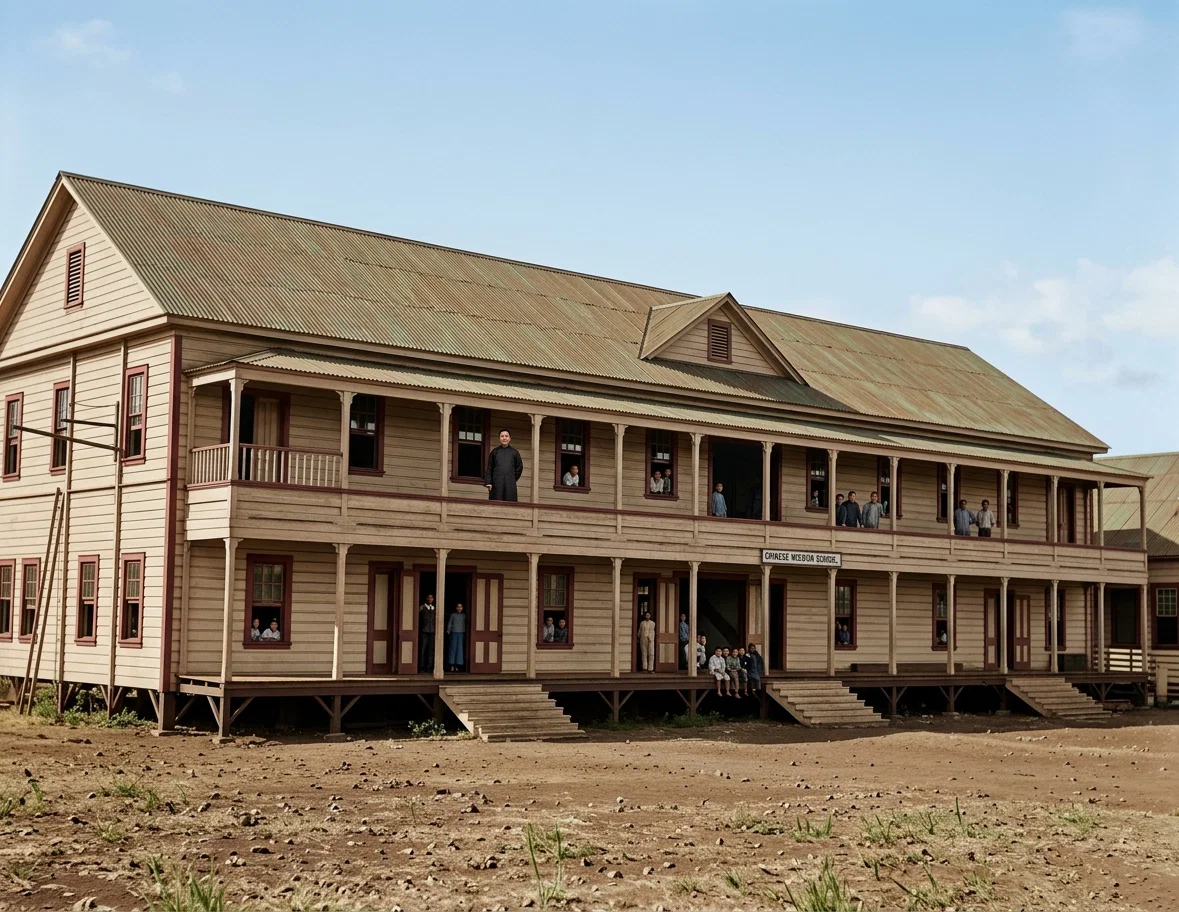
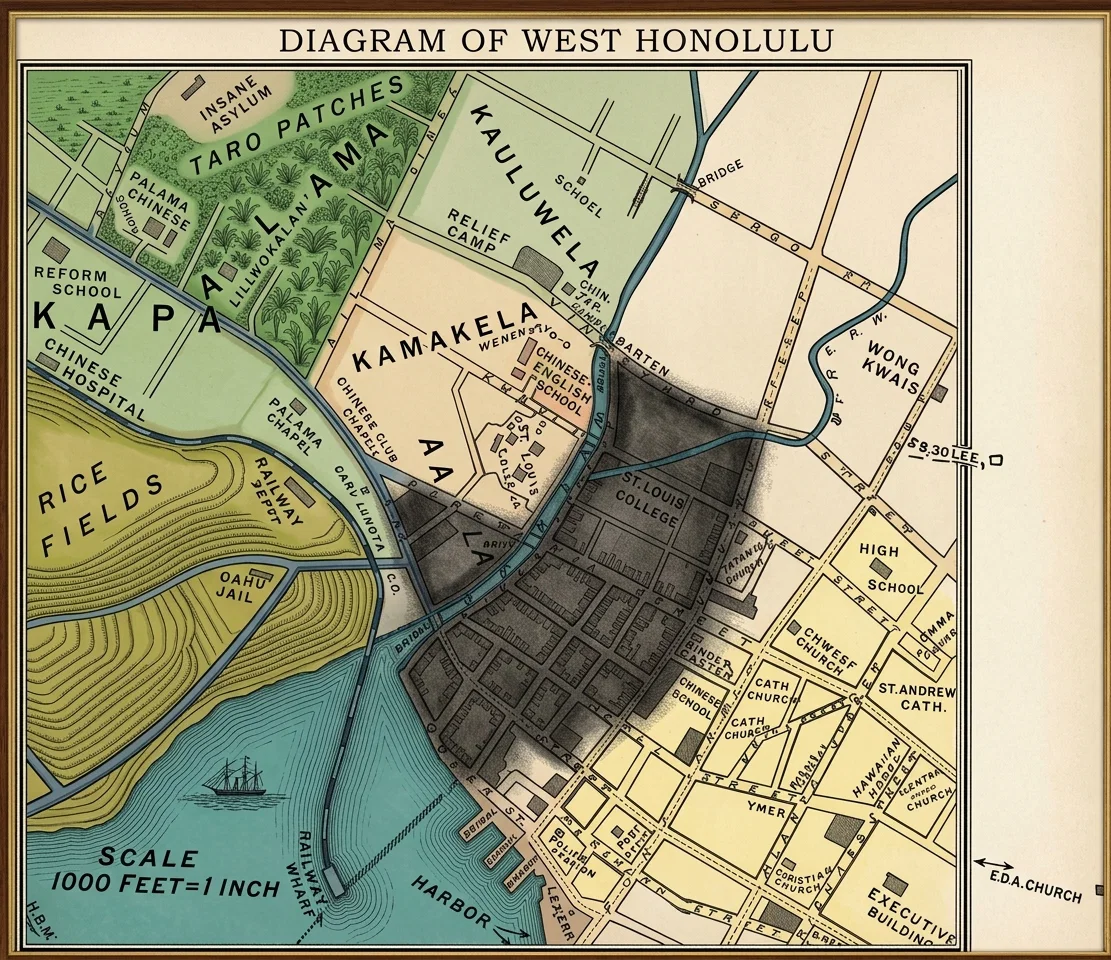
The carpenter work is now nearly finished, the painters have begun work, and a few weeks more will suffice for the completion of the main building. It contains eight school-rooms, nineteen by twenty feet, and an assembly room thirty by forty feet, on the first floor; and on the second floor, twenty-two rooms for dormitory purposes, capable of accommodating comfortably three boys each in single beds. The dining hall, kitchen, bath rooms, office, reception room, library, etc., will be in a separate two-story building twenty by fifty-four feet. We shall live, for the present at least, in a small four-roomed cottage, twenty by twenty feet, in an adjoining lot. Our location relative to the Chinese population is changing. While old Chinatown was standing, we were situated just across the stream from its borders, near enough to draw students, yet not actually in Chinatown. Our place has not been under local quarantine at any time during the prevalence of the plague, though of course included under the general quarantine of the city. Now Chinatown is coming to us. It is shifting across the river and building up rapidly about us, so that henceforth we shall be within its borders. These points may be made clear by reference to the accompanying diagram. Beginning on land adjacent to our leased lot (itself contiguous to the school lot), twenty two-story tenement houses with stores on the first floor, and nine cottages and dwelling houses of different sorts, have gone up within the last month, and they are still building. We now have Chinese on four sides.
Main school building in partially unfinished condition. The figure on the upper veranda is that of Kan Wing Chew, who happened to be inspecting the building when the picture was taken. He stands second to Wong Kwai only, in his activity for the interests of the school. At the right may be seen a portion of the cottage we are now occupying.
While our present situation is not what we would have chosen, yet our site was selected when present conditions could not possibly have been anticipated. Should pestilence again come to town we should find ourselves in pretty close quarters with its subjects; but there is doubtless a providence in it all as yet not fully understood by us. As these people are thus brought to our very doors without any planning of our own, we have the utmost confidence that God will cause his face to shine upon us and our work. Even should we be called to “walk through the valley of the shadow of death,” we will fear no evil, for He is with us.
At present we are unable to open a public school, as our buildings are not yet in readiness; but we are having some classes come to our house for recitation, and, beginning with our next-door neighbor, we have begun the work of visiting from family to family. On their first visit among the Chinese women, Mrs. Howell and Mrs. Kinner found two ready to receive instruction. A little time is now afforded for what our hearts have longed for: more visiting and gospel work among the people in their homes, and some study of their language; so we are assured that it is in the providence of the Lord that we are here. For about a month I have been taking a lesson a day in Chinese, with quite satisfactory results so far. Without the knowledge of a people’s language, it is just like working with the feet shackled and the eyes blindfolded, as all our foreign missionaries will testify. The difficulties to be encountered in acquiring Chinese, make it slow work. It is generally considered that one can not obtain a working knowledge of the spoken language in much less than two years, while the written requires a longer time, it being for the most part quite different from the spoken.
It has given us courage, as also shame, to observe the perseverance and fortitude displayed by the Chinese in carrying out their part of the school enterprise, in the face of such forbidding obstacles as have had to be surmounted since the appearance of the plague. The large amounts of money subscribed and donated for the relief of the fire sufferers, who were without food, clothing, or homes, have made collections on school pledges difficult; but never for a moment has the courage of the Chinese wavered with reference to carrying out the enterprise, nor has the work of building lost its vigor when it was possible to obtain men to do the work. It is enough to shame those who, in meeting difficulties, profess to trust in infinite power and wisdom, of which these people know nothing.
It is difficult to make a very definite forecast now. We are confidently assured by leading Chinese that we shall have eighty or a hundred boys to begin with, as soon as the boarding school is open. While it is the opinion of some that many of the Chinese will return to China as soon as they realize their fire claims, and while there is considerable talk by some of migrating to Queensland, Australia, yet the classes who may do this will affect our school but little.
Plague conditions in Honolulu are gradually improving. Within the last thirty-eight days there have been but seven cases, and but one within the last twelve days. The last two were white people. Up to March 31 the total number of deaths was sixty-one, of recoveries, nine.
Our hearts are encouraged by the fact that God has laid a real burden upon some for China and the Chinese, and we anticipate with much gratification the accession of some of these to our teaching force.
W. E. HOWELL.

JAMAICA

MAROON TOWN.—We are now working among the Maroons in one of their chief towns called Accompong. These Maroons are a race of people who are, no doubt, descendants of the Coromantee tribe, and who it seems were brought here by the Spaniards, and held as slaves. Soon after the island was captured by the English, the Maroons secured their freedom by taking refuge in the rocks and dens of the mountains in the more remote parts of the island. One of the famous strongholds of those days was Nanny Town, beneath the Carrion Crow peak of the Blue Mountain range. Great depredations were, from time to time, made by these people; and in spite of the many efforts put forth to bring about terms of peace, they still maintain their independence. In the year 1738, renewed efforts were put forth to bring the Maroons to terms, Mosquito Indians, militia, volunteers,—all uniting in the effort. At last Colonel Guthrie, one of the Darien settlers, who came to the island, penetrated the wilds in which the Maroons lived, and engaged them in a treaty to serve as a kind of mountain police; March 1, 1738, the treaty was made, and was the next year confirmed by the legislature. The contractors in behalf of the English were Colonel Guthrie and Captain Sadler; and for the Maroons, “Accompong Johnny,” “Coffee,” and “Quacco.” One thousand five hundred acres of land was assigned to them in different parts of the island; and they were pledged to assist the government in case of war and rebellion, and to capture and deliver up all runaway slaves; “Cudjoe” was appointed their leader, and he and his successors were to have power to deal with offenders, and inflict any punishment, except death, upon their followers. These privileges they hold even to this day.
There are various settlements in the island; namely, Accompong Town, Scot’s Hall, Moore Town, Charles Town, and Old Maroon Town. All the Maroons of these different towns enjoy the same privileges, paying no taxes, rent, etc., etc. They are a hardy people, employing their time chiefly in hunting, and cultivating the lands assigned to them.
In Maroon Town there is a Presbyterian church to which the greater portion of the people belong. The Third Angel’s Message has, however, found its way here. Elder C. A. Hall has come among them, and is putting forth strenuous efforts to present the truth as simply as he knows how, so that they may be able to comprehend the importance of the message. For the most part they seem not to doubt the truth in any way; but a certain amount of superstition prevails among them, which will no doubt take some time before it can be eradicated.
They attend our meetings regularly from night to night, and unless prevented by heavy rains, are never absent. There are about three who now refrain from work on the Sabbath, but have not (except one) taken their stand permanently. Yet we do hope that, by the help of God, a few honest souls will be brought out from this people, and especially in this place to which our labors are now directed.
Brethren, pray for the work here, as it is a most important field. May the Lord bless the efforts put forth, so that many souls may rejoice in this glorious message, and at last share in the overcomer’s reward.
THOS. J. KENNEDY.

NOVA SCOTIA.

HALIFAX.—Aug. 11, 1899, we began a series of tent-meetings in this city. As cold weather came on, we continued meetings in halls, Brother Corkham taking one, and I another. Brother and Sister Israel in the meantime rendered valuable assistance in Bible work and in distributing papers and tracts in the homes of the people.
As a result thus far, we have a Sabbath-school of fifty-one members, and a church organization of twenty members, with twelve other adults observing the Sabbath of the Lord.
Two brethren are giving part of their time to canvassing for our publications. One has taken fifty orders for “Heralds of the Morning;” the other has delivered fifteen copies of “Coming King.” One sister has taken thirty-five orders also for “Coming King,” and delivered part of them.
This little plant of the Lord, though small, may in his hands bring forth much fruit.
Since the others have gone to other places, Brother A. R. Hyatt has joined me in the work here, and we have begun a series of gospel meetings in another part of the city. We trust the Spirit of God may awaken other souls to the reception of the message.
G. E. LANGDON.

A RECONNOISSANCE IN THE WILDS OF QUEBEC.
April 10–13, I enjoyed a good quarterly meeting with the church in Montreal, at which two of the youth offered themselves as candidates for baptism, and were encouraged to move with reference to carrying out their convictions. I then went to a point in Labelle County situated about one hundred miles northwest of Montreal. Here it was my object to open up a new French field, and prepare the way for a family of believers in Montreal whose head is conversant with both the English and French languages, to settle on a piece of land in that field, and to subdue and till it as a means of self-support while serving as light bearers. Believers in cities who can not support themselves where they are and keep the Sabbath, would do well to leave the cities, and locate in the country, where they can sustain themselves by tilling the ground, or laboring at some other trade, help support the cause financially, and shed the light of present truth on those around them.
I was quite successful in accomplishing the objects I had in view in making this journey. I became acquainted with several intelligent and enterprising French families, who had come from localities in France with which I was familiar, and had settled on farms, and were making life a success. I visited, instructed, and prayed with these families, and gave them a general idea of the work in which I am engaged. They highly appreciated the message I bore them as far as I had time to develop it. Especially were they interested in what I said on the love of Christ and the love we should manifest toward our fellow-beings, even toward our enemies, and on the evidences of Christ’s near coming. I also visited their French pastor, who bade me Godspeed.
Not far from these interested parties, I found plenty of cheap and good wood land on which the family I referred to could settle. A French brother who had been a colporteur for a Bible society, but had lost his position because of his keeping the Sabbath, and could not support himself in Montreal and observe God’s holy day, had preceded me in taking up a piece of land in the wilds of Namur township. This township was so named because its first inhabitants were French Belgians who had come from the city of Namur in Belgium. It is also in this township that the French families reside which I visited on this trip.
My experience in reaching our French Bible colporteur was a peculiar one. I first stopped at a station on the Canadian Pacific Railroad from which I had been told I could be taken by stage to Namur, a distance of about twenty miles. This would bring me to within five miles of the point in a forest, for which I had started. But having reached my station, I found that no stage line connected it with Namur, and that the nearest terminus of the stage line connecting the railroad with Namur was several stations beyond the one at which I had stopped. The price that was asked to take me to Namur was so exorbitant that I could not submit to pay it. I therefore arranged to be taken, for a reasonable amount, to Namur, by a man from that place, first on a loaded lumber wagon, then on the back bunk of “travers” sleds, according as we should go on bare ground in the open country, or on the snow in a forest nine miles wide. We first met with an accident. Our wagon broke down and failed us, leaving me with a heavy overcoat, a satchel, and a bundle of bedding I had taken for protection against the cold in rough camp life, to plod along for miles in the mud. But God sustained me, and I stayed overnight with a noble French Catholic family, whose heart and confidence God gave me.
The next day I was obliged to walk about ten miles. When I had gone about half of this distance, I parted with the man who had agreed to take me to Namur, and was left alone to travel nearly five miles on foot with my baggage. The night had shut in upon me, and I had to travel most of this distance through a dense forest in which wolves were numerous. I had just seen by our road an unmistakable mark of their ravages in the remains of an innocent reindeer that had fallen a victim to these voracious creatures of the forest.
I was an entire stranger, and had but a blind, winding footpath to go by. The deep snow was fast melting, and I would often sink in it to my knees under my luggage. I found strength in prayer, and felt as if I was braced up by iron bands. Perspiration oozed from every pore until my clothing was wet from my head to my feet. But God gave me courage as well as strength. On my knees I found these. Yet as a prudential measure I at one point roared out, causing the forest to ring, that the wolves might be kept at bay by their knowing that I feared them not. I also hoped that the sound of my voice would catch the ear of the man whom I was trying to reach. This object was not gained; but shortly relief came as I saw in front of a mountain before me a faint light emitted by a lamp in a rough shanty.
I was thankful to God when I reached the rude hovel, where I met our Bible colporteur and the man looking for a farm. The latter had preceded me on foot from the station, leaving the baggage behind with me; for he thought I would return to Montreal, not being able to proceed. Said he and our colporteur, “How could you come through with such a heavy load?” And the former added: “I had no baggage, and yet am all jaded out.” He is a man in the prime of life,—only a little past forty years of age. I replied, “God sustained me,” and I was further encouraged by these Scriptural declarations: “Out of weakness were made strong, waxed valiant in fight, turned to flight the armies of the aliens.” Heb. 11:34. “They shall still bear fruit in old age.” Ps. 92:14. My portable bedding proved to be very acceptable, as I found that the foundation of my bed in the rude hovel consisted of shavings and green hemlock boughs.
This has been to me a precious experience. By using precaution, I received no harm, and was stronger when I reached Montreal, than when I left the city. On this journey I reflected seriously on the importance of physical exercise, the advantages of which I still realize in a strong constitution which I obtained in clearing up land and tilling the ground in my childhood and youth. Even in old age this vigorous drill makes it easier for me to endure harshness, fatigue, weariness, and pain. I look back to those who were my fellow students in a seminary nearly half a century ago, who shunned physical labor and looked down upon me because I indulged freely in useful physical exercise, and see that they are nearly all under the sod. God has spared me, and I know that one reason for this is that I have, more or less, kept up physical exercise.
How I feel for our children and youth who do not do this, and, as a result, dwindle out with a poor constitution and but little power of endurance, and little or no relish for self-denial! Some of these are fast becoming demoralized by the corrupt moral atmosphere of cities. How can such meet the conflicts before them in coming wars? How can they endure the privations and hardships consequent on being incarcerated behind prison walls for the sake of Jesus and the practical truths connected with the doctrine of his soon coming?
While I do gratefully acknowledge God’s care over me, and his sustaining grace given me on my recent trip, I wish it distinctly understood that I believe such pioneering as I have recently engaged in, should, for the most part, be left for younger workers. Where are the strong young Frenchmen who have studied at our colleges, or have had precious experiences elsewhere? Will our Conferences to whom they belong keep them laboring for those speaking the English tongue because they can do that thing, and deprive French fields of the very laborers God himself has designed for them?
It will be a duty of no minor importance for those having the charge of the work in cities like Montreal, wisely to plan for a position for those who can not support themselves and keep the Sabbath. And what plan can be wiser than to place such on farms? Five families, or parts of families, already have had to leave Montreal to gain a livelihood elsewhere. Two of these have gone to Vermont. But, thank God, in due time these will be replaced by others accepting the truth. Recently a young Welchman kept his first Sabbath with me; and a few others of the English tongue have already become convinced that they ought to obey the message, from literature handed them by my tract worker. D. T. BOURDEAU.
DIAGRAM OF WEST HONOLULU.

NEWS AND NOTES

—The Orange Free State capital has been removed from Kroonstad to Heilbron.
—The price of lead was reduced by about twelve per cent last week, by the American Smelting and Refining Company.
—It is reported that “new discoveries of rich quicksilver deposits have been made in Brewster County, Texas, during the last few days, and another big rush of prospectors to the district has begun.”
—It is said that influential Cubans are about to petition the pope for a Cuban mission. They consider this a crucial period for the church in the island, and predict that unless native clergymen are granted, there will be many defections to Protestantism.
—“The Baldwin Locomotive Works, of Philadelphia, received, a few days ago, from the Egyptian government, an order for twenty locomotives, to be used on the Egyptian railways. The government explains to inquiring persons in England that it can obtain locomotives in this country at lower prices and in less time than elsewhere.”
—In a few days Adjutant General Corbin will order reopened a “large number of recruiting stations, to secure men for duty in the Philippines. It is found that nearly 3,500 vacancies in the ranks will occur from ordinary causes, between now and the end of the year, and, as there is no idea of reducing the force in the islands, the vacancies must be filled.”
—“The contract for building the great bridge over the St. Lawrence River, at Quebec, has been awarded to the Phoenix Bridge Company, for about $4,500,000. This bridge will be made in three spans, and the central one, a cantilever, will be the longest in the world, surpassing that of the Tay bridge in Scotland by several hundred feet. There will be 900 carloads of structural material to be hauled from Phoenixville, Pa., to Quebec, and cars of special strength and unusual size must be made for the purpose.”
—Thirty-four Chinese have filed a petition to become California guardsmen.
—Senor de Lome, former Spanish minister to the United States, is now ambassador to Italy.
—An official report shows that Captain Carter defrauded the United States government of $2,000,000.
—The Western Association of Stove Manufacturers, in session at Columbus, Ohio, decided to advance the price of stoves five per cent.
—The National Wall Paper Company is to be amicably dissolved, and the seventeen factories composing it will resume individual business.
—The United States Senate, by a vote of twenty-nine to twenty, refused to consider the Pettigrew resolution, expressing sympathy with the Boers.
—The South Atlantic Squadron has been ordered to participate in the festivities in honor of the four hundredth anniversary of the discovery of Brazil.
—After wrecking the office of a lumber firm at Wyandotte, Mich., by blowing the safe open with dynamite, burglars secured about six dollars and a few postage stamps.
—Bishop Hurst, chancellor of the American University at Washington, announces two gifts by President McKinley to that institution, one present and the other prospective. At present he gives $1,000.
—President McKinley issued a proclamation extending for six months from April 11, the time allowed Spanish subjects in the Philippines to designate their allegiance to the United States, or to leave.
—American soldiers in the Philippines are to be furnished with canned roast beef, “because of the necessity of their having fresh meat, and the impossibility of providing refrigerated beef, or cattle on hoof under the existing conditions.”
—Ninety members of the Bachelor’s Club, of Atchison, Kan., signed an agreement refusing to recognize socially any young woman who wears birds on her hat, stating that if moral suasion will not protect the birds, harsher methods must be adopted.
—A French steamer is at Lorenzo Marques with 10,000 bags each of coffee and sugar, for the Boers. Four similar consignments will be delivered this month. British ships patrol outside the harbor nightly to prevent a repetition of the “Maine” disaster.
—The Peninsular Portland Cement Company has platted a village thirteen miles from Jackson, Mich., to be known as Cement City. The company say that there are marl beds of sufficient thickness on their holdings to keep the factory running for the next century.
—The American garrison at Catubig, Island of Samoa, consisting of thirty men of the Forty-third Infantry, were recently attacked by rebels, and twenty of them were killed. The ten survivors were rescued, after holding out heroically against overwhelming odds for three days.
—It is said that “the newly appointed civil governor of Porto Rico, Charles Herbert Allen, surprised the natives by wearing a straw hat, blue coat, and duck trousers, the comfortable suit of a yachting man. They expected to see a man gorgeously appareled, with plenty of gold lace in evidence.”
—In a recent interview with a correspondent of the New York Sun, the wife of President Kruger said that “up to the present time thirty-three of her grandsons, four of her sons, and six of her sons-in-law had gone to the front, in addition to numerous other relatives. Up to that time two of her grandsons had been killed.”
—A dispatch from Portici, Italy, at the north foot of Mt. Vesuvius, says that “loud explosions within Vesuvius continue, accompanied by frequent but slight shocks, that are felt at San Vito and in the direction of Pugliano. Notwithstanding the statement of the observatory authorities that there is no immediate danger, the inhabitants in the neighborhood of the volcano are panic-stricken.”
—As an example of lavish money expenditures by Americans at the Paris Exposition, it is stated that “Mrs. Potter Palmer has rented a fine mansion near the Trocadero, the residence of the Marquis de Montgomery, paying $4,000 monthly. Mrs. Spencer Eddy, of Chicago, pays $60 a day for a small suite near the Arc de Triomphe, and Mr. Busch, the St. Louis brewer, has engaged a more pretentious suite in a hotel, for $300 a day.”
—The United States House of Representatives has approved the proposed Constitutional amendment altering the method of electing United States senators. This amendment proposes that, in lieu of the present Constitutional provision that “the Senate shall be composed of two senators from each State, chosen by the Legislature thereof,” the Senate shall be composed of two senators from each State, who shall be elected by a direct vote of the people thereof for a term of six years, and each senator shall have one vote. A plurality of votes cast for candidates for senator shall be sufficient to elect. The method proposed is one that is growing in favor, as it is said to be the only effectual remedy against the election of men of great wealth who lack qualifications for the position, but are able to buy up the political majority in a Legislature.” It is considered as a matter of course that the present Senate will not pass the bill; but it is thought that “ultimately, unless signs fail, public opinion will compel the Senate to pass the bill.”

Names and Addresses of Adventists Not Taking the Review

WANTED, the name and address of every Seventh-day Adventist in your church who does not take the REVIEW. Address the editors.

CAMP-MEETINGS FOR 1900.

DISTRICT ONE.

Meeting Date
Pennsylvania, Philadelphia, June 7-17
New England, Arlington, Greater Boston, Mass., June 14-25
Chesapeake, Baltimore, Md., June 21 to July 2

DISTRICT TWO.

Meeting Date
Louisiana, July 13-22
Mississippi, July 24-31

DISTRICT THREE.

Meeting Date
Wisconsin, Eau Claire, June 5-17
Ontario, Guelph, June 14-24

DISTRICT FOUR.

Meeting Date
*Iowa, Ames, May 31 to June 10
*Minnesota, Anoka, June 7-17
*South Dakota, Sioux Falls, June 12-24
North Dakota, June 29 to July 8
Manitoba, Morden, June 28 to July 8
Nebraska (local), Dannebrog, May 29 to June 3
Nebraska (local), Morrillville, June 6-13
Nebraska (local), Sterling, June 27 to July 2
Nebraska (local), Hot Springs, S. D., July 13-23
Kansas (local), Great Bend, May 31 to June 10
Kansas (local), Wellington, July 12-22
Kansas (local), Stockton, July 26 to Aug. 5

DISTRICT FIVE.

Meeting Date
Texas, Dallas, Aug. 2-12
Texas (local), Houston, June 1-11
Texas (local), Marshall, July 13-23

DISTRICT SIX.

Meeting Date
*Upper Columbia, Walla Walla, Wash., May 24 to June 3
Upper Columbia (local), Spokane, Wash., June 14-24
California, San Jose, June 5-17
Montana (local), Great Falls, June 21 to July 1
Montana (local), Bozeman, July 5-15
Announcement of later meetings will be published in due time. Particulars as to the time and place of holding State and local camp-meetings should be sent to the undersigned as soon as definitely planned. L. A. HOOPES, Sec. Gen. Conf.

SOUTH TEXAS CAMP-MEETING.

The local camp-meeting for South Texas will be held at Houston, June 1-11. All roads entering the city will charge one and one-third fare to the brethren in the State, who attend the meeting. When you purchase your ticket, say that you are going to the Seventh-day Adventist camp-meeting at Houston, and get a receipt from the ticket agent, showing that you purchased your ticket for that purpose.
Our people in this part of the State are anxiously looking forward to this meeting. We expect a good attendance, and believe the meeting will prove a great spiritual feast to all who attend.
I hope none of our people in the southern part of the State will stay away from the meeting, even if they will have to sacrifice in order to go; for the Lord is sending special admonitions to his people, with reference to the importance of attending our camp-meetings. E. T. RUSSELL, Pres.

Minnesota Conference.

The annual session of the Minnesota Conference of Seventh-day Adventists will be held in connection with the camp-meeting at Anoka, Minn., June 7-17. All the business interests of the Conference will be considered, and it is hoped that all the churches will be fully represented by their delegates. The usual reduction in railroad rates is being arranged for, notice of which will appear in the Minnesota Worker. C. W. Flaiz, Pres.

WANTED AT THE BATTLE CREEK SANITARIUM

Fifty bright, young and middle-aged men who have had experience as clerks and salesmen,—particularly as traveling salesmen. Steady employment and a moderate salary will be given, with opportunity for increase of salary with increase of ability in field work connected with the Battle Creek Sanitarium Health Food Co. and its branches.

ADDRESS WANTED.

ANYONE knowing the address of Miss Irena Shever will confer a favor on her by sending her name and address to A. Z. Squires, Canton, St. Lawrence Co., N. Y.
Continue reading: ONTARIO, NOTICE!