The Youth’s Instructor, Vol. 43, No. 39.

A VISIT TO JEYPORE

The Youth’s Instructor

Sep 26, 1895

S. D. A. Publishing Association · Battle Creek, Mich. · Sep 26, 1895

A VISIT TO JEYPORE.
IN FOUR PARTS.— PART IV.
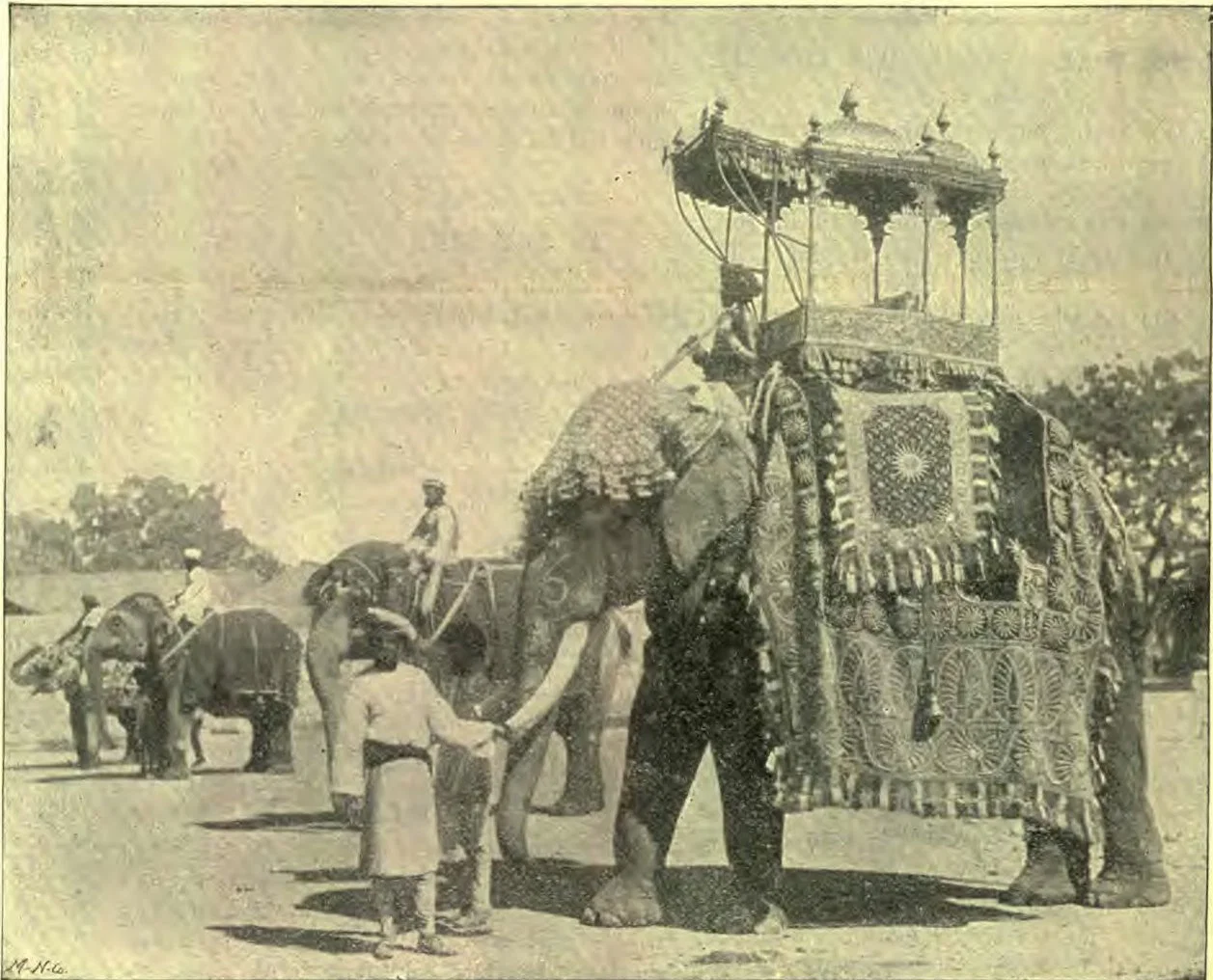
By far the most interesting place to visit is Amber, the ancient capital of the kingdom, situated a short distance from the modern city, on the margin of a small lake surrounded by mountains. To visit this antique city, permission of the political agent is requisite. Having called upon him the previous day, he readily granted me permission, kindly furnished a guide, and had two of the maharajah’s royal elephants on the following morning at the foot of the mountain in readiness to carry three American tourists from St. Louis and myself to the maharajah’s famous Amber palace.
THE MAHARAJAH'S ELEPHANTS.
The drive from the hotel to the foot of the mountain was very pleasant. The morning air was cool and refreshing. We passed a number of very magnificent tombs, the largest of which we stopped to see. It was built of white marble. Labor and money were not spared in its construction. Immense sums are often spent on these tombs, as an expensive tomb is considered by a Hindu to be a sure passport to heaven. The tomb known as the Taj-Mahal, of Shah-Jehan and his wife, is perhaps the most beautiful and most costly building on earth. It is said that twenty thousand men were twenty-two years building it.
We next passed a shallow lake filled with the sacred crocodiles. It is quite possible that in bygone years many devout Hindu mothers sacrificed their infants to the ancestors of these ugly animals. Since English rule has become supreme in India, such inhuman religious customs have been suppressed by law.
Upon our arrival at the mountain, we found that two of us were enrolled for each elephant. My lot fell to the one called by the natives the “lady elephant.” In obedience to the command of her keeper, the lady elephant kneeled down, and a small ladder about ten feet long was placed at her side to enable us to mount. We were soon seated in the howdah. The command to hold fast was very appropriate, for the huge beast in regaining her feet seemed to do it by great sudden jerks. The movement experienced on an elephant’s back is a gentle churning, combined with a slow twisting; and a person is apt to think that should the elephant fall, it would be a long way to the ground; but there was no danger, as the sagacious animal carefully found her way. We passed several precipices; if she had fallen then, we would probably have been dashed to pieces on the rocks many feet below.
For a short distance our road wound through a mountain forest; then it made a sharp turn, and we suddenly came upon the mysterious valley of Amber. It has been described thus: “Picture to yourself a deep crater, the sides of which are covered with a thick, somber jungle, in the center of which rises a green mound forming a pedestal for a fairy-like and dazzling marble palace, beside which the wonders of Seville and Granada would appear insignificant; and around the palace lies a silent and deserted town whose smallest houses are palaces.”
Near it is a beautiful lake, in which the sunlight reflected the foliage, the palace, the fort, and many features of the mountain side most beautifully in its sparkling water.
This lake also swarms with crocodiles; but tradition has it that a prisoner who was to be offered as a sacrifice to the god Kali, in attempting to make his escape swam across the lake unhurt by the crocodiles. The Hindus attributed this to the special protection of the gods, and conferred great honors upon the prisoner. Near the palace is a small temple where a goat is daily offered up to Kali as a substitute for the human being offered every morning in bygone ages. We arrived at the temple too late to see them offer the goat, though the blood was still fresh upon the floor and slaughtering weapon. As to what they did with the goat after it was killed, I was unable to learn. Most likely it was cremated, as the Hindus do not eat flesh.
The palace is a very large building after the Indo-Saracenic style. The superior richness and beauty of its architecture and its ornaments make it a building of rare beauty.
The only human beings to be seen in this desolate city were the native servants who have charge of the palace; but when the time came to give baksheesh, we were convinced that there were quite a number of them. From the top of the palace we had a good view of the city, which wore the appearance of being abandoned to doleful creatures.
The surrounding hills, furrowed by ravines opening on the lake, and covered more or less with temples, houses, and streets, many of the buildings partly gone to decay, present a picture which forcibly recalls the description of Babylon after its fall, as depicted by the prophet Isaiah.
WILLIAM LENKER.

BE NOT WISE IN YOUR OWN CONCEIT.

(Conclusion.)
It is anything but wise, my young friends, to seek your own pleasure, to sow a crop of tares in foolish, sinful actions, which will not only lead others to do the same, but will bring forth a bitter harvest for your own reaping. The Lord says: “Be not deceived: God is not mocked: for whatsoever a man soweth, that shall he also reap. For he that soweth to his flesh shall of the flesh reap corruption; but he that soweth to the Spirit shall of the Spirit reap life everlasting.” Youth is the sowing time, and the words and deeds of the early life are like seeds that will germinate and produce a harvest after their kind. Then why not sow seeds of kindness, of love, of faith, of patience, of self-denial, and true benevolence, and keep all your passions under control? Such sowing will produce a harvest after its kind. Let every word and deed be a seed that will result in good fruit.
If you seek the help and grace of God, the Holy Spirit will take possession of mind and character, and work in you that which you can work out with all safety to yourself, and with all benefit to others. You will show that you love God supremely, and your neighbor as yourself. What more desirable work could you do, what could be more satisfactory to yourself, than to know that you are a blessing to your fellow men? Under the dictation of the Holy Spirit, you may be a laborer together with God in uplifting humanity. The atmosphere that surrounds your soul will be of a pure, healthful character.
Untried character is not reliable. We are to be tried by temptation in order that we may learn to seek wisdom from God, and to flee to the stronghold in time of trouble. He alone will be successful in resisting temptation who finds help and grace from God. Individually we stand as did our first parents—face to face with manifold temptations that solicit mind and heart. All heaven is watching with intense interest, to see whether we will look unto Jesus and submit ourselves to his will, or whether in the temptation we shall follow the inclinations of the natural heart and the solicitations of the evil one. O, how often you have lost the battle because you have acted independent of him who has made you his own by creation and by redemption! Yielding to the solicitations of evil, you have experienced evil as did Adam when he fell into the snare; but those who through faith are kept by the power of God, learn good and precious things. They experience the peace of Christ which passeth understanding. In resisting temptation, you refuse to be confederate with Satan, and place yourselves under the banner of Jesus Christ. In the sight of heavenly intelligences, you develop yourself as a conqueror. It is made manifest that you are a son of God. “As many as received him, to them gave he power to become the sons of God, even to them that believe on his name: which were born, not of blood, not of the will of the flesh, nor of the will of man, but of God.” You represent Christ in true goodness of character, and understand what these words signify, “And the Word was made flesh, and dwelt among us, (and we beheld his glory, the glory as of the only begotten of the Father,) full of grace and truth. . . . And of his fulness have all we received, and grace for grace.” You receive grace, you develop grace; and as you reveal grace in your words, in your spirit and actions, God pours upon you a larger measure of grace. In proportion as you surrender yourselves to the working of the Holy Spirit, you are supplied with heavenly grace. You are molded and fashioned a vessel unto honor, and become a channel through which God makes manifest his grace to the world.
MRS. E. G. WHITE.

STRAIGHT PATHS.

“MAKE straight paths for your feet, lest that which is lame be turned out of the way.” Heb. 12:13. Why does the scripture say straight paths? Why does it not read this way: Make paths for your feet? You see there must be some other kind of paths than straight ones.
Now open your Bibles to Isa. 59:8, and you will find the following: “The way of peace they know not; and there is no judgment in their goings; they have made them crooked paths.” Then there are two kinds of paths,—straight and crooked. Some one may say, “The Bible says we should make straight paths; but I wonder how we are to do it.” I suppose many of the readers of the INSTRUCTOR have made paths in the snow. Did you always make them straight? How did you do it? I remember, when I was young, that in order to make my snow-paths straight, I looked at some object ahead of me, not turning my eyes to the right or to the left, but looking straight ahead.
Jesus has gone before us, and the apostle says that he was an example to us, and that we “should follow in his steps;” and in another place we read: “Turn not to the right hand nor to the left.” So, then, by looking to Jesus every day our paths will not be crooked. This looking to Jesus does not mean looking at some one else, for then our eyes are on some other object; it means that we are trusting our Saviour.
We have learned how our paths may be made straight. Now I suppose you are asking yourself, “Why must my path be made straight? Won’t one little curve in it be all right?” Well, let us see what our verse says: “Make straight paths for your feet, lest that which is lame be turned out of the way.” One time a small boy thought he would like to be like “big men,” and smoke. I imagine his conscience hurt him a little; for instead of using tobacco for his cigarette, he folded up paper and used it. Now being all ready for a “light,” and meeting a young man on the street, he asked for a match. The young man could plainly see the reason for this request, so instead of giving the match to the little fellow, he had a chat with him about setting bad examples for his playmates, and the boy decided at last that it would be better not to try to smoke even a paper cigarette. You see if he had done so, perhaps some of his little friends would have said: “Why, there’s Johnny smoking a cigarette. If he can do it, we can.” Do you not think he would have been turning the lame out of the way, if he had thus set a bad example before his playmates? And then not only Johnny would have made a crooked path, but he would have caused the other boys to make crooked paths, too.
If our eyes are fixed on Jesus, and we do not look once at anything else, we are sure to make straight paths. We will turn no one out of the way, and will become like Jesus much sooner than if we look back to see how straight we are going, or begin to look at ourselves to see how good we are getting. How many of us will try to keep our eyes fixed on Christ every day, so that we may be making straight paths? ADELAIDE JUDSON.

STREAMS OF BLESSING.

ABUNDANT mercy from above With truth and justice doth unite To form the living stream of love, Which blessings brings with glad delight. O wounded heart, there floweth clear A healing balm to soothe and cheer! No saddened soul should faint with fear When streams of blessing are so near.
As morning brings her lovely beams And floods the verdant fields with light, So hope, in peaceful radiance, streams In darkened souls — illumes their night. As zephyrs round the flow'rets play And fragrance gently bear away, So faith shall from our hearts each day Petitions sweet to heaven convey.
Ascending to our Father's throne Our supplications sweetly rise Where Jesus' blood doth cleanse, atone, And make us heirs of paradise. When thus our hearts from sin are free, From off their altars, Lord, to thee Shall grateful praise ascending be — A tribute in eternity.
JONATHAN SPENCE.

IN THE SCHOOL OF CHRIST.

To a genuine, whole-souled Christian, Jesus is the kindest, wisest, most patient and loving of masters. Life is a school; and as I sit on my bench learning the lessons which he appoints for me, my loving teacher comes to me and kindly explains many a “hard saying,” and helps me with spiritual light. My soul often glows within me when he opens out his precious promises, and makes new revelations of his love. Sometimes he employs the rod of discipline, but never unless it be for my good. “Whom the Lord loveth he chasteneth, and scourgeth every son whom he receiveth.” The disciple is not above his Master, neither is the servant above his Lord. There is a very intimate connection between these two words “disciple” and “discipline.” If I am the one, I must expect to have the other. What are we in Christ’s school for except to be instructed, and chastised, and purified, and strengthened, and sweetened, and prepared to be graduated at last into the joys and glories of heaven? Jesus governs his school by a law of love; but his authority is sovereign there. “If ye love me, keep my commandments.” That is the real test of piety. Our Master, who redeemed us with his blood, has a right to appoint our studies, to set our copies, prescribe our duties, chastise our waywardness, and enforce his rules. The highest attainment any pupil of Christ can reach is unquestioning obedience.—Dr. Cuyler.

THE DEVOUT SCIENTIST.

I WILL frankly tell you that my experience in prolonged scientific investigations convinces me that a belief in God—a God who is behind and within the chaos of vanishing points of human knowledge—adds a wonderful stimulus to the man who attempts to penetrate into the regions of the unknown. Of myself I may say that I never make the preparations for penetrating into some small province of nature hitherto undiscovered without breathing a prayer to the Being who hides his secrets from me only to allure me graciously on to the unfolding of them.—Agassiz.

A GREAT INDIAN.

Donehowaga, chief sachem of the Senecas, and known to civilization as General Eli S. Parker, died September 1, at his country home in Fairfield, Conn. As a historical figure of a decaying and disappearing race, his life and services to his country are worthy of a brief notice. General Parker was a full-blooded Seneca Indian, and was born on the hunting grounds of his nation not far from where the present city of Buffalo now stands, in about the year 1828. He received his first schooling in a Baptist mission school, and subsequently studied in two academies. He studied law and civil engineering, and finally took service as a government engineer. A few years before the civil war, while superintending some government work at Galena, Ill., he formed the acquaintance of General U. S. Grant, and the friendship then formed lasted through life.
Upon the breaking out of the war, he offered his services to the country,—once to the governor at New York and once to the authorities at Washington,—but was refused. Finally President Lincoln gave him a commission as captain, and he was ordered to report to General Grant. From that time he served upon the staff of Grant as his secretary, and later he was made brigadier-general of volunteers. At the surrender of Lee at Appomattox, General Parker was present, and it is said that the Confederate commander took him for a negro, and was indignant at the thought that such an unnecessary humiliation should be imposed upon him as to surrender in the presence of a man of African blood; but when he learned who he was, he was reconciled and apologized.
After the war, General Parker became Indian commissioner, and filled the office with remarkable ability. He was married in 1867 to one of the most popular young ladies of Washington. He was fortunate in business, but lost nearly everything he possessed by the failure of the Freedman’s bank. Since 1876 he has been police clerk in New York City.
It may not generally be known that the Six Nations, though widely scattered, still occasionally hold a general council, as near after the old fashion as possible. General Parker was the chieftain of his tribe, and his name, Donehowaga, means “western door,” because by the terms of the compact entered into by the Six Nations, the Senecas were to guard the western frontier. The famous Indian chief Red Jacket bore the same title.

A MILLENNIAL ANNIVERSARY.

In 1876 this nation celebrated at Philadelphia the one hundredth anniversary of its existence as a nation. A hundred years seem quite a long time, and at that time it seemed almost as if this nation were getting old. Still the United States is one of the youngest nations; and compared to some it is very young indeed. One of the nations of Europe, Hungary, is about to engage in the celebration of the thousandth year of its national existence. It is now about fourteen hundred years since Attila the Hun, gathering together the people of that name, made himself the terror and the scourge of Rome.
The Huns are believed to be of the same race as the Kalmucks of the north of Asia, from whence they migrated at some unknown time in the remote past. Moving southward by easy migrations occupying centuries of time, the Huns increased in size, numbers, strength, and skill in war, until at the time of their arrival on the Roman borders, driving before them the Goths and Vandals, they were a formidable race of warriors. Attila has been called the “Scourge of God,” and it was his boast that the grass never grew where his horse’s feet had trod. “Yet,” says Gibbon, “the savage destroyer undesignedly laid the foundation of a republic which revived, in the feudal states of Europe, the art and spirit of commercial industry.” This was done by the inhabitants of the countries ravaged by Attila, who fled for safety to some low islands in the Adriatic, where they continued until the settlements thus formed grew into the city and republic of Venice, celebrated in history. So from such humble beginnings arose a maritime and commercial power of which a poet has said:—
“She looks a sea Cybele, fresh from ocean, Rising, with her tiara of proud towers, At airy distance with majestic motion— A ruler of the waters and their powers; And such she was; her daughters had their dowers From spoils of nations, and the exhaustless East Poured in her lap all gems in sparkling showers. In purple was she robed, and of her royal feast Monarchs partook, and deemed their dignity increased.”
After many great battles, sometimes victorious and at other times defeated, the Huns established themselves in Europe, where they remain to this day, a part of the empire of Austria; indeed, the empire is now generally called Austro-Hungary, the emperor of Austria being also king of Hungary.
Since 1848 Hungary has been a constitutional kingdom; and in no kingdom in Europe is there such a spirit of liberty as in Hungary. The memory of the great Kossuth is cherished there, and the work begun by him is not yet finished. The celebration of the millennium of Hungarian power in Europe will doubtless be a great affair. There will be representations of the nation in its progress from the barbarous Kalmucks to its present state as one of the foremost countries of the world. The sultan of Turkey will send a choice collection of warlike relics which the Turks have taken from the Hungarians in former wars. Hungary is the right arm of Austria; the flower of her army are Hungarians, and she occupies a proud position among the nations of the world.

The Cholera.

Again our country is threatened with the cholera. This time the danger menaces our west coast, a remarkable proof of the fact that increasing facilities for trade are attended by dangers which must be sedulously guarded against.
During the war between China and Japan the great care of the Japanese to protect their soldiers while in China from disease was frequently alluded to by the papers. Every precaution, apparently, was taken; even the drinking water was carried from Japan! But in spite of all these precautions, cholera broke out in the Japanese army, and has followed the troops wherever they have gone. It has gone to Formosa with those who are operating in that island; it was brought to Japan by those who returned. Few Japanese soldiers were killed by Chinese bullets, but the Chinese cholera is a far more dangerous foe than Chinese soldiers, and Japanese skill is put to a greater test to combat the latter foe than their valor was to defeat the former. It is reported that there have been twenty-five thousand cases of the cholera in Japan. The Chinese are suffering more than the Japanese, and in Peking alone fifteen hundred people are dying daily. This is a terrible mortality, and no one can tell where or when it will end. Russia is also afflicted with cholera, and in one province,—Volhynia,—seven hundred and eighteen deaths have occurred in a little over a month.
The danger to our country is that the cholera will reach our western ports from the coast towns of China. The United States warships are leaving the Chinese waters, just as they seemed to be needed to protect our citizens there, and some of them are reported to have the cholera aboard. It has even reached the Hawaiian Islands, and there have been several deaths at Honolulu. Steamers from China make regular trips to Oakland, Tacoma, and Portland, and the warm weather of our west coast provides the most favorable condition for the propagation and activity of the cholera germ. The press is calling upon the government to take prompt measures to prevent the advent of this dread scourge, and doubtless it will do all that can be done in this direction by government. A knowledge of the laws of health, and the ability to apply the ounce of prevention before the pound of cure is needed, is a safeguard against this and all other diseases; but the general public pays altogether too little attention to these important matters.

German Sedan Day Celebrations and Socialist Tensions

THE great celebrations in Germany over the victories of that nation in 1870 have not passed without some very suggestive things, which have marred the pleasure and irritated the temper of the young German “War Lord,” as he delights to call himself. The French ambassador left Berlin on “Sedan day.” This, of course, was expected; but when it was learned that the Russian embassy was closed and unlighted at night, when all around was so brilliant, it was not very pleasing to the emperor. The Socialists of Germany, who now number millions, behaved in a way especially to anger the young emperor. They protested against the celebration, and the Socialist press said such sharp, hateful things against the emperor, that at last he exclaimed, “It is time that we made an end of this!” So one editor was arrested, and his paper stopped. If he tries to suppress free speech in Germany, he will find a task of no small magnitude upon his hands.

Atrocities in Cuba Raise Questions of American Intervention

RECENT atrocities committed by the Spanish troops upon the people of Cuba have raised the questions, Have we another Armenia near our own shores? and, Where in national affairs does national courtesy end and national humanity begin? A sentiment seems to be forming in this country that it is about time for the United States to interfere in the Cuban war, in the interests of humanity. It now looks as though, if the struggle is kept up until the meeting of the next United States Congress, that body will surely take up the question, and Spain may expect some very plain talk in regard to her misgovernment of Cuba, and the cruel manner in which the present war has been carried on.

M. E. K

The government of Turkey being very reluctant, if not absolutely refusing, to grant the reforms promised long ago for Armenia, and which recent events show never to have been fulfilled, is pressed hard by the British government, and it is likely that a British fleet will soon be sent to enforce England’s demands.

M. E. K

WHAT SHALL WE READ?

TALKS WITH BOYS AND GIRLS.—NO. 4.

WHAT SHALL WE READ?

Dear Children: We are living in a reading age. The country is filled with papers especially for the youth. So when we talk about, “What shall we read?” it is not whether we can find anything at all to read, but what shall we select out of the great mass of reading-matter around us that we may read with safety?
We are living in an age when the youthful mind naturally goes out after something exciting. Stories of adventures, hairbreadth escapes, daring feats, and the shedding of blood seem naturally to take the lead. To feed this perverted appetite many youth’s papers and libraries are published and placed in the windows of our newsdealers to tempt the boy or girl that passes by. If the parents object, many times this cheap literature is purchased secretly, and read at times when the fathers and mothers are away. They know not the terrible work that is being done in the once pure minds of their children until it begins to bear fruit in the cigarette, the pistol, or the questionable parties.
There is no need to take time to enter into a discussion of this class of reading-matter. It is all worthless. There is nothing in the language that is worth remembering. It is usually made up of slang phrases and frontier expressions which denote extreme ignorance, and often of abbreviated words which denote the worst kind of profanity. We would say, Beware of all five- or ten-cent libraries or cheap novels. It is true there is a large amount of reading for a small amount of money. So can you buy a large amount of rotten apples for a small sum. But they are dear, because you do not need them. So with this fictitious reading. It poisons the mind and weakens the intellect.
There are other books that are classed in the department of fiction that may contain excellent language, and at one time may have taught an important lesson, and have been worthy of a reading. But the issue that brought them into existence being passed, they are out of date, and it is not profitable to spend the time to read them. “Uncle Tom’s Cabin” is a fair representative of this class. “Black Beauty,” a production written after the style of “Uncle Tom’s Cabin,” having the horse instead of the slave as the central figure, can be read with much profit. Boys and girls may learn a lesson of kindness to animals from its perusal. As there is not much prospect of the horse’s being entirely emancipated from his cruel treatment, this book promises to have a longer life than “Uncle Tom’s Cabin.”
The object in view while reading a book or paper has a great deal to do with the choice of suitable reading. There are a few books of fiction that might be read with profit if the reader realized where the profit was; but so many read these works just to enter into the sensational ideas that are woven in, and receive injury rather than benefit. Perhaps they have read the most perfect language, but have taken no thought to it. They have failed to learn any expressions that will ever be of any service to them, although they have passed over a mine of them. All they have received is the husks that soon become as vanity. To such, this class is a positive injury. From observation we are forced to say that all the probable good that could be derived from fiction can be acquired by reading biography or history, therefore we would advise our boys and girls to keep as free from fiction as possible, and give more attention to biographies, travels, histories, and sciences.
The better you become acquainted with the lives of men and women of principle, the more you will be encouraged to pattern after them. The more you read travels, the better you will be able to make a practical use of your knowledge of geography. Historians always give interesting items that cannot fail to be beneficial. Books in simple language on the practical sciences furnish a large field for thought, and should be connected with your school studies.
The Bible contains many of the most interesting biographies that can be found. It is not silent on history or the sciences. Were it not for the Bible, much of ancient history would be lost. So we must say above everything else, Read your Bibles. Select the best papers, magazines, and books, and read to store the mind with useful knowledge.
J. H. D.

Sensational Preaching.

The tendency of many modern preachers to preach everything but the gospel, is too well known to call for any extended proof. In many instances the church pulpit has become the rostrum where, preceded and succeeded by operatic singing, with a long, drowsy prayer thrown in, the latest fad is discussed by the minister. Of course a text is chosen to start with; if it were not for this, none would suspect they were listening to preaching. But ministers have for a long time been learning how to select texts which have no relation to the subjects presented. A minister in a western State, preaching the funeral discourse of a child, used for a text these words: “And her child was caught up unto God, and to his throne.” Rev. 12: 5. We once heard a very able minister preach a funeral sermon from the words: “But tidings out of the east and out of the north shall trouble him.” Dan. 11: 44. When ministers manifest such skill to select unappropriate texts for such solemn occasions as funerals, it need surprise no one that they can easily find a text, no matter what they desire to discuss.
We are led to make these remarks from the account in a late paper of a minister who preached upon the bicycle, taking for his text these words: “And, behold, he wrought a work on the wheels.” Jer. 18: 3. Aside from the text, which with its proper meaning contains an excellent religious lesson, but perverted as it was by this preacher, contains no lesson at all, the sermon(?) was nothing but a popular lecture on bicycles, their advantages, uses, etc. Such preaching, or what pretends to be, is outrageous. The English language affords no words sufficiently strong properly to denounce it. A minister of the gospel is supposed to have a message from God for the people,—something to comfort saints, to instruct in doctrine, to alarm and awaken sinners. When none of these results are gained, there is no true preaching, and the whole effort is a miserable travesty, made more so by the fact that a scripture text is read, as if it were to be the foundation of what is said. Said Jesus, “Go ye into all the world, and preach the GOSPEL to every creature.” And Paul exhorted Timothy to “preach the word.” M. E. K.

ACT FROM PRINCIPLE.

MANY young persons have been started on the road to dissipation by being influenced to act contrary to principle. Perhaps the early teaching of a good father or mother has left its impression, so that when the temptation is presented to touch the intoxicating bowl or to go to questionable places, the conscience says, No. But the entreaties of friends of social distinction appear so strong that it is sometimes nearly impossible to resist.
We remember conversing with a young person who was invited to dine with aristocratic relatives on the Sabbath. This young Christian knew that songs and music would be indulged in that were not appropriate for the Sabbath. Then again, to refuse to be present with no other excuse than the objection to the music, would probably be offensive to the friends. Was it duty to give offense, or attend and suffer the trial, and probably feel condemned afterward?
How often young people are brought into these trying places! How often they decide them without prayer, and decide them wrong! They forget that God should always be first in all they do. “And whatsoever ye do, do it heartily, as to the Lord, and not unto men.”
It is said that on one occasion near the close of the Revolutionary war, an officer in General Washington’s army met with the general at Philadelphia to transact some business with him. Before leaving, he received an invitation to dine with the general, which was accepted, and upon entering the room he found himself in the company of a large number of guests. As they were mostly strangers, he took his seat at the foot of the table, and refrained from taking an active part in the conversation. Just before the close of the meal, General Washington stood up and called him by name, and requested him to drink a glass of wine with him. “Will you have the goodness to excuse me, General?” replied the officer. “I have made it a rule never to take wine.”
Instantly every eye was turned upon this young man, and a murmur of surprise and indignation ran round the table. That a person should be so unsociable and so mean as to refuse to drink wine with one of such high authority, was perfectly intolerable.
With this feeling in the minds of the guests, Washington addressed them thus:—
“Gentlemen, our friend is right. I do not wish any of my guests to partake of anything against their inclination, and I certainly do not wish them to violate any established principle in their social intercourse with me. I honor my friend for his frankness, for his consistency in thus adhering to an established rule which can never do him harm, and for the adoption of which, I have no doubt, he has good and sufficient reasons.”
People who will not respect the principles of their guests, however dignified such people may appear, are not worthy of our confidence or association. A young man or woman should never associate with those who will not respect another’s principles. In turn, we should ever regard the convictions of others as sacred, however foolish they may appear to us. We are not in this world to be judges of others. The golden rule given by our Saviour is a safe standard under all circumstances: “Whatsoever ye would that men should do to you, do ye even so to them.” J. H. D.

LESSON 2.—THE SLAVERY OF SELF.

(October 12, 1895.)
I. WHAT is the first sin mentioned that gives rise to the “perilous times” of the “last days”? 2 Tim. 3:2.
2. What must every one do in order to become a true follower of Christ? Luke 9:23.
3. Why did many of the rulers not confess Christ when he was on earth? John 12:42, 43.
4. Whom do men love when they desire the praise of men?—Themselves.
5. Can men truly believe on Jesus while seeking such honor? John 5:44.
6. What, then, more than all else stands in the way of faith in Jesus?—Love of self.
7. What are the two great requirements of the law of God? Matt. 22:37–40.
8. Is it possible for the natural man to keep the law of God? Rom. 8:7, 8.
9. Then what is the condition of all men by nature?—They are in slavery to self. (See note 1.)
10. In what way do men show themselves to be slaves?—(a) By their inability to break off bad habits; (b) By keeping the commandments of men instead of the commandments of God; (c) By every sin they commit. (See note 2.)
11. Why do men naturally do all these wrong things?—Because of selfishness.
12. To what does this love of self lead?—It leads men to serve men and to seek their favor, instead of serving God and seeking his favor.
13. What direct command is given in 1 Cor. 7:23?
14. Whom alone are we to serve? Matt. 4:10.
15. What can you say about the desirability of freedom? (See note 3.)
16. Who alone can give this desired freedom? Luke 4:18; 2 Tim. 4:18.
17. How free was Paul after his conversion? 1 Cor. 9:19.
18. How free can Christ make men? John 8:36.

NOTES.

1. No man by nature is truly free. All, in consequence of the fall, are slaves; all are subjects to things which bring them into bondage,—slaves of habits, customs, and traditions,—slaves of men, slaves of self, slaves of sin.
2. Men show themselves to be slaves in the following ways:—
(a) They become so addicted to habits which they know are an injury to them, that they cannot break them off. They try to do it again and again, but fail. The habit is master, and they are slaves. This lack of power is thus stated by the apostle: “For what I would, that do I not; but what I hate, that do I.” Rom. 7:15. “For to will is present with me; but how to perform that which is good I find not.” Verse 18.
(b) Whosoever follows the commandments of men instead of the commandments of God is the servant of men instead of the servant of God. This is vain worship, because it is man-worship. (See Matt. 15:9; Isa. 29:13, 14; Titus 1:14.) The Lord has warned us not to go with the majority or the great men when we think they may be going wrong. The Lord says, “Ye have plowed wickedness, ye have reaped iniquity; ye have eaten the fruit of lies: because thou didst trust in thy way, in the multitude of thy mighty men.” Hosea 10:13. “Thou shalt not follow a multitude to do evil.” Ex. 23:2.
Many shun duty for fear of what men may think or say of them, or do to them. Against this the Lord has often warned his people: “Say ye not, A confederacy, to all them to whom this people shall say, A confederacy; neither fear ye their fear, nor be afraid. Sanctify the Lord of hosts himself; and let him be your fear, and let him be your dread.” Isa. 8:12, 13. (See also Isa. 57:12, 13; Matt. 10:28, 32, 33; Ps. 56:4.)
(c) Whoever commits sin is the servant, or slave, of sin, and through sin, of the devil, who is the originator and author of sin. John 8:34; Rom. 6:13; 1 John 3:8.
3. Freedom is a condition desirable to all. All people like to be free,—free to think, act, and speak; free to go where they wish and do what they please. It is an inborn principle. God made man free in the beginning, and it is only sin that has brought bondage and slavery of any kind into the world. The words of Patrick Henry, “Give me liberty, or give me death,” are but an outburst of this natural desire for freedom.
Continue reading: IGNORANCE OF THE BIBLE