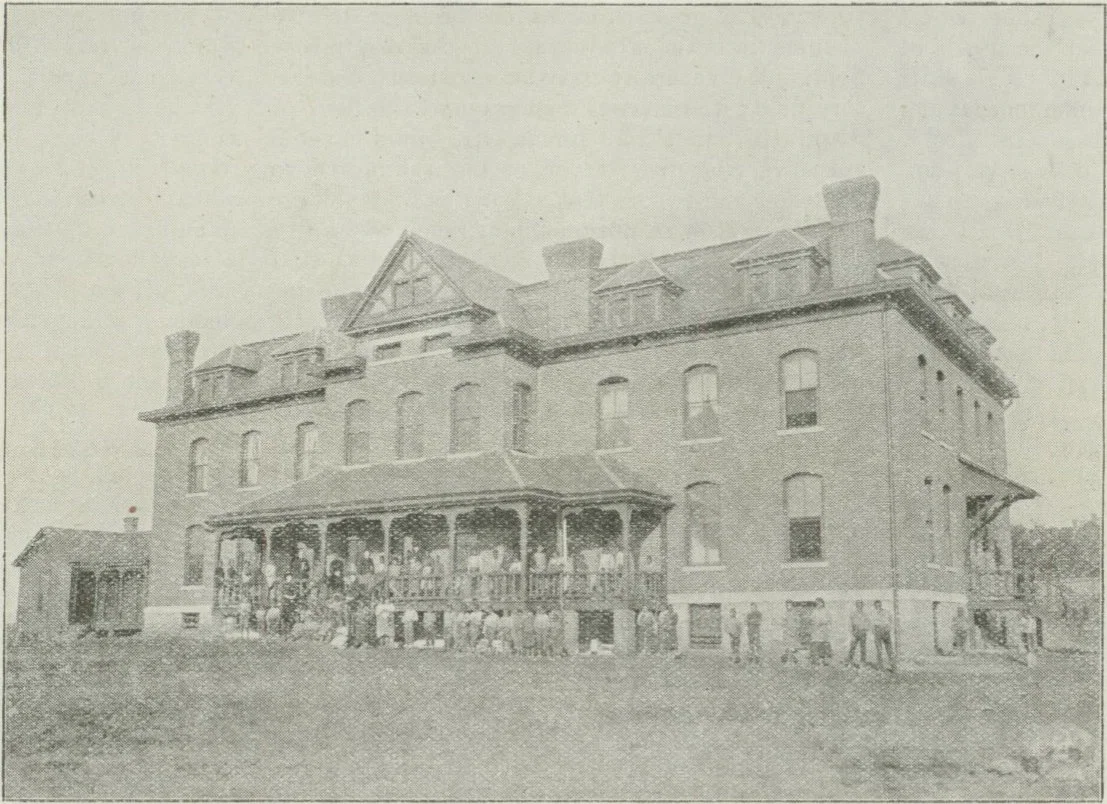
“Feed my lambs,” said Jesus; and when he said that, he meant the black as well as the white; but the world has ignored this, and usually, in our country especially, black children have been given a full measure of everybody’s distrust and aversion. They are often the inheritors of the worst characteristics of the white race, as well as of the ignorance and degradation of their own race. Then, with all this fearful legacy, cruelty and neglect and want hurry them into a criminal career. What to do with these criminals by inheritance and force of circumstances, has long been a problem; but while our wise men have often sat inactive because the problem was difficult, now and then others, unaided, have gone to work and solved it, as far as they personally are concerned. They wisely concluded that if they fed with the bread of life as many as possible of the black lambs, there would be fewer black sheep to go to the prison, the chain-gang, or the gallows.
One of those who early became interested in these unfortunates, was Mrs. Almira S. Steele, an educated Massachusetts lady. She went south seventeen years ago to do missionary work among the colored people. She was an experienced teacher, the widow of a Union soldier, and the mother of a little daughter. Her first work was in establishing schools among the colored people of South Carolina; but the Kuklux spirit was so strong against her work there, that the Women’s Home Missionary Society of Boston, under whose support she was working, transferred her to Chattanooga, Tenn. However, in spite of opposition, she managed to found eleven colored schools in South Carolina and three in Alabama.
She was removed to Chattanooga soon after a scourge of yellow fever had swept through the city. Many children had been orphaned, and there was absolutely no provision made for the little black orphans. Mrs. Steele applied to the missionary society for aid; it had no orphan fund. She applied to the county; its people were not yet ready to be taxed to save either the bodies or the souls of black children. “Then,” says Mrs. Steele, “I prayed for light, and it came. I saw that I had been deceiving myself. I wanted an orphanage, but I wanted somebody else to build it. I said to myself, ‘Build it yourself. You have money saved from teaching; you have your husband’s life insurance; you have your pension.’ Then I turned to my little daughter, and I said, ‘Darling, we will trust the Lord for our future, and we will use our money to make a home for these little waifs.’” So Mrs. Steele bought a place, fitted it up for twenty inmates, and opened her orphanage with three children. That was twelve years ago, and her home has sheltered and protected more than five hundred since then. Once she was burned out; but with the insurance and six thousand dollars which influential, noble-hearted people of the South raised for her, she rebuilt the home, better than before. Afterward three attempts were made to burn her out, and then she went to the mayor of the city.
“What can you do for me?” she asked him.
“I don’t know, Mrs. Steele,” he answered. “You haven’t an enemy in the city, that I know of, but I’ve heard more men curse you than almost anybody else.”
“Why, what is the matter?” she asked.
“Nothing but that you take in a lot of darkies, and treat them as well as if they were white.”
“Is that all? I’m sorry for them. I’m in this work for life! If you can help me, do so; if not, I’ll apply to my Boston friends to help me get my children there, where we can be protected.”
“I wouldn’t have it known in Boston for anything,” replied the mayor; and very soon after this, some of the leading Chattanooga papers espoused her cause, and the home has not been molested since.
Until lately Mrs. Steele knew nothing of Seventh-day Adventists—did not suppose there were more than ten or twelve in the world. She has long believed in the personal return of Jesus, but only eighteen months ago was convinced that there was no authority in the Bible for a change of the Sabbath day. She is a guest at the Battle Creek Sanitarium, and it was there that a friend and I called upon her to learn more about her work and its possibilities. We found her work to be as truly “rescue work” as if she were working for the people of the slums. She told the pitiful story of a little girl of nine years, who, because she had scribbled a lady’s name on a piece of paper, had been sentenced to several months’ imprisonment for forgery! Mrs. Steele begged that the child be given to her, but was not permitted to take the little wronged one from prison till the shameful cruelty had nearly killed her. For a year and a half she was an invalid. Now she is a healthy young woman of eighteen. What she might have become, if, indeed, prison life had not killed her, but for this large-hearted worker, is too painful to think of.
Thirty of Mrs. Steele’s children are staying for a month or two at the Battle Creek Haskell’s Memorial Home for Orphans, and two are in the home of Dr. J. H. Kellogg. Six more are entered as pupils at the Battle Creek College. When they reach the age of fifteen or sixteen, Mrs. Steele often sends her orphans away to commercial or industrial schools, that they may learn to be intelligent leaders among their own people. Before that, they are taught in the orphanage. Twenty-five of the orphans of her adoption have married, seventeen are teachers, four are studying for the ministry, many are in schools or Northern homes, and the rest are still under her watchful care. Some have followed her in her changed religious beliefs, and she hopes and prays that her love and example may help the rest to see what seems so plain to her.
“Oh,” Mrs. Steele exclaimed, “it’s a trial to bring them up—for they’re often mischievous and naughty. I tell them, Children, it takes a deal of patience to care for your bodies; but I’m after your souls,—this is all a trap to catch your souls! I can’t do much of the great deal there is to do; but I thank the Lord that he’s letting me oil the hinges, so that others may open the door easily which has often swung hard for me. Oh, if people want love, let them take up a work like this, and their lives will be filled with the love of grateful hearts!”
She ought to know, if anybody can, the blessedness of caring for the neglected and despised; that it brings her joy is plain from her countenance and all her words, and also from the fact that she has started another colored orphanage in Atlanta, Ga., and one for whites in Deer Park, Md., which was carried on for five years with the aid of Mrs. S. B. Elkins, of Washington, D. C.
Mrs. Steele’s work is wholly a work of love. She put her earnings and her legacies into the home; then she deeded it to a board of directors, only stipulating that she shall be manager while she lives; and now she works without salary, and trusts in the Lord. Truly love is the mightiest thing in the world; it will reach up to the gates of God for his blessing, or down to the gates of hell to save a soul.
ORPHANAGE FOR COLORED CHILDREN AT CHATTANOOGA.
SOME SANITARY SUGGESTIONS.
By Mrs. D. A. Fitch
BY MRS. D. A. FITCH.
(Sanitarium Cooking-School.)
No doubt much sickness arises from the careless introduction of germs into the stomach with our foods. Hence the following precautions:—
String beans should be well washed before being326cut or broken. Green peas should be washed in at least two waters before being put to cook. Strawberries should be washed before the caps are removed. All berries should be well washed. A good way to do this without loss is to place them in a colander, and dip them up and down several times. All dried fruit should be submerged in very hot water for a few minutes, then thoroughly rinsed in several waters to insure cleanliness. Potatoes and apples should be washed before paring, and then be treated to a dash of cold water for fear of germs. If there are decayed spots in the apples, be sure to remove a liberal amount of the apparently sound portion; for fruits have circulation, and the germs of decay are carried to all portions, more or less. Cooking is said to destroy the germs, but not the poisons manufactured by them.
Any standing foods should be well protected by a cover,—not necessarily a tight one always, for a simple thickness of muslin will entangle much of the impurity which is so likely to fall into the food from the atmosphere, and it will still permit the steam to escape. Care should be taken to prevent dust from lodging on both dishes and food. Pantry and cupboard doors should be closed when sweeping is being done. Much of the dust might be kept from flying in the air by sweeping with a dampened broom, or with a moist cloth fastened over it. The easiest way to do this latter is to slip over the brush of the broom a skirt made just to fit it. This skirt may be gathered at the top, dampened, and slipped on over the handle. It works nicely. Try it. A carpet on a kitchen floor is very unsanitary; for the simple walking over it, to say nothing of sweeping it, is the means of stirring up myriads of germs of many sorts. It pays to clean a floor well. Wetting and wiping it up is not mopping it, much less is it cleaning it. Plenty of water and strength should be used, good rinsing be done, and thorough wiping.
Always be particular to have the hands and finger-nails clean before handling food or cooking utensils. The hair should be firmly drawn back, and it is a most excellent plan to enclose it in a thin muslin cooking-cap, so there will be no temptation to replace the hair while the hands are employed with the food. Always have a holder or baking cloth handy (a pocket in the apron is the handiest place for it), so there will be no call to use the apron for a holder. I have seen this garment used as holder, towel, and pocket handkerchief. If at any time the handkerchief must be used, thoroughly cleanse the hands afterward. By careless use of handkerchiefs and the promiscuous use of towels, catarrh has been transmitted from one member of the family to another. We cannot be too careful in these matters.
LOSS AND GAIN.
By Ellen Thorneycroft Fowler
I sorrowed that the golden day was dead, Its light no more the country side adorning; But whilst I grieved, behold, the east grew red With morning!
I sighed that merry spring was forced to go And doff the wreaths that did so well become her; But whilst I murmured at her absence, lo ’T was summer!
I mourned because the daffodils were killed By burning skies that scorched my early posies; But whilst for these I pined, my hands were filled With roses.
Half broken-hearted, I bewailed the end Of friendships than which none had once seemed nearer; But whilst I wept, I found a newer friend, And dearer.
And thus I learned old pleasures are estranged Only that something better may be given; Until at last we find this earth exchanged For heaven.
— Ellen Thorneycroft Fowler.
THE DOCTOR AND HIS PATIENTS.
By John Harvey Kellogg
FROM SANITARIUM PARLOR TALKS BY
J. H. KELLOGG, M. D.
(Reported by David Paulson, M. D.)
Question.— What is the treatment for pneumonia?
Answer.— It is impossible to prescribe a formula for all cases of pneumonia. In the first place, the patient should get a good, sensible doctor. Pneumonia must be treated in a rational way, in a modern way. The old-fashioned way was to bleed the patient until he became faint. The most rational method of treating pneumonia is, at the very beginning, to apply ice-bags over the affected lung continuously, alternating with hot fomentations lasting for from five to ten minutes every three hours. Hot flannel should be kept over the rest of the body, to keep it warm and dry. Keep the extremities thoroughly warm. If the patient is a child, apply a hot blanket pack, to bring the blood to the surface, and then treat as before said. The purpose of the application of cold is to check the inflammatory process, so that it will not extend so far into the lung. The hot applications are intended to counteract the effect the cold might have in interfering with the circulation. This treatment, however, should be applied only in the first stage of pneumonia. After the disease has passed twenty four hours, at most, then the cold application should not be made so continuously. Hot fomentations should be applied once an hour, to be followed by cold applications, for forty eight hours; then use hot applications instead of cold.
But, as I said, you should not depend upon home treatment; you should get an intelligent physician, and this treatment should be under his supervision, because pneumonia is a very serious malady. This method has long been used in Germany. Ziemssen, one of the best German authorities, gave this treatment in his excellent cyclopedia more than fifteen years ago. There is another very useful method, which consists in the inhalation of oxygen. I have certainly saved the lives of several patients by means of oxygen, giving them pure oxygen to inhale. But it ought to be used in sufficient quantity to amount to something. My method of treating a patient is to have him take a five-gallon bagful an hour. I also keep the patient inhaling all the time he can do so without fatigue. The great thing which threatens life in pneumonia is the diminution of the respiratory field. We naturally have an enormous respiratory field; the mucous membrane of the field of respiration, if it were spread out, would cover a space varying from seven or eight hundred to two thousand square feet. This is a very large surface. Now in pneumonia as much as half of this respiratory surface is so obstructed that it is of no use, and the consequence is that the patient is short of breath, and finds himself breathing at the rate of fifty or sixty times a minute, instead of eighteen or twenty times. If we give the patient pure oxygen instead of diluted oxygen (and by diluted oxygen, I mean ordinary air, which is only about one fifth pure oxygen), the patient gets much more oxygen into the blood. The dusky color of the skin, the duskiness of the lips, and the shortness of breath disappear, as does the accumulation of impurities of the blood; and dyspnea will also disappear very soon, and in about five minutes the countenance will be clear and bright through the inhalation of pure oxygen.
Pneumonia is now recognized as a germ disease,—a disease which is due to infection of the lungs by the germ named the pneumococcus. This germ gets into the lungs, and develops its poison; this poison is absorbed into the body, and produces a rise of temperature—a fever. When this poison begins to be eliminated, the patient is relieved. The temperature then goes down, although the poison, during the early part of the disease, does not seem to be eliminated with sufficient rapidity. But when the poison is eliminated, the system is relieved from the embarrassment resulting from the development of these poisons within the body. There is a certain period in which there is a crisis, and if the patient passes that crisis, he is pretty certain to recover. His temperature falls, free perspiration occurs, and he is convalescent. Now there is, at this critical period, developed in the body an antitoxin. Nature not only provides a method of abating the disease, but after a certain period of development of the germs in the body, there are formed in the body other toxins, which neutralize the poisons already produced, causing a sudden fall of temperature, and a consequent relief of the patient.
Q.—Is pneumonia very fatal in this climate?
A.—It is not nearly so frequent in this as in some other climates, yet it is always a very fatal disease. In pneumonia, under ordinary treatment, the death-rate is from twenty-five to thirty per cent. in some of our leading hospitals. Sometimes it is from thirty-three to thirty-four per cent. of all the patients who have pneumonia. Of course we must remember that the patients taken to the hospitals are of a poorer and feebler class; their systems are depleted, and their condition serious, so that there is a higher mortality in the hospitals than in ordinary private life.
The great mortality of pneumonia is partly due to irrational treatment. The most important element of the irrational treatment of this disease, in my opinion, is the administration of alcohol; and yet alcohol is considered by many as absolutely necessary in the treatment of this disease, in order to sustain the patient. But it is impossible to sustain the patient by the use of alcohol, because alcohol is a depressing agent in every respect. Some years ago I had a flower growing in a pot in the window, and I said, “If alcohol is a sustaining element, it should sustain this plant.” So I placed some alcohol where the fumes would reach the plant, and it wasn’t more than a week or two before the plant was positively dead. And that is not at all surprising; for alcohol has this property in reference to every living plant. I tried the experiment with beer also. I watered a plant with beer, and it died in short order. I dropped a minnow in some alcohol, and it died in five minutes. I have subjected worms to the action of alcohol, and I even applied it to a turtle, which is very difficult to kill, and it died in a very brief space of time. The eminent Dr. Reichert, a professor in the Philadelphia University, three or four years ago took the heart of a frog, and arranged it in such a way that when it contracted, it would lift a little lever. (The heart of the frog will live for some time after it is taken out of the body. This is also true of the other reptiles of this kind.) He made an arrangement so that the lever rested on the heart and also on a fulcrum; the other end was made to lift a weight, and the weight that the heart would lift was actually measured. When the heart contracted, it would raise up the end of the lever, and by that movement it was made to move this weight. Dr. Reichert observed this, that when he applied even the most dilute solution of alcohol, the heart could not lift so much as before; and if the alcohol was applied strong, the heart was paralyzed, and could not lift at all. He found that the effects of alcohol distinctly and invariably lessened the heart’s power to contract.
In pneumonia the heart action is relaxed. Why is this?—Because when one fifth of this two thousand square feet of respiratory surface is cut off by disease, the heart has to force the whole of the blood through the rest of it. The pump has to work harder with a small opening than with a large one; so it is with the heart in these diseases which diminish the respiratory area of the lungs. The heart needs to have something which will strengthen it in pneumonia; but that is what alcohol does not do. Its tendency is to overwork the heart, and that leads to death. That alcohol weakens has been demonstrated a great many times. Dr. Parke, of England, took three soldiers, and made them work; then he measured their work. Then he gave them alcohol, and made them work; and he found they could not do nearly so much work with alcohol as without it. I think this principle may be considered established; so if any of you have pneumonia, don’t take alcohol.
But, “What shall I do when I have pneumonia?”—Take a hot and cold sponging, and hot and cold applications to the spine. A very excellent method of relieving the heart is a hot blanket pack. I have always found that when the patient gets into a condition where the heart is flagging, a hot blanket pack is the very best means of relieving the heart. It relaxes the surface blood-vessels, so as to take off some of the work which the heart has to do. It dilates the tubes and makes them larger, so that the blood circulates more freely, giving relief.
PASSING EVENTS AND COMMENTS.
By T.
Bible Critics.—Criticism of the Bible has become almost a craze, or as is often said, a “fad.” There is a kind of fascination in it for aspiring men who desire to exhibit their independence of thought. We have seen the large mastiff sauntering along, and every whiffet in town taking a turn with his saucy bark, careful to keep at a safe distance. And the mastiff was all the time apparently insensible of their attention. The Bible has been barked at for many ages; but it reads now just as it always has read. It still pursues its steady course, pointing out sin, and pointing the sinner to Christ. Men have talked and written about its mistakes and inconsistencies, but its statements stand there yet, while the men who criticized have been forgotten or become a laughing-stock.
Just now we have in the so-called higher criticism a refined, sugar-coated infidelity, that in its insidious assumptions is much more harmful to true faith than out-and-out Ingersollism. So thoroughly is this deadly thing permeating the church, that Dean Farrar, of London, says: “I cannot name a single student or professor of any eminence in Great Britain who does not accept, with more or less modifications, the main conclusions of the German school of critics.” Ministers of the Christian religion are busily disseminating the seeds of unbelief as a means of gaining notoriety for themselves. A young clergyman has lately written on the book of the Acts, which he divides into two parts, one of which was written by a certain “we,” and the other proceeding from even a more imaginary source than that. The New York Observer remarks that it is not at all surprised at this; for it has become so accustomed to seeing Moses quartered, Isaiah sawn asunder, and Daniel divided, that we may now expect to see the New Testament writers attacked and dissected.
The Lintels Smitten and the Posts Shake.—One of the capstones of Methodism received a sharp blow in the General Conference at Cleveland last week, when it was proposed by Dr. Buckley and other prominent men of that denomination to strike out a foot-note of the Discipline relative to the subject of baptism. It has long been the practise, or at least the profession, of the Methodists to give adult applicants for membership their choice of three modes of baptism, either sprinkling, pouring, or immersion. Sprinkling, being the most convenient form, has undoubtedly been favored to the neglect of the others, especially of immersion. The foot-note referred to, reads as follows: “Persons baptized in infancy must publicly assert before the church to the baptism covenant. The re-baptism of persons known to have been previously baptized is inconsistent with the nature and design of baptism, as set forth in the New Testament.” The inconsistency of granting to adults who have not been sprinkled in infancy the privilege of selecting their own mode of baptism, and of denying that privilege to adults who were so unfortunate as to have been sprinkled when they knew nothing about it, is very glaring, and Dr. Buckley claimed that the Methodist Church has lost more than half a million people, because the privilege of choice was not granted to them.
But the proposition to obliterate this inconsistency called forth most vigorous and earnest protests from those who felt called upon to stand by the foundations of Methodism, because it is very evident that if those who are sprinkled in infancy are to have the liberty to select their own baptism when they come to years of understanding, that liberty annuls infant baptism, and declares it to be of no value or significance. Thus the ringing blow at what might seem a casual provision, strikes in reality at the very foundation of Methodism, and the denomination finds itself face to face with the most glaring inconsistency whichever way it may turn. There is but one reasonable way out of the dilemma, and that is, to acknowledge the evident truth that the sprinkling of infants is not baptism in the Bible sense. But this the Methodist Church is not prepared to do.
No action was taken in regard to the troublesome foot-note, but at the earnest suggestion of thoughtful minds, the brethren were asked to give the matter further and more prayerful consideration.
A Bad Decision Reversed.—It will be remembered by many of our readers that in 1893 Elder McCutchen and Brother Keck were arrested for working on Sunday on some seats in the church building in Gainesville, Ga., and were fined by the mayor fifty dollars each. The case was appealed to the superior court, where the decision was against them, and from there the decision was carried to the State Supreme Court. Last week we received a copy of the Gainesville Eagle, with an account of the trial and the decision rendered by the last court, reversing that of the lower courts. The charge against these brethren was not for violation of a Sunday law, but was that of disorderly conduct. In deciding the case, the Supreme Court said:—
A municipal ordinance making it penal to “act in a disorderly manner,” or “make an unnecessary noise within the corporate limits, calculated to disturb the peace, quiet, or good order of the city,” or to “be guilty of disorderly conduct,” is not violated by quietly working in a closed church on the Sabbath day upon the benches therein, the work in question not being itself of such a character or causing such noise as would ordinarily disturb any citizen, and the only “disturbance” occasioned by it arising from the fact that it was done on the Sabbath. The design of such an ordinance is to insure the peace, tranquillity, and repose of the community, and not to prevent acts otherwise unobjectionable, but which from the fact that they are done on that day are shocking to the religious or moral sensibilities of a portion of the citizens.
Judgment in each case reversed.
And in a brief comment, the Eagle added, “We are glad to know that our upper court has stepped in and placed the conscientious member of the Christian church on the same footing of the law as the keeper of a livery stable.” Of course there is no malice in saying that the whole prosecution was the work of bigotry and prejudice. But we are very happy to know that these do not prevail in the supreme courts, and that our brethren are free from the heavy penalty which has for more than two years been hanging over them.
What Were the Causes?—The zeal of those misguided individuals who are laboring to reform this nation so as to place religious usages and institutions upon the basis of civil law, often defeats their purpose. They cannot bear to make haste slowly, and in their eagerness to obtain the object, they often stumble. Claiming too much, they get nothing. This has been verified the past winter in Congress. Some months ago Dr. Talmage was prevailed upon to leave his popular pulpit in the metropolis, and go to the nation’s capital, where his voice and influence would be felt in the councils of state. Note has been made of his famous sermon preached for the benefit of Congress on the 10th inst. It consists of a series of extravagant and exclamatory outbursts of eloquence and zeal characteristic of the speaker.
One thing we notice particularly is his invective against atheists and infidels. He alludes to Tom Paine as “a libertine and a sot, who did not believe in anything good until he was dying, and then shrieked out for God’s mercy.” We do not rise to defend Tom Paine’s religious or anti religious ideas, but in the cause of freedom and liberty he wrought a work which will bear a favorable comparison to all that Talmage has ever done or ever will do. Tom Paine lived in the time which gave rise to the French Revolution, and doubtless drew much of the bitterness which he felt for the Bible and its religion from the circumstances with which he was surrounded. France was groaning prostrate under the dominating hand of priestcraft. Men judged of religion and of the Bible from what they supposed to be its fruits, as brought out in the terrible corruption which crushed the liberties of the French people under the name of religion. The whole being of Tom Paine cried out against such tyranny, and it is most unfortunate for the world, as well as an everlasting reproach to himself, that he attributed these evils to the Bible, rather than to those who perverted the Bible.
We would be glad to remind Mr. Talmage and his co-laborers in the religio-political crusade, that they are entering upon the same road over which the Catholics of France passed, that led to the oppression of the people and the crucifixion of liberty under the direction of a fallen and apostate church. One cannot but deplore Paine’s infidelity, and the cruelty and horrors of the French Revolution; but it is no more than fair to look back of those dark scenes to the influences from which they sprang, and that source we shall find to be a popular and corrupt church clutching the authority of civil power.
The Coming Fete.—The czar of all the Russias will be crowned formally on Tuesday, May 26, amid scenes of the greatest pomp and display. In many respects the festival will be unique. For in addition to the attention bestowed upon distinguished guests, the poor and common people are not to be forgotten. They will be treated to free shows, free theaters, free food, free drink. It is reported that every visitor to this popular festival will receive a loaf of white flour bread, half a pound of sausage, a sack of nuts and candy, a slice of cake, and a little jug of drink with their majesties’ initials upon it. Rumor still insists that the czar will further celebrate the event by proclaiming greater religious freedom. Beyond this grand pageantry, we see the nations there assembled mingling in strife. And just beyond that, another grand coronation will take place, to which we have an invitation. There we hope to meet our readers. There will be a great feast (Luke 12:37); the King himself will serve his guests. The good of all ages will be there; the angels will attend; and everlasting joy will be the portion of all. T.
TO CLEVELAND AND THE CONFERENCE.
By G. C. T.
The Methodist General Conference of the United States convenes once in four years on the first day of May, though it is now proposed to change the day of meeting to the first Wednesday in May. This year the conference convened in Cleveland, and we took the opportunity to attend the meeting for a short time last week. Leaving Battle Creek at 3 P. M., we spent a pleasant evening with old acquaintances in Detroit, and late in the evening took a large and comfortable passenger steamer down the Detroit River, and across the west end of Lake Erie to Cleveland, a distance of one hundred and ten miles, where we arrived in time for breakfast the next morning. The Seventh-day Adventist hotel (mission house) being closed on account of a general meeting at La Grange, we took up our quarters at a modest Gentile institution near the heart of the city.
The meetings of the conference are held in the National Armory, a capacious building fitted up with a large platform near the center of the drill room, with an assembly chamber sufficiently large to accommodate the five hundred and forty delegates which are in attendance, and galleries on each of the four sides. The presiding officer of the conference meetings is one of the bishops, and no one in particular, but they seem to alternate, no one conducting two meetings in succession. A large staff of secretaries, reporters, and editors is constantly taking notes and assisting in the work. One meeting of the conference is held each day from 8:30 to 12:30. The afternoon is taken up with committee meetings, and the evening with exercises of general interest. There is no time set apart for devotional meetings, though the public meetings are opened with prayer and singing.
One of the greatest drawbacks to the meetings is that which frequently attends such an occasion,—the difficulty of obtaining a good hearing. In the large building the constant movement of hundreds of people almost drowns the average speaker’s voice, so that comparatively few outside of the delegates obtain a satisfactory idea of what is being said. The presiding bishop exercises his gavel quite freely, and shouts for order, but seems to have but little control over either the delegates or the galleries, where people are continually moving and talking, and creating a gentle commotion. In its parliamentary practise the conference bears a good deal of the character of a political convention. There is generally great strife to obtain the floor, and frequent passages at arms between the chairman and delegates, occasional outbursts of displeasure and even anger in discussion, and more or less signs of intrigue and wire-pulling in their proceedings. Confusion sometimes reigns in an attempt to debate a measure, and the rulings of the chairman are frequently criticised with more or less acrimony. Sallies of wit are by no means infrequent, and are apt to be received with full appreciation.
We shall endeavor in our News column and Special Mention to give to our readers the main features of the conference, so shall not attempt to make a particular allusion to them here. It was a pleasure to see the prominent men which compose this great denomination, with the names of many of whom we have become more or less familiar in the past. They are, many of them, earnest, devoted men,—men of marked ability and energy, deeply impressed with a sense of the importance of the work in which they are engaged, and convinced of its final success. There are representatives present at the conference from different foreign mission fields. One of them, a Mr. Shaw, from South India, spoke with no little acerbity of his impressions of the conference. After stating that he had for months anticipated the great pleasure which the conference would give him, and the privilege of mingling with the mighty men who composed the denomination, and the blessing he expected to enjoy, he said that he had not been there two days before his feelings turned to deep disgust at the evidences of connivance and intrigue which he saw all around him, and which came to his ears. His remarks produced a profound sensation, and while there was, no doubt, more or less occasion for them, it is quite probable that his apprehensions might have been overexcited.
The retirement of bishops Bowman and Foster marks a new era in the history of the church, and creates a rather sad impression in the conference. No one can help feeling sympathy for the old veterans who are the first of their class to be laid on the shelf because of the incompetency of old age. It was proposed to elect two new bishops in their places, and several days were spent in this task, as there was not sufficient unanimity to give to any two men a competent majority of votes. The position of chairman is not apparently a very desirable one to a man who prizes peace of mind.
We neither went to the conference with a criticizing spirit nor came away with a cynical feeling; but we thank God for the contrast which marks our own assemblies of similar nature. We appreciate more than before the cohesive force of a definite message of truth. We see more clearly than before the necessity of each one who desires to promote the unity of the faith keeping his eyes steadfastly fixed upon Jesus Christ. Self-love or sectional feelings work alienation of hearts. Popularity and worldly power encourage independence and egotism, and in no place are these traits of character more untimely and mischievous than in a deliberative assembly of brethren. G. C. T.