S. D. A. Publishing Association · Battle Creek, Mich. · Jun 8, 1887
RECOLLECTIONS OF CHILDHOOD
By William Wordsworth
THERE was a time when meadow, grove, and stream,
The earth, and every common sight,
To me did seem
Apparel'd in celestial light,
The glory and the freshness of a dream.
It is not now as it has been of yore;—
Turn wheresoe'er I may,
By night or day,
The things which I have seen I now can see no more.
Now, while the birds thus sing a joyous song,
And while the young lambs bound
As to the tabor's sound,
To me alone there came a thought of grief;
A timely utterance gave that thought relief,
And I again am strong.
The cataracts blow their trumpets from the steep,—
No more shall grief of mine the season wrong:
I hear the echoes through the mountains throng,
The winds come to me from the fields of sleep,
And all the earth is gay:
Land and sea
Give themselves up to jollity,
And with the heart of May
Doth every beast keep holiday.
Oh evil day! if I were sullen
While the earth herself is adorning,
This sweet May morning;
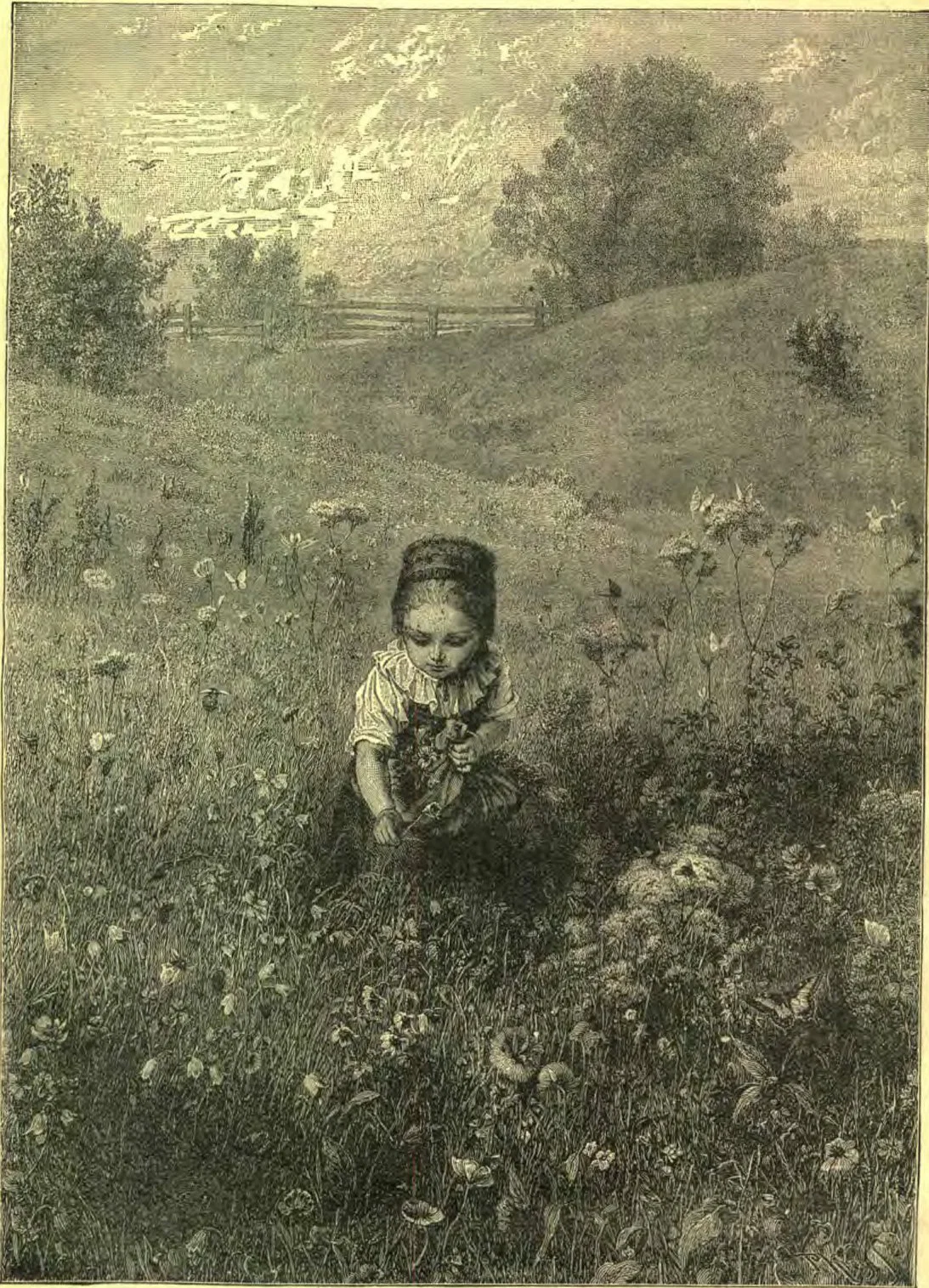
And the children are pulling,
On every side,
In a thousand valleys far and wide,
Fresh flowers; while the sun shines warm
And the babe leaps up on his mother's arm.
Sing, sing, ye birds, sing, sing a joyous song!
And let the young lambs bound
As to the tabor's sound!
We, in thought, will join your throng,
Ye that pipe and ye that play,
Ye that through your hearts to-day
Feel the gladness of the May!
What though the radiance which was once so bright
Be now forever taken from my sight,
Though nothing can bring back the hour
Of splendor in the grass, of glory in the flower;
We will grieve not, but rather find
Strength in what remains behind;
In the primal sympathy
Which having been must ever be;
In the soothing thoughts that spring
Out of human suffering;
In the faith that looks through death,
In the years that bring the philosophic mind,
And O ye fountains, meadows, hills, and groves,
Think not of any severing of our loves!
Yet in my heart of hearts I feel your might;
I only have relinquished one delight,
To live beneath your more habitual sway.
I love the brooks which down their channels fret,
Even more than when I tripped lightly as they:
The innocent brightness of a new-born day
Is lovely yet;
The clouds that gather round the setting sun
Do take a sober coloring from an eye
That hath kept watch o'er man's mortality;
Another race hath been, and other palms are won.
Thanks to the human heart by which we live;
Thanks to its tenderness, its joys and fears:
To me the meanest flower that blows can give
Thoughts that do often lie too deep for tears,
—Wordsworth.
THE TWO SCHEDULES.
By Irene Widdemer Hartt
“At last,” Christie Lefwell said to herself as she sat before the desk in her room, “at last my time is my own! I can read and study to my heart’s content. I will make out a schedule, as Aunt Susie used to, and go by that. She said it helped her so much, for no moments were allowed to fall out between.”
Christie was a true student; she cared more for her books than for anything else, and her family sometimes declared she was good for nothing else; but she had shown herself capable of a great many other things during the past three months. For three weeks they were without a servant, and she gave up school to help her mother with the housework and care of the children. No sooner had they obtained a servant than Mrs. Lefwell was taken ill. Then for more than two months Christie was nurse and housekeeper. Only yesterday the invalid, still very weak, had gone from home for a change of air, and this morning, with a good servant in the kitchen, and no nursing duties, Christie felt that she had a right to her time. It was too late to return to her school this term, so she would study at home.
It did not take long to write out what she would do each particular hour. From eight till half-past was her morning devotional reading; from that time till ten she read French history. She had just turned over the second page of that history when her door was thrown open suddenly, and Fred, her younger brother, burst in.
“Chris, come quick,” he cried; “I can’t find my exercise-book, and it’s after half-past eight. Come, help me hunt it. I’ll be late and lose my marks.”
Down went the history and up went Christie.
“Where did you have it last?” she asked as they ran down the stairs together.
“You’d better ask where Dora had it last. She’s116always carrying off my books. The next money I get, I’ll buy a box with a lock and key to keep them in.”
After quite a search it was found behind the sitting-room table, where Fred let it fall when he was done with it.
The first chapters of any long history are inclined to be dull, and Christie’s was not an exception; but she was glad to get back to it, and was reading eagerly on when a great uproar arose in the hall below. Frantic cries for Christie ascended. Down went the history again and up went Christie.
“O children,” she called over the banisters, “I thought you were in school.”
“Come down, Christie,” called Mamie. “Dora slipped on the stone steps at school and cut her lip awfully. The teacher sent her home. It’s bleeding like everything.”
Christie had flown down, and had the little sister in her arms before Mamie had finished.
“How it must hurt, poor dear!”
“It do hurt,” sobbed Dora.
“Sister’ll wipe it off, and put something on it to heal it. Then she’ll tell you a story till it stops hurting. You had better go back to school, Mamie.”
“Maybe I could help you.”
“No, thank you; there is nothing to do but to hold her.”
So Mamie went back to school, and Christie devoted herself to Dora. It was not a very serious cut, but as Dora was scarcely more than a baby, it was hard for her to bear. Christie told her story after story, till the pain was long a thing of the past. It was after eleven before Dora thought she could play alone. Then Christie ran down to the kitchen to see that the dinner would be ready by the time the other children came home from school.
“Shure, miss,” announced Katie, “there’s not a grain of salt in the house, it’s that shpilt wid the box upsittin’. How can I cook widout salt, shure?”
There was no one to send for it. Dora was too little to go alone, so Christie had to go, taking her with her. It was a quarter of twelve when she returned home, and she had that fifteen minutes for reading. She took up the history again, although it was the hour for English literature.
“I’ll finish what I have begun; it’ll be the best way,” she mused, “and I shall have all the afternoon to myself.”
At one o’clock, when the children were fairly out of the way, she took up her philosophy and had an hour’s quiet reading. From two to four she was to sew, and she had but threaded her needle when Katie came in to say there was a lady waiting in the parlor to see her.
“I never thought of callers, or of such an early one,” she sighed, as she folded away her work and went down.
It was not a caller exactly. It was her Sunday-school teacher, who had come on an errand. One of the class, Nettie Wills, the only child of a poor working-woman, was very ill and lay alone all day. The other girls had promised each to spend a part of a day apiece with her, and Miss Brown had called to know if Christie would devote a couple of hours to her this afternoon; none of the others could go now.
She thought of the stockings which were to have been darned between two and four, of the poems which were to be studied from four till five, and the friendly calls she was to pay between five and six. But not a moment elapsed before her cheerful reply came.
“Yes, Miss Brown, I will go immediately.”
“I knew you would. I am always quite sure that whatsoever your hand finds to do for the Lord will be done readily and with all your might.”
Mrs. Wills did not return from her work till six o’clock, and Christie was kept with Nettie till that time. She was indeed glad when the hour of her release came, for she was tired, and it was with lagging steps she made her way home. Supper was ready, and the children were clamoring for it. When that meal was over, Dora’s little lesson must be taught her; then she was put to bed. Fred and Mamie claimed Christie’s assistance with theirs the rest of the evening, and when they went to bed, it was too late for her to read, so she went to bed too. Her little schedule, with its tempting list of work, lay on her desk as if to mock her when she went into the room. She had not carried it out at all. She did not know it, but all that day she had been going by a schedule; everything she had done had been written down for her to do, and the Lord had made it out. When she wrote hers in the morning, he had written another for her, and not one duty on this other schedule had she refused to do. His way, not hers, had she done all that day. After all, the time had not been her own, as she called it, but his, and as his she had ungrudgingly redeemed it. —Irene Widdemer Hartt.
Chinese Junks on the River Canton
By W. S. C.
TCHOUNG-KOUO.—NO. 3.
This time I shall tell you something about Chinese sailing vessels, or junks, as they are called. In the River Canton, at the city of that name, can probably be found the greatest number and variety. I will quote a portion of an article written by a French Catholic missionary many years ago, which contains a brief but good description of them.
“The river of Canton, at night, presented really the most fantastic spectacle I had ever witnessed. It seemed to me almost more populous than the town. The water is covered by a prodigious quantity of vessels of all dimensions and of indescribable forms. The greater part are shaped like a fish, and among these the Chinese have chosen for models those of the most extraordinary figure. Some of the vessels are built like houses, and are richly decorated; many are resplendent with gilding, and elegantly carved in transparent lace-work, like the wood carvings of some of our ancient cathedrals. All these floating habitations, hung round with pretty lanterns, are cruising about incessantly, without ever becoming entangled one with the other. The skill of their occupants in this respect is really admirable; you see that they are an aquatic population, born, living, and dying on the water.”
“Every one seems to find on the river what is necessary for his subsistence. During the night I was amusing myself a long while in watching the passing and repassing before our junk of a crowd of small craft, that were nothing else than provision shops,—bazaars in miniature. They were selling soap, fried fish, rice, cakes, fruit, etc.; and, to complete the effect of the picture, you must add the incessant beating of tam-tams (a kind of drum) and the letting off of fire works.”
Some of the government junks are really floating palaces, divided into suits of rooms, elegantly upholstered, and elaborately gilded and painted, the effect of which is greatly heightened by the beautiful polish the Chinese give to painted work.
The war junks are of a ruder construction, very high at both ends, and rigged with sails of bamboo matting. They are very difficult to maneuver, and never undertake long voyages. The form of these war junks varies greatly, and the names they bear are in keeping with their form. For instance, the “Centipede” is the name of one painted into the shape of that hideous insect, and having three rows of oars to represent its feet. The “Hawk’s Beak” is the name of another having the ends curved like a bill, and provided with a helm so as to be propelled either way without turning about. Then there are junks having four wheels, two in front and two at the rear, all turned by cranks. This kind of junks dates back far in the past. The Chinese needed only a knowledge of the power of steam to have distanced Fulton centuries ago. Most of the junks are painted to represent fishes, reptiles, or birds, and on the prow are painted two enormous and very terrible eyes, no doubt to frighten an enemy. The bottoms of all junks are divided into several water-tight compartments, so that a leak cannot endanger the entire junk. The system of water-tight divisions in use upon ocean steamers is original with the Chinese, who have been constructing their vessels in this way for centuries.
Another kind of junk is used in boat-racing, a diversion the Chinese are very much interested in. At certain seasons of the year, every town in China has its junk races, when the people give themselves up to great rejoicing. The Government officers, mandarins, and rich merchants, present prizes to the winners, those who are to take part in the races forming themselves into a company, and electing a chief. The junks are very long and narrow, so that there is room for only two sets of rowers. The boats are richly carved, and elaborately gilded and painted. The ends are painted to represent the head and tail of the Imperial dragon, thus giving the craft the name long-tchouan, or “dragon-boat.” They are festooned with silk and tinsel, and hung with streamers their entire length, while long pennants float from each end. Each boat carries a little mast on which is hoisted the flag of China. On either side of this mast are placed two men, who never leave off striking the tam-tam and beating long rolls on the drum, as the rowers buckle to the oars, and make the junk skim over the water. The very slightest mismanagement is sufficient to upset these boats, but their occupants are expert swimmers, and quickly recover their hats and oars, climb again to their perches, and go on with the race.
These games last for several days, and are continued from morning until night, while the vast throng of spectators fill every available spot on the shore, remaining faithfully at their posts all the time. Perambulating kitchens and provision dealers pass continuously in and out among the crowd, to feed the immense gathering, who eat and drink from morning until night, every day while they remain. The prizes generally consist of pieces of silk, jars of wine, roasted and boiled pigs, and sums of money. After the races an immense banquet is arranged, to consume the pigs and the wine. W. S. C.
MY FLOWERS.
All in the early morning hours
I walked through blooming garden bowers,
Where purple pinks and pansies grew,
And roses sparkled in the dew.
They were so lovely in my sight,
I plucked the red ones and the white,
And with full hands I wandered down
Until I reached the busy town.
Then round me, like a swarm of bees,
Came ragged children, crying, “Please!
Oh, please give me a flower!”—And so
I had to let my treasures go.
I gave them, every one, away:
But somehow all the long, warm day
Those flowers seemed just as sweet and bright
As if they still were in my sight.
—St. Nicholas.
GOOD BOYS.
The wisest teacher may be at fault when he attempts to foretell the future of his pupils. The model boy, who escapes bad marks and wins the prizes, whose hair is always smooth, his teeth and nails always as they should be, who never drops his slate, nor slams the door, nor leaves it open,—how natural to predict for him sure success in after life!
Perhaps he will achieve it. Probably he will do so if the foundation of his goodness is strong and well-laid. But if it is built upon a basis of timidity, or inordinate love of approbation, it indicates weakness of character, not strength; and in the rude struggles of men, strength wins the victory—strength intelligently used.
We once knew a boy who was, in all visible things, an absolute pattern. Not a flaw could be found in his conduct, any more than a spot of dirt could be found on his garments. Yet at the age of thirty-five this model was a man in ruins,—bankrupt in fortune, debauched in morals, past any reasonable hope of reform; and those who had known him best were obliged to admit that the model boy was father of the dissolute man.
His goodness at school had been genuine as far as it went, but it did not spring either from principle or from benevolence. At the first rude test it had disclosed itself as empty and shallow. Then his former companions recalled that he had always been unpopular, that he had had few friends, that he had been the friend of few of his fellows.
Perhaps the surest mark of inferiority that a human creature can show is coldness of heart. The human quality of human nature is love. He is most a man who loves most, and he is least a man who has least capacity of affection.
A good case in point is Abraham Lincoln, now newly revealed to us in a popular biography. He was far from being a model boy, or an exemplary youth; but he could love, pity, give, and help. He could save the life of the town drunkard whom he found freezing by the roadside. Some of his old comrades remember to this day his bursts of human rage at cruelty done to turtles and cats. He had his faults; but he could think, he could feel, and he could love. He was a good boy.—Selected.
THE LITTLE BOOTBLACK
A HUNDRED years ago there lived a little boy in Oxford, England, whose business it was to clean the boots for the students of the famous university there. He was poor, but bright and smart. Well, this lad, whose name was George, grew rapidly in favor with the students. His prompt and hearty way of doing things, his industrious habits and faithful deeds, won their admiration. They saw in him the promise of a noble man; and they proposed to teach him a little every day. Eager to learn, George accepted their proposition, and he soon surpassed his teachers by his rapid progress. “A boy who can blacken boots well can study well,” said one of the students. “Keen as a brier,” said another, “and pluck enough to make a hero.” But we cannot stop to tell of his patience and perseverance. He went on, step by step, just as the song goes—
“One step and then another,”
until he became a man—a learned and eloquent man, who preached the gospel to admiring thousands. The little bootblack became the renowned pulpit orator, George Whitefield.—Christian Neighbor.
AT WAR WITH GRASSHOPPERS.
In the June number of the St. Nicholas, C. F. Holder gives an interesting account of a battle once fought between an army of grasshoppers and a body of Russian soldiers, the latter being completely outwitted by the insect. It is but a few years since the inhabitants of some portions of the United States encountered a similar foe, which, like the Russian’s enemy, completely baffled their skill in their attempts to route it. The consequences of war are very terrible, but not always more serious than the work of destruction wrought by a genuine plague of grasshoppers, as perhaps some of the readers of the INSTRUCTOR can testify. The following quotation is the description referred to above:—
“One of the most remarkable wars that ever occurred, a war in which thirty thousand soldiers met an opposing force numbering tens of millions, is not recorded in the military histories of the country in which it took place. The country was Russia, and in the year 1825 came the first call for troops.
“The provinces lying between Odessa and Kiev sent forth the first alarm. Clouds, like gigantic whirlwinds, had appeared in the air, rising in vast columns and spreading out in strange forms above the earth. Nearer they came, and finally the terrified peasants found that the clouds were alive,—in fact, were vast armies of grasshoppers! The face of the earth was soon covered with them, and at midday the sun was darkened, the insects hovering over the earth like a pall. They covered the houses, crawled under doors and into cracks, piled themselves up in heaps, and spread devastation wherever they appeared.
“The poor farmers vainly fought them with fire, standing by their gardens to the last. The vast hordes settled upon the green crops, in some places to the depth of four or five feet, and when they rose, the barren ground alone was left to tell the tale. Borne along by the wind in waves and sheets, the noise of their wings sounded like the rushing of a gale through the rigging of a vessel. So great were their numbers, that the peasants were crazed with fear. Some believed that the end of the world had come; while all saw starvation staring them in the face; for not only did the grasshoppers eat up every blade of green, but they devoured the stores of hay and every edible thing.
“The news of the resistless advance of this vast invading army, bringing famine with its onward march, soon reached the Government of Moscow; and in response to an appeal from the people, the Emperor Alexander ordered out an army of thirty thousand soldiers to fight them. Instead of guns and cannon, the men were armed with spades, shovels, bags, and implements for making fires; and they advanced upon the enemy, stretching out in a line over two hundred miles long.
“The horses could hardly drag the wagons through the living mass, often two and three feet deep. The grasshoppers clung to the horses and men, and leaped about their heads, adding to the confusion. They were shoveled up in mounds, collected in bags, raked together and burned, yet there was no perceptible effect upon their numbers: and through the governments of Ekaterinburg and Kherson, for hundreds of miles, to the Black Sea, they lay in a solid mass two feet thick.
“Through May and June they rose in continuous clouds, carrying destruction everywhere. A distinguished naturalist, on his way to the Crimea, met the insects fifty miles from Kiev; they clung to the wagon wheels like thick mud, and the speed of his horses was reduced from eight miles an hour to one. For a long distance he passed thus through these invaders. Crossing the Black Sea, he found that on the island of Phanagoria the insects had left the ground. At a distance of five miles they resembled columns of black volcanic smoke hanging in the air at a height of six hundred feet, the upper portion assuming the appearance of dark clouds that cast weird shadows upon the earth and darkened the sun’s rays.
THE NIHILIST CONSPIRATORS.
ANARCHISM, Nihilism, and a spirit of lawlessness pervade society alarmingly even in our own well-organized government; yet in contrast with existing evils under some other forms of government, the citizens of the United States are highly favored, escaping many of the perplexities which result from misrule. Perhaps there is no better example for contrast than a glimpse of Russian society as given in the following paragraphs from the Youth’s Companion:—
“The recent desperate attempt upon the life of the Russian Czar, which took place on or near the very spot on the Newsky Prospect where his father was murdered six years ago, shows that the desperate spirit which prompted that act still survives. This is the fourth or fifth time, at least, within five years, that the present Czar’s life has been threatened, and there is probably no one of his immense number of subjects who leads a more thoroughly anxious life. The would-be assassins, as on previous occasions, were found to belong to the vast and secret society of the Nihilists; a society which has long been the terror of the palace, and of peaceable Russian subjects everywhere. Some of the leaders were promptly arrested. They were found to be, not from the lower or ignorant classes of society, but military officers, university students and men—and women, too—of good education and social position. Even a policeman was found to be concerned in the plot.
“This is a striking feature of the Russian revolutionary movement. In most countries conspirators against the State have been unlearned and usually poor men, who have had nothing to lose by anarchy, and who imagine that they have much to gain thereby. But in Russia, the Nihilists seem to belong almost altogether to the upper and middle classes. The great mass of the Russian peasants still venerate the Czar, as if he were a being more than mortal. They would regard the raising of a murderous hand against him as worse than sacrilege. It is in the universities, in the wealthy country houses, in the palaces of the nobles, in the quarters of army officers, that Nihilism seems to be most rife and most dangerous. The Nihilists, moreover, do not seem to be a single, compact, and united organization, but to compose a great number of societies, the purposes and methods of which widely differ from each other.
“Some of these societies are moderate and patriotic. They do not wish to bring about anarchy, or the reign of socialism. They desire to get rid of the galling and dreary despotism of the Czars and their government; and to obtain, by means of a constitution like those of the other European nations, the political freedom of the Russian people. There are, also, other societies, which are constantly engaged in plots to commit acts of murder, incendiarism, and other deeds of violence. They are composed of fiery and desperate spirits, who are ready, and seem, indeed, almost eager, to sacrifice their lives in order to attain their bloody purposes.
“The Czar lives in constant dread of these desperate conspirators. He never goes abroad except under the escort of a strong guard. His palaces are constantly watched by spies and secret emissaries. If he travels, every foot of the railway or road over which he is to pass is under the surveillance of gendarmes and police, almost within speaking distance of each other. Every minute precaution is taken, indeed, to hold his person safe from the attacks of the secret and resolute enemies who are known to be always at hand, watching their chance. Every day of his life is imbittered by the dread of a sudden attack, which may come at any moment, in some unexpected way, and from some unthought-of quarter. This is the penalty the Czar has to pay for the absoluteness of his rule. Cruelty, injustice, tyranny, raise a host of unseen enemies, who, under such a government, can find, or, at any rate, will employ, no other outlet than violence for their discontent.
“Such a state of things can only be brought to an end by allowing the people to take a share in the government. Political freedom affords a safety valve for the utterance of disaffection. So long as the Czar remains a despot, Nihilism, or some sort of secret and dangerous combination, will continue to exist.”
WONDERS OF HEAT.
Some of the effects of heat you have already learned; of what constitutes heat, you may gain some ideas in the following paragraphs from Golden Days:—
“‘What is heat?’ is a question that has puzzled philosophers from the earliest times, and even in this age of scientific study and discovery, the question is answered by a theory. Like electricity, it is something that we cannot see, though we can study and lay down fixed laws in regard to its effects. It is silent and unseen, but it produces powerful and irresistible results.
“Place one end of the iron poker in the fire, and it soon becomes hot. The ‘theory’ is that the particles or molecules of which the poker is composed do not touch each other, but are so near that they seem to us to be all one; the particles or molecules are separated by little spaces, called pores—something like the spaces between the fruit in a basket of oranges, except that the molecules nowhere touch each other, and the oranges do; and the molecules are many million times smaller than the oranges. They are so small that they cannot be distinguished with the aid of the most powerful microscope. The molecules are held together and kept in place by a kind of attraction, called cohesion.
“When the poker begins to get hot, the cohesion begins to lose its power, and, as before stated, the molecules move around among themselves; hence we say ‘heat is motion.’ If the heat can be made great enough, the cohesion is so far overcome that the molecules are not held in place, but run apart, and the body is said to be melted. If the heat be continued, the cohesion is entirely overcome, and the molecules go off in gas. This is most easily shown with a piece of ice. As the ice is warmed, the cohesion is partially overcome, and it becomes a liquid; if heated still further, the cohesion is entirely overcome, and it goes off in gas, or steam.
“Heat is motion, and motion suddenly arrested is changed into heat. The laborer, when driving a post with a heavy hammer, finds that the top of the post becomes very hot, because when the hammer strikes the post the motion is stopped and changed into heat. Rub a piece of coarse cloth with the hand; some of the motion is stopped, and the hand feels hot.
“It is said that the Indians started their fires by rubbing a block of dry wood with a stick. It is very easy to get the stick hot, but it will be found rather difficult to make it blaze. Wood-turners hold a piece of soft wood upon whatever they are turning, and quickly burn a black ring around it. Machinery is oiled to make it run more easily. When the oil is worn off, the machine moves harder and the motion that is stopped is changed into heat, and the machine is heated and spoiled unless oiled again.
“All who travel are familiar with ‘hot boxes.’ The oil is worn off from the axle, and the wheel turns harder. This lost force is changed to heat, and the axle soon becomes hot enough to set the waste, with which it is packed, on fire. As the body becomes heated, and the cohesion is partially overcome, the molecules become farther apart, and the body grows larger, or expands. This force is almost irresistible.
“The sides of a large and heavy bridge had bent outwards; iron rods were put through from side to side. One end of each rod was fastened firmly to one side of the bridge; a thread was cut on the other end for a nut. The rods were heated, and of course expanded or lengthened. Then the nuts were screwed up firmly to the side of the bridge. When the rods cooled and contracted, the sides were brought together with as much apparent ease as though they had been sheets of paper. Blacksmiths make use of the same principle in setting the tires on wagon-wheels. The tire is made a little smaller than the wheel; then it is heated, red hot and expands and becomes larger than the wheel. When it is placed in position and allowed to cool, it fits very tightly.
“Mercury is a metal, and is expanded very easily by heat. The thermometer is only a very small glass tube, with a bulb at the bottom filled with mercury; the warmer the weather, the more the mercury expands and rises in the tube. A clock loses time in summer because the rod to the pendulum expands and becomes longer; and the longer the pendulum, the slower it swings. To prevent this, gridiron pendulums, which prevent the pendulum from becoming longer, are used.”
NOTE
WE are not told who this man of God was, but he had an especial message from God that he should go directly to the altar, bear his testimony, and return by another way. Many are the speculations as to the reasons why this was required. Some have supposed that it was because he would come in contact with men who would make inquiries as to the message he had given, and thus finding those who were in sympathy with the king, his life would be endangered. But one thing is certain: had he not stopped under the oak tree to rest, the old prophet might not have overtaken him. Another important lesson taught by the narrative is that every person whom God uses in his service should have an individual experience, and when God's word reveals to him any duty or truth, he should be faithful in the discharge of the same, without compromising his integrity in any way whatever.
OBEDIENCE
LESSON 8.—IMPORTANCE OF OBEDIENCE.
(Concluded.)
1. WHAT special message did a prophet of God bear against the altar at Bethel? 1 Kings 13:2.
2. What most signal manifestation showed that God was with him? Verses 4, 5.
3. What charge did God give him before he started? Verse 9.
4. After God had restored the king’s hand in answer to the prayer of the man of God, what did the king desire of him? Verse 7.
5. Did he resist this temptation? Verse 8.
6. What temptations did an old prophet set before him? Verses 13-15.
7. How did the man of God still persist in adhering to the command that had been given him? Verses 16, 17.
8. After he had refused, what testimony did the old prophet bear? Verse 18.
9. What was the result of this artifice? Verse 19.
10. What consequence followed this transgression? Verse 24.
11. What practical lesson can we draw from this?—That when God plainly reveals his will by his word, the slightest disobedience from that word will bring his disapprobation.
12. Because judgments do not immediately follow transgression, what are people emboldened to do? Eccl. 8:11.
13. Will their punishment be any less certain? Verse 13.
14. To whom does the Saviour liken those who hear his sayings and do them? Matt. 7:24, 25.
15. To whom does he liken those who hear and do them not? Matt. 7:26, 27.