Besides the good letters which are printed in this paper, there are many just as interesting waiting, which will appear right along. These little writers have our thanks for their pleasant letters; and it seems as if you were all beginning to think you have a duty to make a good Budget, and that may be you can help one another to be better girls and boys. It is pleasant to read what you are doing for missions. Do your efforts spring from a desire to do all you can for One who has done so much for you? It is true love for the Saviour which makes people love to give to his cause; and an understanding of what he sacrificed for us ought to make us love to sacrifice for him. Even the youngest who writes for the Budget has learned the story of the cross,—the sacrifice of Christ's beautiful home with his Father, of his shameful treatment by persons whom he would have been glad to bless, of his great burden for man's sins, and of his cruel death upon the cross, between two thieves. It don't seem possible that any of the readers of the INSTRUCTOR could give stingily, does it? The Lord loves a cheerful giver, and he will have a great reward for him by and by if he is faithful. How many of the INSTRUCTOR family will share liberally in that reward?
FLOY M. WHITTAKER, of Los Angeles Co., Cal., writes: “As I always like to read the letters in the Budget, I thought I would write. I am twelve years old, and live with my papa and sister, but I came with my sister to California for her health. Our home is in Pueblo, Colorado. I have six missionary hens, and thirteen little chickens, and will soon have more little chickens. I have made $2.75, off from the eggs, which amount I gave to the missions. I have been canvassing for the INSTRUCTOR, and have the promise of one subscriber. I am reading the ‘Testimonies,’ and like them so much. I am trying to be a good girl, so that I may meet you all in heaven.”
EMMA JOHNSON writes a letter from Douglas Co., Neb., in which she says: “I live about twelve miles southwest of Omaha. I keep the Sabbath with my parents. There are also a few in Omaha who keep the Sabbath. I am going to try to get as many subscribers for the INSTRUCTOR as I can, so I can win a prize. I send two dollars to the Scandinavian Mission. One dollar I earned from a missionary garden, and the other dollar papa gave me as a New Year’s gift. I am going to obey my parents in all things, for in doing so I know I obey God. I want to be counted among the faithful.”
The next is a letter from the Province of Quebec, written by JESSIE DINGMAN. She says: “Thinking that the friends of the INSTRUCTOR would like to hear from the little folks out here in Canada, I will write you this letter. I am nine years old. My mother is dead, and I live with my grandparents. I wash the dishes and do many other chores for my grandmother. I have an Esquimaux dog, whose name is Dickey. He is a cunning little fellow, and has learned many tricks. I go to Sabbath-school every Sabbath, and learn my lesson in Book No. 1. I have just been learning about Isaac. I have begun to read the Bible through, and am learning the commandments. I have the INSTRUCTOR to read, and like the nice stories in it very much. After I read my papers, I send them to other children to read. I am trying to do missionary work in this way. I want to be a good girl, and be saved when Jesus comes.”
JOSEPH W. MARSHALL writes from Oakland, Cal. He says: “Although I have been a reader of the INSTRUCTOR for a long time, this is my first letter to the Budget. I am a member of the Oakland Sabbath-school, and also a member of the Rivulet Missionary Society. This society has thirty members, and we take a club of 125 INSTRUCTORS for our work. Some of the members of our society have tried canvassing. I have sold over 75 books,—‘Child’s Poems,’ ‘Little Will,’ and ‘Gypsie’s Album.’ A policeman stopped me one day and asked me if I had a license. Of course I had none. The next day I went to see the mayor, who asked me why I was canvassing. I told him I belonged to a missionary society, and was earning the money to pay my pledge. He then said if I would bring a note from my father and one from some well-known person of the place, he would give me a free license. If you would like, I will write sometime and tell you more about our Rivulet Missionary Society.”
We shall be glad to learn more of your society.
FLORA THOMPSON sends a letter from La Cygne, Kan., in which she says: “I like to read the letters in the Budget. When I read those from my little friends in Fontanelle, Iowa, I feel that they are just for me. We belong to that church and Sabbath-school. We have kept the Sabbath three years. There are no Sabbath-keepers here except ma, Harry, and I. We three have a little Sabbath-school of our own every Sabbath, and mamma hears our lessons,—mine in Book No. 4, and Harry’s in Book No. 2. In meeting, we sing and have a Bible reading. We miss the church at Fontanelle, and the Sabbath-school and prayer-meeting too; but as mamma’s work is here, it cannot be helped. Mamma is a teacher in the La Cygne public schools. La Cygne is on the River Le Marias Du Cygne. The river was so named by the French voyageurs. John Brown’s home is not far from here. Five miles from here the victims of the Hamilton massacre were buried. It is of this massacre that Whittier speaks in his poem ‘Le Marias Du Cygne.’ The massacre occurred May 18, 1858. The place of the murder is marked by two large stone slabs, which were hewn from a ledge of rocks, and erected as a monument to the memory of the dead by the soldiers who were placed upon the border to protect the citizens. The massacre occurred upon the last farm on which John Brown lived in Kansas. There are but a few logs left of the log cabin which stood by the spring. It is sixteen months since we came to this place from Fontanelle. I know all the commandments, the books of the Bible, and the fruits of the Spirit. I go to day school, and am in fifth reader and the fifth grade. I have been sick for two months. I want to be a good girl, so that I may be saved when Jesus comes.”
THE LAND OF HATS.
By W. E. L.
“Oh dear!” sighed Lucy, as she came in from school one rainy day, with her dinner pail on one arm, her books slipping out from under the other, and her umbrella turned the wrong side out. She was a very bedraggled, discouraged-looking little girl.
“I do wish,” she said, as she gave her hat a little fling up on the hook, and went to hang up her rain cloak,—“I do wish somebody would make umbrellas to wear on the head.”
Lucy heard a low laugh, and turning quickly around, she saw her Uncle Hal sitting quietly in one corner of the room, watching her.
“I don’t care if you do laugh,” said Lucy, half-provoked; “you’d want an umbrella on your head, or something else, if you had had such a time as I have coming home from school. Just see the cover of my new reader; it’s all wet and spoiled, and I had taken so much pains to have my books look nice!”
“It is too bad to get a new book spoiled in that way,” said Uncle Hal, looking sober. “I wasn’t laughing because you got wet; I was only thinking how queer you would look in one of the umbrella hats I have heard of.”
“An umbrella hat!” exclaimed Lucy, in open-eyed surprise. “I didn’t suppose anybody ever had such a thing.”
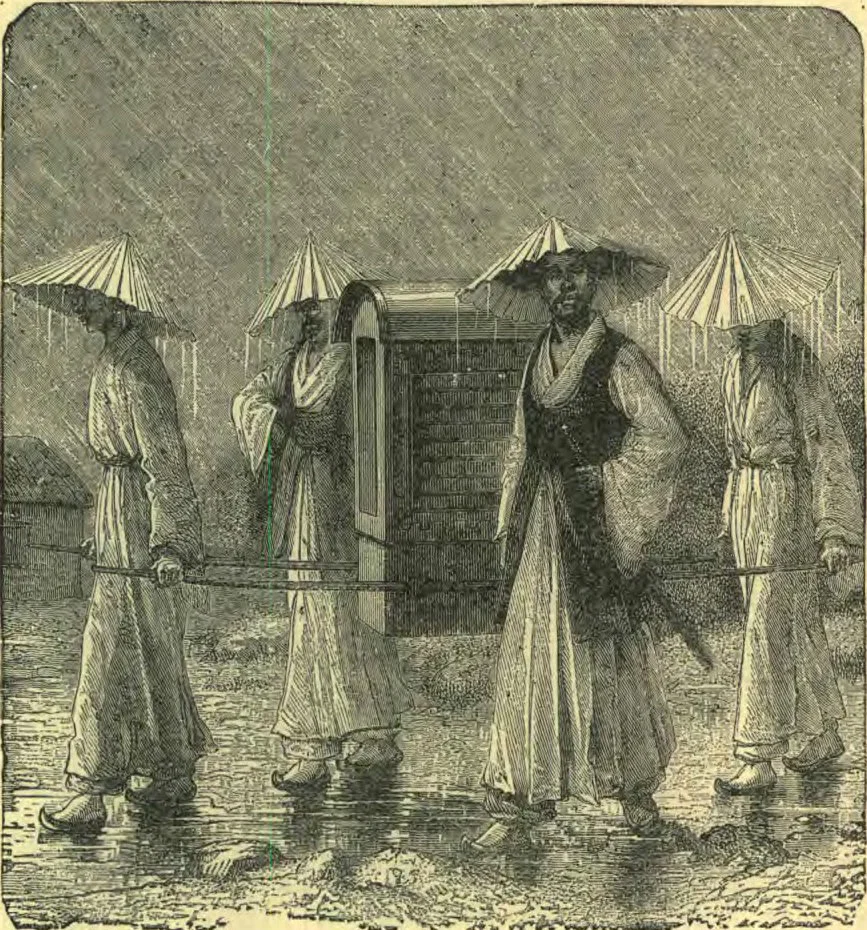
“Yes,” said Uncle Hal; “the Coreans wear umbrella hats. If you will bring me your geography, I will show you where they live.” So Lucy brought her geography, and helped Uncle Hal search for that unheard-of land.
“Ah, here it is,” said he, after letting Lucy hunt for it awhile. “A little peninsula in Eastern Asia, off the northern part of the Chinese Empire. It is often called the “Hermit Nation,” because the Coreans traveled nowhere themselves, and would let no one visit them. Seoul is its capital. Here it is,” said he.
“But about the hats,” interrupted Lucy.
“Oh, yes,” said Uncle Hal. “We may call Corea a land of hats. There are outdoor hats and indoor hats, wedding hats, and army hats, and hats for almost everything you can think of. Their rain hats are made of fine bamboo splints woven together with silk or horsehair. The rain runs down the drooping sides, and drips off as it would from a roof. But there is one bad thing about the hat,—it will leak. The rain beats through the bamboo; and when the sun comes out, it flickers through the poorly woven affair, and altogether gives the wearer considerable discomfort; so that it is not a very good umbrella hat after all. But since the Coreans do not have anything better, I suppose they are contented.
“But you would think the mourners had the queerest hats,” continued Uncle Hal. “These are braided out of straw, and are shaped like a huge round bowl. They are bright yellow, and come down over the head like a bushel basket, so that you can see nothing of the wearer’s face, as he solemnly paces down the street. The mourner’s clothes are made of a coarse, yellow-gray cloth. He often holds a piece of this cloth, stretched on bamboo sticks, before his face, so as to hide himself more completely.”
“I shouldn’t think that would be very pleasant,” said Lucy.
“No,” replied Uncle Hal; “but that isn’t the worst of it. For three whole years, he must wear ragged clothes; and he must not visit, or go about among his friends. In fact, he must make himself as nearly like a dead man as a living man can.”
“I do not see much sense to that,” said Lucy.
“I don’t suppose there is,” said Uncle Hal, rising as he heard the dinner bell ringing through the hall; “but the Coreans worship their dead relatives instead of the true God, and that, I presume, is why they are so careful about their mourning customs.”
“Well,” said Lucy, “if I should have to wear a ragged yellow dress for three whole years, I think I would rather stay in this country and carry an umbrella that turns wrong side out.” W. E. L.
HOW SPRING CAME.
By Mrs. Jas. A. Field
A SOUTH wind blew, and set the snow a-melting,
And made the little brooks begin to run;
From changeful skies soft April rains came pelting,
And wore away the white drifts every one,
And then out shone the golden April sun.
The little brooks ran fast, with liquid laughter,
Through field and forest spreading the glad word;
Snow-drops woke first; hepatica came after;
It was not long before the violets heard;
And then—out sang a thankful little bird,
So sweet it set the woodland's heart a-throbbing.
And all the meadows smiled to blossoming;
The brook's laugh softened to a happy sobbing,
And every little longing, living thing
Crept forth to round the miracle of spring.