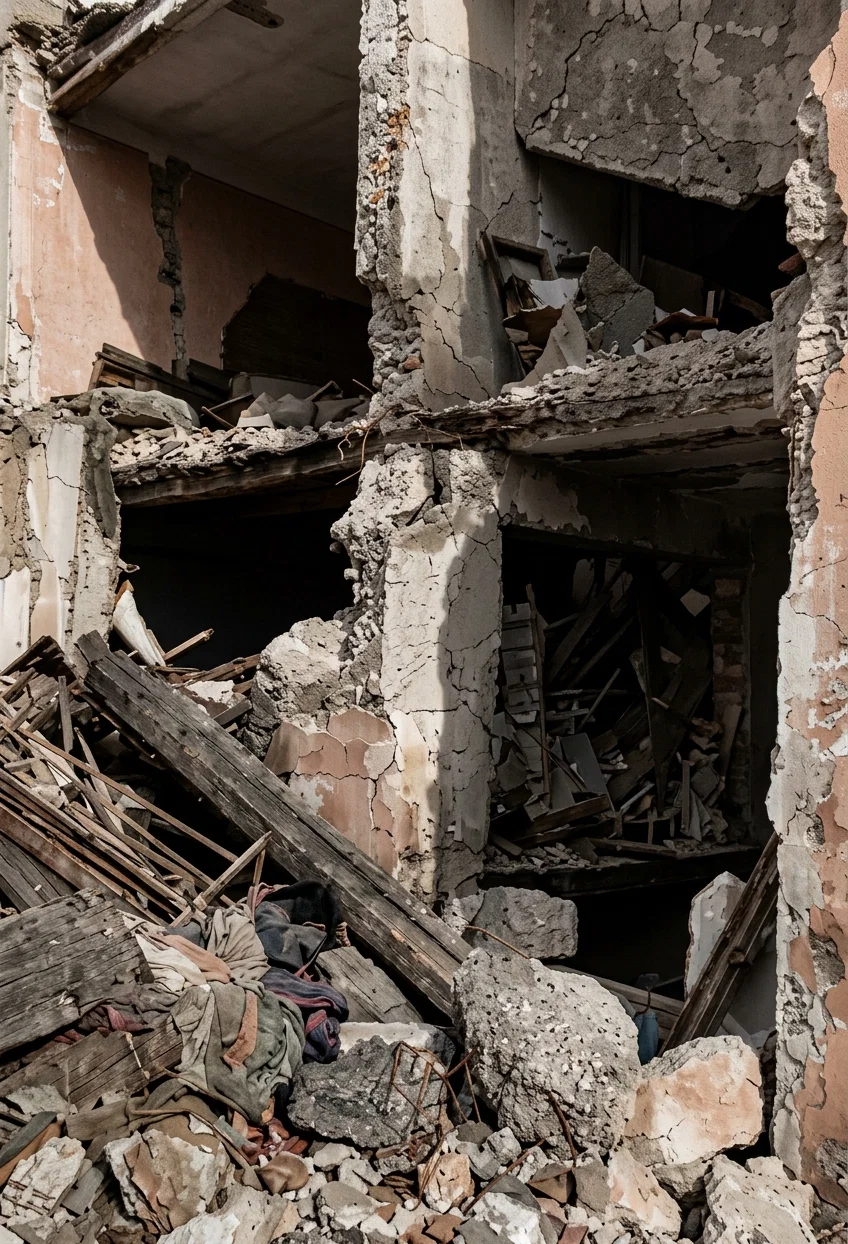
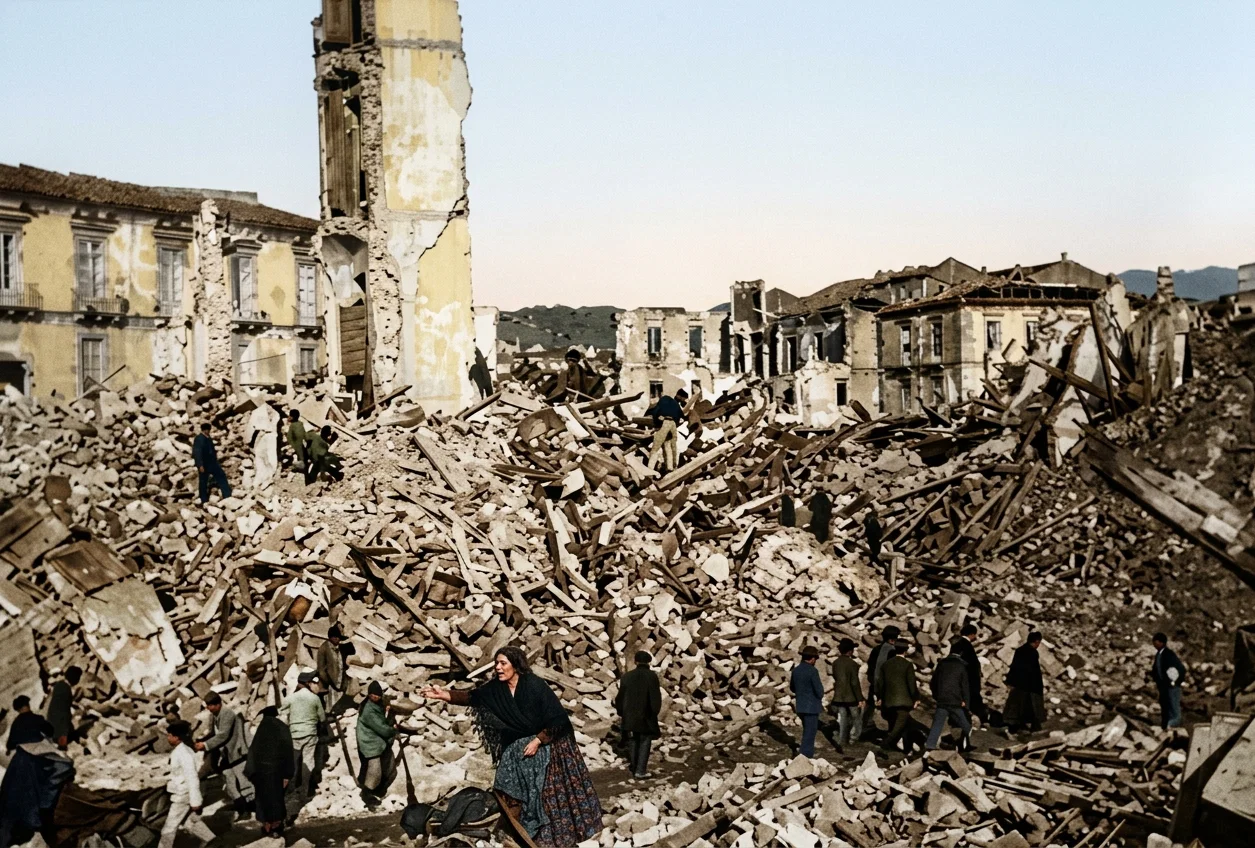
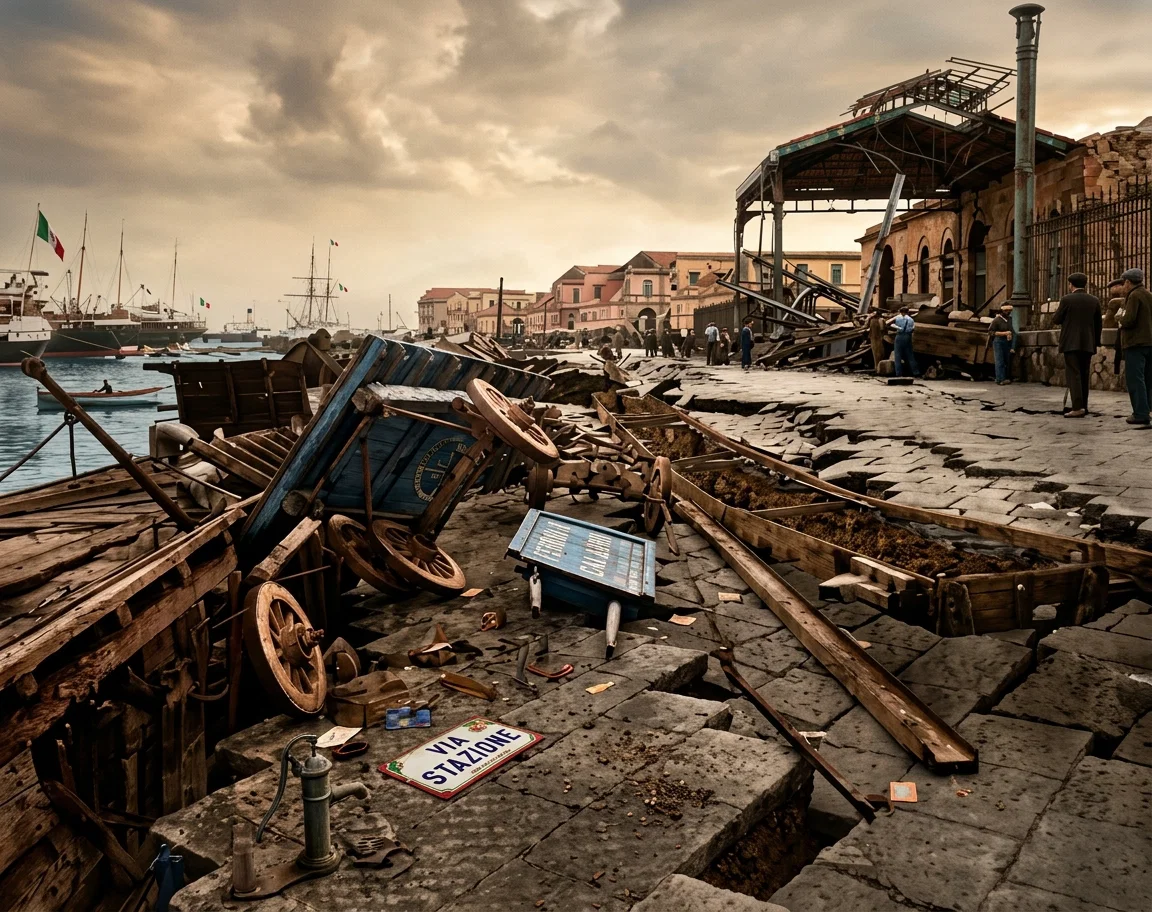
As soon as the shock was passed, the terror-stricken survivors went groping around among the ruins seeking a place of safety. When finally the morning dawned and the gruesome scene in all its reality loomed up before their frightened vision, many wanted to flee never to see their native city again. Others thought of their loved ones buried under the debris, and hurried back to the pile of ruins that had been their home. They called loudly for their dear ones, and frequently a feeble response would come from under the ruins. They would then set to work with a feverish anxiety, hoping to save a mother, a daughter, a son, a father, a brother, a sister, a sweetheart, or a lover. But with mountains of debris covering their loved ones, what could they do without shovels or tools of any kind? They dug away with bare hands until they wore away their nails and blood spurted from their lacerated hands. Then in despair they would sit down upon the pile of ruins and weep and groan; finally the voice of the buried loved-one would faintly call again, and with renewed force, regardless of wounds, they would apply themselves to the work of rescue. But in many cases, the despair deepened as insurmountable obstacles baffled their every attempt at rescue, until the faint voice died out nevermore to be heard. The desperation of these survivors, who in many cases had their whole families buried under the ruins of their homes, can never be imagined. Their utter inability to help their loved ones forms one of the saddest pictures of which history has any record.
One member of parliament had a brother, who was also a deputy, buried under the ruins. He himself had miraculously escaped death. His first thought after his deliverance was of his brother, and he ran to the house where he lived. He called loudly for him, and finally there came back a faint response from under the debris. He ran for assistance, but in the midst of such confusion and distress it was difficult to find adequate help. With a few soldiers he worked, digging deeper and deeper into the ruins, where his brother, the apple of his eye, was buried alive. Every once in a while he would call him to encourage him and find out if there was still hope. But the voice grew fainter and fainter. For two days they worked without interruption, but to no avail. With tears in his eyes and sighing heavily, the deputy said: “I heard my brother weeping last evening under the ruins, and I have done everything in my power to save him, but I have not been able to rescue him.” The deputy seemed to have aged twenty years in those few strenuous moments. His brother was afterward found dead. This is but one of hundreds of similar cases that might be mentioned, and that would make volumes of tragedy more terrible and gruesome than were ever penned by the greatest of romancers.
A Victim: Incased in Ruins.
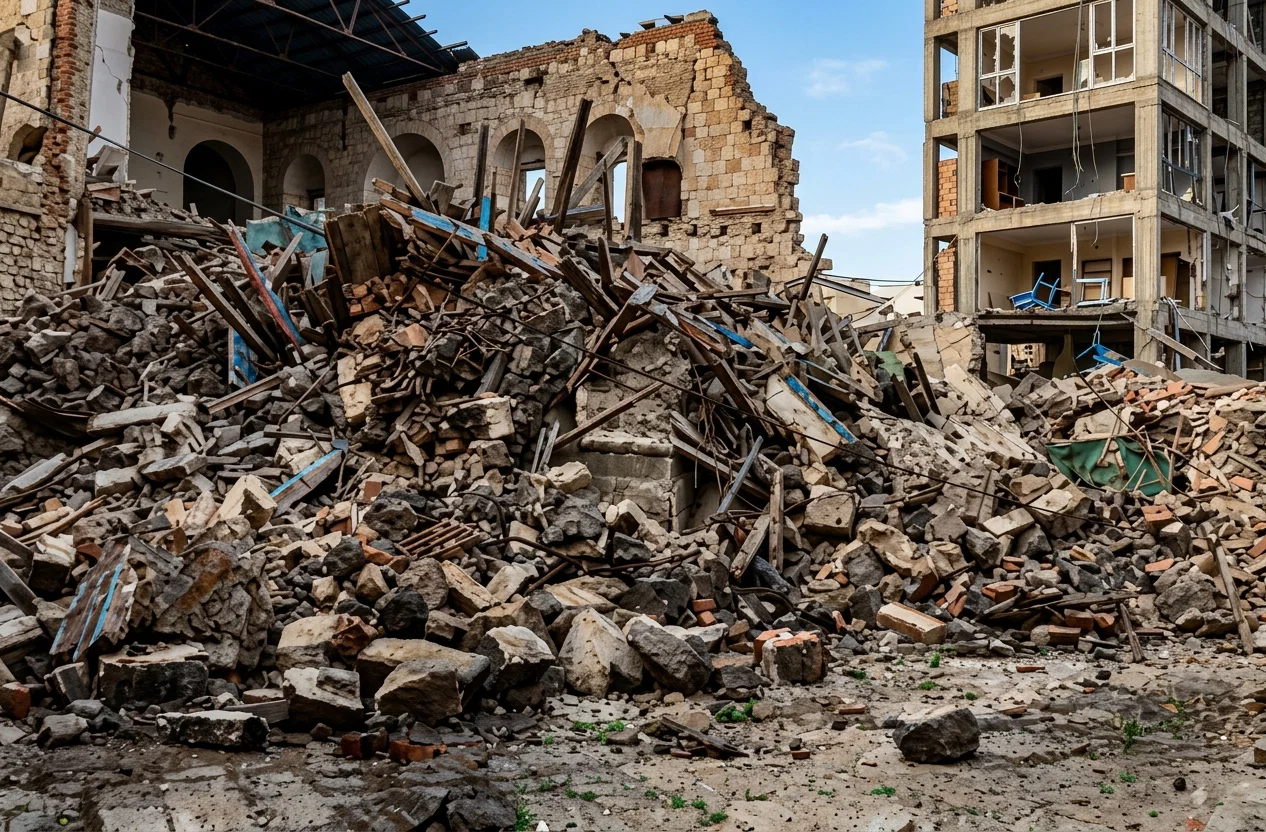
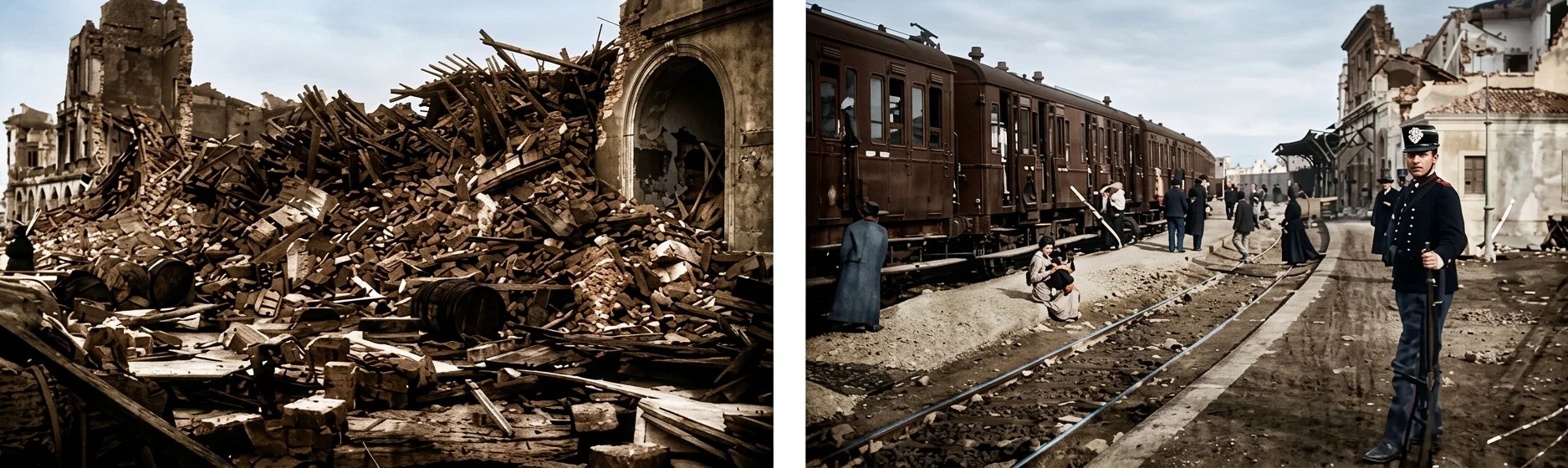
Ruins and Tottering Walls in Messina.
“He hath made of a city a ruinous heap.”
Noble Conduct of King and Queen.
Immediately on receiving the news of the disaster, the king and the queen of Italy hurried to the place of the catastrophe, and proved themselves worthy of the high office which they occupy. The king went into the very midst of the destroyed city and examined in detail the mighty ravages wrought by the catastrophe. Between overhanging walls that threatened to precipitate themselves upon the passer-by, the king wended his way, that nothing might escape his notice or deter him from fully doing his duty toward his suffering subjects. The people tried to dissuade him from risking his life in the midst of the doomed city, but he was deaf to all advice as all that loomed up before his eyes was the greatness of the catastrophe and the great needs of the sufferers. His presence on the scene of the disaster worked wonders in infusing new courage into those that wanted to flee, and in inspiring the soldiers and marines and others in their efforts to rescue those buried under the ruins.
The queen, on board the great war-ship called by her name, proved herself indeed an angel of mercy to the poor, wounded, and suffering who were carried aboard as they were gradually extricated from the ruins. She had words of cheer and comfort for all, and being a mother, her tender sympathy went out especially for the little orphans who were gathered from the doomed cities. She would kiss the frightened little ones, and make them feel at home, and cause them to forget their loved ones who were gone never to return again. One little child, as the queen tried to comfort her, said that she was in distress because she had lost her doll in the debris. The queen quickly reassured her of her care for her, and then immediately got together some pieces of cloth and made a rag doll which she presented to the little orphan.
Her majesty assisted very efficiently in the operating room, as her studies have extended even to nursing. On one occasion she was holding the legs of a woman on her shoulders while the surgeon operated upon her. As the operation lasted a little longer than she had expected, she tried to shift her burden to another, but as the woman cried out for pain, she remained at her post until the operation was finished. While she was in the operating room, a man crazed by the terrible effects of the tremble shock rushed into the room, “All is lost!” A woman, hysterical and crazed by fright, made a rush for the door with the intention of throwing herself into the sea, but the queen hastily intercepted her by throwing herself across her pathway. At this the frenzied woman gave the queen such a blow on the chest that a few drops of bright red blood showed themselves on her lips. Nevertheless she took no notice of this stunning blow, and went right on with her work of helping the suffering and comforting the orphans.
These are but a few details of the self-sacrificing work that the noble queen performed in favor of her stricken subjects. It is not to be wondered at that so many of the nations have conferred upon her degrees of honor, as she certainly merits them all.
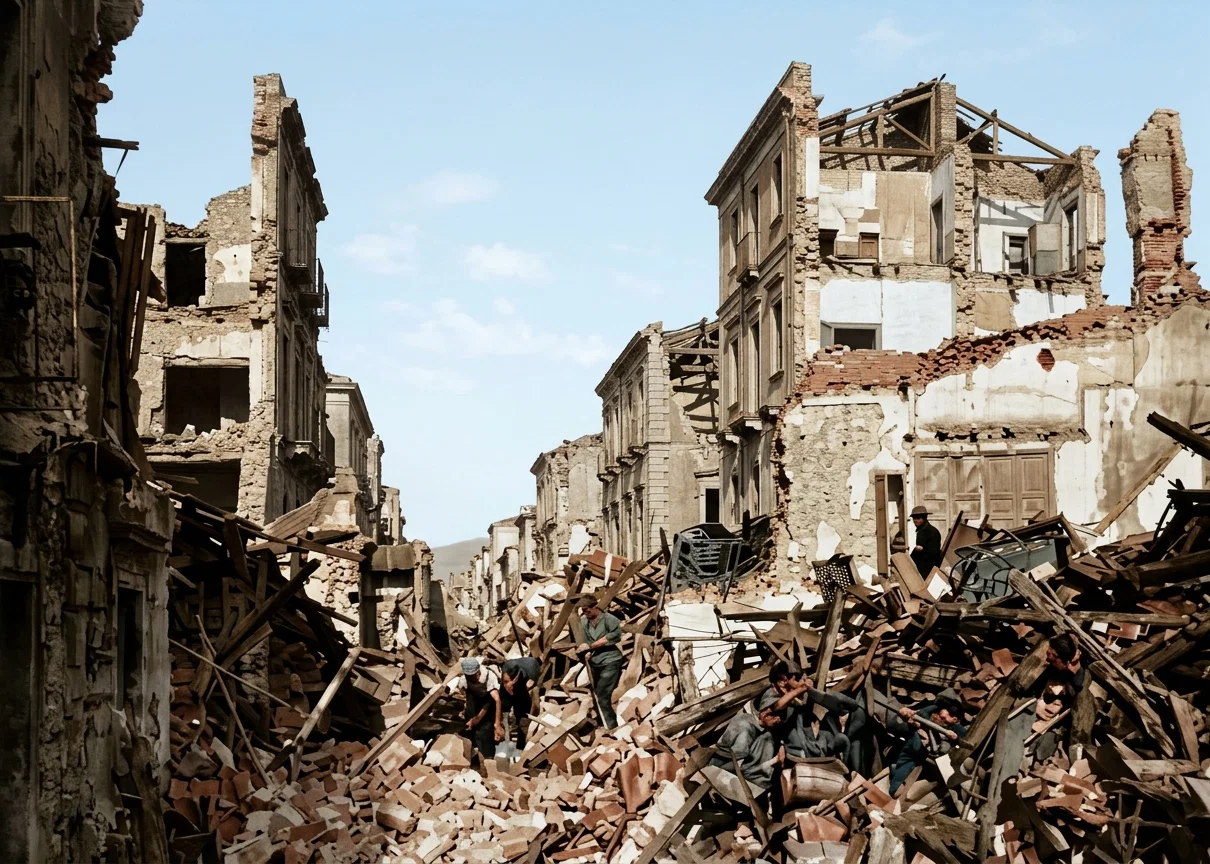
The earthquake is one of the most trying experiences through which humanity can pass; for it is a force so mighty, and works along such strange and mysterious lines, that one remains perfectly helpless before its destructive power. It may be said of man while he is in the throes of the earthquake that he is as a sheep before the slaughterer. Bravery and heroism avail nothing, for many of the strongest and most courageous were sleeping their last sleep under mountains of debris before they had time to realize what had happened. I saw bodies of the dead lying10peacefully upon their beds where death, in the twinkling of an eye, had placed his cold imprint upon their brow. Some fell three and four stories into the cellar and perished, while others survived the shock and managed to extricate themselves from the ruins. It is impossible to record the sad cases. Those with lives saved were often reduced to direst poverty. Many, many went mad. Sometimes only a single survivor of a family remained. Cases too pitiful to tell met one constantly. Members of wealth and title were left in abject want.
One of the Principal Streets in Messina.
Wonderful Escapes.
One man gives the following account of his experience in the earthquake. He had just awakened and was lying in bed thinking, when suddenly he was hurled out of bed and up against the ceiling. The next thing he knew he found himself in dense darkness, incased in a narrow doorway with all hopes of escape apparently gone. Suddenly coming to himself he felt a piece of cloth before him, and pinned in as he was he could only pull at it with his teeth, with the hope that behind it there might open up a way of escape. He pulled away desperately with his teeth and worked with all his might until he began to leave his teeth in the tough goods. But finally it gave way, and to his joy he saw the street. He wormed his way toward the light, but alas, a great beam intercepted his way and he despaired of going farther. Finally he managed to attract the attention of some passers-by who by a gigantic effort succeeded in pulling him through a hole through which his head could scarcely enter. He was terribly bruised, but saved.
Near the railroad station the morning of the earthquake a drummer who was hurrying away from the scene of destruction met a young man who was working with all his might to liberate his father from the ruins, but when he finally had him extricated from the debris, he found that his head had been crushed. The young man gave a shriek of horror and went mad and dashed his brains out on a wall close at hand.
A tragical and heart-rending chapter in the earthquake experience might be written under the heading, “Buried Alive.” Many a poor sufferer who outlived the first shock of the earthquake died by inches under the debris. Who knows how many prayers may not have ascended and conversions taken place under the cruel ruins of the doomed cities? With many this might have been their only moment for reflection on the future life and their need of making some preparations for the great day of God.
At the railway station, showing large fissures in the streets.
The last day I was at Messina, I saw three persons, a young lady of sixteen years of age, her sister, a girl of thirteen, and the brother, a boy of eleven, who had been taken out from under the debris that day. They had been buried under the ruins for about nineteen days and were taken out alive and in quite good condition. There is every prospect that they will all three live if no unforeseen difficulty sets in. In fact, the young lady, who is a rather pretty girl, had still a slight tinge of color in her cheek. This sounds rather like a newspaper yarn, for it would seem impossible to find persons alive under mountains of debris after nearly three weeks of time; but I saw them myself and know it to be true.
They were shut up in a room which was deeply buried under the debris. A part of the room had caved in, killing the mother and a baby, so that they had to remain enclosed for that long time with the corpses of two dear ones. They managed to find a little lamp and some matches and by means of this light discovered some figs, onions, and some wine. On these scanty rations they lived during this long period of distress and hopeless despair. They had drunk the wine and eaten the figs, and were on their last supply of onions when they were rescued. The boy managed to dig his way through the debris, got his head out and began to shout. He attracted the attention of the soldiers, and thus they were all three saved.
I saw a little doorway hardly large enough to contain a person, and in that place a girl had been imprisoned for ten days. One lady was buried under the ruins for twelve days with a beam pressing heavily upon her abdomen so that she looked more like a corpse than a living being when found, but by a large injection of salt water into the blood she was saved.
Another young lady was found under the debris with her hands and feet firmly pinned to her body so that she could only slightly move her head. There chanced to be some live chickens near her and these began to pick her face and would probably have eaten away her flesh if she had not tried to move her head back and forth until she was finally rescued after many days.
Then there were those buried under the ruins who, no doubt, suffered worlds of torture, for the earthquake shocks continued steadily after the first great shock, and are still much in evidence. These new shocks must have gradually pressed down the debris upon the sufferers so that little by little they were finally crushed under its weight.
During my stay in the earthquake district, I was kindly housed by the American vice-consul in a house which was much damaged by the earthquake, and which threatened to collapse. It was a building in which Garibaldi stayed during the stormy days of the Italian independence. The frequent earthquake shocks, which sometimes were quite strong, together with the damaged state of the building, did not add to my comfort during my stay at Messina, but it was nevertheless a welcome sight to meet with such kind hospitality in the midst of so much ruin and desolation.
The religious aspect of the situation I shall leave for another article, as that in itself is worthy of careful study. I might say, however, that the earthquake did not seem to follow doctrinal lines, or, in other terms, made no visible distinction between the members of the Protestant and Catholic churches.11
Under the ruins of the magnificent cathedral were buried images of saints and a madonna called the Madonna della Lettera, because it is claimed that the apostle Paul brought a letter from Mary to this church when he came on his missionary tour to Sicily. This madonna was very richly adorned with a gold mantle and many precious stones so that many millions were buried with her under the ruins of the Duomo which, as one can see from the accompanying photo, was completely destroyed. [See cover page of last week.] Some priests also perished in the collapse of this great edifice. Priests and nuns were killed in various parts of the devastated regions. But also some Protestant ministers were buried under the debris, and perished. One minister of the Waldensian Church with his family perished, as did the Baptist minister and his family. The Methodist preacher of Reggio and his family perished. Taking it all together, several hundred members of the different Protestant churches must have perished.
The earthquake, as generally occurs in similar catastrophes, did not lack in caprices. In the destruction of the insane asylum the inmates were almost all saved, while the doctors and attendants were nearly all killed. A church which had been condemned as unsafe, and therefore had been closed, was left almost entirely intact, while all the other churches were hopelessly destroyed. One old lady 106 years old was found alive under the ruins and did not wish to be disturbed from her resting-place, as she said she did not care to live for she had lost all her people. A soldier fell, bed and all, from an upper story to the cellar and found himself still lying in bed and unhurt.
A part of the Port of Messina after the Tidal Wave. A train at Reggio ready to leave 5:21, December 28. Stopped by the quake.
The earthquake seems to be no respecter of persons, and gathers all, rich and poor, into its grim bosom. For this reason we ought to learn one great lesson from this awful catastrophe, and that is, that in these last days we must be every day living as those servants who are looking for their Lord’s return.
I wish to close this article with the solemn words of our Lord, “And what I say unto you I say unto all, Watch;” “therefore be ye also ready.”
C. E. MILTON.
The New Life in Christ
The “Western Watchman” remarks in an editorial upon the preaching of a Protestant evangelist, that “all modern life, and much of that which is not modern, is a sham,” and continues: “We just can’t be honest; and that is all there is about it. We are all wearing masks and living on false pretenses;” which is as much as to say that we can’t be Christians. It would seem as tho the able editor of the Western Watchman could see the logic of his remarks. Roman Catholicism endeavors to cure the inward depravity of men by outward penalties. The only way that it can be done is by being born again in Christ Jesus and receiving the new life. More than “motive” is needed for supernatural living, as the editorial intimates. There must be life as well. By this we do not mean a new life in the sense of turning over a new leaf or placing oneself in different environment; but actual life power from on high. This Roman Catholicism does not pretend to furnish. Nor do those who depart from the simple teaching of the word of God.
Alaska-Yukon-Pacific Exposition Nears Completion
The grounds and buildings of the Alaska Yukon Pacific Exposition which will open May 1, are said to be practically finished, with the exception of the government building. Rapid and thoro progress has been made throughout; even the electric light system so far along as to have a preliminary exhibit. Nearly 1,000,000 eight candle-power incandescent lamps are used besides a multitude of arc lights. It bids fair to be one of the greatest of world's fairs.
Book Notices.
“Light on the Old Testament from Babel.” By Albert T. Clay, Ph.D., Assistant Professor of Semitic Philology and Archeology in the University of Pennsylvania. Second Edition, Cloth, Illustrated, Map, and Index. Price, $2.00. The Sunday School Times Company, Philadelphia.
This is a revision of a work published a few years ago, and now revised and brought up to date. Its general aim is to show that the Bible narrative is confirmed by the discoveries in ancient lands adjoining the land of Israel and having dealings with that people. Besides this it gives a large amount of information concerning archeology and its rapid development. Among the striking topics are, The Great Antiquity of Man; The Babylonian Creation and Deluge; the Tower of Babel; The Fourteenth Chapter of Genesis; Babylonian Life in the Days of Abraham; The Code of Hammurabi, and his code compared with that of Moses; The Name Jahweh, or Jehovah, in Cuneiform Literature; The Amarna Letters; Babylonian and Assyrian Inscriptions, and Babylonian Life in the Days of Ezra and Nehemiah. Some of the chapters in the book are illuminating. The essential differences between the Mosaic and the Hammurabic code are pointed out, and the superiority of the former fully shown. We see no reason to conclude that similarities in some respects prove dependence in any, nor does our author so affirm. The name of the covenant God of the Israelites seems clearly to be found in Babylonian records. The well-known Amarna letters are discussed and their evidence once more weighed. We see no reason as yet to accept the conclusions of the great antiquity of man as disclosed or rather argued and conjectured from the tablets. When Babylonian legends claim a period of 432,000 years prior to the Deluge, during which only ten kings ruled,—a story utterly preposterous,—why should we accept as conclusive their boastful claims of long existence made at a later date? Why should we assume a uniform accumulation of debris over buried objects, a process easily modified by a half-dozen different things? Why should it be assumed that advanced culture and refinement indicated long national existence? Why not admit the possibility of degeneration? Why assume many other things? These lower stratas in buried cities may have been tombs, sewers, or store chambers. Then, too, the archeological records are very fragmentary. Why should the very incomplete and uncertain fragments be set over against the far clearer, more consistent testimony of the Bible in any case?
“Twelve Lessons in the Fundamentals of Voice Production.” By Arthur L. Manchester. Well printed and bound in cloth. Price, $1.00. Oliver Ditson Company, Boston.
The author of this little work is director of music and professor of voice culture at Converse College. It is not a theoretical work, but has been tested in lessons, published in The Musician, and republished in book form at the requests of many readers. It is not a treatise on singing, nor does it profess to be an exhaustive treatment of tone production. It deals with the fundamentals and essentials, the basis of all true advanced work. Its aim is systematic order and definiteness.
“The Most Popular Hymns.” Selected and Arranged by Gilbert Clifford Noble. Large page. Bound in dark manila, with illuminated front. Price, 50 cents. Hinds, Noble & Eldridge, 31-35 West 15th St., New York City.
The compiler has done well in his selection of a hundred hymns and sacred songs, more or less, 108 pages. The book opens with “Nearer My God to Thee,” and closes with, “God Be with You Till We Meet Again.” About the only one we would delete is “Lead, Kindly Light.” Of course, all the good ones could not be given; but that would have given place for one more. The selection, however, is excellent.
“He Knew Lincoln.” By Ida M. Tarbell. The McClure Company, New York City.
A charming little monologue told by one who knew Lincoln, and put in shape by Miss Tarbell. One of the best little things on Lincoln ever published.
“The Acts.” Translated out of the Greek. From the American Standard Edition of the Revised Bible. Bound both in cloth and leather. Thomas Nelson & Sons, 37 East 18th St., New York.
A dainty little volume, easily carried in a teachers’ Bible next to the cover. It is designed to help the Sunday-school teachers in the study of the Acts.
China Asking for Justice.
Owing to the concessions that have been made with the Japanese, the Chinese Consolidated Benevolent Association, commonly known as the Chinese Six Companies, have called the President’s attention to the fact that they have been denied rights that are granted to the Japanese, stating that in Reno, the state of Nevada, their property had been destroyed without due process of law, and they would like to have the President do something to prevent the discrimination against Chinese children, whether citizens or aliens, who wish to attend school; but there is little hope of their petitions being granted.
Watered Butter Seized
Watered butter is about the last thing that one would expect to find, and yet several thousand pounds made in a Pacific Coast creamery were recently seized by a collector of internal revenue and found to contain from eighteen to twenty per cent of moisture. Sixteen per cent is the highest allowed. The butter was so mixed as to retain more of the water.
California Constitutional Convention Bill
A bill has been introduced into the California Assembly, by Messrs. Preston and Coghlan, “providing for submitting to the electors the question of calling a convention to revise the Constitution of the State of California.”
The Malaysian Mission Field.
By George Teasdale
THIS field spreads over an area equal to Europe, and one island alone, Borneo, is large enough to cover the whole of the British Isles. There are three islands larger than Great Britain; Sumatra is about the same size as Great Britain; Java and the Celebes contain fifty thousand square miles each; eighteen more islands are as large as Jamaica; besides islands of smaller size and islets almost without number. In one island alone there are said to be thirty-two and different languages and dialects spoken, and among the written languages of the archipelago there are nine different alphabets.
These native peoples are exceedingly interesting. One soon learns to love them. The simplicity of their lives draws us to them. I like to be at the door when they come making inquiries. It interests me to hear them ask for “Missi Tinggi” or “Missi Gmok” (tall or stout), or “Tuan Bsar” (Great Tuan Jones—of course referring to his position). Our names are just as difficult for them to remember and to say as are theirs for us. Their efforts at English are not less interesting. Here is the advertisement of a dhoby (washerman): “I wash ladies thirty cents a dozen, gentlemen thirty-five. All customers executed promptly.”
Their lives are less artificial than are the lives of those who live in more civilized lands, and they are possessed of a simplicity of manners which is quite attractive.—George Teasdale.
Sin-sick and Diseased Portugal.
By C. E. Rentfro
Some months ago a prominent daily, O Seculo, commenced a series of articles both in editorials and by a certain physician appealing to the nation for the protection of the children. Some of the titles were as follows: “The Future of the Race,” “The Infantile Mortality in Portugal,” “A Shame of Civilization,” “Of One Thousand Graves Opened in the Cemeteries of Lisbon, in 1904, 326 Were for Children,” “The Terror-Striking Consequences of Ignorance and Carelessness,” “Questions of Hygiene,” “Victims of Ignorance,” “It Is Necessary to Organize Summary Instruction to Evade the Infantile Mortality.”
An illustrated article came out giving some interesting facts: The appeal of the Seculo concludes with reports of a rigid examination. In 500 children only one realizes the standard of beauty and robustness. A paragraph from the article will give some of the principal diseases with which these were affected:
“Thus in 500 children appeared 122 with diseased lymphatics, 60 with badly implanted teeth, 20 with ulcerated teeth, 25 with rickets of the ribs, 28 with prognathism, 23 of a very thin or slender type, 12 with pigeon-breast, 16 with teeth revealing grave hereditary diseases, four with chisel teeth, two with rickets of the cranium, seven with rickets of the face, 105 with enlarged abdomen, the rest with other diseases. From among these children how many appeared that might realize the perfect type of robustness and of beauty? Rigorously not one. It is certain that to one was given this classification, altho sufficient qualifications were lacking for it to merit this distinction.”
A Company of Our Workers and Health-reformers in Portugal.
After some comments, the writer spoke of the alimentation the children received for breakfast the morning of their examination.
“Three hundred and sixty-five had as a custom breakfasted on bread and coffee; 20 on bread and tea; 21 on beans, coffee, and bread; 10 on soup, bread, and coffee; 33 on fish, bread, and coffee; 14 on eggs, coffee, and bread; 23 on meat, coffee, and bread; one on cheese and bread; 5 on bread, cooked in oil and water with garlic, coffee, and bread; 8 had nothing. . . . Now since the stomach is treated in this way, supplied with food the nutritive principles of which are almost nil, is it to be wondered at that in 500 children appear scarcely 73 without defect?”
This is a picture of the condition generally in Portugal which may find an echo in other countries. A demand is made by great necessity for some one to instruct the people. They need the message of reform in obedience to the laws of nature and the holy law of God, the Ten Commandments. A beginning has been made in this country and the accompanying photo shows a small group of commandment-keepers and health-reform students. Some progress has been made in both lines. These who appear in this picture have left off the fermented wines, tobacco, tea, coffee, and condiments that create a desire for the stronger stimulants and narcotics. They have begun to appreciate that God desires to dwell in clean bodies and that He desires the employment of all their consecrated powers in His service.
The two young men on the right we wish to send to our school in Gland, Switzerland. One may reach there before these lines appear in the paper. Those who remain will do what they can to represent their Redeemer, preach the truth in their lives and by scattering the printed page. We already have literature in English, German, French, and Portuguese. The Young People’s Society has been presented by kind brethren with clubs of SIGNS, Watchman, Hausfreund, French Signs, and our Portuguese papers, which will be delivered or mailed to persons of the respective languages. We wish to thank those who so kindly donated papers. We can use ten more SIGNS. Pray for us that God may help us to present the only message of reform that can save Portugal from destruction through sin and disease. C. E. RENTFRO.
Go Ye Forth.
By Kathrina Blossom Wilcox
“As My Father hath sent Me, even so send I you.” John 20:21.