THE decease of an individual of note, at the present time, is usually made an occasion for an advertisement of Spiritualism. Not long ago the Spiritualists claimed to have a message from the “departed spirit” of the late Mr. Pullman, the millionaire car manufacturer, in which he expressed penitence because he had not done better by the working men. And now they come forward with a communication from Miss Willard, the lamented leader of the W. C. T. U. Miss Willard, it was announced, found herself upon a rather “low plane” in the spirit world,—whether as the sequence of having occupied a high plane in the material world, or not, was not stated. There is a natural interest on the part of most people to learn what the “spirits” of departed friends have to say for themselves, since they are supposed to be vastly wiser after death than they ever were or could have become in life.
THE other day we received from some one—whether a Spiritualist or not we do not know—a printed card setting forth the “benefits” which Spiritualism has conferred upon the human race. Among these were that “It proves man’s immortality,” “destroys all fear of death,” “sweeps away the idea of a personal devil,” “denies the soul-corrupting doctrine of any vicarious atonement for sin,” and “solemnly affirms that every guilty soul must arise and become its own saviour.” In this it takes issue with the Christian church, and if its claims are accepted, it must be denied that people are made happy by Christianity. But upon the well-established principle that a tree is known by its fruits, Spiritualism stands condemned. We never heard of any one who was made miserable by Christianity, and we never heard of any one who was made happy by Spiritualism.
THE doctrine that a man must be his own saviour is not calculated to make any person happy who has any true knowledge of himself. The world has been trying that plan of salvation for thousands of years, and nothing has ever come of it but utter failure. The need of salvation for mankind was never more manifest than it is to-day. And as if in recognition of this fact, there are more plans for self-salvation proclaimed to-day than were ever known in the past.
THIS doctrine that a man must save himself is identical with the doctrine that a man must be saved by some other man, or set of men, or by the state. The Roman Catholic religion points the individual to the priest and the pope for salvation; in nothing can he go contrary to the dictum of priest and pope as regards religious belief and practice. And as both priest and pope are mortal beings like himself, having the same faculties that he himself has, and no more, and the same opportunities for obtaining spiritual knowledge that he has, and no better, it is plain that he might just as well depend on himself for salvation as upon them. And the same is true as regards an individual’s relation to the state. The wisdom and power of the state are only human wisdom, such as is possessed by the individual. The doctrine of salvation by the state is now being widely heralded by many in the name of moral reform. But in principle it is identified with Romanism and Spiritualism; and in the natural course of events these three must join hands and stand together. There will yet be startling developments pointing to the consummation of such a union.
A ROMAN Catholic priest, of Kingston, N. Y., having said in some remarks made at a funeral address, that it was the duty of every loyal Catholic to take up arms against the United States in case of war with Spain, the Catholic authorities there and at other places in the State have made almost frantic haste to disclaim his utterances as voicing the sentiment of the Catholic Church. They have taken the occasion to pose as fighting patriots of the most pronounced type, ready to follow the American flag in the bitterest opposition to the interests of that most Catholic nation—Spain. And that they are, for the most part, sincere in these protestations, we do not doubt.
IT seems to have been realized by the Catholic authorities that there was a logic behind the priest’s remarks that would strongly appeal to the credibility of the American people. Unquestionably, consistency demands that all Catholics remain at least friendly to Spain; for, as every person knows, Spain is joined in close union with the Catholic Church; and what does a union of church and state amount to if each of these is not to support the other? Spain does support the Catholic Church; that is beyond question. Shall the Catholic Church now refuse her support in Spain’s extremity? We do not pretend to say what she will do; but we say that she cannot consistently withhold her active support from Spain when that “most Christian government” and faithful ally of the church is threatened with harm from the forces of a foreign power. Especially must this be true when that foreign power is, in its principles of government, anti-papal.
EVERY Catholic, therefore, whatever may be his personal feelings and preferences, is as certainly bound to153uphold Spain as he is bound to be loyal to his church. He is bound to do this or repudiate his religion altogether. It is a cardinal principle of that religion that church and state ought to be united; and in harmony with that principle the Catholic Church and Spain have for centuries been closely united. And no Catholic can now repudiate the principle of church and state union, and the union of the Catholic Church with Spain in particular, and still be a loyal member of the Catholic Church. By the very act of repudiating that principle, he would proclaim himself a Protestant.
IT is religion, above all things, that determines an individual’s course of action. In the very nature of things this must be so. Religious obligations are recognized as the highest and most sacred. Dealing as they do with eternity as well as with time—with affairs and interests that infinitely surpass in magnitude those of this temporal world—they take hold upon the mind and heart as nothing else can; they command the deepest emotions of the soul. In his sympathies, and the conduct through which these find expression, an individual therefore may be expected to respond first of all to the demands of his religion. The sincere Catholic is a Catholic before everything else. The religionist of any name—if he is sincere—puts the claims of his religion before all others. This is only what every religion demands.
Hearing on the Sunday Rest Bill.
THE principal speaker at the hearing in behalf of this bill was Rev. W. F. Crafts, whose chief aim for many years past has been to promote Sunday observance by legislation. Mr. Crafts said that the bill was the same as had been recommended by the District Commissioners in 1896, and that it had been asked for at a union meeting of the churches of Washington in 1895, and had been indorsed by Archbishop Keane, Father Stafford, and Cardinal Gibbons, of the Roman Catholic Church. He also claimed that the measure was favored by the American Federation of Labor, the Knights of Labor, and the Brotherhood of Locomotive Engineers. Upon this point he was disputed by Dr. W. A. Croffut, who said that he had recently talked with leading officials of the labor unions, and found them opposed to Sunday observance by law, and desirous of being left free to rest or work on Sunday as they themselves might choose.
It cannot be denied, however, that resolutions favoring Sunday laws have within recent years been passed at meetings of the labor unions, and that these organizations stand on record as committed more or less definitely to Sunday enforcement.
Mr. W. A. Gordon appeared for the Churchmen’s League, an organization representing the Protestant Episcopal Church. He said that the League did not ask that the liberties of any man should be curtailed, but that the Sabbath should be preserved from profanation.
The “profanation” of the “Sabbath” can of course be nothing else than an irreligious use of the day. Mr. Gordon’s speech was a plain admission that the Churchmen’s League asked Congress to forbid the people of the District spending Sunday in a way that was not religious.
Mr. H. C. Kirk, President of the Secular League of Washington, took decided exception to the implied charge that Washington was a city given over on Sunday to immorality. He made statements to show that Washington compared favorably with any other American city in this respect.
Elder Geo. B. Wheeler, of the Seventh-day Adventist Church, scored a point by asking if the bill aimed to distinguish between a religious and a secular noise; otherwise, the church bells and Salvation Army drums would be prohibited from use on Sundays. He referred the committee to a similar law in Tennessee under which one hundred and twenty persons had been arrested and seventy-eight fined or imprisoned. Quoting from recent statements made by Mr. Crafts, Mr. Wheeler brought out the fact that the leading advocate of the bill denounced all who do not observe Sunday as being traitors to God and but little better than traitors to their country. Mr. Crafts interrupted him with the statement that what he had said was meant for Christians; but obviously, that which constitutes treason for one person, must constitute treason for all; for one and all stand under the same obligations both as regards God and their fellow men.
Rev. A. H. Lewis, representing the Seventh-day Baptists, made an able and telling speech against the bill, treating the subject from the standpoint of history and of the true interests of Christianity itself. If an institution claiming to be Christian, he said, could not be maintained without having the support of the civil arm, it would better go down as having demonstrated itself a fraud.
It remains for the Congressional Committee on the District of Columbia to decide, from the report made to them by the sub-committee, whether or not the bill shall be favorably reported to Congress.
Saloon Observance of Sunday in Chicago.
“Harper’s Weekly.”
“THE man doesn’t live,” said the mayor [of Chicago], “who could shut up Chicago saloons on Sunday. I shall not try to do it. It isn’t for political reasons—that’s not important especially—but because the people would not tolerate it for an instant.”
“Then you don’t believe in enforcing laws not approved by public opinion?”
“No, I don’t,” replied the mayor, “and I don’t intend to try it.”
“But your oath of office requires you to enforce all laws, and Sunday opening of saloons is against law.”154
“There’s a difference of opinion about that,” answered Mr. Harrison. “Our Sunday closing we interpret to mean the outward closing, the semblance of closing. That I believe in.”
“No Sunday Laws Needed.”
THE following under this head relative to the hearing on the District Sunday Bill, spoken by so influential a paper as the Washington Post, may be taken as reflecting the sentiments of a large proportion of American citizens outside of those who desire Sunday legislation because of a religious regard for the day. It is for this reason that it is given space in the SENTINEL:—
“It will be observed by reference to our report of the hearing before the House sub-committee, on Friday last, that the only persons who appeared to advocate the bill were a few professional busybodies, while a somewhat larger number of public-spirited persons unselfishly gave their time to combat a measure which has for its object a tyrannical interference with the rights of individuals. To these latter the community owe a debt of thanks. The bill in question contemplate an intolerable oppression, and yet the great mass of the population have left to accident their protection against its sinister and odious purpose.
“The chief champion of the bill was the Rev. Wilbur F. Crafts, who seems to be unable to find legitimate employment in his pretended occupation, and who, therefore, serves as superintendent of what he calls a Reform Bureau—at a salary, of course—and manifests his activity by meddling impertinently in other people’s business. We have had this Crafts with us in the character of an irritant for some years past. Upon what authority he proceeds, and how far he represents the wishes and opinions of any considerable element of society, we do not pretend to say. All we know about him is that he undertakes to regulate the morals of the District and to annoy and bore nearly everybody in it with his offensive importunities. Speaking to the sub-committee, on Friday, he tried to produce the impression, if he did not actually assert, that he plead the cause of certain labor organizations—the Federation, the Knights, and the Brotherhood of Locomotive Engineers—but no representative of any of those orders was present to ratify his pretensions, and in our belief none would have done so had he been present. The labor organizations do not need Crafts to voice their sentiments or to advocate their rights. They have full control over their own affairs. They can see to it that their members have one day of rest out of every seven. We do not believe that these organizations ever commissioned Crafts to speak for them. It is our conviction that they would infinitely prefer to be left free to spend the Sabbath according to their individual preferences.
“Crafts and his coadjutors have been conducting their . . . propaganda for a very long and weary time. . . . In the prosecution of their pestiferous enterprise they have resorted to every form of slander and mendacity. They have pictured Washington as an immoral city, where vice runs riot, where the Sabbath is habitually desecrated, and where, for lack of Sunday laws—to be formulated by themselves, of course—our youth are systematically corrupted and debased. The facts are, as shown by the statistics of the Police Department, that, in Washington, Sunday is the most orderly and decorous day of the whole week; that ours is a moral and a well-behaved community; that the thing we need least of all is a new law still further regulating the observance of the Sabbath. They complain vociferously of the profane noises which, on the Sabbath, disturb the pious at their devotions, while the truth is that the church bells furnish the only clamor on that day which can be said to annoy or distress any reasonable human being. They come forward with lists of the ‘places of business’ found open on Sunday, when it is perfectly safe to say that nine-tenths of them could not be closed without paralyzing our common civilization. They are, in fact, a set of blatant and pernicious busybodies, who represent nothing worthy the attention of Congress.
“Such citizens as Gen. William Birney, Prof. W. A. Croffut, Rabbi Stern, Rev. Geo. B. Wheeler, Rev. A. H. Lewis, and the others who appeared to protest against the Crafts’ bill are entitled to the heartfelt gratitude of the public. They stand for something in the communities to which they respectively belong—for legitimate occupation, for intelligence, for responsibility, and for the spirit of religious and political freedom.
“They plead the cause of human progress and enlightenment. They stand for the principles which this republic was founded to perpetuate. They do not ask that others shall be forced to accept their dogmas. They ask only that which the pioneers of liberty in America died to win for their posterity—emancipation from the cruelties and horrors of fanaticism. They are entitled to the respect and confidence of Congress. They represent the true public opinion of Washington. We want no more Sabbath legislation. We need no more. We are a moral and a cultured people. We ask that no encouragement be given to salaried meddlers with our affairs.”
Hearing on the Sunday Bill in Albany.
THE hearing on this bill, the object of which is the removal of Sunday restrictions from plays, games, and general amusements recognized as being lawful on ordinary days of the week, was held before the Committee on Codes at Albany, March 1. The opposition speeches to the bill were very tame and contained nothing worthy of mention. The principal speech was that made by Mr. Harburger, of the Assembly, in favor of the bill, of which he is the author. This contained a number of interesting points, which we regard as worthy of wide publicity. To this end we make the following quotation:—
“I contend, first of all, that there are fewer violations of law and fewer breaches of order where the liberties of citizens are not curtailed on Sundays than in large cities in which there are such fanatical restrictions. In the city of Glasgow, in Scotland, where perhaps the severity of the Sunday ordinances against harmless amusements of any sort have been carried further than elsewhere, the number of arrests beginning at midnight on Saturday until midnight on Sunday is 10 per cent. larger than on any other day in the week, and in the city of London, where rigid local ordinances have curtailed the amusements155of the people, the recent public statement of the London police department shows that there are more arraignments in the criminal courts for disorderly acts on Mondays than on any other two days in the week. I have been to the trouble of inquiring how in Berlin, Vienna, Paris, Milan, and other cities where there are no such radical restrictions against entertainments and amusements on Sunday operate, and I find that in each Sunday’s arrests are fewer than on any other day and serious crimes on Sundays are a rarer occurrence than where such restrictions prevail. In the city of Glasgow the number of persons fined for intoxication in a year is twice as large as the number fined for the same offense against order in the city of Vienna and the population of Glasgow is 700,000, while the population of Vienna is 1,400,000.”
“The opposition to a free Sunday,” said Mr. Harburger, “has been waged along three successive lines: “first, opposition to Sunday travel; second, opposition to Sunday newspapers; third, opposition to Sunday art galleries, museums, and libraries. What intelligent man,” he continued, “on the floor of this assembly does not remember the long and vigorous battle waged between the narrow-minded bigots on the one side and the broad-minded and intelligent friends of freedom on the other concerning the opening of the Metropolitan Museum in New York on Sunday? The one day in the week upon which workingmen and their families, clerks, employés of commercial houses, and the great body of the population generally have for recreation, the ponderous doors of this establishment in the Central Park were closed upon that day. The libraries were closed, the minor art galleries were closed, and if some of the bigots had had their way the parks would have been closed. But battles for liberty, battles for freedom, battles for the restoration of popular rights are never lost.”
“I contend that where the largest personal liberty is allowed by law on Sunday, there is the most liberal and unrestricted acknowledgment of the rights of every man who is so disposed to worship on that day and the largest freedom consistent with order. In the district which I have the honor to represent the sentiment for liberal Sunday laws is so nearly overwhelming as to be unanimous. An intolerant Sabbatarian would find no following there, and yet as the records of the New York health department for 1896 and again for 1897 show, the clergyman in New York who performed the largest number of marriages is a resident of the Tenth Assembly District, a clergyman of the Lutheran Church there.”
“In the six square blocks bounded by Second and Fourth Streets, Second Avenue and Avenue B, there are three churches of the Catholic faith, a larger number than are to be found in a like portion of a like territory in any portion of the United States, and in another portion of the district the spiritual ministrations of practically all the inhabitants come not from those associated with any of the Christian churches, but from the synagogues which are there numerous. Yet such a thing as a collision or dispute on religious grounds in this neighborhood of the thickly populated East Side is unknown. All dwell together in harmony; there is no conflict and no friction.”
“Religious holidays are celebrated by this, or that, portion of the population as they occur in the round of the year, and in summer time especially some of the ceremonials are in part celebrated out of doors, but there is no such thing as a dispute of any kind. The golden rule is the rule of all. How is it in so many of the districts of the west and southwest where Whitecaps flourish and regulators abound—where the rights of one individual in a small town are held on the suffrance of his fellows? These are the places in which rigorous, austere, fanatical, and unreasonable Sunday laws abound, wherein, as has been said, the chief function of each man is thought by him to be to interfere with the rights of his fellow. I appeal to the consideration of the Assembly not for liberal Sunday laws but for the abolition of illiberal ones inconsistent with popular right, detrimental to order and morality, unreasonable, impracticable, favorable to corruption, and totally unsuited to the requirement and to the welfare of the people of a great cosmopolitan city.”
We cannot of course recognize Mr. Harburger’s distinction of “liberal” and “illiberal” Sunday laws; for in principle, all Sunday laws are the same, and the principle of them all is an illiberal principle.
It seems to have been taken for granted that Mr. Harburger’s bill would not become a law, otherwise the opposition to the measure would doubtless have been much more strenuous.
Iowa Merchant Arrested for Sunday Store Opening
—THE Iowa Clinton County Advertiser, says the Sabbath Recorder, “reports the arrest of H. N. Schuier, of Belleview, Iowa, on the charge of ‘Sabbath desecration,’ for keeping his store open on Sunday. The case was fixed for trial on February 10. The Advertiser says that the arrest is the result of a ‘revival’ at Belleview.”
Sunday Closing Petition Movement in Wesleyan Churches
THE Ram's Horn reports that “a gigantic petition movement for Sunday closing is to be inaugurated in all the Wesleyan churches of England, this year.”
Longton Barbers Ordered to Close on Sunday
The following notice was recently served on the barbers of the town of Longton, Elk County, Kansas:—
“You are hereby kindly requested to close and keep closed, your barber shops, in the city of Longton, Elk County, Kansas, after this date, on the first day of the week, commonly called Sunday.”
The notice is signed by the mayor, D. W. Jackson. What its effect was we have not yet learned.
New York Bill Would Permit Sunday Sports After One O'Clock
A BILL has been brought before the New York Legislature which provides for “permitting non-professional games and sports on Sunday after 1 o’clock P. M. in cities of the first class, but prohibiting taking admission fees.”
Studies in French History.—12.
By Mrs. L. D. Avery-Stuttle
“Another thing which King Philip did,” began Professor Carman, “was to permit his son Louis VIII. to go over to England with an army—which the English barons had invited him to do—in order to take the throne from King John, whom they did not at all like. But John soon died, and popular opinion agreed that his innocent son, Henry, ought to have the throne. So Louis went back home.”
“O, Professor Carman! Milly Brown has an essay about Louis IX.,” piped Harry Ray.
“Is that so, Milly? When did you write it?”
“Yesterday,” said Milly, blushing.
“Well, we may as well hear it, if you have no objections. Just step right up here, Milly.”
“I don’t know that it will be at all good, teacher; but mother and Aunt Fannie wanted me to try,” and Milly began:—
“Louis the Eighth, the son of Philip II., did not reign more than three years. He married a very nice woman, who was noted for her good common sense, and her wonderful tact. Her name was Blanche.
“When Louis VIII. died, his wife Queen Blanche was the regent of the kingdom. Little Louis the Ninth was then only twelve years old.”
“Will Milly please tell what ‘regent’ means?” interrupted Jack Smith, “I have an idea, but I’m not quite sure.”
“I suppose it is one empowered to act in the place of a king or queen,” replied Milly, at which Professor Carman nodded assent, and Milly proceeded:—
“While Queen Blanche was regent, the nobles, relieved by the death of the firm Philip, determined to have things their own way again. But Blanche managed to get along with them, and by her great tact, avoided trouble. She chose a wife for Louis IX., as the custom was, and Louis was so fond of her that his mother feared he would neglect his other duties for the sake of being in her company. So, to escape her watchful eyes, they used to meet on a stairway, and talk and visit to their heart’s content, and the sentinels would pound on the floor as a warning, when the queen appeared; so we see that some kings can’t always do just as they want to.
“Louis IX. was very nice looking and graceful in his bearing, and for a while, when quite young, was fond of nice clothes and fine equipage. But after a few years he began to dress with great simplicity, and to show an inclination toward religion, which was quite remarkable, though at his brilliant wedding no one would have imagined that he would ever be called ‘Saint Louis.’”
“He was a very good man, history says, a kind husband, neighbor and son. But he was foolish enough to insist upon going off to Palestine to fight the Turks. This was a very sad mistake. The great reason for his undertaking this crusade was, that he was taken very ill, and so he made a vow that if he got well, he would take an army over to Jerusalem. So I suppose he thought he had to keep his vow. He reigned from 1226 to 1270, or forty-four years.”
“Very good, Milly; you have brought out a great many truths in your essay. In fact you have done well; I hope it will not be long before others follow your example.”
“I know there is very much more about Louis IX., professor, but I did not have time to study his history any longer.”
“Well, perhaps, it would be well to talk a little more about him,” said Professor Carman.
“As Milly says, it was a foolish piece of business for him to start out for Palestine, but there were dreadful things happening in Asia. The Mongul Tartars were butchering the Christians, and Louis thought he must do something at once. These barbarians used to murder people, and then make piles or pyramids of their heads. They even stamped the dreadful word ‘destruction’ on their money.”
“At last, after an extensive preparation, Louis started out, and when he came near to the city of Damietta, in Egypt, he was so eager for the fight that he jumped into the water and waded ashore.”
“Was the city taken?” asked Florence Ray.
“Yes; but some how the king failed to make a permanent success of it. Next was fought the dreadful battle of Mansourah, in the narrow streets of which city the wretched French soldiers who had succeeded in forcing their way into the city were miserably massacred. The men who escaped fought bravely and gained some victories, but the climate was so deadly that many died, and the poor sick king was finally taken prisoner with all his army.”
“It seems so strange,” said Joe Palmeter, “that it took them so long to learn that the battles of the Lord ought never to be fought with the sword.”
“Yes, indeed, Joseph, but that lesson has to be learned and re-learned in every age. At last the king gave the city of Damietta back again for his ransom. This generosity so pleased the sultan that he made a rebate of one fifth of the price he had at first demanded from the Christians.”
“Meanwhile, I wonder what became of poor Queen Marguerite,” said Harry Ray. “Did she go with him?”
“Yes; and she suffered much from anxiety while he was a prisoner. She cautioned the old knight who was nursing her to kill her if the Saracens should take the157town in which she was. But she was quite shocked when the old fellow told her that he had intended to do so from the first.
“The little son that was born to the king at this dreadful time was named Tristan; meaning ‘The Sad.’”
“Louis stayed in Palestine four years, and then his mother died; so he returned home at once, his expedition proving to be only a great expense, with dreadful loss of life, and almost no profit to any one.
“But the French people were glad to see their king again. He had been gone away six years and they gladly welcomed him. But Louis was unable to shake off his sadness because he had not been successful in his crusade; so instead of the cheerful countenance which was natural to him, his people were grieved to see a settled melancholy upon his face.”
“I think I have read somewhere that Saint Louis was a great hand to bring people together who had been enemies,” said Edna Phillips.
“Yes; he delighted to be a peacemaker, and he spent the next fifteen years after he came home, in acting the part of a father to his people. People were accustomed to settling their disputes by the sword, up to this time; but Louis would not allow this wickedness, and rather than that either party should lose anything financially, the generous, peace-loving king would make it right with the injured party out of his own pocket.”
“It’s awful strange, I think,” said Rob Billings, “that a man who was so tender-hearted and kind would fight those terrible crusades.”
“It was under a mistaken sense of duty, I am sure,” said Professor Carman, as he dismissed the class.
MRS. L. D. AVERY-STUTTLE.
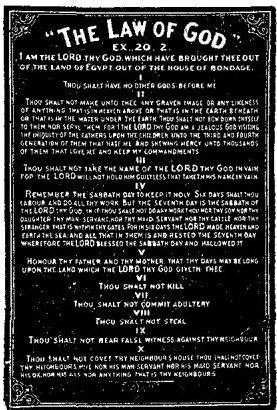
SOMETHING NEW, NEAT, NICE,
And necessary, if you would know, and have others know the COMPLETE DECALOGUE as God spake it from Sinai’s flaming summit.
A CHART 12x18 INCHES.
On thick paper, mounted at top and bottom with metal and ready to hang on the wall.
Postpaid, 25 Cents.
Postage stamps acceptable.
PACIFIC PRESS PUBLISHING CO., 39 Bond Street, New York.
MAP Illustrating the Travels of Paul.
Very useful for Sabbath Schools
Especially when studying the Book of Acts.
Clear and plain. Size 52x71 inches. Printed on cloth. Regular price, $5. We will send it to any address Postpaid for $4.
Order now and get the benefit of a splendid help in the Sabbath School or family.
Address, PACIFIC PRESS PUB. CO., 39 Bond St., New York.Oakland, Cal. Kansas City, Mo.
The House That Rum Built.
By The Happy Pilgrim
The alms-house.—This is the house that rum built.
The drunkard.—This is the man that lives in the house that rum built.
Appetite.—This is the chain that binds the man that lives in the house that rum built.
Intoxicating drink.—This is the serpent in flowery guise, with the artful tongue and dazzling eyes, that welds the chain that binds the man that lives in the house that rum built.
The rumseller.—This is the monster that holds the rein over the serpent in flowery guise, with the artful tongue and dazzling eyes, that welds the chain that binds the man that lives in the house that rum built.—The Happy Pilgrim.
Send for List of Excellent Books
SEND FOR LIST OF EXCELLENT BOOKS slightly damaged, offered at half price. Address, PACIFIC PRESS PUBLISHING CO., 39 Bond St., New York.
TO OUR PATRONS:
By Editor
Write names plainly.
Remit by P. O. Money Order, or Express Order, or by Bank Draft on New York. Personal checks are not desired.
Make all Orders and Drafts payable to Pacific Press Publishing Co., not to the editor or any other individual.
We will receive Postage Stamps in small quantities and any kind of good money. Defaced coins will not be taken. If paper money or coin is sent, register the letter.
Catarrh Inhaler Free.
Only One Person in Fifty Cured by old methods of treating Catarrh now everywhere condemned.
The new Scientific Catarrh Inhaler of Dr. Worst's mailed free to all readers of the AMERICAN SENTINEL.
CURES BY INHALATION
And is the latest and best up-to-date method for curing Catarrh, Asthma, Colds, Bronchitis, Sore Throat, Headache, and endorsed by all Physicians.
SPECIAL OFFER.
I will for a short time mail any reader naming the AMERICAN SENTINEL my new Inhaler with medicine for one year on three days' trial free.
If it gives satisfaction, send me $1.00, if not return it.
Send for it now. Address, Dr. E. J. Worst, Dept. 47, Ashland, Ohio.
The Gospel Primer.
A Book for the Children.
Contains 160 pages of matter, which will interest the old as well as the young. There are thirty-three full-page illustrations, which, in themselves, teach many gospel truths.
PRICE - - - - .25
Address this Office.
Steps to Christ.
In twelve chapters are presented in a simple and beautiful manner the steps by which a sinner may be made complete in Christ. It contains a wealth of counsel and encouragement for those who are laboring with the difficulties that beset a growing experience.
Price (Fleming Revell edition) . . . .75
NUT · BUTTER MILLS.
By Joseph Lambert
Something new. Designed especially for converting nuts into butter for table and culinary purposes. Valuable recipes for the use of nuts. Shelled and unshelled nuts of all kinds at reasonable prices. Send for descriptive circular and price list.