Your ShelfYour Projects

Signs of the Times, Vol. 30, No. 22.

THE SOWING AND THE REAPING
Earlier text: THE IMPURE VISION

"LIVABLE."

"Yes," said Mrs. Farren, decidedly, "Milly Morris is a nice girl clear through, and if anybody ought to get along easy with a tryin' mother-in-law, she ought. A more livable person I never knew."
"Livable?" repeated her listener. "Livable? That must be a local word. I don't think I ever heard it before."
"It may be local," rejoined Mrs. Farren, a trifle loftily, "and it may be bad, and it may be good; but anyhow it's just what I mean. Milly's livable. She's been brought up in a big family, and she's had to be, if she meant to be comfortable herself and let other folks be comfortable too. There were more livable folks when I was a girl than there are now, and I think the big families had a good deal to do with it, tho of course not everything.
"There were plenty of people then who never got their corners worn down, no matter how many brothers and sisters they had; but even when they rasped, those days, they got along together after a fashion. Nowadays, land! sometimes it stumps me fair and square why the nice people I know in nice families can't seem to stand each other's little ways.
"O, I don't say it isn't so; when the doctors say they can't—and it generally ends in doctors—why, I suppose they truly can't. It's nerves, and nobody understands nerves unless the doctors, and I'm a long way from being sure that they do. But just you count up sometime the families where there's always one member mysteriously off visiting, and then the number of folks you know that separate when they'd naturally stay together, if only they could hit it off—lone sisters and only-surviving bachelor brothers, and mothers and only daughters, and all sorts of family remnants that ought to be each other's best comfort. But as soon as they try living together, one of 'em gets nervous prostration, or has hysteric spells, or is ordered off quick to travel somewhere where the climate doesn't agree with the other one. They're fond enough of each other, generally, and they aren't generally ugly-tempered; they just aren't livable.
"It can't be endured, always, and it can't be cured, sometimes; but I'm firm in believing it could be prevented most times. If, when folks first began to harden in their own little crankums and fret over the cranks of the folks they care most for, they'd stop and think of what they were doing and where they were getting to, why, ninety-nine times out of a hundred they'd pull up in time, and get their nerves and feelings and foolish frettings tight in hand before they run away with 'em!
"Yes, that's what I surely do believe. And outside the great, big, deep foundation virtues, if I had a daughter, the little virtue, if it is a little virtue, I'd rather have her have than any other would be just that, being livable. It's an all-round, lifelong blessing to whomsoever it concerns."
"It may be good or it may be bad or it may be local," assented the listener thoughtfully, "but whatever it is as a word, livable is a good thing to be. I'll own that."—Youth's Companion.

LIFE IN HOT WATER.

THE highest temperature at which a living organism can exist is probably 89° Centigrade, or 193° F. This is the temperature of hot springs, in which filamentous micro-organisms have been found by Professor W. A. Setchell. He searched carefully for life in the geysers of Sonoma County, California, which are still hotter, but was unsuccessful. The limits of life in water containing silica are considerably lower, and they are lower still in water containing lime. No organisms were found in acid waters, and all the strictly thermal organisms are of very low grade. The cell structure is peculiar, and the protoplasm must be different from the ordinary kind, for that would be coagulated by the heat. The exact nature of this difference, however, is yet undiscovered.—Success.

NEW SACRED SONGS AND HYMNS.

BY LLEWELLYN A. MORRISON.
With Appropriate High-class Musical Settings.

SACRED SONG.

His Way. Over the Journey. O Happy Day! The Pearly Gates and Golden.
All six-page songs, suitable for home, concert, or church. SPECIAL PRICE, Two Copies, 25 Cents.

HYMNS.

Follow Me. My Advocate. What Is Love? A Morning Hymn. Peace Be unto You. The Love Unfailing. A Guest of the King. The Comforting Christ. The Spirit-fill'd Life. The Way Is So Delightful. In Love's Divine Confiding. Good-night.
These hymns all have special musical settings. Single page sheets, with music and words. Heavy toned paper. Regular Price, 5 Cents Each. SPECIAL PRICE, 30 Cents Per Dozen.

HOME SONGS.

My Mother. I-re-ne (A baby love song).
These songs are great favorites. Regular Price, 50 Cents Each. SPECIAL PRICE, TWO for 25 Cents.
By Mail, Post-paid.
LLEWELLYN A. MORRISON. 106 Shuter St. Toronto, Can.

Pure Olive Oil

Pure Olive Oil at $2.25 per gallon. Satisfaction guaranteed. Manufactured by A. E. Crist, Kelseyville, Lake Co., Cal.

THE OUTLOOK IN PERSIA.

[By Rev. Benjamin Labaree, D. D., Urumia, Persia, missionary of the American Presbyterian Church (North).]
SINCE the first onset of the Russian excitement six years ago, which swept the greater part of the Nestorians of Urumia into nominal relations with the Greek Church, gathering in also not a few from our Presbyterian fold, our churches have seemed as if benumbed in their spiritual life. Happily there seems to be coming a change for the better. The withdrawal of the Russian mission, probably only for a time, has given our pastors and people fresh courage and some larger freedom of action. A turn in the tide of popular interest toward the evangelical faith is quite apparent. In many villages faces once familiar in our congregations, but now absent for months, are reappearing. The old desire to hear the Gospel, as preached from our pulpits and taught in our Sunday-schools, is reviving. "What brought you back?" was asked of some young men, heads of families, in one of our congregations. They replied, "We have never been able to get rid of the convictions we received in our boyhood while attending the mission schools." Messages are coming, too, from villages wholly Russian in name, "Come and preach to us."
A number of churches have held revival services since the week of prayer, some with and some without missionary aid. As a rule, they have been attended by large numbers, and many, we hope, have found the Saviour. But there has not been the general and deep spiritual awakening that we have known in some former years.
The Syrian (Nestorian) nation is a small one, and, as a Christian nation, has suffered much at the hands of Islam. But it is likely to have an influence on the future of Persia beyond its numerical standing. Intelligence is spreading in the community; a new sense of inherent capacities for higher duties and responsibilities animates the thoughtful classes; poverty is giving way to more prosperous conditions; eagerness for education is growing rapidly; and there is an increasing number of our Christian men and women engaged in missionary efforts for the non-Christian populations.
Probably in the eyes of the great Moslem population around us no branch of our missionary work stands so high in honor as the medical institutions—
hospital, dispensaries, medical students, and graduates, with the revered physician-in-chief at their head. From a scientific standpoint many interesting facts and signal results might be given, but its moral and spiritual influence is its highest honor from the missionary point of view. Religious services on Sunday in two languages and daily evening prayers, which the patients able to do so, are expected to attend, emphasize not alone the purposes of the institution, but also its dependence on the divine blessing for its highest success. Our physician reports that in his private practise among the nobility he has found an increasing disposition to religious inquiry, which has led to many important conversations.
A prominent Moslem ecclesiastic was seriously ill last winter. Sending for our missionary physician, he urged him to say frankly what were the prospects for his recovery. When informed that he could not hope to live many weeks, he was deeply agitated. Being asked why the thought of death should trouble him so greatly if his entrance into Paradise was assured through his Moslem creed, he replied that there was the trouble; he could not be sure of what was before him at the judgment-seat of God. The Christian's confident and joyous hope was tenderly explained to the dying mollah, and he remarked that with such a hope death would be a very different matter.

IN GERMAN EAST AFRICA.

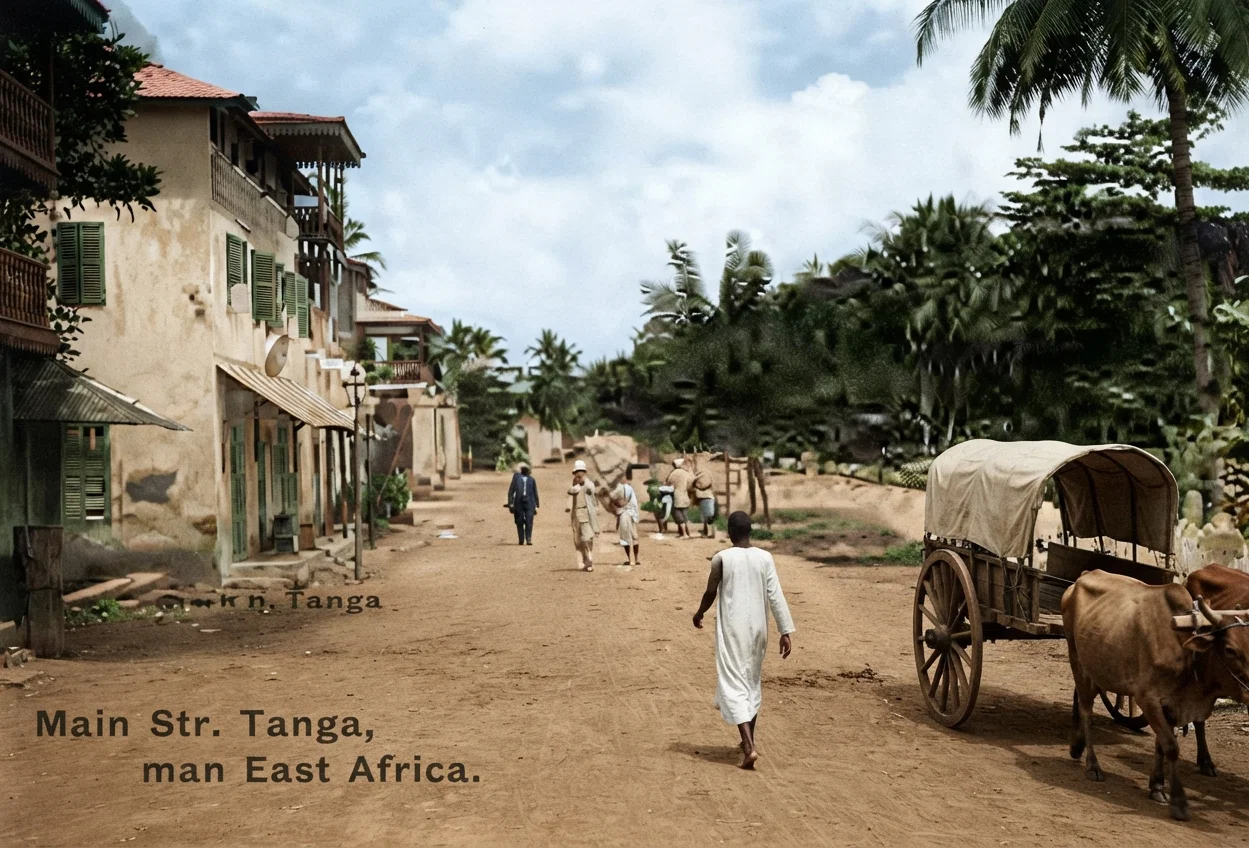
A CARD from Brother L. R. Conradi, dated Tanga, March 29, 1904, says: "Our party of five reached this port Sunday [the 27th] early. Our two missionaries met us. We are all in good health and spirits. We leave to-morrow for our station, 150 miles inland, of which 50 is by rail, 100 on foot."
At the General Conference one year ago in April, Brother Conradi, as president of the German Union Conference, told us about his efforts to open a mission in that field, and how he was providentially assisted. When he went to the colonial office, he incidentally told an official that our people had a sanitarium in Samoa, a German colony in the South Pacific Ocean. It so happened that this official had been to Samoa, and was favorably impressed with our work there. Thus one small institution in a small, isolated colony in the South Pacific was destined to work an influence for the furtherance of a like good work in east Africa, bordering the Indian Ocean.
Main Street in Tanga, German East Africa.
While in search of information about the country, Brother Conradi had been warned not to go to the head of the Lutheran Mission, as he was much opposed to us. But on going into a bookstore in quest of some descriptive work, and telling his object, the gentleman he spoke to said: "The head of our Lutheran Mission would surely be pleased to see you. I will take you to him." On being presented to that official, instead of meeting opposition, he was greeted very pleasantly. The gentleman said: "You want to go to east Africa? If you go to that country, there are lots of Catholic missions, and free territory. If you go there, God bless you." Then the gentleman took him to the bookkeeper to procure information about the cost of the journey and other expenses, and offered to give further information when desired, giving as a parting word, "God bless you in your work."
Some time later Brother Conradi went to the colonial office again. On meeting the official first mentioned, that gentleman said: "I am so glad to meet you again; I wanted to write to you and tell you that the governor of east Africa has arrived. I told him about your work, and he wants to see you." On receiving a letter of introduction, he called on the governor at his hotel. On presenting his letter, the governor said: "Mr. Conradi, I am glad to meet you. The mission work of your people has been highly recommended to us, and I can but say, I welcome you to east Africa."
Thus the good providence of God opened the way for the mission work which, from a small beginning, bids fair to be a successful medium in the salvation of the heathen. Surely that for which the Lord has procured so favorable an opening can not fail of His continual blessing if the opportunity be faithfully improved. We expect to hear further good news from German east Africa.

THE OPPORTUNITY OF PROTESTANTISM.

THAT the Church of Rome will again dominate the world is a matter of prophecy (see Revelation 13), and the present trend is conspicuously that way. But there are occasional uprisings of opposition which show that the Spirit of the Lord is still striving to win souls—to pluck them, as it were, as brands from the eternal burning. The Christian Work tells of a revival near ancient Pæstum, in southern Italy:—
It appears that a young Italian immigrant about three years ago entered the Methodist Italian Church in this city [New York], heard the Gospel for the first time, and was soundly converted. Two years ago he returned to Italy, and on the scene of his old home commenced to sow the truths of the Gospel. He was despised by his neighbors because of his Protestant heresies, but he persisted in telling the story of salvation through Christ Jesus alone. Interest was gradually awakened, a Protestant pastor was sent for, and large numbers attended his preaching. The whole town was stirred and the better classes especially supported the movement. Naturally, the parish priest took alarm, invoked the aid of the higher authorities, and a "contradictory" meeting was held between the young Protestant minister and a church dignitary. The people found the teachings of the Protestant conclusive, and uttered prolonged cries, "Long live the Gospel!" In view of the opposition of the church authorities, the mayor, who until then had favored the movement, begged the young minister to leave. This he declined to do, urging his rights as an Italian citizen. The revival continues to grow, and is spreading to other towns. It is now proposed to build a church. A lot has been given and a part of the money subscribed.
If such efforts could only be carried to the full meaning of Protestantism, those who fall in line with them would have an anchor that would secure them against falling back into the lap of Rome when the eventual pressure shall come against them. But unless they do go forward to the keeping of "the commandments of God, and the faith of Jesus" (Rev. 14:12), they will surely be overcome when the test comes as to receiving the "mark of the beast." There are many people in the Old World who are opposed to the political rule of the Papacy; but, failing to "put on the whole armor of God" in their opposition, they will eventually fail. Even the governments of Italy and France, notwithstanding their hostility to the church's political influence, will yet, as Germany is doing, find it politically expedient to recant. Just so it will be with those professed Protestants who do not accept the full Gospel, and "contend for the faith once delivered to the saints;" they will not be able to stand when the political reaction comes, and the governments begin once more to enforce the dictum of the church. Now is the time for true Protestantism to step into the breach while there is a tendency away from Rome. The favorable opportunity will not be for long.
The present opportunity in Italy is emphasized by a note from Rev. Alexander Robertson, D.D., of Venice, in the Missionary Review:—
Italy is a Roman Catholic country only in name. The churches are almost empty of worshipers and are filled with sightseers; the priests outside of Rome are comparatively few in number, and are men of the lowest appearance—even outwardly dirty and repulsive. There is entire lack of reverence for the Roman Catholic Church. Even the pope is not particularly esteemed. One cause of this is political. Italians are intensely patriotic, and see that the church is the enemy of their country. Another cause is ethical; they see that the influence of the church is on the side of immorality. Another is commercial; the chief effort of the church seems to be to extract money from the people. Italian thinkers are accustomed to contrast Roman Catholicism and Christianity, and to hope for the coming of a day when Christianity will destroy it.
As noted before, however, these objections will all yield to the political reaction, excepting on the part of those who are grounded in "the commandments of God, and the faith of Jesus." As the young republic of the United States gave an impetus to religious liberty in the Old World, so our present yielding to the political influences of Catholicism will be the precursor of like reaction in Italy and other European states. And this return to Rome is being so accentuated in Germany, and even in the Church of England, that the tide will not be long in turning in those states that have always professed allegiance to the Catholic faith.

WAITING.

THEY are waiting everywhere— Where the fields of earth are fair, Where the rivers nobly run, Where the blossoms seek the sun, Where the hills rise high and grand, Looking proudly o'er the land— Waiting! Waiting!
They are waiting in the wild, Sick and weary and defiled, And the Saviour's healing word They have never, never heard; Ever hungry and unfed, Left without the living bread— Waiting! Waiting!
For the happy beam of day That shall chase their gloom away, For the news, so glad and blest, That shall set their hearts at rest, For the peace we know and prize, And the hope beyond the skies— Waiting! Waiting!
For their cry to heaven hath flown, Yet not voiceless nor alone, And the Master waiteth, too, Waiteth, ransomed souls, for you, Till the life devotion sweet Be outpoured at His feet— Waiting! Waiting! —S. G. Stock.

OUR WORK AND WORKERS.

THE Iowa general camp-meeting will be held at Colfax, June 2-12.
THE brethren at Muncie, Ind., are preparing to build a house of worship.
THREE persons were baptized in Indianapolis, Ind., May 1, by Brother C. J. Buhalts.
SEVEN candidates were baptized at Unionville, Ind., recently, by Brother J. C. Harris.
EIGHT candidates were baptized at Farmington, Ill., on the 1st inst., by Brother N. G. Huffman.
A CHURCH of twelve members was organized on the 8th inst., at Richmond, Ind., by Brethren W. J. Stone and W. D. Curtis.
IN connection with a five days' general meeting at Hawkeye, Iowa, beginning April 27, nine members were added to the church.
ON the 7th inst. thirteen members were added to the church at Mount Vernon, Ohio; eleven were by baptism, one on profession, and one by letter.
THE workers' began preparing the ground for the Northern California camp-meeting on the 17th inst. The meeting will be held at Bushrod Park in this city, June 1-12.
FROM the Mexican Field we learn that Brother H. H. Brand, of Healdsburg, Cal., is on a visit to Mexico, looking for a suitable locality for a colony of Seventh-day Adventists.
A REPORT to the Mission Board from Brother N. Z. Town, of Argentina, South America, tells of the baptism of seven converts at Navarro. They were all Catholics, addicted to wine, tobacco, tea, and coffee—all of which they promptly gave up. The report also notes that Brother Juan McCarthy had organized a church of fourteen members further north, and in another place eighteen had accepted the truth, together with isolated families and individuals.
IN many ways the importance of circulating our literature is attested. It often bears fruit where least expected. Writing to the Workers' Record, Brother G. Phillips tells this incident: "A family moved into a house that had just been vacated, and they found a 'Bible Readings' with the back torn off. The lady told one of our sisters that when she wanted to hear a good sermon preached from the Bible, she took the good old book and read a chapter from it, as it was so much better than what she heard in the popular churches."
A NEW pamphlet in the Japanese language has been issued by Brother S. Chujo, of 1627 Sutter Street, San Francisco, Cal. The title is, "The Great Day of the Lord," and the subject is treated under twenty-three correlative topics, making as many chapters. The scope of the work is quite comprehensive of the faith, filling 184 pages, ten of which are full-page illustrations. Price, 10 cents. It ought to be circulated widely amongst our Japanese population at home, as also in Japan. Address orders to California Tract Society, 306 San Pablo Avenue, Oakland, Cal.
IN the Mexican Field, a little paper issued by our mission in Mexico City, we find this item: "Since last September we have worked to get our printing plant established, and the Lord has signally prospered us in this work. A small outfit has been bought, a lot in a beautiful location has been secured, and we are now engaged in erecting a neat little building, which will serve as a printing office and depository." A paper entitled El Mensajero de la Verdad is printed in Spanish for missionary work, and is doing good. The Mexican Field further says: "The Bond brothers, who are working in Sabadell, Spain, use El Mensajero and tracts printed at our office. These brethren are meeting with encouraging success in their work, and we are glad to know that Brother Wilson, who has a knowledge of the Spanish language, has gone from England to join them."
BROTHER E. W. FARNSWORTH and wife arrived in San Francisco, from Australia, on the 16th inst. They had expected to come by the northern route, but on arriving at Honolulu found the plans changed. They report the work in an encouraging condition in the Australian field. On the voyage they sold nine copies of "Christ's Object Lessons" to persons on the steamer, and gave one to the library. They have a great burden for the extension of our book work, and the circulation of our periodicals. They took the train in this city for Berrien Springs, Mich., on the 19 inst., after visiting Mrs. Farnsworth's brothers, Professors M. E. and U. C. Cady, at Healdsburg, and making a short stay in this city. Their destination is London, Eng., after attending some of the camp-meetings in this country. They have had a varied experience of eight years in New Zealand and Australia.

WANTED FOR MISSIONARY WORK.

(Always prepay postage.)
ONE or more copies of the old pamphlet, “The Vindication of the True Sabbath,” by Elder J. W. Morton. Address, Wm. C. Hopkins, Bishop, Cal.

Persistence Rewarded

Persistence Rewarded.—The American Baptist Mission in the Congo Free State reports the establishment of a new station through the persistent efforts of a native evangelist. When Miesi, our evangelist, began his work in Kingombe two years ago, the people tore down the house he bought, and, when he gathered material to build a new one, they stole his thatch grass, but he continued to work and the blessing came. They have now built their own meeting place, that can hold about 250 people, and it is decided to organize a church. Of the fifty candidates for baptism examined, only thirty-three were approved at the time. The rest were advised to wait a little. Sunday morning early we gathered for prayer, and before we had finished the house was nearly full of people. A church was formed with pastor and deacons. Then the candidates for baptism were received. They were of all ages, from ten to sixty years, the man who was the leader in destroying the evangelist’s house being among them. The church was able to begin its work with seventy members, and the evangelist reports that forty more have professed conversion.—Rev. P. Frederickson.

THE LORD AS A PARTNER.

SAID a brother to me a short time ago: "We raised the best crop of Irish potatoes last year we ever raised in our lives, and I'll tell you why. When we planted them we counted the rows and set apart the tenth as tithe. In the fall we dug and sold them at a good price."
Said the brother: "We used from the nine-tenths all summer, and when we dug them in the fall we were surprised to find such a large yield. The neighbors told us they would rot, and that we had better sell them, but we decided to keep them, and did so. Out of twenty bushels we lost none."
This brother will this year tithe his whole crop in the same way. Out of sixty acres of wheat six acres will be set apart as tithe. The same plan will be followed with his large crop of cotton and corn; and who that knows the Lord can doubt the result? Taking the Lord in as partner in his farming business he claims His protection. Brethren, is it not time for all of God's people thus to show their faith in the Lord their God and be protected by His mighty power from the pests and pestilences that are already abroad in the land? The Lord is ready to do His part. Are you ready to do yours? O brethren, why should the world say any longer, "Where is their God?"—W. W. Eastman, in Southwestern Union Record.

Missionary Activity and Church Health

The best stimulant for church work is missionary activity. A church which takes no interest in missions is a church in the last stage of consumption.—My Poon Chew, editor Chinese Daily World, San Francisco.

A CHINESE SCHOOL.

BROTHER WM. COVERT, president of Wisconsin Conference, gives to the Reporter a private letter from Sister Ida Thompson, a missionary in China, from which we take the following interesting sketch:—
I live in a Chinese house, with no modern improvements whatever. There are five rooms down stairs, and four on the second floor. The school occupies the best room on the ground floor, the Chinese teacher one room, one is used as a Chinese reception room, and one for a cook-house.
We have no yard of any sort. The clothes must be dried on the roof. All water must be carried in large wooden buckets on the backs of coolies. The drinking water is carried from the mountains, several miles distant. For this we must pay five cents gold per trip—two pails full. The water for cleaning purposes must be carried from the river. This is cheaper—about twelve trips for five cents gold. But you see we can not say, "As free as water," in this city. There are no waterworks here at all. It makes a lot of trouble to carry in and out all the water used, but there is no remedy here in Canton. I guess you would think it strange to save water in jars, and be careful not to waste any. It seems so to us, also; but daily doing drives the strangeness away.
Our school opened March 17, 1904, with seventeen girls, but has increased to twenty-one, with a promise to admit three more. This is all the room we have at present, and so we have closed our doors to others. Perhaps you know that the custom in Chinese schools is to study aloud as well as to recite aloud. All this goes on in one room at one time. It is rather hard on us to get used to such a racket, but I do not mind it so much now. Sabbath, we had twenty-five at our Chinese Sabbath-school, which began at 10 A. M., and closed at 12 M. They gave good attention to what was said, and did not seem tired when the time was up.
There are some very bright faces in my school. School hours are as follows: 7 to 9, 10 to 12 A. M.; 1 to 4 P. M. I guess, if the little tots at home were pushed off to school as early as this, they would think it strange. You see, they get up, and come without breakfast. At 9 A. M. they return home, and eat their rice and a bit of fish or pork, or perhaps a little green relish. At noon the meal consists of a drink of tea; and many have nothing until 5 P. M., when such a lot of rice as they sit down to would almost frighten a Westerner. As the little girls came into school the first day, many brought ten or twenty cents (Mexican) wrapped in a bright red paper, which they presented to the teacher or to me; also some Chinese cakes and pieces of sugar-cane, about five inches long. There were gifts of gratitude. One may take them, thank the donor, and then return one-half or all, as he chooses; or keep all, and be considered polite.

CAMP-GROUND NOTICE.

ALL persons coming to the camp-meeting at Oakland, Cal., should bring their baggage checks with them to the camp ground and hand them to our baggage-man there. Reduced rates for transfer to and from the grounds have been secured from one express company only.
Those coming by way of San Francisco should re-check their baggage on their ten-cent ferry ticket across the bay to Sixteenth St. Station, Oakland. Baggage will be transferred from all local stations in Oakland.
To reach Bushrod Park, on Sixty-third St., take any electric car, and transfer to the Telegraph Ave. cars, on Broadway.
G. W. MILLS, A. L. LINGLE, Camp-meeting Com.

NORTH DAKOTA CAMP-MEETINGS.

THE second annual camp-meeting and conference of the Seventh-day Adventists of North Dakota will be held at Harvey, June 20-27, preceded by a workers' meeting commencing on the 15th. The conference will convene on Tuesday, June 21, at 9 A.M. We earnestly desire that this meeting be fully attended by the brethren of North Dakota. Reduced rates on the certificate plan have been obtained.
For the benefit of those in the southeastern and northeastern parts of the state, camp-meetings will be held at Hankinson, June 29 to July 4, and at Devil's Lake, July 6-11. We hope all our brethren living in those parts of the state will take advantage of this precious opportunity to seek the Lord with His people.
J. G. WALKER.
INTERNATIONAL SERIES THE SUNDAY SCHOOL

LESSON II.—JUNE 12.—CHRIST CRUCIFIED.

Lesson Scripture, Mark 15: 22-39, A. R. V.
(22) "And they bring Him unto the place Golgotha, which is, being interpreted, The place of a skull. (23) And they offered Him wine mingled with myrrh: but He received it not. (24) And they crucify Him, and part His garments among them, casting lots upon them, what each should take. (25) And it was the third hour, and they crucified Him. (26) And the superscription of His accusation was written over, THE KING OF THE JEWS. (27) And with Him they crucified two robbers; one on His right hand, and one on His left. (29) And they that passed by railed on Him, wagging their heads, and saying, Ha! Thou that destroyest the temple, and buildest it in three days, (30) save Thyself, and come down from the cross. (31) In like manner also the chief priests mocking Him among themselves with the scribes said, He saved others; Himself He can not save. (32) Let the Christ, the King of Israel, now come down from the cross, that we may see and believe. And they that were crucified with Him reproached Him.
(33) "And when the sixth hour was come, there was darkness over the whole land until the ninth hour. (34) And at the ninth hour Jesus cried with a loud voice, Eloi, Eloi, lama sabachthani? which is, being interpreted, My God, My God, why hast Thou forsaken Me? (35) And some of them that stood by, when they heard it, said, Behold, He calleth Elijah. (36) And one ran, and filling a sponge full of vinegar, put it on a reed, and gave Him to drink, saying, Let be; let us see whether Elijah cometh to take Him down. (37) And Jesus uttered a loud voice, and gave up the ghost. (38) And the veil of the temple was rent in two from the top to the bottom. (39) And when the centurion, who stood by over against Him, saw that He so gave up the ghost, he said, Truly this man was the Son of God."
Golden Text.—"Christ died for our sins according to the Scriptures." 1 Cor. 15: 3.

SUGGESTIVE QUESTIONS.

(1) After the trial before Pilate, where was Jesus taken? Verse 22. Note 1. (2) On arriving there what was offered to Him? How did He regard the offering? Verse 23. Note 2. (3) What then was done to Him? What did the soldiers do with His garments? Verse 24. Note 3. (4) What hour of the day was Jesus crucified? Verse 25. (5) What superscription was written over Him? Verse 26. (6) Who were crucified with Him? In what position? Verse 27. Note 4. (7) In what manner was Jesus treated while on the cross? What did they say to Him? Verses 29, 30. (8) What did the chief priests and scribes say to Him? Verse 31. Note 5. (9) What further insult did they offer? What did His fellow-prisoners say? Verse 32. Note 6. (10) What occurred at the sixth hour? Verse 33. (11) And at the ninth hour? Verse 34. (12) What did some of the people say when they heard this? Verse 35. Note 7. (13) What did one of them do? What did he say, as he did this? Verse 36. (14) Then what occurred? Verse 37. (15) What then took place in the temple? Verse 38. Note 8. (15) What did the centurion say when he saw that Jesus was dead? Verse 39. Note 9.

NOTES.

1. The mental and physical ordeal of the preceding night and the morning of the crucifixion are impossible of realization by the ordinary mind. Yet amidst it all, Jesus sorrowed not for Himself, but for those who were rejecting their only Saviour from sin. The whole proceeding, however, is to close with a capital execution, the most cruel that satanic ingenuity could devise. It was designed to be not only the most cruel but the most shameful of all punishments.
2. Lightfoot, an eminent English commentator, says: "It was a kindly custom of the Jewish ladies to give to those who were being crucified a stupefying draught of wine, mingled with a powerful narcotic drug, bitter, but offered as an anesthetic to stupefy and dull the sense of pain." But Jesus refused it, as He was to drink the dregs of suffering for sin. As the wrath of God is to be "poured out without mixture" upon those who receive the "mark of the beast" in the last days of human probation (Rev. 14: 9-11), so our self-denying Lord patiently accepted the full consequence of the penalty imposed upon Him by the minions of His adversary.
3. The division of the garments of Jesus shows how the prophetic Word is always fulfilled to the smallest detail. Thus is shown the full and accurate foreknowledge of God. "Thy Word is true from the beginning; and every one of Thy righteous judgments endureth forever." Ps. 119: 160.
4. In the Common Version there is added here, verse 28: "And the scripture was fulfilled, which saith, And He was numbered with the transgressors."
5. A great truth was unwittingly expressed when the revilers of Christ said, "He saved others; Himself He can not save." Had He saved Himself, He could not have saved others. It was by the sacrifice of Himself that He was enabled to save others. Heb. 9: 22, 26; 1 Peter 1: 18, 19; Rev. 5: 9
6. The Lord does not permit sinners to make their own terms of believing. Men who will not believe in Christ on His conditions, would not believe under any circumstances, even if their own conditions were met. This is illustrated in the parable of the rich man and Lazarus. Luke 16: 30, 31. The Jews had before asked signs of Him when He was giving them signs that would have convinced any one at all susceptible to the truth. The Word, and not signs, is the crowning evidence set before us.
7. The people evidently misunderstood the words of Christ, as is quite common with those who do not believe. A remarkable instance of misunderstanding the Word of the Lord is given in John 12: 28, 29. Jesus had addressed His Father, saying, "Father, glorify Thy name," and a voice from heaven replied, "I have both glorified it, and will glorify it again." The people heard the voice, and some of them said that it thundered.
8. The rending of the veil in the temple indicated the close of the typical service in the earthly tabernacle. All the types had met their Antitype. The time had come, of which Jesus had said, "Behold your house is left unto you desolate." Matt. 23: 38. The way into the heavenly sanctuary was now to be opened, "Christ having come a high priest of the good things to come, through the greater and more perfect tabernacle."
9. "Truly this man was the Son of God."—This was the best that the poor heathen captain could say, with his limited understanding, while the yet faithless disciples were silent; and a fellow prisoner, still hanging on a cross, had been alone in a full confession of the stricken Saviour. Luke 23: 39-43. In all His bitter experience, from Gethsemane to the cross, Jesus had verily trodden the winepress alone, and there was none of the people with Him. Isa. 63: 3.
Continue reading: LESSON XI.—THE EARLY ADVENT MOVEMENT