The Youth’s Instructor, Vol. 35, No. 2.

JOHN BUNYAN

The Youth’s Instructor

Jan 12, 1887

S. D. A. Publishing Association · Battle Creek, Mich. · Jan 12, 1887

JOHN BUNYAN.
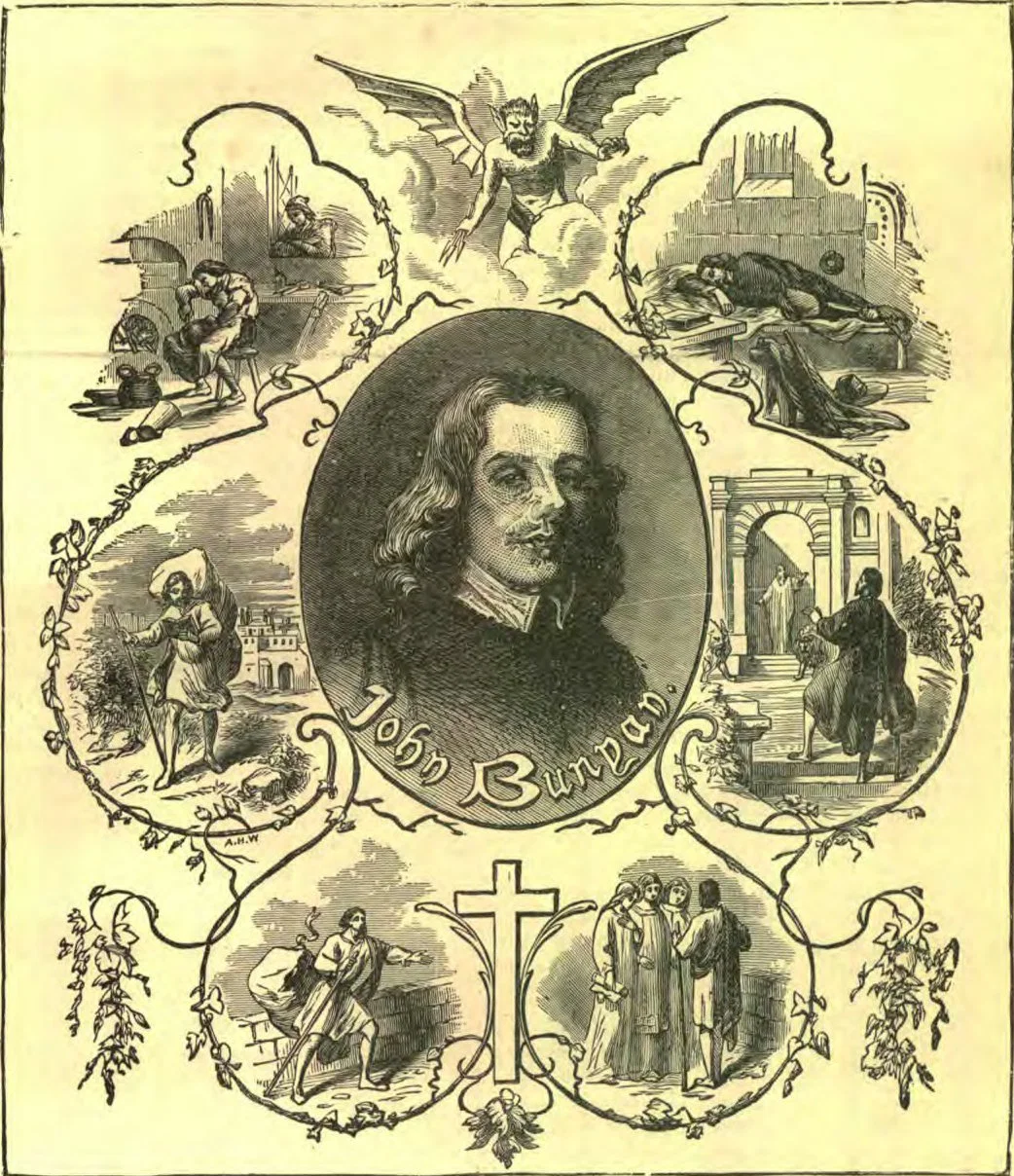
Over two hundred years ago there lived in England a good man by the name of John Bunyan. He was a very poor and unlearned man, yet he did so much good that his name is better known to this day than that of many who were counted famous in his time. Bunyan was a tinker by trade. The center piece of our engraving gives a picture of him, and up in the left-hand corner you may see him at work at his trade, mending some old kettles. The tinkers were a low class in those days, roving around the country from place to place, wherever they could find work. They were often classed with the gypsies. But Bunyan seems to have been better off than most tinkers, for he had a home. He was so very poor that when he was married neither he nor his wife had so much as a dish or a spoon between them. But she brought with her two books, “The Plain Man’s Pathway to Heaven,” and “The Practice of Piety,” that in the end proved to be of more worth to him than almost any other dowry she might have brought; for his mind, already inclined toward religion, was set, by reading these books, to earnestly seeking the way of life.
Now he began to preach to his neighbors and to all whom he could get to listen. But though he preached what he thought was true, it didn’t happen to be what most people at that time believed; and as it was not allowable for a man to speak his mind freely on matters of religion, it came to pass that the authorities shut John Bunyan up in jail. He was in great distress at this turn of affairs, for he did not know what his family would do now that he could not do any more tinkering. At length he bethought him to learn to make tagged laces, which he sold to hawkers for barely enough to keep his wife and four children alive. For twelve years he was kept in jail, at first guarded closely, but afterwards allowed more freedom.
In the quiet of his prison he had a good chance to study his Bible and think of serious things. By and by he began to write out what he had been thinking. He told what he had to say in homely English, but it so took hold of the hearts and imagination of the people that his books are much read even at the present day. The book people are now most familiar with is called “The Pilgrim’s Progress.” This was begun while Bunyan was in jail. In our picture the artist has given several scenes from this book, and I shall tell you a little about the story, in the hope that if you have never read the book, you will do so as soon as you can.
Bunyan imagines that he has a dream, in which he sees a pilgrim setting out from the City of Destruction, with so great a load on his back that he can hardly walk under it. The man’s name is Christian, and he has set out on a pilgrim’s journey toward the Celestial City. He falls into a great many mishaps. At one spot on the road he comes to a place somewhat ascending, whereon stands a cross, at the sight of which Christian’s burden rolls off his back down the hill, and is seen no more. Then while he is wondering that the sight of the cross with the bleeding One hanging thereon should so ease him of his burden, three shining ones meet him, and give him new apparel and a written roll that he is to read when he desires consolation on his journey. Further on he comes to the top of a hill called Difficulty, where he finds a house built by the Lord of the way for the refreshment of pilgrims; but before he can enter the house he has to pass through the porter’s lodge between two chained lions. At the door, four beautiful ladies make him welcome, and on his departure equip him with a suit of armor. His path next lies through the Valley of Humiliation, where he meets a terrible dragon, Apollyon, and, after a desperate struggle, gets the better of him. By and by he falls into the clutches of a grim giant called Despair, who thrusts Christian into a dark dungeon, and cudgels him so soundly that he well-nigh despairs of his life. But escaping from the giant’s toils, he pursues his journey, crosses a deep, dark river, whose waters threaten to engulf him, and at last reaches the Celestial City, a place most glorious to behold, where the king of the country bids him welcome to its delights forevermore.
This is in brief the story; of course Bunyan did not write it simply for the sake of the story. He hoped that by making use of the imagination of his readers, he might more strongly impress on their minds the truths he wished to talk about, for the story most fitly represents the Christian life. No one knew better than Bunyan how to portray the hard struggles with Despair in Doubting Castle; for he had been driven almost to frenzy by the old giant himself. Bunyan believed in the doctrine of hell fire, and so strongly was his sensitive nature stirred by it that he thought he never could be saved. For a long while he fancied he heard hobgoblins shouting in his ears, “Sell him! sell him!” and he was afraid he had committed such a sin as Judas did, and had betrayed his Lord. But after a time his mind grew calmer, and he was able to enjoy religion.
Bunyan lived to be sixty years old. His place in society after he came out of prison was very different from that in which he had formerly moved. His book had made him many admirers, and he was now familiarly known among the Baptists as Bishop Bunyan. He could travel freely from place to place, preaching his doctrines, and laboring for the welfare of his hearers. It was in the year 1688 that he went on a journey to reconcile a father and his son, prevailing on the old man not to disinherit the younger one; but this labor of love cost Bunyan his life. He had to ride through a heavy rain, and became so thoroughly drenched that a fever shortly set in and terminated his life. He lies buried in Bunhill Fields, near the grave of good Dr. Watts.
Many people try to make out that Bunyan was in his youth a very bad man, because he often calls himself the vilest of sinners; but this was only because the least things looked in his eyes large as mountains, and led him to cry that all his righteousness was as filthy rags when compared with the purity of Christ. The worst things he ever accused himself of were a fondness for dancing on the village green, and ringing the bells for chimes.
Everybody ought to become acquainted with John Bunyan through his “Pilgrim’s Progress;” and you ought to read it when you are children. I have heard a lady, who read it several times when she was a girl, say that it added half to her enjoyment of the book when she read it now, because she first read it when she was so little that she could understand nothing about it but the story. But whether it is the story that attracts you, or, as I hope, the good moral the book teaches, you must be sure to read the “Pilgrim’s Progress.”
W. E. L.

THE ANVIL OF GOD'S WORD.

LAST eve I paused beside a blacksmith's door, And heard the anvil ring the vesper chime; Then, looking in, I saw upon the floor Old hammers, worn with beating years of time. “How many anvils have you had,” said I, “To wear and batter all these hammers so?” “Just one,” he answered; then with twinkling eye, “The anvil wears the hammers out, you know.” And so I thought, the anvil of God's word For ages skeptic blows have beat upon; Yet, though the noise of Paine, Voltaire, was heard, The anvil is unworn, the hammers—gone.

AN OLD ROMAN CITY.

Nimes, in France, is such a very ancient city, having had an existence since the days of Christ, that I thought the readers of the INSTRUCTOR might be interested to learn something regarding it. There is nothing about the town itself that is especially interesting, unless it lies in the venerable appearance of the city and its narrow, crooked streets; but its varied history and the ruins it contains of by-gone centuries attract many tourists within its precincts. The city contains nearly one hundred thousand inhabitants, of whom one-fourth are Protestants, and the rest Catholics. The buildings are of stone, and are roofed with tile or slate. The streets are paved with round stones, and the teams make a great noise in passing over them.
The country around is comparatively level. No timber is visible, but olive orchards are numerous. The city is partially supplied with water from a large spring. The water is soft and comparatively pure, and it bubbles up from a distance of forty-five feet below the surface of the earth. When it rains, the stream increases according to the amount that falls. The water passes away in two directions, and then unites to form an island, on which grow trees and shrubbery. The spring is about seventy-five feet square, and is walled with cut stone, the foundation of which was placed there by the Romans. The water is conducted through the city by two walls, there forming a stream large enough to run a small mill. Across this stream are many stone bridges. This spring was a famous resort for the Romans, and stone baths are yet in existence, where they enjoyed a bath in its soft water. It is still a popular resort for the citizens, who spend their leisure hours under the shady elm and cottonwood trees.
Near the spring is an old temple of Diana, built long before the first advent of our Saviour. The roof was partially demolished by the Turks in the eighth century, when they made their successful raid through Europe, demolishing cities and tearing down idols. There are near this temple numerous ruins, indicating that this was once an important place for idol worship. In this temple are many gods and images. Near the building is a marble statue of the goddess Diana, a piece of workmanship that shows how skilled the Romans were in the art of sculpture. It is still in good preservation.
About one-fourth of a mile above the temple, on an elevated spot, stands a tower said to be built in honor of Hercules, and it bears the name of Babel. It is said to be the oldest structure in Nimes. It is two hundred and eighty-five feet in circumference, and it is nearly one hundred feet high, half its original height. There are winding stairs in the center, with one hundred and thirty stone steps. From its top an excellent view of the surrounding country can be obtained, and on a clear day you can see the Mediterranean Sea, twenty miles distant. From this tower the Romans used to signal to the surrounding country.
In the center of Nimes stands an immense arena. Its walls are seventy-five feet in height, and sixty feet thick at its base. It has two stories, with sixty openings in each story. There is one entrance, built of stone. There are catacombs underneath and in the walls. In these places of refuge the Turks once hid in the eighth century; but a French king burnt fagots to smoke them out, and many of the unfortunate men who had invaded the land thus lost their lives. The walls are still blackened by the effects of that fire. This structure will seat seventeen thousand persons, and it is claimed that sixty thousand persons can here find standing room. It was built in the reign of Adrian and Antonius, between the years A. D. 107 and 161. It is still used during the summer months for bull fights. These fights are attended with cruelty and great risk of life. The animal selected for the occasion is placed in the arena, and is tormented by the actors in the ring, who gore the animal with sharp instruments until the beast is maddened. Then the fight commences, and often men lose their lives in the affray. Thousands of people assemble to witness these cruel scenes. On the walls of the arena, about thirty-five feet above ground, can be seen a fig whose only sustenance is the nutriment drawn from the crevices in the rocks; and yet it seems to thrive, and produces figs twice a year.
Nimes has figured largely in persecuting the people of God, and not until lately has this persecution ceased. There is a well in the city full of the bones of the martyrs, and many other traces of persecution could be cited. Wm. Ings.

LIFE'S SUNNY SIDE.

CHOOSE for thy daily walk Life's sunny side, So shall all peace and joy With thee abide. If shadows o'er thee fall, Faith still can see The Father's smile through all— Sunshine to thee! Then always look above, Whate'er betide, And choose with heart of love, Life's sunny side.
—Companion.

OUTRAGES UPON OLD PEOPLE.

RESPECT for gray hairs is a sentiment which so harmonizes with the virtuous instincts of human nature, that it has been inculcated by every moralist and enjoined by almost every religion. Yet there are rough boys and thoughtless girls among us who see nothing in old age, except its want of power to defend itself against outrage.
Within sight of the window at which these lines are written lives an old man, who, in his life of eighty-eight years, has wronged no one, has benefited many, has reared sons and daughters, has faithfully done his part as man, citizen, and neighbor, until now, his work being finished, his children married and settled elsewhere, he lives almost alone in his old, old house, awaiting the end.
Because he is old and cannot run or strike, rude, ill-taught boys steal his fruit before his eyes, overrun his fields, pull the rails off his fences, throw down stones from his walls, and thus make bitter to him many of his days and evenings, which ought to be happy and serene. He dares not complain for fear of provoking the young savages to worse outrages.
An event occurred in New Jersey not long ago which brings to mind the case of this good old man. At North Bergen, in that State, lives Jacob Lambert, who is described as “a crusty old farmer.” His orchard is near a silk-mill, in which are employed a number of girls, who like to get apples for nothing, and who “have been making the old man’s life a burthen to him by stealing his fruit and jeering at him.”
He remonstrated, threatened, and pursued, but as the girls ran faster than he could, they only stole and jeered the more. He showed them an old gun, and threatened to “pepper them with buck-shot.” They laughed at his threats. At length, he fired both barrels at a riotous crowd of girls, and one of them fell bleeding to the ground, with so many buck-shot in her body that it took the doctor two hours to cut them out, and she came near dying of the shock and pain.
That this act on the part of the “crusty old farmer,” was wicked and cruel, no one will deny; he confessed as much himself by running away from the quest of the police. But what can be said of the provocation but that it was impious and shameful? The girls violated laws which have the sanction of all the ages, and of every virtuous mind that exists.
We strongly advise our young readers not to stand by in silence when they see an aged person treated with disrespect. Boys are terribly afraid of boys, and girls of girls. Some who care little for the public opinion of their school, care very much for the public opinion of their street. The other day, a boy not more than nine years of age put a stop to the ill-treatment of a crazy old woman by a crowd of boys. He simply said, “It’s mean to treat her so.” The boys felt that it was mean, and one by one desisted.—Youth’s Companion.

W. S. C

SEA TALES.—NO. 11.

A few days afterward a noble old brahma fowl belonging to the vessel committed suicide. He and his mates had been living continuously forward under the forecastle deck, near the chain lockers. The steward had that day let the fowls all out for an airing. This one had never before shown signs of despondency, and no reason for the rash act can be given. He had always been well fed and in comfortable quarters. Shortly after dinner he had been seen at the knight's heads, gazing absently into the sea, when suddenly, uttering a loud cry, he flew overboard. No doubt he repented the rash act as soon as he felt the chill of the cold water; but his repentance came too late. The captain got out his pistol and was going to shoot him and end his misery, but before he was ready, the bird had passed too far astern. We all felt sorry for the poor thing, yet we could not refrain from laughing while watching the maneuvers of the sea-birds. No sooner did they spy old chanticleer, than down beside him they all huddled, round and round in circles, the large birds inside, the gulls outside. After a little, a huge captain, as a white albatross is called, approached the rooster, and bobbing his head rapidly and repeatedly, seemed to be interviewing him, while the gulls and other birds drew closer, as though to listen to what was said. I hope the poor thing drowned quickly. No doubt the sea birds tore him to pieces as soon as he began to sink. It seemed hard to leave “old Tom” to his fate.
About 6:30 P. M. of the same day we heard for the first time on this passage, the welcome cry, “Sail, ho!” and passed a large ship bound for some port on the western coast of South America.
At 11:30 A. M. the man at the wheel sang out, “Land, ho! on the starboard bow;” and the north islands of Ramarez could be dimly discerned in the distance,—very faintly, as the weather was thick, with frequent rain squalls.
About noon a bark was sighted on our port bow, going with us, but under close-reefed top-sails. By three o'clock we had left her away astern, as we carried all sail up to two o'clock, when a single reef was put in the mainsail; at sundown the topgallant was in. The way we “lugged” sail that day was something frightful to look back upon. The captain told me that he had seldom abused a vessel so badly before, but he was anxious to pass the “Horn” before dark. The sea was simply immense; no conception of it could be formed by any combination of words. Our vessel, large as she was, would be way down, masts and all, below the level of the waves, as she sank into the trough of the sea. Terrible rain, snow, and hail squalls came every half hour, and burst upon us with shrieks like the yells of a horde of maniacs; while the sea broke over the brig from all directions as she lay down, rails under, the spars buckling to the strain, making the brig tremble and quiver, as she dipped her bow to the huge seas.
By two o'clock we were abreast the two north clusters of the Ramarez, and at half past five had passed the “Horn.” Cape Horn is the southern extremity of Terra del Fuego, or “the Land of Fire,” so called from the fact that, pass it during the day or night, one will see smoke in the day time and flame at night, in every direction, from the countless fires built by the natives.
The Hermite, or Cape Horn islands constitute the archipelago that forms the southern extremity of South America. They consist of one large island, four others of moderate size, and numerous smaller islands and rocks. The shores are intersected by deep, narrow arms of the sea, on the sides of which rise the mountains, the summits for the greater part of the year covered with snow, while their steep and rocky declivities are partially overgrown with evergreens. Down these declivities swarm the natives at the approach of vessels, and seek by false fires and signals to mislead captains and cause wrecks, hoping to feed upon the lifeless bodies afterwards cast upon the rocks. The natives are low in stature, and live in a filthy, barbarous condition, having no other covering than a scrap of green hide which is tied to their waists. They have no government, and the neighboring tribes, who speak different dialects, are almost always hostile. They are cannibals, and they never cultivate the soil, occupying only the shore, and living chiefly on such shell fish as they find among the rocks on the beach. When, as sometimes happens, heavy, continuous rains put out their fires, they do not know how to rekindle them, but assemble in a mass, and rush on the camp of some neighboring tribe and steal their camp-fires, with which they return and rekindle their own.

W. S. C

Governing Anger: Prevention Better Than Control

To rule one's anger is well; to prevent it is better.— Edwards.

PARABLES OF CHRIST.

LESSON 18.—THE TEN VIRGINS.

1. WERE the Scriptures originally written in chapters and verses as we now have them?—They were not.
2. Why were they so divided afterward?—For convenience of reference; that is, so that any passage could be easily found.
3. Is there necessarily any change of subject in going from one chapter to the next?—There is not.
4. How should the Bible be read in this respect?—We should read right on from one chapter to another, just as we would from one verse to another in the same chapter.
5. Of what had the Saviour been talking all through the twenty-fourth chapter of Matthew?—Of the time of the end.
6. With what word does the twenty-fifth chapter begin?
7. To what period of time would this naturally refer?—To the period just before the mind in the preceding chapter,—the time of the end.
8. What do we mean by “the time of the end”?—The years just preceding the second coming of Christ.
9. What work is going on in heaven at that time?—The cleansing of the sanctuary; or in other words, the work of the Investigative Judgment.
10. What is going on upon the earth at the same time?—The work of warning the world, and preparing the people of God for the coming of the Son of man in the clouds of heaven.
11. How is this work represented in the fourteenth chapter of Revelation?—By three successive messages of warning.
12. How is the same work represented in Luke 14: 15-24?
13. How is it represented in the first thirteen verses of the twenty-fifth chapter of Matthew?—By the parable of the ten virgins.
14. What did these virgins do? Matt. 25:1.
15. Into what classes were they divided? Verse 2.
16. What did each class do? Verses 3, 4.
17. During what period did they all take their rest? Verse 5.
18. What is typified by the going forth of all the virgins to meet their bridegroom, as represented in verse 1?—The giving of the first message.
19. What was proclaimed in that message? Rev. 14:7; 10:6.
20. What is meant by the tarrying of the bridegroom spoken of in Matt. 25:5?—That he did not come when expected in April 1843.
21. What is meant by the slumbering, or resting, period spoken of in the same verse?—The period of inactivity that followed the disappointment.
22. According to the parable, what was to take place at midnight? Matt. 25:6.
23. What does this midnight cry represent?—The second message.
24. What was proclaimed in that message? Rev. 14:8.
25. What did the virgins all do when the midnight cry was given? Matt. 25:7.
26. In what carelessness had the foolish virgins indulged? Verse 8.
27. What is meant by letting their lamps go out?—They had neglected to practice the graces of faith, love, and good works, and so the Spirit of God had ceased to enlighten their hearts.
28. What answer did they receive when they tried to borrow? Verse 9.
29. What took place while they went to buy oil to fill their lamps? Verse 10.
30. What is meant by the coming of the bridegroom spoken of in this verse?—The coming of Christ to his Father to receive the capital of his kingdom,—the New Jerusalem, called in Rev. 21:2, 9, “the bride, the Lamb’s wife.”
31. How is this ceremony described in prophecy? Dan. 7:13, 14.
32. What is meant by the shutting of the door?—When Christ, after finishing his work as priest in the most holy place, receives from his father his kingdom, his work as High Priest and Advocate is finished, and those who have not secured salvation will be forever shut out of the kingdom.
33. In the parable what does our Lord say to those who tried to enter after the door was shut? Matt. 25:11, 12.
34. What further proof have we that our Lord was still on the same subject that he was discussing in Matt. 24? Compare Matt. 25:13 with 24:42.

THE ATLANTIC OCEAN BED.

HAVE YOU NOT SOMETIMES WISHED YOU COULD LOOK into the great ocean bed, and see all the wonderful things there hidden? That you can never do; but man, by exploring some portions of it, has revealed many interesting facts of this great cavern, which we may all know by reading the record of his discoveries. Not the least of these is what the bed of the great ocean is made of. On this subject a correspondent of Public Opinion (London), gives the results of several soundings made at various times, which are as follows:—
“In 1853 Lieutenant Brookes sounded between Newfoundland and the Azores, and brought up some of the deep-sea mud by the aid of a special sounding apparatus, and microscopists found this mud to be composed almost entirely of globigerinæ, and very similar to those occurring in the chalk.
“Again, when the enterprise of laying a cable between Ireland and the United States was first undertaken, it became a matter of immense importance to know not only the depth of the sea through the whole line along which the cable was to be laid, but the exact nature of the bottom, to guard against the chances of cutting and fraying the strands of that costly rope. The ocean, for the whole length along which the cable was to be laid, was sounded, and specimens brought up from the bottom and examined. As a result of these operations, we know the contours and the nature of the surface soil covered by the North Atlantic for a distance of seventeen hundred miles from east to west as well as we know any part of the dry land. It is a prodigious plain, one of the widest and most even plains in the world—a very fortunate thing for the cable.
“If the sea was drained off, a wagon might be driven all the way from Valentia, on the west coast of Ireland, to Trinity Bay, Newfoundland, and except upon one sharp incline, about two hundred miles from Valentia, it would not even be necessary to put the skid on, so gentle are the ascents and descents along that long route. From Valentia the road would run down hill for 200 miles. Then would come the central plain, 1000 miles or so wide, the inequalities of surface of which would hardly be perceptible, although the depth varies from 10,000 feet to 15,000 feet, and there are places in which Mont Blanc might be sunk without showing its peak above water. Beyond this the ascent on the American side begins, and gradually rises to the Newfoundland shore.
Almost the whole of the bottom of the central plain, which extends many hundreds of miles north and south, is covered by a fine mud, which, when brought to the surface, dries into a grayish-white, friable powder, very much like soft, grayish chalk, and, examined chemically, it is composed almost wholly of carbonate of lime. Examined under the microscope, we find it to consist, in great measure, of globigerinæ shells. So that the deep-sea mud is substantially ‘chalk.’
“These globigerinæ have been the shells of a very low organism. The animal is, in fact, a mere particle of living jelly, without mouth, nerves, muscles, or distinct organs. Yet this formless particle is capable of feeding, growing, and multiplying, and of separating the carbonate of lime which is dissolved in sea-water. Here and there this hardened mud reveals the remains of higher animals, which have lived and died and left their hard parts in the mud, just as oysters die and leave their shells behind them in the mud of the present seas. We find in the chalk remains of shell-fish, sea-urchins, and star-fishes. More than three thousand different species of aquatic animals have been found in the chalk, some very rare, others very common.”

NOTE

The parable of the ten virgins illustrates the experience of the church in the closing movement relative to the second coming of Christ, commencing with the work about 1840.
The tarrying time was between the first passing of the time in the spring of 1844 and the true ending of the days in the autumn of that year. Midway between these two points, the midnight cry of the parable was given, when men in different parts of the land, simultaneously, and without a knowledge of each other's views or movements, started out as by a common impulse, and raised the cry, Behold the Bridegroom cometh! Light on the true ending of the days and the sanctuary question came forth at the same time, and gave the movement its power. Then was fulfilled verse 8. The foolish said to the wise, Give us of your oil. They were told to go to the Lord for themselves.
The coming of the Bridegroom represents the coming of Christ, not to this earth, but to the marriage which takes place at the close of Christ's work as priest, and before he comes to this earth. He came to the marriage before he entered the most holy apartment of the heavenly sanctuary at the close of the 2300 days in 1844. See Dan 7:13, 14.
They that were ready went in with him to the marriage. The Investigative Judgment decides who are ready, and this going in consequently does not take place till the close of that work. Then the door is shut; that is, probation ends. Then the foolish virgins come saying, “Open unto us,” but are rejected. The solemn and important period in the parable is that which determines who are ready to go in with Christ into the marriage; and in that period we are now living.

CORK

The substance that we call cork, which is used so commonly for stoppers to bottles, etc., is the soft, elastic bark of the cork-oak, a tree which grows in several European countries, but most extensively in Spain and Portugal. To remove the bark, incisions are made in it both crosswise and perpendicularly, when great slabs are stripped off quite easily. Beginning when the tree is about fifteen years old, it can be thus skinned as often as once in eight or ten years without injury, the trees afterward living, it is said, 150 years.
The next process is to “soak the bark in water, press it under heavy weights, dry it before a fire, and then pack it in bales for shipment.” It is estimated that $1,000,000 worth of the raw bark is shipped to this country every year.
The work of cutting and rounding the corks was formerly done by hand, but Americans have invented a machine by which twenty times as much work can be done as by the old process, although the hand-made corks are the nicest. They are made in “thousands of sizes and grades, from the size of a pin head up to four centimeters in diameter.” It is said that no fewer than 600 grades are kept in stock.
Cork is employed in various ways. On account of its buoyancy in the water, it is used in the construction of life-boats, also in the manufacture of life-preservers and cork jackets. Formerly the refuse was burned, but now nothing is wasted. Some one has said, “In a granulated state, it is used as roof-packing. The heat cannot get through the cork protector. The palace car builders use it to pack under the floors of their cars to deaden the sound, and under the roof to keep the heat out. The finest of the refuse is used by picture-frame makers in decorations. They sprinkle it on their bronzed or japanned frames; the large models, in the shape of pictures, are made from it when pressed like papier mache.” Granulated cork costs only two cents per pound, and is used quite extensively in packing choice commodities.

CURIOUS GROWTH OF TREES.

THE Popular Science Monthly gives it as a peculiarity of the growth of trees that they they “try to grow around and envelop with their bark any object against which they may grow. A nail or coin, if driven a little way into a tree, is in a year or two completely covered up; and sawyers often find such objects in logs while cutting them into planks. A few years ago, while cutting down an old apple tree which stood on the boundary of a city house lot, we found a fence post directly in the center of the trunk, in perfect preservation. The tree, when a young sapling, had evidently been set out close to the post, and had grown around it until it was too late to remove it without destroying the tree; so, when the old fence was removed, the tree was left in undisturbed possession of its strangely acquired property, till forced to give it up to the ax of the wood-cutter.
“A similar occurrence is illustrated in which an oak and a juniper tree have grown together in two different places. The trees are situated in Russia, and the manner of their growth is very peculiar. The first junction is a few feet above the ground, and a little higher up the two trees unite again; and so closely are they blended, that certain of the branches of the juniper have passed entirely through the trunk of the oak, firmly riveting the trees together. As the species of oak and juniper are so distinct from each other, it is impossible that the joining of the trees could be due to any process of natural grafting; but it is probable that the two trees, growing so near together, have tried to mutually ‘take in’ each other, just as the apple tree above referred to enveloped the fence post. Similar growths are not uncommon, and doubtless some of our readers may have observed equally curious freaks of nature in the woods of this country.”

HARD TO PRONOUNCE.

It is said that the longest word in the Welsh language is Llanfairpwllgwyngyllgogerychwyrndrobwllantysiliogogogoch. This awful word of seventy letters and twenty-two syllables, the name of a village in Wales, constituted the subject of a lecture, given by the Rev. J. King, M. A., at the museum, Berwick, England, in which he showed that it means—“St. Mary’s white hazelpool, near the turning-pool, near the whirlpool, very near the pool by Llantisilio fronting the rocky islet of Gogo.”
It is to be hoped that this is the longest Welsh word, for if there be any longer we pity the poor Welshman who is obliged to pronounce it. We dare say, however, that no Welshman will ask for our pity; for the Welsh are proud of their language, as they have reason to be. Their language seems hard to us, but it is very rich, and has enabled some of the greatest orators in the world to express their burning thoughts.—S. S. Classmate.

Jack Frost, the Friend of Boys and Girls
OLD KING WINTER'S SONG.
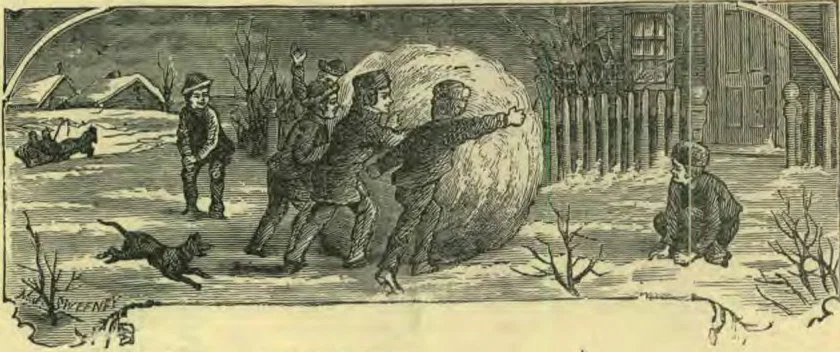
Oh, I am the friend of the boys and girls! I am the fellow they love When there's plenty of frost on the earth below, And plenty of sunshine above. To me they look for the frozen pond, All ready for skate and slide; To me they turn with their sleds so swift For a coasting hill so wide.
There is snow for the sleigh-rides far and near, And the bells are ringing a chime Of the merriest music in all the world, As a tribute to winter-time.
If I kiss the cheeks of the lasses so That they tingle awhile, what then? I must have my share of the fun before The summer shall come again.
I deck the trees with a fringe so bright That they glisten in sun or shade; And I scatter my snowflakes in the air Till they fill each valley and glade; And, climbing up to the mountain-top, Each shrub and tree I crown, And I spread the whitest of covers o'er The ground so barren and brown.
I'm hoary-headed and old, I know, But the boys won't care for that; They're bound to welcome the jolly old King Who wears the snow-brimmed hat. For I am the friend of the young and strong, And a merry old soul am I When there's plenty of snow on the frozen ground, And over it all blue sky!
—Selected.
Continue reading: THE SUNSHINE OVERHEAD