The Youth’s Instructor, Vol. 49, No. 22.

HOW TO STUDY THE BIRDS

The Youth’s Instructor

May 30, 1901

Review and Herald Publishing Company · Battle Creek, Mich. · May 30, 1901

HOW TO STUDY THE BIRDS
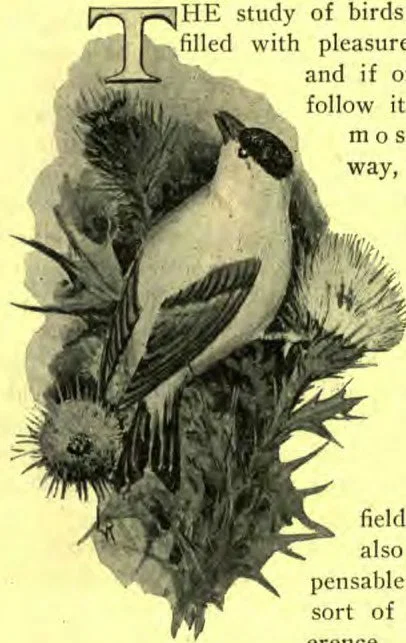
The study of birds is a pursuit filled with pleasure and profit; and if one desires to follow it in even the most superficial way, he needs an equipment for the purpose. The outfit need not be large. It should consist of a note-book and a good opera or field-glass. It is also almost indispensable to have some sort of book of reference. There are a number of works arranged especially for the novice. Among these may be mentioned, “Our Common Birds, and How to Know Them” (John B. Grant); “Birds of Village and Field” (Florence A. Merriam); “Handbook of Birds of Eastern North America” (Frank M. Chapman), or “Bird Life,” by the same author. “Bird Craft” and “Citizen Bird” are two other very useful books. It is difficult to choose out of this list the one best adapted to the purpose, but “Bird Life” or “Bird Craft” will not disappoint you. Any newsdealer or bookseller will get the books for you.
Mr. Grant has given us three very useful rules in identifying birds. These rules may be briefly stated here:—
“Study one bird at a time.
“Begin with the commonest; that is, with those that are most abundant, and most easily recognized.” The INSTRUCTOR bird articles will assist you in pointing these out.
“Do not attempt, at the commencement, to identify any bird which presents puzzling characteristics, or rather, any which does not present some striking mark, either of song or plumage, to serve as a sign for certain classification.”
Having everything in readiness, and armed with your opera-glass and note-book, start out either some early morning or toward sunset. You will find it difficult to get sight of birds during the heat of the day, or when a stiff wind is blowing. The hours immediately following daybreak are the very best time for bird study, as the birds are then most active. This activity continues until the heat of the sun causes them to hide away in the sheltering foliage of the trees. Therefore “let him to whom early rising is an abomination, in the name of Morpheus, slumber on; only, when his tardy start is effected, he shall not witness bird life so exuberant, nor listen to such floods of melody, nor inhale such richness of perfume, nor find refreshment in airs so balmy, as he might have done had he been earlier astir.” During colder weather, as in early spring, or late fall or winter, the middle of the day will doubtless prove the best time for observation.
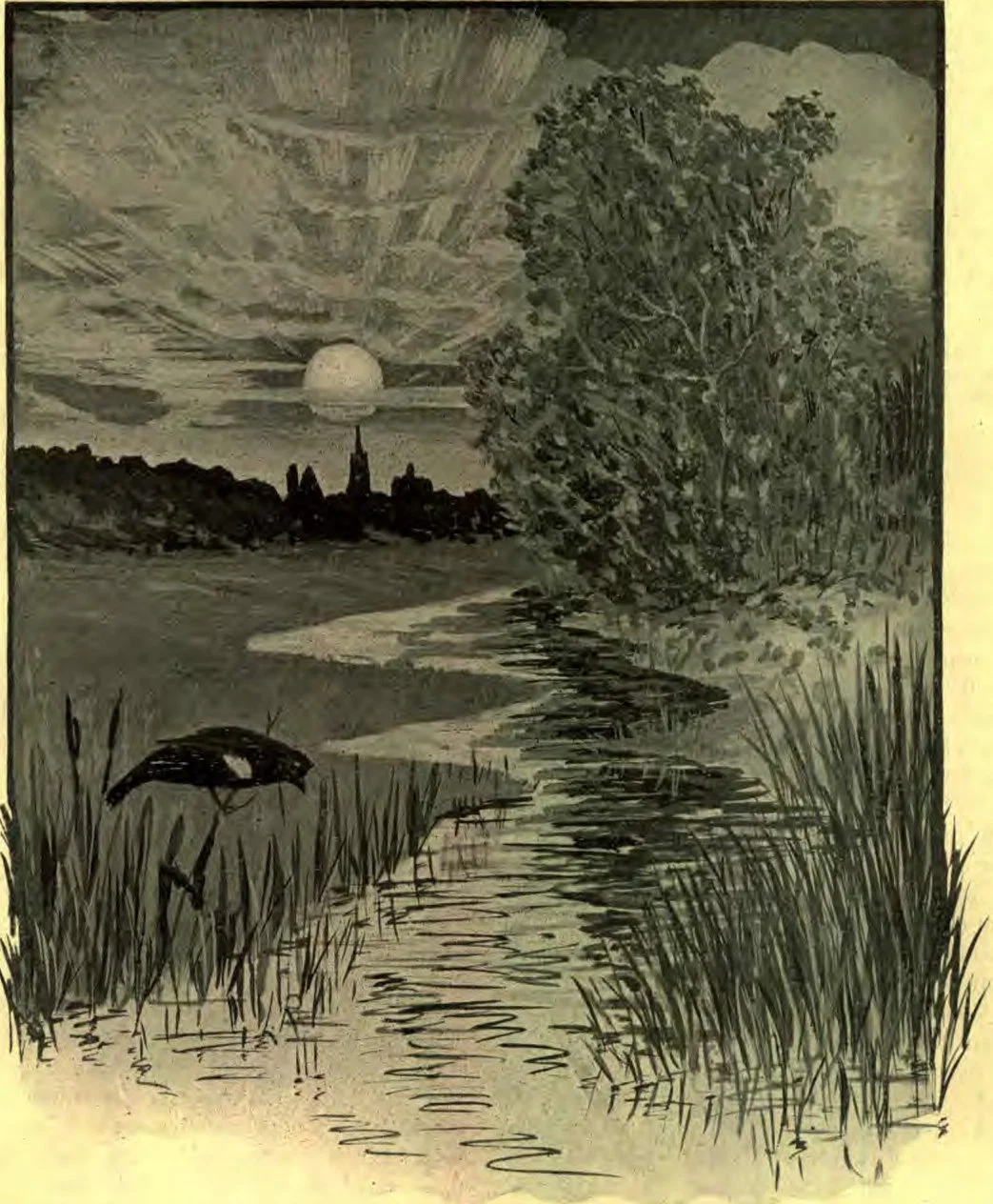
THE HOME OF THE REDWINGS
If you wish to inspect more closely a bird already in view, do not approach it directly, as it will be almost sure to take alarm at your first step. Take an angling course, which will cause you to pass more closely beside it; make as if you had some other point in view. So doing, you may get very close to many birds which would otherwise not allow you to come near. Birds go a great deal on evident intentions; and when one moves directly toward them, they have but one explanation, and are off. For the same reason do not have about you the appearance of stealth or watchfulness. Many birds have marked the attitude before, and have learned that it means mischief. Rather, assume the guileless and unconcerned ways of the careless wanderer, and avoid any steadfast gazing. Some birds are very curious; and if, in addition to what we have just advised, you utter notes and calls in as close resemblance to those of birds as you can manage, they may remain to answer, or draw nearer to investigate.
When you have found your bird, your opera-glass will be of wonderful service. You can not hope to get near enough to many birds to make out their markings with any degree of distinctness. A good glass will show the bird more clearly. Do not bring the glass to your eyes too suddenly. Be deliberate. The quick movement, or the quick flash of sunlight from the barrel or lens will frighten most birds into flight.
Study the marking of the bird very carefully. Do not trust your memory. Put it down in your note-book. The shape of tail and wings should be distinctly noted, with any special marks or colorations. If the bird has any notes, calls, or a song, the same should be given attention. The location of the bird may also greatly assist in identification. The haunt of the redwing blackbird is beside some stream, pond, or lake, amid rushes and cat-tails. The meadow-lark will be found mostly in the open field. If you notice anything peculiar in the flight or habits of the bird, make careful note of the feature. Having everything carefully in mind, you will doubtless have little trouble in learning the name of the bird, but, what is more important, will have made a closer acquaintance with one of God’s creatures.
Sometimes you will be able to secrete yourself in some sheltered spot haunted by birds, where you can see them at close range, and with slight effort. Such a place, near the edge of some stream or body of water, will be especially fruitful in results.
But do not confine yourself to any one section. Range the lowland; you will find birds there you can not find in the wooded hill country. Scurry the woods; you will there find birds that never visit the meadow. Hide in some old, deserted orchard; here you will find birds you had not seen elsewhere. Skirt the ponds and marshes; each kind of country has its favorites.
But remember it is not how far, but how much. A city park will furnish you all the ground you need. A back orchard, a wooded field, or a strip of meadow is sufficient. Do not tramp, but look. Have your eyes open. It takes sharp eyes and keen minds to see anything, and especially the things of nature. As you try, your powers and abilities will grow. The mere contact with nature alone will be an education. L. A. REED.

TWO COMMON SPARROWS

ALL beginners in bird study find the sparrow family a hard one. There are so many kinds of sparrows, and the different kinds look so confusingly alike! “How shall I ever be able to tell them apart?” the novice says to himself.
Well, there is no royal road to such learning, it may as well be confessed. But there is a road, for all that, and a pretty good one,—the road of patience. And there is much pleasure to be had in following it. If you know one sparrow, be it only the so-called “English,” you have made a beginning.
If you know the English sparrow, I say; for I find numbers of people who do not. Half those who read this article, I venture to think, might be put in that class. Take the average citizen of Philadelphia or Boston into the country, and let him come upon an English sparrow in a wayside hedge, and there are three chances to one that he will not know with certainty what to call it. As likely as not he has never noticed that there are two kinds of English sparrows, very differently feathered,—the male and the female.
In a short paper like this I am not going to attempt a miracle. If you read the paper to the end, never so carefully, you will not be prepared to name all the sparrows at sight. As I said before, they are a hard set. My wish now is to speak of two of the smallest and commonest.
One of these is called sometimes the chipping sparrow, sometimes the chipper, and sometimes—much less often—the doorstep sparrow. Personally, I like the last name best,—perhaps because I invented it. Scientific men, who prefer, for excellent reasons, to have their own names for things, call him Spizella socialis; that is to say, the familiar, or social, little spiza, or sparrow. The idea of littleness, some young readers may not know, is contained in the termination ella, which is what grammarians call a diminutive. Umbrella, for instance, is literally a small umbra, or shade.
With most of my readers the chipping sparrow is a bird of spring, summer, and autumn. For the winter he retires to our extreme Southern States and to Mexico. If you live in Massachusetts, you may begin to be on the watch for him by the fifth of April. If your home is farther south, you should see him somewhat earlier.
Perhaps you will know him by this brief description: A very small, slender sparrow, with a dark chestnut-red crown, a black forehead, a black bill, and plain—unstreaked and unspotted—under parts.
His ordinary note or call is a “chip” (whence his name), and his song is a very dry, tuneless, monotonous, long-drawn “Chippy-chippy-chippy,” uttered so fast as to sound almost like a trill. You may like the bird never so well, but, if you have any idea of music, you will never call him a fine singer. What he and his mate think about the matter, there is, of course, no telling. He seems to be very much in earnest, at all events.
He is a social bird, I say. You will not have to go far afield or into the woods in search of him. If you live in any sort of country place, with a bit of garden and a few shrubs and fruit-trees, a pair of chippers will be likely to find you out. Their nest will be built in a tree or bush,—a small structure, neatly lined with hair,—and in due time it will contain four or five eggs, blue or greenish-blue, with brown spots.
Our other bird is of the chipper’s size, and, like him, has unstreaked and unspotted lower parts. His bill is of a light color,—“reddish brown,” one book says; “pale reddish,” says another. This is one of the principal marks for the beginner to notice. Another is a wash of buff or yellowish-brown on the sides of the breast. The upper parts, too, are in general much lighter than the chipper’s.
You will not be likely often to find this bird in your garden or about the lawn. He is called the field sparrow, but he lives mostly in dry old pastures, partly overgrown with bushes and trees. His nest is placed on the ground or in a low bush, and is often lined wholly or in part with hair. He and the chipper belong to what is called the same genus; that is to say, the two are so nearly related that they have the same surname. The chipper is Spizella socialis, the field sparrow is Spizella pusilla,—just as two brothers will have one name in common, say, Jones, William, and Jones, Andrew.
The chipper is a favorite on account of his familiar, friendly ways. The field sparrow deserves to be known and loved for his music. Few birds sing better, in my opinion, though many make more display, and are more talked about. The beauty of the song is in its sweetness, simplicity, and perfect taste. It begins with three or four longer notes, which run at once into quicker and shorter ones, either on the same pitch or a little higher. Really, the strain is almost too simple to make a description of,—a simple line of pure melody, one may say. You must hear it for yourself. Sometimes the bird gives it out double, so to speak, catching it up again just as he seems ready to finish. The tone is the clearest of whistles, and the whole effect is most delightful and soothing. It is worth anybody’s while to spend a season or two in bird study, if only to learn this and half a dozen more pieces of our common wild-bird music.
The field sparrow’s times of arrival and departure are practically the same as the chipper’s. Neither bird is hard to see or very hard to distinguish; a bit of patience and an opera-glass will do the business, though you may have to puzzle a while over either of them before making quite sure of your knowledge. In bird study, as in any other, we learn by correcting our own mistakes.—Bradford Torrey, in S. S. Times.

WATER CHANGED INTO WINE

V

“Draw out NOW.”—The time selected by the divine mind as the moment of opportunity has arrived. The water is wine, and the Master says, “Draw out now, and bear unto the governor of the feast.” So when you have been greatly favored from above, when showers of blessing have been your portion, then as the finger of Providence points out some needy soul, and the Spirit speaks to you, saying, “Draw out now,” do not delay to obey. The future nourishing and refreshing of your own soul demand implicit obedience. As the message comes to you, “Draw out now,” all heaven waits to co-operate with the effort you put forth to give to others the blessings of salvation which have been given to you. Disobedience to the Spirit’s leading will poison the waters of life, and ruin the wine of grace within the soul. That which, had you promptly yielded to the Spirit’s leading, might have blessed and cheered the heart of another, will by and by become a stumbling-stone to others and a source of darkness to you.
It was in obedience to Christ’s command, “Draw out,” that the blessing resulting from this miracle was obtained. And it is so in our Christian experience. May we not sometimes neglect to obey while we are seeking a blessing, when in reality the blessing for which we seek will be found only in results of obedience? Christ works miracles for a purpose; for He had no sooner worked this miracle than he said, “Draw out now, and bear unto the governor of the feast.” Christ never worked useless or objectless miracles.
“But the Servants Which Drew the Water Knew.”—It is written that the servants who drew the water knew it was wine. Perhaps there were many onlookers who in their minds doubted the miracle of the water being turned into wine, but the servants who drew the water knew. And so we see it to-day. The saving and keeping power of the glorious gospel is seriously questioned by many, doubted by others, and ignored by some; yet the humble servants of God, who are drawing water from “the wells of salvation” with which to refresh their souls, and quench the thirst of dying sinners,—those who are engaged in actually giving to others of that which God has miraculously wrought in their own experience,—they know both the reality and the blessedness of the Christian life. While others may doubt and conjecture, they, by reason of their experience in the things of God and their labor of love for others, know, like the blind man of old, whereof they speak. Whereas once they were blind, now they see, and they know it.
But he who seeks divine blessings for his own refreshment, and who makes no effort to give the bread of heaven and the water of life to a dying world, soon loses the ability to recognize and appreciate divine things. Those who are drawers of water from the inner side of the wall know whence the water comes. Those who are constantly engaged in ministering to others of the grace of forgiveness and the beauties of salvation, are those who know in reality that their sins are forgiven.
“This Beginning of Miracles Did Jesus.”—It is interesting to note that Christ did not work his first miracle at Jerusalem, with great show and pomp, before the priests and leaders of the people. On the contrary, he chose the quiet little village of Cana as the place where he would both honor the marriage institution and manifest the glory of his Father; for, he said, “My Father, he doeth the works.” It is also interesting to notice how unostentatious Christ was in all he did in connection with the performance of this miracle. He did not call the people around him, and seek to attract their attention to the wonder he was about to work. He uttered no moans or incantations, as so many so-called modern wonder-workers are wont to do. He did nothing of a sensational nature to attract morbid curiosity. He did not even speak an audible word. He simply gave the command, and when the command had been obeyed, it was promptly followed by another, and the obedience to this second command discovered to all present the wonderful miracle the Commander had wrought. Thus it is with many of our greatest blessings. Many of the mighty miracles wrought by the Master within the soul are discovered to us by the Spirit of loving obedience,—obedience to-day making manifest the miracle which resulted from our obedience yesterday. “Draw out now” discovers to us to-day the transformation wrought by his mighty power when first he called us to obey.
“And His Disciples Believed on Him.”—The disciples’ faith was greatly strengthened by this miracle. They saw that nothing could fail in the hands of the Master. They were made to see also that he who could turn water into wine could turn defeat into victory; that he could transform weak and erring men into vessels of honor and service; that he could take the poorest of human instruments, and by his grace make of them the richest instruments of righteousness. They had believed on him before, but this wonder confirmed their faith. It is as it was written of the Samaritans: “Now we believe, not because of thy sayings: for we have heard him ourselves, and know that this is indeed the Christ, the Saviour of the world.” John 4:42. Miracles do not produce faith; they simply strengthen, reinforce, and confirm it.
Although Christ would not transform the stones into bread on the occasion of his great hunger in the wilderness, yet at the marriage feast in Cana he turned water into wine to refresh and gladden those present. Although he would not provide a necessity for himself, he was willing to give luxuries to others. He refused to make bread for himself; yet he supplied wine to others. Herein is his unselfish character manifested. At his crucifixion these taunting words were spoken: “He saved others; himself he can not save.”
“Wine is a mocker, strong drink is raging; and whosoever is deceived thereby is not wise.” Prov. 20:1. Surely it was no such wine as this that Jesus provided. It must have been the pure, unfermented, refreshing juice of the grape, even the same as he provides in the clusters as they hang in the vineyard. W. S. SADLER.
(Concluded next week.)

A TENDER MOTHER

Dame Nature tucks her flowers in bed, And piles on blankets soft and warm, Then sings them crooning lullabies Through the long night of cold and storm.
But when the golden morning comes, And robin with his flute is here, She wakes her children every one With, “Time to be getting up, my dear!” —Emma C. Dowd.

One Word: Obey

“ONE word links man with angels, makes him one With the majestic march of star and sun, Unlocks the universe to him, and brings Him near the glory of the King of kings. Earth’s wisdom fails, earth’s pride must pass away; One word alone guides man to God— ‘OBEY!’”

OLD READY

JOHN won his odd title when he was a small patient in the children’s ward of the Samaritan Hospital. His broken arm was not yet out of the sling before he was helping Nurse Romaine care for the other children, and the children straightway hit upon the name that fitted him perfectly, “Old Ready.” That was ten years ago, and he was still in the hospital. The broken arm got well speedily; but before that happened, it was found that the willing worker could not be spared.
First, he was put on the rolls as errand-boy, but he soon outworked those narrow limits, and was promoted to higher responsibilities. Step by step he had come up and up since then; the position he held now it would be hard to define exactly, for he found work to do, and plenty of it, in every department within his reach. That had been the case all along; the thing that needed doing was the thing he took in hand, asking no questions, waiting for no bidding. He was still Old Ready to all in the hospital, from Dr. Ellis, the chief surgeon, down.
Promotion is a pleasant thing for boy or man; all the pleasanter for John because his mother, hard at work in the mill, and his sister Katy, the busy little housekeeper, had such pride and delight in his advancement. He had a hope of making them prouder still; a day, not on the calendar yet, shone away off in the future—the day that should advance him to the pinnacle of his ambition, the position of assistant steward. He was studying hard to fit himself for that.
In the fury of a winter storm, when the bitterest night of half a century was settling upon the world, John was shut up in his room, studying as hard as he had worked all day. Unless specially summoned, he need not open his door again that night. He heard the ambulance arriving with a new case, and he heard the bearers carry the litter into the children’s ward. “Poor little soul!” he muttered. “I hope it isn’t a case of freezing.” A glow of thankfulness warmed him; Katy, snug and warm at home, was in no danger of freezing. “Right sort of night for that, though.”
It was indeed the “right sort of night for that.” The air was thick with a driving white mist; the ambulance was like a snow-drift on wheels; the litter-bearers, and the troubled mother beside them, plunged through deep snow as they came up the steps. In a moment the men were out again, and the ambulance was driven away; already there had been another call. John, seeing nothing of all this, only knowing of it by the sounds, went on with his studying. Dr. Steel and Nurse Romaine could deal with a case of freezing without his help.
True, but this was not a case of freezing, and they could not deal with it; the little form on the cot before them had been cruelly torn by machinery.
“I was working late, and she had just come from the house, bringing me my supper,” the poor mother explained, wringing her hands. “I was telling her she shouldn’t have done that in all the storm, though it’s but round the corner, and while I was saying it, and while she was laughing and making light of the storm—she’s always so brave and good!—the belt caught her somehow, and—oh dear! oh dear! You can save her to me, can’t you, doctor? You must save her to me!”
“Only one man in the State can do that,” said Dr. Steel, after a swift examination. “Ellis can, if we can get him here. We must get him, for the case is beyond me.”
He hurried out into the hall. John, in his room, heard him giving a sharp order to Negley, the night messenger; then he heard Negley, as usual, piling up difficulties in the way of what he was told to do.
“I’m willing enough to start out and try it, Doctor. If you can tell me where to go, I’ll go, but you say yourself there ain’t no clue to follow. And to go wadin’ round through all this snow on a wild-goose chase, why——”
“Stop your grumbling, and go!” With that fierce growl the doctor strode back into the ward.
John needed no more calling than this; in two minutes he was out in the hall, looking like an Arctic explorer. Negley was taking his comfort, with no notion of going out, except under stronger pressure. He grinned derisively at sight of the high boots and the fur cap, but a fellow who would volunteer to go out in such a storm as this was worth seeing under the circumstances.
“Good for you! This lets me out!” he remarked, and instantly he slipped off to a warm corner, quite out of everybody’s way.
Just in time, for Dr. Steel had bounced out again to put spurs to his lagging messenger. He saw John, laughed in huge relief, took everything for granted at once, and forthwith gave his orders.
“Ready, I want you to find Dr. Ellis. I don’t know where he is, and nobody at his house knows, but find him. Tell him to come here without losing a minute, to save life. Tell him that—to save life.”
“All right, sir.”
On his way out, John saw Nurse Romaine knocking at the door of his room. She saw him at the same time, and hurried to him.
“I was after you to come into the ward,” she said, “but if you are going after Dr. Ellis, that will be better. You will say so yourself when—afterward. Much better, for you will find him.” She opened the door for him, and the blast swept him out.
She shut the door, and went back to the ward. “It is a cruel thing, all round,” she said to herself, “but this is the kindest part of it all. No pocket can hold the wage of the willing worker, and I pray it may be paid to him in full!”
What a storm this was that John had come out to battle with! He was full of life, and he loved a sharp tussle with the weather, but there was something too much of this. The intense cold found him out through all his warm clothing, and the wind knocked him this way and that in spite of all resistance. Those were trifles that did not count; he could fight the wind, and the fight would keep him warm; the snow was the only thing he really feared, it hindered him so. Of course he could master the worst of the deepening drifts, if he had time, but there was the trouble; time was a precious thing when Dr. Ellis was sent for to save life.
In front of the Albermarle Hotel, half a square from the hospital, he got footing on a car; it carried him a few rods; then it stopped in a hopeless drift, and he got off; and that was the last car he saw that night. Well, even that short ride had almost frozen him; floundering on foot would keep his blood stirring, at any rate. Even so, his fingers and toes ached with the cold, his nose and ears smarted, his face tingled painfully under the lashing of the frozen snow.
In spite of his best efforts, he was a long time in getting to the Brotherhood Hospital, and that was really only the starting-place he had set for himself; Dr. Ellis came here every evening, and here the clue must be picked up. In two minutes John was out in the storm again, the clue in hand; the doctor had been there, and had gone off to one of his many “poor cases,” in Prince Street. That was afar off, and John could get there only on foot. No matter, the clue led there, and he followed the clue with a light heart and in perfect confidence.
He followed the trail to Beppo’s house in Prince Street; then to Sullivan’s house in Rose Street; then here, there, and everywhere. Dr. Ellis, great surgeon and physician as he was, was at the call of whosoever had need of him, night or day. So, for half the night, as it seemed to him, the weary messenger pursued the chase through the hindering drifts, never losing the trail of the man he tracked, but never coming nearer to him.
The storm grew worse, if that were possible. Even on wind-swept spaces the snow was more than ankle-deep; in other places the boy must labor through drifts that swallowed him to the waist. Everywhere he must fight his own way; not a car was moving, and no vehicle nor horse was to be had. He tried to whistle as he plunged onward, but the wind outmatched him at that, and drove the whistle down his throat. That was just as well, for his whistling had but little spirit in it. He acknowledged to himself that the fight had become rather wearing. In truth, it was cruelly hard, and the long, fierce struggle was telling fearfully at last, even on his sturdy young strength. He was cold now, terribly cold, and he never in his life had been so tired. He would not confess it, but by this time all of him was exhausted except his courage and his will.
Then the crushing climax came, the stunning, hopeless word was spoken. Another messenger, coming in a sleigh, with horses enough to drag it through drifts house-high, had found Dr. Ellis first, and had carried him off quite out of reach. Carried him where? To the Albermarle Hotel—to within half a square of poor John’s starting-place.
What to do now? Even John confessed that he could not possibly conquer again those terrible drifts; his feet might as well have been lead for all the life or feeling that there was in them, and he was tired beyond words. The Albermarle had telephone connection! Off to the nearest telephone station, then. If the wires were not working, then indeed he must give up; but he would not give up till he had tried this last chance. After that he might rest.
He must rest before that. He had hardly started in his new course when, for the first time, he fell down. He got his frozen feet under him, and struggled up again, but only to fall back helpless into the smothering drift. He had twisted his ankle so that he could not stand on it, and there was nothing to do but stay where he was until help came. That meant the end of everything, for no help could be hoped for; it seemed that only he, of all the city, was abroad in the storm. Well, it was good to rest, at any rate, he was so tired and sleepy. He would be snowed under, like the child they had brought to the hospital, but—That reminded him. He wrenched himself broad awake. Somebody must help him to the telephone station!
A sound, more welcome than any he had ever heard, reached him. Not far away an ambulance bell was clanging. He shouted again and again, lustily as in his best days. Men answered him, and presently the Brotherhood ambulance was there beside him. Another minute, and he was in the ambulance, with warm blankets about him.
“Wouldn’t bother you, only for the kink in my leg.” He croaked the words feebly enough, but with all his old, cheery pluck. “Off with you now, quick as you can! Must telephone—Dr. Ellis—save—life—oh, keep me awake!”
The flash of energy had died out already, and the fatal drowsiness beset him again with a power he could not resist. His rescuers knew the full meaning of those words, “To save life,” and desperate as his own case might be, they must help him do his errand. With merciful cruelty they shook and scolded him till he found himself in the warmth and light of the telephone station.
“Give me Albermarle Hotel.”
Rallying all his forces, he waited for the test calls. He looked up at the office clock, and was sure it had stopped. From the story it told he had been away from the hospital not much more than two hours. For a wonder the wires were working, and the call was answered. Then, with all the voice he could muster, he himself called for Dr. Ellis. Dr. Ellis spoke back to him.
“It’s Ready, doctor, with a message from Dr. Steel. He says you must come to the Samaritan Hospital, without losing a minute, to save life. To save life, doctor! Do you hear that? I’ve lost a lot of time hunting for you. You must hurry!”
“I hear, Ready, and I’ll go. This instant, Ready.”
That was all. John had done what was given him to do, and now he could rest. When he came to himself, hours afterward, he was in the Brotherhood Hospital. Doctors and nurses were busy with him, and every part of him that could feel was in pain. They put him to sleep, and he got through the night in some way. The next day Dr. Ellis himself was there, looking him over, and tenderly putting him to rights.
“You’ll do,” the doctor said at last. “The leg will be as good as new pretty soon, and the hands and feet will be ready for use by the time the leg is.”
“Yes, but did you get there in time last night, doctor? That’s what I want to know.”
“In good time, Ready.” The doctor’s face lighted up in a way pleasant to see. “There would have been a different story to tell if you hadn’t got to the telephone, though. She will come through all right, and be none the worse for the accident, I can promise you that. Now go to sleep.”
The doctor stood thinking for a little, then whispered in John’s ear, “Get ready for duty as soon as you can—assistant steward! Oh, yes, that’s what it is, dating from last night! Good-by.”
John forgot all his pain. Assistant steward! The great dream of the future had come true in a night! To his great surprise he dropped off to sleep thinking about it.
Later Nurse Romaine was there, crying over him, and kissing his swollen and blistered face. “Your mother would have come, dear,” she explained, wiping her eyes, “but she is at our hospital with—with her. O John! It was hard to send you out away from her, and she so dreadfully hurt, and calling for you all the time, but what could we do? That was the only chance of saving her. Only Dr. Ellis could do what had to be done, and only you could be trusted to find him. Your mother agreed that it would be best not to excite you and worry you before you started. Besides, your heart would have been half broken to leave her. You two did save her, and that is the great thing, isn’t it?”
“But—who?” John whispered, in troubled perplexity. “Not—it couldn’t have been Katy!”
Nurse Romaine put her face tenderly against his. “Katy, yes, dear. You earned her life last night, my willing worker. She will live and be well, but she would have died only for you, John.”
So the wage of the willing worker was paid in full to John, as Miss Romaine had prayed. All the promises of hope were made good to him, and the assistant steward of the Samaritan Hospital is as happy as he is busy, which is saying much.—Youth’s Companion.

Use Your Gifts Faithfully

“Use your gifts faithfully, and they shall be enlarged; practice what you know, and you shall attain to higher knowledge.”

Strength Received From Christ Limited by Willingness

“THE amount of strength we may receive from Christ is limited only by our willingness. His ability is greater than our desires.”

TWO PRINCES

There were two princes, long ago, Named Prince I Wish and Prince I Will, Whose great-grandchildren, you must know, Are reigning still.
They ran and played, they drank and ate, They read in books both old and new; Indeed, they lived just as their great- Grandchildren do.
But Prince I Wish would never try To learn a lesson as he should; He just would wait, and loudly sigh, “I wish I could.”
And Prince I Will would never pause At any task he might fulfill; And so he won his way because He said, “I will.” — Frank Wolcott Hutt.

THE CHEERFUL SUNBEAM

One day a sunbeam met a cloud; ’Twas in the month of May. Frowning, the cloud said, angrily, “You’re always in the way!”
The sunbeam smiled, and said, “My dear, Why can’t we work together? The flowers need us both, you know, Sunshine and rainy weather.”
— Selected.

CANVASSING IN THE SIERRAS

II

“Would you like a drink of good water?” asked one of my new acquaintances that evening, and led me out under a cherry-tree by the milk-house. At our feet was a boiling spring, the water ice-cold, sweet, pure, and refreshing. “We have no drunkards here,” said he; “if one accustomed to liquor once tastes this water, he will drink nothing else while he remains with us.”
My first and fifth orders were taken on Monday morning—five orders in half a day! After dinner an eight-mile ride to Humbug was easily made. I found to my sorrow that the place had been properly named, so in a few moments I started over a steep range for Butte Valley. On the upward climb, I comforted myself with the thought of coasting down the other side, but such a steep, rocky grade was not to be used as a bicycle track. Near its base was a sluggish creek, while the mosquitoes were as thick as gnats about a mass of decaying fruit. I shall remember the place as Mosquito Cliff. Picking my way down the grade, I paused now and then, feasting my eyes upon the wild roses, some of them fully nine inches in circumference. There was also the common, small variety. The most beautiful flower to be seen was the mountain lily.
As night came on, I saw an occasional bonfire, surrounded by Indians preparing their suppers, but the hotel was the only white man’s dwelling in the valley. On reaching Prattville again, I had traveled sixteen miles, and taken no orders.
Not waiting for dinner, I set out eagerly for Greenville, and had climbed the grade and started down when a sound like a pistol shot startled me. It was caused by the bursting of my tire, so I had to walk the remaining eight miles. At 5:30 a generous grocer gave me a lunch, which still left me abundant relish for supper. Though the town was quite large, I did not obtain any orders, and as hotel rates were two dollars a day, I soon started around Indian Valley. This valley is made up of several arms, or smaller valleys, reaching back into the mountains. On my return to Greenville, I passed through Crescent Mills, a place never to be forgotten by early settlers. Placer-mining has been prohibited, and the quartz has failed, making the once wealthy, active town a picture of desolation. WM. YARNELL.

Instinctive Loyalty to Goodness as Faith

He who, when goodness is impressively put before him, exhibits an instinctive loyalty to it, starts forward to take its side, trusts himself to it—such a man has faith, and the root of the matter is in him.— Sir J. Seeley.

GROWING

Every birthday, passing o’er, Finds my mark, behind the door, Climbing higher from the floor, And the scales proclaim I weigh a little more.
Every winter, white with snows, Every spring, with buds and blows, Every season at its close, Leaves me just a little larger as it goes.
But this wondrous earthly ball Offers work to great and small,— Duties to employ us all; So I’ll not be idle, waiting to grow tall.
ELIZABETH ROSSER.
Continue reading: The Little Girl at Mount Vernon