The Youth’s Instructor, Vol. 49, No. 22.

HOW TO STUDY THE BIRDS
Earlier text: HOW TO STUDY THE BIRDS

The Little Girl at Mount Vernon

When the great George Washington lived at Mount Vernon, his country place on the Potomac River in Virginia, a little girl lived there with him. Her name was Eleanor Custis. She was called “Nelly” usually. She was the granddaughter of Mrs. Washington, and the adopted daughter of General Washington himself.
When Nelly was only two years old, and her brother a little baby of six months, their own dear father, Mr. John Parke Custis, died. He had been a brave soldier in the American army during the Revolutionary War, but he died just as his country was rejoicing over its victories.
General Washington had loved his stepson, and he grieved sadly over his loss. He begged that Mr. Custis’s two younger children might be given him to keep and bring up as if they were his own.
Mrs. Custis was unwilling to give the children away. But at last she did, and Washington adopted the little ones in what is called “full legal form;” that is, they were to be his very own, and he would act as their father from that time on, and legal papers were drawn up and signed in proof of this.
Nelly’s hair was dark, and her eyes a beautiful black. She was a very lively little girl, fond of playing out-of-doors. Her life at Mount Vernon must have been full of little pleasures. There are few better play places in the world than an old Virginia plantation, and Mount Vernon was then one of the finest in the State. It is still a lovely place.
At either end of the mansion, at the back, is a long, arched gallery, or colonnade, built in a curve, and leading to the kitchens of other outbuildings, delightful places to play on rainy days. There are brick walls, too, dividing the lawn from the garden and from what were once farmyards and deer parks; and these walls have odd turns and twists, as if they were made on purpose for children’s games and adventures.
Nelly must have loved the old garden. It is still kept in good order, with borders of box along the gravel walks and around the flower beds. In some places the box is higher than a child’s head, but in one part of the garden it is closely clipped, and winds all about in the form of a labyrinth—like the puzzle pictures that you trace with your pencil in order to reach the center. The red roses bloom there as late as October, and they and the scarlet sage make bright spots in the beautiful pearl-gray mist that comes up from the river.
Nelly had a dear little room of her own in the house, which you may still see, if you go to Mount Vernon, furnished just as it was when she lived there. Her bed, with its tall posts, had curtains of an old-fashioned white stuff called “dimity,” looped up here and there and edged with fringe. The bed was so high that Nelly had to go up three little steps to get into it. Nobody had ever thought then of making a bed so low that you could step into it easily from the floor.
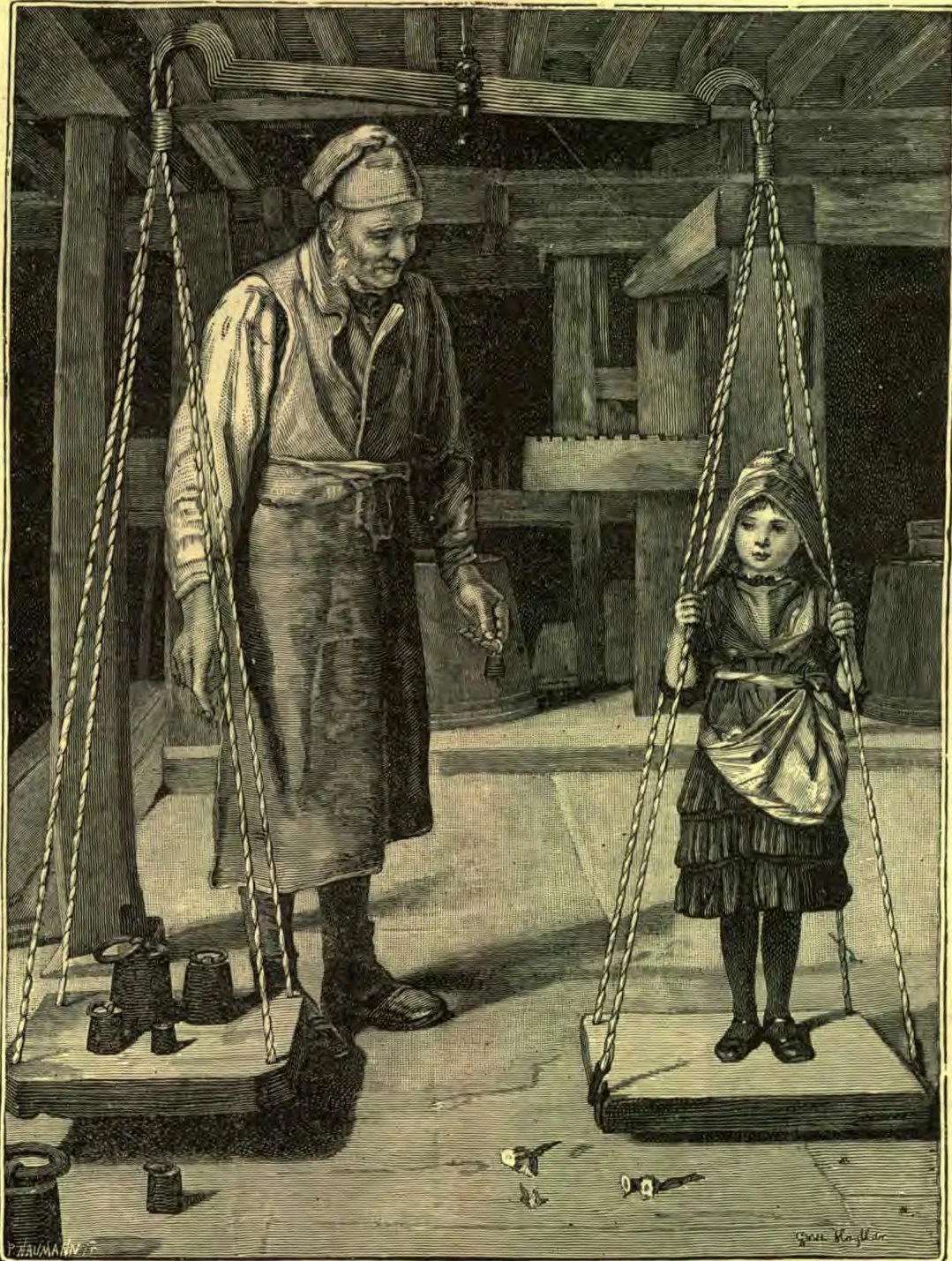
JUST A LITTLE LARGER
Both the Custis children had lessons at home every day. Their studies were carefully overlooked by General and Mrs. Washington. It was not always easy to keep Nelly at her books, as she liked romping much better than study. Sometimes she used to cry when she had to practice her music.
Nelly had a music room on the first floor, furnished with a cunning blue sofa and chairs embroidered with musical instruments. The spindle-legged, three-cornered piano, called a “harpsichord,” which stands there now, was not bought for Nelly until she was about to be married, when General Washington gave it to her for a wedding present. But there was another harpsichord, or spinet, that had belonged to the first little girl at Mount Vernon, Nelly’s “Aunt Martha;” and Nelly used to pick out her tunes on its short keyboard.
Little Miss Custis had a queer little guitar, too, called a “bandoria.” You may see it in the music room when you visit Mount Vernon; and you may also see the flute upon which George Washington used to play.
Nelly was still a little girl when General Washington was made president of the United States. New York was then the national capital, and Mrs. Washington and the two children went there to live. They were there for more than eight years. Nelly used to see almost all the distinguished men of whom you learn in your United States histories. The children probably enjoyed the style and splendor, but it is well known that the President and Mrs. Washington were heartily glad when they were free to go back to their home in Virginia.
In time Nelly grew up to be a lovely woman. She married Mr. Lawrence Lewis, a nephew of General Washington. The general gave his nephew a fine estate near Mount Vernon, and they called their home “Woodlawn.” But Nelly loved Mount Vernon best; and while her grandfather lived, she and her husband stayed with him.
Nelly was brought back to Mount Vernon to be buried when she died, at the age of seventy-four. Her tomb is close to that of Washington, and there is a long inscription on it, telling how she was “reared under the roof of the Father of his Country,” and how fair and sweet she was in herself.—Jeannie Pendleton Ewing.

JUNE STUDY OF THE FIELD

(June 2-8)
Introduction.—The articles for study this month in the Missionary Magazine are “Protestantism in Brazil;” “In Basutoland;” “Central American Mission, South;” “Aborigines in Australia;” “Our Work in Egypt;” and “Sketches from the European Field.”
Catholicism in Brazil.—The religion of the country being Catholic, society has been molded by the prevailing influence. The results have been the same as in other countries where the papacy has ruled with an unrestrained hand. That which has brought darkness is, first, the ban placed upon the word of God. The members of the church are forbidden to open the Bible. If it is found in their hands, it is taken away, and they are told that it is the book of the devil; that what they are to know of its contents must come through their spiritual advisers and teachers. The colporteurs who fall into the hands of the priest are treated roughly, and frequently lose their life. (The experience of our laborers in Brazil, as reported at the recent Conference, and published in the Bulletin, may be read with interest in connection with this study.) Second, the Catholic religion in Brazil is not spiritual. In every sense of the word, the people worship idols. Seats are provided in very few of the churches, for the people do not enter them expecting to hear a sermon. A missionary who spent three years in one of the largest cities of Brazil, where a commodious cathedral was situated, says that only three sermons were delivered during that time, and so extraordinary was this event that it was published in all the newspapers. Third, the hope to save themselves by works, and not by faith in the living Saviour, brings disappointment. The incident is related of one young lady who lay dying. She pleaded over and over again for a missionary. When one was found, she told him that she had sent candles to every church in Brazil, that the saints might save her soul; she had gone on her bare hands over roads for miles; she had built a chapel, and had given money to every charity of which she knew. She had done everything she could think of to take away her sin, but still she was left without peace,—dying, and all dark before her. With such a religion, with souls going into eternity without hope, longing for life, does not Brazil appeal to us for help?
The Beginning in Basutoland.—The first Sabbath-keeper in Basutoland was Brother David Kalaka. When Elder S. N. Haskell made a missionary tour through South Africa about five years ago, this brother, who served as his guide, was a local preacher of the French Protestant church. After Elder Haskell left, he accepted as much of the truth as he knew, and later attended a Bible institute conducted by Elder O. A. Olsen, when, with three other natives, he was baptized. Being an educated Basuto, and having served for several years as a member of the council of the head chief of Basutoland, he was well known throughout his country, and his receiving “a new religion” created quite a stir. Even before his baptism, he was called, within three weeks, two or three times by the French minister and as many times by the head chief, to answer for his new faith. The Lord helped him to give a reason for his hope from the Scriptures; and the chief admitted, in the presence of his counselors, that “David had the Bible religion.” Later he was called to the chief for personal talks, and it was evident that the forcible answers from the Bible made a deep impression. After his baptism, Brother Kalaka returned to his home, and many came to him daily to inquire about the “new doctrine.” In this way a knowledge of the message spread hundreds of miles throughout Basutoland. The growth of this work led to the establishment of the mission in Basutoland, about which we study this month.
First Work in Egypt.—Although from earliest times Egypt has been associated with the history of God’s people, it has, until very recently, received little attention from those proclaiming the last message of mercy. The third angel’s message was introduced in Egypt by Dr. H. P. Ripton, but scarcely had he begun when he was killed in the Alexandrian riot. As a result of the Armenian massacres, a number of Armenians fled to Egypt, among them some who bore with them the rays of present truth. Through their faithful labors many became interested, and in Cairo a number began to follow the light. Some of these published the truth in tract form at their own expense, and began to call earnestly for the living preacher. For more than three years a brother has labored in Port Said, Cairo, and Alexandria as a ship missionary and colporteur, circulating reading-matter in the English, French, Italian, German, Greek, Russian, and Arabic languages.
Among the Waldenses.—In connection with our study of the Waldenses, it is interesting to note the experience and prophecy concerning this work, as related by Sister White on her visit there more than fifteen years ago. After exploring several caves and other retreats which the Waldenses had sought in their flight for life, she says: “We climbed still higher upon the rocks above the cave, and there bowed in a season of prayer. Jesus seemed very near while we pleaded with him to imbue us with more of the spirit of true devotion and firm adherence to principle that had led so many in these valleys in times past to lay down their lives for the truth’s sake. . . .
“As we slowly made our way down the rocky path by the side of a rushing stream, we could not but wonder how many pilgrim feet had trod this rugged path before us in the hope of finding an asylum from the wrath of their oppressors, and our hearts ascended to God in prayer that the precious light of present truth might reach to descendants of this long-persecuted people. We firmly believe that God will open the way, that he will remove the obstructions which now shut the light from them.”
Then in view of what is now being done, the following is especially interesting: “The angel that joins the third angel is to lighten the earth with his glory. There will be many, even in these valleys, where the work seems to start with such difficulty, who will recognize the voice of God speaking to them through his word, and, coming out from under the influence of the clergy, will take their stand for God and the truth. This field is not an easy one in which to labor, nor is it one which will show immediate results; but there is an honest people here, who will obey in time. The persecutions which their fathers endured have made them apathetic and close-mouthed, and they look upon strangers and strange doctrines with suspicion. But the miracle of God’s mercy, working with man’s human effort, will yet cause the truth to triumph upon the very soil where so many have died to defend it. Knowledge will be increased, faith and courage will revive, and the truth will shine as the light of the morning all through these valleys. The old battle-field will yet be the scene of victories now unseen, and the adoption of Bible truth will vindicate the past fidelity of their fathers.”

THE BURNT-OFFERING AND MEAT-OFFERING

(June 8)
Memory Verses.—Ps. 51:10, 19.

QUESTIONS

1. How many kinds of offerings were presented before the Lord? Note 1.
2. When one brought a burnt-offering from his cattle, what was it to be? How was it to be offered? Where? Lev. 1:3; note 2.
3. How did the person then offer it? What promise was given? V. 4.
4. How much of the animal was burned? How did the Lord regard the offering? V. 9; note 3.
5. How often did the people of God bring a burnt-offering to the Lord? Ex. 29:38, 39, 42; note 4.
6. When Abel and others offered their burnt-offerings, how did the Lord show that he accepted their gift? Gen. 4:4; note 5.
7. Of what material was the “meat-offering” made? Lev. 2:1, first part.
8. What did the flour represent? John 6:48.
9. What was placed upon the flour before it was offered? Lev. 2:1, last part, 13; note 6.
10. In what different ways could the meat-offering be prepared? Lev. 2:4, 5, 7.
11. Of what was no meat-offering to be made? Lev. 2:11.
12. Why was the leaven forbidden? Note 7.

NOTES

1. There were various kinds of offering, each of which taught some precious lesson, and brought to God’s children a special blessing. But though there were many offerings, there were but three general classes:—
(a) Sin-offerings.
(b) Consecration-offerings.
(c) Peace-offerings.
The first were for the purpose of putting away sin from between the people and God, that he might not be separated from them. The sin-offerings brought pardon. When sin was forgiven, the people wanted to make the second kind of offering,—the offering of consecration. For when they had seen how kind and good the Lord is, they desired to be wholly his, to consecrate themselves to him. And when they were wholly given to the Lord, they desired to make the third kind of offering, the offering of thanksgiving, the offering of a glad, peaceful heart. Last week we studied the sin-offering; to-day we learn of the burnt-offering (the offering of consecration); and next Sabbath we will consider the peace-offering.
2. God never asks any one to do anything against his will. An unwilling offering would not be acceptable. So the Lord told his people (and he says the same to us) that when one brought his offering, he must bring it of his own voluntary will; that is, freely and gladly. By his own choice, he was to put his hand upon the head of his offering, and give it to the Lord. When he did so, he was simply saying, Here, Lord, I give myself to thee; I desire to be wholly thine. Take me now to be thine forever. And the Lord promised, that when he did so, his offering should be “accepted for him.” God greatly desires to have us give ourselves to him, “a living sacrifice, holy, acceptable” unto him. Rom. 12:1. If we do so; if we make an offering of everything we are, of everything we have, of everything we ever hope to be and to have, we may be sure that it will be accepted, and God will honor us with a place in his work now, and in his kingdom hereafter.
3. All the offering was burned. It was therefore called the “whole burnt-offering.” Ps. 51:19. If the offering had not been all burned, it would not have taught all the truth. For as the burnt-offering meant the offering of the one who brought it, it must show that he was to give himself wholly to God. The Lord can not accept a partial offering; he desires all our life. Every life given fully to him is a sweet savor, a precious offering of righteousness, and causes Heaven to be glad. The secret of a Christian life is in making a whole offering, of giving all. When all is given, God can keep it; for it is truly in his hand. To give up to the Lord only a part of our life is really to keep all of it for self. Let us give all we have, and then take all that God would have us take.
4. Twice a day, in the morning and in the evening, the people of God offered up their burnt-offering. Twice a day they consecrated themselves to him. This is what our Father would have his children do now. But we often forget this, and act as if the offering made when we were converted will answer for the rest of our life. And oh, how many young men and women backslide because of doing so! The Lord would have us renew our offering every morning and every evening. In the morning we may accept Jesus anew as our Saviour, and by faith say, “To-day, dear Lord, I will be wholly thine;” and when the day closes, we may thank him for his blessings, and with a glad heart tell him that we will be his through the night, and ask for his keeping power. Those who follow this plan will not fail. Dear young friend, make this plan yours, and do it to-day.
5. We are told by the Spirit of prophecy that God sent fire from heaven and burned up Abel’s sacrifice. The Lord will see to it that our offering, the offering of our life and service, is truly honored. He will cause us to know that we are accepted of him.
6. The oil placed upon the flour was a type of God’s Spirit, and the frankincense of the sweet fragrance of the righteousness of Jesus. The lesson which we should learn is that if we desire our offering to be accepted of God, it must be anointed with the oil of his Holy Spirit, and be mingled with the righteousness of Christ. If the Spirit and righteousness are lacking, the Lord will smell no sweet savor, and therefore can not regard the offering we bring. The salt, which was mixed with the sacrifice was the symbol of the covenant. It meant that what was done was to remain unchanged, that neither God nor his people would break the promise made.
7. Leaven, or yeast, is a type of sin, and therefore could not have a place in the offering. God desires us to be free from sin. He says, “Purge out therefore the old leaven, that ye may be a new lump.” And then he tells us to “keep the feast, not with old leaven, neither with the leaven of malice and wickedness; but with the unleavened bread of sincerity and truth.” 1 Cor. 5:6-8. “A little leaven leaveneth the whole lump.” He who cherishes even one sin, however small, may be sure that sooner or later his whole life will be filled with wrong. The only true and safe plan is to put away every sin, to purge out all the leaven and so be a pure and perfect offering.

TO THE CHILDREN

Profits accruing from the sale of this book go to the General Conference Association.
Write to your Tract Society for one of our three-color work circulars giving a full description of “Easy Steps in the Bible Story.”
Ask your parents to purchase you a copy of —

Easy Steps in the Bible Story

By Adelaide Bee Cooper, Editor Youth’s Instructor, Introduction by Elder Stephen N. Haskell.
It is the only book we have that gives a connected account of the early Bible Stories from creation to the giving of the law on Sinai.
The early Bible Stories never lose their beauty, freshness, and charm. They bring new inspiration to those advanced in years, and are read with pleasure and eager delight by youth and children. The principles revealed in the lives of the early Bible characters will, if instilled into the minds of the young, make an indelible impression for good that neither time nor later associations can erase.
Mothers, read them to your children!
In this book the author retains the beauty, simplicity, and sweet expression of the Bible narrative, and gives a clear, vivid description of the six days of creation, and a complete record of all subsequent events found in the Scriptures to the giving of the law on Mount Sinai.
Children, you should read “Easy Steps,” and you can do the very best kind of missionary work by loaning and selling this book to your playmates and friends.
The illustrations in this volume are practical. They have been prepared with the special purpose of aiding the children in gaining a correct and intelligent idea of the Bible story—not simply to please the eye.

What Our Ministers Say of “Easy Steps in the Bible Story.”

The morning my copy of “Easy Steps” came, beginning with the title page, I read every line in the book before laying it down. I found it to be just what its name implies,—“Easy Steps in the Bible Story.” My little boy, not quite five years old, can not read a word, yet he can give a connected account of almost the whole story by the simple, expressive illustrations. I hope thousands of children will be provided with this book, and will get the instruction and pleasure from it that our little boy has. ELDER A. G. DANIELS. President General Conference.
That best of all Bible books for children—“Easy Steps in the Bible Story”—gains the unqualified approval of the children themselves. They are glad to read it more than once. ELDER A. T. JONES.
God would have the story of the creation; of the flood; of his servants, Abraham, Isaac, and Jacob; of Joseph and Moses; and the deliverance of the children of Israel—of his wonderful dealings with mankind—repeated in the language of the people. This is what “Easy Steps” does. It gives the story of what God says, and what he has done in his dealings with the children of men. ELDER STEPHEN N. HASKELL.
My copy of “Easy Steps” at hand. My wife read it to our little girl, three and one-half years old, and she is completely carried away with it. I brought home some other books of a like description, and my wife and little girl think “Easy Steps” the most interesting of all. It is a veritable jewel in text, and gem in art. When the little girl was asleep, I sold the book; and when she awoke, I had to put her off by telling her I would find it for her. I made haste to procure another copy. ELDER E. S. WIGHT.
The book contains 160 pages, table of contents, and list of illustrations. Our artist has prepared 150 beautiful pen-drawings, illustrating the text of the book. It also contains many full-page illustrations. Beautiful cover design. Two styles of binding.
PRICE IN CLOTH, 50 CENTS.
PRICE IN PAPER, 25 CENTS.
The price brings the book within the reach of all. The children can act as agents for this book. For territory, address —
Your Tract Society; the Review and Herald Pub. Co., Battle Creek, Mich.; or the Pacific Press Pub. Co., Oakland, Cal.

Selfishness Dries Up the Springs of Happiness

SELFISHNESS dries up the springs of happiness.

Raising the Battleship Maine from Havana Harbor

A Chicago company has closed a contract with the government for the raising of the battle-ship “Maine,” sunk three years ago in Havana harbor. The contractors propose to hoist the sunken ship, repair her sufficiently to float, and then bring her to New York. If in suitable condition, the famous ship will be thoroughly repaired; and if not, she will be exhibited, and afterward broken up and manufactured into souvenirs. The expense of raising the ship is estimated at one hundred and fifty thousand dollars; but it is hoped that her value will be one million dollars, even if damaged beyond repair, and fully two millions if in condition to be fitted again for service.
Do not fail to read the articles on “The Miracles of Christ,” as they come week by week. With this number the fifth paper on the first miracle is given. It contains practical instruction and many precious lessons, that can not fail to be helpful in the Christian’s daily experience.

HER OPPORTUNITY

It is a good thing for those who are given to bewailing their lack of opportunity to do some great thing “to make the world better,” to stop and think once in a while about the opportunities that come to them every day to do that very work. It may be in a very small and quiet way, but small and quiet things, done for love’s sake, often have a wide and far-reaching influence. In a late exchange the story is told of a girl who, on reading of the generous gift of a rich man to a hospital, began to wish that she too might do something like that for the benefit of the suffering—that she might do something to help make the world happier and better. It was a sincere wish, and her father, who heard it, called her to him, and told the following incident of his early experience:—
“When I went to college,” said the father, “I was a farm-boy, used to a home life with my mother and sisters. The college was in the midst of a busy town. I had a small room in a cheap boarding-house, which swarmed with noisy students. They sang, shouted, played games, fenced, and sometimes drank. It was impossible for me to study. After a couple of months I ceased to try, and sang, and told stories, and soon began to drink with the rest.
“One day the sister of one of my classmates asked me to supper. Each of the class had been asked by her in turn. She was a plain, middle-aged woman, not learned or bright in any way, busy in taking care of her family and house. But she had a thought to spare to a stranger—a boy whom she saw on the brink of ruin.
“When I was going away, she said, laughing, ‘Of course you will be working hard now to be leader of your class, to satisfy your mother. It is simply impossible for you to study in that babel of a house. Why not take the corner of my back porch for a study?’”
“She led the way to a little nook overlooking an old-fashioned garden. ‘It is never used,’ she said. ‘Nobody will disturb you. You can enter from outside. We shall not interfere with you, nor will you with us.’”
“The quiet little corner, shaded by grapevines, was an enchanted place to me after the noisy, ill-smelling boarding-house. I came to it the next day, and found a chair and table, with a lock-drawer for my papers and books. I remember that the tears stood in my eyes for sheer happiness. It was the first time that I had been alone since I left home. I went to work. I would be leader of my class! I would satisfy mother!”
“Well, that little nook was my salvation. The woman who gave it to me, and her husband and children, grew to be dear to me. They brought me into a world of innocent, pure aims, quite apart from my college life. If I was kept near to the right during the years when a man is most sorely tempted, it was by the kind thought which gave me that quiet corner. There was not one of my class whom that woman did not know and help in some simple way. Yet she had neither money nor great intellectual gifts.”
He who, without thought of “credit” or praise or fame, is unselfishly anxious to carry on his “Master’s business” will never lack for opportunities. Rather, he will be quick to see the needs and to fill the opportunities that come to him. There are no words to estimate the influence of such a life, and, in greater or less degree, it is within the reach of any one who truly desires it.

Subscription Renewal Notice for the Youth's Instructor

JUNE, 1901

If the yellow address-label on first page of this paper, or on the wrapper, bears this month and year (John Brown 1901), it indicates that the following blank should be filled out by you now, and mailed to the Review and Herald, Battle Creek, Mich., before the end of this month:—
Name, ........................................
Post-office, ........................................
Street, ........................................
County, ........................................
State, ........................................
Inclosed find $ (money-order, express order, registered letter, or bank draft), for which please send... copies of the YOUTH'S INSTRUCTOR....months to above address.
P. S.—If you object to clipping this out of your paper, or wish to forward other subscriptions, please write names and full addresses on a separate sheet, stating amount inclosed for that purpose.

Baby’s First Wardrobe

HYGIENIC PATTERNS

Complete outfit, based on healthful principles—22 NEAT PATTERNS, with full directions for making, showing necessary material, etc., sent, postpaid, for 50 cents. A beautiful booklet on the proper care of infants also included with every order. Send stamps or silver to— MRS. F. M. KELLOGG, 36 Washington Ave., Battle Creek, Mich.

GRAND TRUNK R'Y. SYSTEM.

Taking Effect Dec. 16, 1900.
Trains leave Battle Creek.

WEST-BOUND.

No. 2, Mail and Express, to Chicago — 12.15 P. M.
No. 1, Chicago Express, to Chicago — 8.30 A. M.
No. 3, Lehigh Valley Express, to Chicago — 3.50 P. M.
No. 5, International Express — 2.17 A. M.
No. 75, Mixed, to South Bend — 8.30 A. M.
Nos. 9 and 75, daily, except Sunday.
Nos. 1, 3, and 5, daily.

EAST-BOUND.

No. 8, Mail and Express, East and Detroit — 3.45 P. M.
No. 4, Lehigh Express, East and Canada — 8.22 P. M.
No. 6, Atlantic Express, East and Detroit — 2.10 A. M.
No. 2, Express, East and Detroit — 6.50 A. M.
No. 74, Mixed starts from Nichols yard — 7.15 A. M.
Nos. 8 and 74, daily, except Sunday.
Nos. 4, 6 and 2, daily.
W. C. CUNLIFFE, Agent, BATTLE CREEK.

Bearing One Trouble at a Time

“NEVER bear more than one trouble at a time,” a wise old clergyman once said to a friend; and added: “Some people bear all three kinds—all they have had, all they have now, and all they expect to have.”
How it would roll off the troubles if every one would only follow this sensible advice! There is plenty of trouble in the world, and always will be—plenty of real trouble. But it comes to each one—his share—for a purpose,—the great and wise purpose that is hidden in the heart of Him who sits as a refiner and purifier of precious metals. And if we will take the trials as they come, neither looking back at what has been hard to bear, nor forward at the things we shrink from meeting, but just bravely and whole-heartedly meet what we must meet to-day, our souls will be purified, and our characters strengthened.
But this looking forward and back, this picking up of old griefs and constant expectation of new ones, is not, after all, bearing trouble: it is nothing but worry, and worry kills not only the body but the soul. There is no help promised to the worrier; but all strength and grace are assured to him who, relying on the word, “As thy days, so shall thy strength be,” goes forward bravely and cheerfully to meet what may come to him to-day.
Continue reading: FOR EVERY DAY OF THE WEEK