If a person of mature age is converted and baptized in a church where sprinkling is the form of baptism employed, and then lives a life of surrender to God that demonstrates the power of the Spirit to cleanse from the old sins, would such a one, upon being led to a conviction of further truth and of the inadequate symbolism of sprinkling for baptism, be naturally called to go through the ordinance of immersion? In the text, “Except a man be born of water and of the Spirit,” can not the water be regarded as symbolic of the cleansing power of Christ’s redemption as applied to the past life? s.
First, the question really answers itself. It may be remarked, however, that one who is sprinkled is not baptized. He may believe that he is, and in that belief conscience is satisfied; but the word “baptize,” which is the Greek word, means not to sprinkle, but to “dip,” to “whelm,” to “immerse.” It is the only baptism there is; and when one learns that his baptism was “inadequate,” and the symbolism was “inadequate,” there is but one thing for him to do, and that is to walk in the light.
The life of the Christian, if it be a progressive, faithful life, is one constant revelation of the inadequacy and imperfection of the old things. That Christian life is to be pitied which does not see greater advancement, and does not have a constant reaching out for more light, for greater victories, for clearer vision. This does not mean that the works of the past, even though mistaken, may not have been wrought in God. This wonderful truth is expressed by our Lord in John 3:20, 21: “For every one that doeth evil hateth the light, neither cometh to the light, lest his deeds should be reproved. But he that doeth truth cometh to the light, that his deeds may be made manifest, that they are wrought in God.”
The man whose moral life has been from wrong motives, does not want to come to the light. He hates it. He fears that his deeds will be reproved. He does not want to know that which will condemn him in the past or that which will involve a cross in the future. His neighbor, whose life, so far as outward appearance is concerned, seems to be about the same in every respect, works from a different motive. All that he has done has been done with a desire to glorify God and do His will, and therefore in heart he has been doing truth. He always seeks more light. He comes to the light, that all the deeds that he has wrought in the past, mistaken though they may have been, are “made manifest, that they are wrought in God.”
And so the one who may have been sprinkled—with conscience satisfied at that time, because he believed he was doing the truth—demonstrates that he was doing the truth, by following in the greater light when it comes to him. That would, of course, lead him to be immersed. Immersion is truly expressive of faith in a crucified, buried, and risen Saviour, while sprinkling has no such symbolism.
The last question: Water and the sprinkling of water are used as a symbol of cleansing, because the unclean in Levitical times was sprinkled with water; but that was not with the idea that the water itself cleansed. It was simply an accompaniment of the judicial sentence of the priest that pronounced the sinner clean. See Lev. 14:1-7; Ps. 51:7; Eze. 36:25.
Joshua asked the Lord that the sun should stand still; but the astronomers claim that the sun stands still all the time, and the earth moves. How should we understand this?
C. L.
It is easily understood if we will allow the common usage of language to prevail in the Bible as it does elsewhere. We speak of the sun rising and the sun setting. We do not mean that. We all know that the portion of the earth upon which we are has revolved toward the sun; and we know that when the sun sets, that portion has revolved away from the sun. It is easily understood, though we use the language of appearance. So it was in Joshua's day. The sun did not go down. Joshua desired that it should not go down in appearance—should stand still. This could have been met in two ways. The reflection of the sun could have been cast back upon the earth just as long as God desired it, if He chose to work that way; or He could have retarded the motion of the earth, so that the day would be much longer. It was in God's power to do either.
33 — FOOD ON THE SABBATH DAY
By F. C. B.
Is it right to cook on the Sabbath? Is it right to warm food on the Sabbath?
F. C. B.
It may be, and it may not be. The fullest instruction that God has given us respecting this, is found in the sixteenth chapter of Exodus. It pertained to that land through which the children of Israel were then passing, the peninsula of Arabia. The weather there was warm. They were told then to boil that which they would boil, and bake that which they would bake, on the sixth day, so that nothing should be done on the seventh day. That general principle is just as true now as it was then; but sometimes people can not follow it. Sometimes the wife has an unbelieving husband, and he demands his food warm. We believe that it is pleasing to God for her to prepare food for her husband on that day, but to make her work just as light as possible. Some people have feeble stomachs. In a cold country, it is better in such instances to warm the food.
God did not make the Sabbath to be a curse, but a blessing. There is danger of our doing as the Jews did, making it a burden. They condemned the disciples because they rubbed out wheat in their hands on the Sabbath day, looking upon it as a species of threshing grain. Our Lord justified the disciples in the work they did. He tells us that the Sabbath was not against man, but it was made for man, to be a blessing to him.
The great general rule ought to be this,—that the work on the Sabbath be minimized to the utmost, so that there will be more time and more comfort in the observance of the Sabbath than could otherwise be. The one who has it in his heart or her heart to remember the Sabbath day to keep it holy, with love to the great God who gave it, will put forth every effort to minimize secular work, and so secure as much of the time as possible for true worship and missionary effort. These questions of conscience must be decided by the individual himself.
14:26
How do we reconcile this text with the first part of the chapter, regarding what we shall eat and drink?
C. C. L.
The first part of Deuteronomy 14, down to verse 21, is very specific regarding what we may eat and what we may not eat. A general statement does not overthrow special demands. The children of Israel certainly would not understand that the instructions given in verse 26 set aside the very specific instructions given in the first part of the chapter. The things that their soul desired would not be outside of God's express prohibitions. This is very evident in the laws of modern governments. There are laws which, taken by themselves, would seem to allow all kinds of liberty and license; but there are specific expressions which greatly modify the general law. Verse 26 is a general permission which God gave to His children when they came up to the great feasts; but they clearly understood that it did not imply the transgression of the specific laws which God had Himself given.
SYSTEMATIC BIBLE STUDY
IN our reading during the next few weeks, we will have a number of chapters that are devoted to long genealogies. It may not appear that it will be profitable for us to take the time to read these lists of names; but the more familiar you become with the Bible, the more interested you will be in them. You will find the names of many of these men and women elsewhere in the Bible, in connection with historical events, or as manifesting important national traits of character. While the value of this matter may not be apparent to us at the start, yet we may be sure of this one thing,—that since God's providence has placed it in the Sacred Volume, it is there for a purpose.
Read three chapters each week-day, and five on the Sabbath.
A Faithful Colporteur in the Philippines
His Successful Work—Experience with a Dog
THE following cheering word comes from Brother Floyd Ashbaugh, who has been working alone as colporteur in the Philippine Islands for the past two years:
“During my two years of work in the Philippines as a colporteur, the Lord has abundantly blessed me, and kept me from sickness and disease.
“Besides placing several hundred copies of truth-laden books in the homes of the people, I have had the blessed pleasure of seeing some take their stand for the gospel. One young man in Manila bought a book of me, became acquainted with our workers, accepted the truth, and is now a faithful worker. Two sisters from Iloilo accepted the gospel message from reading tracts and from a few Bible studies.
“EAT HEARTILY”
“I usually board with the people when out on colporteur trips, though the fare is sometimes scanty. One man gave me two raw eggs and a piece of bread for breakfast, with the admonition, ‘Now eat heartily, for it is a13long way to the next town, and you will get very hungry if you don’t.’
“It is almost pathetic to see the efforts some of the Lord’s poor will make to purchase books containing the gospel. One man sold his pig, a woman pawned her jewelry, another arranged to make monthly payments from their small earnings,—and all that they may have the truth.
“The work has its difficulties as well as its pleasures, but colporteurs do not go to their fields looking for the easy places. They take hold where the Master calls, whether the work is hard or easy. Under the tropical sun or in the pouring rain, among typhoons, plagues, fevers, or outlaws, the Lord’s promises are sure. Not one fails. It is our blessed privilege to ‘abide under the shadow of the Almighty.’
“The books are exerting a great influence in favor of the gospel message.
FIRST COLPORTEUR’S INSTITUTE IN THE PHILIPPINES
“Three weeks ago, I attended our first colporteurs’ institute in Manila. About thirteen attended regularly, and several give promise of making successful workers. In the future, I shall give more attention to training native workers to handle the books successfully. The Lord is blessing in a special manner the work with the printed page in this field.
THE FRIGHTENED DOG
“I went one evening to deliver a book. After I had waited some time for admittance, a bristling dog was suddenly shoved out through the door, with instructions to devour as large pieces of me as possible. The dog, however, was more frightened at me than I at him, and ran off growling, while I stood my ground, and asked the inmates to explain their peculiar action. After explanations and apologies, the man paid me for his book.
“At one place, I took seventeen orders in about three hours. At a town gathering, I was introduced by a prominent man, who ordered the book and spoke in its favor. Then the people came up and signed their names.
“The work is onward in this field. We love it, and have no desire to leave. Our courage and faith in the speedy finishing of the work were never stronger than at present.”
T. E. B.
The Courage of a Modern Missionary
By Ross C. Porter
(Threatened by the Police, but Went On with His Work — Arrested and Cast into Prison — Magistrate Impressed and Non-plussed at the Trial — His Victorious Success)
By ROSS C. PORTER
Superintendent Asiatic Division of Our Work
ONE of our European missionaries related an experience that impressed me as an illustration of how God directs and overrules in mission advance. I will give it as I heard it related, as nearly as I can remember it.
A company of people in Rumania, who had been reading the Bible, and literature bearing upon the second coming of Christ, and upon the last gospel message, which is to prepare a people for that event, wrote to Hamburg, Germany, for a minister to come and baptize them into their newly found faith.
“You Are Warned Not to Baptize”
Rumania is one of the most strongly Catholic countries of Europe. When the missionary arrived, as he stepped from the train, a policeman tapped him on the shoulder, and inquired if he were from Germany. He answered that he was. The officer asked him if he were a Protestant minister. Again the answer was in the affirmative. He then said, “I am instructed by the magistrate to inform you that you are warned not to baptize any persons in this state except you baptize them into the state church.”
To this warning the minister courteously replied, “I have not baptized any person in this state into any church.” The policeman responded, “No, sir; but I give you warning.” The missionary replied that he was to hold a service on the hill, and gave him an invitation to attend it if he wished to do so.
The Officer Witnesses the Baptism
The service was held, the officer attending. At the close of the service, the missionary announced another service to follow immediately, which was to be held down by the waterside, and to which all were invited. After the usual opening, the missionary walked into the water until he reached the usual depth for performing the baptismal ceremony, when he invited those who desired baptism to come into the water. The candidates came. They were immersed, in keeping with the gospel commission.
The officer witnessed the baptism from the bank. When the service was concluded, and the congregation dismissed, the missionary came out of the water. The officer stepped up to him, and taking him by the arm, said, “You are my prisoner,” and led him to jail, and locked him in a cell. The magistrate who gave the warning against baptizing candidates except into the state church, was the magistrate from whom the missionary must obtain his passport to return to Germany. Since he had offended him, how was he to get his passport?
Believing that he was acting as a missionary must under divine commission, he decided to ask God to give him his passport and hasten him on his return journey, as other important engagements awaited him. There in his prison cell, like Paul, Silas, Peter, and John, of apostolic times, he prayed and gave thanks to his God that he was counted worthy to suffer shame for Christ’s name. He prayed for an early release from his confinement, and a passport to return to his work in Germany.
The Enraged Magistrate
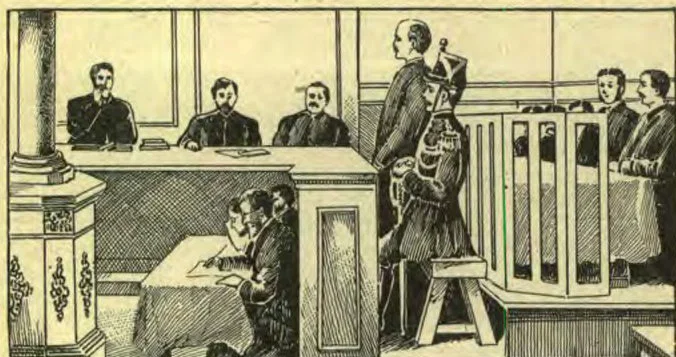
The officer reported the case to the magistrate, who was greatly enraged to think a stubborn German missionary had defied his authority. He summoned the offender to appear before him at once for trial. He expected to see a hard, defiant looking man when the prisoner was brought before him, and he was quite surprised when the officer brought in a very pleasant looking, calm, and perfectly composed Christian gentleman.
The magistrate said to the missionary: “You do not look like a bad man. Why did you disregard my warning, and baptize into another than the state church?” The missionary replied: “I am preaching the gospel and baptizing believers under a commission from the King of kings, which authorizes me to preach the gospel and baptize believers in every nation under heaven. No magistrate or officer of the law has a right to interfere with my carrying out that commission so long as I conduct myself civilly.”
He gave the commission as follows: “And Jesus came and spake unto them, saying, All power is given unto Me in heaven and in earth. Go ye therefore, and teach all nations, baptizing them in the name of the Father, and of the Son, and of the Holy Ghost: teaching them to observe all things whatsoever I have commanded you: and, lo, I am with you alway, even unto the end of the world. Amen.” Matt. 28: 18-20.
Commissioned by the Same King
The missionary then said: “This commission gives the gospel minister the right of way to preach and baptize believers in every nation, and to instruct them to observe all the teachings of Christ, unqualified by any requirement to surrender the rights authorized in this commission if opposed by the civil authorities.
“You, as a magistrate, are acting under a commission from the same King; and as a civil officer, you are a minister of God to keep the peace in the state, while I, as a minister of the gospel, preach the gospel and baptize believers. If we both keep our proper places, and each acts in his legitimate sphere, we will never conflict while in the performance of our duties, as we are both under commission from the same King.”
Turning to the officer, the magistrate said: “I have never had a prisoner before me who talked to me as this man has. I do not know what to do with him. There is a train just leaving for Germany, and I think we would better give him a passport and put him on that train, so sending him out of the country.” The passport was written, and the officer escorted the missionary to the train, giving him his passport, and he left for Hamburg, Germany, on the first train leaving the city after the baptism.
Magistrate Asks the Missionary to Return
One year later, the magistrate instructed his clerk to write to that missionary, inviting him to return and hold a series of meetings in the court room in which he was tried, saying that that talk about the gospel commission had remained with him ever since, and he desired to hear more of such gospel preaching.
This was a most remarkable overruling of divine Providence. He who from His throne in the heavens superintends His work on earth, declares that “all power is given unto Me in heaven and in earth.” This is the prelude to this authoritative commission. He heard the prayer of His missionary, reversed the decree of the magistrate, opened the prison doors, secured from an offended magistrate a passport, and sent His servant on his homeward way rejoicing in the omnipotent power of the commission which superintended his mission, and then impressed the magistrate to send for the minister to come back to tell him more of the sweet gospel story.
WANTED FOR MISSIONARY WORK
Clean copies of Signs and other Adventist literature for reading rack. A steady yearly supply is desired. Mrs. F. R. May, Box 145, Bartlesville, Oklahoma.
SIGNS, Reviews, and tracts, for free distribution. W. Davis Burt, R. D. 3, Nicholson, Pennsylvania.
A quantity of papers for missionary purposes. Mrs. Jennie Lamb, Cloverdale, California.
Clean copies of present truth publications, including War Extras. Please accept thanks for all such favors. Emma Kincaid, 2557 A Hebert Street, St. Louis, Missouri.
All denominational literature for missionary purposes. Mrs. Louisa Hedrick, L. Box 375, Lake Arthur, Louisiana.
A continuous supply of denominational papers, magazines, tracts, leaflets, etc., for free distribution in San Diego. J. Gregory, Paradise Valley Sanitarium, National City, California.
WANTED
Steady work on ranch by experienced man with family of small children. I know this party to be willing, experienced, and very handy with tools and other farm work, including milking. When I was on my ranch, I would have been glad to have steady help like this brother. For particulars address Joseph Clark, 1511 K Street, Sacramento, California.
TRUE WITNESSES
Present perils and abnormal world conditions are witnesses of the soon-coming King.
You have seen these witnesses, have heard them, felt them. All the world shares with you this knowledge. But do you know that they testify clearly that we are nearing the end of earth's history?
Two New Tracts—
Have We Come to Armageddon?
Sixteen Pages
Signs of the Times
Sixteen Pages
One cent each. Postage prepaid on orders of 10 cents or more.
Read them, and pass them out to your neighbors, that both you and they may understand the testimony of these true witnesses.
May be obtained from our depository in your state. (See page 15.)
Pacific Press Publishing Association
Mountain View, California
THE CENTRAL ROUTE
THE THREE BEST WAYS
BETWEEN
# California and the East
THE CENTRAL ROUTE
Less than three days to Chicago
THE SOUTHERN ROUTE
All rail or via the palatial Southern Pacific steamers between New Orleans and New York
THE SHASTA ROUTE
Via Portland or the North
The best of equipment and service
Protected throughout by automatic14block signals
INQUIRE OF ANY AGENT, OR
MR. C. S. FEE
General Passenger Agent
San Francisco, California
# SOUTHERN PACIFIC
Alcohol—The Destroyer of Men
By David H. Kress
Alcoholic Liquors Not Nutrient—Pathological Effects—Degeneration and Destruction Everywhere
A Brood of Curses Threatening Civilization
By DAVID H. KRESS
In many of our civilized countries, especially among the ignorant classes, alcoholic beverages have in the past been considered highly nutritious; and because they increased bodily weight, physicians recommended their use to the emaciated and the sick. The nursing mother took beer to increase the flow of milk, or because of the quieting influence it exerted on the nursing child.
As a result of these erroneous ideas, drunkenness among women increased, until this has become one of the most serious problems that confront Great Britain.
Beer and wine produce body weight, but this is no evidence that they are nutrients. The increase in weight is a pathological process, not a physiological one. While in appearance the drinker may be the picture of health, in reality he is a physical degenerate. He is incapable of recovering, often, from the mildest disorders.
Alcoholic drinks produce a species of degeneration of all the organs of the body, but they affect chiefly the heart, the liver, and the kidneys. Dr. Bollinger, of Munich, a city that has the reputation of consuming more beer than any other city in the world, says it is a rare thing to find a normal heart or a normal kidney in an adult resident of that city.
The degenerative effect on the organs mentioned is not the worst feature of this excessive consumption of alcohol. Alcohol affects the brain in the same manner that it affects the heart and the kidneys. It causes brain degeneracy, and moral degeneracy is always associated with brain degeneracy. In speaking of the influence of beer on the German nation, Prof. Edward von Hartmann says, "Although of all nations, the German has the highest capacity for culture, the general culture of its higher classes is undergoing frightful retrogression, because of the beer consumption of its students."
Dr. A. Forel, of the university of Zürich, says: "To be convinced of its moral effect, one needs only to study in Germany the beer jokes, the beer conversation, and the beer literature. Among the academic youth of Germany, the drinking of beer has truly killed their ideals and their ethics, and has produced an indescribable vulgarity."
Twenty years ago I was connected with a medical mission in one of the most degraded portions of the city of Chicago, where I had opportunity to observe the influence of drink upon the people. The misery, the sorrow, the degradation, physical, mental, and moral, were appalling. The inquiry frequently came to me, "What is responsible for all this wretchedness?" There could be but one answer—alcohol.
I recently visited some of the South Sea Islands, where the results of the use of alcohol are much more pronounced. In civilized countries, where the nature of these poisons is understood, their use is confined generally to adults and chiefly to men, and is discouraged among women and youth. It is not so among the natives of those islands. The results are sad indeed. The ungoverned passions stimulated by drink have dragged them down to an appalling state of degradation.
When Captain Cook first landed in the islands of New Zealand, he noted that the natives were perfect in form and features. At ninety they were still agile and active, showing little evidence of age or degeneracy. Serious wounds, he said, would heal without having any apparent attention. The Maoris were at that time pronounced the finest specimens with which the Anglo-Saxon race had been brought in contact. Now drunkenness is witnessed everywhere among them, and lewdness and immorality of the worst type exist. The Maoris of to-day are degenerates. They have been reduced in numbers from 120,000 to less than 40,000. Chief Justice Stout, of Wellington, in passing sentence in the case of a drunken native, said, "If this drinking among the Maoris is not checked, we are in measurable distance of the time when the Maori race will be exterminated."
The natives of Australia, when first discovered by the white man, were a strong, robust people. They are now almost extinct.
The same brood of curses is threatening the existence of civilized races, as well as the savage races mentioned. The death-rate of France exceeds the birth-rate. The French people are dying out, just as certainly as are the natives of New Zealand and Hawaii. America is not securely great. Like Babylon of old, she may say, "I sit a queen, and . . . shall see no sorrow," at the very time when the fearful results of drink and vice are writing her doom. Like causes, if continued, will produce like results.
GREAT BARS
By Eliza H. Morton
By Eliza H. Morton
BEFORE great bars the traffic stands
That leads men down to hell,
That asks for license to do wrong,
And sings, “All, all is well.”
Public opinion is a bar
To degradation low.
It puts a bar on the saloon.
Its bugle cry is NO.
Before the bar of science, pause,
You drunkards, ere you die.
Know, alcohol is death condensed.
Drink it and helpless lie.
The bar of common sense appeals
To all that’s noble, true.
It says to man: “Arise. Be strong.
The victory is for you.”
The bar of the eternal God
Condemns “high license” strife.
Wo, wo to him who builds with blood,
Who takes his neighbor’s life.
What Some Eminent Physicians Say About Alcohol
SIR ANDREW CLARK, great London physician: "I am speaking solemnly and carefully, in the presence of truth; and I tell you that I am considerably within the mark when I say that, going the rounds of my hospital wards to-day, seven out of every ten owe their ill health to alcohol."
DR. LORENZ, famous Austrian surgeon: "I am a surgeon. My success depends upon my brain being clear, my muscles firm, and nerves steady. No one can take alcoholic liquor without blunting these physical powers which I must keep on edge. As a surgeon, I must not drink."
PROFESSOR OSLER, "Principles and Practise of Medicine": "It was formerly thought that alcohol was in some way antagonistic to tuberculous disease, but the observations of late years indicate clearly that the reverse is the case, and that chronic drinkers are much more liable to both acute and pulmonary tuberculosis."
T. D. CROTHERS, M. D., Hartford, Connecticut, superintendent Walnut Lodge Hospital: "The latest and most authentic statistics show that over ten per cent of all mortality is due to the abuse of alcohol, and fully twenty per cent of all disease is traceable to this cause; also, that over fifty per cent of insanity, idiocy, and pauperism springs from this source. All authorities agree that from seventy-five to ninety per cent of all criminality is caused by the abuse of alcohol."
DR. WILFRED T. GRENFELL, missionary to deep sea fishermen, Labrador: "We find that the perils of the harbor are far greater than the perils of the sea; that more lives are ruined and more misery and suffering are caused by the vices of the port than by the shoals and hidden rocks along the coast." "It [intoxicating liquor] is far and away the most serious danger the seaman of this day has to contend with."
DR. CLOUSTON, quoted by Dr. Horsley in his "Alcohol in the Human Body": "From the medical and scientific point of view, we have this great physiological fact before us, that the first thing alcohol does in ninety-nine cases out of one hundred is to affect the mental working of the brain of the man who imbibes."
SIR THOMAS BARLOW, M. D., K. C. V. O., British Medical Journal, April 1, 1905: "Wine is not, as is supposed, 'the milk of the aged'; it tends to produce cardiac weakness, muscular and rheumatoid pains, and deterioration of the fine arterioles and blood-vessels. Alcohol is also responsible for much insanity and mental disorder."
SIMS-WOODHEAD, M. D., professor of pathology, university of Cambridge: "A man under the influence of small quantities of alcohol has no right to believe his own senses. He can not trust them to give him correct facts, and he can not rely upon his judgment for the interpretation of facts."
Bible Religion in Daily Life
"BIBLE religion is to be brought into all that we do and say. Human and divine agencies are to combine in temporal as well as spiritual achievements. They are to be united in all human pursuits, in mechanical and agricultural labors, in mercantile and scientific enterprises."
Russia—
"Turned Back" (by Japan?)
"Brought Forth"
(in the Present War?)
TITLE of an article appearing in the November number of the Signs of the Times Magazine. It is a study of the thirty-ninth chapter of Ezekiel.
Some of the others are: "Austria's Fate in the Present War"; "Demons Stirring Up War"; "Armageddon"; "Turkey's Attitude in This War"; "Our Times Foretold"; "How the European War Is Fulfilling Prophecy"; "Is the Anglo-Russian Alliance Foretold in Prophecy?" "Devil Worship in London"; "The Call of the Hour."
50,000 Copies
(Three Editions)
of the October number had to be printed to meet the demand. Agents, finding such a ready sale for it, ordered a second time. They will find the November number just as good, and we venture to say, "one better."
People want to know what the Bible says about European affairs.
Ezekiel, Daniel, Joel and Revelation
all foretold present-day conditions. Their prophecies are pointed out and explained in this magazine. That is what popularizes it with agents and readers.
Prices.—Single copy, 10c; $1.00 a year; 5 or more, one year, 60c each. 5 to 40 copies, 5c each; 50 or more, 4c each. Sell 25 and earn $1.25, or 50 and earn $3.00.
Send subscriptions and orders to our depository in your state.
Signs of the Times Magazine
Mountain View, California
Opportunity
Are you seeking an opportunity to engage in refined work that is pleasant and remunerative? Would such work be more attractive to you if it aimed at making strong-minded, moral men and women of our boys and girls? Hundreds of women, and some men too, have devoted a few hours each day during the fall and early winter months to selling the very attractive and easily sold small Books for the Home commonly known as
# 40%
BOOKS
While there is ready sale for these books the year around, still the months of October, November, and December are the harvest months. Parents, relatives, and friends are already planning their holiday gifts to the children and to one another. Their minds are especially receptive just now to suggestions for this purpose. Surely some of the six books for old and young, four for youth, three for children, and three others for the little ones, will supply their needs.
This is a picture of the Prospectus, which is furnished for $1.00 — the total cost of equipment. On two rings are attached all the covers, and samples from each of the sixteen books. This small, neat binder makes it possible to show the books to the very best advantage.
Previous Experience Not Necessary
Very often a mere sight of the sample covers and pages sells one or more of the books to a single individual. One woman, well advanced in years, sold 23 books, and made a little over $5.00 profit, and worked but part of two afternoons.
Another, who was in rather poor health, and thought she couldn't sell books at all, reports a sale of 89 books in a few days' time. Don't worry; you can sell them.
Your orders or request for further information will receive prompt attention from our depository in your state. Better write at once. Opportunity NOW knocks at your door.
Pacific Press Publishing Association
MOUNTAIN VIEW, CALIFORNIA
BOOK NOTICES
"A HUNDRED YEARS OF MISSIONS," by D. L. Leonard, D. D., associate editor of the Missionary Review of the World. Price, cloth, $1.20 net; by mail, $1.33. Funk and Wagnalls Company, New York and London.
This is the third edition of a book with which many students of missions are familiar. It is the story of progress which has been made since Carey's beginning, brought down to the year 1913, and thoroughly revised. Among its twenty-four chapters are, "The Christian Idea of Missions," "Missions in the Early Centuries," "The Non-Missionary Centuries," "The Reformation and the Discovery of America," "A Great Missionary Revival," and then, "The Various Missions in the Various Parts of the World," concluded with "A Land Which Remains to Be Possessed." Every student of missions should read the volume.
"THE BREAK OF DAY." A South African story by M. Sinclair Middlemiss. Drummond's Tract Depot, Sterling, Scotland; S. W. Partridge and Company, Ltd., London.
The object of the story is to show the work that has been wrought in South Africa in a missionary way—something of the progress that has been made. The little story tells what has been demonstrated by many a missionary's work,—what the gospel itself will do among the most ignorant and benighted.