PLEASE explain the meaning of the “third heaven,” in 2 Cor. 12:2, and “paradise,” in verse 4.
The “third heaven” is the place where God dwells by his own personal presence. The first heaven is where the birds fly, the aerial heaven, and the second is where the stars are, the sidereal heavens. See Gen. 7:23; Ex. 32:13; 1 Kings 8:30, and other texts. “Paradise” means a garden of delights, and the “paradise of God” is where he dwells, in the third heaven. See Rev. 2:7; 22:1, 2. The “third heaven” of 2 Cor. 12:2 is the same as the paradise of verse 4.
No. 315. The Passover.
WILL you please explain Ex. 12:14, 17? Why do not the Seventh-day Adventists keep the Passover, as the Israelites did? Christ kept it, did he not? Did he keep the Passover, as it is stated in Ex. 12:14–17? I. E. H.
We do not know as we could make the matter any plainer in the limits of this department, than it is made in Exodus 12. The word “forever” pertains to that age, as long as the Passover should exist. When Christ came, he was the Antitype of which the paschal lamb was the type. That Passover lamb and feast constituted one of the shadows that pointed to Christ. When the shadow reached the cross, the substance, the shadow ended. Col. 2:16, 17. Since our Lord died upon the cross, “Christ our Passover is sacrificed for us.” 1 Cor. 5:7. Yes, Jesus kept that typical Passover which was ordered of God. Previous to his death the offering of the paschal lamb was faith’s expression of belief in a coming Saviour, as well as a memorial of deliverance from Egyptian bondage. Since the crucifixion we have the Lord’s supper, a memorial of deliverance from sin in the death of Christ, and faith’s expression of his coming again. 1 Cor. 11:23–26. Seventh-day Adventists do not keep the ancient Passover, because, (1) they were never delivered from Egyptian bondage, and (2) because all typical feasts and offerings ceased at the cross. They find their protection and covering in the application by faith of the blood of Christ, the Lamb of God.
No. 316. The Camel for Food.
KINDLY explain Lev. 11:4. Does the camel divide the hoof and chew the cud, too?
The camel chews the cud; but it has no hoofs at all, simply a soft, cushioned foot. Cloven-footed is a hoof cleft, like an ox. In the camel only two of the toes of the foot are free, each of these terminating with a short and somewhat curved nail. The rest of the toes are connected by means of a broad elastic cushion, or pad.
No. 317. The Centurion’s Servant.
PLEASE explain the seeming contradiction, to say the least, between Matthew and Luke in the account of the centurion’s servant? F. M. J.
The account is found in Matt. 8:5–13 and in Luke 7:1–10. Matthew speaks as though the centurion did it all, while Luke says that the centurion sent his friends. This seeming difference may be explained on the simple principle, recognized in both legal circles and the Bible, that what a man does or says by his agents, he does or says himself. Thus the Bible declares that God created the world, but he did this through Jesus Christ. The men(261)sent by the centurion represented him, they stood in his place. This is illustrated by what the centurion said of his soldiers, and his faith that Jesus could send spiritual agents to heal his servant. He believed that Jesus could heal through angelic messengers, without being personally present, and yet the healing was of Christ after all. The principle was as true as regards the centurion.
No. 318. A Coming of the Son of Man.
EXPLAIN Matt. 10:23: “But when they persecute you in this city, flee ye into another; for verily I say unto you, Ye shall not have gone over the cities of Israel, till the Son of man be come.”
The whole discourse of chapter 10 had reference not only to the times of the apostles, but to the Christian dispensation. The twelve apostles should not go over the cities of Israel till Christ should be revealed in the glory of his majesty, as he was on the Mount of Transfiguration (see Matt. 16:28; 17:1–5, compare with 2 Peter 1:16–18), and in his suffering and death and resurrection for the race; but it is typical of the Christian dispensation, and the preaching of the Gospel to the nations of earth, and our Lord’s second coming.
No. 319. The “Four Beasts.”
WILL you kindly explain Rev. 7:11? What are the four beasts there mentioned? Also Dan. 12:11. Where does that period commence and where end? J. M. C.
1. The word “beasts” in Rev. 7:11 is an abhorrent translation. It is better as in the Revised Version, “four living creatures,” or “four living ones.” By reference to Rev. 4:6–8 and Ezekiel 1 we learn that these living creatures form the foundation of the living throne of God.
2. The 1,290 days of Dan. 12:11 are thought to begin in A.D. 508 and end in 1798, when papal supremacy was overthrown. See “Thoughts on Daniel and the Revelation.”
No. 320. Coming with His Saints.
WILL you please explain Jude 14, 15? Does it refer to the second coming of Christ? If it does, how is it in harmony with 1 Thess. 4:15–17; Matt. 24:31? How could he come after his people, and come with ten thousand of his saints? J. W. S.
The word “saints” in Jude 14 is translated from the Greek word hagiais, meaning simply “holy ones,” and God’s angels are holy ones. Rotherham’s emphatic translation reads, “Behold! the Lord came amid his holy myriads, to execute judgment,” etc. That angels are called “saints” see Dan. 8:13; 9:21; Luke 1:19. When Christ comes, it will be with the holy angels, after his holy people; both are saints, or holy ones. There is, therefore, no discrepancy between the texts cited by our querist.
The first text refers to the Spirit of God, which quickened, or made alive, Jesus Christ, “by which also he [Christ] went and preached unto the spirits in prison.” When? The next verse tells us it was “when once the long-suffering of God waited in the days of Noah, while the ark was a-preparing.” Then the Spirit of Christ strove with men (Gen. 6:3); and then Noah by the same Spirit was a “preacher of righteousness” “by faith” (2 Peter 2:5; Heb. 11:7). The second scripture—1 Peter 4:6—reads as follows: “For, for this cause was the Gospel preached also to them that are dead, that they might be judged according to men in the flesh, but live according to God in the spirit.” It was not preached to men while dead; for “the dead know not anything.” Eccl. 9:5. Their thoughts are perished. Ps. 146:4. See also Ps. 6:5; 115:17. It was preached to them that are dead, but it was preached to them when they were alive. And the Gospel was preached to them then, before Christ came to die, for just the same purpose that it has been preached since,—that they might be able to give an account to God in the judgment; that, while being in the flesh, they might live and walk in the Spirit. The passage is difficult and obscure, and is so considered by all commentators; but it should be understood in harmony with all other Scripture.
No. 322. Contributions.
IS IT right to solicit contributions from the unsaved to carry on God’s work? “Smith’s Bible Dictionary” says publicans and sinners were not allowed to put money in the alms box. If this be true, why should we do it now?
“The earth is the Lord’s, and the fullness thereof; the world, and they that dwell therein.” Ps. 24:1. All are his not only by creation, but by redemption. All persons are stewards, to whom God has intrusted life, intellect, influence, talent, property, means. Whether that stewardship is acknowledged by all or not makes no difference; all are responsible. But if any person, unconverted though he be, who holds in his possession the Lord’s means, gives it of his own free will to carry on the Lord’s work, let him give it. It belongs to God, and may be the means of bringing light to the sinner’s soul. But it is well to ask them for it in a reasonable, Christian way. If one unfaithful steward of God’s money should, however, give us money which we knew he had wrongfully taken from another steward, we should feel it our duty to restore it to whom it belonged. If we knew not, and the money was offered, we should take it as for the Lord, which his Spirit had stirred up his steward to give. What the Pharisees did or did not permit does not make law or right. Jesus said, “The publicans and the harlots go into the kingdom of God before you.” Matt. 21:31. See also Matt. 9:10, 11; Luke 19:7, 8.
No. 323. Remitting Sins.
Please explain the meaning of the statement in John 20:23 which reads, “Whosesoever sins ye remit, they are remitted unto them; and whosesoever sins ye retain, they are retained.” J. H. S.
It means that God authorized them to proclaim his word, in which is not only stated the terms of salvation, but salvation itself to those who receive it. To those who believe the word of God preached by the apostles there is remission of sins, but to those who believe not, their sins remain. See 1 Thess. 2:13; John 3:18; 9:41. So Jeremiah was set over nations and kingdoms to root out, to pull down, to destroy, and to build and to plant, but the prophet did this by declaring the word of God and its conditions, through which all these results were accomplished. Compare Jer. 1:9, 10 with chap. 18:7–10. So with the apostles and all true ministers of God’s word; they are savors of life unto life or of death unto death. See 2 Cor. 2:15, 16.
No. 324. The Lord’s Supper and Its Time.
Why is it that Seventh-day Adventists [and others] meet every quarter to partake of the Lord’s Supper? G. M. A.
There is no command for such a meeting once a quarter or against it. The time of the Passover is expressly given in Exodus 12. So also of other yearly feasts, of which each year of Levitical service was a type of the whole of our Lord’s work. The Passover was not only a type of “Christ our Passover” (1 Cor. 5:7), but a memorial of deliverance from Egyptian bondage (Ex. 12:14, 27). The Lord’s supper is an occasional symbol of a continuous feast on the word and life of Christ. It also looks forward to Christ’s second coming. Its frequency of celebration was left to the faith, discretion, and devotion of God’s people. When it is to be celebrated is thus stated, “As oft as ye drink it,” “as often as ye eat this bread and drink this cup, ye do show forth the Lord’s death till he come.” Among the early Christians it seems to have been celebrated daily. Acts 2:46. See No. 315, page 4.
No. 325. Is It Spurious?
REV. 20:5 is now considered spurious, not being found in the early MSS. or before the fourth century. M. H. W.
It is considered spurious only by those who have a point to prove. It is only omitted by the Peshito Syriac and Vatican MS. No. 1160; but it is found in the following MSS.: Codex Alexandrinus, Codex Vaticanus, and Codex Ephraemi Rescriptus, No. 9, supposed to be of the fifth, seventh, and fifth centuries respectively, which are presumably not copies of each other, but of earlier MSS. than the Syriac and Vatican MS. No. 1209. The revisers adopted for their revision the text “for which the evidence is decidedly preponderating,” and when that differed from the Greek text “from which the Authorized Version was made, the alteration be expressed in the margin.” (See Preface to Revised N. T., Division II, ¶ 4.) But there is not even an indication of doubt over Rev. 20:5.
Return from Captivity
By I. E. Kimball
ZION AND BABYLON. NO. 2.
BY I. E. KIMBALL.
Return from Captivity.
We have noted how the chosen people came to suffer the Babylonian captivity. But God spake of a return after seventy years. And I will now note its fulfillment; for all this is made the basis of a most interesting prophecy, which we will hereafter consider. The New Testament has her Zion and Babylon, her captivity and her deliverance therefrom, as we shall see.
The fall of Babylon by the might of the Persian arm opened the door for the deliverance of Israel. In the first year of Cyrus, of whom God had spoken, calling him by name, nearly a hundred years before his birth, he, now monarch of all the earth, decreed Israel’s restoration. Thousands received it with joy; the golden vessels which had been taken from the temple at Jerusalem were given into the hand of Zerubbabel; they were brought forth from the temple of Bel, and taken, together with a long train of captives, back to the6ancient sanctuary. Cyrus not only permitted but commanded the temple to be rebuilt. So Israel came home to the desolated cities of Judea and raised up their former habitations; and when the seventh month came, they congregated at Jerusalem, built the altar, and began to sacrifice. At the beginning of the second year, they were ready for work upon the temple.
Joshua and the Levites set forward the work amid mingled wailing and rejoicing. They wrought sedulously. The walls of Jerusalem went up, as declared in Ezra 4:12, and the parallel in 1 Esdras, where it is said: “They built the market places, and repaired the walls of it, and do lay the foundation of the temple.” Then the people of the land, who at first desired to build with them, began to weaken their hand. They hired counselors to oppose Israel during Cyrus’ reign. Cambyses was informed against them. Finally Smerdis, known as the Impostor, stopped the work by decree and armed force. “A troop of horsemen and a great multitude of soldiers in battle array” stopped the work. The walls of Jerusalem were now or later broken down, and the gates burned with fire, as finally reported to Nehemiah. So the work ceased for some fifteen years.
Then the prophets Haggai and Zechariah began to speak in no hesitating manner. The people believed, and went to work, altho straitened in every way, when, lo! a decree from Darius favorable to their building was issued. Even the royal treasury was opened to them for the completion of the work. So they prospered. At this second decree many came up from Babylon, as we should infer from the records, particularly in 1 Esdras. The prophets who set forward the work called upon the people to “flee from the land of the north” and “deliver themselves,” and many must have responded.
Then followed, after many years, another grand move, and a third decree from the Persian king, which accomplished the final restoration.
Ezra prepared his heart to teach Israel statutes and judgments. The king favored him wonderfully with munificent gifts, and all the money he could find in all the province of Babylon. Thousands responded from all quarters of the dispersion, and returned with Ezra to Zion. This was a full generation removed from the first exode from Babylon.
Then, too, just a little later, Nehemiah, who bitterly wept that the wall of Jerusalem was broken down and the gates burned, obtained leave of the king, and joined Ezra, taking precedence in the work. He would restore the walls and gates. The residents of Jerusalem began to build over against their own houses, and all Judea joined in the work. Then the enemy mocked and ridiculed; they conspired to stop the work by force of arms. But Israel builded and finished in troublesome times, with sword in one hand and implements for work in the other. Forty-nine years are allotted by the prophet to this work of building. See Dan. 9:25.
A word with reference to Babylon, which now crumbled to dust. God had said she should be as Sodom—fall from her lofty state, never to be rebuilt, she should be desolations forever. She became in the Medo-Persian reign a second-class city. Finally the inhabitants removed to Ephesus and elsewhere, and her walls were quarried for other cities; she became heaps and a den of dragons forever.
A Greater Restoration.
I have set forth the return from Babylon, and the particular stages in the restoration; for this is made to forecast a grander restoration, as we will now see by consulting the prophecy of Zechariah.
Let us note first that Joshua, the priest-head of the nation, was a type of Jesus, the Messiah; for the two names are identical in the Hebrew. Thus he bore the name of the One who first planted them in the promised land, and of the One who will restore them to it eternally. In the book of Esdras this priest is called Jesus. And we are not left in doubt as to the design of God in thus making the Jesus of that day a type of the Jesus to come; for Zechariah was commanded to take silver and gold and witnesses from some of the principal families of the captivity, together with the priest; he should then go to the house of Josiah and make crowns of the gold and silver in the sight of the chosen witnesses, placing them upon the head of Joshua. Then he should utter this prophecy:—
“Thus speaketh the Lord of hosts, saying, Behold the man whose name is The BRANCH; and he shall grow up out of his place, and he shall build the temple of the Lord; . . . and he shall bear the glory, and shall sit and rule upon his throne; and he shall be a priest upon his throne; and the counsel of peace shall be between them both. And the crowns shall be . . . for a memorial in the temple of the Lord. And they that are far off shall come and build in the temple of the Lord,” etc. Zech. 6:12–15.
Those “far off” signify the gentiles, as in Isaiah and in Paul’s writings. Indeed, the apostle’s words in Eph. 2:11–22 are but a commentary upon this very prophecy. “The temple of the Lord” in the New Testament is a living temple. “Ye are the temple of the living God.” “The house of God, which is the church of the living God.” So then the temple which Christ should build was his church, which the gates of hell can never prevail against. Christ himself is the chief corner-stone, as Paul says.
In the third chapter of Zechariah the priest (Joshua) is represented in earnest importunity before God with Satan, his adversary. Joshua is accepted, Satan rebuked,—the priest glorified and crowned. Then the angel connects with this the revelation of God’s “servant, the Branch,” who is spoken of as the stone “which I have laid before Joshua,” whereon should be graven “seven eyes.” The temple is immediately referred to, and the foundation which Joshua and Zerubbabel had laid years before is doubtless referred to.
They were now preparing to finish the work. God himself should grave the graving of these seven eyes upon this stone, and in that day the iniquity of all would be removed. See Zech. 3:8, 9. This refers to the day of Christ’s glorification, when he took all sin upon himself, and became our High Priest and Intercessor. Then were the seven spirits of God given to him, which are variously shown as seven eyes, seven horns, and seven lamps of fire, to show the all-discerning, all-powerful, all-illuminating Spirit, which is sent forth into all the earth. See Zech. 3:9; 4:2, 6, 10; Rev. 5:6; 4:5; 3:1. So in Zechariah’s prophecy, the lesson to be impressed upon Zerubbabel’s mind by this was that in the building of the temple he should rely wholly upon the Spirit of God. In explanation the angel said: “This is the word of the Lord unto Zerubbabel, saying, Not by might, nor by power, but by my Spirit, saith the Lord.” Mountains should become plains,—great difficulties be removed,—and they should bring forth the finishing stone, shouting the grace of God as manifest in the accomplishment of the building. He goes on to say that those seven were the eyes of the Lord which run to and fro through the whole earth. See Zech. 4:7–14.
As the word “Jesus” was significant, so “Zerubbabel” was also; for Haggai, who prophesied at the same time, looking to the day when the “Desire of all nations” should come, and the thrones and strength of the kingdoms of the heathen be destroyed, said, “Will I take thee, O Zerubbabel, my servant, . . . and will make thee as a signet,” etc. It would seem that more than his personal salvation in the last time is here shown. The name, signifying scattered to Babylon, or born at Babylon, is made to apply to all who return from Babylon. Zerubbabel, the builder, is a type of all the Gospel temple. Thus God has his Zerubbabel in the builders of to-day. Moreover, the fall of Babylon is ever taken as a bold type of the end of the world. See Isaiah 13; Jeremiah 25, etc. And, coupled with this, we have the return to Zion, with songs and everlasting joy. See Isa. 13; 14: 1, 2; Isaiah 34 and 35; Jeremiah 31, etc. Hence we conclude that the return was altogether a type for the Gospel dispensation, which we will proceed to consider.
TRUER, BETTER, BRIGHTER.
By Jennie Thayer
BY JENNIE THAYER.
[Suggested by a sermon on Evolution.]
How much truer the inspired record fair
Of the dawning of the day,
When dark night did flee away,
And, in six brief days of labor,
Bird and beast and man were neighbor,
Than the million-year story, ending—where?
How much sweeter ’tis to know He doth care
For the creatures of his hand,
Given life at his command,
Than that in remotest ages,
By obscure and doubtful stages,
Without plan, man evolved from—none know where!
How much purer faith in the Gospel rare,
In the love of God’s own Son,
And the vict’ry he hath won
Over all the hosts of evil,
Over sin and death and devil,
Than to think ourselves to soar—how? and where?
How much better humble, trustful prayer
For a heart refined and pure,
For a faith both tried and sure,
Than the wisdom of the sages,
Over which the whole world rages,
Leading on its followers—none know where!
How much surer trust that in Christ we’ll heir
Life eternal in that land
Where is seen no fun’ral band,
Where with joy each glad heart raises
Through eternity his praises,
Than that we ourselves have life—how? and where?
How much brighter is the hope soon to share
With our Saviour, Brother, Friend,
In a world that knows no end,
All the wonders of creation,
While we bow in adoration,
Than to pass from life away—none know where!
O, how cheering is the thought, in the air
He’ll receive us home at last,
Trials, doubts, and fears all past;
Free from sin and made immortal,
We will enter heavenly portal,
Live with Jesus Christ for aye—we know where!
TEMPERANCE LEGISLATION.
By W. N. Glenn
BY W. N. GLENN.
An act of Congress, passed in 1895, requires the Commissioner of the Department of Labor to secure information regarding the excessive use of intoxicating liquors among the employees of large corporations. In accordance with this law the Commissioner is said to be sending out a schedule of questions to the managers of large manufacturing establishments, transportation companies, etc. The spirit that lies behind the giant liquor interest is very prolific of schemes for leading the opposition into some roundabout chase in order to stave off any practical action. Statistics have long ago demonstrated the devastating effect of the use of intoxicating liquors. In fact, the dire results of such indulgence are plain to common observation without the formal processes of official statistics.
Such laws are generally the offspring of the liquor interest, and only serve as blinds to temperance people and temperance advocates, who are generally too easily quieted with that most deceptive of all subterfuges, the “half loaf.” One of the “reform” evils of the present day is a dependence upon securing reform through the civil law. This means a dependence upon the lawmakers, who, for the most part, are politicians whose principal object is reelection or promotion to higher place. They wish to be in favor with all classes, but especially with the class which is the most potent in politics, and that is the class which is under the influence of the alcohol habit and the liquor business.
The “temperance” people, many of whom are only nominally such, make demonstrative demands for legislation, and the liquor traffic consents to allow some “half-loaf” measure, some temporary mollifier of temperance zeal, something involving a long series of “red-tape” proceedings through the manipulations of those who can be influenced to bring it to naught. Investigations and statistics “drag their slow length along,” till the “half loaf”7finally crumbles away to give place to some new delusion.
Investigating the excessive use of intoxicants among the employees of great business corporations is one of the tamest pretenses in behalf of temperance that could be suggested. Of all the wage-earning classes in the world the employees of large corporations are the most abstemious. In these great institutions there is always much depending upon the alertness, promptitude, and general faithfulness of every one, in whatever position. Therefore managers require sobriety on the part of employees, and employees know that their positions are always at stake. So, whatever might be their inclination under other circumstances, the one thing most of all that is demanded of such employees is sobriety.
This is a point that is quite generally overlooked in the wholesale summing up of the dreadful effects of liquor drinking among wage workers. It is easy to see that the selection of this class for government investigation was a shrewd game in the interest of the liquor traffic. Any report that is likely to come of such investigation will, almost to a certainty, be to the advantage of the liquor power.
Many temperance people are deluded with the idea that high license is a long stride, a “half loaf,” in the securing of prohibition of the liquor traffic; but it transpires that the powerful California Protective Association, composed of some 8,000 wholesale and retail liquor dealers, is making an effort to secure a state high license law for the protection of the liquor business. The underlying design is thus to place the business entirely under the control of state authority—away from the local influence of municipalities that from time to time may be controlled by temperance sentiment. But the siren song of a high license law is very soothing to some ardent temperance advocates.
Another pretty idea is just now looming up in the way of proposed legislation. The governor of California proposes, it is said, to lay a considerable portion of the burden of supporting insane and inebriate asylums upon the liquor traffic, by a direct tax. The plausible plea is that “the liquor traffic is directly responsible for a major portion of the insanity, pauperism, and crime of the state.” Many temperance people are hailing this proposition as a blow at the liquor business; but while the governor is gathering statistics, the president of the Protective Association comes out with a statement that the idea originated with them.
The liquor men now boast of their support of the public schools, and if they can add to that a few other good things, they will become so entrenched in the good works of our common society that their business will be deemed indispensable to the public treasury. The great enemy of souls is about as anxious to manipulate the so-called temperance legislation in the interest of alcoholism as he is to introduce legislation in regard to religious matters. His strong fortress is deception; the modern politician is his pliant, though often unwitting tool; and human legislation is a potent means of securing his varied objects.
THE GLORY OF GOD REVEALED IN MERCY.
By Ellen G. White
BY MRS. E. G. WHITE.
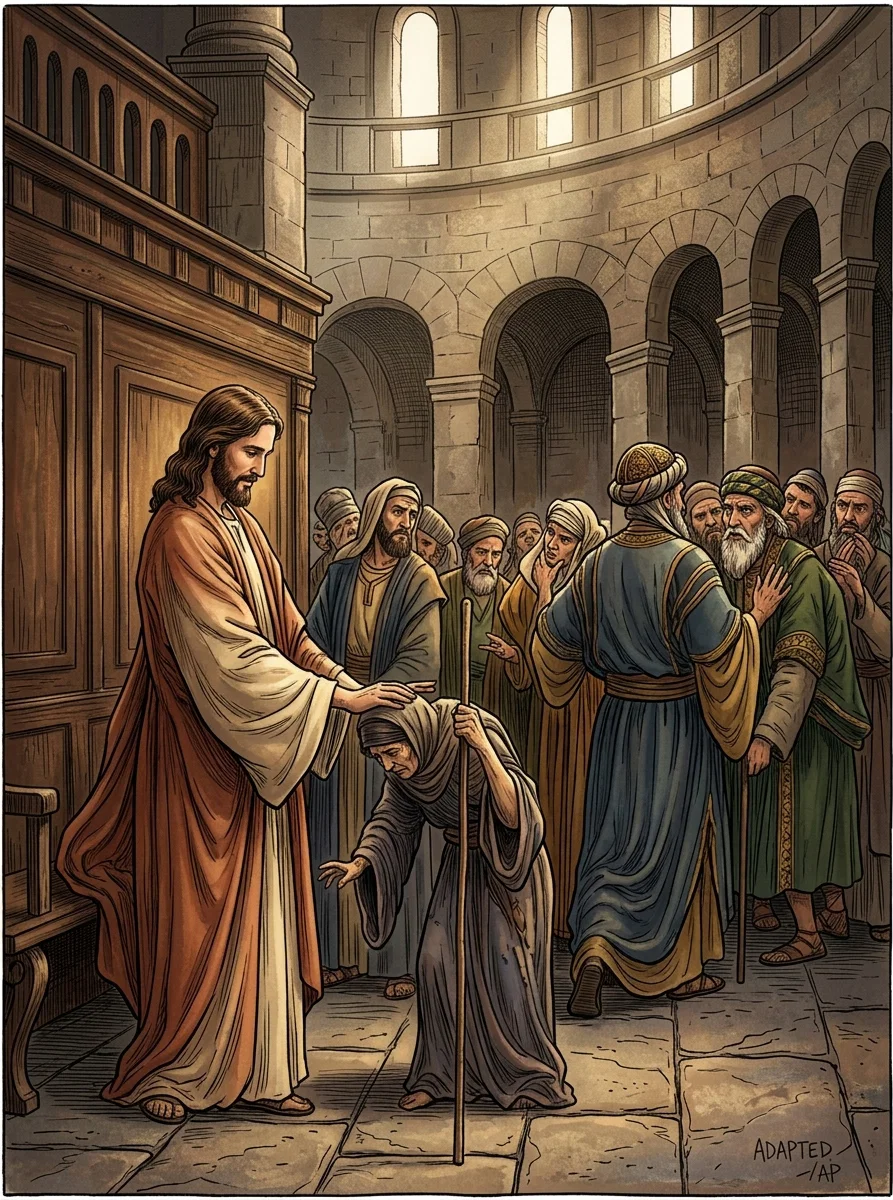
“And he was teaching in one of the synagogues on the Sabbath. And, behold, there was a woman which had a spirit of infirmity eighteen years, and was bowed together, and could in nowise lift up herself. And when Jesus saw her, he called her to him, and said unto her, Woman, thou art loosed from thine infirmity. And he laid his hands on her; and immediately she was made straight, and glorified God.” The compassionate heart of Christ was touched at the sight of this suffering woman, and we should suppose that every human being who looked upon her would have rejoiced that she was loosed from her bondage, and healed of an affliction that had bowed her down for eighteen years. But Jesus perceived by the lowering, angry countenances of the priests and rabbis that they felt no joy at her deliverance. They were not ready to utter thankful words because one who had been suffering and deformed by disease was restored to health and symmetry. They felt no gratitude that her deformed body was made comely, and that the Holy Spirit made glad her heart till it overflowed with thankfulness, and she glorified God. The psalmist says, “Whoso offereth praise glorifieth Me.” But in the midst of the words of gratitude is heard a discordant note. “And the ruler of the synagogue answered with indignation, because that Jesus had healed on the Sabbath day.” He was indignant that Christ had caused an unhappy woman to sound a note of joy upon the Sabbath. In a loud voice, harsh with passion, he said to the people, “There are six days in which men ought to work; in them therefore come and be healed, and not on the Sabbath day.”
If this man had really had conscientious scruples in regard to the true observance of the Sabbath, he would have discerned the nature and character of the work that Christ had performed. If he had cultivated truth and righteousness in his heart, he would have given an entirely different interpretation of the work which was performed on the Sabbath day, and which he said belonged to the six working days. The work that Christ had done was in harmony with the sanctification of the Sabbath day. The people on this side and that side wondered and were glad at the work that had been wrought for the suffering woman; and there were those whose hearts were touched, whose minds were enlightened, who would have acknowledged themselves the disciples of Christ, had it not been for the lowering, angry countenances of the rabbis. The people knew that if they expressed their admiration of Christ, it would cost them something. Many believed on him, but dared not confess their faith, fearing that they would be turned out of the synagogue. They loved the praise of men more than the praise of God.
In the work of mercy which Christ had performed, his divine power shone forth, and testified that his resources were found in the only true and living God. Many were obtaining a correct knowledge of God, and by faith in Christ were getting a better acquaintance with the Way, the Truth, and the Life. To the angry rebuke of the ruler of the synagogue Jesus replied with dignity and authority. In distinct utterances the voice of Christ was heard saying: “Thou hypocrite, doth not each one of you on the Sabbath loose his ox or his ass from the stall, and lead him away to watering? And ought not this woman, being a daughter of Abraham, whom Satan hath bound, lo, these eighteen years, be loosed from this bond on the Sabbath day?” They had condemned Christ for relieving a suffering woman, who had been under affliction for eighteen years, when they themselves would not scruple in relieving the thirst of a beast on the Sabbath day. They would not leave their ox or their ass tied up in the stall when it was in need of water, but would lead it out where water might be obtained. He pointed out their inconsistency, saying, You feed your cattle on the Sabbath, and yet you are angry with the people who are sorely distressed and suffering, who are under the oppressive power of Satan, because they come on the Sabbath day to be healed. You do a work of mercy for your beast, but pass judgment because I have broken Satan’s power and set free a daughter of Abraham on the Sabbath. “And when he had said these things, all his adversaries were ashamed; and all the people rejoiced for all the glorious things that were done by him.”
The rabbis had taught the people that all who were of Jewish extraction were holy and peculiarly favored of heaven. Why did they not lift up their voice in gratitude to God because this suffering daughter of Abraham was freed from her long bondage? The woman had not been possessed in spirit, but the Lord had suffered Satan to exercise his will8in bringing disease upon her; for God was demonstrating the character of his kingdom before the whole universe of heaven. This opportunity must be given him to reveal the character of apostasy. The inhabitants of worlds unfallen could view in this case the attributes of Satan and the character of God. The law of God is a transcript of his character. The rebel leader was in opposition to the law of God, and revealed the fact that his principles were those that actuated one who is lawless, disobedient, unholy, an accuser, a liar, and a murderer. The true character of the ruler of the synagogue was laid bare, and it was made manifest that he was on the side of the great rebel, tho sanctimoniously professing to be very punctilious concerning the law of God. He knew not the principle of love that underlies the commandments, and preferred that the woman should suffer rather than that Jesus should work a miracle to heal her, and thus counteract his work of misrepresentation. Tho the rebuke of Jesus brought reproach upon his adversary, and tho the people rejoiced because of all the glorious things that were done, yet the ruler never forgave Christ for departing from the maxims, customs, and commandments of men, with which the rabbis had burdened the law of God and obscured its spiritual significance.