Review and Herald Publishing Company · Battle Creek, Mich. · Jun 13, 1901
Arrival at Penang: A Voyage from Calcutta
By Mrs. J. S. Place
Penang
Who knows where it is?—I did not until the morning of this last January 25, when on board the “Arratoon Apcar,” bound from Calcutta to Hong-kong, we steamed into its harbor. If your atlas is handy, you can find it on the west coast of the Malay Peninsula. For nine days we had been out from Calcutta,—only thirteen hundred miles,—but we had been running very leisurely on account of plague restrictions, which forbade any vessel of that line, leaving Calcutta, to land passengers at any port for nine whole days. Two of these days had been spent on the muddy Hughli, and the other seven on the beautiful blue waters of Bengal Bay, bluer than which our eyes never saw; delightfully calm, too, it had been all the way, and with a pleasant company of home-returning missionaries and American tourists, we had enjoyed the journey very much.
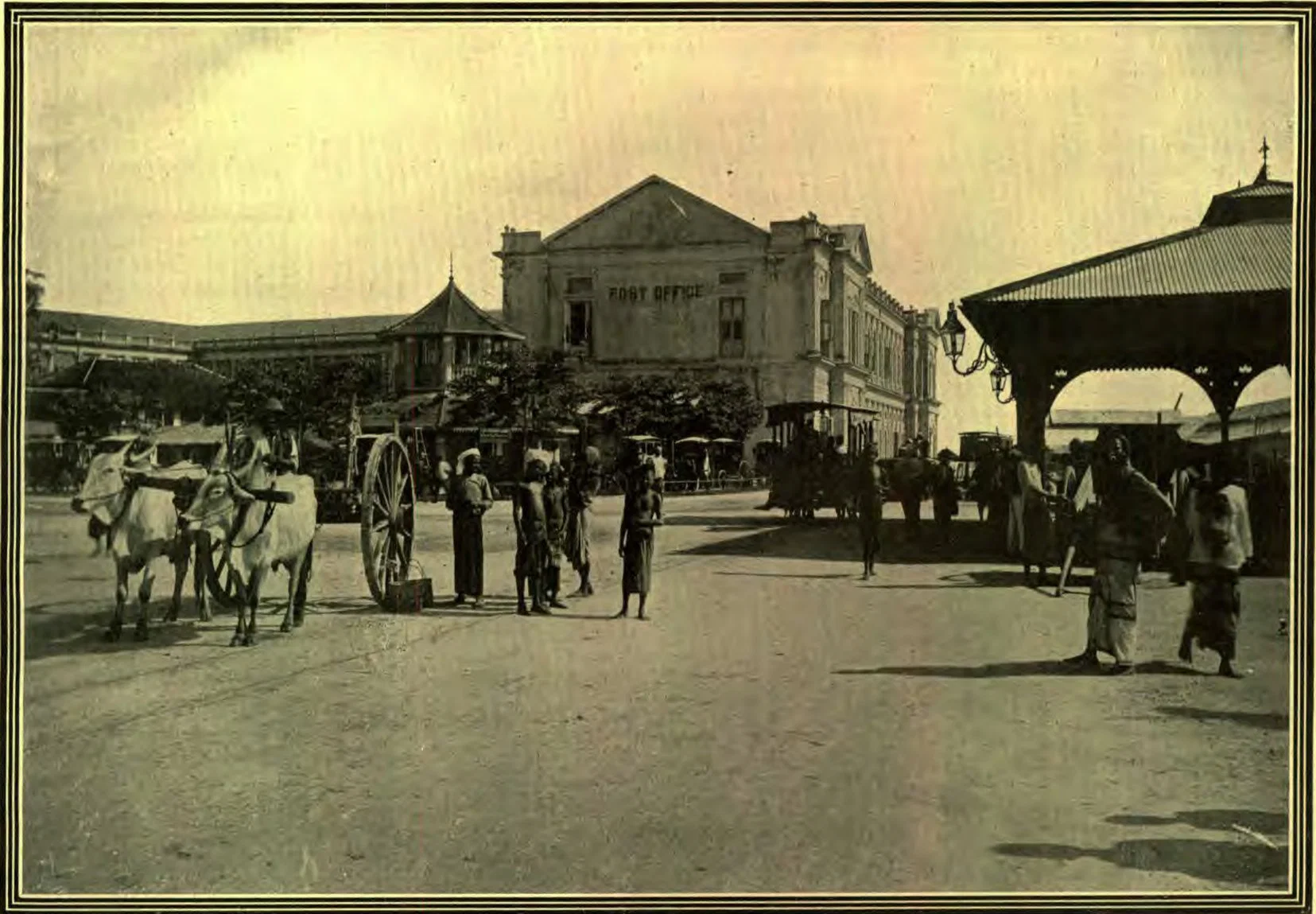
STREET SCENE IN PENANG
For a day or two the monotony of sea and sky had been broken now and then by little islands along the horizon. The Andamon group we had passed on our right, the southernmost of which is a penal colony for all India. Very pleasant, ever-green islands they are, there in the blue sea,—so pleasant that oftentimes the prisoners choose to remain after their term has expired.
Notwithstanding these occasional “breakers,” we were delighted that early morning with our first glimpse of Penang Island. I did not know that it was an island, and was consequently surprised at seeing it off to our right, our ship having changed her course during the night, and run up around into the narrow strait between the mainland and the island, which makes a very good harbor. The real name of the harbor is Georgetown, but being the principal point of interest about the little island, it all goes by the name of Penang.
It seemed good to set our feet on land again, but as we directed our steps toward the post-office, we were surrounded by jinrikishas, pulled by hardy Chinamen, who seemed to think our feet ought not to set on land, but the rather step into their vehicles. This we did, and had a pleasant ride all about town. Bayard Taylor called Penang “the most beautiful island in the world,” and it is indeed a lovely spot.
The ’rikisha men are muscular fellows indeed. They will trot off at a lively rate, any time of day, with two good-sized persons in their carriage . Their hearts and lungs, however, do not usually endure more than five or six years of such service.
Although within six degrees of the equator, with an average temperature of eighty degrees, this island is crowned with a hill two thousand seven hundred feet high, which furnishes a fine resort for the European inhabitants when they wish to escape the heat.
About one hundred years ago Penang was ceded to the British by the sultan of Kedah. During the reign of the East India Company, it was the seat of a presidency government, and was a peer of Bengal and Bombay. Although it has fallen from this height, it holds rank to-day as quite an important shipping-station. Its principal exports are tin and pepper. Of the former our ship took on one hundred and twenty tons.
The inhabitants are mostly of the Malay type. As we rode about through the streets of the town, we thought, Surely there are some hearts among these who long to know more truth. Who will tell them about Jesus and his coming?—Some one will. Who will it be?
Mrs. J. S. Place.
Schooling of Boys and Girls in India
IN India one boy in five attends some school but only every fiftieth girl.
JOSHUA'S LAST WORDS
By Ellen G. White
For several years the children of Israel had been in possession of the land of Canaan. The wars of conquest ended, Joshua had withdrawn to the peaceful retirement of his home at Timnath-serah.
“And it came to pass a long time after that the Lord had given rest unto Israel from all their enemies round about, that Joshua . . . called for all Israel, and for their elders, and for their heads, and for their judges, and for their officers.” The Lord had impressed his faithful servant to do as Moses had done before him,—to recapitulate the history of the people, and call to mind the terms which the Lord had made with them when he gave them his vineyard.
Several years had passed since the people had settled in their possessions, and already could be seen cropping out the same evils that had heretofore brought judgments upon Israel. As Joshua felt the infirmities of age stealing upon him, he was filled with anxiety for the future of his people. It was with more than a father's interest that he addressed them, as they gathered once more about him. “Ye have seen,” he said, “all that the Lord your God hath done unto all these nations because of you; for the Lord your God is he that hath fought for you.” Although the Canaanites had been subdued, they still possessed a considerable portion of the land promised to Israel, and Joshua exhorted the people not to settle down at ease, and forget the Lord's commands utterly to dispossess these idolatrous nations.
The people in general were slow to complete the work of driving out the heathen. The tribes had dispersed to their possessions, and it was looked upon as a doubtful and difficult undertaking to renew the war. But Joshua declared: “The Lord your God, he shall expel them from before you, and drive them from out of your sight; and ye shall possess their land, as the Lord your God hath promised unto you. Be ye therefore very courageous to keep and to do all that is written in the book of the law of Moses, that ye turn not aside therefrom to the right hand or to the left.”
Joshua appealed to the people themselves as witnesses that, so far as they had complied with the conditions, God had faithfully fulfilled his promises to them. “Ye know in all your hearts and in all your souls,” he said, “that not one thing hath failed of all the good things which the Lord your God spake concerning you; all are come to pass unto you, and not one thing hath failed thereof.” He declared that as the Lord had fulfilled his promises, so he would fulfill his threatenings. “It shall come to pass,” he said, “that as all good things are come upon you, which the Lord your God promised you; so shall the Lord bring upon you all evil things. . . . When ye have transgressed the covenant of the Lord, . . . then shall the anger of the Lord be kindled against you, and ye shall perish quickly from off the good land which he hath given unto you.”
Satan deceives many with the plausible theory that since God's love for his people is so great, he will excuse sin in them; that while the threatenings of God's word are to serve a certain purpose in his moral government, they are never to be literally fulfilled. But in his dealings with his creatures, God has maintained the principles of righteousness by revealing sin in its true character,—by demonstrating that its sure result is misery and death. The unconditional pardon of sin never has been and never will be. Such pardon would show the abandonment of the principles of righteousness which are the very foundation of the government of God. It would fill the unfallen worlds with consternation. God has faithfully pointed out the results of sin, and if these warnings are not true, how can we be sure that his promises will be fulfilled? That so-called benevolence which would set aside justice, is not benevolence, but weakness. God is the Life-giver. From the beginning, his laws were ordained to give life. But sin broke in upon the order that God had established, and discord followed. As long as sin exists, suffering and death are inevitable. It is only because the Redeemer has borne the curse of sin in our behalf, that man can hope to escape its dire results.
MRS. E. G. WHITE.
CANVASSING IN THE SIERRAS
By Wm. Yarnell
(Concluded)
THERE are a great many high mountains on the road between Sierraville and Sierra City. These had to be crossed on foot that August day; for I had been compelled to throw away my wheel. As one nears the town, he sees large, red-painted quartz mills on every side. Leading to one of these is an enormous, elevated cableway, formerly used to carry ore from the mine to the mill. These mills, however, are all still. The machines once used in pounding out the gold that gave to California such a glittering reputation, now stand idle and useless.
On a leveled portion of the mountain-side is the business avenue of the city. Far up the mountain small houses are stuck, as on stilts. Should one be so unfortunate as to fall from the front window of one of these houses, he would probably descend a long way down the mountain before stopping.
I did not consider it wise to test the generosity of the people. What one could see and hear on the street was a sufficient evidence of their poverty, and of their disapproval of anything in the book line. A fruit dealer offered me a ride to Downieville. As we were jogging along, he pointed out the bones of a horse in the chasm below, afterward telling how its careless driver had gone a little too near the edge of the grade. Many wild plums grow on these mountains, the most of them being gathered by the people before the fruit is ripe.
Downieville was once the Klondike of America. Most of its mines are still operated. Fabulous tales are told about rich nuggets picked up in surrounding cañons. The town is situated on the forks of a mountain stream, a part being built within the forks, and a part on each side of the river proper. Several bridges connect the different portions. Baggage is carried by burros, a large number of these little animals being driven along by a man on horseback. Being tempted to give up the canvassing work, I visited the schoolmaster. “No! stay with it through thick and thin,” he said; “the world is full of men who quit; we want men who will hang on.” So saying, he signed for one of the books, and paid for it in advance.
Three days later found me pressing onward over an eight-mile mountain trail toward Missippi, a place without banks or stores, merchants or farmers, or even a wagon-road. Near a high summit were a few wild raspberries. Otherwise, the trip was uninteresting in the extreme.
Rising at half-past four the next morning, I started for Moor’s Flat. For two and one-half miles the trail was down a grade to be traveled more easily by winged creatures than by those depending on feet. On the other side of the stream, the middle fork of the American River, is a smaller trail, which one must climb. The denomination of values in Moor’s Flat is not coin, but fruit, vegetables, and groceries. One man alone assumes the responsibility of providing the people with groceries.
As I walked on toward Bloomfield, a larger city (it would be considered by the inhabitants an insult to call it a town) than any I had yet visited, I met a Chinese fruit peddler. He stopped his horse, asked me about my trip, tried to cheer me up, then, reaching his hand down in a box, inquired, “You likee peachy?” and handed me two large, juicy peaches, which would have tempted a more fortunate person than I.
Two orders rewarded my efforts in Bloomfield. After leaving, I had not walked many miles before being invited to ride by a kind-hearted doctor of Nevada City. After crossing the South fork of the American River, we drove up a very steep grade. When we were about half way up, I noticed an inscription on a large rock. The doctor told me that it was in memory of a man who had, at that very place in the road, been murdered by men desiring the gold which he was taking to the city.
At length we came in sight of Nevada City. Its large buildings, paved streets, sidewalks, business houses, banks, its free library and churches, and the shrill whistle of a locomotive in the distance, reminded me of home, and filled me with joy that soon I should be permitted once more to be with my friends.
WM. YARNELL.
ALONE
It is human to stand with the crowd; it is divine to stand alone.
It is manlike to follow the people, to drift with the tide; it is godlike to follow a principle, to stem the tide.
It is natural to compromise conscience and follow the social and religious fashion for the sake of gain or pleasure; it is divine to sacrifice both on the altar of truth and duty.
“No man stood with me, but all men forsook me.” wrote the battle-scarred apostle in describing his first appearance before Nero to answer for his life for believing and teaching contrary to the Roman world.
Noah built and voyaged alone. His neighbors laughed at his strangeness, and perished.
Abraham wandered and worshiped alone. The Sodomites smiled at the simple shepherd, followed the fashion, and fed the flames.
Daniel dined and prayed alone. Elijah sacrificed and witnessed alone. Jeremiah prophesied and wept alone. Jesus loved and died alone.
And of the lonely way his disciples should walk he said, “Strait is the gate, and narrow is the way, which leadeth unto life, and few there be that find it.”
Of their treatment by the many who walk in the broad way he said, “If ye were of the world, the world would love his own: but because ye are not of the world, . . . therefore the world hateth you.”
The church in the wilderness praised Abraham, and persecuted Moses. The church of the Kings praised Moses, and persecuted the prophets. The church of Caiaphas praised the prophets, and persecuted Jesus. The church of the popes praised the Saviour, and persecuted the saints. And multitudes now, in both the church and the world, applaud the courage and fortitude of the patriarchs and prophets, the apostles and martyrs, but condemn as stubbornness or foolishness like faithfulness to truth to-day.
Wanted, to-day, men and women, young and old, who will obey their convictions of truth and duty at the cost of fortune and friends and life itself!—Selected.
Lo, I Am With You Alway
“Lo, I am with you alway.”
Secure
By Frank Walcott Hutt
What of the morrow? Lord, in thee confiding,
Let me not doubt thy promise and thy power;
I shall not fear, within thy love abiding
In peace this very hour.
I shall not dread the dark of any sorrow,
Nor any woe that compasseth my way,
Since thou wilt safely guide me through to-morrow,
Who keepest me to-day.
— Frank Walcott Hutt.
UNDER THE WAGON-SHEET
By Minnie Rosilla Stevens
Only a few years ago, as every one knows, the thriving Territory of Oklahoma was little more than a wilderness belonging to Indian tribes. Then her forest trails were traveled chiefly by Indians or cattlemen; while Uncle Sam’s blue-coated sentinels kept guard over the solitude.
But the snap of a pistol at noonday changed all that. As if by magic, homes of white men appeared where the smoke of camp-fire and tepee had ascended, and savagery gave way to civilization.
The rush of immigration into Oklahoma was tremendous, and a trip thither at that time was novel, to say the least. In a wagon devoted especially to our use, two other women and myself made the journey when enthusiasm over the new Territory was at its height; and some of our haps and mishaps on the way may interest those who never made a trip overland in a wagon-train.
THE SITUATION
By far the larger portion of settlers entered Oklahoma from Kansas. At the time of the opening, there were only one or two railroads in the whole Territory; therefore nearly all travelers were obliged to journey to their new homes in the regulation canvas-covered mover’s wagon. For weeks a steady procession of these white-topped “prairie schooners” crossed the Kansas line, and after traversing the Cherokee Strip, dispersed in all directions, each finding port at last on a quarter section of land.
We had never traveled in this way, but being among the settlers of a remote section of the new country, we could reach our destination in no other way. We were inclined to think the new mode of travel would be amusing, or at least enjoyable, and hoped for new experiences on the way. The wish was gratified, but whether pleasantly or otherwise, I will leave you to decide.
OUR FIRST NIGHT IN A MOVER’S WAGON
As we women had never tried sleeping in a wagon, we thought it would be advisable to make our first attempt to do so, in advance of necessity. Out in the starlight the four wagons stood, loaded and ready to start, each with its white cover, protected on top with a strip of shiny new oilcloth. We climbed up on the tongue, and squeezed through the narrow, oval opening above the dash-board. A small rope had been run into a casing in the end of the wagon-sheet, drawing it up, shopping-bag fashion, until it fitted snugly to the wooden frame beneath. It was a gymnastic feat to wriggle our way into the wagon, between the puckers of the draw-string; but we finally tumbled down on the blankets inside, and surveyed, as well as the darkness permitted, our novel sleeping-room. The space seemed limited for three, but with much adjusting we finally so arranged matters that we thought it would be possible to pass the night in tolerable comfort.
With the usual foolish dread of “night air,” — as if the One who made air for his children and all created creatures would not provide suitable air at night as well as during the day! — we carefully stuffed surplus garments into the opening at each end of the wagon cover, then slipped rather dubiously into our allotted places. It was crowded and close, but we all disdained speaking of these discomforts, and finally fell asleep in spite of them.
The next thing I remember was waking up gasping for breath. I gave a half-suffocated scream that wakened the others, who joined their voices with mine. We made a frantic scramble for the exit, and one after another crept out into the cool night air, which for the first time in our lives we really appreciated. We soon recovered breath to sustain a vigorous tirade against covered wagons in general, and every person who should venture to suggest one as a sleeping apartment; then with an extra blanket or two we repaired to the empty house, and there passed the remainder of the night.
The men in the other wagons slept comfortably on, allowing free ingress to the fresh air. In stopping the ventilation in our wagon, we had failed to take into consideration the air-tight oilcloth over the top, consequently we were soon suffocating. It is hardly necessary to say that we did not undergo the same experience twice during the journey. Before sleeping elsewhere, we had learned to find all the comfort contained in a mover’s wagon berth; but at its best we can not commend it as a bed of roses.
THE CARAVAN
The next morning our departure was delayed in various ways, and the sun had completed half his upward journey when at last we drove slowly down the lane of silver poplars, and turned into the highway leading south. It was a bright day in early March, and our hearts beat high with pleasant anticipation. Four heavily loaded wagons formed the body of the train, accompanied, according to their own sweet will, by a colt, a frisky heifer, a sober old cow, and a handsome greyhound. Bringing up the rear was a rather seedy phaeton, drawn by a sorrel pony of great age, but possessing no other particularly remarkable feature, unless it was a mouth as hard as adamant, and an innate stubbornness, for which the only remedy was a long hickory, liberally applied. At the back of the wagon devoted to our special use, had been built a small crate, inclosing a calf too young to travel otherwise, but in its little stall it rode safely the whole distance, faithfully followed by its anxious mother.
Our family and two hired men completed the retinue; and thus we began our journey. Jog, jog! jolt, jolt! for three long weeks we went, over hills and rocks, through valleys and mud, ever southward toward “Beautiful Oklahoma,” the modern “promised land.”
STUCK IN THE MUD
Recent rains made the roads rather rough, but they were dry except where patches of “hardpan” retained moisture indefinitely. In such spots, travel had mingled earth and water into stiff mud of astonishing depth and stickiness. Woe to the traveler who should enter such a morass carelessly; to him Bunyan’s “Slough of Despond” would no longer seem a figurative, but a most literal horror, brought down to date.
We jogged gently along for three or four miles, and were beginning to think about camping for dinner. In the road just ahead was a dark, muddy looking spot, impossible to avoid; but as it did not appear at all dangerous, we approached it without apprehension. “In we plunged boldly,” but, alas! we could do nothing else; and after a few frantic plunges, we came to a decided stop in the middle of the bog. No amount of shouting or lashing could infuse sufficient energy into the struggling team to move the heavy wagon farther. As the wheels settled deeper and deeper into the mire, it became cruel to compel the horses to further efforts, and some of the men set out for the nearest farmhouse, in quest of shovels and levers to pry the wagon from the mud. The memory of that scene is still rather painful. Suffice it to say, we women sat by the roadside the whole afternoon, watching the men at work about that unfortunate wagon. The sky clouded over, and it had begun to rain dishearteningly when at last, with four horses in the traces, and a shout and a struggle, the heavy vehicle rolled out upon solid ground. The others in the train followed safely in turn, and we drove on two miles, camping for the night at a vacant farmhouse about six miles from our starting place.
Minnie Rosilla Stevens.
(To be continued.)
ONE OF HIS ANGELS
FOUR years ago the doctor spent a fortnight with his old college friend, Judge Rush.
The visit was a painful one. The old Rush mansion was stately as ever; the white-haired judge as warm-hearted and chivalric as when he was a schoolboy. But his only son, Harry, had married a village girl whom the judge regarded as his inferior. Already Harry had begun to drink and gamble. They were all unhappy.
The doctor cut short his visit. The beautiful old home, he felt, was full of hidden jealousy and hate. Not even one of God’s angels,—not death itself,—he thought, could ever set it right.
It was three years before he went to the house again. Harry wrote, begging him to comfort his father by a sight of his old friend. The letter was cordial and affectionate, “not like Harry,” he thought. The young man met him at the station with an eager welcome. He had changed in some strange way, was graver, simpler; he was an earnest man, no longer a vain boy.
The doctor found the judge in his chamber at luncheon. It was served daintily on a little table, and Harry’s wife was attending to his wants.
“Sit down, sit down, and take a bite with me!” cried the judge. “I can’t leave my room, and I can’t lose sight of you. Mary will bring another plate. She is very good to me,” looking affectionately at her, as she nodded and hurried away.
The doctor was puzzled. As he talked with the judge, he found he had lost his old cynical, bitter humor.
But in the woman the change was startling. The vanity, the self-assertion, were gone. She was gentle, earnest, tender in her manner, but in her face there was a look which the old doctor could not interpret. He spoke of it to the judge.
“Yes, yes, poor Mary!” The old man adjusted the cups hurriedly, his voice choking. When he could control it, he continued: “It’s the baby, you see,—our little boy. She’s never lost him out of her mind for a minute, poor girl!”
“I—did not know,” stammered the doctor.
“Yes. We lost him last March. Two years old.” The old man was silent a while. “A most remarkable boy, doctor. I thought I was going to live over my life in him. I’ve his picture here, but it does not hint what he was. He brought us all together. I never knew Mary until I saw her wisdom and devotion with him. Well, well, God knows best!”
That evening, when the doctor came in to bid his old friend good night, he found the Bible open before him. The old man smiled and touched it. “Yes, I neglected that sort of thing all my life; but now I’ve a long journey before me, and I must find out how to make it.” He bade the doctor good night, but held his hand a minute. “Some day,” he said, with a smile, “I shall see the boy again.”
“He sends his angels where he will,” the doctor murmured, as he walked away, “but they come oftenest, like their Master, as a little child.”—Selected.
THE WORLD'S PARTNER
I SHARE the fragrance of the air
That blows across the hill.
I may not set my tent up there;
Another owns those fields, but still
God gives me sight, that I may gaze
On all the lovely scene,
That I may see the trees ablaze,
And watch the herds and flocks that graze
Contented and serene.
I may not pluck the radiant rose
Whose fragrance comes to me;
Upon another's vine it grows,
But all its beauties I may see!
God gives me sight and scent, that I
The rose's charms may know.
The tinkling brook that babbles by
Flows where another's lowlands lie,
But I may hear it flow.
— True Education.
HEALING THE NOBLEMAN’S SON
By W. S. Sadler
I
INTRODUCTORY
Preceding Events.— The following is a brief outline of the Saviour’s movements from the time of the first miracle at Cana, to this, his second miracle:—
The Bible Story of the Miracle.— “So Jesus came again into Cana of Galilee, where he made the water wine. And there was a certain nobleman, whose son was sick at Capernaum. When he heard that Jesus was come out of Judea into Galilee, he went unto him, and besought him that he would come down, and heal his son: for he was at the point of death. Then said Jesus unto him, Except ye see signs and wonders, ye will not believe. The nobleman saith unto him, Sir, come down ere my child die. Jesus saith unto him, Go thy way: thy son liveth. And the man believed the word that Jesus had spoken unto him, and he went his way. And as he was now going down, his servants met him, and told him, saying, Thy son liveth. Then inquired he of them the hour when he began to amend. And they said unto him, Yesterday at the seventh hour the fever left him. So the father knew that it was at the same hour, in the which Jesus said unto him, Thy son liveth: and himself believed, and his whole house. This is again the second miracle that Jesus did, when he was come out of Judea into Galilee.” John 4:46-54.
Place.— Cana, of Galilee.
Circumstances.— The anxious father, a nobleman, came from Capernaum, and besought Christ to “come down” and heal his afflicted son. Christ did not go to Capernaum, but healed the child without the agency of his personal presence. While yet at Cana, Christ spoke the words: “Go thy way: thy son liveth.” The Master sent his word a distance of eighteen miles, and healed the dying child. The people of Capernaum had had every opportunity of becoming acquainted with Christ and his work, and accepting him; for he sojourned in that city for a season. See John 2:12.
Great Lesson.— Time, space, and locality are all non-essential to the exercise and reception of the healing power of God. His word can heal at a distance as effectually as when the sick one is in the personal presence of the divine Healer himself. Willingness to obey the laws of the divine Healer, such as will lead to the bringing of one’s plans and practices into harmony with God, is the one great requirement for receiving the full benefits and blessings of divine healing. Every child who has recovered from sickness and disease has been raised to health by the healing power of God. These miracles of healing should lead us to recognize the same power at work in nature’s healing; for one is as truly miraculous as the other.
STUDY OF THE MIRACLE
“Jesus Came Again into Cana of Galilee, Where He Made the Water Wine.”— During his absence from Cana, where he turned water into wine, Jesus passed through many and varied experiences. Immediately after the imprisonment of John the Baptist, and the beginning of what he evidently recognized as a war of animosity and persecution, the Saviour departed from Jerusalem, and went into Galilee, beginning what is termed his “Galilean ministry.” One of the first incidents of this ministry is the remarkable miracle of healing the nobleman’s son. The Revised Version says, “He came therefore again unto Cana of Galilee.” His reasons for coming were, first, the persecutions already begun in Jerusalem as a result of Jewish hatred and stubborn unbelief. Christ himself said that “a prophet hath no honor in his own country” (John 4:44); second, the Galileans were willing to receive light and truth, for it is written, “The Galileans received him.” John 4:45. Therefore, because they would not receive him at Jerusalem, he came again unto Galilee, where the people waited to believe his message, and receive him as the one sent of God.
John calls to mind the first miracle which the Master worked, speaking of it as the one by which the water was turned into wine, thus bringing again to our minds its great lesson; namely, that every cluster of grapes growing on the vine to-day is a miracle; for it is literally a process of making water into wine. On the occasion of Christ’s previous visit to Cana, he simply performed a work which he had been doing since grapes first grew in Eden, and which he has been doing ever since; that is, making water into wine. On the occasion of the marriage feast, by direct miracle, he eliminated the element of time.
“A Certain Nobleman, Whose Son Was Sick.”— We are told that a certain nobleman, or king’s officer, came down to Cana seeking Christ. This Jewish nobleman was in the king’s service, and had his title from the powers of earth, but the Master whose help he sought was a royal nobleman of heavenly descent, one altogether lovely, and the chiefest among ten thousand. Those who would be truly noble here below must earnestly seek Jesus for wisdom and grace, even as this earthly nobleman sought him long ago. Capernaum was a city eighteen miles distant from Cana. The nobleman’s son was stricken down with disease, and lay at the point of death. No doubt all the physicians in the vicinity of Capernaum had been called. The child was too ill for them to undertake to bring him to Jesus, and so the father set out to bring Jesus to the suffering child. In this father’s efforts there is a beautiful lesson for the Christian worker; many a soul is too sick with sin and its consequences to find his way to Jesus. His mind is too dark, and his heart too hard, to bring him into the divine presence by way of much teaching and long study. If such is the case, let us, like the nobleman, do the best we can to bring Jesus to the dying sinner. You may have a brother or a sister, a dear friend or relative, whose case seems well-nigh hopeless; it may appear useless to make further effort to help them; but do not give up, take the matter to Jesus, and implore his help. Have you been to the Master before with this same case? Come again. Your oft coming will not weary One who gave his life to save the lost.
W. S. SADLER.
(To be continued.)
A Task of Fortitude and Delicacy
To BE honest; to be kind; to earn a little, and to spend a little less; to make, upon the whole, a family happier for his presence; to renounce when that shall be necessary, and not be embittered; to keep a few friends, but these without capitulation; above all, on the same grim condition, to keep friends with himself,—here is a task for all that a man has of fortitude and delicacy.—Stevenson.
ABERRATION OF LIGHT
By W. S. Chapman
In the year 1727, Dr. Bradley, a celebrated astronomer, discovered that there were changes in the position of stars, and was at a loss to account for it. A hundred years previously, Réaumur ascertained that light has a velocity that can be measured. Reasoning upon this, in connection with the known motion of the earth, Dr. Bradley at last concluded that the earth's motion must have some relation to light, in its passage from the stars, and that, therefore, in looking upon one, the rays of light become more and more inclined from a vertical position before reaching the observer, who is carried onward by the motion of the earth on its orbit, during the period of time the light is traveling from the star to the earth. This variance, which makes the stars appear to deviate slightly, yearly, from their true position, is called “aberration,” or “the aberration of light.”
W. S. CHAPMAN.
"HE'S A BRICK"
In the first place please observe that a brick is a sharp, attractive fellow, while common human clay is formless and ugly.
If you want to be a brick, you must contrive to get into some “mold of form;” all the better if, as in the terra-cotta works, you get the stamp of some beautiful pattern. Your lives must be true to the square. Your surface must be smooth to the eye. No boor is a brick.
Then to be bricks, you must fit yourselves to be of some use in the world; you must adapt yourself to some niche. Did you ever hear it said of a man, “He's of no account, but he's a brick”? Or of a woman, “She's stupid and lazy, but she's a brick”?
Brick is clay ready to do something,—to wall in a home, to pave a walk, to support machinery. No aimless, namby-pamby man can be a brick.
“Moreover, a brick must have some iron and sand in it; and a human brick must have a good supply of iron in his blood, and a fine stock of what the boys call ‘sand,’ but your more dignified professor calls ‘grit.’”
“A man with no will of his own, who promises one man to do one thing, and then promises another to do precisely the opposite, who praises you to your face, and blames you to your back, who is a Prohibitionist with Deacon Jones, and ‘takes a little something,’ with Rob Bleareye, will never be called a brick.
“And, finally, it takes fire to make bricks. Oh, you think that Greatheart, with his jolly face, his warm hands, ready for any kindness, his strong feet swift on helping errands—you think that Greatheart is so cheery because he never knows sorrow and hardship.
“Nay, friends, that's just why he is so sympathetic in your sorrow—because his own sorrow has been severe; that's just why he helps you so royally over the hard places—because he has traveled that way himself, and knows how painful it is.
“A man may be pleasant, and all that, though he has had no strengthening, toughening trials. He will be like sun-dried clay. But to make brick,— hard, red, solid brick,— the clay must go the kiln.”—Selected.
Verses of Praise to God
“How shall I call Thee, who art always here?
How shall I praise thee, who art still most dear?
What may I give thee save what thou hast given?
And whom but thee have I in earth or heaven?”