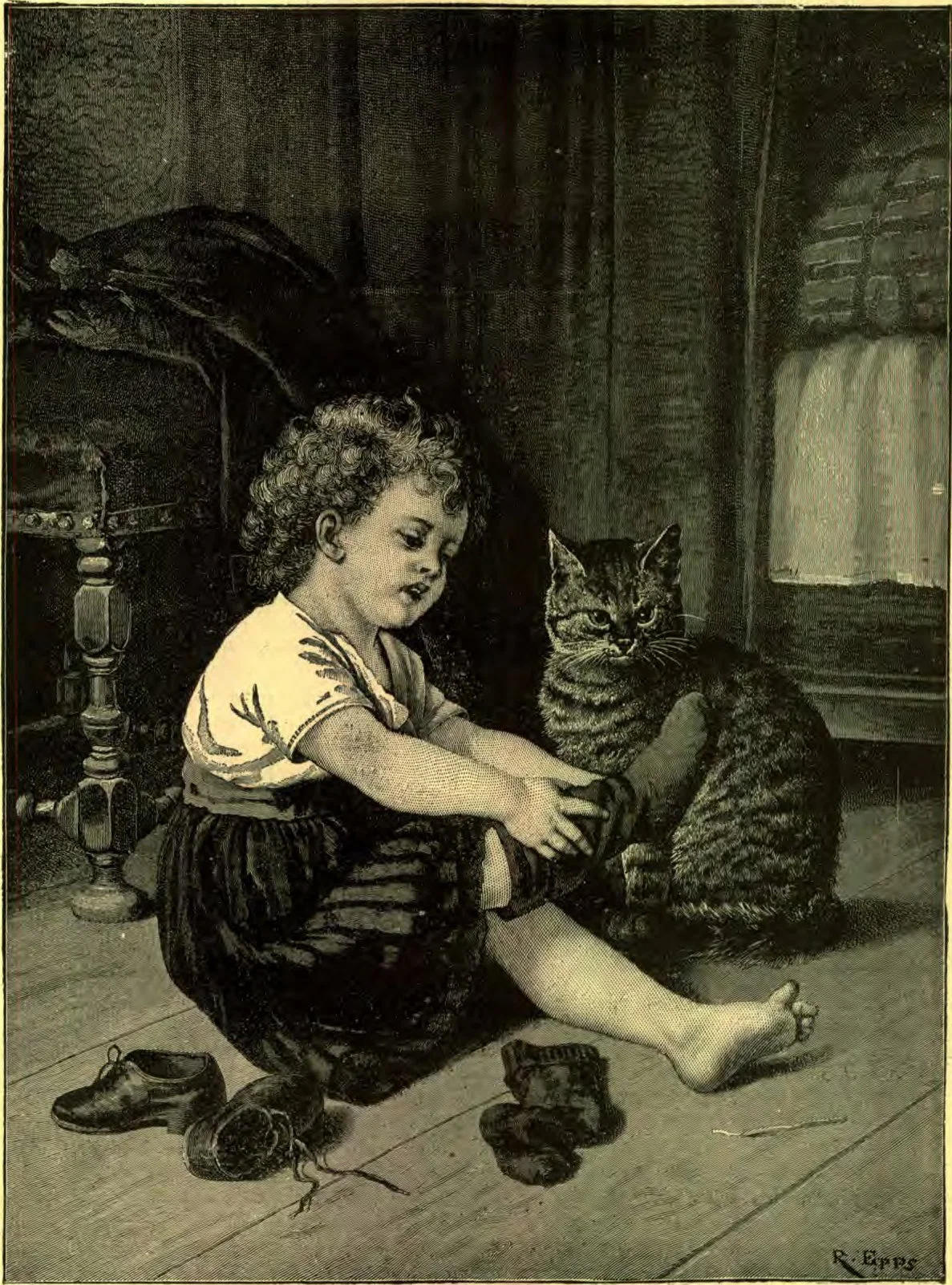
THE Little Boy loved the Big Fir. For one thing the Big Fir never changed. Everything else the Little Boy knew was always changing. The Brook was low and clear in the summer and fall, and high and muddy in the winter and spring. The Cloverfield was green in spring; red with bloom in summer, and brown and sear in fall. And the Orchard was pink and white in spring; red, yellow, and purple with ripe fruit in the late summer and fall; and naked and dreary in the winter. But the Big Fir never changed. The Little Boy could not even see that it grew, like other trees. Sometimes he thought it was waiting for him to catch up.
But he loved it most because of the stories it told about itself; for although he always went to his father whenever he had any question to ask about it, he was sure that the tree itself must tell its own story, only father had to explain it to him. So when he had learned something new about it, he came out and lay on the warm earth, where he could look up into its far-away top, and listen again to the story sighed out to him and the wind. So, little by little, the story was pieced out, and it sounded something like this:—
“I dare say, Little Boy, that four hundred years seems to you an impossible length of time for any one or anything to live; and yet it is just four hundred years since a little brown fir-seed slipped from the grasp of a lively red squirrel, fell to the ground, and hid under the moss. That little seed was I. There I lay in the dark for months, wondering what would become of me; but at last my tight skin burst open; out came a little foot, which went feeling its way down into the cool, damp earth; and out came a little hand, which went reaching its way up into the light and air, until, one beautiful spring day, it spread out its soft, green fingers to the sunlight. Such a tiny tree as I was! The beetles and spiders that ran about me seemed great beasts, and the birds that flew over me were like giants. But my fingers kept catching the light, and the little mouths that were on my foot drank in the rain, as it soaked down into the earth, and I grew, and was glad to live.
“When autumn came, I saw the leaves on many trees turn brown, and fall to the ground; and the flowers that had made the summer fields and woods gay, drooped and faded. ‘Ah!’ thought I, ‘they are all dead; and I shall die, too.’ But as I watched my little fingers, I was surprised and rejoiced to see them remain as green, and spread out as stiffly, as ever. Then I noticed there were some other trees whose fingers were just like mine, and which looked green and thrifty, although the air had grown cold, and the nights were long.
PLAYMATES
“Then I was not afraid; and as I looked at myself again, I saw three little brown cones, one at my very top, and one on each side, a little way down my stem. I did not know what they were for, but I thought they looked pretty, and so I was glad to have them. I took good care of them, and in the spring they began to swell, and at last burst into three beautiful pale-green paintbrushes; the one on top shot straight up; the other two became branches. I was surprised, too, to see those trees that had lost their leaves in the fall, covered again with leaves and bloom. All the plants that I had thought dead were growing again, too; and so I was led to wonder at the skill of the Power that made us grow in such different ways.
“Well, every summer and fall I stored up more and more little brown buds; and every spring they opened, and so I grew taller, and added more branches. I became stouter, too, for in the spring my hungry roots sucked up food and water from the earth, changing them into sap, and passed the sap up between my bark and wood; then my bark was quite loose, and might be easily peeled off. But the sap thickened into a jelly, and finally became soft wood. Year by year this wood gets harder, so I am harder at my heart than next to my bark. And year by year new circles of wood are added, so that if I were cut down, you could tell my age by counting the number of rings from my heart to my bark; the inner rings are broad, but the outer ones are so fine you could scarcely distinguish between them.
“When I was small, my bark was a dark-brown color; then for a long time it was quite light, thin, and smooth, but with many little blisters on it, full of sweet-smelling pitch, as clear and about as thick as honey. As long as my bark was smooth, I was called ‘young fir.’ I would not have made good fuel then; for my wood was soft and ‘sappy.’ But by and by my bark grew rough and thick, full of great seams and ridges; and then I became an ‘old fir.’ My lower branches died for lack of sunlight, and fell off,190and the bark grew over their scars, until one hundred feet of my trunk now stand straight and clear of limbs. I am over two hundred feet tall, and eight feet in diameter; and my roots reach deep into the earth, and spread far out on every side; but I have no tap-root; that is, no root that reaches straight down into the earth under me.
“Down yonder in the valley stands another fir; his age is the same as mine, but he is not so tall, and his branches are longer, and grow lower down his sides. He grew alone; but I was so crowded by other trees that I had no room to spread wide, but was forced to reach up, and up, and up. If he were to be sawed into boards, they would be full of knots, but mine would be smooth and straight.
“I could tell you many things that I have learned during my long life. When I was younger, the children I knew were not white like you, but of a red, or copper, color, as were also their fathers and mothers. They did not build houses, and plant gardens, and live in one place, but kept coming and going all the time. Nor did they keep cattle and sheep; but they fished in the rivers, and hunted deer and bears in the woods.
“I heard them talking of a strange race of white people who lived in the far East, but I never thought to see any of them. And I did not until I was over three hundred years old; then your grandfather came with his family, and cattle, and wagons. It was a strange and terrible sight to me to see him cutting down trees all around me. Every day I thought, ‘Surely I shall be cut down to-day.’ But I was spared, and I heard him say I was too fine a tree to be burned. When the others had lain on the ground all summer, they were burned, and I felt the hot breath of the fire, and my branches waved in the air that rushed in, but I was not injured.
“My family grow in cold or cool countries, but firs in the far North are much smaller; indeed, I have heard it said that in the extreme north of Asia, one may walk over a forest of old fir-trees, as he would walk over a carpet of moss here. I should not like to live there, would you, Little Boy?”
AUNT BETTY.
HELPING MOTHER
By Margaret Goss Day
We like to help our mother when she's working all the day.
My little sister dear and I can help in many a way;
For when she sweeps, we help to dust the tables and the chairs,
We get her everything she wants down cellar or upstairs;
We carry water for the plants, and pick the opened flowers;
And then she puts them in a vase, and calls them hers and ours.
We put our toys up in their trunk when we are through with play,
And say, “We've worked so very hard it's been the shortest day,
And time for any other work we never could have found!”
But she says what helps her quite the most is having us around!
— Margaret Goss Day.
FOLLOW DIRECTIONS
“What looking shoes!” exclaimed the candid older brother. “Blacked ’em with stove polish, didn’t you?”
“No, I didn’t,” said the little girl, petulantly. “I used the polish Eleanor thinks so much of. I sha’n’t try it again—my shoes look horrid.”
“Better go back, and look at the bottle,” said Eleanor, quietly; “you will find it isn’t the fault of the polish.”
And the little girl hurried up the stairs. She gave one more annoyed look at the black fluid, then stopped, and read the label for the first time. Oh, yes, there in big letters were the words: “Follow Directions,” and reading on, she saw what the older sister meant. It wasn’t the fault of the polish: it was the fault of the little girl who hadn’t followed directions.
There are a great many persons who fail to “follow directions” in other and more important matters, and then blame some one else that the results are not all that could be desired.
Perhaps it is the case of a young Christian who thinks that her friend is singularly self-deluded in feeling that the new life takes one over “the pathway of peace.” At any rate, her own burdens are not taken away, but are almost as heavy and hard to bear as before. The trouble is, she has failed to follow the directions fully. She has only half-heartedly come to Christ, and has wholly forgotten or ignored that other direction, to take his yoke upon her, and learn of him. No wonder the result is not satisfying.—Young People’s Weekly.
IN A JAPANESE SUNDAY-SCHOOL
It was a Sunday-school in Tokio, and held in a neat little church, not greatly unlike many in America. It was made up of bright girls and boys, too, but every one had shining, black, velvety hair, sloe-black eyes, and an olive complexion.
The first thing you would have noticed was that many a girl had a baby brother or sister on her back, slid down in the pouch-like folds of her kimono, often clinging like a little monkey to her neck.
When we went in, they were all singing to a familiar tune, but in an odd, unfamiliar language, “What Can You Tell, Little Pebble?” and one little Japanese maiden stood up, and trotted her baby brother to the tune till he went fast asleep, and gave her no more care while the school lasted.
There were pretty colored picture-rolls and golden-text recitations, and then something very odd happened. A big boy went around the church, that was strung across at right angles with strong wires, and drew white curtains everywhere,—and the audience room had suddenly become six little recitation-rooms! To be sure everybody could hear what his neighbor said behind the curtains, but in Japan it seems to be only the distraction of the eyes that has to be prevented.
Who is the little man with short, gray hair? He seems to be a sort of sexton. “Oh! that’s a woman. Her short hair says she is a widow who will not marry again, and she is the church housekeeper,” was the answer.
Now everybody began to talk as loud as he could, and everybody seemed to end his sentence with “Get up!” Whether it was so or not, we got up and went into the kindergarten room. Oh, how shivering cold it was! Not a spark of fire for a room full of dear little boys and girls, who, in spite of their red noses and chilled fingers, were having a very happy time.
“They never have fires in their homes in winter,” said my guide; “and they do not mind it, for they do not miss it.”
They certainly knew their texts beautifully well, and recited them with great composure.
In another school each child carried a wooden admission ticket, with a bright-red silk string to fasten it to his little cloak,—such bright-colored little coats, often covered with gay-colored flowers or grotesque figures, such as we would use for curtains or sofa covers!
But what struck the visitor was the prompt way in which text after text was recited, and the eager little hands were stretched up—for they all sat on the floor—for reward tickets, on which were only new texts to learn for next time. Is it not good to know that some of the little children in Japan can thus become familiar with God’s word?
1. What truly wonderful lessons were stored up in all the services of the children of Israel! Every part of their worship taught them something about Christ. The Lord planned it all out carefully, because he desired them to become acquainted with Jesus, the One who would take away the sin of the world. Therefore even the color of an animal was used to point out a part of the Saviour’s offering for men. Of course we are not to understand that the outward clothing of Jesus was red, for that was not the case; but his blood is pointed out. By his blood he brings us forgiveness and cleansing. In his blood (that is, in his life and all it contained) we are to wash our robes and make them white.
2. The yoke was a figure of sin. Lam. 1:14. And as the red heifer was a type of Jesus, who was never in bondage to sin, it was necessary that it should never have worn a yoke. The animal which had not worn a yoke, which had never been made to serve man, was a true picture of the Son of God, who was always free from evil, and who never served the enemy at any time in his life. The heifer was a perfect offering; so was Jesus.191
3. The ashes were all carefully gathered and put in a clean place; for in this offering, they were the part to be used. And just as they were stored up for all who needed to be cleansed, so the goodness of the Saviour has been preserved in heaven for those who desire to be cleansed from sin.
4. There were two classes who could have the blessing of the offering,—the Israelites and the “strangers.” The Lord was willing, even in those days, to help the Gentiles. He did not want his people to think that his blessings were for them alone. Sometimes there are those who teach that the Lord did not help any people but the Jews until Jesus came into the world; but that is untrue. Jesus is “the same yesterday, and to-day, and forever.” And what he did when he lived on earth, and what he does now in the gospel, is only what he always wanted to do through his people, the Israelites. The offering was a type of Jesus, and he died for the “sins of the whole world.” Therefore the offering for purifying sin was for both his people and the strangers.
5. The ashes were mixed with “living waters” (margin). The living water was a figure of God’s Spirit. When Jesus was on earth, he said that he would give living water to those who would believe on him, and the living water of which he spoke was his Spirit. John 7:38, 39. The ashes of the heifer represented the goodness, the righteousness, of Christ. Thus, when the ashes and the water were put together, and sprinkled upon the man or thing that was unclean, it was the putting together of God’s righteousness and Spirit, and putting them upon sin to cleanse it away. It really meant the washing away of sin by the blood of Christ.
6. If any one had touched a dead body, he was unclean, and needed to be cleansed, or else cut off—put to death. The dead body was a type of sin, which defiles all who touch it. All who have been brought into contact with sin—and all have, “for all have sinned”—must either be cleansed by the blood of Jesus or be destroyed at last by the wrath of God. Especially must all God’s children be careful in this; for if they are not, they have no right to come into God’s presence. To be unclean while professing to be God’s servant, means to defile not only the sanctuary of our own heart, but to make unclean the church to which we belong. Let us thank the Lord that he has provided a way for cleansing whenever, through carelessness, we are made unclean by sin. When we find that our character has been defiled, let us hasten to the One who is clean (see Num. 19:19), and pray him to wash us, and make us white as snow.
Daily Schedule for Sleep, Study, and Work
Eight hours to sleep, and two to walk,
And three to eat and laugh and talk;
Six for study every day;
Five are left for work and play.
Eat well, sleep well, work well, read well,
And your life will always speed well.
— Youth’s Companion.
CONTENT
By Elizabeth Rosser
THE world was full of rivers, and on their
mighty tide
Ten thousand ships went threading through
and through;
Ten thousand teeming cities stood on the riverbanks,—
And I was but a tiny drop of dew.
But as I lay unheeded upon a blade of grass,
A weary bee fell near me, scarce alive;
With hope revived, he saw me, and drank, and
quenched his thirst,
And bore his load of nectar to the hive.
A chain of mighty mountains stood guard upon
the earth,
And reared their heads where eagles never
soar.
The joy of all beholders, what dignity was
theirs!—
And I was but a pebble by the shore.
Of value or of beauty, no single gift was mine,
The beach was strewn with millions just like
me:
Yet for a puny baby I once was made a toy,
And changed his fretful cries to tones of glee.
By night the silvery moonbeams rejoiced the
dreamy world,
A myriad twinkling stars shone clear and
bright;
By day the dazzling sunlight its golden splendor
shed,—
I was a little taper in the night.
I know my ray was feeble; but in a window set,
All night I burned, and did my little best;
And ere the dawn of morning,— ah! what a joy
was mine!—
A soul I guided home to peace and rest.
ELIZABETH ROSSER.
NOTES AND COMMENTS
By Augustin J. Bourdeau
Stairways that Move.—Moving stairways are common sights now in the large cities. Several were on exhibition at the Paris Exposition; and at the large stores Magasins au Louvre, in Paris, the moving staircases are used by thirty-five hundred persons an hour during the busy part of the day. One of these stairways was recently installed at the Twenty-third Street Elevated Railroad Station, New York, to elevate the passengers to the trains. Chicago also has them.
The Composer of “Dixie.”—Probably it is not generally known that the composer of “Dixie’s Land” is still living in a little Ohio town. Though eighty-six years old, and badly crippled with rheumatism, Mr. Daniel Emmett declares that he is still “in good health.” At the time “Dixie” was written, Mr. Emmett, then a young man, was traveling with a minstrel troupe; and one night after an unsuccessful performance the manager informed him that he wanted him to write something new—something “lively and popular.” The next day, accordingly, Mr. Emmett set himself to work, and on the following day was able to play and sing “Way Down South in Dixie’s Land” before the company. This success was no less remarkable than the immediate popularity of the song, which was finally adopted by the South, and has continued from that day to this as one of our national airs.
French versus Japanese Wit.—During the Paris exposition of 1867, Japan sent an embassy to the capital of France “to treat for three free ports in France, in return for which France was to have three in Japan. The negotiations proved short and amicable.” “Make your choice,” said Japan. “We will choose afterward.” Yokohama, Tokio, and Han-yang were the places selected by the French Minister of Foreign Affairs. Instead of objecting, the Japanese embassy simply “smiled, and went on their way.” Japan subsequently sent word that “the three ports mentioned were agreed to, and in return Japan desired Havre, Marseilles, and Southampton.” At this the French officials were greatly amused. They never laughed so much before, and certainly never since. Southampton a French port! Gently but unmistakably they explained the situation. “Southampton is in England,” they replied. “We know that,” came the response, “but then Han-yang is in Korea.” Of course this rejoinder silenced the French officials, and showed them that the Japanese study geography.
Why He Afterward Gave More.—An interesting story is related of Robert Carrick, one of Scotland’s richest bankers. It seems that “being one day visited by a deputation collecting subscriptions toward a new hospital, he signed for two guineas; and one of the gentlemen, expressing disappointment at the smallness of the amount, he said, ‘Really, I can not afford more.’ The next person visited was a large manufacturer named Wilson, who, when shown the list, exclaimed: ‘What! Carrick only two guineas!’ Upon being informed of Carrick’s excuse, Wilson said: ‘Wait; I will give him a lesson.’ ‘Taking his cheque-book, he filled in a check for ten thousand pounds, the full amount of his deposit at Carrick’s bank, and sent it for immediate payment. Five minutes later the banker appeared, breathless, and asked, ‘What is the matter, Wilson?’ ‘Nothing the matter with me,’ replied Wilson; ‘but these gentlemen informed me that you couldn’t afford more than two guineas for the hospital. ‘Hallo,’ thinks I, ‘if that’s the case, there must be something wrong, and I’ll get my money out as soon as possible!’ Carrick took the subscription list, erased the two guineas, and substituted fifty, on which Wilson immediately tore up his cheque.’”
A Year’s Corn Yield.—The number of bushels of corn produced in this country during the year 1900 is estimated to have been about two thousand millions. To transport all this grain would require three million two hundred and fifty thousand cars, or a solid train nearly twenty-five thousand miles long. Or, to put it another way, it would require nine solid trains, each one as long as the distance from San Francisco, Cal., to Chicago. At twenty-five cents a bushel, the amount received for the total crop was about five hundred million dollars.
It Told Too Much.—It will be easy to see why the following advertisement, which appeared day after day in a Western journal, failed to bring a single reply: “WANTED: Situation by a practical printer, who is competent to take charge of any department in a printing and publishing house. Would accept a professorship in any of the academies. Has no objection to teaching ornamental painting and penmanship, geometry, trigonometry, and many other sciences. Has had some experience as a lay preacher. Would have no objection to forming a small class of young ladies and gentlemen to instruct them in the higher branches. To a dentist or chiropodist he would be invaluable; or he would cheerfully accept a position as bass or tenor singer in a choir.” This many-sided advertiser finally added the following to his advertisement: “P. S.—Will accept an offer to saw and split wood at less than the usual rates.” This “P. S.” secured for him a situation at once. It is better for a man not to tell all he knows, or all he can do, but to be able to do one thing well, and be willing to do that.
AUGUSTIN J. BOURDEAU.
The Value of Punctuality
By Freeman Hunt
FIVE minutes in a crisis are worth years. It is but a little period, yet it has often saved a fortune or redeemed a people. If there is one virtue that should be cultivated more than another by him who would succeed in life, it is punctuality; if there is one error that should be avoided, it is being behind time.—Freeman Hunt.
Share Your Blessings With Others
Whatever your age or your surroundings may be, you have some blessing given you fresh each morning from God. Do not keep it all for yourself. Let others share it with you. Give your tired mother some of it in a hearty kiss and tender word, or such gentle help as you can render her. It will cheer your father all day to feel that his boy takes him into his young life. Let every one who comes near you be the happier because you are young and happy. If you have studied and read a good deal, do not use your knowledge simply for yourself, but impart it to others less fortunate. It will make your little world brighter. God does not give you the water of life to be thrown upon the ground. Pass it on. The man who lives for himself alone is worse than useless. He is a positive hindrance.—Our Boys’ Magazine.
GRAND TRUNK R'Y. SYSTEM.
By W. C. Cunliffe
Taking Effect Dec. 16, 1900.
Trains leave Battle Creek.
WEST-BOUND.
No. 9, Mail and Express, to Chicago — 12.15 P. M.
No. 1, Chicago Express, to Chicago — 8.30 A. M.
No. 3, Lehigh Valley Express, to Chicago — 3.50 P. M.
No. 5, International Express — 2.17 A. M.
No. 75, Mixed, to South Bend — 8.30 A. M.
Nos. 9 and 75, daily, except Sunday.
Nos. 1, 3, and 5, daily.
EAST-BOUND.
No. 8, Mail and Express, East and Detroit — 3.45 P. M.
No. 4, Lehigh Express, East and Canada — 8.32 P. M.
No. 6, Atlantic Express, East and Detroit — 2.10 A. M.
No. 2, Express, East and Detroit — 6.50 A. M.
No. 74, Mixed (starts from Nichols yard) — 7.15 A. M.
Nos. 8 and 74, daily, except Sunday.
Nos. 4, 6 and 2, daily.
W. C. CUNLIFFE, Agent
BATTLE CREEK
SELF-PRONOUNCING S.S. Teachers' Reference Bible
By Editor
Contains the Celebrated Teachers' Helps,
Comprising nearly 400 pages. Also a complete series of fifteen new maps.
DESCRIPTION
IMPERIAL SEAL BINDING, TUCK EDGES, known as “DIVINITY CIRCUIT,” ROUNDED CORNERS, FULL RED UNDER GILT EDGES.
We offer this Bible, postpaid, for only six new yearly subscriptions at 75 cents; or twelve new six months' subscriptions at 40 cents.
We will also send it, postpaid, with the INSTRUCTOR one year for $2.25. For 20 cents extra we will stamp your name in gold upon the cover. Address—
THE YOUTH'S INSTRUCTOR,
Battle Creek, Mich.
THE YOUNG PEOPLE'S WORK
In all our Conferences the young people looked forward to our late general meeting as a time when plans would be laid for establishing the young people's work on a firmer basis, and giving it an acknowledged standing. During the meeting this work received some attention; its importance was recognized; and as one step toward unifying it, and bringing it into a better condition, and in order that the companies of young workers might have some definite central source of instruction and communication, it was recommended that it be connected with a generally recognized department of the Conference.
This was done; and in the readjustment of the general organization, the young people's work was made a branch of the Sabbath-school Department of the General Conference. During the week of May 19-25 the Sabbath-school Committee held a number of meetings in behalf of the general interests of the department. At this time the young people's work was prayerfully considered, and the following recommendation passed:—
“That in each church there be conducted, regularly, a young people's meeting, the object of which shall be to lead the young people into deeper Christian experience and greater usefulness in God's service; these meetings to consist of brief Bible studies, reports of work done, and suggestions for future work.”
It was also recommended that a department, to be devoted especially to fostering and promoting the interests and growth of the young people's work, be opened in the YOUTH'S INSTRUCTOR. In this department, reports of work actually done, either by companies or individuals, with plans, suggestions, a simple Bible study, etc., may be given from week to week.
As it is desirable in a work of this kind for all to follow the same general plan, it was recommended that beginning with the opening of the Berean studies in October, those lessons be made the basis of a Bible study at the regular meetings of the young people. During the summer it is planned to have a series of simple, practical Bible studies, based on “Steps to Christ.” A sincere study of this book, and the receiving of its truths into the heart by each member of the young people's bands, will result in raising up hundreds of young persons who will be ready and anxious to work for others. The first of these Bible studies will be printed in the INSTRUCTOR of June 27, for use in the young people's meeting held during the first week in July.
Sister L. Flora Plummer, as Corresponding Secretary of the Sabbath-school Department, will have charge of all correspondence relating to the young people's work, and will keep its needs and importance before the Conference workers and church officers. She will be glad to write to any company that does not understand the general plan, to answer questions, to counsel in regard to difficulties that may arise, and to help in getting the work started as far as lies in her power. Until further notice, her address will be 1502 Third Ave., S., Minneapolis, Minn.
Sabbath afternoon, June 1, at the meeting of the young people's company in Battle Creek, Elder W. A. Spicer spoke with reference to the general plans adopted, the necessity of individual work, and the object ever to be kept before the young people's companies. We wish Seventh-day Adventist youth everywhere could have heard his earnest words; but since that could not be, we are sure all will enjoy the following paragraphs taken from a report of his talk:—
“At the recent General Conference the subject of the young people's work was referred to the Sabbath-school Department of the Conference Committee. In the meetings following the general gathering, the Sabbath-school Committee spent some very interesting hours in considering this important work.
“First of all, the committee recommended that throughout the conferences and the churches, the brethren and sisters be urged to encourage the young people in Christian service, and in meeting together for mutual encouragement and Bible study. A department in the INSTRUCTOR is to be opened, to be called ‘Young People's Work.’ We like this title, for the last word of it is suggestive of the object in all this movement. It is not so much young people's plans, or young people's talk, or even young people's societies, as young people's work.
“The work is the real point, and in all our plans, and in all the meetings, the thought ever to be kept before us is that this movement means service, and a definite seeking, by the grace of God, for the qualifications to render ever better service in the cause of Christ. Christ said, ‘My Father worketh hitherto, and I work.’ We can hold the life only as we allow Jesus, who is the life, to work in us the works of God. What we as young people need is the converting power of God daily in all our lives; but in order that the ground gained may be held, and advancement made, it will be profitable for the young people to meet together for Bible study, which will better fit all to go out to bless others with the blessings received in the meetings.
“The basis of all the meetings must be Bible study. The work of God is not mere activity. ‘This is the work of God, that ye believe.’ As faith comes by hearing the word of God, the first thing young and old need is to come to the word of God to hear his voice, and to receive the faith that works by the power of the word.
“In addition to the Bible study, the committee believed that some time in each meeting could profitably be devoted to reports from members of the work done during the week,—of experiences that had especially brought the blessing of the Lord, and deepened in the heart the love of Jesus for some one to whom he had made the worker a blessing. For in all the Bible study, and in everything, the thought is to be that the blessing gained is to be passed on to others. The whole world is before us, and the Lord wants us, as young people, to prepare for work. We must help one another get the warm love of Jesus for everybody welling up in our hearts, so that we shall be watching for opportunities for service at all times. It is such a simple thing to work for him! A kindly deed, some want ministered to, an encouraging word, even a pleasant smile, goes so far in the world about us; and too often we do not stop to think of the little ways of service that come to us in our everyday lives, wherever we may be.
“Talking of these things in our meetings, and keeping this thought constantly before our minds, we shall be building one another up in love for God and his cause. Love teaches the way. The little child does not have to study and plan how to show its love for mother or father. The love in the little heart flows out so freely and so naturally that it needs no studied plan to give expression to it. Just so, as we open our hearts to let the blessed Saviour in, that the love of Jesus for every soul in the world may constrain us, and work in us, we shall find that love will teach the way, and day by day we shall know how to yield ourselves to God, that he may make us a blessing. Feeling this love, and being in earnest to be of service in God's work, any meeting of the young people will be an inspiration to deeper consecration. Keep ever in the forefront, then, of the movement; this thought—that the supreme aim is service, and that the love of Jesus in our hearts is to be our guide in this work.
“From time to time, suggestions will be made in the ‘Young People's Department’ in the INSTRUCTOR as to details that may add to the interest of the program of the weekly meeting. Perhaps a three- or five-minute essay on some mission field, or a study of some missionary biography, would be profitable. The editor of the INSTRUCTOR will invite, and will be glad to receive, from those engaged in the young people's work, suggestions as to work actually done, which will help others to learn of methods and ways that have proved profitable.
“The Committee did not discuss constitutions and by-laws for the young people's companies. The important thing is the young people's work; and when young people, whose hearts are full of the love of God, meet together and begin the Bible studies, and talk of ways in which they may get others to attend, and how those who have not experienced the love of God may be brought to see the blessedness of surrendering the life to Jesus, there will be the young people's work going on. And as the work grows and develops in the hearts and lives of the youth, we may trust the Lord to bind it together, and order it in ways which his own Spirit may suggest.
“God wants the young people in his service; every department of the cause, at home and abroad, cries out for them. So much must be done, and the time is so short, that we may expect to see God awakening young and old to the fact that the set time has come for that blessed, closing work of power, which is to turn the hearts of the fathers to the children, and the hearts of the children to the fathers, that with one voice old and young may sound the message of glad tidings to all. The place to begin is where we are. Let us brighten our own homes with good words and the tender love of Christ within, and then carry the blessed influence to all without.
“May the Lord make the young people's meetings not simply interesting occasions,—not at all a matter of social entertainment, but blessed seasons of earnestness in seeking God, in studying his word, and talking about the very practical work of service for him.”