We left Bocas, April 21, on the gasoline launch “Zepher,” to visit the churches in Costa Rica, and then go up to San Jose, to get our Spanish worker settled in his new home and future field of labor. San Jose has a population of one hundred and five thousand. The Spanish language is spoken almost entirely.
After meeting with the church in Port Limon, we took the train for Pacuarite, reaching there just in time to conduct the funeral services of Brother Cruikshank, who had been drowned while bathing in the river. We held a meeting with the church, and then continued our journey to the capital of Costa Rica.
The railroad is owned by the Americans, and the cars are built about the same as those at home. They have iron bars across the windows, for protection when the passengers are tossed from side to side as the train sharply turns curves, or comes to a sudden stop. We notice that the ties and the telegraph poles are made of iron, and learn that this is so because of the wood-eating ant, which would soon destroy them if made of wood.
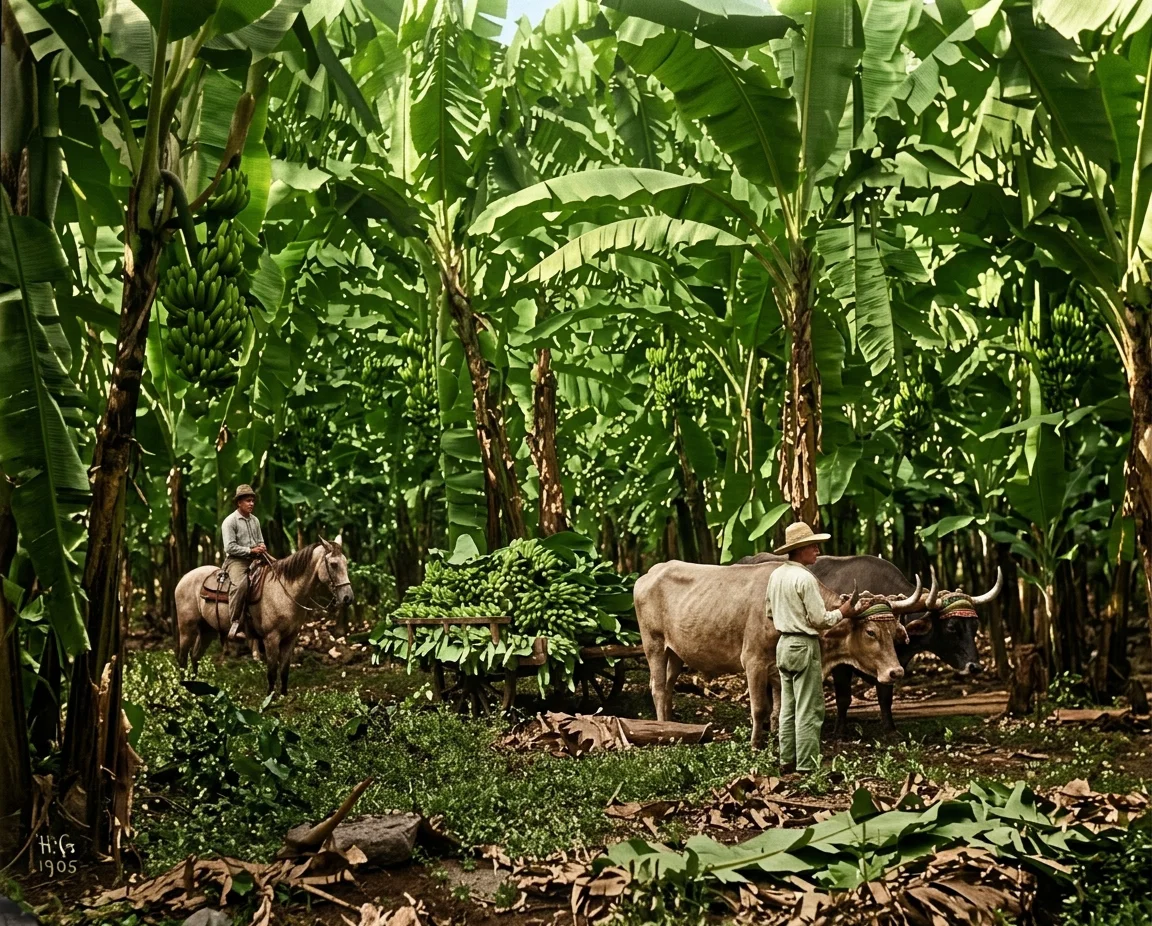
As our train whirls us along through tropical wonders, we have a good view of the country. We sweep through great banana plantations, with their plants extending up above the top of our car, their green leaves waving in the breeze made by our train as we hurry by. Again, we see the bananas cut, and stacked high upon carts, to each of which is hitched a yoke of oxen. We notice that the yoke, instead of being fastened across the neck of the animals, thus enabling them to pull by their shoulders, as they do in America, is placed across their heads, and they pull by their horns. There are great piles of bananas by the side of the track, awaiting the train that is to take them down to Port Limon, there to be loaded on to the steamer, and taken to the United States. Vast quantities are raised for the American markets. Then we are whirled through cocoanut groves on the one side, and orange groves on the other.
No other part of the grand division has so dense a growth of wood as Central America, and the trees are so bound together by small vines that one can walk through the forest only by cutting his way a foot at a time. Among the many trees are the mahogany, the ebony, and the rosewood, which are shipped to all parts of the world, for furniture making. Other products of Costa Rica that find their way to all parts of the world, for furniture making. Other products of Costa Rica that find their way to all parts of the United States are chocolate and coffee. The former is made from the seeds of the cocoa-tree. This tree is planted much as we plant the peach- or the apple-tree. After a few years, it bears a fruit about eight inches long, in which are the seeds from which chocolate is made. There are large orchards of coffee-trees, with their beautiful green leaves and their bright-red berries. In each berry are two kernels of coffee. Great expense, as well as labor, is required to get not only the banana to the market, but also the coffee, chocolate, and cocoa.
We are slowly climbing the mountains, for San Jose is many feet above the sea. How pure the air is, and how grand the scenery! The many varieties of fern-trees nod to us as we pass, and the trees, covered with orchids, send in through the open windows their sweet perfume. The mountains rise almost straight above us, and the track seems to hang to the very mountainside, winding about like the letter S. We shoot through a tunnel, then across iron bridges over deep canyons, every turn bringing new pictures. Up we climb, and the very clouds are below us. We have just passed through a rain cloud, and we see a bright rainbow in the valley below. Sometimes we shudder, and shut our eyes, as the train crawls along the edge of a precipice. We do not see many birds, catching only a glimpse of a bright-colored macaw or a beautiful parrot. We may see a monkey grinning at us from the branches of a tree. There are a great variety of lizards, and one may chance, if he is not a vegetarian, to eat one when called out to dinner, especially the iguana lizard, which is sold in all the markets.
As we near the summit, we notice that the sign-boards are all in Spanish, and our fellow passengers all speak that language. Our train makes a long stop at Cartago, a city of about fifty thousand inhabitants. What a crowd there is at the station, and what a confusion—all the men and women jabbering and gesticulating much! But they are very polite. Even the boys take off their hats when we ask them a question.
The houses are all built with one story, and of adobe, with tile roof, and in such a manner that they form a solid front around the block. Here is the volcano Irazue, thirteen thousand feet above the sea, the only point from which, it is said, can be seen the two oceans. We look down into the fissures made by the eruption, and throw stones down into them, but are unable to hear them strike the bottom. We pass by a stream where the women are doing their week's washing. They dip the garment into the stream, then strike it on the rocks again and again. When clean, it is dipped into the stream, and put on the grass to dry. This is the way washing is done all over the country.
While in San Jose we visited the market, a long, low building, and as we looked at the stalls, we saw that Costa Rica is a land of good things to eat. There are string-beans half as long as your arm. These, tied up in bundles, are sold for so much a bunch. There are also sweet potatoes, cabbage, cauliflower, celery, lettuce, green corn, and tomatoes. As we walk through the market, we almost forget we are not in America. Fruits are plentiful—oranges, limes, guavas, mangoes, breadfruit, pine-apples, papaws, alligator-pears. The13latter is about the size of the American large pear. The meat tastes like fresh butter, and is eaten with salt.
The women, as they form groups in the parks, are all smoking their cigarettes, and our hearts ache as we think of the many thousands of Spanish people in our field, and remember that we have only just started the work for them, with only one Bible worker.
HARVESTING BANANAS IN COSTA RICA
The Scandinavian Union Conference
By Guy Dail
GUY DAIL
The third annual session of the Scandinavian Union Conference was held in connection with the Norwegian Conference, at Christiania, June 8-11. Denmark, Norway, Sweden, Finland, and Iceland were well represented at this meeting, which will probably prove to have been the most important session of our people that has yet convened in the land of the ancient Norsemen, because of the resolutions passed, and the advanced steps taken. Scandinavia has now decided to enter upon an undertaking in full harmony with the policy outlined by its sister union conferences of the Old World—a policy based upon a sound Biblical principle: “There is that scattereth, and yet increaseth. . . . The liberal soul shall be made fat: and he that watereth shall be watered also himself.” We believe that as no man liveth unto himself, so also no conference can live unto itself, and no union conference can live, in the truest sense, when thinking only of those within its borders. God’s people must turn their eyes to the “regions beyond.” The cause of missions, and the liberality that supporting missions begets, must be linked together with the educational, tract and missionary, Christian temperance, and Sabbath-school departments of the home field, if we wish to see the greatest good come to the greatest number of believers.
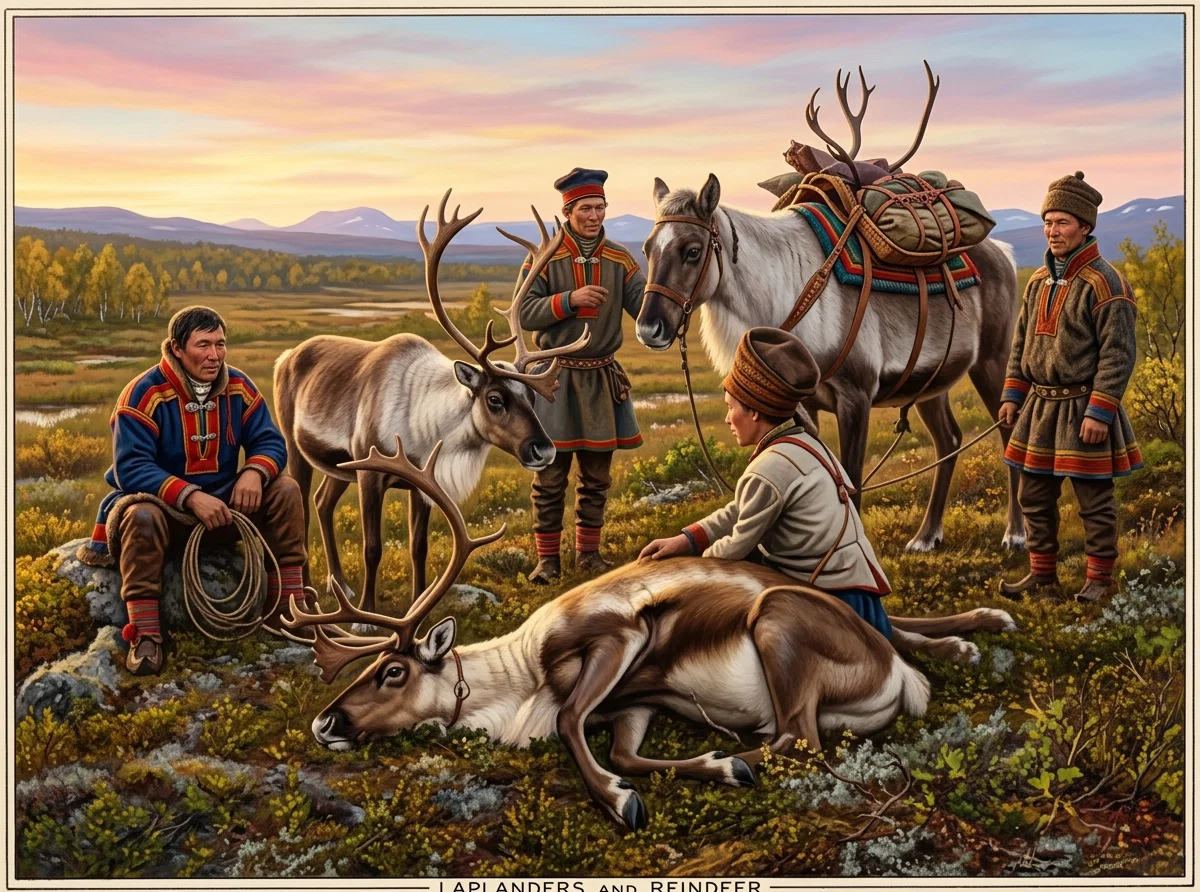
LAPLANDERS AND REINDEER.
Several important resolutions were passed at this Scandinavian Union meeting, but that which we regard as by far the greatest and most beneficial to the union conference and to the cause of God in general is this:—
“Resolved, That the First-day offerings of the Scandinavian Union Conference from April 1, 1906, be devoted to establishing a mission in Abyssinia, and that the officers of the union conference be requested to look for suitable young persons, who can be trained to go to Abyssinia, and open up the work there.”
Just as soon as the plans proposed for Africa can be carried out by the British and Scandinavian Unions, the African territory occupied by the five European unions will extend from Algeria on the north, where the Latin Union is operating, to the northern boundary of the South African Union, and will include Egypt and the Sudan, Abyssinia, and British and German East Africa. Everywhere we find that an aggressive movement into the citadel of the enemy, as he is entrenched in these heathen lands, begets confidence in the third angel’s message, arouses the enthusiasm of God’s people, and quickens their religious life. When we, to whom God has revealed such a wonderful truth, thoroughly awake, as the Moravians awoke, and send out an army of consecrated young men who are supported in their arduous labors by the prayers, sympathies, and means of the church at home, then we shall see that our God will do a short work in the earth; he will speedily prepare the way for his coming.
A second resolution, yet somewhat akin to the one just quoted, provides that the three most northern counties of Norway (Nordland, Tromso, and Finnmarken), with the three northern counties of Sweden (Norrbotten, Vesterbotten, and Angermanland) be organized into the Northland Mission, beginning with Jan. 1, 1907, and that it be under the control of the Scandinavian Union Conference. It is understood that this will not affect the present arrangement of the canvassing work. In this territory there are about 25,000 Laplanders, 25,000 Finns, 375,000 Swedes, and 200,000 Norwegians. The area is 302,000 square kilometers. If we remember that the Scandinavian Peninsula is about 2,000 miles long, we can see the necessity for a division of the field.
In 1898 Scandinavia had thirty-seven evangelical laborers; in 1905 it had only thirty-five. The brethren were astonished when their attention was called to that fact, and it helped them to see more than ever the need of training young men and women for workers. Therefore, the proposition to hold a four months’ winter school, or union institute, at Nyhyttan, Sweden, easily carried. It is expected that Elder O. A. Johnson, assisted by a Swedish language teacher and a Danish language teacher, will conduct the course, which will last from Nov. 1, 1906, to March 1, 1907.
It was voted to ask that Elder P. A. Hansen be freed from local work, so he might devote his whole time to the interests of the union conference. It is planned that he visit Iceland this summer, and assist in taking over into the union the chapel erected by Brother Ostlund and his associates in Reykjavik. The report of the work in Iceland was very encouraging. Our paper there now has one thousand more circulation than the largest political paper in the island; its list is much larger than any other of the fifteen periodicals published there, its monthly issue being three thousand eight hundred, which we think will easily reach four thousand before the close of the year.
In 1905 the Scandinavian Union tithe was $17,037, $3,053 more than for 1904; the offerings amounted to $2,900, or $265 more than for the previous twelve months; the book sales to $39,119, against $37,613 for 1904; 266 believers were added, or sixty-three more than the year before, and their membership was raised from 2,416 at the beginning to 2,493 at the close of 1905. Very many went to America, so that the net gain was not so large.
Ministerial credentials were granted to P. A. Hansen, F. Anderson, F. R. Oberg, D. Ostlund; missionary licenses to Oscar Anderson, Alma Bjugg, and N. Anderson.
The following officers were elected: President, P. A. Hansen; other members of Committee, presidents of Norway, Sweden, Denmark; J. C. Ottosen, F. Anderson, E. Lind; Treasurer, Jens Olsen; Secretary, J. C. Raft; auditors, P. Hansen, E. Lind.
It was also unanimously decided to push the publication of “Ministry of Healing” in the Danish-Norwegian and Swedish, so that book may be from the press by the first of October, if possible, in these two languages. The work is rapidly advancing on the Danish-Norwegian “Revelation,” and the Swedish “Revelation” will also be out this autumn, together with the Finnish.
We believe that this field, with its twelve and one-half millions of people, was never in a better condition than at present, and hope the immediate future may show that God’s blessing is with his workers here. All are of good courage, and feel that they had a blessed meeting.
Randers, Denmark.
Missionaries and Helpers in India
There are at present nearly twenty seven thousand missionaries and helpers in only India.
God Gathers the Outcasts of Israel
“THE Lord God which gathereth the outcasts of Israel saith, Yet will I gather others to him.” Isa. 56:8.
India’s Twenty-One Million Widows
“Widows are the greatest sufferers of India,” says Ramabai, “and their treatment surpasses description.” How many are there?—Twenty-one millions.
North Dakota Camp-Meetings
By R. A. Underwood
THREE camp-meetings have been held in the North Dakota Conference this season. Two of these were conducted in the English language, and one in the German.
The first of the English camps was pitched at Rock Lake, a thrifty little village, founded only about two years ago, in the heart of one of the finest wheat and flax belts in the State. The encampment consisted of about thirty family tents, accommodating approximately one hundred of our brethren and sisters.
The denominational membership in North Dakota is very much scattered. The constant removal of families to places where homesteads and cheap lands can be secured, makes our numbers in this conference more or less variable. At present there is an active emigration to the newly formed province of Alberta, Canada.
From the very beginning of this meeting it was manifest that the faithful labors of Elder Huntley and Brother Richard Graham, whose home is near Rock Lake, were yielding a rich harvest. Not only to the evening services, but to the day meetings, the people of the community came in ever-increasing numbers. During the entire ten days there were a number of households—father, mother, and children—who drove eight, ten, twelve, and even eighteen miles to listen to the glad tidings of the gospel of the kingdom. On rainy nights the campers made room for these friends, and a happy company they were.
From the first a blessed spirit marked the meetings. Never have I attended a camp-meeting where there was less gossiping and visiting and more communion among brethren concerning the truths of the Bible. The heavenly Visitor did his appointed work, and about twenty persons, for the first time, declared their allegiance to the commandments of God and the faith of Jesus. About seventeen souls were buried with their Lord in baptism.
The interest from the village itself was excellent. Storekeepers posted announcements that during camp-meeting week their places of business would be closed early. Nearly every evening there was a contingent of traveling men from the little village hotel in attendance at the large tent. And from what we learned afterward, in some of these hearts' good seed was sown, which we have faith to believe will yet bring forth fruit in the garden of God.
All through this vicinity Brother Richard Graham and his wife have scattered our literature, given Bible readings, and created a deep interest. To these two self-supporting missionaries belongs, under God, a goodly share of the harvest garnered at this meeting.
The North Dakota field is sadly in need of more English laborers. At present there is only one ordained English minister in the work, besides the president. Another strong, aggressive laborer could do much good. The never-ending ebb and flow of immigration in this vast section gives us a comparatively new population all the time.
The writer was able to be present during but a part of this meeting, being obliged to return home on account of a severe attack of la grippe. Elder L. H. Christian was present two days. We were favored with a visit from Sister Bessie L. Shaw, of India, whose work received a most liberal support from those present. Brother J. S. James and Professor Magan were present throughout practically the entire time.
The school work at Harvey has a splendid prospect for success. Prof. N. W. Lawrence, who has had charge of Mount Vernon College, has been elected president for the coming year.
The German meeting at Bowden was very well attended. A good spirit was manifested throughout. Hearts were especially touched by Sister Shaw's talk on India, and over eleven hundred dollars was subscribed for the work in that needy field. The meetings were conducted by Brethren Valentiner, Haffner, and Kunkel, and the local ministers. Elder J. G. Walker, the president of the conference, divided his time between the meeting at Rock Lake and that at Bowden.
The meeting at Stanley was small, but blessed by the presence of the same sweet Spirit of God. Twelve souls followed their Lord in baptism. There was a fair-sized and deeply interested attendance from the village. Elder C. A. Burman, Brother J. S. James, Professor Magan, and the writer were the principal speakers at this meeting.
At all three meetings a spirit of liberality for the needs of the regions beyond was manifested. Altogether about fourteen hundred dollars was donated for India, two hundred dollars for the Northern Union, five hundred dollars for the work in the South, twelve hundred dollars for the Harvey School, and one hundred dollars for the work among the blind. And in addition it was voted to support a German laborer at Winnipeg with Elder Kunkel this season.
R. A. UNDERWOOD.
Are You Coming South?
By C. F. Dart
To those who are thinking of coming to South Carolina, and especially those who are coming expecting to canvass, I would suggest that they plan to come in time to attend our camp-meeting, which will be held at Cowpens, August 9-19. Come and get acquainted with the work and workers. We expect a real spiritual feast. The canvassing work will receive attention. The canvassers are doing well. One brother took eighty-four orders last week, and he has been taking from sixty to ninety orders a week. A youth, nineteen years old, rather inexperienced in this work, took seventy-one orders the past week. He has been taking from twenty-five to fifty orders a week. And one sister averaged thirty-two cents an hour for the month of June. South Carolina is ripe for this work. There never was a better time to canvass in the State than now. The Lord is calling many to come here. I shall be glad to correspond with any one in regard to this field.
C. F. DART, Field Agent.Campobello, S. C.
The East Caribbean Field
By I. H. Evans
LEAVING New York, June 6, on the boat “Grenada,” for Trinidad, after an eight-day voyage I arrived at the island of Grenada, where the boat made its first stop. Nearly two days before this we had passed within the northern boundary line of this island conference. Island after island we left on either side of us; but as the boat made no stop, I was carried on in spite of my desire to see the people.
As our boat pulled into the beautiful little harbor at Grenada, the gang-plank had scarcely touched the dock when Brother Sweany came aboard and gave me a hearty welcome. I went ashore, and rested awhile in the house of a Mrs. Walker, where we met Sister Sweany, who, with her husband, was going to the conference on the same boat on which I had passage.
No church of our people has ever been raised up in the city of St. George, Grenada, although two efforts have been made; but Brother Sweany has just closed a very successful campaign about sixteen miles in the country, where he organized a church of about twenty-five members, and baptized twenty adults the Sabbath preceding my arrival. About twenty more, besides numerous children, who he expects will obey, are either keeping the Sabbath or are much interested.
St. George is a pretty little town, with narrow, well-paved streets, and antique, tile-roofed houses. About seventy thousand people live on the island, with about ten thousand in St. George itself.
It has been a long, hard struggle to get a foothold among this interesting people, but the brethren hope for better things in days to come.
Leaving Grenada on Friday at about 9 A. M., we arrived in Port of Spain about 8 P. M., when we were met by Brother Sterrie Wellman, and taken at once to his hospitable home, where I enjoyed meeting Elder D. E. Wellman and his family.
Sabbath was a busy day for the church in Port of Spain. After Sabbath-school and the election of officers for the ensuing six months, the writer spoke of the love of God to his people, after which eight precious souls were baptized by Elder Wellman, and received into the Port of Spain church. The membership of this church is about one hundred and forty, and is increasing year by year. The ordinances were then celebrated, in which nearly all present joined.
I was impressed with the quiet behavior of this people in the house of God. After the service was dismissed by benediction, instead of breaking out into a babel of confusion, they instantly sat down and bowed their heads in silent prayer. During the service they pay the best of attention, and are very orderly and well mannered.
The conference opens June 24 and closes July 4. The use of the largest hall in the city has been secured for four nights during this meeting15have been thoroughly advertised, and the brethren confidently expect a large attendance.
Already this conference has twenty-three organized churches, with twenty-one church buildings. Its membership is about eleven hundred. Delegates to this coming conference are expected from various islands, and all are looking forward to a successful meeting.
Just in the rear of the church building in this place is the Watchman Press. It is a two-story building about eighteen by forty-six feet. It has a tile and galvanized iron roof. A new cylinder press has recently been installed, and together with their jobber, they are in a condition to do considerable work. They run this large press by hand, and on it they print the Caribbean Watchman, a bright, well-edited, sixteen-page monthly. They circulate seven thousand copies monthly of this excellent paper, and do all the printing by hand. They greatly need a small electric motor, of about two horsepower, with varying speed, with which to operate their machinery.
It is truly painful to see the self-denial of the workers in this hot, tropical country, putting up with every conceivable inconvenience in order to get the truth out cheaply before the people.
Almost fifteen million persons are within the boundary lines of this West Indian field. The publishing work is an important factor in placing the truth before them. With more than three thousand Sabbath-keepers, we have not a single school, or sanitarium, or institution outside of this little publishing plant, in all this vast section.
Something must be done to give the work a permanency and the facilities which it greatly needs. We hope this coming conference will develop plans for future aggressive work.
I. H. EVANS.
The Work in South Africa
By W. S. Hyatt
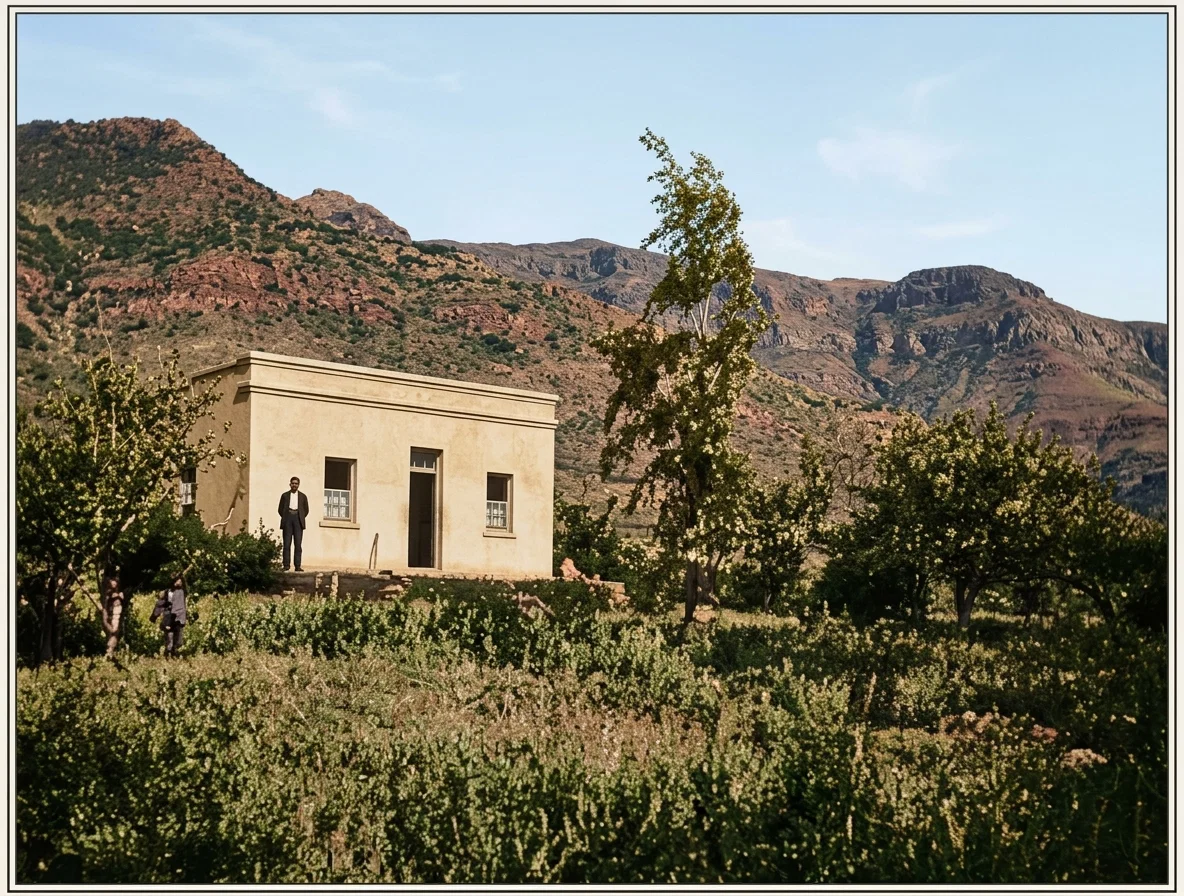
KOLO MISSION HOUSE, BASUTOLAND
It was my privilege to spend two weeks, during the month of March, at the Kolo Mission, Basutoland. Brother and Sister Chaney have worked faithfully to carry forward the work in this field. They have been not only missionaries, but medical missionaries among the people. They have cleansed and dressed many terrible sores, and treated, by means of simple methods, those who were sick and suffering. In every lawful way they have tried to gain the confidence of the people, that they might bring the gospel to them. Slowly but surely the work is advancing, and its influence is being felt among the Basuto people.
Since our mission was located at Kolo, several other schools have been opened near by, consequently the attendance at our school is not large. But something is being accomplished. During my visit, two young men who were attending the mission school decided to keep the Sabbath. Many of the native people are being troubled over the Sabbath question. Recently several chiefs have been inquiring after light on this subject.
Last year Brother Chaney spent a few weeks doing colporteur work among both Europeans and natives. In less than two months he sold seven hundred and fifty dollars' worth of our books, and gave away a large number of tracts. He has planned to spend more time in this work during the present year. Many of the natives can read, and can thus learn the truth from the printed page.
Another colporteur wagon has been started in Cape Colony, that we may reach the scattered farmers and natives. Elder G. W. Shone, with Brother R. Moko to assist him, has charge of this work. They will sell and distribute literature and hold meetings wherever there is an opportunity to do so. We are sure that this is one of the best ways to reach the partially educated natives of these districts.
The Cape Conference has three colporteur wagons at present. These are working in the thinly populated districts and in those sections that are not of easy access. Our field is large, and the people are scattered, but the truth must go into the “highways and hedges.” These wagons are trying to search out every dark corner, and let the light of truth shine into it.
In the Orange River Colony the message is spreading among all classes. Recently two of our young brethren were visiting some friends who lived at quite a distance. While visiting these friends they heard of some earnest Christian people in that vicinity, and called upon them. After a short talk, they gave the people a few tracts, and went their way. To-day four families are rejoicing in the truth as the result of that visit.
Our brethren in that colony, having a burden for the souls of their servants, began to hold meetings with the natives living near, with the result that several have begun to keep the Sabbath, and ten or twelve have been baptized. A well-educated native teacher has recently accepted the truth. He is a Basuto, but is now teaching the Zulu, hence understands both languages. We hope he may be a help in our native work.
Reports from the ministers and missionaries are of an encouraging nature. Elder Edmed has held a series of tent-meetings in Pretoria, and twenty-five have accepted the truth. A tent-meeting is being conducted by Brethren Groenewald and Olmsted in the Cape Colony Conference, and good reports have been received. Elder Hankins is conducting a mission in Cape Town. A few are interested, and fruit is beginning to appear.
W. S. HYATT.
China
By Ida E. Thompson
CANTON.—Our work is about the same from day to day here. We see the same faces; but in one way this is well, for it gives us an opportunity to add each day a new lesson, a new truth.
A second teacher has been secured, as our school was too large for one to manage. A few pupils have dropped out, but we still have thirty-six, with a regular attendance of above thirty.
Our second teacher is also a heathen. It seems too bad not to be able to give them a Christian teacher; yet I am sure we must be patient. I am in the school-room from two to three hours myself, teaching the gospel to the different classes. We think that some of our first year's girls are doing nicely in their studies; and we also feel that their hearts are warm toward the Master. In two years more these first-class girls can teach for us. And if we are so fortunate as to have them established in present truth, we may hope for more fruit from their efforts.
Our school opens at 8 A. M. this year, and closes at 4:30 P. M. We spend one hour and a half out of this time for rice and recreation.
The children can learn the Psalms in less than one third the time it requires me to memorize them, so I have to study a long time before I begin to teach them. Their memorizing ability is good. Really, I am quite in love with China's plan of memorizing all lessons, if only the pupils were taught to understand the The first year we had school, some of the little girls eight years old came with Chinese records and statutes as books. They were used in native schools. I bundled them home as softly as I could, and gave them other books free, and required them to explain the meaning of things to me. Some parents were much afraid their daughters were departing from the old paths, but finally gave in.
We have from sixty-five to seventy at our Chinese Sabbath-school now. Three of the girls are used as teachers, for teachers are scarce. This causes them to study the lessons more thoroughly, and perhaps may add to their own growth. We are studying the book of St. John as Sabbath-school lessons, verse by verse, as we have no prepared lessons as yet.
How good God is, and how carefully he plans for the advancement of his cause! Years before we came, he had the Bible translated; he sent men ahead to prepare the native to receive the gospel. If he had waited for us to do this, when would it have been done?
IDA E. THOMPSON.
The Love of God in Believers
“O RIGHTEOUS Father, the world knew thee not, but I knew thee; and these knew that thou didst send me; and I made known unto them thy name, and will make it known; that the love wherewith thou lovest me may be in them, and I in them.” John 17:25, 26.