The Youth’s Instructor, Vol. LII, No. 27

Be Ready: Verse on Opportunity

The Youth’s Instructor

July 5, 1904

Review and Herald Publishing Assn. · Washington, D. C. · July 5, 1904

Be Ready: Verse on Opportunity

OPPORTUNITY will some day ring your bell— Be ready; She will not inquire if you are ill or well; She will not stand waiting there While you hasten to prepare; She must hurry to where anxious others dwell— Be ready.
—Driftwood.

What the Boy Did

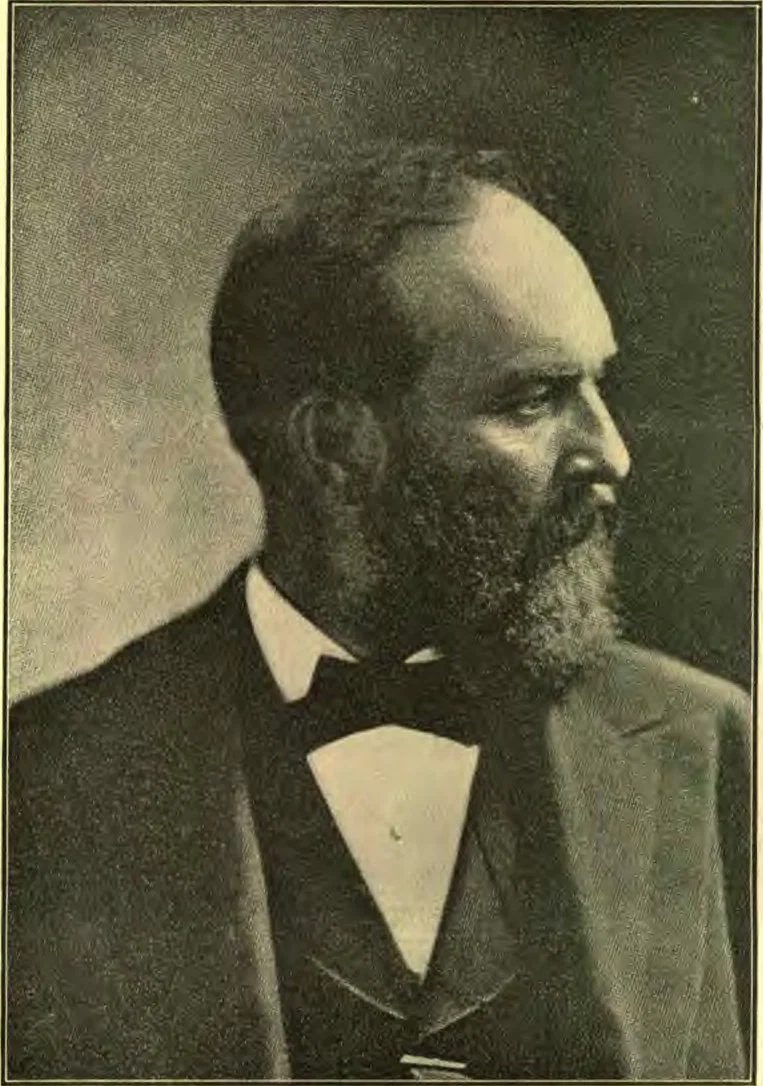
In the wilds of Ohio on a bleak, bitter November day, in a little log cabin, a fair-haired, blue-eyed baby boy opened his eyes. As the father took his namesake in his arms, he said, “He is worth his weight in gold,” and the child’s after-life proved this to have been a true prophecy. When James Abram Garfield was eighteen months old, his father, who with the help of Thomas and Methelabel, his brother and sister, had been fighting one of the numerous forest fires, caught cold, and died suddenly from congestion of the throat. When dying, he said to his wife, “I am going to leave you, Eliza. I have planted four saplings in these woods, and I must now leave them to your care.”
Every one said that this was a sad providence—a mother so young and frail left to bring up four children, and carry on the farm alone. She was advised to sell everything, and find homes for her children among friends, but Eliza Garfield was not the woman to do this without first having made a heroic attempt to care for the family.
Thomas said to her, “Don’t cry, mother, dear. I am ten years old now, and I can run the farm.” His mother told him that he certainly could do a great deal toward it, and that with God’s help they would keep together and pay their debts. It was now late in spring, and her small but brave helper, Thomas, sowed wheat and planted corn and potatoes on the thirty acres of land left them. With the help of a kind neighbor, Thomas completed the small barn which his father had begun. His mother and sisters split the rails and drove the stakes for the fence around the wheat-field.
James, with these examples of untiring industry and perseverance ever before him, at an early age tried to help. “Me do it too,” he would cry as Thomas took the rake or hoe and went to the fields. “One of these days, Jimmy,” the brother would say with a smile, although he hoped there were better things in store for the little brother he loved so dearly. While James did not inherit wealth, he did inherit from both his parents energy, courage, and perseverance, invaluable traits that may be acquired if not inherited.
About four years after the death of Mr. Garfield, Mrs. Garfield gave enough land from her small plot upon which to build a new schoolhouse, the neighbors having clubbed together to build it. The house was twenty feet square, with a slab roof, a floor made of logs split in halves, and had log benches without backs. The teacher, a young man from New Hampshire, boarded with Mrs. Garfield, and a warm friendship was soon established between James and himself. James, a bright, active child, never wearied of asking questions. The teacher, telling of the lad’s wonderful progress in school, would say, “James will make his mark in the world one of these days, take my word for it.” His mother, like the mother of Scripture, laid up these words in her heart, and determined to give James every possible advantage.
The schools of that time were very poor compared with those of to-day. Instead of the excellent educational opportunities every boy and girl now may have, James Garfield was taught only the “three R’s”—reading, writing, and arithmetic—with geography and spelling additional. As soon as James could read, he began to devour everything he could find in the shape of a book. In the family library, containing only about six volumes, Ween’s “Life of Marion” and Grimshaw’s “Napoleon” were favorites with the enthusiastic boy. Every evening after the work of the day, Mrs. Garfield would read to her children from her well-worn Bible.
THE TWENTIETH PRESIDENT
James had a wonderful memory, which grasped and held everything that came before his mind. With this memory was linked a strong imagination, which enabled him to fill the orchard with Indian chiefs and noted heroes of the books he read, giving to each tree the name of a favorite hero or chief. He often delivered long and loud talks to his make-believe audiences.
Thomas watched his progress with fatherly interest and admiration, never regretting for an instant that it was his lot to support the family, nor that James received the education that he himself so much longed for.
James did the work about the farm whenever it was possible for Thomas to get outside work so as to earn a little ready money. Once Thomas went away for six months to work, earning twelve dollars a month. James tried hard to fill his place at home, but could not put his soul into the work as Thomas had done. He wished to read and study all the time. His mother told him that Providence would open a way for him to continue his education, though how or when she did not know. When Thomas returned with seventy-five dollars in gold, a large sum of money in those days, he hired a carpenter to build a new house from logs he had been saving for years, as the old house was very small and dilapidated. The new house was to have three rooms below and two above. During the building of the house, James became clever with chisel, mallet, and plane. Thus he learned the carpenter’s trade, which helped him out of many a hard place. He earned his first dollar, which he gave to his mother, by planing twelve-foot boards for one cent each. He worked all day Saturday, since there was no school, and before night had planed as nice as could be one hundred boards.
James had a restless spirit, and longed to get into the world. About ten miles from his home there was a large potash factory. This potash was called black salts in its crude state. James was offered work in this factory at fourteen dollars a month by Mr. Barton, the owner of the factory, who had watched James build a shed on his grounds, and admired his industry and quickness. James, who had a good bringing up, did not associate with the men whose profanity and coarse language shocked him. Instead he read the books on a shelf in Mr. Barton’s house. These were entirely different from any the carefully brought-up boy had read, and did not tend to keep down his longing for activity. Among them were such books as “The Pirate’s Own Book,” “Lives of Eminent Criminals,” Marryatt’s Novels, and Jack Halyard. These books only increased his desire to go to sea. After some time James at last persuaded his mother to let him try a trip on Lake Erie. Arriving in Cleveland with high ideas of what captains ought to be, he started out to find a vessel leaving the wharf. On asking for work on a steamer, the captain, who was a coarse, drinking man, ordered him off with terrible oaths. This experience taught James that story life and real life were two entirely different things, and also shattered his high ideals of noble captains.
While wandering around in search of work, he came across the canal boat “Evening Star” tied to the bank. On going aboard he found Amos Letcher, the captain, to be a cousin of his, who gave him work at twelve dollars a month, driving the mules which drew the boat between the Ohio River and Lake Erie. While on board, an incident happened which showed James Garfield’s fairness. By accident James hit a boat-hand with a pole. He apologized, but the man started a fight, in which the sixteen-year-old boy threw the man down, and when urged by the crew to finish him, James refused to hit him while he was down. When the man arose, they shook hands. He was always willing to keep out of a fight, but did not seem afraid of any one.
One night as James was standing on the edge of the deserted deck, a lurch of the boat threw him overboard, and as he could not swim, and the men were below, he thought he was lost. Just then his hands hit something hard, which proved to be a rope; by this he pulled himself on deck. Examining the rope, he found it had caught in a crevice of the deck. He tried hundreds of times to catch the rope in the same place again, but failed. On seeing how wonderful had been his escape, he decided that he must make the very most of his life.
After returning home he met a friend who had been to Geauga Seminary in Chester, and naturally was enthusiastic in telling of its advantages. James and two of his cousins decided to go and room together, boarding themselves so as to lighten expenses. On arriving in Chester they found rooms with an old lady. James had exactly eleven dollars when he entered school, but he hoped to earn more with his carpenter’s trade. How many boys and girls of to-day would start to school with eleven dollars, and only the hope, not the assurance, of earning more?
There is a description given of James at that time by a schoolmate who said, “His clear, blue eyes and free, open countenance tended to invite esteem, while his height was increased by the coarse wool and cotton trousers he wore, which were outgrown and reached only half-way down the tops of his cowhide boots. These, with a threadbare coat which was so short in the sleeves that it made his arms look like Ichabod Crane’s in Sleepy Hollow, topped off with a coarse slouched hat much the worse for wear, was his only suit of clothes.” His head was covered with a shock of yellow, unkempt hair, which fell over his shoulders like a Shaker’s.
LOUISE R. SWIFT.
(To be concluded)

For the Boys and Girls

MANY of the so-called wonderful feats or “tricks” performed by those who make a business of astonishing and deceiving the people are merely illustrations of scientific principles. Two or three simple ones are given below, with the hope that the thoughtful boy and girl will be able to recognize the natural law involved in each, and will send the editor the result of their observations in a letter.

A Simple and Puzzling Board Illusion

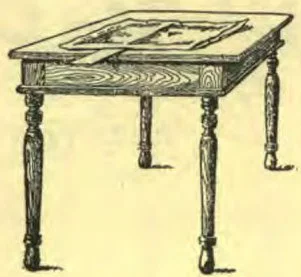
Procure a piece of thin board of soft wood, say pine; it should be a foot and a half in length and two inches wide. Place it upon an ordinary kitchen table, allowing it to protrude almost half its length beyond the edge of the table. Now place a newspaper upon the table, covering the board to the edge, as illustrated, and smooth it out carefully, being sure that the paper is in perfect contact with the board as well as with the table. Strike the board a smart, sharp blow with the hand or an instrument, and the board will either break off or tilt the table and remain fast to it, just as if it had been nailed fast.

How to Drive a Needle Through a Copper Coin
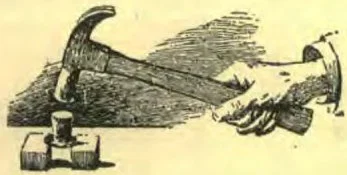
An apparent mechanical impossibility may be accomplished by simple means, using a copper cent, and a cork, with a common cambric needle as accessories. Take a copper coin, place it upon two small blocks of wood, leaving a very narrow open space between the blocks. Now, having selected a good, sound cork, force the needle through it until the point just appears at the other end. Break off the portion of the head of the needle showing above the top of the cork. Place the cork upon the coin, and strike it a fair, smart blow with the hammer. The needle will be driven entirely through the penny by a single blow.

Putting a Bird in an Empty Cage

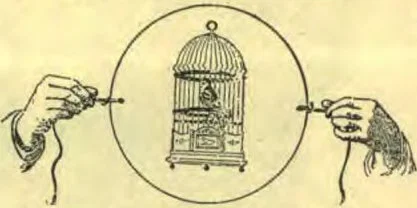
Take a disk of cardboard, draw upon one side a bird cage, or paste upon the card a picture of a cage cut from some paper or magazine. In the exact center of the opposite side, draw the figure of a bird so that the head of the bird points to the opposite edge of the card from what the top of the cage does. A picture of a bird may be substituted for the drawing. A bit of string attached to holes in the extreme edge of the cardboard disk will enable you to twirl the card rapidly with your fingers. The resulting illusion will show the bird in the cage sitting upon his perch, where before only the empty cage was seen. Two figures of any kind may be used in place of the bird and cage.

What Some Thinkers Say about the Bible

REVERENT students of the Bible are overwhelmed with the evidence of its divine authorship. Ask Sir Isaac Newton. “We account the Scriptures of God to be the most sublime philosophy.” Ask the poet Milton. “There are no songs comparable to the songs of Zion, no orations equal to those of the prophets, no politics like those the Scriptures teach.” Ask Rousseau. “I must confess the majesty of the Scriptures astonishes me; the holiness of the evangelists speaks to my heart, and has such strong and striking characteristics of truth, and is, moreover, so perfectly inimitable that, had it been the invention of men, the inventors would be greater than the greatest of heroes.” Ask the philosopher Locke. “If any man would attain the true knowledge of the Christian religion, let him study the Holy Scriptures, especially the New Testament. Therein are contained the words of eternal life. It has God for its author, salvation for its end, and truth without any mixture of error for its matter.” Ask Petrarch, the man of letters. “If all other books were destroyed, this one retained would be a greater treasure than all the millions published by mortal man.” Ask Sir Walter Scott, the lover and maker of books. As his dying eyes look forth from the study at Abbotsford down the winding Tweed, and Lockhart asks, “From what book shall I read?” “And do you ask?” said Scott. “There is but one book.”

A Cloud of Witnesses

John Henry Newman, the author of “Lead, Kindly Light,” declares of the Bible: “Its light is like the body of heaven in its clearness; its vastness like the bosom of the sea; its variety like the scenes of nature.”
Heinrich Heine is a Jew, a brilliant wit, a doubter. Picking up a Bible as the only book in an hour of despair, he exclaims: “What a book! Vast and wide as the world, rooted in the abysses of creation, and towering up beyond the blue secrets of heaven! Sunrise and sunset, birth and death, promise and fulfilment, the whole drama of humanity, are all in this book! It is the book of books.” Dying years after, a changed man, Heine says: “I attribute all my enlightenment to the reading of a book. With right it is named the Holy Scriptures. He who has lost his God can find him again in this book, and he who has never known him is here struck by the breath of the divine Word.”
Theodore Parker said: “This collection of books has taken hold on the world as no other. The literature of Greece, which goes up like incense from that land of temples and heroic deeds, has not half the influence of this book, from a nation alike despised in ancient and modern times. It is read in all the ten thousand pulpits of our land; in all the temples of Christendom is its voice lifted up week by week. The sun never sets on its gleaming page. It goes equally to the cottage of the plain man and the palace of the king. It is woven into the literature of the scholar, and colors the talk of the street. The merchant can not sail the sea without it; no ship of war goes to the conflict but the Bible is there. It enters men’s closets; mingles in all the grief and cheerfulness of life.”
Ewald is a German scholar of great learning. Picking up the New Testament, he said to Dean Stanley: “In this little book is contained all the best wisdom of the world.”
Huxley, who invented the word “agnosticism” and accepted the name agnostic, pleads for the Bible as the best source of highest education for children. “I have always been strongly in favor of secular education in the sense of education without theology, but I must confess I have been no less seriously perplexed to know by what practical measures the religious feeling which is the essential basis of conduct was to be kept up without the use of the Bible.” He calls the Bible “The national epic of Great Britain,” “The Magna Charta of the poor and of the oppressed,” and says: “I do believe that the human race is not yet, possibly never may be, in a position to dispense with it.”
Matthew Arnold is a great critic, but he says: “As well imagine a man with a sense for sculpture not cultivating it by the help of the remains of Greek art, and a man with a sense of poetry not cultivating it by the help of Homer and Shakespeare, as a man with a sense for conduct not cultivating it by the help of the Bible.”
Lessing is a German man of letters, a liberal thinker. Hear Lessing: “The Scriptures for seventeen hundred years have occupied the mind more than all books, have enlightened it more than all books.”—Selected.

Verses on Serving God and Mankind

“To honor God, to benefit mankind, To serve with lofty gifts the lowly needs Of the poor race for which—the God-man died, And do it all for love—oh, this is great! And he who does this will achieve a name Not only great, but good.”

Hugo Grotius and His Book-Chest

When Prince Maurice of Nassau, son of the great Prince of Orange, was stadtholder—that is to say, governor—of Holland, two men stood in the way of his rise to arbitrary power. One of them was the advocate, Olden-Barneveld; the other, his young friend and adviser, Hugo Grotius. Hugo de Groot, generally known as Grotius, was born in Delft, April 10, 1583. He entered the University of Leyden, after a very rigorous examination, at the age of twelve; at fourteen he defended, publicly and with much applause, theses in mathematics, philosophy, and jurisprudence; took his degree as bachelor of arts; and published a translation of a learned Latin work, with copious original notes. At the age of seventeen he began the practise of law at The Hague, where he soon mounted high in political power, besides being famous for his legal and literary attainments.
This was the man whom Prince Maurice sought to sweep from his path, along with Olden-Barneveld. He succeeded in procuring their arrest and trial. Barneveld was beheaded in The Hague, and Grotius was condemned to imprisonment for life in the gloomy castle of Loevestein. Through thirteen doors, each secured with heavy bolts and locks, the prisoner was conducted to the narrow rooms designed for his living tomb. The commandant of the fortress was Lieutenant Prounix, generally known as Deventer, a bitter enemy of Grotius, so that the only consolations the prisoner had were granted by the States General. Chief of these was the daily visit of his wife and his little daughter Cornelia.
Madam de Groot was allowed to purchase food for her husband's table in the little town of Gorkum just across the Waal, and to cook in the kitchen of the prison, assisted by her maid Elsie, a comely lass of twenty. It was through her efforts, also, that books, the chief joy of his captivity, were conveyed to Grotius in his prison. These were loaned to him by his friends, his own library having been confiscated along with the rest of his property. The sister of one of these good friends was the wife of a tradesman named Daatsalaer, living in the town of Gorkum, and was frequently visited by Madam de Groot. To her house the books were sent, and were carried from it to the prison in a large chest; for the great black-letter folios of that day were excessively bulky and heavy. After the books were read, they were returned from the prison again to be exchanged for others, so the weight of the prisoner's book-chest became a frequent subject of grumbling among the soldiers entrusted with its carriage to and from the ferry.
In his gloomy prison, Grotius wrote many works, which carried his fame throughout the whole civilized world. Poems, translations, learned treatises, and moral essays flowed from his pen, and the book-chest went back and forth more frequently than ever. But all this work began to tell upon the health of the imprisoned man. “Our bird does not beat his wings against the cage, nor mope upon his perch,” Madam de Groot said sadly to her friend, Dame Daatsalaer, “but I see him pining. O that I could give him wings, and open the bars!”
One day a committee of the States General visited the prisoner in his two little rooms, where they found him writing at the table, while his wife sat beside him, patching a sleeve of an old velvet doublet. Information had been lodged that Grotius had been planning escape. It was said that Madam de Groot had been seen buying some strong rope at Gorkum, and the committee had come to inquire into the matter. Accordingly they ransacked everywhere, turning over manuscripts, books, and clothing, but finding nothing.
“Take special heed to this chest, Master Lieutenant,” said Mius van Holy, peering suspiciously into the chest. “Methinks that here is space for much contraband goods besides all this learned lumber.”
But nothing was there save the great folios, and the committee were obliged to withdraw. Grotius stooped to replace one of the books, but his wife stayed his hand, and stood looking at the empty box as if a new thought had struck her. “ ‘Space for much contraband goods,’ said that knave Van Holy,” said she, at last. “Hugo, it might be that he spoke more wisely than he knew; it might be space for a man.”
The eyes of Grotius brightened for a moment; but he presently shook his head. “Enough for his coffin, mayhap,” he said, “but not for his living carriage. The chest is but four feet in length—small space for a long-limbed man.”
“It may be done,” cried Madam de Groot, vehemently. “Under these ornaments are air-holes. Lay by your doublet, Hugo, and make the attempt at least.”
So the attempt was made; and Grotius found that by coiling up his limbs, he could really manage to lie in the chest with the lid closed.
“Let us try it for an hour,” said Madam de Groot. “There, I have turned the hour-glass; knock on the lid if you can not endure to the next turning.”
Strengthened by the hope of escape, Grotius patiently endured the cramped position for the hour. The next day there was another trial; and this time the hour-glass was turned for the second time. The vision of escape began to grow brighter. Still, the hazard was so great, and the risks were so terrible, that the attempt was put off from day to day until there was no knowing how long they might have hesitated had not little Cornelia innocently given the signal for action.
It was Sunday, the twenty-first of March, 1631. A wild equinoctial storm was raging, with sheets of rain dashing against the windows, and wind howling around the fortress. In a temporary lull in the storm the bells of Gorkum could be heard ringing.
“What mean those merry peals?” asked Grotius, looking up from the pictured pages of the Testament he was showing to his little daughter.
“They must be ringing for the opening of the great fair,” said Madam de Groot.
“And to-morrow would be the right time for my papa to go to Gorkum,” said little Cornelia; “for Madam Daatsalaer says that all exiles and outlaws may come to Gorkum on the fair-days, and none dare harm them till they are past.”
Grotius softly set the child from off his knee, and passed into the bedroom, making signs to his wife to follow him.
“Wife,” said he, taking her by the hand, and speaking in a low tone, “it may be that the Lord himself speaks by the mouth of the innocent child; what think you?”
“Hugo, I well believe the time has come,” answered Madam de Groot, breathing quickly. “Let us put it by no longer!”
In the midst of their agitation over the hasty resolve, a grating of the locks was heard, and Deventer appeared. He informed them that he was to leave the fortress for a few days, as he had been promoted to a captaincy, and must go to Heusden to receive his company. After he had gone, Madam de Groot summoned her faithful maid Elsie, and told her all, asking her if she would be willing to take charge of the book-chest and its precious contents in case it should be sent to Gorkum the next day.
The maid quailed for a moment, but soon plucked up courage to say that she would take it, and would do her best. “You are a good girl, Elsie,” said Madam de Groot, the tears shining in her keen eyes, “and I am well persuaded that you will never have to repent of what you do.”
The next day was still wet and stormy, and the waters of the Waal were swollen and turbid. Dressed only in his linen underclothing, Grotius curled himself up in the chest, with his head resting on a large pictured Testament for a pillow. His anxious wife propped his cheek with a bunch of soft thread, and padded the curves of his body with rolls of linen and paper; then with a solemn and tearful farewell, she closed and fastened the chest, kissed the lock with streaming eyes, and gave the key to Elsie. The clothes Grotius had taken off were thrown over the back of a chair beside the bed, the bed-curtains were carefully drawn, and the soldiers were summoned to carry the chest to the boat that waited for it.
“Heavier than ever,” grumbled the men, as they lumbered after Elsie down the stair. “The prisoner himself must be in here to-day, besides his ponderous books.” At this, Elsie laughed in the most free-hearted way possible.
The court of the prison was reached, and now came the first great danger. Should the commandant’s wife, who was now in charge of the prison, inspect the books that were leaving the fortress, all would be lost. She might have done so had the weather been fair; but at the sight of the wet courtyard, where the chest stood in the driving rain, she had no will to venture into it; so the box with its precious load was safely passed through the gates of Loevestein. Two sailors lifted the chest on board the boat, talking, as the soldiers had, about the heaviness of the load, and a second time jestingly accusing Elsie of carrying off the prisoner as well as his books. Seated beside the chest on the wind-swept deck of the little boat, Elsie covered her head with a white handkerchief, the ends of which she allowed to flutter in the wind.
“Your kerchief will hardly keep your pretty head dry, mistress,” said one of the sailors.
“I wear it as a signal to a fellow servant with wits not so thick as your own,” said saucy Elsie.
It was, in truth, a signal to let Madam de Groot know that all was well; and Elsie knew that at that moment the eyes of her mistress were straining at the window to see whether she wore the white handkerchief, or sat with her face buried in her hands as a token of failure.
The swollen waters of the Waal were passed, the town of Gorkum was reached, and the precious chest was safely carried to the house of Daatsalaer. The shop of the mercer was thronged with customers, and Elsie ordered the men to carry the chest to the room beyond, and there quietly paid and dismissed them. Then beckoning Madam Daatsalaer aside, she said, “Madam, I have brought my master; he is in the room within there.”
The suddenness of this speech was dangerous; for Madam Daatsalaer uttered a cry that drew the attention of all in the shop. But recovering herself, and making an excuse, she followed Elsie into the next room.
“Master! master!” cried Elsie, rapping on the lid of the chest.
There was no answer.
“O my master!” cried the girl, wringing her hands. “He is dead! surely he is dead!”
But at that moment there was a rap within the box. The lock was turned, the lid thrown back, and Grotius arose in his linen garments, looking, through exhaustion, almost as white as they.
“Why are you so pale, madam?” said he, looking at good Dame Daatsalaer, who was white and trembling.
“Alas! I am sorely frightened,” said she, breaking into tears. “My lord, the whole world is talking of you, and there will be no keeping this hid.”
“Madam,” said Grotius, with steadfast gentleness, “I am at this moment thanking God for the deliverance he has granted me; but sooner than harm shall befall you, I will enter the chest again, and be carried back as I came.”
His sincerity and nobleness touched the good woman’s heart. “No! no!” said she; “whatever comes, my husband and I will do all that we can to aid your escape.”
And so they did; for Daatsalaer spoke to a friend of his, a master mason named Petersen, who consented to take Grotius to Antwerp disguised as a journeyman bricklayer. Clad in a coarse doublet and trunk hose, carrying a trowel and a measuring rod, Grotius traveled safely to Antwerp, in the Spanish Netherlands, and so came into the world again, and to the honor and fame that belonged to him.
Meanwhile at Loevestein all was confusion and tumult; a messenger was dispatched to Heusden to carry the news of the escape to Captain Deventer, who returned in hot haste, and rushed in rage to the rooms of Grotius. “Here is your cage,” said Madam de Groot, with a smile, “but your bird is flown.”
The commandant hurried to the house of Daatsalaer. There was the book-chest and the Testament and the bundle of thread, but no further sign of Hugo Grotius, who had passed forever from the prison of Captain Deventer.
The stadtholder was not so angry as had been expected; he even used his influence to have Madam de Groot released from the prison, where she was for a short time held. She and Cornelia joined Grotius in France, where they found him honored as he deserved. Such is the story, and the true story, of Hugo Grotius and his famous book-chest.—Harper’s Young People.

Honored to Have a Place in the Plan

“For my part in the plan is but weakness, My place in the structure small— But what a thing for a worm of the dust To be in the plan at all!”

The Origin and Use of the Cross

MUCH is written of the cross. That Jesus died upon it, is all that many people know. Long prior to Christ, however, the cross was used. Its origin takes us back to the lowest forms of heathenism among the Asiatics, Egyptians, Grecians, and Romans. It began with the sun-worship, when Ishtar, the Assyrian Venus, was represented as holding a staff, the upper end of which was in the form of a Latin cross. In Assyrian history it was worn as a religious emblem, as many Catholics wear it to-day. There are specimens of such still preserved in the British Museum. They date back as far as one thousand years before Christ. The emblem is also found on Greek pottery seven hundred years before Christ, and was also used as a symbol by Buddha; while Roman coins of the period of two hundred sixty-nine before Jesus show the cross of Saturn.
The cross was generally used as the weapon for capital punishment. King Bomilicar was crucified by the Carthagenians. Alexander crucified two thousand Tyrians, and the Jews crucified Christ. In such a death was comprised every idea and circumstance of disgrace and public scandal. Few punishments produced more suffering. The passing of the spikes through the hands and feet shocked the whole system, and the depending of the body upon these frail and wounded members was only a remote attack upon the citadel of life. The flies in great numbers irritated the sore places. The sun pouring its rays down upon the unprotected head caused thirst, dizziness, and faintness. The breath came in gasps. The heart worked under great disadvantages, and every straightened movement for relief but aggravated the pain. For days the victims lingered, suffering untold pain.
Some years ago a party of travelers were passing over the Swiss mountains. After they had gone a considerable way, it began to snow heavily, and the oldest of the guides gravely shook his head and said: “If the wind rises, we are lost.” Scarcely had he spoken, when a gale arose, the snow was whirled into drifts, and all marks were obliterated. Cautiously they moved on, not knowing where they were, and almost giving themselves up for lost. At length one of the guides, who had gone a short way before them to search out the path, was heard shouting, “The Cross! The Cross! We are right.” He had come across one of those religious memorials which are so prominent in Roman Catholic countries, and this one, set up at first by some private individual for personal reasons, had become at length a well known and easily recognized landmark for the traveler.
O young people, though the cross had its origin in heathenism, it eventually became the grandest implement and the most glorious emblem of death. It is the sinner’s landmark. “As Moses lifted up the serpent in the wilderness, even so must the Son of man be lifted up: that whosoever believeth in him should not perish but have everlasting life.”
“It is the old cross still, Its triumph let us tell, The grace of God here shone, Through Christ the blessed Son, Who did for sin atone; Hallelujah for the cross!”
WILLIAM P. PEARCE.
Continue reading: Can All Accomplish Something for the Lord?