YES, if the heart is wholly and unreservedly given to God, he will bless even the lowliest service. The following letter from a sister in St. Joseph, Louisiana, shows what a busy person may do. One needs not wealth and high social position to make him an acceptable servant.
“I am a poor widow with a mother and a daughter to support. My daughter is now attending school in New Orleans, Louisiana. Our home is in Vicksburg, Mississippi, and we spend the summer there. I am a cook by trade, and have served as such here for the past three winters.
“I have had the blessed privilege of telling these poor people of the true Sabbath, of which they had never heard, and now many of them acknowledge it as such. The pastor of the Flouramount Baptist church has publicly confessed to his people that all who teach that the first day is the Sabbath of the Lord are teaching that which is not truth.
“Two persons are strict observers of the Sabbath. We meet first in one home and then in another for our Sabbath meetings, and have Bible readings, singing, and prayer. The Little Friend is the only paper we take. When my daughter was with me, we had Sabbath-school regularly, and also a Sunday-school for several hours in the afternoon. Seventy-two pupils were in attendance. Many had never heard of such a school, as there had been none here for ten years. I also organized a public school, and secured a teacher from Vicksburg.
“Last year I sold ninety-six books—‘Gospel Primer’ and ‘Christ in Song;’ and bought and gave away one hundred tracts. I supply not less than four families with food daily. I gave away one suit of clothes to-day, and have given quite a number of others.
“The Sabbath-school has closed, as I have been very busy with other work, but I am still continuing my Bible readings among my neighbors, especially those on the Sabbath.
“CHARITY BROWN.”
“The love of Christ constraineth us.” Are you, dear reader, so filled with that love that you want every one else to know how precious it is? Then go and tell it to those who know it not, and you shall receive a blessing.
EMMA NEWCOMER.
Great Privileges Bring Great Responsibilities
“GREAT privileges never go save in company with great responsibilities.”
Rounds of Love to Men
By Whittier
WHEN we climb to heaven, ’tis on the rounds of love to men.—Whittier.
The Sabbath of the Heart
EVERY day should have some part free for the Sabbath of the heart.—Wordsworth.
(a) Conditions in Honduras. Review and Herald, May 19.
(b) The Work in Iceland. Review and Herald, May 26.
(c) Peru, Unentered. Review and Herald, June 9.
(d) Incidents from Work in China. Review and Herald, May 19, 26; June 2, 9, 16.
(e) Pastor Oberlin and his Wonderful Work, Review and Herald, June 16.
CLOSING EXERCISES:—
Consecration Service.
Benediction.
Note
There are so many good reports this month that the program can easily be varied. The entire hour could be devoted to the reports from China. The article on “The Bible in India” is an excellent one to study. Ten minutes could well be spent in two- or three-minute messages from the field. Our workers everywhere report progress. We must catch the inspiration that these good words from the field bring, and let it mold our lives. By the study of the field we may be able to encourage some of our young friends to take a stronger hold on the truth, which is making its way, according to God’s Word, to the ends of the earth.
E. H.
A New Tract Rack
WE now manufacture a good, substantial tract rack made of oak-grain strawboard, in imitation of wood, and capable of holding a quantity of five or six different kinds of tracts.
Tract racks will do their work while you do yours.
Price, 20 cents each, postpaid; or six for $1.
Better send for six racks, and put them up in the dentists’ and doctors’ offices, barber shops, lunch rooms and hotels, railway stations, etc., in your town,—wherever people are compelled to wait.
Many persons date their first knowledge of Bible truth to literature obtained from a reading rack. No doubt you will be glad to use a number of these racks in your vicinity.
Address Review and Herald Publishing Assn., 222 North Capitol St., Washington, D. C.
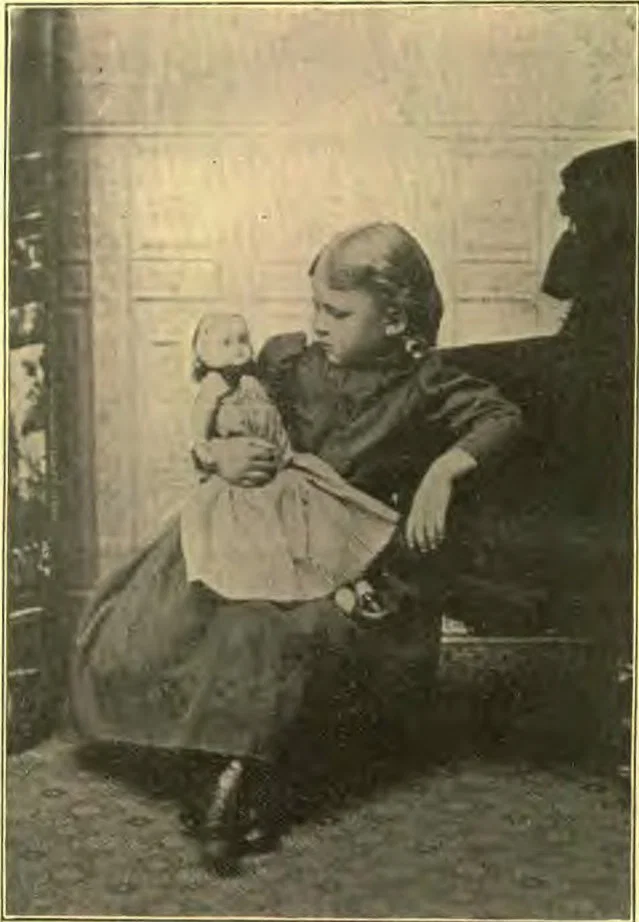
When My Dolly Went to School
By Alice Lewis Richards
WHEN my dolly went to school,
I bought her a slate and rule
With my only silver dime;
And I said to dolly dear,
“Now, my pretty, do you hear?
You must always be on time.”
But I told her not to worry,
Nor get into a flurry
If she happened to be late;
And what teacher has to say
She must every word obey,
And must always sit up straight.
Then her little study book
And some other things she took,
With a bottle full of ink,
And a pen and blotter too,
With a tablet clean and new,
For to write her little think.
But my dolly had a will,
And she never would sit still,
So the teacher had to use a stick.
Then the boys would tease her so
Just because she didn’t know
How to get her ’rifmatic.
Soon my dolly grew so haughty,
And some days she was so naughty,
That she wouldn’t mind a rule;
And she couldn’t learn to spell,
Nor would she get her grammar well,
So I thought I’d take her out of school.
And I’d wait a year or two
Till my dolly older grew,
Then, perhaps, she’d try to learn.
But she promised to do better,
So I did consent to let her
Go to school another term.
— Alice Lewis Richards.
Animal Stories
A Motherly Gobbler
Mr. Morris once owned a gobbler that possessed the maternal instinct in the superlative degree.
Mr. Gobbler was determined to sit. Sometimes it was on apples, sometimes on potatoes, and at last, all else being taken from him, he pushed some corn-cobs into one corner of a manger, and tried again.
Mr. Morris decided that if the old fellow would sit, he might as well do it to some purpose, and accordingly gave him a “sitting” of hen’s eggs. He was faithful to the task imposed upon him, and at the end of three weeks “came off” very proudly with his family of chicks.
For the first few days he was very proud of his chicks, and strutted around the yard taking the best of care of them. One day Mr. Morris took some friends to the chicken yard to see the funny sight, and they laughed considerably, for the brood and their foster-mother certainly presented an amusing appearance. Mr. Gobbler seemed to realize that they were making fun of him, and from that time on, whenever he saw a stranger approaching, he would walk away and pay no attention to his charges until the people were out of sight.
Notwithstanding his difficulties with visitors, he successfully raised his little brood until they left him of their own free will, and went to roost with the older chickens.—La Pette Howe.
How a Dog Saved a Horse
When I was a boy, our folks owned a dog called Rover. No dog-fancier would have taken a second look at him on account of his pedigree, for he had none. But this deficiency was well supplied by brave, intelligent doghood.
There wound through our farm a spring stream with high, precipitous banks on one side, while the ground sloped gradually on the opposite side to banks as high or higher. Not far from the house and by this stream we staked out one of the horses, so that it could reach the tender, juicy grass close to the edge of the water. The high-water mark and flood probabilities were not understood, so disregarded.
One night in early spring there came one of those sudden, flooding rains so characteristic of central Kansas twenty years ago. Some time in the night Rover came to the doorway of our partially built house where we were camping out, and barked fiercely. As marauders of various kinds were not uncommon, we were suspicious. After barking a few times in a way indicating that something unusual had happened, he ran rapidly toward the stream. In a few minutes we heard his pattering feet again as he bounded up to the doorway, barking more fiercely than ever.
Following him this time, he led us to the horse, which stood in the still rising deep water, with its nose drawn down, pulling vigorously. As near as he could get to the horse stood Rover, making his only effort, by barking and tail-wagging, to release the horse. We waded in, severed the rope, and saved the horse, much to the delight of Rover.—Kraken.
Just in Time
Years ago my father owned a high-spirited and vicious horse, Billy. One of his bad habits was to start at the top of a hill and run to the bottom, and no power on earth could stop him.
At the time of which I write there was a two-year-old child living in the house which my father occupied. One day the child’s older brother, Fred, and my mother had been out with Billy. When they reached the top of the hill at the foot of which they lived, Billy started to run.
As they neared the house, little Kathie ran out to meet them. Fred saw her coming, and tried with all his strength to stop the horse, but in vain. Much more quickly than I can tell it, they reached the foot of the hill, the child in the path, when Billy dropped his head and stopped within a foot of the child, and stood there looking as innocent and gentle as if he had never had an evil thought in his horse brain.—Etta M. Dodge.
Tommy’s Dream
TOMMY had a curious dream one night. He had been kept in from play to help his father. But, instead of being proud to think that his father wanted his help, he was cross about losing his play—so cross that his father quietly remarked he would not ask him to stay in again.
When he lay down to sleep that night, he dreamed that two angels were sent down to earth to make a record of all the nice, loving things the boys and girls were doing. One angel was to take note of all the big things that were done, and the other was to write down all the little, unnoticed deeds of life. They parted as they reached the earth, and when they met again, on their way back to heaven, they compared notes. One had scarcely filled two pages of his book.
“There are not many conspicuous things done, after all,” he said, in explanation.
“I have scarcely found time to write down all that I have seen,” said the other angel, and he showed a little book filled from cover to cover with the record of loving little deeds.
Tommy’s heart stood still, and he thought, “My name must be there, too; for it was a nice thing to stay in and help father.”
Then he heard the angel explaining why there were some boys and girls he did not take any notice of at all. “They did nice things,” he said, “but they were so cross about it and so unwilling that I could not write them down; for, you know, I was told only to record the loving deeds of life.”
Then Tommy woke up, and, as he lay still and thought about it, he knew that he could not possibly have been in the angel’s book that day.— Ram’s Horn.
Best Lessons
“Oh, there’s that Ruth Knolls and her brother again! Do you know, Miss Merton, she is just awfully dull in school, and we girls laugh at her so much. She hasn’t a particle of brilliancy.”
Viva chattered this speech out as she walked along the street beside Miss Merton.
“She has something far better than brilliancy,” said Miss Merton.
“What?” said Viva, her cheeks flushing uncomfortably; for she felt that she had made a mistake, and she was very anxious to stand well in Miss Merton’s opinion.6
“She has a courteous manner. That is a grace that is very great, but far too rare. I know Ruth quite well, and her kindness and courtesy are unfailing in company or at home. She is good.”
“I am sorry I spoke so,” said Viva. “I really don’t know anything about her except that she stumbles so dreadfully in her lessons.”
“No doubt she is very sorry about it, and I am sure she works faithfully. It is a fine gift to be quick and bright in understanding things. But you know, my dear, that it is far more important to be kind-hearted and gentle. When you girls go out in the world, no one will ever ask or know whether you got good grades in algebra or Latin. If you have done your best, it is wrought into you, whether your best is very good or only mediocre. But be sure of this: Every one who meets you will know without putting you through an examination whether you are a gentlewoman or not. It isn’t practical to quote Greek or discuss psychology or read Shakespeare with every one you meet; but you can always speak kindly and listen courteously, and quietly look out for the opportunity to do little deeds of kindness that make our lives so much more worth living.”—Selected.
A Beacon Light of Progress—Fort Snelling
By John Gordon
Much of the early history and development of the Northwest is read in the story of Fort Snelling. Situated on a high bluff above the Mississippi, facing the Minnesota as it flows to meet the great river, the old stone fort looks out now upon scenes of peaceful civilization; but when its ramparts were reared above the cliffs, it stood as the one fortress of protection on the far frontier, amid the most bloodthirsty savages.
During Jefferson's administration, in 1805, the United States government sent its first commissioner, Lieutenant Zebulon M. Pike, to explore the Mississippi River. He was instructed to deal with the British traders who were violating the laws of the United States in regard to the fur trade, and to form alliances with the Indians, then almost wholly under the dominion of the British, who were teaching them to despise the weakness of the new government. He reached the mouth of the Minnesota in September, and held council with a band of Sioux headed by Little Crow. He induced these Indians to cede certain of their lands to the United States, and it was then that the government secured the military reservation upon which Fort Snelling now stands. Lieutenant Pike's voyage of discovery, up the Mississippi to the homes of the Chippewas, is one of the thrilling adventures of our early history. He carried the flag into lands which, though belonging to the United States, had felt for years the iron rule of the British trader, dealing under and wrongfully flying the Union Jack.
John C. Calhoun, secretary of war during the Monroe administration, was deeply interested in the development of the Northwest and the condition of the aborigines, and it was due to his efforts that Fort Snelling was founded for the double purpose of encouraging the fur trade and the protection of the frontier. Under his orders a portion of the Fifth Regiment of Infantry, then stationed at Detroit, was ordered, February, 1819, to proceed, under Colonel Leavenworth, to the military reservation secured by Lieutenant Pike, at the junction of the Mississippi and Minnesota Rivers, and there establish a military post. They reached their destination in September, having gone by way of the Great Lakes, and the Fox and Wisconsin Rivers to Prairie du Chien, and thence up the Mississippi. Rude barracks were put up for protection during the winter, and the following year excavations for the foundation of the fort were begun, the corner-stone of which was laid Sept. 10, 1820. This was, at first, called Fort St. Anthony, but Colonel Josiah Snelling having assumed command in 1820, the name was changed, by recommendation of General Scott, to commemorate that of the builder. The building was finished in 1822, and the post became a center of civilization. All the northern exploring parties, with their guards of soldiers, set out from it, and to it they returned for rest and protection. Missionaries and traders found there a warm welcome from the isolated officers and their wives; settlement was encouraged, and the savages held in check by the presence of United States authority, as vested in the soldiers at the fort.
Reminiscences of early days on the frontier, of Indian uprisings, of hardships endured from isolation and climatic conditions, fill pages of the early history of the old fort, but the most interesting memories cluster around the exploring expeditions which revealed the richness and extent of this great country of ours.
The expedition sent out from Michigan, in 1820, under Lewis Cass, reached Fort Snelling by way of Lake Superior, on the way north. There, too, came the artists, geologists, and surveyors of the northern boundary of the United States, in 1823, under Major Stephen H. Long. In 1832, Schoolcraft's expedition for the exploration of the Mississippi River used Fort Snelling as a point of vantage; Catlin, in his “North American Indian,” describes the picturesque setting and scenery. Jean Nicollet spent a year there, and went from thence with his assistant, John C. Fremont, “The Pathfinder,” to make a very exhaustive exploration of the basin of the upper Mississippi, and David Dale Owen made there his headquarters when investigating Minnesota, during the summers of ’47, ’48, ’49, and ’50. All of these efforts were of great scientific value to the United States, and would have been scarcely possible without Fort Snelling as a base of supplies and protection.
During the Indian uprisings the fort and block-house afforded shelter for the settlers. It seems strange now to recall that the first farmers in Minnesota were the Swiss refugees from Lord Selkirk's starving settlement, in Manitoba. They came to Minnesota in 1827, and were allowed to farm on “the reservation,” on the west side of the river, under the protection of the fort.
The country adjacent to Fort Snelling is exceedingly picturesque. Historically and romantically the old gray stone pile might well appeal to those good Americans who glory in the story of the nation.—John Gordon.
MEMORY VERSE: “The angel of the Lord encampeth round about them that fear him, and delivereth them.” Ps. 34:7.
“Then the king of Syria warred against Israel, and took counsel with his servants, saying, In such and such a place shall be my camp. And the man of God sent unto the king of Israel, saying, Beware that thou pass not such a place; for thither the Syrians are come down.”
This happened a number of times. The king7of the Syrians would say, I will make my camp in such and such a place. But when he came there, expecting to surprise Israel, they had escaped from him. The king of Syria was very much troubled. He thought one of his servants must be telling his plans to the king of Israel; so he called them all together, and asked, “Will ye not show me which of us is for the king of Israel?”
“And one of his servants said, None, my lord. O king: but Elisha, the prophet that is in Israel, telleth the king of Israel the words that thou speakest in thy bedchamber.
“And he said, Go and spy where he is, that I may send and fetch him. And it was told him, saying, Behold, he is in Dothan. Therefore sent he thither horses, and chariots, and a great host: and they came by night, and compassed the city about.
“And when the servant of the man of God was risen early, and gone forth, behold, an host compassed the city both with horses and chariots. And his servant said unto him, Alas, my master: how shall we do? And he answered, Fear not: for they that be with us are more than they that be with them.
“And Elisha prayed, and said, Lord, I pray thee, open his eyes, that he may see. And the Lord opened the eyes of the young man; and he saw: and, behold, the mountain was full of horses and chariots of fire round about Elisha.
“And when they came down to him, Elisha prayed unto the Lord, and said, Smite this people, I pray thee, with blindness. And he smote them with blindness according to the word of Elisha. And Elisha said unto them, This is not the way, neither is this the city: follow me, and I will bring you to the man whom ye seek. But he led them to Samaria. And it came to pass, when they were come into Samaria, that Elisha said, Lord, open the eyes of these men, that they may see. And the Lord opened their eyes, and they saw; and, behold, they were in the midst of Samaria.”
Now Samaria was the chief city of Israel. The king lived there, and there he had his soldiers. So when the great host that had been sent to take Elisha walked into Samaria, and the gates of the city were closed behind them, they were wholly in the power of the king of Israel.
“And the king of Israel said unto Elisha, when he saw them, My father, shall I smite them? shall I smite them? And he answered, Thou shalt not smite them: wouldest thou smite those whom thou hast taken captive with thy sword and with thy bow? set bread and water before them, that they may eat and drink, and go to their master.
“And he prepared great provision for them: and when they had eaten and drunk, he sent them away, and they went to their master. So the bands of Syria came no more into the land of Israel.”
Not all the mighty host that the king of Syria sent to take Elisha could do any harm to the Lord’s prophet; for the Lord protected his servant. Very often when we are in danger, and sometimes when we are in danger and do not know it, if our eyes could be opened, we would see angels about us to keep us from harm. Let us never forget the Memory Verse,—“The angel of the Lord encampeth round about them that fear him, and delivereth them,”—and think of it whenever we are in danger or tempted to do wrong.
Questions
1. What king again made war against Israel? With whom did he counsel? What did he say? Who told the king of Israel what the Syrians were going to do? How did this help the king of Israel?
2. Did this happen more than one time? See verse 10. What did the king of Syria think? What did he ask his servants?
3. What did one of his servants say to the king of Syria? What command did the king then give? In what city was it told the king that Elisha might be found? Whom did the king send to take Elisha?
4. What did Elisha’s servant see the next morning when he went out to take a walk? What did he say to his master? What cheering answer did Elisha give? How many did he say were with him and his servant?
5. What did Elisha ask the Lord to do? What happened to the young man? What did he see?
6. What did Elisha ask that the Lord would do to the Syrian hosts? How was his prayer answered? Where did the prophet lead them? When they were inside the city, what did he ask of the Lord?
7. Find Samaria on the map. Who lived there? Whom did he have with him? What must the Syrian soldiers naturally have thought when they found themselves in the power of the king of Israel?
8. What did the king ask Elisha if he might do? How did the prophet reply? What did he bid the king set before the Syrians? After this was done, where were the men sent?
9. Why could not the host of soldiers take Elisha? Does the Lord send his protecting angels to shield his children from harm? How do you know this? Repeat the Memory Verse. What lessons may we learn from our study to-day?
The Anvil of God's Word
LAST eve I passed beside a blacksmith's door,
And heard the anvil's vesper chime;
Then looking in, I saw upon the floor
Old hammers worn with beating years of time.
“How many anvil’s have you had,” said I,
“To wear and batter all these hammers so?”
“Just one,” he answered, then with twinkling eye,
“The anvil wears the hammers out, you know.”
And so, I thought, the anvil of God’s Word
For ages skeptic-blows have beat upon;
Yet though the noise of falling blows was heard,
The anvil is unworn — the hammers gone.”
—Selected.
Child Labor Among American Youth, Census Returns
THE census returns show that the number of children in the United States between the ages of ten and fifteen who are working for their living is one million seven hundred fifty thousand.
Ostrich Plucking
OSTRICH plucking is an event which is advertised in the newspapers of California, and attracts crowds of visitors to the farm to witness the operation. The removal of the feathers is not really a “plucking,” but is literally a “cutting.” The bird to be clipped is coaxed into a corner, and a bag drawn over his head. The birds are so large and strong that careful handling is necessary, but as an ostrich without sight is helpless, he offers no resistance after his head is covered. The big plumes are carefully cut away, leaving an inch or so of the quill.
After the feathers have been cut away, the head is uncovered, and the bird allowed to run off, and it is always amusing to see the air of shame a plucked bird has as he sidles back to his pen, as though he realized that he had lost his beauty and attractiveness, and felt a sense of mortification.
The birds live in captivity sixty or seventy years, and at a period of every nine months yield about thirty dollars’ worth of feathers.—Selected.
Why Not?
By Jessie F. Waggoner
[THE stanzas given below were written for the author's Sabbath-school class of boys in the Haskell Home, to assist in reviewing the life of the prophet. Each pupil was expected to memorize the poem, and to verify each point by a text of Scripture. The boys so thoroughly enjoyed the work that they asked to have the stanzas appear in the INSTRUCTOR.—ED.]
ELIJAH was a man of old,
With passions like our own,
Who knew discouragement and fear,
And felt both sad and lone,
E'en once forgot that God was nigh,
And ran away and wished to die.
And yet God used him in his work,
And heard him when he prayed,
In famine sent him food and drink,
And cheered him when afraid,
Was with him in temptation's hour,
And gave him overcoming power.
By faith he grasped Almighty strength,
And rose above his fears,
And finished grandly all his work—
When lo! a light appears,
And he is taken up on high,
To live with God beyond the sky.
If one just like us gained the sky,
Then why not you? and why not I?