The Youth’s Instructor, Vol. 29, No. 18.

THE NATURAL BRIDGE

The Youth’s Instructor

May 4, 1881

S. D. A. Publishing Association · Battle Creek, Mich. · May 4, 1881

THE NATURAL BRIDGE.
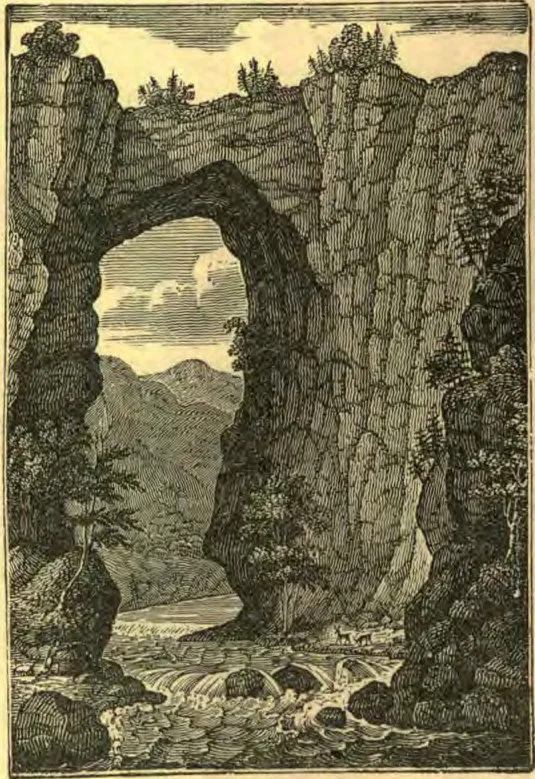
One of the most remarkable curiosities in the world is the Natural Bridge across a little stream in the southeast corner of Rockbridge county, Virginia, in the midst of the wild and majestic scenery on the western side of the Blue Ridge Mountains.
About twelve miles from Buchanan, on the stage road to Lexington, as the traveler passes around the foot of the hill down a steep descent, he suddenly finds himself upon a narrow track like a lane between two high fences. Looking over these fences into open space, nothing would suggest to him that he is upon the great Natural Bridge so celebrated in the history of our country; but passing beyond these barriers, and down a deep gorge, he finds that this bridge crosses a narrow chasm a little less than one hundred feet wide and two hundred and thirteen feet deep, at the bottom of which flows a little stream called Cedar Creek. The thickness of this bridge of solid rock is about forty feet, its breadth is sixty feet, and its material is a tough and highly silicious limestone extremely hard to break, formed in massive blocks and strata, the weather-beaten surface of which shows no tendency to decompose or crumble away.
Says one who has visited the spot: “The Natural Bridge is more wonderful than Niagara. The ravine which it spans is nowhere else crossable for several miles above or below. It seems like a providential provision for the convenience of the people who inhabit the neighborhood.”
“We went down a zigzag path to Cedar Creek,—down, down among the shadows into the canyon, for nearly two hundred feet, and then looked up. Yonder is the amazing structure, arching the abyss. From the water of Cedar Creek to the roadway above, it is two hundred and ten feet, or fifty-five feet higher than the fall of Niagara. From below, the bridge is seen to great advantage along the course of the little stream; but away from this gorge, it is not a conspicuous object in the scenery, as it does not rise above the general level around it. The span is ninety feet across at the top, and a little over fifty at the base, making an irregular, elliptical arch, widening from the water to the summit. The width of the bridge also varies, being forty-five feet at the narrowest point, and broadening outward toward the bluffs. The stranger is at first impressed with the magnitude of the bridge. The pictures and descriptions all fail to give the proper idea of its mountainous dimensions. It spans a dizzy height. To look up from below, one realizes something of its majestic proportions, the tall lindens planted at one’s feet scarcely reaching half way to the level of the frescoing under the arch. ‘Frescoing’ may not be the word to apply to the handiwork of the Almighty; but when you gaze up against the stone ceiling, and trace the image of an eagle, clearly drawn, with outspread wings, and also the scarcely less distinct representations of a lion and other living creatures, it is easy to imagine the intelligent touch of an artist’s hand.”
At the base of the bridge many names are carved upon the steep walls; and every schoolboy has learned to look among them for the initials of George Washington, who is said to have climbed to a good height and cut them conspicuously upon the rock. Inquiry among the residents about the bridge, however, finds no tradition of this interesting event in the life of Washington; but it is related on good authority that, standing at the edge of the creek which flows under the bridge, he threw a silver dollar clear over the arch. Very few of the most athletic men who visit the place in these later days, are muscular enough to sling a single pebble to the ceiling of the arch.
From the bend in the creek just above the bridge, the most striking view is obtained; and from this point, the flinty route is indicated where James H. Piper, a student from Lexington, in 1818, climbed the solid walls and scaled the summit. The school-book story of the knife worn to the hilt in cutting niches for the hands and feet of the climber, and the extended rope thrown down from above, just as the hero was about to fall from his giddy elevation, is no doubt largely a myth. But the thrilling story is founded on fact. Many exciting legends are related in connection with the Natural Bridge, some of which would serve for poems or paintings.
It is said that a wealthy Southern gentleman has lately purchased a large tract of some four hundred acres, including the Natural Bridge. This he proposes to fit up as a grand park, which will doubtless become a favorite place of resort for the lovers of rustic scenery.

J. N. LOUGHBOROUGH

ANCIENT BRITAIN.—NO. 6.

The buildings constructed during the Roman occupation of Britain were, to a great extent, of timber taken from the forests which then abounded on the Island. These buildings have long since moldered away. Some of their stone villas have been dug out of the earth, one during the last year near Brading, in the Isle of Wight. By unearthing this villa, it was discovered that some of the so-called “nice houses” of the Romans consisted of walls of stone four or five feet high, with gabled roofs of timber, lathed and plastered inside.
Many Roman coins have been found in various parts of the kingdom. These bear the stamp of Constantine, Licinius, Crispus, Constans, Constantius, Valens, Theodosius, Maximus, and in fact the names of almost all, if not every ruler of Rome from A. D. 1, to the middle of the fifth century. These are preserved as relics, and may be seen in the British museum, and other museums of the kingdom.
When the Saxons took possession of Britain, their endeavor was to introduce and maintain their own idolatry. Their religion was that then existing in the northern forests of Germany, where the light of the gospel and the civilization of Rome had not penetrated. Their common god was Woden, the war god. To him they dedicated the fourth day of the week, calling it Woden’s-day; from this point, comes our Wednesday. The fifth day was dedicated to their god Thor, from thunder—the god of air and storm and rain. It was called Thor’s-day, from which has come our Thursday. The sixth day was Frea’s-day, the goddess of peace and joy and fruitfulness. From this is derived our word Friday. They claimed that the emblems of this goddess, borne aloft by dancing maidens, brought increase to every field and stall they visited. The seventh day was dedicated to an obscure god, Soetre. Some of the idolaters had dedicated it to Saturn,—Saturn’s-day, from which has come our Saturday. The first day was the day of the sun, Sun’s-day; the second, the day of the moon, or Moon’s-day; from these names have come our Sunday and Monday. These Saxons had also their god of darkness, Tiw for Tuesday. To meet the god Tiw they claimed was sure death. Eastre was their goddess of the dawn, or of the spring; from this same word has come the word Easter, by Christians applied to the festival of Christ’s resurrection.
Not only Hengest and Horsa, made themselves kings over part of Britain, but soon after, five others established themselves as kings in other parts. So Britain had seven kings, called the heptarchy, or group of seven kingdoms. These were, 1. Kent; 2. Sussex; 3. Wessex; 4. Essex; 5. Northumbria; 6. East Anglia; 7. Mercia. These States never entered into a confederacy; sometimes the ruler of one, and sometimes another, assumed the title of Bretwalda, or Emperor of Britain. There were eight of these Bretwalda from Aelli, king of Sussex A. D. 491, to Egbert of Wessex in 827. The term Bretwalda was never more than an empty title, as none of them ever attained the real dignity of sole ruler of the heptarchy, nor indeed power to suppress even smaller petty States which arose from time to time.

J. N. LOUGHBOROUGH

BUTTERCUPS AND DAISIES.

BUTTERCUPS and daisies, Oh! the pretty flowers! Coming ere the spring-time, To tell of sunny hours. While the trees are leafless, While the fields are bare, Buttercups and daisies Spring up everywhere.
Little hardy flowers, Like to children poor, Playing in their sturdy health, By their mother's door; Purple with the north wind, Yet alert and bold, Fearing not, and caring not, Though they be a-cold.
What to them is weather? What are stormy showers? Buttercups and daisies, Are these human flowers! He who gave them hardship, And a life of care, Gave them likewise hardy strength, And patient hearts to bear!
Welcome, yellow buttercups! Welcome, daisies white! Ye are in my spirit Visioned a delight! Coming ere the spring-time, Of sunny hours to tell, Speaking to our hearts of Him Who doth all things well. —Sel.

HOW TO LOVE GOD.

In a beautiful New England village, a boy lay very sick, drawing near to death, and very sad. He was joint-heir, with an only brother, to a great estate, and the inheritance was just about coming into his possession; but it was not the loss of this that made him sad. He was a dying boy, and his heart longed for a treasure which he knew had never been his, and which was worth more to him now than all the gold of the western mines.
One day I came into his room. I sat down by him, took his hand, and looking in his troubled face, asked him what made him so sad.
“Uncle,” said he, “I want to love God. Won’t you tell me how to love God?”
I cannot describe the piteous tones in which he said these words, and the troubled look which he gave me. I said to him,—
“My boy, you must trust God first, and then you will love him without trying to at all.”
With a surprised look, he exclaimed, “What did you say?”
I repeated the exact words again; and I shall never forget how his large, hazel eyes opened on me, and his cheek flushed as he slowly said,—
“Well, I never knew that before. I always thought that I must love God first, before I had any right to trust him.”
“No, my dear boy,” I answered. “God wants us to trust him. That is what Jesus always asks us to do first of all; and he knows that as soon as we trust him, we shall begin to love him. That is the way to love God,—to put your trust in him first of all.”
Then I spoke to him of the Lord Jesus; and how God sent him that we might believe in him; and how, all through his life, he tried to win the trust of men; how grieved he was when men would not believe in him; and how every one who believed, came to love him without trying to love at all.
He drank in all the truth; and simply saying, “I will trust Jesus now,” without an effort put himself in Christ’s hands that very hour. And so he came into the “peace of God which passeth understanding,” and lived in it calmly and sweetly to the end. None of all the loving friends who watched over him during the remaining weeks of his life, doubted that the dear boy had learned to love God without trying to, and that dying, he rested in hope of meeting Him whom not having seen he had loved.—Illustrated Weekly.

GIANT MOUNTAINS.

Mount Everest is the giant mountain of the world. It rears its lofty head above all other things on earth. It seems to touch the sky. No human foot has yet been placed upon its summit. No beast has ever reached its glittering crest. The giant stands alone in awful majesty. At its base, eternal summer clothes the earth with verdure. From the sunny plains below, men look with wondering eyes upon this mighty monarch, always clad in winter robes.
Travelers from many lands have tried in vain to conquer this giant mountain. Some have climbed from height to height; but as they reached one elevated peak after another, they found that other mountain-crests still rose before them. Higher and yet higher some have mounted, each success increasing their desire to reach the top. But all in vain; for, when at last they were compelled to stop, still far above them soared the lofty summit they had toiled so hard to reach.
But where is this giant mountain? I will tell you. Far, far away in Central Asia, India is bounded by a mighty granite wall. This wall consists of rugged snowy peaks, which rise, like giant watch-towers, miles above the level of the sea; and it stretches from east to west more than a thousand miles. This range of mountains is called the Himalaya, and its highest peak is Mount Everest, the giant mountain of the world. At the foot of the Himalaya Mountains there are immense forests and jungles, where the tiger, the elephant, the rhinoceros, and the monkey make their homes. Here grow the stately palm, the useful bamboo, the plantain, and the fig. In the valleys, rice, the Indian’s favorite food, is cultivated.
As we ascend the mountain-side, we find the oak, the elm, the maple, and the chestnut. Here European fruits grow wild. The larger and the fiercer beasts are left below, but wolves, hyenas, buffalo, and deer abound. Still higher, the hardy pine becomes more numerous; at last it is the only forest tree. And on the rugged heights are found the goat, the mountain-fox, the wild sheep, and the bear. Ascending still, all vegetation ceases. No animals are found. Our feet have crossed the snow-line. Far above our heads there rises eight thousand feet of snow.
To cross this mighty range from India to Thibet, would be a journey of 400 miles. Between some of the peaks there are narrow roads called passes. These passes are higher than Mont Blanc, the highest peak in Europe.
One traveler who crossed this range of mountains, says that he had sometimes to walk barefooted on the slippery path. Sometimes he had to creep along the edge of a frightful chasm, holding on to a twig or a tuft of grass. Sometimes he was drawn along a rope from ridge to ridge over a mountain-torrent. Some years ago, two gentlemen (brothers) and their servants crossed these mountains. For ten nights they pitched their tents upon the mountain-sides, four miles above the level of the sea. They reached the highest point yet gained by man; but still more than a mile above them rose the summit of the giant peak.
Though Asia contains the highest mountain in the world, the longest unbroken range is in South America. There the Andes stretch from one end of the continent to the other,—from the Strait of Magellan to the Isthmus of Panama, a distance of more than four thousand miles. One of the principal peaks, though not the highest of that range, is called Chimborazo. It is a perfect dome in shape, and was once regarded as the loftiest summit in the world. The Andes contain numerous volcanoes, or burning mountains, one of which, Cotopaxi, is the highest and most dreaded volcano on the face of the globe.
Turning to Europe, we find another mighty mountain-system, extending for hundreds of miles in various directions. This is the Alps, with its needle-shaped summits, and its long, narrow valleys between them. Here we find Mont Blanc, the loftiest peak in Europe, of which Byron wrote,—
“Mont Blanc is the monarch of mountains; They crowned him long ago, On a throne of rocks, in a robe of clouds, With a diadem of snow.”
Here, too, is the famous St. Bernard Pass, over which Napoleon Bonaparte led his troops to Italy in 1800; and where, in their lonely monastery, live the kind-hearted monks, who, with their noble dogs, succor the weary Alpine travelers.
Eight years ago the Mont-Cenis tunnel was opened. It is seven and a half miles in length, and passes under a mountain ten thousand feet high.
These are some of the world’s wonders; and, as we think of them, we are led to say, “How great must that God be who in the beginning created all these things!” of whom the Psalmist wrote,—
“Lord, thou hast been our dwelling-place in all generations. Before the mountains were brought forth, or ever thou hadst formed the earth and the world, even from everlasting to everlasting, thou art God.” Ps. 90: 1, 2.—[London] Children’s Paper.

SERVICE

Not all that is high is holy; Not all that is sweet is good; Not every desire Toward which we aspire Pleases our God as it should.
Sometimes the joy that we covet Is not a joy when possessed; And to labor right on Till our duties are done Is better, far better, than rest.
He who by pride is exalted, He who as monarch is known, Less honored may be By the Master, than he Who stands at the foot of the throne.
For better is it to be humble, To serve in the lowliest place, To labor and plod With the veriest clod, Than the likeness of God to efface.
For the soul, like a delicate needle, Will move as desire has swerved, And point at the last, When Death holds us fast, To the one we've most faithfully served.

AVOID BAD BOOKS.

THERE are many such books. They teach nothing useful. They give false ideas of life. They set the passions on fire. They make vice appear attractive. They make boys ashamed of what ought to be loved and honored. They take modesty away from the heart of girls. They create a dislike for the quiet pleasures of the home. They beget a distaste for the Bible, for the Sabbath-school, and the sanctuary.
Avoid such books. They smut the character like coals. They defile like pitch. They poison like arsenic. They lead astray like a false guide. And, in many cases, they blight like a disease, and ruin like a destroyer.
Beware of books you would blush to have your mother see in your hands, which your father would not tolerate, and which set your own conscience reproving you. That is a bad book for you, no matter how highly recommended, which makes you less inclined to take hold of your common duties and perform them with real interest. That is a good book which prompts you to something nobler and better than you have been doing.—Myrtle.

Bitter Words.

A single bitter word may disquiet an entire family for a whole day; while a smile, like a gleam of sunshine, may light up the darkest and weariest hours. Like unexpected flowers which spring up along our path, full of fragrance and beauty, so do kind words and gentle acts make glad the home where peace and blessings dwell.

WILD FLOWERS.

Delicate faces, pure and pale, That hide in the shadowy nook, That faintly breathe to the stirring gales And broider the singing brooks.
They are first to welcome the timid spring With gentle and starry eyes, And whisper to earth, sad slumbering, The tidings of balmy skies.
Linger a little along the way, And gather their magic power, Thanking the Father who sends the May, And fashions the sweet wild flower!
—Mary M. Bowen.

SCENES IN THE LIFE OF CHRIST.

LESSON 15.—JESUS RETURNS TO GALILEE.

AFTER the passover mentioned in our last lesson, Jesus and his disciples seem to have tarried some time in the country of Judea before going back to Galilee. The record says: “And after these things came Jesus and his disciples into the land of Judea, and there he tarried with them and baptized.” At this same time John was baptizing in Enon, near to Salim, which is supposed to have been on the Jordan, about two-thirds of the way from the Dead Sea to the Sea of Galilee. And the disciples of John, when they heard that Jesus and his disciples were preaching and baptizing throughout the country, “came unto John and said unto him, Rabbi, he that was with thee beyond Jordan, to whom thou barest witness, behold, the same baptizeth, and all men come to him.” Perhaps these disciples of John were envious because that Jesus and his disciples were more sought after than they and their master; but John certainly had no such spirit, as his answer to them plainly shows. He said to them, “A man can receive nothing except it be given him from Heaven.” He then went on to tell them that he was not the Christ, but that he had been sent to prepare the way before him, and in doing this his joy was fulfilled. But now that work was done; and from that time onward the fame of Christ was to increase, while his own must decrease. He also expressed his perfect confidence in Christ as the Saviour, and told them that without faith in him, none could be saved.
“When therefore the Lord knew how the Pharisees had heard that Jesus made and baptized more disciples than John (though Jesus himself baptized not, but his disciples) he left Judea” and “returned in the power of the Spirit unto Galilee.” Following the great road leading north from Judea into Galilee, Jesus and his disciples would pass by Ramah, Bethel, Gilgal, Shiloh, and other little towns; until finally, about thirty miles north of Jerusalem, they came to the city of Sy’char. The ancient name of Sychar was She’chem, but it is now called Nab’-lous. It is situated in the valley between two remarkable mountains called E’bal and Ger’izim. The great road leading north enters this valley about a mile and a half east of the city. Near this place, and just at the foot of Mount Gerizim, is the well which Jacob dug in the parcel of ground which he bought of Hamor, the father of Shechem.
Many years before the time of Christ, when the children of Israel had first entered the land of Canaan, they came to Mounts Ebal and Gerizim, and there pronounced the blessings and curses, as Moses had told them to do when they were still on the other side of Jordan. These mountains seem remarkably suited for the purpose to which they were set apart by Moses. They rise close together; and it is said that part way up the side of Ebal is a recess in the mountain, exactly facing a similar recess in Gerizim. So travelers think that those who uttered the blessings and curses did not stand on the tops of the mountains, but in these recesses on their sides. In this way they might easily be heard from one mountain to the other, and also by the people in the valley below.

QUESTIONS.

  1. After the passover mentioned in our last lesson, where did Jesus and his disciples go? John 3:22.
  2. What did they do?
  3. Did Jesus baptize with his own hands? Chapter 4:2.
  4. Where was John baptizing at this same time? Chapter 3:23.
  5. Where is this place supposed to have been?
  6. When the disciples of John heard what Jesus and his disciples were doing, what did they say to their master? Verse 26.
  7. In what words had John borne witness to Jesus beyond Jordan? John 1:28, 29.
  8. What kind of spirit did the disciples of John seem to have, in speaking as they did?
  9. Did John have any such feelings?
  10. In what words did he reprove his disciples? Chapter 3:27.
  11. What did he say in regard to his work? Verse 28.
  12. How did he say his joy was fulfilled?
  13. What did he say about the future of both Christ and himself? Verse 30.
  14. What must all do in order to inherit everlasting life? Verse 36.
  15. When Jesus heard how some felt about his making and baptizing more disciples than John, where did he go? Chap. 4:1-3; Luke 4:14.
  16. Name some of the places which they would pass, as they journeyed north from Jerusalem.
  17. To what place would they come when about thirty miles from Jerusalem?
  18. Where was this town situated?
  19. What was this city anciently called?
  20. How far is it from the place where the great road leading north enters the valley running east and west?
  21. Where is Jacob’s well?
  22. What remarkable ceremony had taken place on Mounts Ebal and Gerizim many years before? Deut. 11:29, 30; Josh. 8:30-35.
  23. Explain how those who uttered the blessings and curses might have been heard from one mountain to the other, and also by those who stood in the valley below.
Note.—Read article entitled “Jacob’s Well,” in INSTRUCTOR No. 1 of this year; also “Ebal and Gerizim,” in No. 9.

NEW TESTAMENT HISTORY.

LESSON 27.—THE SERMON ON THE MOUNT.—CONTINUED.

“Moreover when ye fast, be not as the hypocrites, of a sad countenance; for they disfigure their faces, that they may appear unto men to fast. Verily I say unto you, they have their reward. But thou, when thou fastest, anoint thine head, and wash thy face; that thou appear not unto men to fast, but unto thy Father which is in secret; and thy Father, which seeth in secret, shall reward thee openly.
“Lay not up for yourselves treasures upon earth, where moth and rust doth corrupt, and where thieves break through and steal; but lay up for yourselves treasures in Heaven, where neither moth nor rust doth corrupt, and where thieves do not break through nor steal; for where your treasure is, there will your heart be also.”
“Judge not, and ye shall not be judged; condemn not, and ye shall not be condemned; forgive, and ye shall be forgiven; give, and it shall be given unto you; good measure, pressed down, and shaken together, and running over, shall men give into your bosom. For with the same measure that ye meet withal it shall be measured to you again.
“And he spake a parable unto them, Can the blind lead the blind? shall they not both fall into the ditch? The disciple is not above his master; but every one that is perfect shall be as his master. And why beholdest thou the mote that is in thy brother’s eye, but perceivest not the beam that is in thine own eye? Either how canst thou say to thy brother, Brother, let me pull out the mote that is in thine eye, when thou thyself beholdest not the beam that is in thine own eye? Thou hypocrite, cast out first the beam out of thine own eye, and then shalt thou see clearly to pull out the mote that is in thy brother’s eye.”
“Give not that which is holy unto the dogs, neither cast ye your pearls before swine, lest they trample them under their feet, and turn again and rend you.”
“Therefore all things whatsoever ye would that men should do to you, do ye even so to them; for this is the law and the prophets.
“Enter ye in at the strait gate; for wide is the gate, and broad is the way, that leadeth to destruction, and many there be which go in thereat; because strait is the gate, and narrow is the way, which leadeth unto life, and few there be that find it.
“Beware of false prophets, which come to you in sheep’s clothing, but inwardly they are ravening wolves. Ye shall know them by their fruits.” “For a good tree bringeth not forth corrupt fruit; neither doth a corrupt tree bring forth good fruit. For every tree is known by his own fruit. For of thorns men do not gather figs, nor of a bramble bush gather they grapes. A good man out of the good treasure of his heart bringeth forth that which is good; and an evil man out of the evil treasure of his heart bringeth forth that which is evil; for of the abundance of the heart his mouth speaketh.”

QUESTIONS.

1. What caution did our Lord give his disciples in regard to their behavior while fasting? Matt. 6:16.
2. Why did the hypocrites put on a sad countenance and disfigure their faces at such times?
3. What reward did they receive?—Just what they sought,—the approval of men.
4. Why did Jesus exhort his disciples to be cheerful while fasting, observing their usual carefulness in regard to personal appearance?
5. By so doing what might they lose?
6. What would they gain?
7. What caution was given in regard to laying up treasures?
8. Why is it so much better to lay up treasure in Heaven than upon the earth;
9. Why is it then that most men strive so eagerly to lay up treasure here, and are so unwilling to lay up treasure in Heaven?
10. What is the import of the words, “Where your treasure is, there will your heart be also”?
11. Why is it so much better to have our thoughts upon things in Heaven than upon things in earth?—Our characters are formed by our habits of thought, and if we will become pure and holy, we must employ our thoughts upon things of that nature.
12. How does our Saviour warn us against judging and condemning others? Luke 6:37.
13. What encouragement is given to those who heed this precept?
14. What is promised to those who forgive?
15. How are we encouraged to be generous? Verse 38.
16. By what figure are we warned against trusting to the wisdom of men? Verse 39.
17. What is our only source of unerring wisdom?—The word of God.
18. Who is our only perfect pattern?—Jesus Christ.
19. By what figure does Christ show the folly of dwelling upon the faults of others instead of our own? Verse 41.
20. What reproof does he give to those who attempt to correct others while indulging in greater sins themselves?
21. Repeat Matt. 7:6.
22. What is the passage supposed to mean? See Note.
23. Repeat verse 12.
24. What is this precept sometimes called?—The “golden rule.”
25. What admonition is given in verse 13?
26. Why is the road to destruction represented as a “broad way,” and the road that leads to eternal life, as a “narrow way”?
27. How are we warned against false prophets?
28. What is meant by their coming in “sheep’s clothing”?
29. What is meant by saying that “inwardly they are ravening wolves”?
30. How may false prophets be detected? Verse 16.
31. By what figure is this illustrated? Verses 17–20; Luke 6:43, 44.
32. How is this figure explained? Luke 6:45.

NOTES ON THE LESSON.

“Anoint thine head and wash thy face.—These were forbidden in the Jewish canon on days of fasting and humiliation; and hypocrites availed themselves of this ordinance, that they might appear to fast. Our Lord therefore cautions us against this; as if he had said, Affect nothing—dress in thy ordinary manner, and let the whole of thy deportment prove that thou desirest to recommend thy soul to God and not thy face to men.”—Clarke.
“Lay not up for yourselves treasures upon earth,—a good caution against making the things that are seen, that are temporal, our best things, and placing our happiness in them. Something or other every man has, which he makes his treasure, his portion, which his heart is upon, to which he carries all that he can get, and which he depends upon for futurity. It is that good, that chief good, which Solomon speaks of with such emphasis in Eccl. 2:3. Something the soul will have, which it looks upon as the best thing, which it has a complacency and confidence in above other things. Now, in this caution Christ designs not to deprive us of our treasure, but to direct us in our choice of it.”—Matthew Henry.
“Where your treasure is.—If God be the treasure of our souls, our hearts (i. e., our affections and desires), will be placed on things above. An earthly-minded man proves that his treasure is below; a heavenly-minded man shows that his treasure is above.—Clarke.”
“Shall men give into your bosom.—The eastern garments being long, folded, and girded with a girdle, admit of carrying much corn in the bosom.”—Cottage Bible.
“Can the blind lead the blind?—This appears to have been a general proverb, and to signify that a man cannot teach what he does not understand. This is strictly true in spiritual matters. A man who is not illuminated from above is utterly incapable of judging concerning spiritual things, and wholly unfit to be a guide to others.”—Clarke.
“Give not that which is holy unto the dogs—Our zeal against sin must be guided by discretion, and we must not go about to give instructions, counsels, and rebukes, much less comforts, to hardened scorners, to whom it will certainly do no good, but who will be exasperated and enraged at us.”—Matthew Henry. See Prov. 9:7, 8; 23: 9.
“The strait gate signifies literally what we call a wicket, i. e. a little door in a large gate. These gates would admit but one person at a time, and that not without difficulty.”—Cottage Bible.
“By their fruits ye shall know them.—The fruits here referred to are those virtues and graces of the Holy Spirit on which our Lord has pronounced his blessing in the opening of this discourse,—meekness, humility, purity, and a peaceable disposition; none of which belong to the character of wolves. The ‘sheep’s clothing’ respects not the outward garb, but the persons who put on the external semblance of Christ’s disciples, whom he calls his sheep, while their outward disposition, which will eventually show itself in their conduct, proves them to be in heart, ‘ravening wolves.’”—Cottage Bible.

Sabbath Schools Resume After Winter Suspension

The Sabbath-schools which have been suspended during the winter months are beginning to wake from their long nap. If scholars can have Sabbath-school privileges only a part of the year, they should be all the more earnest to improve them. A “rallying day,” which shall bring every boy and girl, and every man and woman who can be reached, into the ranks, will help to give the right start.

“BEAR YE ONE ANOTHER’S BURDENS.”

ELLIE VENNER walked home from school, pondering a text which she had heard her teacher read that morning,—“Bear ye one another’s burdens,”—and she could not understand exactly what it meant. Of course she resolved to ask her mother; but when she reached home she was told that mamma was out.
Then she went to a large dictionary, and found that “burden” meant something to carry.
Finally she thought she would take a walk. Soon she met a poor woman wearing a soiled, ragged dress, and carrying what appeared to be a very heavy basket on her head. Ellie looked down at her own warm dress and thick cloak, and hugged her little muff more tightly to her, as she thought how cold that poor woman must be. Then she looked again at the heavy basket on her head, and thought that must be her burden, and she wondered if she ought to carry it for her. Yet she didn’t believe she would be able to lift it.
Then she went on for some distance, and she came to a narrow, dirty street. It did not look at all inviting, and at first she thought she would hurry by; but, seeing a good many little boys and girls playing there, she finally strolled in. She saw one little girl about her own age, carrying a baby.
“That must be her burden,” Ellie said to herself, “I’ll carry it for her.”
So she walked up to the stranger, and said,—
“Little girl, I’ll carry the baby, shall I?”
The child seemed shy at first; but, when she saw what a pleasant little face Ellie had, she gained courage, and said,—
“Yes; if you’ll hold him a few minutes, I can go and play snowball.”
But the baby was large and fat, and he kicked and screamed when Ellie tried to take him, so that she could not get a good hold; and he fell, and bumped his forehead. Then he screamed louder than ever; and his sister picked him up, and carried him into the house.
Ellie felt very sorry that she had hurt the baby when she was trying to do right.
She went home now, and found that mamma had returned, and of course she went to her with her troubles.
“Poor child!” said the mother, putting her arm around her little daughter, and drawing her closer to her, “The text is not to be taken literally.”
“What does ‘literally’ mean?” asked Ellie.
“You were taking it literally,” replied mamma, “this afternoon, when you tried to carry the baby. ‘There are many burdens which cannot be seen, and they are generally the heaviest.”
“Where do they carry them, mamma?” asked Ellie.
“They often carry them in their hearts, my child. This little girl you were telling me about must be very poor; for you say that she was thinly clad, and had no shoes. Then poverty, with all its discomforts, is her burden. Some people have sickness: that is their burden. Some are lame; some are blind.”
Ellie was beginning to understand the text better now.
“But, mamma,” she asked, looking a little doubtful, “how can I bear this little girl’s burden? Must I be poor, and go to live in her house, and wear her rags, and let her come here to live with you and papa?”
“Oh, no!” said mamma, smiling, and kissing the little upturned face. “We could not spare our little girl. God has given you to us, and we are not going to give you away. But is there nothing you can do to lighten this little girl’s burden? You say she has very scant clothes.”
“I have some money of my own,” said Ellie. “I can buy her a pair of shoes. O mamma! will you go with me now, and help me buy them?”
“Yes,” said the mother, ready to encourage the generous impulse of her child.
They went first to the house where Ellie said the little girl lived. They found her with the baby in her arms. Another little girl was playing on the floor; their mother was ironing; and their father was in bed, quite ill.
Mrs. Venner made some kind inquiries in regard to their wants; then she and Ellie went out to do their shopping. When they returned, the poor woman’s face brightened at the sight of the little comforts which were brought to her sick husband, and the promise of flour, which had been ordered and would soon come.
The little girl put the baby on the floor while she tried on her new shoes, which seemed to make her very happy; and she told Ellie they were what she had wanted more than anything else.
Ellie felt very happy, and, as she and her mother were walking home, she said,—
“Mamma, I think it is very pleasant to bear other people’s burdens. I wish I could do it a great deal more.”
“You can do it very frequently,” replied mamma, “if you are careful to watch for opportunities. There are many little favors you can do for people. Merely speaking a few kind words often gives pleasure. We should be more ready to sacrifice our own comfort for the sake of making others happy, when we think how much Christ sacrificed for us. He bore our burdens and shed his blood for us, that we might be saved.”
Ellie was very thoughtful during the remainder of the walk home; and her mother noticed with pleasure, after this, that her little girl was trying earnestly in many ways to bear the burdens of others.—ROSALIE GRAY, in Well-Spring.
Continue reading: WHEAT