Wheat ranks first among grains in regard to value. To grow wheat successfully the ground must be plowed or cultivated, the furrows closed with a harrow and otherwise worked, till the soil is mellowed and fit to receive the seed.
Young wheat is in danger of being destroyed by an insect called the Hessian Fly. This insect is so called because it is supposed to have been brought from Europe in some straw by the Hessian troops whom the English hired to fight in the Revolutionary war. It first works in the stalk near the root, and when it gets larger, it eats the heart from the joints of the straw, thus weakening it and causing it to crinkle down, which makes it very hard to cut with a cradle.
During the winter the young plants are in danger of freezing, when there is not sufficient snow to cover them; while ripening it is in danger of being rusted by too frequent showers, which causes the kernel to shrink. There is also danger of its getting wet while being harvested; which causes the kernel to grow, and thus renders it unfit for use. The insects that trouble wheat most when ripe are the weavil and wheat moth. The former works into the heads before threshing, and eats the wheat after it is put in the granary. This kind spins a sort of web, with which it will sometimes completely hide from view a quantity of wheat. The moth feeds upon a single kernel, until it turns from a chrysalis to a miller, or butterfly form. The presence of this insect is not easily detected, as the place where it enters is too small to be seen, and it will eat out the substance of the kernel and then leave it in the form of a shell.
There are two principal kinds of wheat, named from the season of the year when they are planted,—fall and spring wheat. The latter is harvested about the same time as fall wheat. Formerly it was not considered very good for flour, but it is now thought to be quite as good, when properly ground, as fall wheat.
The first account we have of wheat is in Genesis, where it is spoken of as growing in the southern part of Palestine near the Mediterranean Sea. The countries bordering on the south shore of the Mediterranean Sea constituted, for many centuries, the granary of the world. Wheat is now cultivated most extensively in North America and the eastern part of Europe; it is also somewhat cultivated in Japan. In France and England there is hardly ever enough raised to supply their own country, therefore they are obliged to import it from other countries. In the years 1858–60, France exported wheat for the first time in fifteen years. Russia is noted for the large crops of wheat which are raised in the central and southwestern parts of the country and exported to Western Europe.
Even the straw left after the wheat is threshed is put to various uses. Perhaps some of the children do not know that leghorn hats are made from it. They receive their name from the city in Italy where the straw was first prepared in the peculiar way which give it its value. LILLIAN SHULTZ.
Letter Budget.
Lucy Cadwell writes from Hastings, Minn.: “Papa has given me a money order to send you for the INSTRUCTOR for one year. I love to read it very much. I am seven years old.”
Minta and Emma Bedwell say: “We and our brothers and sisters go to Sabbath-school with our mother. We like the paper well. We want to meet all the INSTRUCTOR family in Heaven.”
Lloyd Burton, of Afton, Iowa, says: “I like the INSTRUCTOR very much. Those pieces about the country of Palestine are very interesting. We take the Review and Signs. I have read the Bible through twice. We live three miles from Sabbath-school, and it has been so very cold this winter that I have not been much. I want to be a good boy, and meet all the INSTRUCTOR family in the earth made new.”
Lottie Knowlton writes from Hillsborough, Wisconsin. She says: “I have written once before for the paper, but did not see it printed, so thought I would try again. I have taken the INSTRUCTOR four years. I would not know how to do without it. I will be thirteen in July. I have signed the teetotal pledge. I go to Sabbath-school every Sabbath. When I have read my papers, I give them away to others. I have given away thirty-four this last quarter. We have kept the Sabbath five years. I send my love to all the INSTRUCTOR family.”
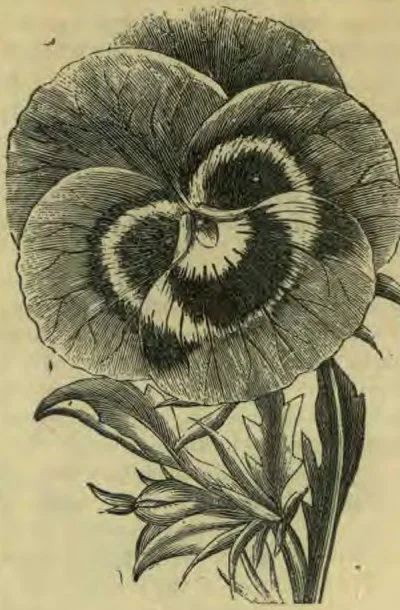
PANSIES
UNDER the shade of the lilies,
Down in the garden beds,
Close by the side of the brooklet,
The pansies lift their heads.
Black, and purple, and golden,
Brown, and blue, and white;
Under the shade of the lilies,
Hid from the warm sunlight.
Tell me, beautiful pansies,
Close beside the stream,
With your bright eyes looking upward,
Say, do you ever dream
Of the days when old King Winter
Will sweep over the garden beds,
And the trail of his icy garments
Will take off your bonny heads?
Nay, say the jolly pansies,
Shaking their heads in a row;
What care we for the winter,
With all his ice and snow?
Safe midst the roots of the lilies,
We'll safely nestle and cling,
Till out of the sunny south-land
Comes the warm breath of spring.
— Vick's Magazine.