The reports from all parts of the Asiatic Division are very encouraging. Six new provinces have been entered during the past year, and the increase in membership is good. The reports from all divisions of the field are full of items of interest and progress. I shall mention a few general features of the work.
Our literature sales in all divisions have been unusually good. The average circulation of the Chinese Signs of the Times has been steadily increasing. Three general agents, contributed by Australia have arrived. Brother Blunden makes his headquarters at Shanghai, Brother Mountain at Canton, and Brother Stacy at Tokio, Japan. They have taken up the study of the language in their work.
Our church school and young people’s work has made a good advance. The Sabbath schools have been gradually shaping into line with the regular policy of our organized plans throughout the general field. Our pioneer, neostyle News Letter, has developed into a printed monthly paper, the Asiatic Division News Letter, through which to report the progress of the work.
Most of our foreign workers are now provided with comfortable houses. This is a great relief, as their former tenements were native, and so unsanitary as to be practically death traps. Plans are now being laid to build houses for the new workers as soon as possible. No more important investment has been made in the Orient than the money expended in erecting houses for our faithful missionaries at the front.
An effort made with the Harvest Ingathering REVIEW has brought in contributions ranging from a few dimes to $5, $10, and $25 (Mexican).
Our operating policy has unified the work throughout the division, and the Asiatic Division treasurer has been relieved of much detail work, so that he can spend more time in the field.
The native work has become better organized, and schools for the training of workers are developing a good class of trained workers for the field. The heroic work of our faithful native missionaries can never be fully written. They trudge along on foot through cold and heat unobserved, carrying heavy loads of literature, while pioneering in unentered fields under circumstances that require the greatest faith.
One Buddhist priest who accepted the faith, turned over to us his heathen gods, saying he had no further need of them. He has since entered the canvassing field, and is doing very efficient work in the sale of literature.
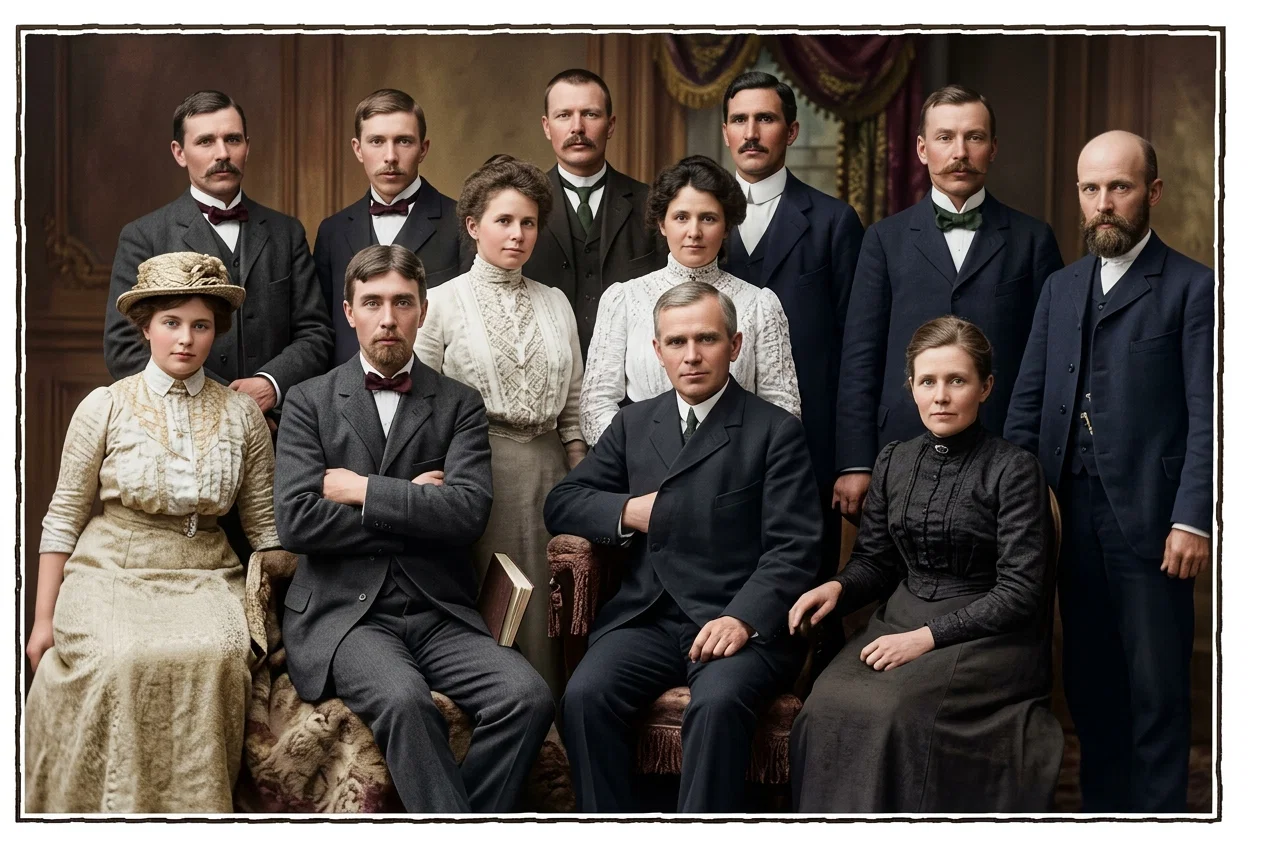
SIX IN REAR, COLPORTEURS; THIRD FROM LEFT IN CHARGE OF BOOK WORK
No. 7 has charge of office; No. 9 of treatment rooms; Nos. 1 and 2, Brother and Sister Gulbrandson, now in Canada; Nos. 3 and 4, Brother and Sister O. J. Olsen, in charge of Iceland Mission.
A minister who accepted the truth by reading during the year, loaded a wheelbarrow with literature, and wheeled it five hundred miles under the heat of a tropical sun to distribute it in a territory where the message had never been given.
A man in the Celebes Islands who became interested through reading, although he has not accepted the truth, began canvassing for our books. He has ordered several shipments, which he has sold in that field where the truth has never been heralded, and faithfully returned the money to the office to pay for them.
These are only samples of many instances of devotion to the work on the part of the native people who are willing to sacrifice in order to give it to their people.
When we think of two families going to Manchuria to open work among eleven million people, and two families just entering Szechuan Province to open work in the great west China field, with eighty-eight millions looking to them for light, we realize the need of more trained workers to meet the calls from these great fields.
The General Conference has allowed our entire budget for 1915 except a small amount for buildings. We consider this allowance very liberal during these times of financial stress, and our workers will plan to use the means placed in their hands as a sacred trust which is to be invested in the best possible way to bring a harvest of souls in return.
All signs declare that the coming of Christ is at hand. The Turks have entered the great war roll in Europe, and this war will doubtless drive them on to the last stage in their history before the close of probation. Time is short, but the outlook for the speedy finishing of the work is most promising.
Iceland
By J. C. RAFT
(Concluded)
J. C. RAFT
OUR missionary work in Iceland has passed through hard trials and has been exposed to much disrepute. The young preacher who pioneered the way sadly betrayed the confidence of his brethren. Instead of devoting himself wholly to the preaching of the truth, he entered into various speculations. He took an agency for a life insurance company in Copenhagen. He was also engaged in real estate business, buying, building, selling, etc. Of all this his brethren in Europe were ignorant. During his visits at our yearly meetings he presented stirring reports from Iceland. Of the real truth we were not informed. This state of things continued until, in 1909, he suddenly disappeared. To escape prison for financial obligations, he had to flee to America. This came to us like a thunderbolt from a blue sky.
From America he wrote letters expressing sorrow for his sins and promising to reform. We felt sorry for our brother, and pitied his family. To save him from criminal proceedings we had to pay the insurance company quite a sum of money. Under such conditions we could not, of course, permit him to continue public labor as our representative, and he was requested to retire for the time being. This he thought was fair and correct, until we had helped him so that he was no longer in danger of legal prosecution. He then returned to Iceland, again acting as if he were our representative. When we could not approve of his way of doing, he was greatly offended, and tried to turn the church from us.
Much time was devoted to efforts to relieve the situation and to help the12brother, a visit to the island being made in 1911. At that time Brother Olaf J. Olsen was appointed superintendent of the mission. At last the crisis came to the church in Reykjavik. But in spite of it all, the truth triumphed. The number of church members at that time was forty-four, three of whom were in America. Twenty-three remained loyal to the truth; whereas twenty-one, the three in America included, sided with our opposer. Fortunately, the twenty-three loyal ones constituted the strength of the company.
ONE OF ICELAND’S BEAUTIFUL GORGES
Then followed a hard battle. Our opposer, with some of his followers, sought to circulate the grossest falsehoods about us in order to crush the work in Iceland. The promise, “For we can do nothing against the truth,” stood its test, and for this we praise the Lord.
When I visited Iceland in 1912, it was apparent that the victory was already gained; and this was yet more evident on my visit to Iceland last summer. The force of the opposition was completely broken, and our denomination had gained greatly in the estimation of the public because of the severance that came.
In 1912, after the division, our church in Reykjavik had a membership of twenty-three. Brother Olsen was young and inexperienced, and unacquainted with conditions in Iceland. Not having full command of the language, he was unable to hold public lectures. But he did the best he could, trusting wholly in the Lord. Our faithful brethren stood firmly for the truth, and God blessed them. The Lord heard the earnest prayers that ascended to him. Now the church has more than fifty members, and many are deeply interested. The last two years we have sold about ten thousand copies of “Christ Our Saviour,” and we have just printed eight thousand copies of another book of a little larger size, called “A View of Our Time.” Considering the fact that Iceland has only about ninety thousand inhabitants, I think the results must be considered quite good. Several ministers of the established church buy our books, and at times even read portions from them in public. A number of persons are interested, and Brother Olsen is receiving letters from many who have been reading our books, requesting him to come and instruct them more fully.
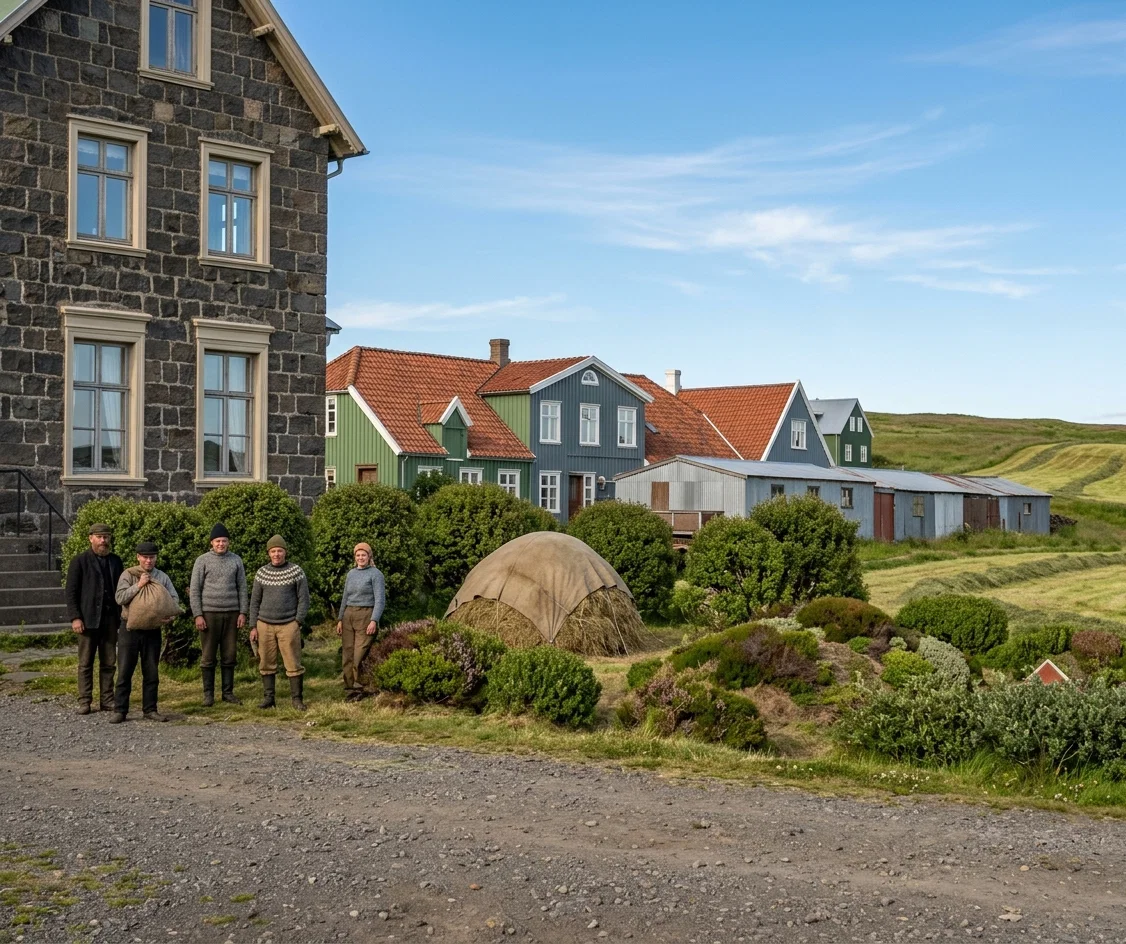
HAYING TIME IN ICELAND
Iceland is an interesting mission field; and now that our work is upon a good foundation, the truth will certainly make more rapid advancement in that far-away island. By the grace of God we have succeeded in regaining the confidence of the people. The Icelanders are honest; and if they find that a man is dishonest and not to be relied on, they lose confidence in him and in the cause he represents. Statements made by several of the more prominent men of Reykjavik go to show that our work in Iceland now has a good standing. Brother Olsen has a full house at his meetings, and the interest is good. During my visit to Iceland the past summer, one of the most widely circulated dailies of Reykjavik (the capital of Iceland, a city of about thirteen thousand inhabitants) contained an appreciative article about Seventh-day Adventists. Concerning Brother Olsen the paper stated: “Mr. O. J. Olsen has been in this country for three years. He has been learning Icelandic, and speaks it very well. He is smart, of quiet manners, and has won the confidence of the city.” After having told of our work — both the gospel work and the book and health work — the editor has this to say about the Seventh-day Adventists:—
“Judging from the progress they have made the last two years, it appears that they have gained a firm foothold in Iceland.”
These words still hold good. The Lord is faithful to his promises. He never forsakes us. Before him, the greatest antagonist can do nothing. His truth is always victorious, but “not by might, nor by power, but by my Spirit, saith the Lord of hosts.”
Our coworkers as well as our brethren and sisters in Iceland are bravely laboring on, and God is blessing them. Many difficulties which we do not have to meet, they must encounter, and they need our prayers and are worthy of our sympathy. The Icelanders like to hear of the progress of the message in the rest of the world, — it can almost be said that they live in a little world by themselves, — and they enjoy speaking of the great and glorious meeting when all the hosts of the redeemed shall be assembled, not in a land of cold and snow, but in the glorious paradise restored, that place of bliss where all speak the same language, and where all sin is forever past. Please remember to pray for Iceland.
Copenhagen.
MRS. W. H. ANDERSON
By MRS. W. H. ANDERSON
The Native of the Kraals as I Know Him — No. 2
MRS. W. H. ANDERSON
In a village all the boys of about fourteen or fifteen years of age have to get together and build a hut for themselves. They build one hut, and all live in it.
They must make it complete without the help of the old men. If they do not, they have to leave the village. After they reach this age, they are their own masters, go where they like, come when they like, and do as they like. There is no parental training. If they are asked to do something they do not fancy, they run off and are gone for a while, and on their return they are free.
They are given many names. One is given in infancy, and as the boy grows older other names are given him. A person is prohibited from speaking his own name. He is not allowed to speak his wife's maiden name, but when they are married he gives her a new one. If a man is speaking to a person by the same name as his own, he will not address him by name, but say Muxediangu, or my namesake. If he has a child named after himself, he will not call the child by name, but as before mentioned. The name given to the white man is not his real name, although it is a name in the native language. This concealment of names is for several reasons, one especially is that in case of witchcraft there may be no clue.
The native is very superstitious. If a log falls across the path, it is never removed, for the spirit of some departed friend or foe has put it there. Occasionally he shingles his hair, but very great care is taken that every bit is well hidden away lest some of it might get burned, and thus cause him to become bald-headed.
As I have said, all have names in infancy,13and more later on. If a person calls another by the name of his infancy, it is considered a great fault, and he is supposed to be punished by becoming thin and weak. They also may not say, “I have a pain in the loins,” for this is supposed to bring death to their elders.
They are great believers in charms, and have many that they wear. The charms are supposed to keep away accidents, witchcrafts, and sickness. One charm is a small horn filled with medicine, to keep away the influence of witches. It is worn about the neck. Another is a bag of snake skins. The heart of the snake is put in the bag, and is supposed to be an antidote against snake bite. Another is a small button worn in the hair. One rather curious charm is a bracelet made of snake skins. When this is worn, it is supposed to bring good fortune to the hunter. Still another wears a charm that the people may love him. Others buy medicine to make certain young ladies love them, and if they will not, they are told that the medicine will make them sick. Medicine made of the little flies that are found on the water of rivers is supposed to insure a spy against being seen in time of war.
Another curious practice is an ordeal by water. When a person is thought to have committed a fault and will not confess it, he is tried by making him put his hand and arm in a pot of boiling water. If they blister, he is condemned as being guilty; but if the skin remains as before, he is free. This is quite a common custom, and you often hear little children say, “I'll put my hand in the pot,” when they are accused of fault. They also have an ordeal by poison. If the one accused dies, he is guilty; and if he lives, he is free. Needless to say that many innocent persons have been killed in this way.
They believe that human spirits go into animals, and people that can afford it get medicine from the witch doctors, which, when they die, will insure their turning into whatever animal they may choose. A lion is often not killed, because they say he is a certain man. People can also turn into hyenas, tortoises, and many other animals, if they have had medicine for it. They have curious ideas about idiots, too. They believe that the poor creatures have insects inside their heads which prevent their thinking like other people. They also believe that the wax inside the ear is produced by worms.
They have great faith in medicine. One time Brother Robinson was starting work in a new chisi, or district. The native teacher had raised a very large crop of sweet potatoes. Brother Robinson thought to interest the natives in coming to school by telling them that the teacher had been with the missionary and had learned how to do things. When he had finished his strong plea, the old men said, “Do you think that we do not know that the white men have medicine to put on their gardens to make them produce like that?” All Brother Robinson could say could not convince them.
They begged him to let them have some of his medicine to put on their gardens, and were quite offended that he gave them none. It is a common thing to hear of a native selling medicine to other natives to put on their lands to make big yields.
When a person dies, he is buried at once, either in his own hut or across the door of it, and no one occupies that hut any more. After a while the village is burned, and another built elsewhere. When Mr. Anderson was building our house, it was a great wonder to the natives. They said, “What will you do with this big house when some one dies in it?” We have often talked of building a good hospital, but if any one should die in it, it could never be used any more. We lost one of our Christian girls, and of course buried her in our little cemetery. The case being measles, we quarantined the compound, and buried her before we sent for her people. When they came, there was a terrible uproar because we had thrown her away in the veldt and not buried her in her hut.
The death wail can sometimes be heard for two miles or more. Cattle are slain in great numbers if an important person dies, such as a chief or his favorite wife. If only a babe or child, the sacrifice consists of a sheep or two; if a young boy or girl, then an ox. In case of a young man, all the boys of the village get together and furnish the funeral ox. They give it readily, perhaps the only one they have.
A child comes to you to ask permission to go to “cry.” You ask him who has died, and he will invariably tell you that it is his mother, although it may be any relative. We had a boy in school that had cried for seven mothers. We kept account, and each one was the one he claimed had borne him. When a person dies certain customs are always observed. Immediately after the death occurs, messengers are sent to the friends and villages around to inform the people of what has happened. All work and play are left, and all hasten to the village of the deceased. The body is anointed with fat, ready for burial. While this is going on, the hut is full of women groaning and making a great noise. Their cry of distress is ma-wo. Everything is done in a very orderly manner; and when the grave is filled in, the men who dug it wash their hands over it, and the women cast themselves upon it, weeping and shouting, “Ma-wo.” Then they march round and round, crying and shrieking. The weeping is carried on for a good many days in the same manner, the length of the time corresponding to the importance of the person in life.
A man marries as many wives as he can pay for and can pay tax on. The wives of one man all seem to get on well together. It seems to us a dreadful thing, but they do not resent being one of many, but rather like it because they have less work to do. They hoe their husband's fields and cook his food, and the more there are of them the less work there is for each. “Many hands make light work,” no doubt is the way they reason it out. The ceremony is a simple one. The bride cooks some porridge for her intended husband, and they eat together out of the same pot. This is followed by dancing, feasting, and singing. The ceremony is then finished. Among other tribes there are different ceremonies, but all are of the same nature. There is always a big crowd on such occasions.
Russia’s Increased National Savings
M. KHARITONOFF, comptroller of the Russian treasury, speaking before the Duma budget committee on January 25, declared that owing to the great increase in the national savings, due to prohibition, the extraordinary outlay occasioned by the war had caused no great suffering as yet in Russia. As proof of this, M. Kharitonoff said the national savings in December, 1913, which amounted to 700,000 rubles ($350,000), had increased to 29,100,000 rubles ($14,550,000) in December, 1914. He added that the total savings for 1913 amounted to 34,000,000 rubles ($17,000,000), as compared with 84,000,000 rubles ($42,000,000) for 1914.
Distress Among the Servian People
METROPOLITAN DIMITRI, supreme head of the Servian Church, describes in the following words the terrible distress of the civilian population of Servia: “Today 1,000,000 Servians, one third of the population, are suffering every possible sorrow. They are destitute of everything. Women, the mothers, wives, and sisters, and the children of a million Servians, are suffering now because of the second invasion, which must last much longer, and more Servians still are being driven from their homes. In six of the most fertile districts no less than fifty per cent of the children are dying from lack of nourishment and medicine, from cold and exposure.”
Christian Schools and University in Egypt
THERE are 200 Christian schools in Egypt, with 17,000 students. The necessity of these is increased by the fact that in the government schools, on account of the policy of the government to maintain strict neutrality on matters of religion, no instruction on any religious subject may be given. Since all Christian instruction in Egypt is of college grade and below, the demand for advanced training is now to be met by a Christian university to be established at Cairo.
Progress in the Mexican Field
In a letter from Mexico City, Professor Caviness reports good progress in various parts of the Mexican field, with further baptisms of believers. Six were baptized in Mexico City at the close of the week of prayer. One of the candidates was an aged sister who forty-two years ago was told by a Mexican woman, the widow of a count, that it is not necessary to go to the priest to confess sins, and that Sunday is not the Sabbath.
Your Girl’s Confidence
By MRS. C. C. LEWIS
MRS. C. C. LEWIS
VALUE your little girl’s confidence, and she will value yours when she is older. I have been so sorry for the girls who are growing up without being “mothered,” and for the mothers whose hearts ache for the confidence of their girls, that I have long desired to say something to help them. Mothers often think, “When Nellie is older, I will spend more time instructing her,” not realizing that when she gets ready to give her instruction, Nellie will have formed so many congenial companions she will not feel any particular need of her mother’s counsel.
The time to win the child is when she comes with some matter that to you may seem trivial, but which is big with importance in her mind. No matter what the point of contact may be, keep in touch with her, and bide your time. Some day she will want to have a little heart-to-heart talk with some one, and she will at once think of mother, because she is always interested in everything little girls want to tell her.
I found a story in the Ladies’ Home Journal, not long ago, that presents this subject in its true light. I wish the lesson would burn its way into the heart of every mother. The story is told by Mrs. Pelham, and is as follows:—
“Why didn’t she come to tell me herself?” said Mrs. Holden, in so hurt a tone that I felt sorry for her. “I’m her mother.”
“Didn’t she come?” I asked.
“Of course not,” said Mrs. Holden. “Do you suppose that if she had I should have needed to come to you to hear that she is engaged? I think it is most unkind of a girl, to say the least, to go to another woman with her love affairs before she comes to her own mother. It is as if she didn’t trust me.”
“Oh, I’m sure it isn’t that,” I said. “Lucile adores you. What she said to me was: ‘Mrs. Pelham, I need advice. Mother’s too busy to be bothered. Will you help me?’ Of course I said I would gladly.”
“She could have come again,” said Mrs. Holden.
“I shook my head. ‘Confidences are sensitive plants,’ I said. ‘They wither at the first unfriendly touch.’”
“She shouldn’t have chosen just the moment when she knew I was in a hurry,” said Mrs. Holden.
“She didn’t choose,” I argued. “You don’t understand, Mrs. Holden. It wasn’t an easy thing to do, knowing that you didn’t like the Lowries. Lucile had probably been trying to find courage to tell you from the moment that George proposed. It always takes time for a girl to screw herself up to the telling point in a case like that; and when she’s there, she just runs off to you with her news without even thinking of what you may be doing at the time. If you won’t hear her, she has to begin screwing up all over again. And, as often as not, she won’t. She just hurries away to some one else who she knows will be sympathetic, as Lucile came to me.’
“That’s a simple way to excuse her,” said Mrs. Holden. “But I say that if a girl has anything to tell her mother, it’s the girl’s business to see that it is told. If it worked your way a mother would have to be ready to stop and listen to anything her daughter had to say, day or night, year in year out, for fear of missing the important thing.”
“Yes,” I agreed, “she would. There is no way of compromising for time, if you really want your daughter’s confidence. That’s why most mothers don’t have it; not because they don’t care about it, but because they don’t realize that to get it you must be ready for it always, and take it when it comes.”
“And let your work suffer, I suppose, even if it is work you are doing for them—as it usually is,” said Mrs. Holden with a shade of disapproval. “I thought you were always saying that a woman who hoped to accomplish anything important must never let outside things interfere with the work in hand.”
“Those cookies you made for the fair were good as could be,” I said. “I should like to have the recipe myself. But they weren’t exactly what I should call ‘important.’”
“They might have been,” insisted Mrs. Holden. “It’s the principle of the thing I’m talking about.”
“Long ago I discovered that whenever a person is on the wrong side of an argument and wants to stay there, he always says that it is not the special case, but the principle of the thing he is fighting for. ‘Mrs. Holden,’ said I, ‘may I tell you a story about “the principle of the thing”?’”
Mrs. Holden opened her hand bag and took out her crochet needle and some Irish lace that she was making. “Surely. Tell me,” she said.
“To tell a story to a woman who is embroidering is one thing—it gives the story-teller the pleasant assurance of silence. But to tell a story to a woman who is crocheting Irish edging is another thing—there is little assurance of attention from a listener who is counting ten, and seven, and six (or is it five?) for the loop. But I was not easily discouraged.
“A long time ago,” I began, “I went to visit a cousin in a lazy little village at the seashore, where nobody ever seemed to be in a hurry for anything. It was a blistering hot day, not a breath of air stirring, nor anything else that didn’t need to. I was sitting on the porch, reading, when the ice wagon came along.
“‘Morning,’ said the iceman.
“‘Warm day,’ said I.
“‘Hot, I should call it,’ said he, taking out a block of ice and weighing it. ‘That’s why I’m late. Everybody along the line wants extra ice today.’”
“‘Ice does seem about the most important thing in the world in this weather,’ I started to say, but stopped, hearing the siren whistle that meant a fire in the village. ‘Where’s that?’ I asked him.”
“‘The ice horses pricked up their ears, the iceman squared his shoulders, dropped his tongs and his ice, unhitched the horses, mounted one of them and rode away in less time than it takes to tell the story.
“‘In about ten minutes he was back. “False alarm,” he said unperturbedly, hitching up his horses again and picking up the block of ice that lay melting in the hot street. “Hard on the ice on a day like this, but my horses draw the fire engine, and I guess my customers ’u’d rather be a little short of ice and have me answer twenty false alarms than be a minute late when a real fire comes.”’”
“‘Four, five,’ Mrs. Holden counted, and turned her lace before she looked up. ‘I suppose you are going to draw a moral from that interesting story,’ she said.
“‘I’m,’ said I. ‘The moral’s so obvious that I should be ashamed to tell it to anybody who wasn’t counting stitches. It is just this: There are a lot of things that seem important under certain conditions; some when it is hot, some when it is cold. And then there are a few, like fire, that are important under all conditions, because you never can tell, until you have attended to them, just what they are going to amount to. Your children’s confidences are a sort of fire; you’ve got to decide pretty quickly when the call comes whether you want to answer—even though it may well be a false alarm—or whether you will run the chance of having something burn to ashes: a thought, or a wish, or a story. That’s all.’”
“‘It’s a good story,’ said Mrs. Holden. ‘I’ll remember it and tell it myself sometime. But just the same, my dear Mrs. Pelham, you’ll find out when Lisbeth grows up that it is a great deal easier to argue these things out for other people’s15children than to settle them for your own. You just wait.’”
“‘Why should I wait?’ I asked.
“‘Lisbeth is only nine now. You don’t have to worry about her confidences yet.’ Mrs. Holden sighed.
“‘That’s just where you make your mistake,’ I told her. ‘Now is the very time to worry about them, or rather to be sure of them. Do you think that if this week had been the first time you were too busy for Lucile, she would have come to me? Indeed not; you lost her years ago. Most of the misunderstandings between mothers and daughters begin before mothers fairly realize that their daughters understand enough to misunderstand anything. Little girls of nine wouldn’t be deserted as they are if mothers knew how much it meant to girls of that age.’”
“‘Whatever do you mean—“deserted”?’ said Mrs. Holden. ‘You use such awful-sounding words! I’m sure there’s not a little girl in Rangeley that doesn’t have the best of care.’”
“‘Three meals a day, a bath, and clean clothes,’ I said without sarcasm. ‘That’s all quite true. And that’s a lot. Most of the world’s children don’t have so much as that. I doubt if I should have noticed what was missing if Miss Loomis hadn’t spoken to me about it.’”
“‘Miss Loomis? You mean the fourth-grade teacher at the school?’”
“‘It was at the Thanksgiving celebration at the school. The assembly room was full of eager, interested mothers, and I remarked upon the number. “Not one of my mothers is here,” Miss Loomis said, “They never come.”’”
“‘What do you mean?’ I asked her, and she answered: ‘Mothers come to school when the children are in kindergarten and in the first grade. It is such a pretty sight to watch the little tots! Mothers love it. And they come again when the girls are in the seventh grade to be sure that they’ll get into the eighth, and when they are in the eighth, to be sure they will graduate. But we are neither the beginning nor the end. We’re just the awkward age; we don’t need anybody to lead us by the hand; we’re not ready to walk arm in arm; so they don’t think we matter. Oh, if mothers only knew!’”
“‘Mrs. Holden had put down her lace and was listening. I could see where her thoughts were harking back. “What did Miss Loomis mean,” she asked, “by saying ‘if mothers only knew’?”’”
“‘She meant,’ I said, as seriously as I had ever said anything, ‘that this was the way mothers lost the chance to know their daughters. Fractions are not fun to watch, it’s true, and the middle grades are not the end of anything in education. But the years that are spent in them are the beginning of a great deal of knowledge and experience in a young girl’s life, every bit of which a mother ought to share. We don’t realize that, most of us. We know that the little bodies are growing; we can’t help knowing that, when the dresses which we expected to last all winter are suddenly above the knees; when the stockings don’t reach, and the coat sleeves leave the wrists all bare. “How they do shoot up!” we say, and hurry to the shop to buy more clothes, or sit down at the machine to make them. But we can’t see their little brains develop, particularly if they are silent and shy, as most little girls are just then.
“‘So we calmly take it for granted that all their young ideas fit as well as ever and don’t need attention, and sit down to bathe the baby. When we finish their clothes, we kiss them good-by, with the sense of doing our highest duty. Do you know I am beginning to think that we take the baby’s bath altogether too seriously nowadays. Anybody with common sense and an hour’s training can bathe a baby just as well as a baby’s mother can. It is a lovely and a loving, tender thing to do. Of course we want to do it for our own delight. And of course we should do it unless there is something more important that requires our attention. But if there isn’t time for baby’s bath and the confidences of the little girl of nine, it is better to let some one else bathe the baby.’”
“‘Why, Lisbeth’s just boiling over with doubts and with discoveries that nobody can help her through except myself. And she is no different from other girls! Of course if she didn’t have me to come to, she would go to some one else, some other girl of her own age, most likely, or a little older. You know what that means; we all know, when we stop to think about it, only we don’t stop often enough or soon enough.’”
“‘Or soon enough,’ said Mrs. Holden, echoing my words. ‘I guess I’m lucky, after all, that Lucile had you to come to. It’s a pretty complicated business, this bringing up a girl.’”
“‘Rather,’ I sighed.
“‘Do you make this Irish edge?’ asked Mrs. Holden.
“‘I shook my head. “I can’t stop talking long enough to count straight,” I said.’”
“‘Then keep this for Lisbeth,’ she said, folding up the lace and handing it to me. ‘She’ll need a new dress if she is going to be flower girl at Lucile’s wedding; and if you’ve been doing the talking I should have done to my own daughter all these years, you’ve spent at least as much time and energy on her as I’ve spent on this lace—
“‘And,’ she added, ‘to rather better advantage, too, I am beginning to see!’”
Conducted by Mrs. C. C. Lewis, Takoma Park, Washington, D. C
By Mrs. C. C. Lewis
Through the columns of this department, hints will be given on all matters pertaining to the home life. Short articles and letters are solicited from home makers, telling of their everyday experiences,—their joys and sorrows, their failures and successes.
Thanksgiving the Year Round
A Thank Offering Box
A WOMAN who has an almost old-fashioned faith in Providence keeps what she calls her “thank offering box.” Into this goes through the year, from one Thanksgiving to the middle of the following November, a sum of money for every accident escaped, calamity averted, or special joy.
These offerings are not confined to her own escapes; but each time some member of her family bobs up from some threatened woe, into the box goes the money offering of thanks.
Not the same amount is given each time, and rarely large sums, for the woman is not rich; but a nice little sum is realized.
This is devoted to giving some one a happy Thanksgiving Day. It does not always go into the regular channels. As the woman says, the poor and hospitals are well cared for in holiday seasons. Sometimes a homesick girl in a strange city is given car fare home for the Thanksgiving gathering she would otherwise miss. Again, a doctor’s bill that had worried a young stenographer who had her mother to support was quietly paid.
In speaking of her pretty custom the owner of the thank offering box said, “Never did I know what thankfulness really meant until I started my box and saw the joy my thankfulness brings to others.”
Such a box, besides cultivating one’s bump of gratitude and making others equally grateful, cannot but afford great pleasure and interest in the spending. It is a gracious thought one more woman could profitably put into practice.—Selected.