Your ShelfYour Projects

Review and Herald, Vol. 90, No. 31.

BE STRONG!

Review and Herald

Jul 31, 1913

Review and Herald Publishing Association · Takoma Park Station, Washington, D. C. · Jul 31, 1913

BE STRONG!

Maltbie Davenport Babcock
BE STRONG!
We are not here to play, to dream, to drift; We have hard work to do, and loads to lift: Shun not the struggle; face it. ’Tis God’s gift.
BE STRONG!
Say not the days are evil,—who’s to blame? And fold the hands and acquiesce. O shame! Stand up, speak out, and bravely, in God’s name.
BE STRONG!
It matters not how deep entrenched the wrong, How hard the battle goes, the day, how long. Faint not, fight on! Tomorrow comes the song.
—Selected.

“What to Do First,” and “Digestive Disorders” Number

The Magazine That Tells You How to PREVENT as Well as CURE Disease
June Edition Sold by May 28—Second Large Edition of July Number (10,000) Fast Disappearing!

SOME AUGUST FEATURES

Beautiful Cover Design (3 Colors) What to Do First for Burns, Drowning, etc. Digestive Disorders—How to Remedy Them Sunlight and the Body What Is the “Staff of Life”? Is Alcohol Never a Food? What to Do for Hay Fever Friedmann Tuberculosis Treatment How to Make Wholesome Breads How to Loosen a Cough “U. S. Inspected and Passed” Questions and Answers, etc. Human Carriers of Disease
EARN A SCHOLARSHIP: Sell anywhere from 1,700 to 3,000 copies to earn a year's scholarship in the Academy or College you have picked out. Sell half the number for a half year's scholarship. Three to eight weeks of vigorous effort will suffice! All aboard!
Make All Arrangements for Territory and Supplies With Our Agency Nearest You. See List in Magazine
10 cents in stamps will bring you a sample copy
Send $1.00 for 20 copies; $2.00 for 50; $4.00 for 100; $8.00 for 200. Fifty or more, 4 cents each, post-paid.

ORDER THROUGH OUR NEAREST AGENCY

(If you do not know the address of our Agency, ask “Life and Health,” Washington, D. C.)
Don’t Forget to Take Subscriptions!

PRICES, POST-PAID

Yearly subscription       -       -       -       -       $1.00 Six months                  -       -       -       -       .50 (Subscriptions for less than six months not accepted) Three years (or 3 subs. 1 year)   -       -       -       -       2.00 Five years (or 5 subs. 1 year)      -       -       -       -       3.00 Five copies, one year, to one or more addresses   -       -       -       -       3.00
NO EXTRA CHARGE ON FOREIGN SUBSCRIPTIONS
Ask Agency for Guaranteed Subscription Receipt Book.

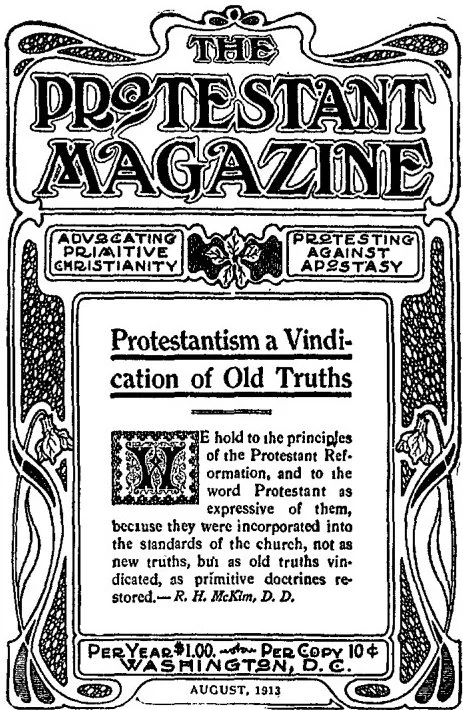
SHALL ROME THROTTLE FREE SPEECH IN AMERICA?

Do You Know That Within the Past Few Weeks Two Protestant Speakers Have Been Attacked by Roman Catholic Mobs, One in Oelwein, Iowa (June 12), and the Other in Pittsburgh, Pa. (June 17), for Daring to Lecture Upon “Rome’s Attitude Toward the Public Schools,” “Savonarola Sacrificed to Popish Greed and Lust,” and “Martin Luther and the Reformation”?
Rome is again trying to carry out her old program, so well expressed in these three words penned in Rome by Prof. W. S. Tyler of Amherst, Mass., in 1870: “REPRESSION,” “SUPPRESSION,” “OPPRESSION.”

PARTIAL AUGUST CONTENTS

Double Frontispiece: First Public Appearance of the Pope After His Recent Illness—Photograph of That Remarkable Bonzano Letter.
Rome Proposes to Have Protestant Periodicals Excluded From the Mails
Proposed Change in Name of “Protestant” Episcopal Church
Primacy of the Roman Pontiff
The Famous Bonzano Letter
The Word of God
Catholics and Religious Liberty
“The Double Doctrine of the Church of Rome”
Great Papal Persecutions
Paganism and Popery
A Murderous Attack Upon Jeremiah J. Crowley
Church and State in Spain
The Church in Politics
Ever since 1910 the American Federation of Catholic Societies has been doing all in its power to have the Postmaster-General of the United States exclude Protestant periodicals from the mails.
DO YOU WISH TO KNOW WHY ROME ALWAYS ATTEMPTS TO SUPPRESS PROTESTANT ARGUMENTS, ORAL OR WRITTEN, WHICH SHE CANNOT ANSWER?
Read and circulate this “Free Speech,” “Bonzano Letter,” and “Papal Persecutions” number.
TO TEN FRIENDS: You can send $3.00 for 10 six months’ (or 5 yearly) subscriptions, in behalf of friends. These will be sent to different addresses.
Send ten cents for sample copy. Liberal terms to agents.
ORDER THROUGH OUR NEAREST AGENCY
(If you do not know the address of our Agency, ask “Protestant Magazine,” Washington, D. C.)
PRICES, POST-PAID
PRICES, POST-PAID

PRICES, POST-PAID

Yearly subscription     -     -     -     $1.00 Six months               -     -     -     .50 (Subscriptions for less than six months not accepted) Three years (or 3 subs. 1 year)     -     -     -     2.00 Five years (or 5 subs. 1 year)     -     -     -     3.00 20 copies ordered at one time     -     -     -     1.00 50 copies ordered at one time     -     -     -     2.00 100 copies ordered at one time    -     -     -     4.00
NO EXTRA CHARGE ON FOREIGN SUBSCRIPTIONS

The City of God

L. D. SANTEE
“Glorious things are spoken of thee, O city of God.” Ps. 87: 3.
[ I AM waiting for that city Where the pavements are of gold. O, the joys within its portals! O, the treasures they enfold! And the feet whose weary journey Climbed the rugged mountains steep Shall, beside life's flowing waters, Find their resting long and sweet.
I am waiting for those mansions And the mysteries they hold, Waiting, while my heart is yearning With a hungering untold. And the Saviour's gracious promise Fills my being more and more, Till I long to know the secrets Waiting on the farther shore.
Some day will the veil be lifted, Hiding mansions bright and fair. Some day will the skies be rifted; We shall see thee “over there.” There will come a day of resting, When the pain and toil are done, When the heartaches are forgotten In the peace and joy of home.
Moline, Ill.

A Great Deliverance

MRS. E. G. WHITE
From the time of Jeroboam’s death to Elijah’s appearance before Ahab, the people of Israel suffered a steady spiritual decline, until they became as idolatrous as many of the surrounding heathen. Ruled by men who did not fear Jehovah and who encouraged strange forms of worship, the larger number of the people rapidly lost sight of the God of Israel, and adopted many of the practises of idol-worship.
Nadab, the son of Jeroboam, occupied the throne of Israel for only a few months. During his reign “he did evil in the sight of the Lord, and walked in the way of his father, and in his sin wherewith he made Israel to sin.” His career of evil was suddenly stopped by a conspiracy headed by Baasha, one of his generals, to gain control of the government. Nadab was killed, with all the house of Jeroboam, “according unto the saying of the Lord, which he spake by his servant Ahijah the Shilonite: because of the sins of Jeroboam which he sinned, and which he made Israel sin, by his provocation wherewith he provoked the Lord God of Israel to anger.”
Thus perished the house of Jeroboam. The idolatrous forms of worship introduced had brought upon the guilty offenders swift retribution; and yet the rulers who followed—Baasha, Elah, Zimri, and Omri—during a period of nearly forty years, refused to repent, but “did evil in the sight of the Lord, and walked in the way of Jeroboam, and in his sin wherewith he made Israel to sin.”
During the greater part of this long time of apostasy in Israel, Asa was ruling in the kingdom of Judah. For many years “Asa did that which was good and right in the eyes of the Lord his God: for he took away the altars of the strange gods, and the high places, and brake down the images, and cut down the groves: and commanded Judah to seek the Lord God of their fathers, and to do the law and the commandment. Also he took away out of all the cities of Judah the high places and the images: and the kingdom was quiet before him.”
The faith of Asa was put to a severe test when “Zerah the Ethiopian with an host of a thousand thousand, and three hundred chariots,” invaded his kingdom. In this crisis Asa did not put his trust in the “fenced cities in Judah” that he had built, with “walls, and towers, gates, and bars,” nor in the strength of his carefully trained army, “that bare targets and spears, out of Judah three hundred thousand; and out of Benjamin, that bare shields and drew bows, two hundred and fourscore thousand,” all of whom were “mighty men of valor.” The king realized that his strength was in God. When he went out to meet the Ethiopian, and set his forces in battle array, he “cried unto the Lord his God, and said, Lord, it is nothing with thee to help, whether with many, or with them that have no power: help us, O Lord our God; for we rest on thee, and in thy name we go against this multitude. O Lord, thou art our God; let not man prevail against thee.”
This prayer of faith was signally answered. “The Lord smote the Ethiopians before Asa, and before Judah; and the Ethiopians fled. And Asa and the people that were with him pursued them unto Gerar: and the Ethiopians were overthrown, that they could not recover themselves; for they were destroyed before the Lord, and before his host.”
As the victorious armies of Judah and Benjamin were returning to Jerusalem, “the Spirit of God came upon Azariah the son of Oded: and he went out to meet Asa, and said unto him, Hear ye me, Asa, and all Judah and Benjamin: The Lord is with you, while ye be with him; and if ye seek him, he will be found of you; but if ye forsake him, he will forsake you.” “Be ye strong therefore, and let not your hands be weak: for your work shall be rewarded.”
As he heard these words, Asa took courage, and soon he led out in a second reformation in Judah. He “put away the abominable idols out of all the land of Judah and Benjamin, and out of the cities which he had taken from Mt. Ephraim, and renewed the altar of the Lord, that was before the porch of the Lord.”
“And he gathered all Judah and Benjamin, and strangers with them out of Ephraim and Manasseh, and out of Simeon: for they fell to him out of Israel in abundance, when they saw that the Lord his God was with him. So they gathered themselves together at Jerusalem in the third month, in the fifteenth year of the reign of Asa. And they offered unto the Lord the same time, of the spoil which they had brought, seven hundred oxen and seven thousand sheep. And they entered into a covenant to seek the Lord God of their fathers with all their heart and with all their soul; that whosoever would not seek the Lord God of Israel should be put to death, whether small or great, whether man or woman. And they sware unto the Lord with a loud voice, and with shouting, and with trumpets, and with cornets. And all Judah rejoiced at the oath; for they had sworn with all their heart, and sought him with their whole desire; and he was found of them: and the Lord gave them rest round about.”
Asa’s long record of faithful service was marred by some mistakes made at times when he failed to put his trust fully in God. When, at one time, the king of Israel entered the kingdom of Judah, and seized Ramah, a fortified city only five miles from Jerusalem, Asa sought deliverance by forming an alliance with Benhadad, king of Syria. This failure to trust God alone in time of need was sternly rebuked by Hanani, the prophet, who appeared before Asa with the message:—
“Because thou hast relied on the king of Syria, and not relied on the Lord thy God, therefore is the host of the king of Syria escaped out of thine hand. Were not the Ethiopians and the Lubims a huge host, with very many chariots and horsemen? yet, because thou didst rely on the Lord, he delivered them into thine hand. For the eyes of the Lord run to and fro throughout the whole earth, to show himself strong in the behalf of them whose heart is perfect toward him. Herein thou hast done foolishly: therefore from henceforth thou shalt have wars.”
Instead of humbling himself before God because of this mistake, “Asa was wroth with the seer, and put him in a prison-house; for he was in a rage with him because of this thing. And Asa oppressed some of the people the same time.”
“In the thirty and ninth year of his reign,” Asa was “diseased in his feet, until his disease was exceeding great; yet in his disease he sought not to the Lord, but to the physicians.” The king died in the forty-first year of his reign, and was succeeded by Jehoshaphat his son.

The World's Armageddon Battle in Prophecy

The Nations Arming for Armageddon

R. C. PORTER
THERE are two remarkable prophecies which are to meet their fulfilment in the last days. They are paradoxical. They are the true forecast of the two-sided scene of international diplomacy of our time. The nations hold peace congresses, and talk discontinuance of war. While doing so they take good care to greatly increase their appropriations for armaments. For the convenience of the reader in viewing the entire picture as portrayed by the prophets more than two thousand years ago, we shall place the two predictions side by side.

The Nations Say Peace

“But in the last days it shall come to pass, that the mountain of the house of the Lord shall be established in the top of the mountains, and it shall be exalted above the hills; and people shall flow unto it. “And many nations shall come, and say, Come, and let us go up to the mountain of the Lord, and to the house of the God of Jacob; and he will teach us of his ways, and we will walk in his paths: for the law shall go forth of Zion, and the word of the Lord from Jerusalem. “And he shall judge among many people, and rebuke strong nations afar off; and they shall beat their swords into plowshares, and their spears into pruning-hooks: nation shall not lift up a sword against nation, neither shall they learn war any more. “But they shall sit every man under his vine and under his fig-tree; and none shall make them afraid: for the mouth of the Lord of hosts hath spoken it. “For all people will walk every one in the name of his god, and we will walk in the name of the Lord our God forever and ever. “‘In that day, saith the Lord, will I assemble her that halteth, and I will gather her that is driven out, and her that I have afflicted; “‘And I will make her that halted a remnant; and her that was cast afar off a strong nation: and the Lord shall reign over them in Mount Zion from henceforth, even forever.’ Micah 4:1–7.”

God Says “Prepare War”

“Blow ye the trumpet in Zion, and sound an alarm in my holy mountain: let all the inhabitants of the land tremble: for the day of the Lord cometh, for it is nigh at hand.” Joel 2:1. “Proclaim ye this among the Gentiles; Prepare war, wake let all the men of war draw near; let them come up: “‘Beat your plowshares into swords, and your pruning-hooks into spears: let the weak say, I am strong. “‘Assemble yourselves, and come, all ye heathen, and gather yourselves together round about: thither cause thy mighty ones to come down, O Lord. “‘Let the heathen be wakened, and come up to the valley of Jehoshaphat: for there will I sit to judge all the heathen round about. “‘Put ye in the sickle, for the harvest is ripe: come, get you down; for the press is full, the fats overflow; for their wickedness is great. “‘The Lord also shall roar out of Zion, and utter his voice from Jerusalem; and the heavens and the earth shall shake: but the Lord will be the hope of his people, and the strength of the children of Israel. “‘So shall ye know that I am the Lord your God dwelling in Zion, my holy mountain: then shall Jerusalem be holy, and there shall no strangers pass through her any more.’ Joel 3:9–13, 16, 17.”
It is marvelous how both these last-day prophecies are being fulfilled. The nations are talking peace, but all of them are making such preparation for war as was never known in any previous age of the world. So striking is this diplomatic peace talk that it has become a matter of caricature and ridicule. Mr. H. N. Brailsford writes in the London Daily News as follows:—
“If war there is to be, of this we may be sure, that no one inside the inferno of struggling races will think twice of The Hague and its humane regulations. The armies that advance and retreat will march amid bands of reckless guerrillas. The villages will be smoking in their path, and women and children will choose between the passions of the combatants on the plains and the chaste cruelty of the mountain snows.”
In June, 1909, Lord Rosebery, former prime minister of Great Britain, speaking before a large number of press delegates assembled from various parts of the British Empire, said:—
“There is a hush in all Europe, a hush in which you may almost hear a leaf fall to the ground. There is an absolute absence of any questions which ordinarily lead to war. All forebodes peace; and yet at the same time, combined with this total absence of all questions of friction, there never was in the history of the world so threatening and so overpowering a preparation for war. “. . . Now, what do we see? Without any tangible reasons we see the nations preparing new armaments. They cannot arm any more men on land, so they have to seek new armaments upon the sea, piling up these enormous preparations as if for some great Armageddon; and that in the time of profoundest peace.”—H. R. Chamberlain, on “The Ominous Hush in Europe,” McClure’s Magazine, October, 1909.
Admiral Fournier, formerly commander of the French fleet in the Mediterranean, predicts “that all the European powers will eventually become involved in what will practically prove to be the Armageddon of the Apocalypse.”—Literary Digest, April 23, 1910.
These utterances from the greatest of cool, deliberate thinkers of our time, echoing the utterances of the prophet of Patmos, who wrote his predictions A. D. 96, is one of the most striking fulfilments of God’s prophetic word.
With the nations talking peace and holding peace congresses while arming on an enormous scale, it is but natural that the real situation should be thus expressed in the public press:—
“Immediate destruction, in the name of humanity, of the half-completed Peace Palace in The Hague, is demanded by the Matin of today, for the following reasons: When its construction was decided upon, the Anglo-Boer war broke out, and plans were laid for the Russo-Japanese war. When the first stone was laid, the kaiser made his first voyage to Tangier, which event was the beginning of the Morocco-European complications. When the first floor was finished, Austria seized Bosnia and Herzegovina. When the second floor was completed, the Franco-German controversy arose. When the roof was put on, the Turkish-Italian war began. ‘Only think,’ the Matin exclaims, ‘the painters, glaziers, decorators, have not yet begun their tasks! We have also heard rumors of statues symbolizing peace. Beware! Each time one is unveiled it will rain shrapnel somewhere. When the temple is completed, look out for a grand scrimmage.’”
The Chicago News of March 27, 1913, under the heading “Terror Besets Europe. Millennial Dream of Statesmen, and the Fruit It Has Borne After Twelve Years,” says:—
“Lucien Wolf writes in the London Graphic: ‘Universal peace and a possible reduction of armaments! The years which have elapsed since this was talked of as practical politics have been the bloodiest the world has ever known since the close of the Napoleonic epoch, while armaments have now swollen to proportions which would have staggered even the unbridled imagination of the Corsican Colossus. One thinks of the witty conventional who exclaimed, “Have a care! They are talking of peace!” “‘Certain it is that ever since we talked so familiarly of the millennium, they we have been drifting more and more in the direction of Armageddon, and now it looks very much as if the dread thing were in sight.’ Shanghai, China. (To be continued)”

Avoiding Debt

T. E. BOWEN
In going into debt there is always a crucial point where some one should hold as with an iron grasp to the true principle of avoiding debt, against a strong sentiment of breaking over and allowing some enterprise—always considered very essential—to go on without the means having been provided to do so without debt.
Right at this point when sentiment, not faith, presumption rather than trust in God, is liable to prevail, is the time to avoid debt. God is able to pay for that which he wants done. It may be a trial to wait his time, but his time is best in the end, and the lessons which come during the time of waiting, praying, and preparing for some definite enterprise may be the very lessons God designs to teach, and from which in the end he will receive the more glory.

Unwise Haste in Beginning Enterprises

At this crucial time some nearly always urge that our people will rally to the work as the enterprise is begun and they see help is needed. This is not always the case, where there are so many other interests demanding the people's financial assistance, and as a result another debt is added to the cause. The men responsible for it may be removed to another locality, and the burden left as a legacy with which other men must struggle.
“God does not want his work to be continually embarrassed by debt. When it seems desirable to add to the buildings or other facilities of an institution, beware of going beyond your means. Better to defer the improvements until Providence shall open the way for them to be made without contracting heavy debts and having to pay interest.”—“Testimonies for the Church,” Vol. VII, page 206.

An Example Cited

In nearly every instance where heavy debts have been incurred, this principle was disregarded. One instance of this kind is named:—
“When the publishing work at — was started, it was the avowed purpose of the workers to keep out of debt; but in their desperate effort to make brick without straw, our brethren were led to depart from this purpose, and, as the result, the work has become involved in difficulty.”

Enclosed With a Barbed-Wire Fence

“Let all now seek most earnestly to avoid the mistakes of the past. Let them guard themselves [not some brethren in the distance, but themselves—every board and committee invested with authority to act for the people] as with a fence of barbed wire against the inclination to go into debt. Let them say firmly: ‘Henceforth we will advance no faster than the Lord shall indicate and the means in hand shall allow, even though the good work has to wait for a while. In beginning in new places, we will labor in narrow quarters rather than involve the Lord’s cause in debt.’”—Id., pages 235, 236.
This is strong, plain language as to how God still looks upon debts. Barbed-wire fences prick, but the instruction is here given that those inclined to run into debt should enclose themselves as with a barbed-wire fence to keep them from involving the Lord’s cause in debt.

To Shun Debt as We Shun Leprosy

“The light given me by the Lord is that wise men, men of financial ability, should visit our schools in every country, and keep an account of their financial standing. This matter should not be left to ministers or committeemen, who have no time to take this burden. The teachers are not to be left with this responsibility. These matters of school business call for talent which has not been provided.”
“Men of financial ability should look over the accounts once, twice, or thrice a year, to ascertain the true standing of the school and see that enormous expenses, which will result in the accumulation of indebtedness, do not exist. We should shun debt as we should shun the leprosy.”—Id., Vol. VI, pages 216, 217.
Franklin, in speaking of debt, said, “When you run in debt, you give another power over your liberty.” This is equivalent to saying that one is by debt brought into bondage. He is not free to do as he otherwise would. He is bound by a yoke, a burden is placed upon him. Isaiah wrote: “Is not this the fast that I have chosen? to loose the bands of wickedness, to undo the heavy burdens, and to let the oppressed go free, and that ye break every yoke?” Isa. 58: 6.
God wants his work in the earth to occupy a place of honor. He wants it to be the head, not the tail. But how can this be true if it is continually burdened by debt? At one time Israel reached that place where, in its conquest of Canaan, nations were placed under tribute. God, under David, led the armies of Israel on to such victory that strong nations were subdued, and year by year they brought their tribute to the treasury of the king of Israel. And this tribute increased more and more during Solomon’s reign. The nation paying tribute is the nation in bondage. The man paying interest on borrowed money is in like manner in a certain sense in bondage.
“And all the people that were left of the Amorites, Hittites, Perizzites, Hivites, and Jebusites, which were not of the children of Israel, their children that were left after them in the land, whom the children of Israel also were not able utterly to destroy, upon those did Solomon levy a tribute of bond-service unto this day. But of the children of Israel did Solomon make no bondmen: but they were men of war, and his servants, and his princes, and his captains, and rulers of his chariots, and his horsemen. These were the chief of the officers that were over Solomon’s work, five hundred and fifty, which bare rule over the people that wrought in the work.” I Kings 9: 20-23.
In some sections we are told that a certain form of slavery exists today. The laborers are kept constantly in debt to the landowner. They cannot leave his employ because the law holds them on account of their debts. Thus, through debt, as Franklin put it, these landowners have absorbed the liberty of these poor people. “When you run in debt, you give another power over your liberty.” The Lord wants his people to be free, so he gives us the word, “Render therefore to all their dues: . . . owe no man any thing, but to love one another: for he that loveth another hath fulfilled the law.” Rom. 13: 7, 8.
Takoma Park, D. C.
(To be concluded)

The Bible the Most Popular Book

K. C. RUSSELL
WITH three large head-lines there appeared a remarkable statement in the Chicago Examiner of June 17, 1913, regarding the popularity of the Bible as compared with other books. The article stated that the information was obtained at the annual book fair which opened Monday, June 16, in Chicago. The following were some of the striking statements made:—
“For every volume of the six best sellers that is issued each year, a car-load of Bibles is manufactured.”
“The public taste changes from time to time,” said Arthur J. Saalfield, president of the Saalfield Publishing Company of New York, “but the Bible continues to be the most popular book printed. Where other books are turned out by the volume, it is turned out by the car-load.”
These statements, coming from those who are interested in its sale from a commercial standpoint, emphasize the fact that the Bible possesses a virtue that is unparalleled by other books. The facts are that its author is divine, and it is a living book, for, says the Lord, “The word of God is quick [living] and powerful.” Its increasing popularity and sale, especially in these times when skepticism, higher criticism, infidelity, and atheism are increasing to such a great extent, are certainly a noticeable evidence of its inspiration.
Chicago, Ill.

Character Measured by Its Weakest Place

“The real force of a man’s character must be measured by its weakest place.”

Valuable Extracts

A. SMITH

God's Jewel Casket

“The church is very precious in his sight. It is the case which contains his jewels, the fold which encloses his flock.”—“Testimonies for the Church,” Vol. VI, page 261.

Church Dear to God

“Nothing else in this world is so dear to God as his church. Nothing is guarded by him with such jealous care. Nothing so offends God as an act that injures the influence of those who are doing his service. He will call to account all who aid Satan in his work of criticizing and discouraging.”—Id., page 42.

Human Nature Adopted

“In Christ we become more closely united to God than if we had never fallen. In taking our nature, the Saviour has bound himself to humanity by a tie that is never to be broken. . . . God gave his only begotten son to become one of the human family, forever to retain his human nature. . . . God has adopted human nature in the person of his Son, and has carried the same into the highest heaven.”—“Desire of Ages,” page 25.

True as Steel

“The Lord will have a people as true as steel, and with faith as firm as the granite rock. They are to be his witnesses in the world, his instrumentalities to do a special, a glorious work in the day of his preparation.”—“Testimonies for the Church,” Vol. IV, page 594.

Angels Making Crowns

“When the Lord makes up his jewels, the true, the frank, the honest, will be looked upon with pleasure. Angels are employed in making crowns for such ones, and upon these star-gemmed crowns will be reflected, with splendor, the light which radiates from the throne of God.”—Id., Vol. V, page 96.

Christ Made No Plans

“Christ, in his life on earth, made no plans for himself. He accepted God's plans for him, and day by day the Father unfolded his plans. . . . As we commit our ways to him, he will direct our steps.”—“Ministry of Healing,” page 479.

God's Plan for Us

“The Lord has his eye upon every one of his people. He has his plans concerning each.”—“Testimonies for the Church,” Vol. VI, page 12.

Inferior to Jesus

“The human family . . . are far inferior in strength and wisdom to Jesus, even after he had taken upon himself man's nature.”—Mrs. E. G. White, in the Signs of the Times, Jan. 18, 1905.

To Repopulate Heaven

“It was his purpose to repopulate heaven with the human race, if after test and trial they proved to be loyal to him.”—Id., May 29, 1901.
“The vacancies made in heaven by the fall of Satan and his angels will be filled by the redeemed of the Lord.”—Mrs. E. G. White, in the Watchman, Nov. 7, 1905.

The World to Be Exalted

“Our little world, under the curse of sin the one dark blot in his glorious creation, will be honored above all other worlds in the universe of God.”—“Desire of Ages,” page 26.

The Heathen Saved

“Even among the heathen are those who have cherished the spirit of kindness; before the words of life had fallen upon their ears, they have befriended the missionaries, even ministering to them at the peril of their own lives. Among the heathen are those who worship God ignorantly, those to whom the light is never brought by human instrumentality, yet they will not perish. Though ignorant of the written law of God, they have heard his voice speaking to them in nature, and have done the things that the law required. Their works are evidence that the Holy Spirit has touched their hearts, and they are recognized as the children of God.”—Id., page 638.

God's Purpose in Our Financial Burden

Gospel Finance—No. 2

God's Purpose in Our Financial Burden

E. K. SLADE
ANGELS instead of men might have been the agencies for forwarding the work of the gospel in the earth, or the messages of warning and the saving truths might be written in glowing characters in the skies, visible to all peoples and understood in all tongues. God is not dependent upon puny man. He has not made him a coworker with himself because human assistance was necessary or needed. The great army of loyal and mighty angels have expressed a desire to leave their place of abode and perform the gospel work in the earth. Sometimes men have seemed to think it a condescension on their part and a great favor shown to God, to give of their time, means, and talents to the Lord's work. We have frequently heard people complain when the needs of the Lord's cause have been presented and help called for. We have sometimes seen persons act and talk as if God were in need, and in his extremity had called upon mankind to assist him and relieve him of his embarrassment by helping to finance the gospel work. When we come to see this thing in its true light, man is made to seem exceedingly small, and God's interest in him is greatly magnified.
The whole arrangement is based upon the question of our needs, not upon God's needing our aid. It is true that the work is being carried forward by the funds furnished by humanity, but a greater work is being done for him who hears the call and heeds the commission in efforts to rescue and save. To become sons of God, we must possess divine nature, or godliness, which is godlikeness. “His divine power hath given unto us all things that pertain unto life and godliness, . . . that by these ye might be partakers of the divine nature.” 2 Peter 1: 3, 4.
Let us not have a narrow view of what divine nature is. We have several revelations of God's character. One act stands out as supreme. God looked upon his vast universe, perfect and pleasing in all his domain, except this one sphere. Here he saw subjects fallen and in darkness, doomed to die. It would seem natural for his love to extend to the unfallen, but we find divine nature manifesting a great love for a race of rebels. The record is, “God so loved the world, that he gave.” His love for the world, for rebels, was such as to lead him to give the gift that would be the greatest sacrifice to him, that he might save them. This is precisely what God designs to accomplish for us in giving us the experience of cultivating love for the lost.
This all emphasizes the importance of being prompted by the right motive in giving. An anxiety for our own safety and salvation will be set aside by a deep regard for the unsaved. It is well always to remember the expression of divine nature: “God so loved . . . that he gave.”
Recent words from the servant of the Lord are very clear on the points we have been considering in this article: “God is not dependent upon man for the support of his cause. He could have sent means direct from heaven to supply his treasury, if his providence had seen that was best for man. He might have devised means whereby angels would have been sent to publish the truth to the world without the agency of men. He might have written the truth upon the heavens, and let that declare to the world his requirements in living characters. God is not dependent upon any man's gold or silver. . . . Whatever necessity there is for our agency in the advancement of the cause of God, he has purposely arranged for our good. He has ordained that there should be a necessity for the cooperation of men, that they may keep in exercise their benevolence. The heart opened by one gift is not to become selfishly cold, and to close before the next is bestowed. The stream is to be continually flowing, thus keeping open the channel by acts of benevolence.”
These important truths give to the financial part of our work a great significance as related to our own spiritual growth; and it should become a more prominent part of our daily and weekly worship.
Mount Vernon, Ohio.
Continue reading: On Through the Year