Your ShelfYour Projects

Review and Herald, Vol. 90, No. 31.

BE STRONG!
Earlier text: On Through the Year

The Survey

Among the Nations

JUDGING from the present indications, the year 1913 will present as many serious international complications as did the year 1912. The whole political outlook today is one either of warfare or of strained relations between nations, to whatever quarter of the globe we look.

Affairs in Mexico

The Mexican Republic on the south is still torn and distracted with internal dissension. While Huerta still ostensibly holds the reins of power, in more than a dozen different states the standard of revolt has been raised, and the general public is made the prey of armed marauding bands, with consequent robbery, pillage, and incendiarism. Several of the governments of Europe, concerned for the safety of their citizens and for their money investments, and tired of the dilatory tactics pursued by the central government in subduing this guerrilla warfare, have made earnest representations to the United States government regarding the situation. At this writing Ambassador Henry Lane Wilson is on his way from Mexico City to Washington to present a personal report to the administration of the actual conditions which exist, with a view to determining the question as to whether the Huerta government shall receive recognition, and what position the United States government shall take regarding the situation.

Revolution in China

Turning to the Far East, to the latest republic in the sisterhood of nations, we find that the Chinese government is threatened in the same way as is the government of Mexico, only perhaps with a better-organized and more-determined resistance. The province of Kwang-tung has declared its independence of the general government. Canton has been made the rebel capital. The Peking government is considered seriously menaced, and present prospects indicate the establishment of a northern and a southern government in China.

The Eastern Question

The Balkan situation is far from settled, although it is hoped that with the depletion of their armies and the exhaustion of their treasuries the warring states may agree to a peace settlement. Previous to the war of the Balkan allies with Turkey, in March, 1912, an agreement was reached by Bulgaria and Servia whereby in event of victory in a war with Turkey, the larger part of Macedonia should go to Bulgaria, Albania falling to Servia and Greece. With the proposal to create a separate state in Albania, as a result of the war, the status of this agreement was modified in the judgment of the Greeks and Servians. Bulgaria, however, does not take this view of the situation. While occupying two thirds of the territory captured by the allies, her desires for territorial expansion seem to have grown, and she demanded all the territory assigned to her in the treaty made with Servia. As a result of the recent engagements, Bulgaria has lost much of the territory of which she became possessed, the Greek and Servian armies gaining many important victories. Turkey itself, taking advantage of the situation, has taken an active hand in affairs and according to the latest reports has overrun conquered territory and reoccupied Adrianople.
The possession of Adrianople again by the Turkish army brings the European concert face to face with a most delicate and difficult situation. A despatch from London, published in the Washington Post of July 23, says:—
The official announcement made at Constantinople that the Turkish troops had reoccupied Adrianople created the worst possible impression in diplomatic circles, and the powers immediately began an exchange of views to find the best means of checkmating Turkey's action, which is looked upon as a clear-cut defiance of all Europe.
The next few hours are likely to decide whether forces hitherto unengaged shall enter the Balkan cockpit. Russia is understood to be ready to accept the mandate of Europe to compel the Porte to respect the treaty of London, and the British cabinet tomorrow will consider whether this government shall consent to active intervention by Russia.
Premier Asquith's speech at Birmingham Monday evening was intended to warn Turkey against just such a development, which would involve Russian occupation of both sides of the Bosporus, and the gripping of Constantinople both in the front and in the rear.
The question of the position of Turkey and the course to be pursued toward her continues to be one of most serious moment. During the last few weeks there has been much discussion in Turkish official circles, and also on the part of the general public, over the advisability of the removal of the sultan's capital from Europe to some point in Asia. Says Current Opinion for July:—
A plan to remove the sultan's capital from Constantinople to an interior city of Asia proved so fruitful of factional strife that the grand vizier summarily suppressed discussion of the topic in the Ikdam and other dailies just before he was killed. The suggestion is understood to find favor with the Young Turks and with the sultan himself. It is opposed by the Sheik ul Islam and the clergy as a retreat in the face of the infidel, if the Paris Figaro is accurate. No such scheme would be tolerated by the powers, according to the official organ of Czar Ferdinand in Sofia, because the Turks could reorganize their army under cover in the interior of Asia. While the sultan is under observation, he can be kept out of mischief. This is taken to mean that the Balkan powers may get into a new conflict among themselves over Constantinople, upon which both Ferdinand and Constantine still cherish designs. The Young Turks are urged to remove their country's capital from the historic city by Field-Marshal von der Goltz, the great German soldier who did so much for their military education. He warns the world in the Vienna Neue Freie Presse against the inference that the future of the sultan's empire is to be calm and peaceful. He urges the Young Turks to take in hand their military reorganization at once. Let them fix their capital at Aleppo, or even at Damascus. “No government with its seat at Constantinople has remained for long healthy and strong.” No doubt, the shifting of the capital would be no easy thing. Rulers and grandees would not want to leave the “paradise on earth.” But the statesman who carried out the idea would win immortal glory. The German emperor himself is said to welcome the idea, but for some reason it is not liked in St. Petersburg.
The final outcome of this question is clear, at least to the student of prophecy. That Turkey will be driven from Europe is inevitable. Where she first will choose to make her headquarters we cannot say. Aleppo, Damascus, or some other city may be chosen. Eventually, we believe, as indicated by the prophecy of Daniel 11, the seat of Turkish rule will be transferred to Jerusalem. But these retreats and makeshifts will prove of no avail; for this nation, the same as others who have forgotten God, is destined to come to an untimely end. Helped and bolstered up now as the result of national intrigue and jealousy, there will come a time when it will be left alone and defenseless. By the fulfilment of prophecy before our eyes, and in the many gathering signs on every side, let us be admonished to faithfulness. F. M. W.

ELIZABETH BARRETT BROWNING

Serving

ELIZABETH BARRETT BROWNING

The sweetest lives are those to duty wed, Whose deeds, both great and small, Are close-knit strands of unbroken thread, Where love ennobles all.
The world may sound no trumpets, ring no bells; The book of life the shining record tells. Thy love shall chant its own beatitudes After its own life working. A child's kiss Set on thy sighing lips shall make thee glad. A sick man helped by thee shall make our thee strong. Thou shalt be served thyself by every sense Of service which thou renderest. —Selected.

My Visit to the Philippines

I. H. EVANS
It was my privilege to spend two weeks with the workers in the Philippines in the early part of the present year, and I was greatly pleased to see the progress the work has made since my first visit, two years ago. At that time the first native converts were baptized, and a church of twenty members was organized, but we had no native evangelists of any experience in presenting the message. However, a beginning had been made, and for this we thanked the Lord and took courage.
When I saw the large gatherings of our people in Manila at this time, with meetings in four or five parts of the city, and a church-membership of more than one hundred and twenty; when I saw several young men, most of whom are high-school graduates, actively engaged in some part of the work; when I saw native evangelists holding a tent effort in the city, at which they do most of the preaching; and when I heard the many calls for help that were received from various places, though unanswered because of the fewness of workers, I need not say my heart was greatly rejoiced.
We held a number of meetings with the workers, and gave instruction in proper methods of work, which we hope will strengthen the young men just beginning to preach the message.
The brethren are publishing a small monthly missionary paper in the Tagalog language. This is a great help to the church. They also need a church building, where general meetings can be held; now they hold all their meetings in private houses, being unable to pay the rent for a hall. They also need, and soon must have, a school, where the boys and girls who desire to enter the work may secure a suitable training. Many of the schools, both public and private, are conducted by Catholics. This, of course, makes it difficult to secure a knowledge of true Christianity, and prejudices most of the students in favor of the Catholic religion. Young men who are educated in these schools, and who have no denominational training except what they receive in a course of lectures or what they have been taught by such personal instruction as our busy workers have time to give, cannot be expected to do the best quality of work.
On the occasion of this visit it was our privilege to organize the second church on the island of Luzon, at a place called Malolos, about two hours' ride from Manila. We spent the day there, and had a baptismal service, after which twenty-eight precious souls united in the church organization. They earnestly requested that a worker be sent to teach them the truth and to develop interests springing up in various places where the believers live. It was planned that one of the native workers go to this place and follow up the interests that already demanded attention. The Catholics are making a hard fight against our work at Malolos, but when the workers are humble agents in the hands of God and faithfully do his bidding, the truth will triumph, and will win out against the opposition of man.
Brother Floyd Ashbaugh came up from Iloilo where he has been canvassing for more than a year with marked success. He reports two believers in Iloilo. These are young girls, but stanch believers in the message. They sent a letter to the believers in Manila, exhorting them to faithfulness even unto death. Later Elder Adams visited them, and he reports them as being faithful Christians. This important center must have a worker soon, and should have one this very year.
Brother Ashbaugh will return to the United States this fall to finish his education, after which he hopes to return to the Philippines for his life-work. He has had a hard field, and has worked under great difficulties among the natives of these islands, with no place to get suitable food, and no home but such as he could make for himself. The Lord has mercifully sustained him, and he has done a good work. He has now gone to another island, which he hopes to canvass before leaving the field.
Brother R. A. Caldwell returns to Australia after five years of hard work among the Filipinos, among whom he has sold many books in Spanish as well as in the Tagalog. Brother Caldwell, by hard, persistent work, has demonstrated that a man can live and make his entire expenses by selling the printed page. His influence has been good, and he leaves many warm friends in Manila and elsewhere. We hope he will return in another year for further work in behalf of this people.
When Brother Ashbaugh leaves the Philippines, the entire responsibility of this great field will rest upon the shoulders of Brother and Sister Adams. The work is too great and the demands are too strenuous for one family to carry alone. Several families should be sent to these islands to build up and carry forward the good work already begun. The call of God to this work seems imperative. Why are these souls so ready to accept the truth, so willing to give up all for the kingdom of God, if it is not that the truth may enter? Why should the church of God hold back its means and men from entering these open doors, when the Spirit of God has gone before and prepared the way for the truth? Is not an open door a call for workers? Yet here are nine million souls waiting to hear the truth, with only one worker! Surely there must be more help sent soon. It is greatly desired that Brother and Sister Finster may be able to return to this field this season. God's people should unite in prayer that the merciful Lord will speedily heal Sister Finster, that they may return to their work soon.
The future looks bright, with every prospect of splendid success in winning souls to the truth in this island field. We ask the united prayers of the people of God for the work in this land of darkness and Catholic superstition.

The Land of the Great Canal

B. E. CONNERLY
It is not more, neither less, difficult to work for the salvation of souls in Panama than in any other country. And it is not more, nor less, difficult to proclaim the advent message to these heterogeneous wanderers who have congregated around the canal than to the millions who have tarried in the fatherland. But, to the reproach of evangelism, for nearly four centuries after the Reformation no gospel missionaries ever interested themselves in Panama. She has been shamefully neglected, and her distress for the need of the true gospel still pleads most eloquently for help.
It is almost axiomatic that Panama has long needed a canal. Navigation has suffered untold loss for the lack of a waterway across the isthmus. But what loss have its semibarbarous people suffered for lack of the Word of God! Who today bemoans the delinquencies of the church? and who is willing to sacrifice to compensate the loss? Not one generation has passed since Charles V in which courts and congresses have not been petitioned for aid to construct a canal; and finally, to accomplish the great enterprise, men, at tremendous cost in life and property, have penetrated fever-infested jungles and are soon to accomplish that for which they have sacrificed so much—the mighty furrow from ocean to ocean.
But who has loved the inoffensive Maya Indians enough to make a sacrifice for them that they might have a knowledge of God and thus inherit eternal life? Who ever brought a Bible to their millions of ancestors? Who has taken the time and energy to offer prevailing prayers for these Indians, that they might be delivered from a dogmatism that for centuries has hung like a subtle aura over their fair land?
The gospel has been denied this people. The world has remembered its own; for war, for plunder, and for suzerain tenures it has not failed to send its Balboas, its Morgans, and its Bolivars; but when did a Zinzendorf or a Paton ever sight this unhappy coast? When did any minister of the word offer to crimson this sod with life's blood that this people might be turned from devotions at the altar of the unknown god and from submission to dogmas that have long ago proved themselves anachronic and worthy to perish from the earth?
This is Panama as she was, and as she still is. Heard from, but still sadly neglected.
Ancon, C. Z.

Matotoka, West Africa

R. P. DAUPHIN
A YEAR ago we arrived at Matotoka, and after a severe conflict with Satan and his allies, succeeded in opening the work at this place. The Temnes in this district are very superstitious, and are wholly given to devil-worship. There are two big institutions in this country, which seem to be the very life of the people. These are the Porot society for the men, and the Bondu institution for the women. Any one who does not belong to either of these societies would be considered a barbarian.
Some time after our arrival, the people began to work their fetish upon us to kill us, and failing, did their best to discourage us so we should leave. But they cannot harm us, for God is here. Sometimes at night, after the day's weary march, as Mrs. Dauphin and I lay down to rest, the rain would come pouring down upon us. We would then have to sit up. Such experiences have made Mrs. Dauphin's health very poor. Despite all that Satan could do, we kept at the work, until at last two men gave up their devil-worship, tobacco, and rum, and with others accepted the truth. We now have a fine school, and a good house built for the mission. A portion of the funds was raised locally. We also during the latter part of the year started work in another town, Ma Parki, belonging to a chief about twenty-seven miles from Matotoka. Here we also have a good school. I have translated some of our hymns into the vernacular, and they are now ready for the press. It is inspiring to hear the schoolboys sing the praises of our heavenly King in their own tongue, and to hear this people who were once in bondage tell of the liberty, peace, and joy that they now have. It is always the joy of one of the two men who gave up devil-worship to speak of the Saviour who died for him. He always puts the emphasis upon me when he says, “He died for me.”
There are now open doors for the message in this and the Limba country. Many have never heard the message of the soon-coming King.
“Fields are white, the harvest waiting, Who will bear the sheaves away? Loud and long the Master calleth, Rich reward he offers free; Who will answer, gladly saying, ‘Here am I, O Lord, send me’?”
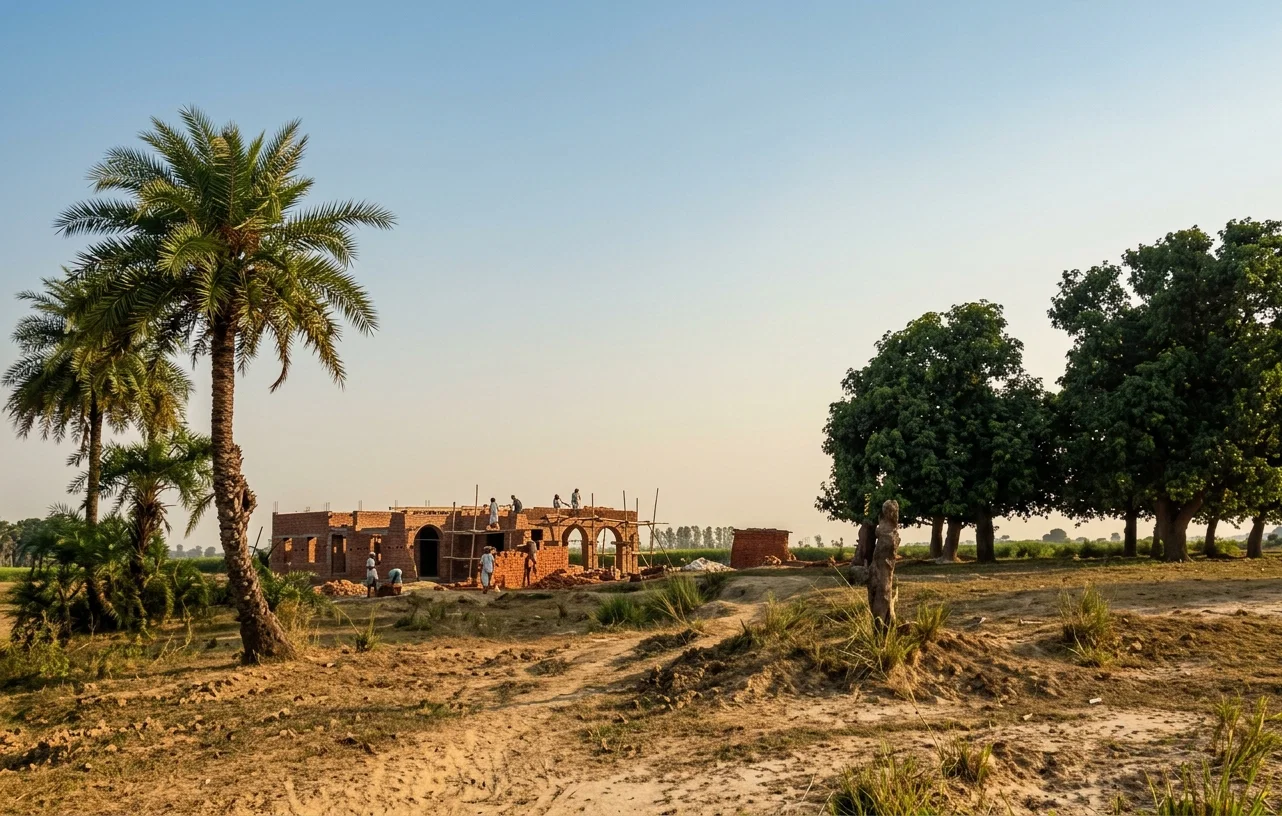
BRICK MISSION HOUSE BEING ERECTED AT NAJIBABAD, INDIA

North India

W. S. MEAD
WE have now been in India a little over a year. Most of the time has been spent in studying one of the languages, but besides the language we have studied many other things. One fact has forced itself upon our minds,—that India is on the other side of the world from the West in more senses than one. I sometimes wonder if any person ever understood India who had never been here; in fact, has any one understood it who has been here?
I have a friend, an educated Hindu, who knew I was reading a book on the Hindu religion. He remarked that if I ever came to understand it, he wanted me to explain it to him, for, though born in it and though a student of religion, he admitted that Hinduism was as yet unfathomable. Of course I was glad for the opportunity of pointing out to him that whereas Hinduism is unfathomable, the religion of Jesus, while unfathomable in its fulness, is simple enough for all to understand in order to be saved by it. Of course he knows this; but to accept it and make a break with all his friends and relatives, and probably with his means of support, is more than he can do. More than ever do I realize that nothing but a deep conviction of sin can make a man truly turn to Jesus, the only Saviour.
The language we study is called Hindustani, or more properly Urdu. It is written in the same characters as the Persian, which is precisely like shorthand written backward. Urdu goes from right to left, and the last page in the book is the beginning of the story.
Here in north India we have two languages equally dominant, Urdu and Hindi, hence, when we issue any literature we must have two separate translations made, and get it out in two different forms, or characters. Roughly speaking, the Urdu is the language of the Mohammedans in this part of India, and the Hindi that of the Hindus. We have a quarterly journal now published in both characters, and we are collecting a canvassing force to sell it.
On the main railway line from Lucknow to the northwest part of India, just two hundred and sixty-four miles from Lucknow, is a station named Najibabad. Here we have a dispensary doing good work (still in a small rented building, however), a school for Mohammedan girls, and last of all, a good brick building in the course of erection, which will be a home for the workers in this place.
If any one questions our need of this house, I wish he could see where the workers have to live now, right in the native town, absolutely surrounded by everything a native town affords. Also I wish you could see the new house, a mile from town, near a creek, with twelve mango-trees at the side door, in sight of the mountains and at times in sight of snow-capped peaks, and where the breezes will not be disease-laden. But don't imagine that then we shall have a life of perfect ease. Najibabad has some disadvantages—but not for relation now. I enclose a picture of the house partly erected. All the trees at the right are mango, and belong to us. Those at the left are date-palms.
We are glad for the privilege of having a part in the work in India. The heathenism all around is oppressive, and far more than ever before do we appreciate the blessedness and truthfulness of the gospel of Christ. And even in this dark land does the message of the third angel seem a vital truth.

I Cannot Remain Idle

I CANNOT remain idle. Ever since I was a child I have had this feeling. Time means everything. If you cannot do a thing here, do it elsewhere. In an hour gained may be accomplished the one thing you have been striving for. — G. Marconi.

How to Abolish the Fly

THE fly is a danger which comes home to every family. And each family can do much to minimize the danger. But the great work must be done by the families in a community working together. A bulletin of the American Civic Association gives a series of rules for dealing with the fly. They are so admirable that we print them entire:—
Flies breed in horse manure, decaying vegetables, dead animals, and all kinds of filth.
Not less than ninety-five per cent of the pests are bred in the stable.
All stables should have a manure bin with a door at the side and a wire screen on the top, that the larva deposited in the manure before it was placed in the bin will be screened when hatched; and as flies seek light and come to the top of the bin, they can be easily killed by burning paper or some other device.
The fly has a thirst only equaled by his hunger; place a dish of poisoned water in the stable, and a greater part of the flies hatched there will be killed.
Flies are nature’s scavengers, fulfilling the same function that some bacteria do, but become an intolerable nuisance and danger on entering human dwellings and by contaminating food.
The presence of flies is a direct evidence of careless housekeeping and of the existence of filth in some form about the premises, and are more dangerous than the good housekeeper’s terror found in bedrooms.
Remember that wherever absolute cleanliness prevails there will be no flies. Look after the garbage cans. See that they are cleaned, sprinkled with lime or kerosene oil, and closely covered.
Remove all manure from stables every three or four days, and when removed keep in a tight pit or vault, so flies cannot breed in it.
Lye, chlorid of lime, or blue vitriol water, crude carbolic acid, or any kind of disinfectant may be used.
Keep flies away from the kitchen. Keep flies out of the dining-room and away from the sick, especially from those ill with contagious diseases.
Screen all food. Apply this rule not only to food prepared at home, but to foodstuffs offered for sale, and especially fruits, salads, and all other things that do not require cooking.
Prevent consumptives from expectorating where flies can feed upon it.
To clear rooms of flies carbolic acid may be used as follows: Heat a shovel and drop thereon twenty drops of carbolic acid. The vapor kills the flies.
A cheap and perfectly reliable fly poison, one which is not dangerous to human life, is bichromate of potash in solution. Dissolve one dram of the potash, which can be bought at any drug store, in two ounces of water, and add a little sugar. Put some of this solution in shallow dishes, and distribute them about the house.
Sticky fly-paper, traps, and liquid poisons are among the things to use in killing flies, but the latest, cheapest, and best is a solution of formalin or formaldehyde in water. A spoonful of this liquid put into a quarter of a pint of water and exposed in the room will be enough to kill all the flies.
To quickly clear the room where there are many flies, burn pyrethrum powder in the room. This stupefies the flies, when they may be swept up and burned.
If there are flies in the dining-room of your hotel, restaurant, or boarding-house, complain to the proprietor that the premises are not clean.—The Outlook.

Let Us Be Kind

“COME, Nell, run down to the office and get the papers,” said Mr. Watkins in a coaxing tone to his fourteen-year-old daughter, who was sitting in a hammock, deep in an interesting story.
Two little wrinkles gathered on the young girl’s forehead as she said, poutingly, “O, dear, father, I don’t want to stop now; I’m reading!”
“Now that’s a good girl,” coaxed her father. “I want to see the news. Come, you’re younger than I am.”
“I should think you might wait till Uncle James goes; he can get the mail,” Nell argued fretfully.
“Perhaps Uncle James won’t go today, and I want the papers,” said Mr. Watkins, a shade of sternness now in his voice.
“Well, I suppose I’ll have to go,” Nell declared, petulantly, rising from the hammock and closing her book reluctantly.
She went into the house for her hat, and when she came out a moment later, ready to start for the office, Dr. Newhall, who had been calling on her invalid mother, said with a smile: “Going to the office, Miss Nell? Wait a minute, and I’ll give you a ride there.”
Half ashamed for fear the doctor had heard her petulant replies to her father, Nell waited while the horse was brought around.
Soon the young girl was seated in the chaise, bowling merrily along beside the kind old doctor, laughing in spite of herself at his funny jokes. Dr. Newhall knew well how to entertain young people, and was much beloved by them. All the boys and girls thought it was a great treat to ride with the doctor.
But by and by, after a short silence, the doctor said gravely, “Nell, I’ve a little story to tell you;” and then to the gray horse, “Whoa, Billy; slowly down the hill.”
“One day when I was a boy of thirteen,” the doctor began, “I was coming from school with the other lads of my age. For a week or more we had been planning to go swimming in the pond below my father’s house the first warm day. And that was just the day for it at last, hot and muggy. So we were hurrying along to have our swim before supper.
“The schoolhouse was about two miles from our house, on the outskirts of the village. When nearly home, we met my father on the road into town carrying a bundle. He stopped me. ‘I wish you would take this package to the village for me, Jim,’ he said, hesitatingly.
“I’m sure I looked disappointed; and my first impulse was to refuse, and rather crossly. But father had not been quite well for a week, and if I didn’t go he would; and he was a good, kind father. Something stopped the petulant word,—one of God’s good angels, I think.
“‘Of course, father, I’ll take it,’ I said quite cheerfully. ‘Never mind, boys, I’ll go swimming some other night.’
“‘Father gave me the package. ‘Thank you, Jim,’ he said; ‘I’m sorry to have you lose your pleasure. I was going to the village myself, but somehow I don’t feel very strong today.’
“‘He walked with me to the road that turned off to the town, giving me some directions about delivering the package. When he was turning back he put his hand on my arm, saying again, ‘Thank you, my son. You’ve always been a good boy to me, Jim.’
“‘I hurried into town and back again. When I came near the house, I saw some of the neighbors standing about the door, and hurrying forms inside the house. One of the men came to me, the tears rolling down his face. ‘Your father,’ he said, ‘fell dead just as he reached the house after he left you.’
“‘I am an old man now, Nell, but I’ve thanked God through all these years that I didn’t refuse my father’s last request, and that his last words to me were, ‘You’ve always been a good boy to me.’”
The old doctor wiped his eyes at the recollection. Nell had been crying softly during the last of the story; and now, as she dried her eyes, she said, “O, doctor! and I was so cross to my dear father tonight! I never will be again.”
It was a very thoughtful girl that walked from the post-office that night with the papers. It was with a thrill of pleasure that she saw her father sitting on the piazza, awaiting her coming. She went straight up to him, put her arms about his neck, and kissed him, as she said, softly and penitently, “I’m sorry I was cross tonight. Please forgive me, father.”
“Of course I will, my daughter;” and he returned her kiss, thanking her for the papers.
Nell kept her resolution pretty well, though she often had a struggle with herself to keep back the petulant word. She wrote on a slip of paper, “Remember the doctor’s story,” and pinned it on her cushion on the bureau, where her eyes fell on it a dozen times a day.
And who of us ought not to remember the doctor’s story? There is no page of remorse so keen as the bitter regret with which we remember neglect or unkindness which we have shown to loved ones now dead.
And, after all, it is such a brief little while we can be with our friends on earth. Let us be kind.—Children’s Friend.

Well Done

Just to do the very best that in us lies each day; Just to glean the sunbeams and toss the clouds away; Just to keep on hoping though the dis- appointments grow; Just to let the healing smile follow the tear-drop's flow; Just to be as loving as we can, and kind, and true; Cling to the golden rule in all that we do; Just to count the blessings with the ills of life, And our Heaven-helped victories over sin and strife,— Then, as we journey toward life's setting sun, Christ will wait to greet us with the praise “Well done.” — Selected.

After the Christian Citizenship Conference

No doubt many readers of the REVIEW noticed with interest the preparations made for the Christian Citizenship Conference recently held in Portland, Oregon. It was stated that there would be from twenty thousand to thirty thousand delegates and visitors in attendance.
In view of this, the commercial club gave the National Reform Association, under whose auspices the meeting was held, a cash donation of fifteen thousand dollars, and agreed to provide a place in which to hold the meetings. During the time of the meeting, it was evident that all was not moving smoothly. After all the great promises made as to numbers, it is claimed by the press in Portland that there were less than one thousand delegates present from abroad.
The great dailies of the city gave full reports of the meetings, and seemed to be in accord with the sentiments expressed; but only two days after the meeting closed, the Oregonian, both in an article and in an editorial, stated the true situation. First, complaint is made regarding the attendance, and then as to the cost of the meeting as compared with the value received. It is stated that none of the fifteen thousand dollars was used for expenses in Portland, but all sent on to Pittsburgh to the National Reform Association.
Several intimations of a lack of at least Christian business methods are made; but on these we do not wish to dwell. We wondered day after day as we listened to the speeches of the National Reformers just how their views would be received by a liberty-loving people. The Oregonian editorial expressed the following:—
“Of course there is more or less peril in too much insistence upon the supernatural view of affairs. All good things will run to extremes if they are not carefully guarded, and they are only too apt to vex their best friends by turning to evil. Take, for example, the doctrine so vigorously preached at the conference, that ‘the state is of divine origin.’ One speaker went so far as to say that since the state derived its authority ‘from God,’ we ought to recognize the Almighty explicitly in all public documents, acts, and especially in legislation. Were his theory to be carried out in practise, we should establish a theocracy in the United States. Leaving aside the difficulties which would surely arise among the sects if any such plan were seriously undertaken, the reflective citizen cannot forget that the Declaration of Independence teaches a very different doctrine. According to that document, governments ‘derive their just powers from the consent of the governed,’ not from inspired source.
“The theory of the divine origin of government and the divine authority of rulers has done so much mischief in the world that it is depressing to hear modern speakers refer to it with apparent favor. Is it not possible to apply the precepts of the Saviour to practical life without reverting to dangerous superstitions long since discarded? But these matters were aside from the main trend of the conference. Upon the whole, it spoke valiantly for civic and personal righteousness, and its lessons will be permanently uplifting to the city.”
We are glad to know that there is still ability to discern the dangers of religious legislation. It is the duty of God's people to do all in their power to spread these great truths that honest souls may know where to stand when the final crisis comes. W. F. MARTIN.

The Wisconsin Camp-Meeting

This good meeting was held at Grand Rapids, Wis., June 19-20. The location in the city was desirable, and easy of access to a goodly number of the citizens. The attendance from the city was fair. There were one hundred and thirty family tents pitched, while many lived in rooms near by.
It was estimated that about one thousand of our brethren and sisters were in attendance at some part of the meeting. I think the average would be about five hundred.
A part of the time the weather was oppressively hot, yet there was little sickness, and all seemed of good courage and to greatly enjoy the meetings. In addition to the home workers, there were present at some time in the meeting laborers from abroad as follows: Elders Allen Moon, J. H. Schilling, J. W. Westphal, F. B. Armitage, B. J. Cady, M. H. Serns, Brethren J. B. Blosser and J. W. Mace, Miss Mimi Scharffenberg, and the writer.
The business of the conference was transacted during the meeting. Many good resolutions were adopted, which, if carried out, cannot but result in the advancement of the work in that great State.
One hundred and thirty-five converts were reported as having united with the church during the year. The Sabbath days were occasions of special blessings to the campers, the Lord coming very near with his Holy Spirit and giving many souls a new view of the value of eternal life. A good many gave their hearts to the Lord for the first time. Seventy-three received baptism during the meeting, and others will receive baptism later.
The missionaries from foreign lands gave a splendid testimony concerning the work in the fields that they represented. Their talks were gladly listened to by the people and were very encouraging. One could hardly think of greater providences and greater Christian experiences than those reported by these visiting missionaries. Their words of courage, faith, and exhortations to zeal in the work of God stirred all our hearts.
The twenty-cent-a-week plan was freely discussed and adopted. It will require good leadership, in a large State like Wisconsin, to swing the entire membership into line, but it can be done, for the people have a heart to finish the work.
It was a good meeting, and the blessing of the Lord was with us. The workers consecrated themselves to a year of hard service in the Master's work, and many gave testimony that they intended to make this the best year of their ministry. We believe that Wisconsin will carry its share of responsibility in the Lord's work, and that there are brighter days in the future for this splendid conference.
I. H. EVANS.

A Convenience for Babies

JESSIE A. SHAFFER
My own baby has derived so much comfort from this simple arrangement that I pass on the suggestion for the benefit of other babies whose mothers read the REVIEW:—
Procure an ordinary barrel hoop and wrap with strips of cloth, tape, or ribbon. Sew up widths of mosquito-netting as if making a bag. Turn under the edges of one end and tie tightly as in tying up a bag. The other end may be hemmed. Place the hoop in the bottom of the bag, the tied portion in the center of the hoop, and attach tapes or ribbon so that it may be suspended over baby’s chair or crib. If the netting is weighted at the bottom or closely tucked in around baby’s pillows or mattress, the mother may go about her duties sure that not a single fly can disturb the little one, and there is no danger that he will be annoyed by it and push it off. Playthings may be suspended inside, and baby is comfortable and contented for hours. The device may easily be packed in trunk or suit case, can be hung up anywhere, and baby’s “tent” will soon become one of the most indispensable articles in the house. Older children find it comfortable for an afternoon nap.

A Word to Mothers

If I might write only one more sentence during my life, it would be this: Let the mothers of this land be the chosen confidantes and companions of their daughters. There is something wrong in every mother, how good soever she may be, whose young daughter cannot lay her head on her lap and, without fear of reproach or repulse, give expression to her full thoughts.
That mother may, or may not, approve her daughter’s wish or opinion; she may think it premature, or every way unadvisable; but O, the relief and safety to that daughter, that she may “tell mother”! Let the two talk it over together, as young companions do—honestly and frankly.—New York Ledger.
Continue reading: Western Oregon Camp-Meeting