The Youth’s Instructor, Vol. 64, No. 7.

Greece Today

The Youth’s Instructor

Feb 15, 1916

Review and Herald Publishing Assn. · Takoma Park Station, Washington, D. C. · Feb 15, 1916

Greece Today

In Sheffield, England, 250 out of 520 tramcar conductors, are women, who receive the same wages for the same hours’ work as do the men serving as conductors.
A large concrete viaduct half a mile long has been built at a cost of twelve million dollars by the New York, Buffalo, and Lackawanna Railroad over the Tuckhannock Valley. This makes possible a new route which saves twenty minutes to the passenger trains running between New York and Buffalo, and one hour to the freight trains.
Mr. Palmer Cox, a Canadian by birth but a naturalized American citizen, is the author of the famous Brownie pictures and books. Mr. Cox is seventy-five years of age, and is as happy and as joyous as his Brownies. His aim has been to give children clean, wholesome fun, not such as is found in the so-called funny page of many of the ordinary newspapers.
Report comes from Germany that the town of Mittenwalde, whose inhabitants are renowned all over the world as makers of violins, is suffering greatly from the war. In times of peace fully four fifths of the output of instruments went to the United States, but the difficulties of export nowadays have almost entirely cut off this trade. Nevertheless, the violin makers continue to produce the instruments, and store them away in expectation of better days.
Mr. Frank Fithen is an armless motorist who has spent three years touring the country. When he completes the trip he is now planning, he will have entered every State in the Union, having driven his own six-cylinder car 85,000 miles. Mr. Fithen lost his arms in an accident at nine years of age. He can dress and undress himself. He writes with little difficulty by holding the pen between his teeth. He can swim, ride a bicycle, and perform feats of fancy riding and balancing on the single wheel.
Dr. T. Kennard Thomson, consulting engineer, claims that he can reclaim fifty square miles of land from New York Bay, and add one hundred miles of new water front for docks. His project fills in the East River, opens up a new East River, a new Harlem River, fills in a part of Sandy Hook Bay, and extends Manhattan Island, together with other additions made to Staten Island. Dr. Thomson’s complete project, he says, would cost as much as the Panama Canal; but it would enable New York to sustain easily a population of 25,000,000.
The success of the Germans in the field, and their still more remarkable success in maintaining the nation when all commerce was cut off, are due to the organization of industry under scientific direction. At the outbreak of the war, Dr. Walther Rathenau, the head of the General Electric Company, was called upon by the minister of war to take charge of the manufacture of war material. His greatest achievement is the development of the process of making nitric acid from the nitrogen and oxygen of the air by means of the electric spark. This provides the nitrates necessary for ammunition and agriculture, and frees Germany, probably permanently, from her previous dependence upon the British nitrate beds of Chile.

Greece Today

Greece is not at war, but she is as firmly on a war footing as is France or Italy. A man out of uniform is conspicuous, and all day regiments pass through the streets carrying the campaign kit and followed by the medical corps, the mountain batteries, and the transport wagons.
When the army of a country is mobilized, it is hard to understand that that country is neutral. You expect to see evidences of her partisanship for one cause or the other. But in Athens, from a shop window point of view, both the Allies and the Germans are equally supported. There are just as many pictures of the German generals as of Joffre, as many post cards of the German emperor as of King George and King Albert. After Paris, it is something of a surprise to see German books, portraits of German statesmen, composers, and musicians. In one shop window conspicuously featured, evidently with intent, is an engraving showing Napoleon III surrendering to Bismarck. In the principal bookstore, books in German on German victories, and English and French pamphlets on German atrocities, stand shoulder to shoulder. The choice is with you.
Meanwhile, on every hand are the signs of a nation on the brink of war; of armies of men withdrawn from trades, professions, homes; of men marching and drilling in squads, companies, brigades. At times the columns are so long that they are an hour in passing the windows of the hotel. All these fighting men must be fed, clothed, paid; and while they are waiting to fight, whether they are goatherds or piano tuners or shopkeepers, their business is going to ruin.—The New York Times.

Guardian Angels

“CAN it be, now tell me, mother, That when I'm at table eating, In the back yard running, playing, At my school examples working, Or some kindly errands running; When I'm at the brook a-fishing, In the field with Fido roving; Or at night, when I am lying Sound asleep, or sweetly dreaming,— Maybe of some funny story, Like that told by Cousin Mary,— Where'er I may be, no matter, That there is some one quite near me, Whom no human eye can e'er see,— One who notes my every action, And whose presence means protection?”
“Yes, my child, our loving Father Sends an angel down from heaven To attend the life he's given. Ever with you, ever watchful, All your joys and sorrows sharing, Always loving, always caring, Is your faithful guardian angel.”
C. C. ROBERTS.

B. F. M. SOURS

Sing!

B. F. M. SOURS

CHEERILY, joyously singing away, Hear the bird chorus at break of the day, List the sweet notes from the broad fields of corn, Where the gay oriole sings through the morn.
Sing of your gladness, O robins and wrens! Sing in the forests, and meadows, and glens; Bluebirds and catbirds, at rest and awing, Fill the far echoes with joy while you sing.
Hark! must I listen, while all these are glad, And my poor spirit be lonely and sad? “Hope thou in God!” ’Tis the word of his love, Pointing my spirit to raptures above.
Oh, when his sunlight illumines the dawn, Doubtings and dreamings and darkness are gone! Oh, when his love fills my spirit with words, How my heart answers in song like the birds!

MRS. C. M. SNOW

On the Boundless Deep—No. 1

MRS. C. M. SNOW

THE steamship “Sierra” left Pier 21, San Francisco harbor, Dec. 7, 1915, at a few minutes after two o’clock in the afternoon. Years before we had watched the departure of many a ship, as we bade good-by to friends who were starting for Africa, Australia, or other foreign countries. But this time there was a difference. As the ship sailed out, the friends were on shore and we on deck. Among the group were relatives who never before seemed quite so dear, and friends of our youth.
The steward of the “Sierra” handed to the passengers rolls of confetti, to toss to those they were leaving, while they retained one end of the roll. These varicolored streamers made the scene look quite effective, but they were, oh, so frail! The thought came, Is this frailty symbolic? and I quickly passed my handful of streamers to the one at my side, and turned away for a moment. (Sometimes the salt sea spray dashes into one’s eyes.)
The gay ribbons parted as off we sailed, but caps waved and handkerchiefs fluttered until the mass of people became a speck, and vanished. But on we went, past Ft. Mason, Ft. Point, Lime Point, out of the Golden Gate, and into the swelling sea. Soon our pilot went down over the side of the ship into his little boat, and the shore gradually faded from view. Finally, when the mountain peaks had also faded, we began to make out the dim figures of the Farallone Islands. We counted what seemed to be eight islands, but may have been distant peaks of one only, rock-ribbed and uninviting in appearance. Yet nestled below the tall peak on which stands the lighthouse is quite a little village.
One hasty visit was made to our stateroom, to prepare for an emergency hospital in case of necessity, and better to prepare ourselves for a quick dash there if needed. Arriving there, we found some very pleasant surprises. A box nearly five feet long contained a most wonderful bouquet of ferns and white and golden Japanese chrysanthemums as large as bowls. Yes, our name was on the box, and also the number of our stateroom. Another package revealed the latest number of eleven of the most popular magazines, such as Literary Digest, World’s Work, Ladies’ Home Journal. There were other bundles and boxes, and a big bunch of letters and cards, over half a hundred, which we did not examine until later.
Literature and letters are good forget-me-nots on a voyage. The recipient carries them about, enjoys their silent companionship, thinks of the giver, and takes a peep now and then, long before he’s steady or ready to devour and digest mentally or physically. These were such substantial evidences of friendship and love that they overbalanced the paper-ribbon idea. Some friends are surely large-hearted, true, and dependable.
While the other passengers went to supper, I remained on deck. The dining room had no attraction for me, although I had eaten no dinner and little breakfast. Ere the sun was lost to view, we were favored with the most beautiful omen—the bow of promise stretched across our pathway.
The hundreds of sea gulls that followed us all the afternoon and evening, swooped down with avidity on the remnants of supper that were thrown into the great garbage can that never needs emptying.
As darkness settled over all, and we felt the mighty toss and boom of the restless water, the mad plunges of the ship, we were comforted by the thought that we were guarded by the heavenly Pilot. Trusting in his love and care, which are vaster, deeper, than the boundless ocean, we slept.
That night we struck a heavy southwest blow. The waves were very high. The ship plowed her nose into them continually, taking on tons of water which ran along the deck and into the portholes, which the night watchman had forgotten to close.
Our room was flooded with bucketfuls of water; but we didn’t care much—not then. Such heavy waves dashed over the ship that water went through the skylight into the dining room and made a watery waste of it. We heard one of the workmen say in a high-keyed voice, made falsetto for the occasion, “Is this ship traveling upside down, or what?”
Twice they had to stop the ship. We did not then know why, but learned that once it was to enable the watchman to close the outer portholes on the front of the ship. The other time the ship was stopped to let it get a more even keel. It was tipping sidewise so that the propellers were out of water and revolving so rapidly that they were in danger of being lost.
Our little daughter’s berth was drenched. When her father rang for dry bedding, they said: “When we can. The whole ship is like this.” So I changed places with her. When the dry bedding came, it was too late to be of use.
There were none of the usual morning greetings in our room. Ordinarily our hands could clasp across it, but now the distance was impassable. Not even a smile passed between my daughter and me. She had not been well for some time, and it was one of the sorriest sights of my life to see her poor dear eyes almost strained from their sockets as she retched and wrenched. Her words, “If only the toss and roll—and nausea—would stop for a minute,” expressed our unspoken thought. But old Neptune ceased not to rock our cradle most vehemently and claw at the pit of our stomachs.
However, we did not feel such lonely despair as the boy who said, or who is said to have said: “Nobody loves me, nobody cares. I’m going out into the garden and eat worms.” Too many seemed to care, for it was an exertion to say, “Nothing, thank you,” so frequently. Even the stewardess was sick, but we were waited on by a kind, solicitous young man. If at this time we had any desire, it was to exchange the stuffy, fetid atmosphere of our close room for the pure breezes on deck. But we had no magic carpet to take us there, no wand to wave and find ourselves dressed. Besides, the deck was a foot or more under water. The next morning in some way we got there, however, and knowing when we were well off, remained very quietly in our steamer chairs until a late bedtime. On deck we found another link, much stronger than paper, in friendship’s chain, a fine, substantial reclining chair, with a card attached on which was our name. This was so much more comfortable, steady, and dependable than our frailer ones, that our hearts warmed to the kind donor.
For two days the weather was extremely rough, with west and southwest seas, making it necessary for the commander of the ship, Capt. J. J. Koughan, to slow down the “Sierra” to half her normal speed, which is seventeen knots.
During all this stormy time, we felt beneath us the everlasting arms, and never before did the promises in the Bible seem so precious and so abundant. We learned, too, the value of memorizing the Scriptures. The words of the thunderstorm psalm repeated themselves in our memory:—
“The voice of the Lord is upon the waters: The God of glory thundereth: The Lord is upon many waters, The voice of the Lord is powerful; The voice of the Lord is full of majesty. . . . The Lord sitteth upon the flood; Yea, the Lord sitteth king forever. The Lord will give strength unto his people; The Lord will bless his people with peace.”
Psalm 91 also was comforting: “He that dwelleth in the secret place of the Most High shall abide under the shadow of the Almighty. I will say of the Lord, He is my refuge and my fortress: my God; in him will I trust. Surely he shall deliver thee from the snare of the fowler, and from the noisome pestilence. He shall cover thee with his feathers, and under his wings shalt thou trust: his truth shall be thy shield and buckler. Thou shalt not be afraid for the terror by night; nor for the arrow that flieth by day. . . . He shall give his angels charge over thee, to keep thee in all thy ways.”
We realized that we were utterly helpless without him, but that we must trust entirely to his care, and felt in even the most trying moment that we would rather be with Jesus on the water than without him on the land.

A New Testament Printed in a Cellar

A STRANGE place indeed in which to print a New Testament! But “necessity is the mother of invention;” and if the Word of God cannot be printed in any other place, by all means let it be printed in a cellar.
Spain, until the last century, perhaps, has been in bondage; and any one who read the Bible, sold the Bible, or listened to the Bible was exposed to great danger. In spite of this, many Spaniards longed to read the Word of God in their mother tongue; and as it was almost impossible to get Bibles or Testaments into the country, it was resolved to try to print the New Testament in some nook or corner of the land where it might be done without observation.
“In the course of time a Christian brother was found who could print, a place was selected for the work, an old miserable press and some type were bought, and an edition of the New Testament was begun, by lamplight, in a cellar, amidst much anxiety and many prayers. The machine was so bad and the type so insufficient, that the work which can usually be done in two hours took eleven or twelve days for its accomplishment.”
The work was so very long and tedious that it exhausted the strength of the poor printer, and the dampness of the cellar, together with the constant exertion, brought on a severe illness. When the edition was nearly completed, the poor man’s life was in so much danger that all his Protestant friends urged him to leave the task for another to finish. But this noble Christian refused to do so, saying, “If these three thousand Testaments cause my death, I shall die with the joyful consciousness of having provided the bread of life for three thousand souls.”
After eight months of incessant labor, the task was completed. This was in 1865. One of his sons, quite a small boy, used to help in the work, and for a long time his little hands bore marks of pressure from the hard and unaccustomed exertion.
The whole matter was very nearly discovered, owing to an accident, before the printing was finished. One day, during the absence of the printer, one of his children, who was carelessly playing with matches, set fire to some paper near the press. The flames spread, and the police and firemen would soon have been there, but in God’s providence the printer returned unexpectedly, just in time to extinguish the fire.
A copy of this New Testament was presented to the library of the British and Foreign Bible Society, where it may be seen. The lady who gave it said in her letter, “We may hope that this will be the last New Testament which will ever have to be printed in a cellar in Spain.” It probably was the last. A change came over Spain, and the above-mentioned society has printed openly, in Madrid, both Bibles and New Testaments. Those who are seeking the true light in old Spain may obtain God’s Book today, not, however, through the assistance of the priests. Old Spain is still enshrouded with the papal cloud of superstition and intolerance that has kept the people in the darkness of ignorance for centuries. But God has set his hand to the finishing of his work in the earth, and no power can keep his blessed Spirit from working on hearts that cry after him. Let us pray that God’s servants in that land may be kept strong and valiant for their work of witnessing.
ERNEST LLOYD.

MAY COLE KUHN

Twilight

The tasks of the day are ended, And a few great stars gleam bright; The birds have sung their vespers, And I feel the hush of night. The whole wide world seems quiet, Swinging through shadows deep, Like a mighty cradle rocking The sons of men to sleep.
Through the heart of the dancing twilight Creep the cares and joys of the day, And out from the glowing embers Peer faces that fade away; And the evening’s peace comes o’er me As the shadows are folded low Over the old earth-cradle That swingeth to and fro.
O fair is the rosy dawning, And bright is the noonday sun! But give me the dusky twilight, When the day is almost done. Then sing me a song of the homeland As the coverlet of night Shines out with a thousand jewels, And the pain of day takes flight.

MAY COLE KUHN

Learning to Study the Bible

MANY a reader of the Bible confesses with some discouragement that, to him, the book has not the interest and the helpfulness that others say they find in it. What can be done for such a one? Such an inquiry as the following, for example, represents a very common experience:—
“There is so much said these days about Bible study. I have been told, ‘The Spirit uses the Word as his special instrument as a means of grace.’ The Bible is God’s word. He must have a message for me individually. Again and again I have sought for that message, only to find the Bible a sealed book, the key to which I am unable to find. —’s Outline Studies were advised, and the course taken, but they did not answer the purpose.
“Can you help me to a way of study? I want especially to learn to hear and know God’s voice speaking to me, and the message he brings, so that I may grow more like him whom to know is to love, that my will may be his will, and my service more gladly rendered.”
To learn how to study the Bible is one of the costliest things that any one can attempt. But it is within the reach of every one who will attempt it in entire readiness to pay the whole cost; and every one who will can do this.
The first price we must pay is nothing less than ourselves; the complete surrender of self and all that we have unto God’s will. Many a Christian, who has honestly repented of sin and accepted Christ as his Saviour, nevertheless has not surrendered the entire life—body, mind, soul, and spirit, every interest, desire, purpose, and aspiration—unto God in Christ, making Christ the Master of the whole present life as well as Saviour for the life to come. But until this is done we cannot even know God’s will for us in its completeness, nor can the Holy Spirit give us the full and satisfying message of God’s Word.
Obedience to every known detail of God’s will for us is another essential. Not sinless perfection is meant by this; but the honest, complete, and habitual purpose to do God’s will in everything so far as we know it at present. A single conscious and habitual departure from God’s will, in omission or commission, can seal up the springs of our spiritual life, block the Holy Spirit, and make our Bible study almost meaningless.
Prayer as an invariable preliminary to and accompaniment of our Bible study cannot safely be disregarded. The Bible is God’s word, and its real message is wholly beyond the mere intellect of man. He who supposes that he can understand it without the direct and superhuman aid and action of the Holy Spirit, is effectively insuring himself against receiving the full message that God would give him from its pages. Let us recognize this; and let us recognize that prayer for the Holy Spirit’s interpretation of what we are about to read in the Bible, whenever we turn to it, is not merely a helpful accompaniment of Bible study, but an absolute essential to the fulness of its blessings.
The principle of complete obedience to God’s will as a life habit comes directly and vitally into play as part of our Bible study. We must obey what we find in the Bible. This practice alone has made an utterly new thing of Bible study to some: to read in the Bible until coming to some sentence or suggestion that has a practical application to one’s own life; then to close the book and ask God to enable us to obey him in that thing; and then to go and do it. The new messages of the Bible to us multiply as we obey those that we find there.
Habit and system are also vital to the Bible study that blesses the life. No normal day is complete without its time specially set apart for Bible study for personal nourishment. This cannot be done in five minutes; and it cannot be done with much blessing at a fag end of the day, or when our strength has been pretty well used up by other things. In other words, the “morning watch” plan, giving at least half an hour at the beginning of the day, preferably before breakfast, to Bible study and prayer, has proved by experience to be one of the most richly blessed of practices in the lives of thousands. The best that God can offer us—himself in direct communion through prayer and his Word—is surely entitled to the best part of our day and the best of our strength and attention. With most of us, that best is in the early morning.
Bible study on this basis is costly, is it not? But is there anything here that is beyond the reach of any one, or that one can safely call unnecessary? If we disregard any of these principles, and our Bible study is barren, why should we be surprised? Oh, let us realize what an infinitely priceless book this is, what infinite pain, and cost, and power have gone into its making, both from God and from man; and then let us cease to wonder that its study should be costly and difficult, rather rejoicing in every demand that it makes upon us, and learning for ourselves how slight, after all, is the highest price we may pay in contrast with the inexhaustible riches that the Father will pour into our lives from the life-giving pages of his Word.—Copyright, 1911, by the Sunday School Times Company.

WHO AM I?

I am more powerful than the combined armies of the world.
I have destroyed more men than all the wars of the nations.
I am more deadly than bullets, and I have wrecked more homes than the mightiest of siege guns.
I steal in the United States alone over $300,000,000 each year.
I spare no one, and I find my victims among the rich and poor alike, the young and old, the strong and weak. Widows and orphans know me.
I loom up to such proportions that I cast my shadow over every field of labor, from the turning of the grindstone to the moving of every railroad train.
I massacre thousands upon thousands of wage earners a year.
I lurk in unseen places, and I do most of my work silently. You are warned against me, but you heed not.
I am relentless.
I am everywhere—in the house, on the streets, in the factory, at railroad crossings, on the sea.
I bring sickness, degradation, and death, and yet few seek to avoid me.
I destroy, crush, or maim; I give nothing, but take all.
I am your worst enemy.
I AM CARELESSNESS.

The Philippine Islands and Their People
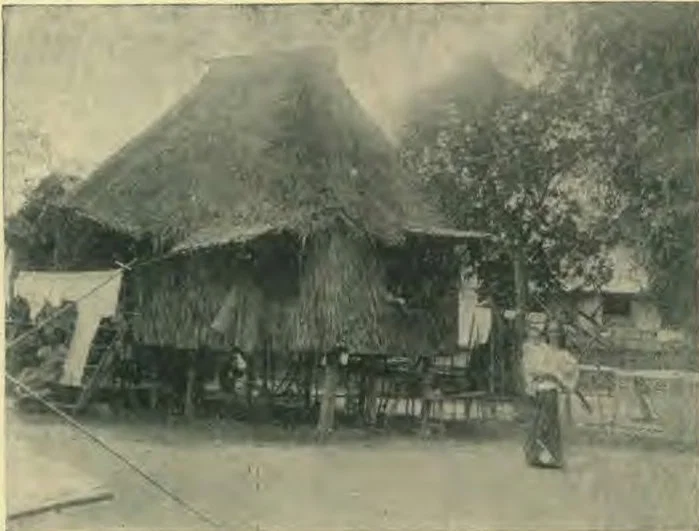
THE Philippine Islands lie about six hundred and fifty miles from the coast of China, with the China Sea washing their shores on the west and the Pacific Ocean dashing against their eastern shores. The distance from San Francisco to Manila, the capital of the islands, is a little more than seven thousand miles.
A TYPICAL NATIVE HOUSE IN THE PHILIPPINES
About three thousand islands comprise the group, having an area of little less than one hundred and fifteen thousand square miles, equal to the combined area of the six New England States and New York. Only 342 of these islands are inhabited.
Luzon, Mindanao, Samar, Negros, Panay, Mindoro, Leyte, and Cebú are the principal islands of this group. The first two named are nearly as large as all the rest of the group combined.
The chief products are hemp, sugar, rice, coffee, and tobacco. Many tropical fruits, as bananas, oranges, and pineapples, are grown in abundance. Mahogany, cedar, ebony, and bamboo trees grow in the islands. It is not unusual to see the foundation pillars of a native house built of solid mahogany or some other expensive wood.
The policy adopted under Spanish domination held in check all progress in the islands, and their resources were therefore not well developed. American enterprise will soon make the land yield a great increase in production.

The Climate

The climate is a continual summer, the thermometer ranging between 60° and 100° F. According to Nelson’s Encyclopedia the highest temperature ever recorded in Manila was 100° F. There are three seasons in the year, the first cool and dry, lasting from November to March; the second hot, but still dry until June, when the wet season begins, and lasts until November. During the rainy season the weather is disagreeable; rain falls daily, and the intense dampness causes bedding, clothing, and even woodwork to mold.

The People

The islands are inhabited by several races of people. The Negritos (little Negroes) live in the forests, and are no doubt descendants of the original inhabitants. There are about thirty thousand of them. They are timid, and remind one of rabbits, as they scurry away at the approach of a stranger. It is seldom that groups of them can be found together. They live largely on game, and the flesh of the monkey, of which they are very fond. This they obtain by the skilful use of bow and arrow. Since the beginning of the centuries of Spanish rule, this people has changed the least of any race, not having amalgamated with any other people. They have never been conquered; yet if unmolested, they are peaceable. They caused the United States army very little trouble during the insurrection. They are savages of the primitive sort, building no houses, and finding their sleeping places by the roots of large trees.
The Igorrotes inhabit the mountains of northern Luzon. There are several tribes of them, each tribe having its own dialect. I spent about one year among them, and became quite familiar with their customs. They are known as “head-hunters.” In one year nearly one hundred Christianized Filipinos lost their heads at the hands of these savages. Their dress consists of a breechcloth only. I was never able to learn their religious belief, but on several occasions, about sunrise, I saw them down along the bank of a stream, gesticulating toward the sun. I surmised from this that they worship the sun. G. Waldo Brown, in his book, “The Pearl of the Orient,” says: “They [the Igorrotes] are pagans of a fanatical type, but conceal their gods and graven idols in the caverns of the mountains.”
The Roman Catholic priests told me it was impossible to reach them with Christianity. This may be true, as far as Catholicism is concerned, but the Word of God teaches that every nation, tongue, and people shall hear the everlasting gospel, and the Igorrotes must be included in this prophecy.
The Tagalogs, who also live on the island of Luzon, especially around Manila, are of medium height, are copper-colored, and have pleasant features, black eyes, delicate hands and feet, and coarse black hair. They are the most civilized and hospitable of all the Filipinos. They are very intelligent and quick to learn.
Our workers in the Philippines have found this to be true, and the Tagalogs are proving a great help in spreading the third angel’s message.
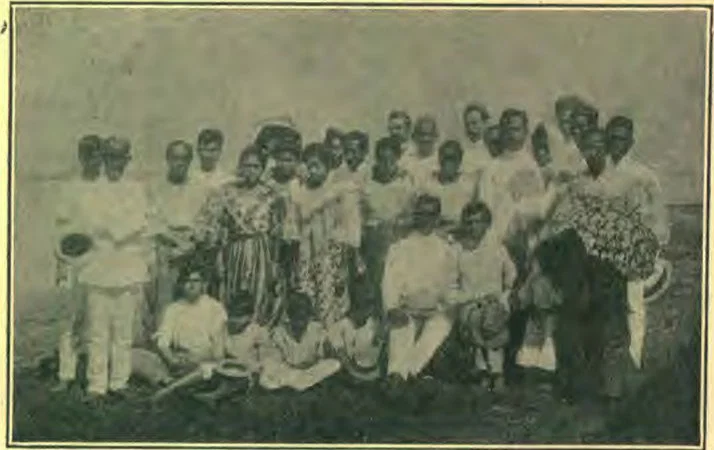
BAPTISMAL GROUP AT MANILA
Altogether there are between thirty and forty dialects spoken. When I was there, Spanish was the official language, but no doubt English is taking the place of Spanish with the younger generation.
The average Filipino is a matter-of-fact person. He must always know the why of everything. He is sensitive, but courageous. He will wait indefinitely to avenge a wrong. The Filipinos are fond of music, every town having its band composed of from half a dozen to a dozen pieces. I believe they play mostly by ear, as I do not recall ever having seen music while they were playing. They are imitative. To illustrate: When the United States soldiers landed in the islands, a song entitled, “A Hot Time in the Old Town Tonight,” was very popular, and our regimental band often played it. Imagine our amusement to see a funeral procession going to the cemetery to the tune of “A Hot Time in the Old Town Tonight.”

Their Needs

Owing to the treatment they have received from the Spanish officials and the insincerity of the officials of the religion administered to them by the Roman Catholic Church, the Filipinos themselves have become insincere. What they need is the real gospel of Jesus Christ and a friendly hand placed upon their shoulder, and to be called “my brother,” instead of being threatened with purgatory or other relics of the Inquisition. The public school system conducted by the United States government has done much to uplift these people.
The majority of the Filipinos have no respect for the Roman Catholic religion. The following excerpts from Dr. A. J. Brown’s book, “The New Era in the Philippines,” illustrate this fact:—
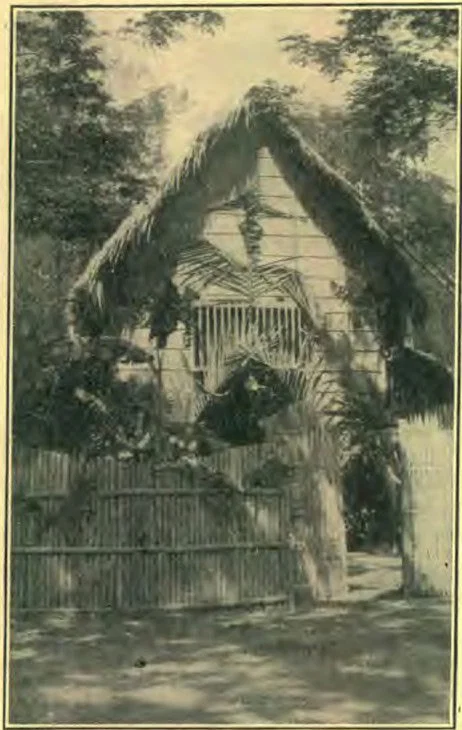
FIRST S. D. A. CHURCH IN THE PHILIPPINES
“Wherever I went, the testimony of those familiar with the facts was that beyond a comparatively small number, ‘chiefly women and old people,’ the attendance on Roman Catholic churches is largely confined to those who come not from ‘profound attachment for their church,’ but from superstitious fear that the priests would otherwise keep them out of Paradise. High Filipino officials seldom attend. A president whom I met, laughed at a priest who furiously threatened him with excommunication because he would not contribute any more funds to the church. In another town that I visited, the priest ordered the president to prevent the Protestant missionaries from preaching in the market place. When the president not only declined to prevent them but actually encouraged them, the angry priest tried to bring him to terms by refusing to allow his dead parent to be buried in the cemetery, whereupon the president compelled the ecclesiastic to officiate under an armed guard. Both these priests were Filipinos, so that no anti-Spanish feeling was involved.”
“The Rev. Frederick Jansen, of Cebú, received a message from a town on the island of Leyte, which had never been visited by a Protestant missionary, urging him to send a Protestant preacher, the messengers saying, ‘Romanism hardly dare lift her head there, and the priests do not venture out after six o’clock in the evening. But the people, who have thrown off Romanism, are reading the Bible and asking for Protestant missionaries.’ The justice of the peace and his friend begged for immediate help, saying, ‘We are not priest-ridden in Leyte. Do come, and you will see great and immediate results here.’”
From the reports received from our workers in the Philippines, we learn that hundreds of the natives are accepting the third angel’s message and are proving most loyal. They will be sincere when they realize that the gospel we are preaching to them is not a sham, but is the revelation of the love of God to the human family, telling of Christ’s soon coming to gather his people to the heavenly home, where sin and suffering will no longer be known.
On Sabbath, March 25, opportunity will be given us to help this needy field in a material way.
Let us plan to sacrifice and give to our utmost, that the work in these islands may be forwarded, and that many other tribes may hear the glad news of the gospel during this year.
EDWARD QUINN, JR.

A New Oil Nut

A NEW oil nut has been accidentally discovered in the Philippine Islands. A shipment of twenty-five bags of what the shipper believed to be lumbang nuts was received recently in Manila from Catanduanes, but it was soon discovered they were something else. A botanist studied the nut and classified it as of the family to which santol belongs. The oil is found to be satisfactory in the manufacture of soap. Natives of the Philippines call the nut by several names—balucanag, cato, dudoa.
The investigator of the nut says that upward of thirty years ago the oil from this nut was generally used for illuminating purposes in the Philippines, but that petroleum gradually displaced it until the present generation forgot all about the uses of this nut oil.
Continue reading: A Fire that Burned Four Months