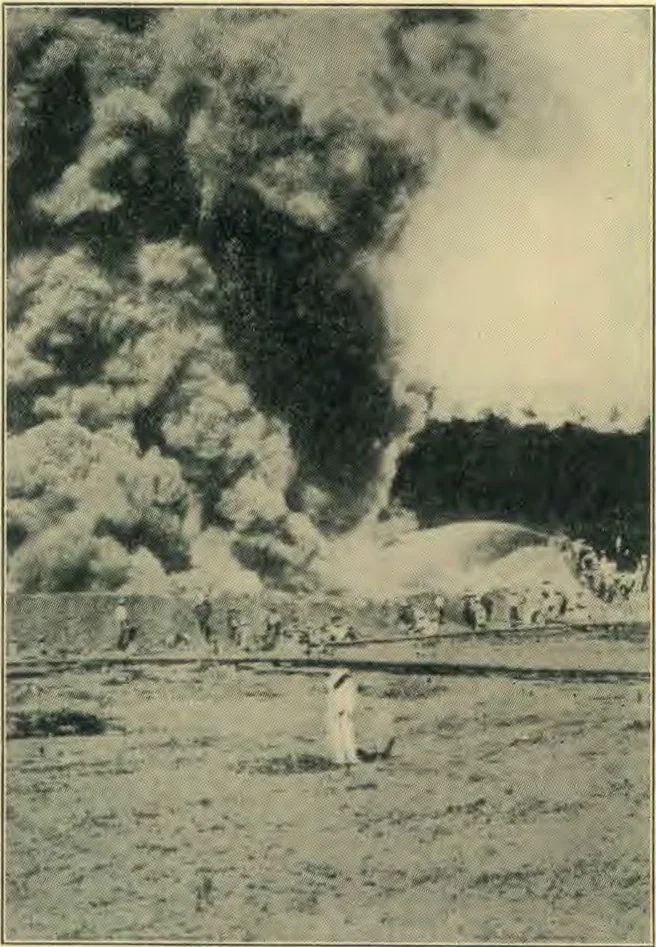
During a violent summer thunderstorm a bolt of lightning struck the oil-soaked ground near the Potrero del Llano No. 4 oil well near Tampico, Mexico, the greatest oil well in the world. For more than four months, the resulting conflagration resisted all efforts to subdue it. The flames, covering an area of more than a city block, swept over the mouth of the great well, but thanks to the concrete cap covering the orifice, the main body of oil did not ignite.
ONE OF THE GREATEST OIL-WELL FIRES EVER SEEN.
Upon the first outbreak of the flames, it was thought that the main well was doomed, as well as a great lake of oil near by, containing nearly two million barrels. Twenty-five hundred men were summoned to the work of fighting the flames, and apparatus which had been successfully used at other fires of the same nature was brought to the spot. This great force of workmen labored ceaselessly day and night until the fire was conquered, four and one-half months later.
The first precaution against the spread of the flames was the erection of a retaining wall of sand and dirt which completely encircled the burning area. The earth itself seemed ablaze, for the oil continued to seep through the soaked ground and furnished new fuel for the flames. The fire mounted hundreds of feet into the air, and at night a red canopy covered the sky, visible for many miles. Thousands of spectators watched the work.
A great battery of steam boilers arrived at the spot, and pipes were led to the fire. The laborers worked under continuous streams of water from fire hose, for the heat was so great that without soaking themselves in water, their clothing would have burst into flames. Those playing the streams upon the workers had to direct the hose while crouching behind shields to protect themselves from the heat.
Weeks lengthened into months, and still the fire burned fiercely. Much to the surprise of experts, the great well, although in the center of the conflagration, did not add its huge flow of oil to the blaze. One of the most remarkable features of the fire was the fact that during the time the fire was burning, the managers were able to draw twenty-five thousand barrels of oil daily from the well through the main flow line from the gate valve, which was well protected by concrete.
After attempting nearly every known method of subduing the flames, the engineers in charge set the laborers at work gradually pushing the retaining walls in toward the center of the blaze. Because of the intense heat this was done under the greatest difficulty. The circumference of the wall was gradually lessened, thus slowly reducing the area of the blaze.
Pipes were led to the bottom of the blazing area, and oil was drawn as fast as possible from the seepage. As it was not fit for commercial use, this was pumped to a safe spot nearly five miles distant from the blaze proper, and then burned, making in itself a huge conflagration.
Finally the sand walls had been pushed in so far that the blaze was confined to a relatively small area, and everything was made ready for a last effort, greater than all previous attempts. Tons of chemicals were piled near the scene, and thousands of feet of extra steam pipes were laid from the boilers and pumps. In the first days of the new year, the attempt was made. Chemicals were heaped into the fire area, and boilers and pumps poured a deluge of water and steam upon the stubborn flames. For hours this frenzied work continued, the result trembling in the balance. At last the ingenuity of man conquered the stubborn forces of nature, and the fire was out.
It seemed almost hopeless to attempt to calculate the damage done by that bolt of lightning. The estimated production of the great well was one hundred and fifty thousand barrels of high-grade oil a day, yet for more than four months but twenty-five thousand barrels a day were drawn. Thousands of dollars were expended upon equipment for the fire fighters, and other thousands went for chemicals which were fed to the flames.
The fire was watched with great interest by the oil trade of the world, who recalled another record-breaking fire which occurred several years ago not far from the Potrero del Llano conflagration. The Dos Bocas gusher, one of the largest in the world at that time, caught fire before being capped. For nearly a year the fire raged, and subsided only when it had consumed all the oil in the fertile pocket which it had tapped. At the present time it produces only salt water and gas.— A. G. Fasbinder, in Popular Science Monthly.
Telephoning From a Moving Train Invented
Mr. A. A. MACFARLANE has invented a device for telephoning from a moving train. He claims that a moving train can be in communication with any telephone in the country.
Above All Nations Is Humanity
ABOVE all nations is humanity — Plato.
Mission Memories from Malaysia
By A. B. E.
JAVA, you know, is the most densely populated island in the world, thirty-five millions of people being packed into forty-nine thousand square miles,” says Sister P. Tunheim, one of the first to take up work in that island. “Think of it! In the low-lying plains and the large cities the people throng like ants in an ant hill. The heart of the missionary is deeply stirred as he watches such scenes day after day.
“I was among the first missionaries who landed in Java, arriving Nov. 19, 1906. There was then only one Sabbath keeper on the island, but now we have sixty or seventy rejoicing in the precious truth.”
“Our first task was to begin studying the languages. This, you will admit, was no small one, as we have five leading languages in Java,—Dutch, Malay, Javanese, Mandoerese, and Soendanese. We have been able to learn only the first three. The others have peculiar written characters, which are difficult to learn to read, and also they each have two distinct dialects. When the natives speak to us, they must speak in the ‘high,’ so as to show honor; and we in return speak to them in the ‘low.’
“After some time we made the acquaintance of a Seventh-day Baptist lady who had a colony for the poor Javanese. She was very anxious that we should take over her colony and run it just as we saw fit. We finally did so, thinking that perhaps some of those who were there might accept the message; but after spending nearly three years at that place, greatly to the impairment of Sister Wood’s health and my own, we did not get any to accept the truth. Thus we put in our first five years in Java without seeing much result, though we learned the languages, and obtained many valuable experiences that have been very useful since then.”
SOME OF OUR TRACT DISTRIBUTORS IN JAVA
“Nearly four years ago we started our work in the large cities. Brother and Sister Wood were located in East Java at Surabaya, and I in West Java at Batavia. Brother R. W. Munson had just started the work in Batavia, and a few had accepted the message, when he had to leave on account of his wife’s health. I have been working alone there since, for three and one-half years, and we now have a church of forty members. Most of these are earnest and faithful in paying tithe and offerings.
“We have learned that the best way to get the truth before the people is by going out among them with tracts and books, and holding meetings and Bible readings. We have tried a colony, as mentioned above, taught quite a large school, helped the poor and the sick, and provided land and work for those who could work. All this is a good work, we realize, a preparatory work, and helps to open the door for the message; but then comes the entering of the door, the test, the keeping of all the commandments, which means more to these people than the plate of rice they have been getting.”
Hearing the Gospel
“Our experiences are varied. One morning I went out visiting with Sister Kwie Nio, our Chinese Bible worker. The first house we went to was the home of a Chinese family. Chairs are luxuries in many of these homes, so we frequently find ourselves seated on a wide wooden or bamboo bench. Soon the lady of the house is seated beside us. Instead of resting her feet on the floor, as we do, she crosses them on the top of the bench in a comfortable position. After that, she pulls her betel box close to her, and from its respective compartments she takes a little tobacco, betel nut, lime, and gambier (tannin). These she rolls in a betel pepper leaf, which she puts into her mouth to make one generous chew. When this is thoroughly mixed in the mouth with a free flow of saliva, which becomes as red as blood, she pulls a large spittoon close to her, so that she can expectorate freely every two or three minutes. By this time she is in good humor to listen to the gospel. While she turns and moves the big chew from one side of her mouth to the other and frequently rubs her black teeth, she asks many questions on the different Bible subjects that we have presented. It sometimes seems strange to be in such an atmosphere; for beside us also is a large altar, where are many images which are worshiped instead of the living God. I cannot express in words the joy it gives us when we go to some of these homes after some weeks or months of study, and find the altar gone, the black mouths of the women clean, and the true altar of worship established.”
Calls for Help
“A short time ago three of our sisters went to the southern part of Sumatra to sell tracts and take subscriptions. They had very good success, and found one of their relatives who had heard the truth in Java and had worked against it, but the Spirit of God had since worked upon his heart and made it tender and teachable. He has fully decided to obey all the commandments, and has written a very pleading letter for me to come and teach him and several others who are anxious to hear more about the message.
“A man who is working in the Resident’s office in Mabon, recently received one of our tracts with our mission address on it. He then wrote to us, ordering a whole case of books, which we sent to him. These have been sold by him and by others to whom he has sent them in different adjacent islands. He has ordered many more tracts and books since, amounting to another case in all.
“There is a man in Timor who has sold more than twenty dollars’ worth of books and tracts, and has paid for them. A man from a near-by island has10written me that he has read some of these tracts and books, and feels convinced that the seventh day is the Sabbath, and wants to keep it. Thus we see the way is opening up faster than we can follow.”
What It Means to Keep the Sabbath
Brother F. A. Detamore, in charge of this great field, often meets cases in which to accept this truth brings severe financial embarrassment. He says:—
“One brother in Singapore gets eight or ten dollars a month. With this he must pay three dollars for rent, buy food for his wife and three children, and give them a scanty covering of clothes. His wife is a Roman Catholic, and scolds because he stops work on the Sabbath, when he could be working and making more money; but he brings his children to the Sabbath school regularly, and pays his tithe month by month. This is but a sample of the situation of many. Should all our people at home make as great sacrifices for the Lord, there would soon be men and means to finish the work.
“It is enough to move a heart of stone to hear some of them tell how they have to sacrifice to keep the Sabbath. One brother said, ‘I can go without food, but when the children cry for food, it is hard.’ God has blessed this brother, and now he is doing well financially; but for months he could scarcely get enough to keep himself and family alive. Do you not think that such persons love the Lord? I fancy their stars will be among the brightest that adorn our Saviour’s crown in glory.”
His Heart Touched
Our mission station in Sumatra is at Padang, the chief city on the west coast. The work was begun there nearly eleven years ago by Elder R. W. Munson and his family, who were there for about six years. A day school conducted in this field has a good attendance. Brother B. Judge, of this station, writes the following incident:—
“I have in mind one young man who was so bad that his parents, having exhausted all other plans for reformation, tried to bring him under the influence of Christianity, thinking there might be something in it that would restrain their son. However, they only wanted him to become a good young man; they did not want him to become a Christian and cast off his parents’ religion. Just as long as his parents tried to bring him under Christian influence, he did not want anything to do with it. But one day, when they were no longer interested regarding the influence of Christianity upon him, God touched his heart, changed it, and today he is a worker for God. At times when he is at work among the people, they remind him of his past life; then springs forth his testimony, ‘I am not ashamed of the gospel of Christ: for it is the power of God unto salvation to every one that believeth.’”
The Singapore Training School
In April, 1912, a church school was opened in Singapore, with an enrolment of twenty, Miss Isabel Fox being the teacher. By the end of the year the attendance of the school numbered twenty-five, and during the next two years it increased to thirty-four, the fluctuation in membership being caused chiefly by parents’ moving away from the city. At the beginning of 1915 it became the training school for this mission, under the direction of Brother K. M. Adams. At the start, the attendance was thirty-six. Seven weeks later it was forty-eight. The tuition is $1.75 a month for twelve months in the year.
On his return from the Shanghai general meeting in the spring of 1915, Brother Detamore found four Malay boys from Battakland in Singapore. They had come to be baptized and to go to school. They had sold their small farms, walked six days to get to a port, and then spent nearly all they had to come by boat to Singapore. “All we want is to know how to teach the Bible to our own people,” they said.
Concerning the work done by this school, Brother Detamore says:—
“We are doing two grades of work beyond the common branches. This is about like our intermediate schools at home, and all the work is in English. Then we have the Chinese and Malay departments, besides a class for natives who are learning to speak and read English. There are about twenty-five in the home, and fifty resident students, and there will be a material increase the coming year. Those in the home are nearly all preparing for the work, and a number of others are doing the same; so we look forward with hope to the help we shall receive from the students now in training.”
Baptism in Battakland
Again and again our hearts have been touched by the appeals that have come to us from this heathen province in the northern part of the island of Sumatra. Recently Brother John S. Yates visited Battakland, and baptized four believers. He says:—
“The work in that part of our field is singularly interesting. The government has not yet given us permission to establish a mission, hence we have no regular mission workers there. However, there are two young men, Brother Siregar (Battak) and Brother Shin (Chinese), who are teaching private schools. Both learned of the truth in Padang, and are now members of the Padang church. These brethren are spreading the message, and are entirely self-supporting. Opposers threaten them, and have succeeded in having Brother Siregar called a number of times before the government officials to answer for his faith. I talked to them about being persecuted, and they both said, ‘We do not fear what man can do to us.’”
“Brother Siregar had a list of twenty candidates for baptism. While perhaps the majority of these were keeping the Sabbath and had given up some of their bad habits, on examination only four seemed ready to unite with us. We promised the others that they also might be baptized when they are fully ready for this ordinance.
“In one year the Battakland tithe has amounted to one hundred and seventy-two guilders, or over seventy dollars. This sounds good when we remember that the average wage is only about that much a year. One month Brother Siregar reported spending a little over six dollars on home missionary work.”
A teacher for our Chinese department has been secured from the Missions Training School at Shanghai. This man, Lo Khi Kwong, does not stop working when the lessons are recited in the classroom, but goes with his students to hold Bible readings with the people. He also holds readings himself with those with whom he has become acquainted. In addition to all this he holds a meeting in Chinese every week at the church. This means that he has a sermon to prepare. The Malay teacher, Samuel Rantoeng, was born at Mendano, in the Celebes. He accepted the truth in Java. His wife has been a Sabbath keeper for several years, and they are both faithful workers.11
Loyal Hearts in Borneo
Borneo is one of the recently entered islands of the Malaysian Mission field; but at the capital of British North Borneo, Sandakan, we already have a church of twenty-two members. Many in different parts of the island are anxious to hear about the second coming of Christ. From Sarawak comes an urgent call for help. Sarawak is one of the political divisions of Borneo, and has a population of about five hundred thousand, most of whom are Dyaks.
A young man in Sandakan, who had been connected for some time with a government hospital dispensary, became convinced that the seventh day is the Sabbath of the Lord. “Shortly afterward he was promoted, and transferred to another place, with double his former salary. However, he was not satisfied to go on disregarding the Sabbath, and decided to resign, and return to Sandakan to learn what it meant to be a follower of Christ. The manager of the establishment told him that he was very foolish to give up such a position to join the Adventists. Another raise in salary was offered him, but he replied, ‘I will not work in Babylon, even if I should get a hundred dollars.’”
Only a glimpse of the work in the Malaysian Mission can be given in one article; but we hope that as your eyes are lifted up to look toward this distant field, your hearts and your interests will be united with those of the workers and believers who, like the disciples of old, are leaving all to follow the Master.
A. B. E.
Temperance Branch of the Helping Hand League
By Editor
READERS of the INSTRUCTOR will recall the request in the article, “League of the Helping Hand,” in the Jan. 11, 1916, issue. We look forward with pleasure to reading the general experiences of our young people in helping others, but can we not enlarge this circle, and form a band of temperance workers who will engage in a definite work of fighting the forces of the liquor traffic, and give a helping hand to others who may be living amid surroundings which will draw them into this pit of destruction?
We believe the great majority of INSTRUCTOR readers are shielded from this great enemy, living in homes where Mr. Liquor is not invited or permitted to enter, with the consequent result that no one is hungry, or cold, or heartbroken because of his presence. What a difference in the surroundings of the home (shall we call it home?) where his presence is! It is not necessary to dwell on this feature; we are all too well acquainted with it. If not, let us read carefully the first article in our excellent TEMPERANCE INSTRUCTOR ANNUAL for 1916, also Elder G. B. Thompson’s article on page 6, in which some insight into this phase of the question is given.
Such incidents as are here given could be multiplied by the thousands of cases even in this land. Surely such a condition calls for the strength and energy of every Christian young person, and a definite organized work along temperance lines. Every member in every Sabbath school, in every Young People’s Society, in every church and every home, ought to connect with this department of the Helping Hand League, and work for the elimination of this evil which wrecks so many homes and destroys so many boys and girls.
The great question arises, “What shall we do, and how shall we begin?” If you are anxious to help and willing to join such a band, send us your name, address, and age, stating your desire to connect with the Temperance Branch of the Helping Hand League, and we will enlist you as a member, and send you suggestions and material for your work. No membership fee will be required; all that is necessary is a willing heart and consecrated hands and feet, to “help others.” Let us organize definitely for active service in the fight against the liquor traffic during 1916.
We recognize that “this evil is to be met more boldly in the future than it has been in the past,” and that if we do this “hundreds will be won to Christ.” Surely, then, in our soul-winning efforts our temperance work must be planned for very definitely.
Send your letters to YOUTH’S INSTRUCTOR, Temperance Branch of the Helping Hand League, Takoma Park, Washington, D. C.
Junior Story
By Ernest Lloyd
IN every church there are things happening in some of the various lines of endeavor that would help others if passed on. A most inspiring little incident that illustrates this has just come in from one of our ministers. Two little girls, aged eleven and thirteen, when recently baptized, laid away their rings. A little later the minister told them of our missionary work and how the literature is bringing people into the truth. They became much interested, and wanted to do something; so they sold their rings and sent for 25 copies of the Signs Magazine. These they sold in a half day, and then ordered 50 for the next month. This wasn't enough, so for the third month they ordered 50 Signs and 50 TEMPERANCE INSTRUCTORS. Surely the example of these little missionaries newly in the truth should inspire any one who hears of it.
ERNEST LLOYD.
Why Preach the Gospel
God Wills It
God’s
Only
Son
Preached and ministered on
Earth, and
Lives to minister in heaven.
Christ Wills It
Go and make disciples
Of all nations, baptizing them into the faith of the
Father, the
Son, and the Holy Spirit.
Proclaim the good news to
Every creature, He that believeth shall have
Life, and have it in greater fulness.
— Selected.
Missionary Volunteer Society Programs for Week Ending February 26
THE programs for the Missionary Volunteer Societies, Senior and Junior, for this date, with notes, illustrations, and other helpful material, will be found in the Church Officers' Gazette for February.
Philip’s Prayer
By Mrs. S. Roxanna Wince
A True Incident
MRS. S. ROXANNA WINCE
TALL for his age (he was only five),
Reticent, thoughtful, sweet, and fair,
Healthy, playful, and much alive,
He sobered at bedtime to say his prayer.
Kneeling down at his mother’s feet,
His flaxen head on her knee a-lean,—
“God help Philip to be a good boy,
And please, dear God, bless the threshing machine.”
He finished, and opened his eyes again—
But why the smile on mother’s face,
When most of the days were drear with rain,
And shocks of grain stood still in their place?
His father had said, “The wheat would spoil,
And the beautiful oats, and the long-strawed rye,
And nothing be left for weeks of toil,
While the starving people would faint and die,
“If the threshing machine should break or fail.”
He had heard it all, and had understood
Our need to go, in the rain or hail,
Straight to the Giver of every good.
And the mother listened, and ceased to smile.
For the prayer was that of an older head;
There was need to pray as her child the while
In his innocent faith and trust was led.
Phebe as Student and Teacher
By Cora Ferris
CORA FERRIS
BETH and Linna, with schoolbooks on knee, were having a cozy chat.
“I have learned such a helpful lesson lately,” confided Beth; “one outside the classroom altogether. You know how difficult Phebe Ransome finds it to remember accurately? I believe the poor girl tries hard enough; but she is almost sure to make some slip whenever she is called upon to answer a question in class. At examination time her nervousness makes her worse, and I have seen her almost in tears because she had misstated something she felt certain she knew quite well.”
“Yes,” assented Linna; “so have I. Only the other day she lost ten marks because she wrote the answer to a question just the opposite of what it should have been. I’m sure in that instance it was sheer nervousness and nothing else, for the question was a very easy one; it almost answered itself.”
“Yes. When Phebe first came to school, not many of the girls liked her. She hadn’t an agreeable manner, she seemed a little inclined to be selfish, and she was not always up to time. As you know, students see these things as quickly as the teachers do, and adjust their relations accordingly.”
“But I have noticed a great change in Phebe of late, and the expression of her face is growing sweeter. I’ve petted her a good deal, because the other girls appeared to avoid her, and I thought she must feel lonely at times, especially since she lives too far away from home to go there in vacation.”
“And what do you think she said to me not long ago? We were talking about one of our examinations in rhetoric, and Phebe told me all about the mistake she had made in it. In most of her papers, she says, she makes just one blunder: sometimes a big one, sometimes a little one; but it’s always sufficient to keep her from attaining to her standard — one hundred per cent.
“‘It is such an absurdly small error at times,’ she told me; ‘but if there are only five questions, it means a big reduction. I don’t feel so cross when I have two mistakes, which happens but rarely; but when I have only one, I think sadly of Browning’s words,— “O the little less, and how much it is! And the little more, and how far away!”’”
“Phebe went on: ‘Do you know, Beth, I was sitting thinking about the matter on the evening after we got our papers back, and feeling mournful over my habit of inaccuracy, when somehow that feeling suddenly vanished, and another one took its place. It occurred to me that there is not only one kind of examination,—that of the classroom,—but that we are taking other examinations all the time. We take daily examinations in manners, in punctuality, in consideration for the rights and feelings of others; and I was impressed forcibly that every one of these things is just as important as geography or grammar or history or mathematics.’”
“Pardon my interrupting you, Beth,” said Linna, “but I’d like to mention something just here that I heard the other day. I happened to be in the room when some one was telling our physiology teacher about how difficult he found one of his studies. The teacher’s reply I thought most helpful. He said we should not allow ourselves to think too much of the immediate results of our study — those of marks, etc. — as long as we did our best; but we should bear in mind the fact that what we do when we get away from school is the true test of our ability. We may secure a high percentage for our class work and in our examinations while at school, yet that of itself will not gain us people’s respect if we make a failure of matters afterward. But if we make our after-lives worth while, there is no one who will cavil at us over the loss of a few marks that we couldn’t help, during school days.13
“But please go on with Phebe’s story.”
“Well,” continued Beth, “Phebe’s face fairly shone as she said that; and as there was quietness for a little while, I had time and opportunity to recollect that she had already begun to put this idea into practice. I thought of how much neater in dress she seemed to be now than formerly, and of how she had improved in her carriage as well. Then her hair was done so tastefully: not loose and floppy round her face, as she had been wearing it, nor tightly drawn back, like some of those who go to the other extreme; but it was arranged simply and becomingly. And what a difference the way we do our hair makes in our whole appearance!
“But Phebe’s dress and hair are not the only changes. Her roommate came in for a minute while I was there, and though a little inclined to be boisterous at times (a failing I believe she is trying to overcome), she shut the door after her softly when she came in and when she went out, just stopping to say over her shoulder when departing, ‘Phebe taught me that — by her example.’”
“The dinner bell rang then, and as we arose to answer it, I noticed two more things about Phebe. Her finger nails were clean, and her boots were as shiny as good blacking and polishing could make them. Evidently she had remembered that old saying about cleanliness being next to godliness.”
Linna laughed musically.
“Talking about bootblacking, Beth, for a year I sat across the aisle from a gentleman student in one of our colleges, and in all that time, so far as I was able to learn by careful observation, he never polished his boots, although he blacked them regularly each morning.”
Beth laughed, too.
“Well, Phebe and I went down the stairs together, and when we came to the dining room door, she didn’t push in ahead of the other girls, but just waited her turn quietly, and then walked in, saying, ‘Pardon me,’ to a girl who nearly collided with her in her haste to get inside.”
“Well, I’ve been watching Phebe — though she doesn’t know it — quite closely since our little talk, and I’ve seen a number of things that make me resolve to follow her example. She doesn’t indulge in light, trifling conversation when in company, for one thing; for another, she has quite tabooed anything approaching slang. Her speech is daily growing in pleasantness, and I can see she is trying to cultivate the art of smiling sweetly and readily. It is an art, Linna, don’t you think?”
“Then Phebe is now always in her place in the classroom among the earliest, and instead of sitting drumming her fingers on the desk or whispering, she opens her book at the lesson for the day and studies till class begins. Altogether, I think Phebe is attaining high marks — indeed, if I had the marking I’d give her the coveted hundred per cent — in those subjects that lie outside the range of our school fees.”
And as Linna meditated during her silent period that evening, she determined to join Beth in the classes of which Phebe Ransome was the leader.
Why Marshall was “All Right”
By Bertha G. Woods
“How do you like your new boy? I’m interested in him because he came from up my way.”
Mr. Holcomb leaned comfortably back in his revolving office chair and gave his friend a genial smile.
“Marshall’s all right,” he said comprehensively, “just the sort of clerk I’ve been looking for.”
“Other young fellow didn’t fill the bill, did he?”
“Darrow? No, he did not suit me, at least. To tell the truth, his tales of former grandeur were a little disconcerting.”
“Former grandeur?” laughed his friend.
“Yes, you might call it that. You know his family used to have a very snug income. His father was in the lumber business, but he met with reverses, and I took his boy, partly to help him out. They’re old friends of my wife’s family, you know.”
“Yes, I remember. But how about the ‘tales of former grandeur’?”
“Well, young Darrow never was able to forget or to cease lamenting the lowered family fortunes, nor would he permit me to forget them, either. I used to find it rather oppressive — his allusions to their better days. Oh, yes, he’d drop a hint merely, every now and then, but I discovered very soon that he was more apt to do it when his work for me brought him into contact with some special piece of drudgery or something that I suppose he would consider as bordering on the menial. He didn’t want me to forget that coming to me was a step down from what he had been used to.”
Mr. Gordon laughed appreciatively. “I see,” he assented.
“It’s been a treat to find a boy like Marshall, ready to do any job that comes to hand, whether it’s in the usual day’s work or not. And — ah!” He broke off abruptly, for the door was opening. A boy of eighteen, with clear, frank eyes and a mouth so pleasant in expression that it gave almost an effect of smiling even in repose, came in. He bowed courteously in reply to Mr. Gordon’s word and smile of recognition, and then turned to his employer to report on the errand that had called him out of the office.
“He says he’ll have the papers ready by half past five. We can’t have them this afternoon, for Mr. Selvig won’t get around to sign them before that.”
“Half past five, eh? He’ll send them over then?”
“No, sir, he hasn’t anybody to send. I told him I’d be back after them.”
“But you were to get off at five tonight, you remember — I told you that, to make up for last night.”
“Oh, that’s all right. I’m in no rush!” Marshall’s pleasant smile showed a set of large, dazzling white teeth. He passed on to the next room, where he could be heard making his typewriter click at a rapid pace.
Mr. Holcomb stepped to the door a few minutes later. “When you’ve finished that letter you can slip along home to your lunch. Get in a little extra time that way.”
“Thank you, but I don’t need it. Might as well clear these up. Work’s light today anyway.”
Mr. Holcomb stepped back to his office and resumed his chat with his old friend. A few minutes later he nodded toward the window.
“See that?” he inquired.
“What is it?” Mr. Gordon’s glance followed his.
“It’s Marshall — sweeping off the steps and the sidewalk! The janitor’s boy is sick today and didn’t get around to do it. It’s something I’d not think of asking him to do, but that’s his way. You’d never catch Darrow turning his hand to a thing like that; he’d consider it menial — wouldn’t accord with his former grandeur.”
Mr. Gordon laughed. “Funny the different ways14that two boys will take the same change of fortune. You’re lucky to have a fellow like Marshall.”
“But his family, you know, haven’t any lost fortune to look back to — that I ever heard of,” Mr. Holcomb said to correct his friend. “Marshall’s mother is a poor widow; they live down in that little cheap block of brick houses on Eleventh Street.”
“Yes, but his father? Didn’t you know anything about their history?” Mr. Gordon’s voice had showed surprise. “Why, he was one of the victims in that bank wreck at Springfield, four years ago, I think it was. Lost half his property, and the other half went down when the panic came. He had a big wholesale stationery store up there. Fine man he was; I knew him pretty well. I remember when they lived in their brown-stone front on Highland Terrace.”
“Queer I didn’t know anything about it,” Mr. Holcomb said musingly. “He came to me well recommended, of course, and I knew he needed the place, for they were poor. But nothing was ever said about their ‘better days.’ Darrow wouldn’t have lost two minutes in telling me all about it, and making me feel he was condescending a good deal in coming into my office. But Marshall — well, you can see for yourself that Marshall is of a different stamp.”
“Marshall’s all right,” said Mr. Gordon with emphasis.—Bertha G. Woods, in Young People’s Weekly.
States that Will Vote on the Prohibition Question in 1916