The difference between the Founder of Christianity and the papal system which professes to represent him has been again strikingly illustrated. A despatch from Rome says:—
The Vatican has been compelled to change the cipher, or code, in which the Pope's secret instructions are telegraphed to nuncios and delegates abroad. It consisted of a series of numbers disposed according to a prearranged system, assuring perfect secrecy. Repeated efforts to solve it proved unsuccessful, and it was considered the best in the world. Even when the French government seized the archives of the papal nunciature in Paris, the secret was not divulged. Monsignor Montagnini succeeded in hiding the key. Marquis Crispolti, however, has published a book dealing with the Vatican's negotiations with Berlin in 1878, and reproducing the original cipher telegrams and their translation. The Pope, deeply grieved that the secret documents have been published, and realizing the futility of legal proceedings, has decided to change the system, for the first time in two hundred years.
The Vatican, like the nations of the world who play at the game of international politics, found secrecy necessary to the accomplishment of its purposes. Said the Founder of Christianity, “In secret have I said nothing.” He who was and is the Truth, the Light, the Way, had no use for darkness or secrecy. That is repugnant to the whole spirit of the Master and the gospel. It is the adoption of the unscriptural dogma of the union of church and state that has made Rome think it necessary to employ darkness or secrecy in carrying on her work. This union also has been condemned by the Master, in the words: “Render therefore unto Cæsar the things that are Cæsar’s; and unto God the things that are God’s.” Matt. 22: 21. How much better to follow the Master’s example and heed his admonitions!
Helping Those in Distress
To give relief to the millions of inhabitants of China, who are now exposed to starvation through the destruction of crops and the prevention of agriculture caused by the overflow of rivers, the local board of the American Red Cross Society has made an appeal to the public for contributions. President Taft recently issued a proclamation, stating the dire distress in the Orient, and appealing to the people of the entire nation for assistance.
He Hath Said
By Eliza H. Morton
ELIZA H. MORTON
He hath said, “I’ll never leave thee,
I will never thee forsake.”
I believe that precious promise,
To my heart its joy I take.
He hath said, and he will never
Once forget his blessed word;
’Tis the sweetest, dearest message
That my ear has ever heard.
What he’s said, he’s said forever,
I can trust his promise true;
He is faithful, loving, tender,
And he knows me through and through;
Yea, he knows my faults and failings,
But his love is just the same:
He hath said, “I’ll never leave thee.”
Blessed be his holy name!
His is true and faithful friendship;
What he says I will believe,
Though my soul is fainting, struggling;
He will never, never leave,
Never leave me in the darkness.
Earthly friends may all depart;
He’s a spring of living water
To my weary, fainting heart.
Portland, Maine.
New Organizations in Southeastern Europe
By L. R. CONRADI
L. R. CONRADI
TEN years ago Hungary and the Balkan States were hardly touched. That vast area, equaling Texas in size, and having a population of 38,000,000, with only a little over two hundred Seventh-day Adventists, was divided into two mission fields. At the end of 1907, there were still but the two organizations, with a little more than 500 members, who paid a tithe of $2,000 annually. But from January, 1908, Hungary appears as a conference, and in July of the same year the Croatian Mission was cut off from it. The name Croatian was changed at the commencement of 1909 to Adriatic. With the dawn of 1911, Transylvania—the southeastern part of Hungary, mostly peopled by Saxons—appears as a conference, having 400 members; while the rest of Hungary, with about 350 members, was now a mission field.
During November, 1911, it was our privilege to conduct three general meetings in that field; and as in the meantime the number of members there had increased to 1,300, several important changes took place, preparatory to the organization of a union. Our first meeting was held near Constanza, on the Black Sea, November 8-11. As the Rumanian priesthood is still very hostile to our work, and does everything in its power to prevent the advancement of our cause, we chose this country place for our meeting, which seemed providentially prepared for us. One of our German brethren is an old citizen of Rumania, and has been elected for some years as the chief magistrate of the district, although his faith is known. The brethren there have built a little hall, as an addition to one of their dwelling-houses. It has a seating capacity for more than one hundred persons, and was well filled with delegates from different parts of Rumania and Bulgaria. The Lord has greatly blessed the work in this field, so that we have now about 300 members, a dozen of whom live in Bulgaria. In the first three quarters of 1911, 62 new members were received, and the tithe amounted to $2,000. On the Friday we were there, the collection for missions amounted to $340 in cash and pledges. On the Sabbath we had a good experience. Brother A. Doerner was ordained to the ministry, and two new believers were baptized. One of them was in government employ, and had attended our meetings for some time, but had not taken his stand for the truth until this meeting. We all felt the time had come when Rumania and Bulgaria should be separate mission fields. The following Sunday, we spent in the city of Bukarest, and spoke in the evening to a full house. The brethren have secured three halls there, Rumanian services being held in two of them, and German in the third. If the work continues to develop as it is doing at present, Rumania will soon form a good little conference.
From Bukarest we proceeded to Koloszvar, the leading city of Transylvania, where the conference was held in a large hall, November 15-19. This city is really the birthplace of present truth in Hungary. Having read in a German paper that there were many Sabbatarians in Transylvania during the time of the Reformation, and that a few were still there, in 1890 I went to Koloszvar to investigate the matter. A Unitarian professor there, who spoke English well, introduced me to the family of Brother Rottmeyer, the oldest Baptist in Hungary, who was then in charge of the depot of the British Bible Society. During my visit there, the seed of truth was sown, and he and his family soon began to keep the Sabbath. From that little grain of mustard-seed, the truth has spread throughout Transylvania, until there are now 550 believers in that section of Hungary alone. For the conference meetings, we rented a large hall in the city, which was crowded with attentive hearers night after night. Fifty-eight delegates from twenty-six churches and companies were present at the opening services of the conference session, and altogether about 300 of our people were in attendance. Thirty-six persons were baptized during the meetings. The tithe of this conference has increased to about $2,800 annually. The collection taken for missions yielded about $200. Brother H. Meyer was again unanimously chosen president of the conference. Brother Boex, our general canvassing agent, was present to organize the canvassing work.
Our next meeting was held in Budapest, the capital of Hungary, November 22-26. Probably no other nation has concentrated so much of its efforts on the development of its capital as has Hungary. With its suburbs, the city has now nearly 1,000,000 inhabitants, while there is hardly another town in the country with a population of more than 100,000. This conference was in many ways of great importance to our future work in Hungary and the Balkans. The hall chosen was itself a place of interest, being the old Hungarian parliament building, where Kossuth delivered his important speech against the government, and declared a republic, in 1848. The building is round in form, and seats about 600 persons. Over the rostrum still hangs the old coat of arms of Hungary. About 130 of our people from the mission fields were present, and there were 44 delegates. In view of the fact that we now have a membership of about 375 in central Hungary, a new conference was formed, called the Central Hungarian Conference. It is equal in size to Massachusetts and Vermont, and has a population of 4,000,000. Several new missions were also organized. They are as follows: The West Hungarian Mission field, with a population of 4,000,000; and the North Hungarian Mission field, with a population of 3,500,000. The Adriatic Mission field was divided. It now contains Croatia, Bosnia, and Montenegro, with about 3,800,000 inhabitants; while the Theiss-Save Mission field includes four districts of southern Hungary, where the Servian language is spoken, Slavonia, and Servia. We have thus, from the beginning of 1912, two organized conferences and six mission fields there. A collection for missions during the meeting brought in $250. Brother Huenergardt was elected president for the new conference. For the mission fields, Elders Kessel, Cunitz, Schillinger, and Schaefer have thus far been elected, while the union president still looks after Rumania and Bulgaria. Thirteen persons were buried with their Lord in baptism. The attendance of those not of our faith was most excellent.
At these meetings, besides Elder H. F. Schuberth, the union president, Elders Wolfgarten and Huenergardt assisted, and Elder G. W. Schubert was present at Budapest. The prospects are indeed bright for this new field, and we believe that by the end of 1912, when the union13will be fully organized, it will have at least 1,500 members.
Another important step was the starting of a branch of the Hamburg house in the city of Budapest. Our Hungarian paper has a monthly circulation of 10,000 copies. The canvassers are increasing, as they have less difficulty in obtaining the necessary permission when we have a depository in the country itself. There are at least six leading languages spoken in this territory: the Hungarian, German, Rumanian, Bulgarian, Servian, and Croatian. Thus the light of present truth is spreading into every corner of Europe, and strong, organized fields are being developed, with a number of efficient laborers who can present the truth effectually in all these different tongues. Many of the 1,300 members were formerly Catholics, and we are happy that the truth is powerful enough to gather out a people for the Lord from every nation, tongue, and creed. May we all remember this important field in our prayers.
New Mission Station in Korea
By C. L. BUTTERFIELD
C. L. BUTTERFIELD
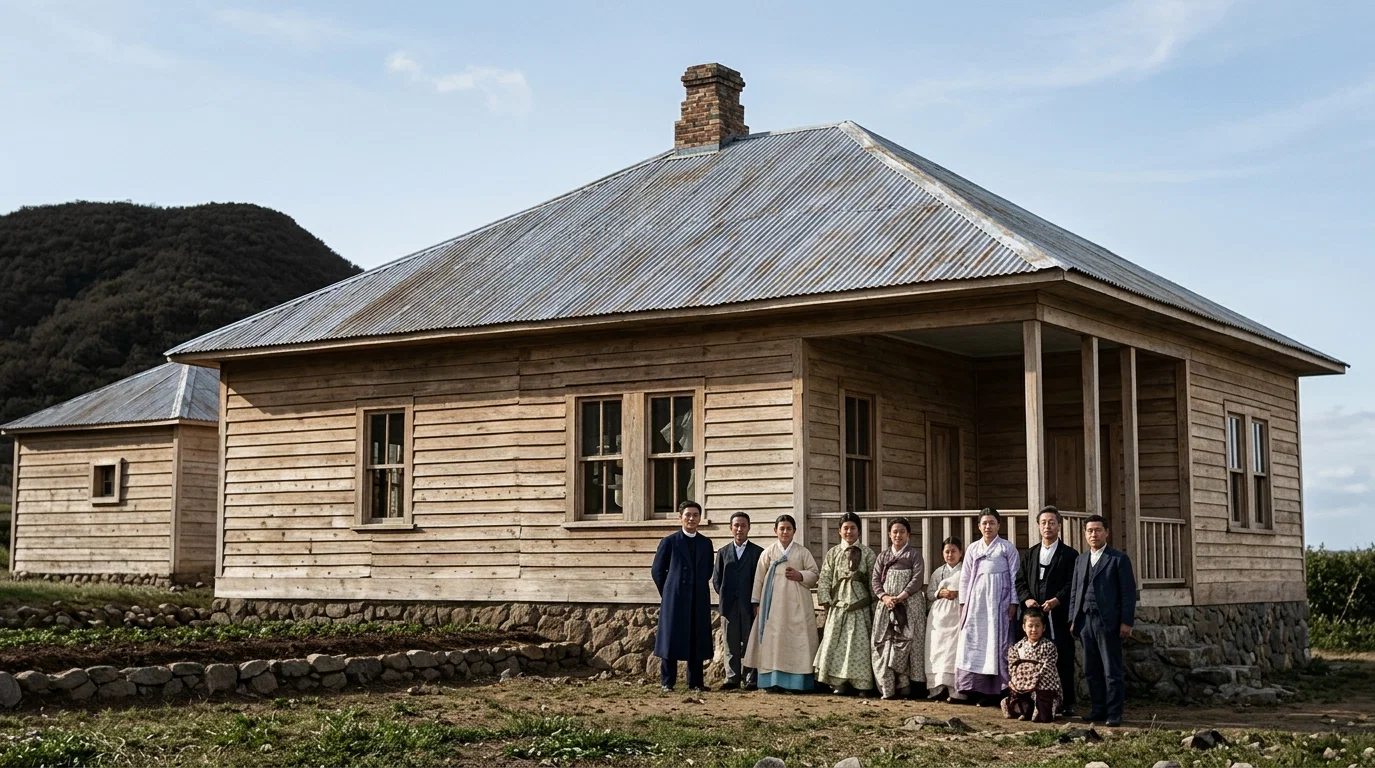
AFTER spending much time in looking for a suitable location for a mission station in southern Korea, Keizan was selected, and an acre of land was purchased Aug. 29, 1911, the anniversary of the annexation of Korea by Japan.
Brother and Sister R. C. Wangerin moved to Keizan at once, pitched their tent, which without the center is twenty-eight feet square, and began a series of meetings. They had to live in half of the tent, while using the other half for the services. Meetings were held every night for over a month, and about twenty persons took their stand for the truth.
October 23 work was begun on the house. The writer took oversight of the building, employing Korean and Chinese carpenters and masons. A good, substantial one-story house, twenty-six by thirty-four feet, containing four large rooms, closet, pantry, and two porches, has now been completed, and stands as a memorial to the truth, in front of the great Kyong San Mountain, at the head of a large valley, where it can be seen from thousands of homes.
Before the house was completed, the weather became very cold, and living in the tent was anything but pleasant. Brother Wangerin moved into the house on November 19. The tent was taken down November 26, leaving us with no place to hold meetings. A suitable building could not be obtained, as there was none large enough, so we decided to build a large Korean house on one corner of the mission property. In this our native workers can live, and, by opening the doors, we have an L-shaped room, nine by forty-five feet, in which meetings can be held.
Our workers at this station are now comfortably located in a densely populated territory. Brother and Sister Wangerin, with their little child, are the only Americans in the place; and as they and their native helpers endeavor to hold up the banner of the third angel's message, we bespeak for them the prayers of God's people, that they may win many souls to Christ in this, their new field of labor.
Seoul.
The Papacy in Jamaica
By Linton Rashford
LINTON RASHFORD
Never in the history of this island has the Papacy shown itself as it is doing at the present time. Since the earthquake of 1907, the headquarters have been removed to Winchester Park, the eastern end of North Street, Kingston. Here a very imposing structure has been built of reenforced concrete. It is artistic in design, and shows no lack of money in its construction.
In the center of the building is a large copper-covered dome, and around the base on the inside is written in large bold letters, “This is the church, the pillar and ground of the truth.” This boastful claim was manifested in a fair held on the same grounds during the Christmas season. To say that this fair was the most popular place of amusement is to say the least that can be said concerning it, as more than eighteen hundred persons were present each night. The many questionable methods used for raising money were astonishing. To those who know the work of the little horn spoken of in Dan. 7:25, the boast, “This is the church, the pillar and ground of the truth,” is not surprising; for what is more contradictory to the Book of truth than such a claim? Surely it is not in America alone that the wonderful influence of this insidious mystery is gaining ground.
Some of the most wealthy people here are Roman Catholics. These not only make large gifts to their church, but have much influence over others, as those who are not Catholics are to a large extent in sympathy with that church. Truly the days of her widowhood are almost spent, and in heart she says, “I sit a queen, and am no widow, and shall see no sorrow.”
Their schools have a large attendance, owing to the fact that they supply food and clothing to those who could not otherwise attend. This mistaken idea of charity is working marvelously, especially among the poor, who boast of the love of the nuns and priests who hunt the homes of the people, gathering out the children for the school. A good thing indeed! But he knows little who does not know the crafty aims of the mystery of iniquity. Get hold of the children, and the parents will follow. Well did the prophet say, “It cast down the truth to the ground; and it practised, and prospered. . . . And through his policy also he shall cause craft to prosper in his hand.”
NEW MISSION HOME AT KEIZAN, SOUTHERN KOREA. BUILT WITH MONEY FROM THE $300,000 FUND. IT COST $715, ASIDE FROM LABOR DONATED BY THE MISSIONARIES
John spoke of the deadly wound, but he also spoke of the healing. “And all the world wondered after the beast.” What do these things mean? The way is being prepared for the last great struggle between the mystery of iniquity and the mystery of godliness. Who then is wise and will observe these things?
Old Harbor.
British East Africa
By A. A. CARSCALLEN
A. A. CARSCALLEN
It has now been some time since we sent a report to the REVIEW, and as we always like to hear of the advance of the work in the different parts of the world, we suppose it is our duty to report the progress of our work here in the heart of Africa.
It is five years since we arrived in Kavirondo, on the shores of the great Victoria Nyanza. During the past four years we have met some opposition from the local government official, and have been kept from extending our operations as we had hoped. This fact has not stopped our work, however, and we are glad to report progress.
Last year we visited the country for many miles around the mission, and became quite well acquainted with the people in most of our district. One portion especially seemed to be worthy of all the attention we could possibly give it. It is about sixty miles west of Gendia, and lies just south of the mouth of the Kavirondo14Bay.
The inhabitants of this place are really Uganda people, their forefathers having come from Uganda. They speak both the Kavirondo and the Uganda language. They have heard how the Uganda people have accepted the gospel, and they seem anxious to hear for themselves. We held several meetings with them, and as a result, we now have six of these people at the Gendia Mission, and the rest are calling for us to come and teach them. We find them good workers, and very bright at their studies. Perhaps they learn because of their anxiety to learn, and because they work harder at their studies than do some of the others, but they seem to us to be really a brighter people than the common natives in this region.
A few days ago the chief came to see me, and brought his wife along. He said he had just been to the government station to ask to be relieved of the duties of chief, so that he could come to school. I have since learned that he has been released, and I now hope to have him with us as a student. He is not an old man, but has influence with his people; and if he accepts the truth, he will be a great help to us. He has two brothers with us, and they are anxious for him to come.
This same chief has another brother at another mission north of the gulf. He came to see the two brothers at Gendia, and was surprised at what he saw and heard. He said we taught the Word of God as the others did not, and that he was going to leave the other mission and come to us. One of the brothers now at our place was at the other mission before coming to us. I hope to visit these people and have a talk with the chief in a few days, and I am almost sure of getting several boys to come to Gendia Mission with me to learn “about God.”
We are in need of school-books, and have been working on them for some time. During the year, we have prepared a primer, which is now nearly ready, and which we are anxious to get out as soon as possible. The sickness of some of our workers has delayed this work greatly. I have been alone at Gendia since May, and have so much to do in looking after the daily work that I find it almost impossible to do anything on the books. The primer is greatly needed, and we are trying to get it ready to send to Hamburg in a few weeks.
We also have a hymn-book, which we hope will not be very far behind the primer. We now have more than sixty hymns translated. We hope to add some that have been translated by the other missions, and shall try to have about seventy-five printed in a little book. We shall then need to turn our attention to getting out a reader for the more advanced boys. We have some of the material ready for such a reader, and just as soon as the primer and the hymn-book are sent to the press, we hope to begin to arrange the matter that we have, and to write more, hoping to get it ready for publication by spring. We have had the Gospel of Matthew translated for some time, and I am now rewriting it on the typewriter, and making corrections. When I go home on furlough next year, I hope to take it along and have it printed. I also have a grammar written, and am now making some additions to it, and getting it ready for the printer.
Altogether, we feel thankful for the progress we have been able to make with the language work in only five years. When we consider that the Swahili language has been studied by missionaries for over thirty years, and it is not yet considered that Swahili students have settled all the points of grammar, etc., we are encouraged by the progress we have made.
Progress in such work, however, is only a means to an end; and we are here, not to reduce the language to writing, but to teach the people the gospel, and to lead them to turn from their evil ways to serve the living God. Therefore we thank God for our progress in the language, because we know that the more perfectly we speak the language, the better able we are to teach the people. Our real progress, therefore, is counted by the number of persons we bring to the light.
(To be continued)
Colporteur Work in Southern Bolivia
By OTTO H. SCHULZ
OTTO H. SCHULZ
The city of Potosi has no Protestant missionaries, and great spiritual darkness is hovering over the people. I was the first Adventist to proclaim the last message there. Now not only the farthest northern city (Hammerfest) but the highest city of the world has been warned through our publications. There is hunger after the true word of God, and thirst after the living water. People search for the way of salvation, but find it not, as the priests have hedged up the path to eternal life.
Some intelligent and gifted men, also a prepossessing lawyer, the father of the burgomaster, are looking for something better than the Roman Church teaches them. The latter was glad when he heard I was a Protestant. He, himself a Catholic, said: “You have a sound teaching, and I like you for it; I do not care for Catholic doctrine.” This sounded good to me. He bought a copy of “Home and Health” and of “Christ Our Saviour,” and two copies of “Coming King,” as well as other literature. He first bought one copy of “Coming King,” and after hastily examining it, said: “This is just what I want. Bring me another one for my friend. Have you any other books here?” I answered, “No.” “Well,” he said, “give me a list of all your books, and when you come back bring me one of each of them.” He is a man of much influence.
I now like that city very well; I met many obstacles there, but Satan’s plans came to naught. As soon as I have opportunity, I shall go there again and endeavor to bring the people closer to Christ, and farther away from the worship of Mary.
One month after reaching Potosi, I took the coach for Sucre. This city is about five thousand feet lower than Potosi. Sucre, the former capital, is the prettiest city in Bolivia. It is built in modern style, with straight, wide streets, tall buildings, and has many shade-trees, which give it a very pleasing appearance. The aristocracy of Bolivia have their residences there. But since La Paz has been made the seat of government, this city has become a quiet place, there being no commerce, and no work for the poorer class. Going there in the hot season, the change of climate incapacitated me for work for several days. The richer class had left for the country, and all institutions and public buildings had closed their doors.
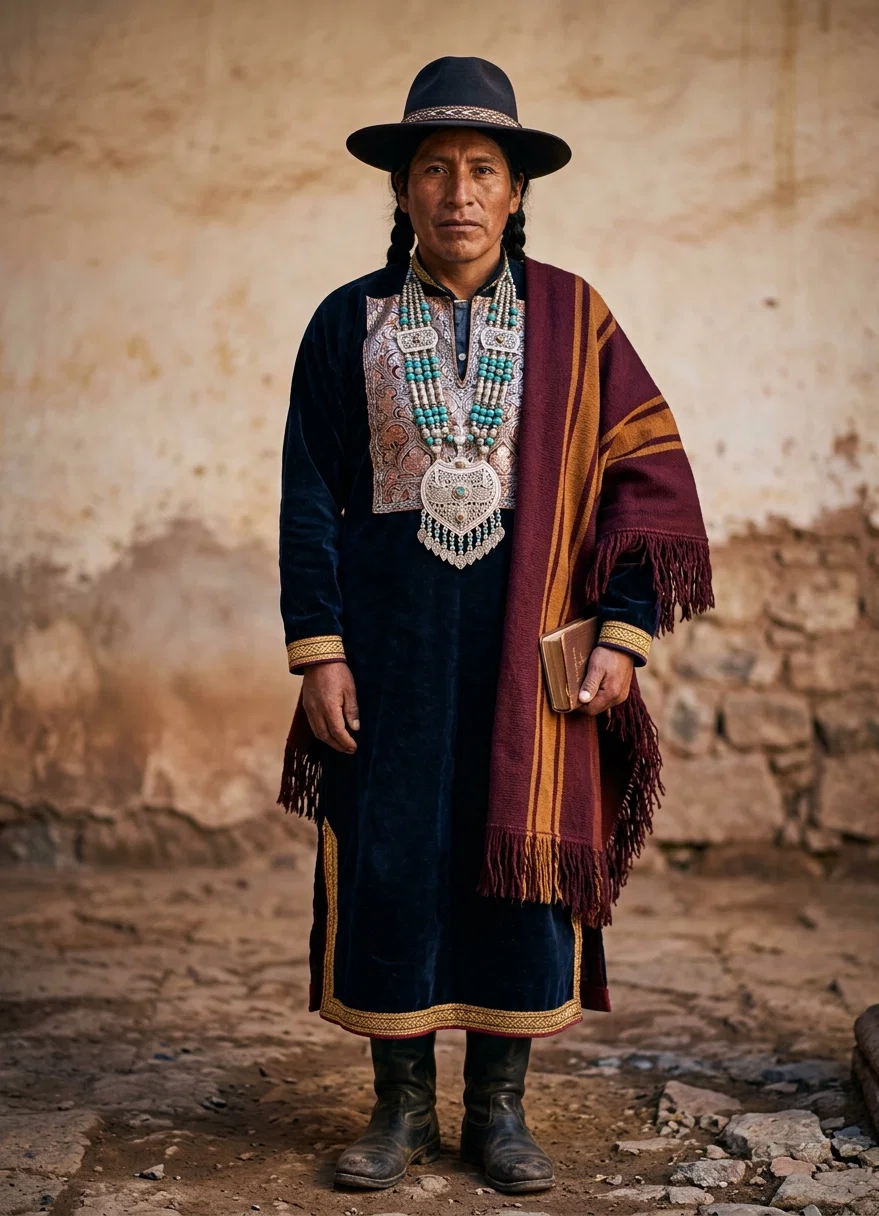
NATIVE INDIAN OF POTOSI, BOLIVIA
Such a situation makes a very dull time for a book agent. At the same time the feast in honor of the dead was celebrated for a whole week, all the people spending their time at the graves. They even ate their meals there. About the only money spent on such days is for drink, thus making the many whisky dealers rich. Most of the feast-days fall upon the first or fifteenth day of the month, when the people have the most money, the very time when the colporteur wishes to deliver his books.
I had much trouble in Sucre. But who can hinder the truth of God? At the end of November when this trip closed, I had sold over $458 worth of literature, although one month of the time was spent in traveling. On the nineteenth of November I left Sucre for Cochabamba, my home. At Rio Malato I had an attack of mountain sickness, and left the train. The next day, however, I was ready to continue my trip. A week later I reached home, but within four days suffered a severe relapse, which continued for a week, and was accompanied with such pain that I could not walk, sit up, nor sleep. The sudden changes15of climate in going from one city to another, and from one elevation to another, often a change of from three thousand to five thousand feet, is very trying on the nervous system.
All these fatigues I count as nothing compared with the many joys of my heart, when I see people turning from Romanism to the gospel. I could read in their faces that they strive for deliverance out of spiritual darkness. Young Bolivia fights against priestcraft of long standing. The people know well that its teachings are fables. We need workers to proclaim the everlasting message. How can they hear without a crying voice in the wilderness to prepare the way? See Rom. 10: 17.
The Lord opens the doors wonderfully. Civil marriage was established a few months ago. The separation of church and state is the next question for Bolivia to settle. I not only believe but I see already that our literature has a great future in Bolivia, and will do a great work in a short time. It is true that traveling is expensive at the present time, but seven railroads are in process of construction, and five other enterprises of the same sort have concessions granted them. The Lord himself is opening the way for his message. With great speed it must go everywhere, for the time is short. Emigrants from all parts of the world will come here to hear the glad tidings of a soon-coming Saviour.
Soon the railroads will open fertile regions. Thousands of square miles in this country are still unknown, and there are tribes of Indians that have never seen a white man. Now is the time to pray for means and laborers to be sent forth. Much has to be done here.
Elder Conradi said last year, “Indeed, South America is the most neglected land,” but he saw only the coast lands, which are ahead of the interior. Bolivia ought to have not one but ten canvassers right now, also at least one nurse. Here is plenty of room. Let us have at least one young man who is willing to go with me to fanatical towns where the priests rule with all power over the people. Not long ago a school was established in Peru for the Aymara Indians. Over fifty already have been baptized. Why not establish an institution for the Quichua Indians? This tribe is larger than the Aymara. Plans were laid long ago for an industrial school. We are anxiously looking forward to the time when the $300,000 Fund for missions will have reached its mark, so that something may be done for the poor brown race, oppressed and inhumanly treated. Many of these slaves of the whites will sit with us at the feet of Jesus, when he has claimed his own, and will sing the new song on the sea of glass. How soon will our longings be satisfied?
Cochabamba.
Longings for Home
By L. D. SANTEE
L. D. SANTEE
My hope wings are weary, yet flying
To a shadowless country, whose bliss
Just over time’s river is lying,
Not darkened with sorrows like this.
My spirit goes forward with longing,
Beyond the dull winter of time,
Where the angelic choristers thronging,
Are chanting their music sublime.
O, I long with desire strong and tender,
For the wonderful evergreen hills,
Where the sunlight of heavenly splendor,
Shall drive away all of earth’s ills.
I study the word of the Highest,
I ponder the promises given,
That those who to him live the highest
Shall enter the portals of heaven.
I think of my heart’s earthly treasures,
Some scattered, some low ’neath the ground,
And empty are life’s sweetest pleasures,
Till the Archangel’s trumpet shall sound.
Whether sleeping, or waking, I’ll greet them
When the Master shall call for his own;
In the raptures of heaven I’ll meet them,
And know them as now I am known.
They fell in the gloom of death’s sadness;
From the pathways of earth they are missed;
But I’ll greet with unspeakable gladness,
The beautiful lips I have kissed.
And I wait, while the seasons are flying,
That call from the evergreen shore,
That shall end all earth’s sickness and sighing,
And banish all death evermore.
Moline, Ill.
An Interesting Occasion
By David Paulson, M. D.
DAVID PAULSON, M. D.
At a certain Chautauqua assembly where I was giving a series of health lectures, there was a man who made it his business to entertain large audiences by performing remarkable feats of dexterity. One of them consisted in balancing three glass balls one on top of another on the rounded end of a broom handle. Desiring to know whether he naturally possessed a special knack for such work, or whether he acquired it by sheer practise, I sought a personal interview with him. He assured me that he had learned it all by patient effort. I inquired how long it took him to acquire the ball-balancing trick, and he told me that he practised it four hours a day for an entire year, and then one hour a day for another year.
On leaving that man, I felt both ashamed and humbled. I firmly believed that God had sent me to that great gathering to instruct the people with life-saving truths, while this performer was there merely to furnish them an interesting entertainment; yet he had spent a hundred times more time and effort in preparation than I, who came with a thousandfold more important message to this congregation. I resolved then and there that by the grace of God I would in the future study to show myself “approved unto God, a workman that needeth not to be ashamed.” 2 Tim. 2:15.
The children of this world are not only wiser than the children of light (Luke 16:8), but they often take far more pains to make their work interesting. How many parents deplore the fact that their children seem literally to devour the comic page of the Sunday newspaper, while they take little or no interest in the family worship. But somebody lay awake nights figuring out how to make that page interesting, and in a crude and unfortunate way he succeeded; while perhaps those parents did not spend ten minutes in prayerful study on how to make the morning worship attractive, helpful, and interesting.
Flowers More Attractive Than Weeds
While it is true that many worldly snares and inducements, like weeds, grow without any cultivation, it is also true that when we do take the necessary pains to grow a crop of roses, we have something much more attractive and lovely than the weeds.
Many believe that the world and the devil have a monopoly of about all the interesting things in this life; but that is a great mistake. Whoever heard of anything the devil has originated that is considered half as interesting as the Niagara Falls that God made?
John the Baptist’s preaching was infinitely more interesting, and drew larger crowds, in an age nearly as worldly as our own, than any cheap show that the devil was running at the same time up in Jerusalem.
While it is true that we can not secure John the Baptist to take charge of our family worship, we can do something far better, and that is to have Christ himself. When he was here on earth, he succeeded in making religion so charming that it captivated even the hardened publicans and sinners, and the little children left their toys and crowded around him till it annoyed the disciples.
Modern science teaches us that food must be appetizing in order to be satisfactorily digested. The same principle holds good in spiritual food; and the same gracious Father who has put such16delightful flavors into food, and such sweet fragrance into flowers, has locked up in every spiritual truth the most appetizing flavors in the universe, and he himself will help us to set them free. And we may actually see fulfilled in our family worship and in our church prayer-meetings and other services the promise, “I, if I be lifted up . . . will draw all men unto me.” John 12:32.
If we have been putting forth but little effort to make our religious exercises interesting, we need not be surprised if we have met with but little success. “He which soweth sparingly shall reap also sparingly.” 2 Cor. 9:6.
Some Practical Suggestions
First of all, do not let the family worship drift into a rut. Absolute and unvarying routine is certain in time to kill everything but the farm. Another important point is to have the entire service so short that no one becomes weary, or feels a sense of relief when it is over.
Talk about Bible incidents in the same animated tone of voice that you do about some interesting event that happened in your community yesterday. If something unusual has just occurred, such as a great earthquake, ask each member of the family to look up some Scripture text on that subject for the following morning. To make this easy, be sure to have in the house a concordance. Cruden’s Complete Concordance can now be secured for $1.50 or less. This plan helps to create an individual Bible habit which is so indispensable for the Christian.
Another good plan for an occasional change is to assign in advance some particular Bible incident, parable, or miracle, then have each one relate the feature of it that especially interested or impressed him. A little judicious and tactful work on the part of parents during the day will insure against failure on the part of any one. Don’t forget that what all take part in will generally be interesting to all. Smith’s Bible Dictionary or some similar work will often throw helpful and interesting side-lights on some Bible scene or incident.
One morning in the week may be profitably used in studying the Sabbath-school lesson. Other mornings short portions of Scripture may be read that are likely to be especially interesting and easily understood. The prayer or prayers that follow should be short and pointed, not the long prayers taking in the wider range of subjects about which each one of us must pray in secret each day if we hope to make progress in the Christian life.
All this is intended to be only suggestive. If it shall be the means in the hand of God of arousing such earnest effort on the part of some that they shall succeed in doing something far better than is suggested in this article, my prayer will be abundantly answered.
Hinsdale, Ill.
Habitual Thoughts Shape Character
WHAT we habitually think about, what we habitually wish for, what we habitually choose and prefer, that we are.— Washington Gladden.
The Home Influence
By B. C.
B. C.
The Lord has said, “Arise, shine; for thy light is come, and the glory of the Lord is risen upon thee.” Isa. 60: 1. Surely the time has come when God would have us arise and shine. He would have us make straight paths for our feet, lest when we come up to the judgment, we shall be condemned.
What is our every-day home life? Is it such as God can approve? Is it always sweet and loving, kind and gentle, like that of our Saviour, under all circumstances? Are we never provoked to anger, or do we sometimes show a hasty spirit? “Behold, the Lord’s hand is not shortened, that it can not save; neither his ear heavy, that it can not hear.”
God requires us to surrender all to him, our hasty tempers, our pride, everything that will drive away the Holy Spirit from our homes. Think of the influence of hasty words or unkind looks upon our children. We of all people desire our children to walk uprightly before God. Parents, mothers especially, are the children’s pattern. If the children do not hear and see divine thought and action in their pattern, how can they be expected to lead righteous lives? If every mother who wills to take her little ones through to the kingdom would take notice of the very small deeds of her children, and would pray, correct, punish if need be to bend the young twig in the right way, there would not be the great number of wayward children that we see to-day, thinking only of self and the pleasures of this world.
The time to begin to train children is when they are very small. The Lord says: “Train up a child in the way he should go: and when he is old, he will not depart from it.” If we take a part of God’s Word, we must take it all. Our home is the only place in which the work of training can be accomplished. We need to be more thoughtful of our home influence, of our influence upon our companion, upon our children, upon brother and sister, upon all who may be in our home; and our influence not only reaches the one in the home, but it is felt among our neighbors throughout the community.
Mount Vernon, Ohio.
Do Right, and God Will See to It
Do right, and God will see to it that you come out right.—Ram's Horn.