ABOUT sixty years ago a Vermont boy, a farmer's son, was sent to East Poultney, by himself, to sell a load of potatoes. It was a great event for him, the proudest day of his life. He sold out his load, then drove out to the tavern, put up his horses, and went in to dinner. How grand he felt, ordering a dinner on his own account and paying his own bill!
A good many people were in the dining-room, among the rest a distinguished-looking man, no less a personage than the sheriff of the county, who had been formerly a member of Congress. But pretty soon our young boy's eyes fell upon a “tall, pale, white-haired, gawky boy,” sitting at the farther end of the table in his shirt sleeves, paying attention to nobody, and eating as if upon a wager.
“This is a pretty sort of tavern, anyhow, to let such a fellow as that sit at the same table with all these gentlemen! He ought to come in with the hostler,” thought our proud potato merchant.
Before long the conversation turned upon some political subject, some act of an early Congress, and there was a difference of opinion as to how certain members had voted upon it. All at once the sheriff turned to the white-haired boy at the end of the table and asked:—
“Isn't that right, Greeley?”
“No,” said the boy, “you are wrong.”
“There!” said one of the other men, “I told you so.”
“And you're wrong, too,” continued the boy, and he proceeded to give the history of the measure in question from beginning to end.
Our dealer in potatoes was astonished out of measure, the more so because the whole company took these statements as law and gospel, settling the whole dispute at once and forever.
The “gawky boy” was Horace Greeley, who was then at work in a printing office at East Poultney. The other boy became a prominent New York physician. The two did not see each other for many years. Then the famous physician met the famous editor one day in the street, and told him this story, to his great amusement.— Selected.
Why I Think It Pays to be Courteous
[The American Magazine recently offered prizes for the best articles on the foregoing subject. The following articles were given first and third prizes, respectively.]
Courtesy a Good Business Asset
Courtesy pays great dividends. Banks, public service corporations, and everybody who comes in contact with the public are realizing the importance of courtesy.
For several years I had a position as information clerk in the largest savings bank in the State. We had over one hundred and sixty thousand individual depositors, representing every color, race, and creed under the sun. I have had many experiences, some pathetic, in which a little display of courtesy created a lasting impression.
I remember one instance particularly: An Italian, accompanied by his wife and two children—and, by the way, they were dressed up for the occasion—came into the bank one day to open a savings account. He had a pay check for his monthly wages given him by one of the railroad companies. He was employed as a janitor in one of the company’s stations. When he needed to indorse the check he was unable to do so, as he could not write. However, he identified himself to my satisfaction, and his wife, who could write, witnessed his mark.
I asked him if he would like to learn how to write his name. He said that he would. I told him that possibly he would not be a janitor all his days, that the company would doubtless promote him in time, and it was, therefore, essential that he should be able to write. He proved an apt pupil, and in ten minutes I had taught him to write his name legibly. He was, of course, delighted, and when he left the bank building I gave him a supply of penholders, pens, and paper, and directed him to practice penmanship.
Every month I am sure to see Giovanni Alberdo come into the bank with his pay check, and invariably he is accompanied by one or more of his countrymen. Alberdo has brought to the bank fifty new customers that it would not have acquired if I had not been courteous and patient with him when he first came to the institution.
Another instance where courtesy paid a large dividend was the following: A woman came into the bank at eight-thirty, an hour and a half before the opening hour, ten o’clock. She said she had to get some money from her account immediately, as she was obliged to leave for the South at once. She showed me a telegram announcing the death of her son by a gunshot wound received in Texas. I condoled with her, had her waited upon immediately, accompanied her to the station, secured her tickets, etc. As the railroad station was only a block from the bank, I had ample time to attend to these details.
About six weeks afterward, a lady garbed in mourning approached my desk, wished me a pleasant good morning, and said, “You don’t remember me, do you?” I replied in the negative. She explained that it was she whom I had accompanied to the train. She told me she had realized seven thousand dollars on the accident and life insurance policies of her late son, and though she was offered by a bank in Texas one and one-half per cent more interest on her funds than we paid, she preferred to deposit them in the bank in Chicago where the employees were courteous to her in her hour of bereavement and trouble.
This bank offered prizes to the employee who secured the most number of new accounts. I won second prize, due no doubt to the kindness of Alberdo and the lady who lost her son.
Courtesy pays extra dividends.
MARK DEVINE.
Courteous Employees Pay the Business Man
I have been connected with the retail grocery business for nearly ten years, and when I say that courtesy is the greatest asset a retail store can have, and it costs nothing, you may know that I speak from experience.
I am only an employee in a retail grocery, but when I began working I resolved to make myself the best clerk in our town. I immediately saw that courtesy would help me to reach my goal quicker than any other one thing I could practice.
So I treated every one that came into our store with all the courtesy I could command. Rich or poor, high or low, white or black, received the same attention from me. I gave everybody a hearty “Good morning” or “afternoon,” as the case might be, when he came in. If I was waiting upon another customer, I told him I would wait upon him next. I acknowledged every purchase with a “Thank you. Call again,” whether it was a penny or a ten-dollar sale, man, woman, or child.
If a lady arrived at my counter with several bundles, I suggested that I wrap them all together. If customers were from the country and had their rig hitched near by, I helped them out with their goods.
One day an elderly gentleman came into our store and purchased a number of items, and I asked him if his rig was near; he told me it was, so I helped him with his goods. This was the first time I had ever seen him in our store, but it was not the last; for from that time on he was a regular visitor, and his business amounts to quite a sum in a year’s time. Each time he comes, I help him with his purchases. One day his wife came in. She told me that her husband liked to trade with our store because we always helped him and that the place where he had formerly been trading did not.
Another case where courtesy paid was with a colored girl who was employed by a very wealthy woman. This girl did all the purchasing of the groceries, and their trade amounted to considerable during the year. When she came into the store, she expected to be shown the same courtesy as any other person. Some of the other clerks in our store, as in other stores, did not like to be so courteous to one of another color, but I showed her the same courtesy I would have shown her mistress. She now comes regularly to our store to make her purchases, but allows no one but me to wait upon her. She is not the only one that requires that I wait upon her; there are many others. Some of the very best people in our town call for me when they come in or order over the telephone.
I meet all customers as soon as they enter. I drop whatever else I may be doing, unless waiting upon another customer. I give them my undivided attention. It matters not how unreasonably exacting they may be, I try to give the impression that nothing is too much trouble if it will please. I try to bear in mind that for the moment the customer whom I am waiting upon is the only person on earth.
Through this method I won one customer for our store whose business amounts to over twelve hundred dollars a year. But it has paid me to be courteous, as I am now receiving more salary than any other grocery clerk in our city, barring none; and it has paid my employer, for many an extra dollar has been taken in.14
THE slightest emotion of disinterested kindness that passes through the mind, improves and refreshes that mind, producing generous thought and noble feeling. We should cherish kind wishes, for a time may come when we may be enabled to put them in practice.—Miss Mitford.
Tests of Discipleship
By Myrtle L. Judd
(Texts for September 3 to 9)
WHAT is a disciple? Webster says, “A follower who has learned to believe in the truth of the doctrine of his teacher.” So, if we are disciples of Christ, we shall be his followers; and, believing his teachings, we shall not only try to live according to them, but seek to win others to him and his service.
We are now prepared to answer more intelligently the questions, What are the tests of discipleship? and, Are we true disciples of Jesus Christ?
Christ said to those Jews who believed on him, “If ye continue in my word, then are ye my disciples indeed.” It is not enough for us to say that we believe Jesus is the Son of God and that he came to this world to save the lost. If we are true disciples, we shall continue in the word until our hearts are filled with a strong desire to see others accept the Saviour. “No true Christian lives for himself. We have our model in him who came ‘not to be ministered unto, but to minister.’” Our attitude toward others’ is a test of our discipleship. Christ’s attitude toward the people was that of compassion. He lived for them, he died for them. “To them he gave the tenderest and choicest utterances that ever fell upon the weary world. . . . Jesus came from the people, to the people, for the people.”
The Bible says, “Greater love hath no man than this, that a man lay down his life for his friends.” But Christ, counting the sacrifice not too great, willingly gave his life for his enemies as well as for his friends. Are we following him to the extent that we are willing to lay down our lives, if necessary, in order that souls may be saved?
We cannot be called true disciples while we “say, and do not.” This is applicable to the Pharisees, but it is also too true of many who profess to be followers of Christ today. If we would follow Jesus’ example, we must do today some of the good deeds we mean to do sometime in the future.
“We shall do so much in the years to come,
But what have we done today?
We shall give our gold in a princely sum,
But what shall we give today?
We shall lift the heart and dry the tear,
We shall plant a hope in the place of fear,
We shall speak the words of love and cheer,
But what did we speak today?”
Our God is “ready to pardon, gracious and merciful, slow to anger, and of great kindness,” and if we are true disciples we shall reveal these characteristics by our daily lives. Instead of being boastful, proud, and lifted up, we shall be humble followers of the meek and lowly Jesus. We shall exhibit the spirit of the Master even in the little things of life, as illustrated by the following story of a spelling class in China:—
“The youngest of the children had by hard study contrived to keep his place so long that he seemed to claim it by right of possession. Growing self-confident, he missed a word, which was immediately spelled by the boy standing next to him. The face of the victor expressed the triumph he felt, yet he made no move toward taking the place. When urged to do so, he firmly refused, saying: ‘No, me not go; me not make Ah Fun’s heart solly.’ That little act implied great self-denial, yet it was done so thoughtfully and kindly that spontaneously came the quick remark: ‘He do all same as Jesus.’”
Have we cut loose from the old life? That is good, but it is not enough. In order to be a true disciple “the young Christian must enter the new life. Leaving the service of one master, he must enlist in that of another. . . . Ceasing to do evil, he must also learn to do well.” We must become more helpful, more patient, more loving, more unselfish, more faithful in all duty, more like Christ.
MEDITATION.—Lord, help me to sense as never before what it means to be a true disciple of thine. May I henceforth walk more closely in thy footsteps, and be “as true to principle as the needle to the pole.” I want to be so filled with love for the souls for whom Christ died that all men shall know that I am thy disciple.
SPECIAL PRAYER.—Let us pray this week that God may give us a new vision of the world’s need—salvation. Shall we not, by God’s help, put sin out of our lives, and take on a burden such as we have never had for souls perishing in sin? O let us pray earnestly for success in soul-winning!
MYRTLE L. JUDD.
“With One Accord”
By Mary H. Moore
“O CERTAINLY,” I said, “I fully agree with you as to the value of the Morning Watch and the Bible Year. It is my habit to read a passage every day, but I don’t see any value in following the routine in the calendar. I read just as I choose. Last year I read the Bible through, but I used the version called the Modern Reader’s Bible, and enjoyed it greatly. This year I am following a scheme of my own. There is nothing binding in the order planned by the department. All they want is to interest young people in Bible study; where or how they read is secondary. I usually manage to learn a verse every day, but it isn’t the one in the calendar. I choose one from where I am reading; but sometimes I — Oh, I just learn a text wherever I happen to find a good one.”
“Ye-es,” responded my friend, “but have you ever thought how it was with the early apostles just before Pentecost? The record says, ‘These all continued with one accord in prayer and supplication.’ Do you not think that might mean more than that they were all willing to pray,—that they all prayed for the same things?”
“Now that God’s work has spread so far, we cannot be ‘all with one accord in one place,’ but I love to think that there is a way we can be preparing for our Pentecost. Just think what it means to have all our Missionary Volunteers around the world reading and studying the same scriptures, and asking our Father for the same blessings! I like the feeling of comradeship it gives me. I am one of the great Missionary Volunteer army, and I am keeping step. And I do not find that following the plan outlined for us all, interferes with my studying and reading for myself besides. It rather adds pleasure.”
MEMORY VERSE: “I am the Lord thy God . . . which leadeth thee by the way that thou shouldst go.” Isa. 48:17.
Questions
1. What question did the high priest ask Stephen after hearing the witnesses against him? Acts 7:1.
2. How did Stephen begin his reply? Of whom did he then speak? Verse 2. Note 1.
3. Who appeared to Abraham? Where was he then living? To what place did he go? Verse 2. Note 2.
4. Why did Abraham leave his home and friends? Verse 3.
5. What event took place before he left Haran? After this to what country did he go? Verse 4.
6. How much land did Abraham inherit in Canaan? Yet what had God promised him? Verse 5.
7. What prophecy was made concerning Abraham’s children? Verse 6.
8. Name the nation that oppressed Israel. Ex. 1:13, 14.
9. What did God say he would do to that nation? After that what did he say of his people? Acts 7:7.
10. Give the names of Abraham’s son and grandson. How many sons had Jacob? Verse 8.
11. Why did Joseph’s brothers sell him as a slave? Who was with him still? Verse 9. Note 3.
12. In what ways did the Lord help Joseph in Egypt? Name some of the afflictions through which he passed. Verse 10.
13. Tell the story of the famine in Egypt and Canaan. Verses 11-13.
14. Why did Jacob go to Egypt? How large was his family at that time? Verse 14.
15. Where did Jacob and his sons die? Where were they buried? Verses 15, 16.
16. As the time of promise drew near what is said of God’s people? Verse 17.
17. What king finally reigned? How did he try to keep the Israelites from increasing? Verses 18, 19. Note 4.
Questions for Diligent Students
1. How many countries are mentioned in this lesson? Find them on the map.
2. How many different persons did Stephen mention? Name them.
3. Why did he give the history found in this lesson as an answer to the accusation that he had said Jesus would destroy Jerusalem, and change the customs given by Moses?
Notes
1. The Jews never tired hearing the story about their forefathers,—Abraham, Isaac, Jacob, and Moses. Stephen gained the attention of the council by rehearsing their history, and at the same time taught that Jesus the Son of David was the promised Messiah, the very truth to which they did not wish to listen.
Charran is the same as Haran mentioned in the Old Testament.
2. “The call from heaven first came to Abraham while he dwelt in ‘Ur of the Chaldees,’ and in obedience to it he removed to Haran. Thus far his father’s family accompanied him; for with their idolatry they united the worship of the true God. Here Abraham remained till the death of Terah. But from his father’s grave the divine voice bade him go forward. His brother Nahor, with his household, clung to their home and their idols. Besides Sarah, the wife of Abraham, only Lot, the son of Haran long since dead, chose to share the patriarch’s pilgrim life.”—“Patriarchs and Prophets,” p. 127.
3. As the caravan journeyed southward, bearing Joseph after he had been sold to the Ishmaelites, the boy wept bitterly when he saw the hills in the distance among which lay his father’s tents. Again he thought of his brothers in Dothan,—and he felt their fierce glances, and heard the bitter words that came in answer to his entreaties. With a trembling heart he looked to the future. What a change had come! From being a tenderly cherished son, he was now a despised and helpless slave. For a time Joseph gave himself up to grief and terror.
But God intended this experience to be a blessing to him. He had learned in a few hours what years could not have taught him. His father had wronged him by his partiality and indulgence. Faults had been encouraged that must be corrected. He was becoming self-sufficient and exacting. He felt wholly unprepared to meet the difficulties before him.
Then he thought of God. As a child he had been taught to love and fear him. He had listened to the story of how God had helped Jacob in his hour of need, he had learned of his love in providing a Redeemer for man. Joseph believed that the God of his fathers would be his God. He then and there gave himself fully to the Lord, and he prayed that the Keeper of Israel would be with him in the land of his exile. He resolved to be true to God, to act as a subject of the King of heaven. He would meet trials with fortitude, and perform every duty faithfully. One day’s experience had been the turning point in Joseph’s life. Its terrible calamity had transformed him from a petted child to a man, thoughtful, courageous, and self-possessed.—Condensed from “Patriarchs and Prophets,” pp. 213, 214.
4. The new king was not ignorant of Joseph’s services, but he did not wish to recognize them. The Israelites added to the wealth of the Egyptians, but they were ranked with those who had sold themselves and their possessions in time of famine. Taskmasters were appointed over them, and their lives were made bitter with hard bondage. Then the command went forth that all the boys should be destroyed as soon as born. Satan moved the king to make this decree. He knew a deliverer was to come, and he hoped to defeat God’s purpose.—Condensed from “Patriarchs and Prophets,” pp. 241-243.
Missionary Volunteer Society Programs for Week Ending September 9
THE programs for the Missionary Volunteer Societies, Senior and Junior, for this date, with notes, illustrations, and other helpful material, will be found in the Church Officers’ Gazette for September.
For helps and suggestions on this assignment, see the Review for August 31.
Suppose: Would Money Make Me a Soul-Winner?
Suppose
“SUPPOSE some one were to offer me a thousand dollars for every soul that I might earnestly try to lead to Christ, would I endeavor to lead any more souls to him than I am endeavoring to do now? Is it possible that I would attempt to do for money, even at the risk of blunders or ridicule, what I hesitate or shrink from doing now in obedience to God’s command? Is my love of money stronger than my love of God or of souls? How feeble then my love of God! Perhaps this explains why I am not a soul-winner.”
Trust in God and Do the Right
“LET the road be long and dreary
And its ending out of sight,
Foot it bravely, strong or weary,
Trust in God and do the right.”
“After You”
By Orison Swett Marden
Some time ago New York newspapers gave an account of the death of a man who was asphyxiated while alone in his rooms in a large apartment house. At the inquest which followed, a lady who lived on the same floor with this man said she had heard him groaning, but that he had always been so very rude to women, she did not make any effort to see what the trouble was.
About the same time another news item appeared, stating that a wealthy woman left in her will to an employee of a big trust company of which she was a patron, a hundred thousand dollars, to mark her appreciation of his devotion to her interests and comforts, “as well as his unfailing courtesy, honor, and promptness!”
Each item tells its own story. But for his habitual rudeness and lack of courtesy the life of the first man might have been saved. Because of his habitual courtesy and kindness, the second man won a fortune.
We never know what will come of courteous conduct—our kindnesses, smiles, or little attentions to people whom we wait upon or come in contact with in any way; but we do know the immediate effect upon ourselves. We cannot hold a kindly attitude to others, we cannot be courteous and helpful, without feeling better ourselves.
The gracious “Thank you,” so often neglected, the pleasant smile, the suppression of rude, hasty words that are sure to give pain, the maintenance of self-control, and an agreeable expression even under the most trying conditions, the attention to others which we would wish accorded to ourselves—how easily life can be enriched and uplifted, made cheerful and happy, by the observance of these simple things! And how they help us to get on in life!
Unfortunately, in large cities, where there is perpetual crowding and hurrying, the example of seeing everybody pushing, crowding, and trying to get the most comfortable seat or secure the place of advantage, tends to encourage the development of the most selfish human instincts.
We are all familiar with public hogs, especially the “end seat hog,” who gets on a car, takes his seat on the outside end, and compels everybody who boards the car after him to stumble over his feet to get past him. I have seen youths forcing their way through a crowd, nearly knocking people down, trying to get into a car first so they could monopolize the best seats.
“I recall an interesting anecdote of the value of politeness in history that should be of especial interest to Americans,” said a noted Frenchman in a lecture on good manners, translated for a New York newspaper. “The Marshal de Rochambeau, who fought bravely for the Americans in the War of Independence, was one of the many good men condemned to the guillotine during the Reign of Terror. One morning he and a crowd of others were led out of prison to a cart which conveyed the victims to execution. Among them was a priest. The Marshal de Rochambeau and the priest were the last of the party. The old soldier, wishing to show respect to religion, begged the priest to enter first into the vehicle. Removing his hat and bowing with graceful politeness, as if he were totally unaware that they were in the presence of death, he said:— “After you, Monsieur l’Abbé!” “The priest, seeing that the marshal, who was eighty years of age, was much older than himself, did not wish to go first, but, bowing with equal politeness, said:— “After you, Monsieur le Maréchal!” “After they had exchanged courtesies for some seconds, the jailer interfered, pushed the priest into the cart, and said to the marshal:— “Stand back, old Marshal, there is no room for you today.” “This very day saw the end of the Terror, the marshal was released from prison, and spent his last days in peace.”
“After you” will unravel a crowd quicker than any vulgar, selfish pushing and crowding to be first. The world itself makes way for the kindly, pleasing, gracious personality. People will involuntarily stand aside and let a polite, well-bred person pass when the unattractive, rude, boorish hustler, however able he may be, must elbow his way and push through the crowd. His boorishness antagonizes all with whom he comes in contact.
The “After you” attitude is especially desirable in the hot season, when tempers are more easily ruffled than in cooler weather. A little courtesy and consideration for others will go a long way to allay the discomfort of crowded cars and boats, and to make life generally more agreeable in the vacation months.
— Orison Swett Marden, in Washington Herald.
Psalm XXIII
“The Lord is my Shepherd; I shall not want”
I shall not want REST.
“He maketh me to lie down in green pastures.”
I shall not want REFRESHMENT.
“He leadeth me beside the still waters.”
I shall not want COURAGE.
“He restoreth my soul.”
I shall not want GUIDANCE.
“He leadeth me in the paths of righteousness.”
I shall not want COMPANIONSHIP.
“For thou art with me.”
I shall not want COMFORT.
“Thy rod and thy staff they comfort me.”
I shall not want SUSTENANCE.
“Thou preparest a table before me.”
I shall not want JOY.
“Thou anointest my head with oil.”
I shall not want DRINK.
“My cup runneth over.”
I shall not want ANYTHING IN THIS LIFE.
“Surely goodness and mercy shall follow me all the days of my life.”
I shall not want ANYTHING IN ETERNITY.
“I will dwell in the house of the Lord forever.”
— Selected.
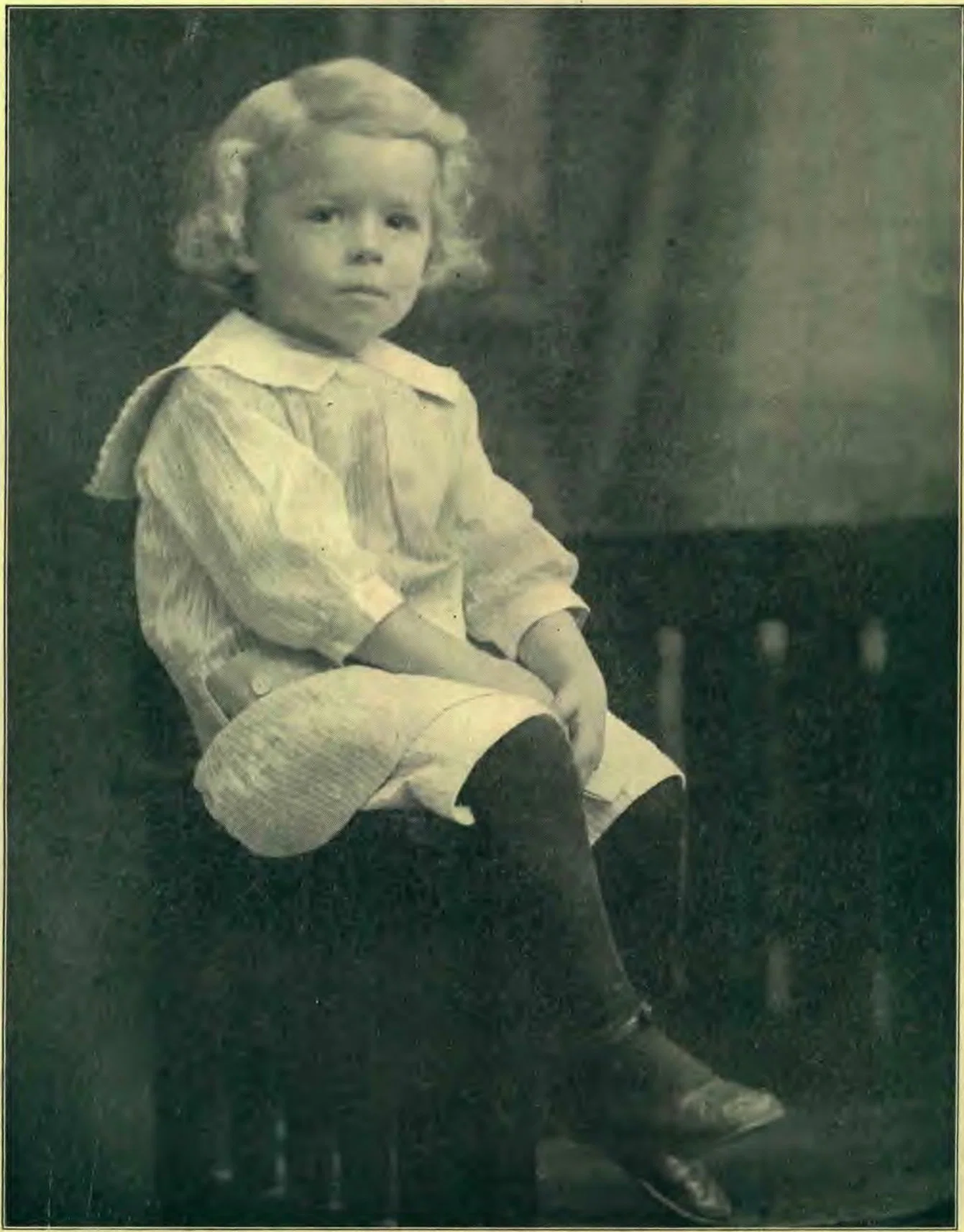
JAMES LEE, SON OF MR. AND MRS. HOWARD LEE, OF SOONAN, KOREA