CEBALLOS.— If there were only one minister to send out, I would rather see him go to China or India than come here. But the message has never been proclaimed in this land. People in this colony are hungry to hear preaching. There has been scarcely any preaching here for two years. The Americans, English, Canadians, and Germans here are about like people you would find in any frontier settlement—more interested in making money and getting homes, and in having dances, card and drinking parties, etc., than in religion. I know of a very few who act like Christians, although some are members of different churches. Lately a union church was erected. There are now two very fine places for preaching. In one there is a good church organ. Many sing well, and enjoy the singing.
THE VALE OF THE YUMURI
The same men who erected the church have collected a maintenance fund for any ministers they can get to come. The first to come would secure a welcome and make an impression. This money will be given freely to any one who preaches here, regardless of denomination.
This is a very fine climate all the year. I noticed only eight hours during all last summer that were especially hot. There is a good breeze most of the time. It is all right to come any day in the year. There is an opportunity for a preacher to work half-days, and, when he wishes, he can do plain saw and hammer work or finishing work. Still I would not recommend a carpenter to come here to work at his trade only. Wages are lower and expenses higher than in the States.
There is no danger from malarial fever. The wells are eighty feet deep, the water is good, and there are very few mosquitoes. About the only thing that causes fever here is much exposure to the cold, dashing showers. Avoid these, and all is well.
Now is there not some one who can be recommended, who can come at once? Delays are dangerous. Satan does not delay and dally. His forces are in haste, not waiting. The King's business demands haste, and I believe a man should come at once, and take a leading part in the work here, and in God's hand cause souls to be saved who would be lulled to sleep by false shepherds. Joseph Clark.
Porto Rico
By B. E. Connerly
MAYAGUEZ.—Our work is moving very slowly. Satan is contesting every step of the ground, but I think there are signs of advance.
Since we were in Arecibo, Brother Moulton has made good progress. One of our young native boys joined him the first of February as a helper. They have three Sabbath-schools—one in the little chapel, and two in private houses.17
Sunday night Brother Moulton conducts a study in the chapel, and on Wednesday evenings the native boy has charge, and they have a good interest. Sister Moulton plays the organ, and assists with the singing, but does not speak the Spanish yet. Brother Moulton and the boy are having comparatively good success with their canvassing.
During our two-months' absence from Mayaguez, the work here suffered a slight relapse, and for lack of means it became necessary for Peter to look for other employment. But we are happy that, through the generosity of the College View brethren, he can still be retained with us as a worker. We are now holding meetings at his home for the benefit of his neighbors, all of whom know of his religion.
We shall have the ordinances in Mayaguez, after which Sister Fischer and two of the native workers will go to Ponce, where, if our plans develop, we expect to open up the first Sabbath-school. There is some interest in that place.
The reports in the REVIEW never seemed more precious. We long for wisdom to carry on the work in our little corner. We are thankful, very thankful, to know the brethren pray for us.
B. E. CONNERLY.
Ceylon
By H. ARMSTRONG
COLOMBO.—We had a truly blessed time in Calcutta. As several of our workers had already gathered in, we were able to hold the week-of-prayer meetings before the conference began. The Lord came very near to each of us, and blessed us with his presence. We were all glad to have Elder Miller with us, and I feel sure that he will do much for the work in India.
We hope to see much progress made during the coming year, and we are dedicating ourselves to this end. We ask an interest in your prayers day by day, and we earnestly long to see our hands strengthened and a work established here that shall be to the praise and glory of God. H. ARMSTRONG.
Fiji
By C. H. Parker
ONE Sunday morning Mrs. Parker, Ramona, Sister Read, and our native girl, and five of our native brethren boarded the “Ramona” (our cutter), and started on our two-hundred-mile trip to Suva to attend the council. Our quarters were cramped on such a small boat, and we had hard work to find moving room for so many of us. The Lord gave us good weather and a favoring wind, so we reached Suva very early Tuesday morning.
It was good to meet our fellow laborers. On Wednesday we met Brother Carr at the steamer. The time up to the evening after the Sabbath was spent in planning and preparing for the meeting. Our first service was held the evening after the Sabbath. Sunday and Monday we met twice a day, and our last service was held Monday evening. All took a lively interest in the meeting, and we feel that what was accomplished will have a telling influence for the more rapid advancement of the work for the coming year.
The school work is a leading problem with us now, and we are looking around for a favorable, central opening. We desire God to lead in this matter, so that we may make no mistakes or retrenchments.
My faith in the message and its speedy triumph never was so great before, and I know that the good ship Zion has her sails set for home. Praise God, the rest is soon to come. May we each be as men ready for their Lord’s return. C. H. PARKER.
Bermuda
By J. A. Morrow
HAMILTON.—Yesterday I went to St. George, where I took five orders from soldiers' wives for "Coming King," and met some very interesting people. I held a Bible reading with one woman, and hope soon to return with my wife and hold further studies. I have often wished that we might do something for these soldiers and their wives, but they are difficult to approach. One of these women said she would be glad to get the "Coming King" to send to her mother, who is in England. Thus we see how far-reaching the Lord will make our efforts.
One week ago we had a new Sabbath-keeper at our meeting here in Hamilton. A family residing about one mile from Hamilton is becoming interested. We have been disappointed in getting halls in which to hold meetings, but we have all the work we can do in a quiet way, and the Lord is giving the increase. At present we are taking three hundred copies of the Watchman and four hundred of Life and Health. Most of our people take part in selling these papers. This gives them a good experience.
It is my earnest desire to be among those who sacrifice for Him, that I may, through his abundant grace, have a part in the final gathering of God's people.
J. A. MORROW.
Burma
By HERER H. VOTAW; MRS. H. H. VOTAW
By request of the committee in Calcutta, we are now connected with the work in Burma. Thus far the weather has been mild, and we are told that it has been about as warm as it is at any time of the year. Those who have been in both Rangoon and Calcutta say that the heat is never so great in the former as in the latter place. We have a nice start in the Burmese language, and hope, by the grace of God, to be able to work directly for the Burmans inside of a year.
Already we feel a real love in our hearts for these people. They seem such a hospitable race that we soon learn to love them. We have been able to hold some Bible readings, with an interpreter, and also some with Burmese who can understand English.
Just now we are expecting to make a short trip down to Maulmain. There is considerable interest in that place. A man came to Rangoon to visit us, and inquired about some points of faith. He is a minister of the High Church of England. As he left, he gave a pressing invitation for us to come to Maulmain and hold services. He said he would get the crowd, and act as interpreter.
I never have been in a place where it seems too difficult for men to obey after being convinced. 'Government' is the overtowering giant in this country, and the height of ambition cherished by most young men is the desire to be in some branch of government employ. To embrace this message is to preclude forever the hope of being in such service. And if a man has been in this work for years, he feels that he can do nothing else. The people here do not seem possessed of the ready resources of the West. All seem to be able to do but one thing. But God has given grace to some, and they have stood most nobly for the truth.
As soon as we can handle the language properly, we hope to get out among the agriculturalists—those who are independent of employers. If once they can be convinced, they will be free to obey. To those in the field, school work seems to present the most promising results. The boys are taught by the Buddhist priests, and a large part of the teaching consists in indoctrinating them in Buddhism. If we had a school, we could easily get pupils; for the people are quick to recognize the superior training given in English schools.
HERER H. VOTAW,
MRS. H. H. VOTAW.
Scotland
By W. A. Westworth
DURING the year 1904 there were added to the church-membership eighty-one names. Not all of these began the observance of the message this year, but this number includes those from the results of work done in 1903. There are also others who have begun to follow the light of truth, who are not included in this number, as they have not yet united with the church.
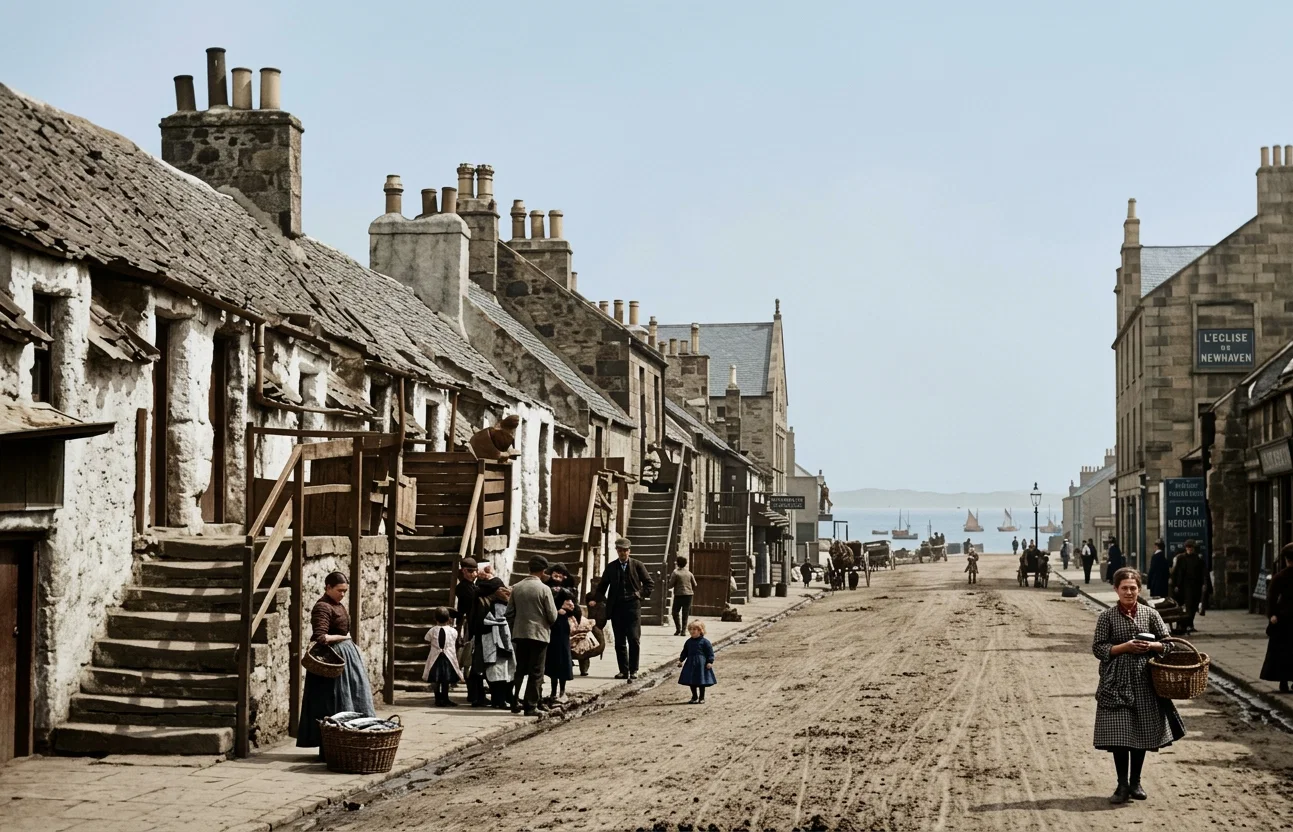
NEWHAVEN, SCOTLAND
Two churches have been organized, and thirty-five persons baptized. Orders for books have been taken, to the amount of eighteen hundred pounds, but as many have not reported their deliveries regularly, we are not able to give the exact figure for this item.
Financially the Lord has blessed us. By the figures of our reports before us, we have evidence of the guidance of the hand of God. As we look forward to the coming season, we feel that we can take heart; for we have, praise the Lord, an equipment whereby we can go ahead and use all our present staff of workers with but a comparatively small outlay of means.
During the year we have been able to add somewhat to the force of laborers. And while there is room for many more, we thank the Lord for the help we have, and pray that his blessing may so attend all, that 1905 may witness a large accession to the faith.
W. A. WESTWORTH.
Brazil
By John Lipke
On Dec. 5, 1904, we left New York on board the steamer “Tennyson,” bound for Brazil, where we had labored several years. We were glad to meet, at the end of a month, our dear brethren at Rio de Janeiro, who rejoiced as they heard how the Lord had blessed us in the States, and how willing our brethren in the States were to contribute toward a printing outfit for Brazil. After stopping at Santos, we went on toward our old home in Brusque, where we have one of our mission schools. Here hearts were made glad as we recounted the blessings we had received during our absence. After that I visited several of our churches, and related our experiences, how the Lord had blessed and led us while working in the States. If our brethren in the States could have seen the glad faces as we told of the contributions we had received for our printing outfit, they would feel fully repaid for the offerings they made.
At some places our people are unselfishly working for the advancement of the truth. At Timbo, where we expect to have one of our local conferences this year, we noticed especially an interest as the result of the work of our lay brethren. At Joinville, Brother Stuhlmann, one of our canvassers who is also doing Bible work, labors faithfully for the salvation of souls. As the ministers carry on a well-organized opposition, some of the people are afraid to follow their convictions, but we know the time will come when these souls will take courage, and like Nicodemus, and Joseph of Arimathea, step forward to hold up the banner of truth. At Massaranduba three families of our people had, in spite of the prevailing opposition, built a nice little schoolhouse. Here we found Sister Martha Beyer, one of our former students, teaching a small German church-school. We are so glad to know that the more opposition there is in these last days, the more the power of God will be revealed, and some will receive it.
During the latter part of March we held a session of our conference committee in Taquary, Rio Grande do Sul. It took us about two weeks to get there. We were glad to find a goodly number18of our people gathered for a general meeting. During this meeting, which lasted about four days, we enjoyed the guidance of God's Spirit. The Lord gave the word of truth as meat in due season. The general meeting was a help to our people, and the committee meeting a help to the work in general. The matter of locating our printing-office received due consideration. Wherever I have been among our people in Brazil, the donations of our American brethren toward our printing outfit made hearts glad.
At Taquary, where we have another mission school, the printing-office will be located soon. Press, types, etc., will have to go through the custom-house in Rio de Janeiro, and after that go with Brother Sabeff, the printer, to Taquary to connect with our school. Taquary is a small city, and the school is located in a suburb. Brother Schenk, the teacher, and the students have worked faithfully on the school land. The school has a good orchard and a nice garden. The buildings are large enough for the printing-office, a home for the teacher, and a number of students.
We need a great deal of literature in the Portuguese language, and as we connect the press with the school, we can give some poor but intelligent students the opportunity to work their way through school, and thereby get out our literature cheaper.
We are sure that our work in Brazil will prosper more than ever before. While in the States, I visited our camp-meetings, and our brethren there pledged toward our press. I would ask those who have not redeemed their pledges yet to do so as soon as possible, because we need the money. May God bless all who have given of their means toward this worthy enterprise.
I have written this report on a river steamer, just after our first general meeting among the Brazilians, and while going to one of our general meetings among the Germans.
JOHN LIPKE.
About My Master’s Business
“WHILE it is yet day, I must be about my Master’s business; and he who helps me onward is twice my friend.”
Land in Chile, South America
By F. H. Westphal
QUITE a number of our brethren have asked me under what conditions they can get government land in Chile. In answer to this question I will write the following for the REVIEW AND HERALD, so that others who may be interested in the same question may also have the desired information.
Those coming from the United States of America on their own expense, would be considered as free colonists, and they would need to hand in an application to the government as free colonists. They must bring a certificate from the government stating that they are legally married. They must bring evidence of the date of the birth of their children, and of their nationality, as well as of their own. They must show that both they and their children have conducted themselves well, and have a good moral standing. They must also bring evidence that they understand agriculture or farming. All coming here should provide themselves with a passport.
A married man can get for himself and his wife forty hectares of land, or about one hundred and twenty acres. For every son he has over twelve years of age he can get twenty hectares, or sixty acres. If a man and his wife come here with five sons over twelve years of age, with the necessary documents, he can take one hundred and forty hectares, or five hundred and twenty acres.
Some of the land is very good, and some of it is not so good. It may be near a railroad station, but the greater part of it is some distance away; the railroads, however, are following up the colonists as fast as possible.
It seems to me that some might improve these privileges, and come here as self-supporting missionaries.
To all our friends we would say that we are of good courage in the Lord, and the work is moving on, but there ought to be many of those gathered in Battle Creek and other places like that, willing to come and use some of this land offered by the government, and plant the banner of truth in many places in Chile. What do you think about this, brethren? Your actions will answer the questions.
F. H. WESTPHAL.
At the Glendale (Cal.) Sanitarium
By GEO. O. STATES
As my health did not improve as rapidly as was hoped, the doctors advised me to seek a lower and damper climate, so, with my younger son, I left Colorado, May 15, arriving at the sanitarium the nineteenth. I have been here about two weeks, and find the low altitude, the sea-breeze, and the even temperature quite restful to my tired nerves.
The institution is located several miles from Los Angeles, and is surrounded with beautiful trees, characteristic of southern California. There are numerous orange, lemon, olive, fig, and other fruits peculiar to this climate.
Best of all, I find the managers, physicians, nurses, and helpers wearing a cheerful countenance, showing the indwelling of the Holy Spirit.
It was a trial, in my nervous condition, to leave my dear brethren and sisters of the Colorado Conference, with whom I had labored so many years, yet I soon felt at home here. I shall probably remain some weeks, and will be pleased to hear from any of my colaborers or children in the faith. GEO. O. STATES.
Book Work at Union College
By G. Phillips
ACCORDING to previous appointment, the State agents of Iowa, Nebraska, Kansas, and Missouri met at Union College the eighth of May, to look after the interests of the book work among the students, and to lay before them the needs of the canvassing work in the Central Union Conference. The president, Professor Lewis, and the faculty, were very kind indeed to us, and have helped us in every possible way. They gave us the chapel hour each morning, and assisted us in various other ways in arousing an interest in the canvassing work, and over fifty responded to the calls made.
More and more I see that our schools are becoming recruiting stations for the canvassing work. We had fourteen in the class here who are going to Missouri to canvass, and when they arrive, we shall have between thirty-five and forty canvassers in that State, and a large majority of these have, either directly or indirectly, come from our church-schools or this college.
We are receiving some very interesting reports from different parts of the State. Our canvassers are taking, on an average, more than $1.50 worth of orders an hour. I am just in receipt of a report from a young man seventeen years of age, which is as follows: “Twenty-six hours, ninety-two dollars’ worth of books sold.” He is handling “Great Controversy.”
We are striving to the best of our ability to follow the direction that God has given by the spirit of prophecy in this work. He has said we should press the sale of the books giving an account of the rebellion in heaven, and we are doing this. It is wonderful to see the way God is blessing our efforts. During the fifteen years I have spent in the canvassing work, I have never seen a better prospect for this work than at the present time. We propose to follow the guiding hand of God and the leading of his Spirit, believing that if we work as he directs, and handle the books that he tells us to, he will give good results.
We have made “Great Controversy,” “Daniel and the Revelation,” and “Patriarchs and Prophets,” our leading books; and the way the Lord has blessed our feeble efforts is wonderful. We have reached a time when the canvassing work must take on larger dimensions. We must lengthen our cords and strengthen our stakes, and go forth in the strength and power of our God,19pressing the battle bravely, and thus hasten the coming of our blessed Saviour.
I must express my thankfulness to God for the kindness and co-operation of the president and faculty of Union College, and the president and ministers of Missouri, the church-school teachers, and the dear fellow workers in the Kansas City Branch Office, for their kindness and co-operation in this work. It is not through any great effort of the writer, but through the efforts of the faithful workers already mentioned that the work in the State of Missouri and the Central Union Conference is being revived. May the Lord help us one and all to work “while it is day;” for “the night cometh, when no man can work.”
G. PHILLIPS.
New South Wales, Australia
By S. M. Cobb
Although it is only one year and eight months since we landed in Australia, many changes have been experienced in the work here, and we have much indeed for which to praise the Lord.
This is a good field for labor, and God's blessing and bounties are scattered with a liberal hand. About two years ago our membership in this conference was a little over five hundred, with one tent in the field. We have now a membership, including those who accepted the truth this season, of over eight hundred. Four tents are in the field; and five ordained ministers and four men laboring as Bible workers and helpers, with the ministry in view, and four lady Bible workers, and thirty canvassers are engaged in the work. This season one hundred and forty-six persons have been brought into the truth in the conference by our efforts in the field work, besides others added to our churches through their efforts.
Opposition, bitter and determined, is being constantly brought to bear upon God's people, to turn them from bearing the message, but these efforts do not avail.
Our camp-meeting held in January was a success in every way. It was said to be the best ever held in New South Wales, and was indeed a most excellent meeting. I do not recall a more spiritual, refreshing season in my experience. A good work was accomplished. One morning near the close of the camp-meeting we asked our people to help us in raising the thirty-five hundred dollars that was apportioned to this conference as its share to build and equip the new publishing plant to be built in Victoria, and in a few moments $3,190 was raised. We are of good courage, and will labor on. S. M. COBB.
Actions Taken by the General Conference Committee
By William Ambrose Spicer
FOLLOWING the General Conference the General Conference Committee held numerous sessions to deal with matters of detail coming before it. Delegates from the mission fields had many questions to lay before the members. Actions taken by the committee which will be of general interest, are here summarized.
Departmental committees were appointed as follows:—
Departmental Committees
Educational Department: Frederick Griggs (chairman), C. C. Lewis (secretary), L. A. Hoopes, C. W. Irwin, F. W. Field, C. H. Hayton, Arthur Fulton, H. R. Salisbury, O. Loepke, O. A. Johnson, Jean Vuilleumier, M. E. Cady, Fannie M. Dickerson, L. Flora Plummer, B. E. Huffman, Orin A. Hall, C. B. Hughes, E. A. Sutherland, J. E. Tenney, J. W. Lawhead, W. W. Prescott, W. A. Spicer, W. E. Howell, M. E. Kern, J. G. Lamson.
Sabbath-school and Young People's Department: G. B. Thompson (chairman), Mrs. L. F. Plummer (secretary), W. W. Prescott, M. C. Wilcox, Fannie M. Dickerson, E. Houser, J. A. L. Derby, M. E. Kern, W. A. Colcord, C. P. Bollman.
Religious Liberty Bureau: K. C. Russell (chairman), W. A. Colcord (secretary), Allen Moon, L. A. Smith, G. B. Thompson, D. W. Reavis, J. S. Washburn, R. C. Porter, S. B. Horton, H. W. Reed.
Medical Council: W. A. George (chairman), J. E. Froom (secretary), C. P. Farnsworth, C. C. Nicola, F. M. Wilcox, E. P. Hawkins, W. C. Green, G. H. Heald, Jno. A. Burden, G. A. Hare, O. M. Hayward, P. F. Haskell, W. M. Adams, S. P. S. Edwards, W. R. Simmons, W. H. White, D. H. Kress, A. B. Olsen, J. C. Ottosen, A. J. Hoenes, E. A. DeForest, G. W. Thomason, R. H. Habenicht.
Publishing Department: W. C. White (chairman), E. R. Palmer (secretary), H. H. Hall (assistant secretary), a representative of each of the following houses: Pacific Press, Oakland; Review and Herald, Washington; Southern Publishing Association, Nashville; International Publishing Association, College View; Kansas City Branch; Fort Worth Branch; Battle Creek Branch; Canadian Depository; and F. E. Painter, A. F. Harrison, I. B. Blosser, J. S. James, George Phillips, W. L. Manful, I. H. Evans, W. A. Spicer, J. E. Froom, M. E. Cady.
North American Foreign Department: G. A. Irwin (chairman), I. H. Evans (secretary), N. P. Nelson, G. F. Haffner, S. Mortenson, B. G. Wilkinson, and the manager of the New York City Foreign Literature Depository.
Relief Bureau: W. C. White (chairman), E. R. Palmer (secretary), G. A. Irwin, J. E. Froom, H. H. Hall.
Assistants appointed: H. E. Rogers (statistical secretary), E. Houser (home secretary).
It was voted,—
That the Echo Publishing Company, of Melbourne, be allowed to pay the royalty on the Australasian Sabbath-school Lesson Quarterly to the Australasian Sabbath-school Department for use in island mission work.
That A. G. Daniells be invited to attend the later European general meetings.
That three hundred dollars be appropriated for a French worker in Quebec, this amount, with receipts from literature and otherwise, to cover a year's labor.
That we accept the offer of the Central Union Conference to share equally in sending and establishing a self-supporting worker in the Philippine Islands.
That the Brazil depository, in connection with the Hamburg Tract Society, publish such literature in the Portuguese language as the means will permit and the requirements demand.
That the week of prayer for 1905 be held from December 9 to 16.
That the offering recommended by the General Conference for the colored work in the South be taken the first Sabbath in October.
That the offering recommended by the General Conference for orphans of the Haskell Home and similar institutions be taken the first Sabbath in April.
That we approve of the suggestion of the Educational Department that the chairman attend such of the union conference teachers' conventions as it may be consistent for him to attend.
That we favor the suggestion of a general educational council in the summer of 1906.
That we encourage the friends of the Huntsville school for colored workers to raise a fund of five thousand dollars for the enlargement of the buildings and the improvement of the facilities of the school.
That we encourage the Nashville church to purchase the Baptist meeting-house now offered to them for five thousand dollars, and that calls be issued in the REVIEW, Watchman, and Signs for gifts to assist in payment of same.
That we ask Elder G. A. Irwin and Dr. J. E. Froom to join our brethren in the South in arranging plans for the Nashville sanitarium work, and when these plans are developed, that we assist in securing the means that will be required.
That our brethren of the Cumberland Conference be encouraged to place the Graysville Sanitarium in good working order.
That our brethren throughout the Southern Union Conference be encouraged to unite in putting the Atlanta Sanitarium in good working condition.
That the managers of the Southern Publishing Association be encouraged,—
(a) To study the plan so successfully followed in England, Europe, and Australasia, by which a small constituency place a large number of papers in their field; and to put the Watchman upon an efficient paying basis.
(b) To enter judiciously into the publication of books for the magnificent book field assigned them.
(c) That friends of the cause be encouraged to loan money to the Southern Publishing Association with which to take up current obligations.
That ministerial credentials be granted as follows: D. C. Babcock, J. J. Westrup, C. A. Hansen, E. W. Farnsworth.
That ministerial license be granted to W. A. Barlow.
That missionary license be granted as follows: Mrs. J. J. Westrup, Dr. Law Keem, Mrs. Law Keem, Dr. Emma Perrine, Amanda Van Scoy, Mrs. E. E. Prescott, Mrs. C. A. Hansen, Mrs. D. C. Babcock, Mrs. V. J. Farnsworth, Mrs. B. G. Wilkinson, J. B. Stuyvesant, H. L. Mignott.
That we advise the publication of the manuscript, “Outline of Our Missions,” prepared in the Mission Board office.
That the building of the General Conference offices in Takoma Park, Washington, be proceeded with at once.
W. A. SPICER, Secretary.
Religious Liberty Notes
By W. A. Colcord
THE National Reformers are still calling for “the Christian Amendment to the Constitution.”
After a riot, in which one man was shot dead and another shot through the hand, resulting from a Sunday observance crusade last fall, in Allegheny, Pa., the Baptist Ministers’ Association of the city passed a resolution recommending that the association “divorce itself from any further affiliation with the Allegheny County Sabbath Association in its Sunday observance crusade.”
A National Reform conference is to be held at Winona Lake, Friday, August 18, at which the following topics, among others, are to be discussed: “The Moral Accountability of Nations,” “Our Sabbath Desecration,” “The National Saviour-King,” “National Christianity in Our Public Schools,” and “National Christianity in Fundamental Law.” A number of men prominent in National Reform work are to be present.
For the first time in the history of the Protestant churches of North America, a great Inter-church Conference, officially representing practically all the denomination on the continent, with an aggregate membership of nearly twenty million, is to be held in New York City, November 15-20, under the direction of the National Federation of Churches. It is claimed that this will be the most important religious gathering ever held in America. As stated in the letter to religious bodies asking for the appointment of delegates, “Sabbath desecration” is one of the questions which “concerns Christians of every name, and demands their united and concerted action, if the church is to lead effectively in the conquest of the world for Christ.” There is every indication that “in the last conflict the Sabbath will be the special point of controversy throughout all Christendom.”
Mr. H. H. George, field secretary of20the National Reform Association, recently made a trip through the West. Reporting this to the Christian Statesman, for May, he says. “We distributed literature freely among the pastors, giving to each a package of about a dozen of our best tracts, taking from them the assurance that they would read them carefully. We placed similar packages with a number of the prominent business men, and had encouraging interviews with them. I handed a banker a package, and was beginning to explain it to him, when he said, ‘I tell you before you begin, that I am heartily in favor of it all through.’ Another said, ‘Most assuredly we need some movement of this kind.’” Thus the seeds of National Reformism are being scattered far and wide, and, as is evidenced by the concluding remarks in the preceding quotation, unless the people are enlightened upon the subject, and have a knowledge of the principles of religious liberty, they will be readily deceived, and will give their influence and support to the delusive sophistries of error and false reforms. What they need is literature that will enlighten them upon the principles of religious liberty. Who has a burden to circulate religious liberty literature among pastors and people?
A New York labor law provided that no employee should be “required or permitted” to work in bakeries or confectionaries more than ten hours a day, or sixty hours a week. The Supreme Court of the United States has lately decided this provision of the law to be unconstitutional, upon the ground that it constituted an attempt to deprive an individual of his liberty without due process of the law. This decision ought to have some bearing on the measures which the Sunday-law people are seeking to have passed in different States, as in Wisconsin last winter, making it unlawful for any employer to keep any employee at work over sixty-five hours in a week, and requiring that “at least fifty-two full rest-days of twenty-four hours each” shall be given all employees every year, seven of which, at least, shall be on “the first day of the week.” But in view of an utterance of Justice Harlan, one of the judges of the United States Supreme Court, in a speech delivered at the Presbyterian General Assembly, at Winona Lake, Ind., May 20, it is doubtful if the Supreme Court would render a like decision as to the constitutionality of Sunday laws. The following report of the speech is taken from the Philadelphia North American of May 22: “A meeting in the interest of Sabbath observance was held Saturday night. John H. Converse presided, and Justice Harlan made the chief address. Justice Harlan made it very clear that it was the duty of State legislatures to sustain Christian sentiment, and preserve the Christian sabbath. He intimated very plainly that the Supreme Court would stand for such legislation. . . . He said that the duty of Christians to observe Sunday as a day of worship and religious service was not to be confused with the right of those who worked to have a rest one day in seven.” From this it appears that the constitutionality of Sunday laws is already prejudged by the Supreme Court of the United States.