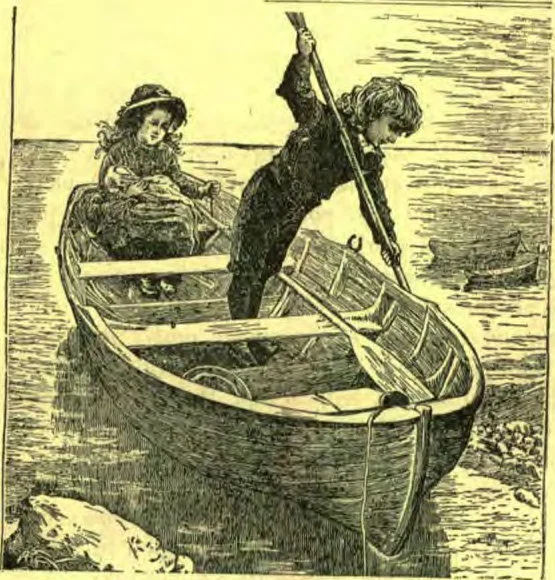
They sailed the wide, wide ocean, a brave and gallant crew,
The Cockleshell their vessel, upon the waters blue.
The captain and the steward, the mate and cabin boy,
The purser and the sailors, were every one named Roy.
They sailed from San Francisco upon a Monday morn;
They touched at Valparaiso, and rounded cold Cape Horn;
They crossed the South Atlantic, and skirted Zanzibar;
And then they went to Russia, and visited the czar.
Then, passing Nova Zembla, they braved the arctic cold;
And, landing in Alaska, they mined for Klondike gold.
At last, safe back in 'Frisco, they left the Cockleshell;
For hark!—the welcome ringing of mother's dinner-bell!
And as I heard their story, I wondered more and more,
Till I found their boat was fastened, and never left the shore.
ELIZABETH ROSSER.
What the Trumpet Creeper Told
By Minnie Rosilla Stevens
NATURE'S WONDER STORIES—NO. 1
What the Trumpet Creeper Told
ONCE upon a time, before ever the Trumpet Creeper had been grown in people's gardens, it grew wild on the banks of Southern rivers, twisting and turning to the very tops of the thick, high trees. And among all the vines, none hung out such beautiful red blossoms as the Trumpet Creepers.
My mother grew in the garden of a queer old man, who loved her, and built a pretty little house for her to climb over; this she gladly did, and with the help of other vines, soon made a lovely green covering for the little cottage, dotted all over with great bunches of scarlet blossoms. I could not climb much then, as I was very small. I kept close to my mother; for I feared that some rough creature might crush my tender stem; and she sheltered me with her leaves, and amused me by tossing her red blossoms in my face.
I thrived so well that I soon began to feel that I myself should like to climb a little; so I reached out toward the lattice, but just then there came down upon us a breeze so cold that it made me shiver through and through, and I was obliged to drop my leaves on the ground, and draw my garments tightly around me, to keep out the cold. Even then I was chilled to the heart; soon I began to grow sleepy, and was very glad when I could forget all about the cold by falling into a deep slumber.
I slept and slept, but after a while I felt the air growing warmer. Then I thought I would try to wake up soon, and begin to climb a little more. I heard a dreadful chattering near me; then something gave me a hard pull, and I was pried up from beneath, and whirled round and round; but I was so sleepy that I could not arouse myself enough to see what it all meant, and presently I went sound asleep again.
I took only a short nap, and then woke up, broad awake. As I opened my eyes, I thought at first I must be dreaming; for everything was so changed I did not know where I was. My mother was gone, and I was alone, save for a few wild flowers and some grass. A girl was bending over and caressing me, much as the old man had done; then I realized what had happened,—they had taken me from my old home, and planted me in a new garden, where I was expected to grow and climb. The girl was very kind to me, and planned to build a beautiful trellis upon which I could mount when I began to grow; but I missed my mother and the other flowers, and felt so lonely that, at first, I resolved never to try to climb a bit higher than I already was.
However, as the warm sun shone, and the gentle showers fell, I began to think that, after all, it might be better to try growing a little than to do nothing at all, so I straightened my stem, put out my leaves, and threw out a tiny branch. The girl watched me in great delight, and I began to love her just as I had the kind old man.
Now the dreadful trials of my life began. One day the girl did not come to see me; day after day passed, but still she did not come. Instead, came other people, who did not care for flowers, and who let loose in the girl's garden some dreadful long-eared creatures, of great size. These ate the grass, and trampled the flowers, and at last they came to me. One bit off my leaves and branches, and chewed and twisted my stem until only a short, frayed stump was left above the ground. Still the girl did not come. I thought I should die there in the ruined garden, without a friend, and was so miserable that I was glad when the cold wind came again, and I could forget my grief in slumber.
When I awoke, one warm spring day, the girl was there, and how she grieved over my misfortunes! “My poor Trumpet Vine,” she said, “how could they ruin you so?”
I had thought I never would again try to grow; but the girl seemed so sad to lose me, and the dear sun coaxed so kindly, and the warm rain pleaded so tenderly, that I thought better of it, and went to work once more.
For the second time the girl left me; but I knew she would come back again, and I hoped to grow tall enough to bow to her when she came. She was gone a long time, but one day in late summer, she entered the garden, and I held out two great bunches of scarlet trumpets to greet her as she came through the gate. How surprised and delighted she was, and how she petted me! I was pleased that my beauty gave her pleasure, and I mean to grow and bloom for her as long as I live. I do not care for praise and admiration for myself. Beauty is vain that does not brighten the world for others, and my red trumpets shall swing in the bright sunshine and fresh air free for all to enjoy; and if they make some one happy, I think I myself shall always be happy.
Minnie Rosilla Stevens.
HOW TO BE HAPPY
Are you almost disgusted with life, little man?
I will tell you a wonderful trick,
That will bring you contentment if anything can—
Do something for somebody, quick!
Are you dreadfully tired with play, little girl,
Weary, discouraged, and sick?
I'll tell you the loveliest game in the world—
Do something for somebody, quick!
—Selected.
AGAINST CIGARETTE SMOKING
Chief Willis T. Moore, of the Weather Bureau at Washington, has issued an order prohibiting persons connected with the service from smoking cigarettes during office hours, and stating further that those who smoke cigarettes at any time will be mentioned in the confidential reports that are made quarterly to him by chiefs of the service and divisions throughout the entire service. Chief Moore said: “The order was issued after careful consideration, and a thorough investigation of the evils resulting from cigarette smoking. It will stand. In this service we are compelled to maintain a very strict discipline, in order to secure satisfactory service. Some of our men, who are regarded as the most thorough and competent, doing every detail of their work with the utmost promptness and accuracy, gradually became careless and lax. I sent inspectors to investigate, and in a number of cases their lapse was found to be directly attributable to the use of cigarettes. I am not prudish, nor do I wish to assume any authority whatever over any privilege that the employees of the service should have; but, as a public servant, I feel that it is my duty to correct any evil that may exist, even if in attempting to make this claim I am overstepping my authority. The order applies to the entire force of the Bureau throughout the entire service. Cigarette smoking must cease.”
BEREAN LIBRARY STUDY
Revelation 4; “Thoughts on the Revelation,” pages 384–390
NOTES ON LESSON 4
(November 11–17, 1900)
The Fourth Chapter of Revelation.—In the fourth chapter of Revelation we are taken into the center of heaven. We are permitted to enter the door of the heavenly sanctuary, and view the rainbow-circled throne of our Heavenly Father. We are shown the four and twenty seats of honor round about the throne, upon which are seated the four and twenty elders, clothed in glorious robes of white; and with crowns of victory upon their heads; also, in the midst of the throne, those four wonderful living creatures, who never cease to ascribe glory to God.
The Throne of God.—This wonderful chapter introduces us into the very center of the universe of God, giving us a glimpse of his mighty throne. Finite minds can not fully comprehend the great power emanating from that throne. We are told that “suns and stars and systems all in their appointed order [are] circling the throne of Deity.” As we gaze into the starry heavens, let us always remember that all that vast multitude of heavenly bodies are moving in a never-ending circle around the glorious throne of God. Our sun and the planets of our system are also “circling the throne of Deity.” All the inhabitants upon the earth, scoffers as well as worshipers, are unconsciously joining in that grand triumphal procession, which is ever witnessing to the mighty power of him that sitteth upon the throne.
The Rainbow.—Who does not love to see it spanning the heavens? It is a likeness of the glory of God, that the Lord has placed in the sky for our encouragement. In Eze. 1: 28 we are told that the glory of the Lord is like the “bow that is in the cloud in the day of rain.” There was no rainbow in the clouds until after the flood; then God said, “I do set my bow in the cloud.” It was a pledge that there would never be another flood. It also means far more. God says, “I will look upon it, that I may remember the everlasting covenant between God and every living creature.” Gen. 9: 16. Wonderful thought—that every time we go to the window to see the beautiful bow in the clouds, God from his glory-circled throne is also looking upon it, that he “may remember the everlasting covenant.” There is power in “the blood of the everlasting covenant [to] make you perfect in every good work to do his will, working in you that which is well pleasing in his sight, through Jesus Christ.” Heb. 13: 20, 21. Why do you love to look upon the rainbow—simply on account of its beauty, or because it is a pledge of God’s love? God looks upon it that he may remember the everlasting covenant,—the blood of Christ, shed that you might be made perfect in every good work, and be well pleasing in his sight. Whenever you see the rainbow, remember the precious fact that God is looking upon it, and remembering that he has made ample provision to save you from all sin. Let the rainbow be a witness that you will accept the blood of the everlasting covenant. “The wrath of God will not fall upon one soul that seeks refuge in him.” God himself has declared, “When I see the blood, I will pass over you.” “The bow shall be in the cloud; and I will look upon it, that I may remember the everlasting covenant.”
The Four and Twenty Elders.—In the earthly sanctuary, which was a type of the heavenly, there were four and twenty chief men, or governors of the sanctuary. 1 Chron. 24: 4, 5, 19. The father of John the Baptist was one of those four and twenty chief men. In the following extract from the first part of the tenth chapter of “Desire of Ages” we learn something of their duties: “Zacharias dwelt in ‘the hill country of Judea,’ but he had gone up to Jerusalem to minister for one week in the temple, a service required twice a year from the priests of each course. ‘And it came to pass, that while he executed the priest’s office before God in the order of his course, according to the custom of the priest’s office, his lot was to burn incense when he went into the temple of the Lord.’ He was standing before the golden altar in the holy place of the sanctuary. The cloud of incense with the prayers of Israel was ascending before God.” Notice: the lot of Zacharias was to burn incense. In Rev. 5: 8 we read that every one of the four and twenty elders had golden vials of odors, which are the prayers of the saints.
NEVERS—FOR BOYS
Never make fun of old age, no matter how decrepit, or unfortunate, or evil it may be. God’s hand rests lovingly on the aged head.
Never use intoxicating liquors as a beverage. You might never become a drunkard; but beer, wine, and whisky will do you no good, and may wreck your life. Better be on the safe side.
Never make sport of one of those miserable creatures, a drunken man or woman. They are wrecks; but God alone knows the stress of the storms that drove them upon the breakers. Weep rather than laugh.
Never tell filthy stories, nor listen to the telling of them. Cleanliness in word and act is the sign manual of a true gentleman. You can not handle filth without becoming fouled.
Never cheat or be unfair in your play. Cheating is contemptible anywhere, at any age. Your play should strengthen, not weaken, your character.
Never call anybody bad names, no matter what anybody calls you. You can not throw mud, and keep your own hands clean.
Never be cruel. You have no right to hurt even a fly needlessly. Cruelty is the trait of a bully; kindliness, the mark of a gentleman.
Never lie. Even so-called “white lies” leave black spots on the character. What is your opinion of a liar? Do you wish other people to have a like opinion of yourself?
Never make fun of a companion because of a misfortune he could not help.
Never hesitate to say no, when asked to do a wrong thing. It will often require courage, the best kind of courage—moral courage; but say no so distinctly that no one can possibly understand you to mean yes.
Never quarrel. When your tongue gets unruly, lock it in; if need be, bite it. Never suffer it to advertise your bad temper.
Never make comrades of boys who are continually doing and saying evil things. A boy as well as a man is known by the company he keeps.
Never be unkind to your mother and father. When they are dead, and you have children of your own, you will discover that even though you did your best, you were able to make only a part payment of the debt you owed them. The balance you must pay over to your own children.
Never treat other boys’ sisters better than you treat your own.
Never fancy you know more, when fifteen years old, than your father and mother have learned in all the years of their lives. Wisdom is not given to babes.
Never lay aside your manners when you take off your fine clothes.
Never be rudely boisterous at home or elsewhere.
Never forget that God made you to be a joyous, loving, lovable, helpful being. Be one.—Independent.
CHICAGO & GRAND TRUNK R'Y
E. W. Meddaugh and Henry B. Joy, Receivers.
CHICAGO & GRAND TRUNK R'Y.
Trains leave Battle Creek.
WEST-BOUND FROM BATTLE CREEK.
No. 9, Mail and Express, to Chicago ........................ 12.15 P. M.
No. 1, Chicago Express, to Chicago ........................ 8.30 A. M.
No. 3, Lehigh Valley Express, to Chicago ................... 3.50 P. M.
No. 5, International Express .............................. 2.15 A. M.
No. 75, Mixed, to South Bend .............................. 8.30 A. M.
Nos. 9 and 75, daily, except Sunday.
Nos. 1, 3, and 5, daily.
EAST-BOUND FROM BATTLE CREEK.
No. 8, Mail and Express, East and Detroit .................. 3.45 P. M.
No. 4, Lehigh Express, East and Canada ..................... 8.27 P. M.
No. 6, Atlantic Express, East and Detroit .................. 2.23 A. M.
No. 2, Express, East and Detroit ........................... 6.50 A. M.
No. 74, Mixed (starts from Nichols) ....................... 7.15 A. M.
Nos. 8 and 74, daily, except Sunday.
Nos. 4, 6, and 2, daily.
W. C. CUNLIFFE, Agent,
G. W. VAUX, BATTLE CREEK.
G. P. A., CHICAGO.
ASSURANCE
By Examiner
It comes to me more and more,
Each day as I pass along:
The love of the Father eternal
Is over us, tender and strong.
'Tis not alone in the sunshine
Our lives grow pure and true;
There is growth as well in the shadow,
And pain has a work to do.
A message comes in the heartache,
A whisper of love in the pain;
The pang we have fought and conquered
Tells the sweet story of gain.
So it comes to me more and more,
As I enter on each new day:
The love of the Father eternal
Is over us all the way.
Having completed the third chapter of Galatians, it will be profitable to spend one week in reviewing this most interesting chapter. Study it carefully, dwell upon it, and you will find that it will yield its sweetness and richness more and more. Make it your spiritual food and drink this week, and it will nourish and strengthen your soul.
For convenience in study and in questioning, let us divide the chapter into parts, according to the main thoughts presented:—
1. In verses 1-5 Paul seeks to show the Galatians that they had received every spiritual blessing by faith, not by works. And he reproves them for departing from the faith, and seeking to be justified by the law.
2. In verses 6-9 the experience of Abraham is referred to as an example of saving faith. Then it is shown that Abraham’s experience is typical; that God has made Abraham an example of faith for the whole world.
3. In verses 10-12 Paul shows the relation of men to the law,—under its curse because all have sinned. He also shows the only way that righteousness can be obtained through the law,—by perfect obedience.
4. Continuing the line of argument, in verses 13, 14, he presents Christ as our Redeemer from the curse, that we may receive the promise made to Abraham.
5. The promise of the inheritance is the subject in verses 15-18. It is shown that the promise is sure; that it is by promise; that the law, coming four hundred and thirty years after, can have no effect to annul the promise.
6. In verses 19-21 the purpose of God in giving the law at Sinai is made plain; also that the law is in no way opposed to the promise made to Abraham.
7. Following up this thought, the apostle shows, in verses 22-25, how the law and the gospel work together harmoniously in the salvation of sinners.
8. In the last four verses he dwells upon our privileges in Christ as children of God and heirs of the inheritance.
QUESTIONS
1. What does Paul call the Galatians? What had they done? How had they received the Spirit? How were they seeking to perfect their experience? How had the Spirit been ministered to them, and miracles worked among them?
2. Whose experience in faith is referred to? What did his faith bring to him? Who are children of Abraham? What was foreseen by the Scripture? Because of this what was preached to Abraham? In what words was the gospel preached to him? Who receive the gospel blessing?
3. What is the condition of those who would save themselves by the works of the law? What scripture is quoted to prove this? Why is no man justified by the law? How do the just live? How only can the law give life?
4. From what has Christ redeemed us? What is the curse of the law? How has he redeemed us from this curse? How was he made a curse? Why did he redeem us? What is the blessing of Abraham? What do we then receive?
5. What is true even of a man’s covenant? To whom did God make the promises? To whom besides Abraham? Who is the seed? How was this covenant confirmed? When was the law given? Then what could not the law do? Why could not the inheritance be of the law? How did God give it to Abraham?
6. Why, then, was the law given? For how long was it to serve this purpose? By whom was it given? Who is the Mediator? Then is the law against the promises? Why not?
7. Where has the Scripture shut all men up? For what purpose? Where were we kept before faith came? To whom does the law drive us? What does Christ do for us? Being justified by faith, from what are we free?
8. When free from the law, whose children do we become? How do we become children of God? How do we put on Christ? What is it to be baptized into Christ? What classes are all made one in Christ? If we are Christ’s, whose seed are we? And heirs of what? Who, then, are the one seed?
The MODERN WEBSTER'S
By Editor
Pronouncing and Defining Dictionary of the English Language.
SIZE, 5¼ x 4¼ INCHES
This dictionary includes English words in common use, collection of classical and modern words and phrases and maxims, and instruction in proofreading.
In its compact form it has a thoroughness and clearness of its own, and is especially adapted to the use of students, and in the library, office, and home.
We will send the YOUTH'S INSTRUCTOR one year with this dictionary bound in stiff silk cloth, indexed, postpaid, for $1.10; or, we will send the INSTRUCTOR one year, with same book, limp cover, not indexed, for $1.00. This offer applies to both new subscriptions and renewals. Address—
THE YOUTH'S INSTRUCTOR,
Battle Creek, Mich.
A NEW SUBSCRIPTION BOOK
ENTITLED
Easy Steps in the Bible Story
From Creation to Sinai
By ADELAIDE BEE COOPER
Editor of the Youth’s Instructor
Introduction by
ELDER S. N. HASKELL
THE EARLY BIBLE STORIES never lose their beauty, freshness, and charm. They bring new inspiration to those advanced in years, and are read with pleasure and eager delight by youth and children.
The principles revealed in the lives of the early Bible characters will, if instilled into the minds of the young, make an indelible impression for good, that neither time nor later associations can erase. Mothers, read them to your children.
In this book the author retains the beauty, simplicity, and sweet expression of the Bible narrative, and gives a clear, vivid description of the six days of creation; the planting of the garden of Eden, the beautiful home of the first man and woman; their disobedience, and its result. The following outline shows the order in which a few of the many important subjects considered in this volume are taken up: Noah is told of the flood; the building of the ark; the tower of Babel; Abraham, the “Friend of God;” Lot leaves Sodom; Isaac and Rebecca; Jacob and Esau; Jacob at Haran; the story of Joseph (this should be read by every fireside); he was truthful, obedient, noble, spirited, and dared to do right; the children of Israel in Egypt; Moses at the court of Pharaoh, and as leader of Israel; the plagues; the Passover; the firstborn slain; Israel released; crossing the Red Sea; in the wilderness; the giving of the manna; water from the rock; the visit of Jethro; and the ten commandments spoken at Sinai.
The book contains 160 pages, table of contents, and list of illustrations. Our artist has prepared 150 beautiful pen-drawings illustrating the text of the book. It also contains many full-page illustrations. Beautiful cover design. Two styles of binding.
PRICE, IN CLOTH, 50 CENTS
PRICE, IN PAPER, 25 CENTS
The price brings the book within the reach of all. Now ready for delivery. Agents wanted. Send for printed canvass.
For particulars address your TRACT SOCIETY, or
REVIEW & HERALD PUB. CO.,
Battle Creek, Mich.,
Or, PACIFIC PRESS PUB. CO.,
Oakland, Cal.
THE HOUSE WE LIVE IN.
By Vesta J. Farnsworth
By Vesta J. Farnsworth.
This book tells how the human body is made, by comparing its parts to the different parts of a house. It also tells how to care for the body. In doing so, many other interesting things are told in a pleasing way. It is printed in large, clear type, with many instructive pictures. It contains 218 pages, and is nicely bound in cloth, with a home scene on the front cover. Price, 75c.
We offer the YOUTH'S INSTRUCTOR for one year and this beautiful book, postpaid, for $1.15; or, we will send the book, postpaid, for five new subscriptions at 75 cents each. Address—
The Youth's Instructor,Battle Creek, Mich.
Pleasing God Rather Than Men
“Do you want to be loved, respected, and trusted? Then ignore the likes and dislikes of men in regard to your actions; leave their love for God’s, taking him only. You will find that as you do so, men will like you; they will lean on you and trust you, and he will give you the power to comfort them.”
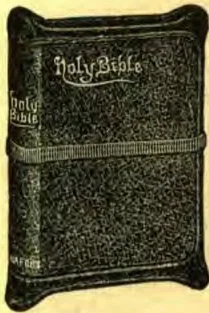
SELF-PRONOUNCING S. S. TEACHERS' REFERENCE BIBLE
CONTAINS the celebrated Teachers' Helps, comprising nearly 400 pages. Also a complete series of fifteen new maps.
Description.—Imperial Seal Binding, Tuck Edges, known as “Divinity Circuit,” Rounded Corners, Full Red under Gilt Edges.
We offer this Bible, postpaid, for only six new yearly subscriptions at 75 cents; or twelve new six months' subscriptions at 40 cents.
We will also send it, postpaid, with the INSTRUCTOR one year for $2.25. For 20 cents extra we will stamp your name in gold upon the cover.
Address—
THE YOUTH'S INSTRUCTOR, Battle Creek, Mich.
“I MIGHT HAVE DONE THAT”
How often we hear people say, young and old alike, when they read or hear of some noble deed or notable achievement, “I might have done that.” And they might, too—but they didn’t.
A dozen girls are folding papers in a room. One of them is more faithful and painstaking than the others; she improves her evenings in study, and is not satisfied with a superficial knowledge of her work, but makes herself familiar with its details. By and by some one is needed to do a higher class of work, that brings with it better pay, and this girl is chosen. “I might have done that,” say each of the eleven, bitterly. But instead of improving the time that is left, they go on in the same old, careless, idle way. They might, indeed, but they don’t.
In a business office a dozen girls are sitting before typewriters, click-click-clicking from morning till night. Most of them have the time divided into three great epochs, according to a calendar of their own,—noon, six o’clock, and pay-day. But there is one who is not content merely to know just enough to “skin along,” as the girls say. She studies punctuation, gives herself long drills in spelling, makes herself familiar with the technique of her employer’s business, and thus is able to bring a live intelligence to her work. Which one of these girls, do you think, that employer will choose to act as his private secretary,—a position bringing with it an increase of salary as well as fewer hours? There is more responsibility, of course, but this girl is ready for duties involving responsibility. “I might have done that,” the others sigh—and go on watching the clock, and thinking of the pay envelope.
Half a dozen young persons find themselves, at the end of a school year, confronted with the unpleasant fact that the days are past when they can get along with taking no thought for the clothes they wear, the food they eat, and the education they had meant, along with other pleasant and wholly desirable things, to acquire and enjoy. One or two of them will have the grit and the courage and the determination to make themselves masters of circumstances; and through long, work-filled years, with scant time for study and less for play, will keep the thought of the goal ever before them, and press on and up toward the mark. It is uphill work, and often the climbing is rough, and the path treacherous; but at last the summit is gained, and the happy toilers will all their lives look out on a broader horizon, will appreciate more truly the wonders of God in nature and science, than will their friends who gave up in the valley. And these same workers will find, perhaps to their surprise, that what seemed a trial and disappointment has been a blessing in disguise. They have learned to work,—to apply what they have studied,—and now they are ready to fill positions of usefulness. “Oh, I might have done that!” the others sigh, from their shiftless corners; “oh, I might have done that!”
Now is the time to do; and while it is true that there is no time like the spring of life for preparation,—the time that God has given for this very thing,—it is also true that it is never too late in any life for the determined will and the honest endeavor.
Let us do what we may; then we shall not be of those who say, “I might have done that.”
OUR SABBATH-SCHOOL LESSONS
By Editor
It has been decided, by the officers of the Sabbath-school Association, in counsel with the publishers of the YOUTH'S INSTRUCTOR and the Little Friend, to make a change in the grading of the Sabbath-school lessons. The benefits of such a change have been apparent for some time, and at last steps have been taken to bring it about. In order that all the Sabbath-schools may know of it, and be prepared to fall in line when the time comes, it is thought best to give the matter a wide notice some weeks before the change goes into effect.
Jan. 1, 1901, the present series of lessons published in the INSTRUCTOR, known as “Junior Lessons,” will be discontinued; and in their place will appear a new series, to be known as “lessons for youth,” as it is thought fitting that the lessons for the youth should be printed in their own paper. These lessons will be graded so as to be appropriate for young people from eleven years old up to the age when it is thought best for them to enter the senior division, and study the lessons printed in the Lesson Quarterly. The time for this change to be made will be left with each school to decide, according to the circumstances.
This series of Youth’s lessons will take the place of both the Junior lessons, in the INSTRUCTOR, and the Intermediate lessons, published in Our Little Friend. Thus many who are now studying the Intermediate lessons will take up the more advanced lessons for youth, and will have the privilege of reading the INSTRUCTOR, which contains matter better suited to their needs than does the Little Friend.
In place of the series thus dropped from the Little Friend will be published a department containing Kindergarten lessons. These lessons will be for the benefit of teachers and mothers having under their charge children under seven years of age. The class for whom these lessons are published will find them very useful in presenting Bible lessons to the little ones.
It is believed that these changes will result, first of all, in a set of lessons better adapted to our youth than those they are studying at present; also, incidentally, in building up the INSTRUCTOR subscription list. And it is hoped that the Kindergarten feature of the Little Friend will prove so attractive and helpful that that paper will not lose by the change.
We would suggest that Sabbath-school officers carefully consider this plan, and the changes it will involve, if any, in the number of papers taken by their schools, that they may order the necessary supplies in due time. If this matter is properly attended to, there will be no confusion nor disappointment for lack of papers. If any feature of the plan is not thoroughly understood, or questions arise in its working out, write to your State Sabbath-school secretary for further information and advice.
Do not put this matter off till the last week in the present quarter; but give it your attention at once.
FOR EVERY DAY OF THE WEEK
Sunday:
There is no love of God without patience, and no patience without lowliness and sweetness of spirit.—John Wesley.
Monday:
One by one thy duties wait thee,
Let thy whole strength go to each;
Let no future dreams elate thee,
Learn thou first what these can teach.
—Adelaide Procter.
Tuesday:
“It is a mistake to think that the sweetness of life can be extracted from things material. All the joys worth seeking are of the spirit.”
Wednesday:
“Power and wealth and fame
Are but as weeds upon life’s troubled tide;
Give me but these,—a spirit tempest tried,
A brow unshrinking, and a soul of flame,
The joy of conscious worth, its courage and its pride.”
Thursday:
For every one of us there are opportunities, not merely for courageous moments, but for a courageous habit of the soul,—opportunities which call for the most manly courage, and put us to the sternest proof.—John White Chadwick.
Friday:
Stilled now be every anxious care,
See God’s great goodness everywhere;
Leave all to him in perfect rest;
He will do all things for the best.
—From the German.
Sabbath:
“Therefore being justified by faith, we have peace with God through our Lord Jesus Christ.” Rom. 5:1.