ALCOHOL; ITS HISTORY, AND ITS EFFECTS UPON SOCIETY.
By W. H. Riley, M.D.
By W. H. Riley, M.D., Superintendent of Colorado Sanitarium, Boulder, Colo.
[All rights reserved.]
History of the Use of Alcohol.
(Continued.)
FOR some hundreds of years after its discovery, alcohol was distinctly the most valuable product of chemistry. The old alchemists went wild over it. They wondered at its power in dissolving oils and resins and balsams, calling it oleum vini and balsam universalis, and making with it varnishes and perfumes and cosmetics, by the sale of which they replenished their not overfilled purses. They admired the clear, colorless, smokeless flame with which it burned, and named it sulphur coeleste, in contradistinction to the ordinary or earthly sulphur, which burns by no means so pleasantly. They used it as a preservative; they used it for the preparation of their chemicals; and, above all, they used it as a medicine.
Under the name of aqua vitæ, or "water of life," alcohol was considered the best medicine known in those times. It was the great remedy for every malady to which human flesh was heir. We have this interesting testimonial as to its esteemed value: "The virtues of aqua vitæ are infinite. It keepeth off fits of apoplexie. It driveth away vermin. . . . In wet and malarial climates every one should take a teaspoonful, with sugar, before breakfast, to keepe off the ague, etc." Prof. Arnoldus Villanova, in the fourteenth century, made a panacea of the "water of life," which was said to have the virtue of "giving sweet breath, fortifying the memory, besides being good for sore eyes, the toothache, gout, etc."
In the seventeenth century, however, people learned that alcohol was an intoxicant, easily and cheaply manufactured, and it ceased to be used solely as a medicine. Hitherto alcohol had been made from wine, and was therefore expensive; now it was found that beer would serve the same purpose, and barley being cheaper and more plentiful than grapes, alcohol was now obtainable by all. Great distilleries arose in different places, especially at Schiedam, in Holland, and great quantities of cheap and fiery spirits were soon being poured out. This industry was encouraged in England, on the ground that it encouraged agriculture, and by the year 1700 England was flooded with liquor at very low prices.
"The results were most disastrous. London streets abounded with gin-shops, and one could actually find placards on them reading, 'Drunk for a penny; dead drunk for twopence; clean straw for nothing.' The effects on the common people were so marked that all thoughtful persons were alarmed by it. In the wet, temperate climate of England, people might drink heavily of beer or wine, and still retain in fair measure their health and their capacity for work; but under the reign of gin, vice and misery and disease increased so fearfully that Parliament finally passed a law practically prohibiting its use. This famous 'Gin law,' passed in 1736, is interesting as the earliest severe blow at liquor-dealing among civilized nations. It levied a tax of twenty shillings a gallon on spirits, and a license of fifty pounds for any one selling or dealing in it. And, being in advance of public opinion, it failed, much as other more stringent laws have failed in our own day.
"To evade the law, apothecaries sold it in vials and small packages, sometimes colored and disguised, generally under false labels, such as 'Colic Water,' 'Make Shift,' 'Ladies' Delight.' There were printed directions on some of these packages—e.g., 'Take two or three spoonfuls three or four times a day, or as often as the fit takes you.' Informers were very prominent and exceedingly offensive, inventing snares to catch lawbreakers for the heavy rewards, and spying and sneaking around in a way particularly distasteful to the English mind. In consequence, they suffered in their turn. The mere cry, 'Liquor spy,' was enough to raise a mob in the London streets; and the informer was lucky if he escaped with a sound thrashing and a ducking in the Thames or the nearest horse-pond. Indeed, such an outcry was made about the matter that the ministry became very unpopular, and the law was not enforced after two or three years, and was largely modified in 1743, after seven years' trial."
THE OTHER SIDE.
By Editor
A GENTLEMAN once said to us, "I do not favor prohibiting the sale of liquor; it would be an injustice to the men in business; besides, it would throw thousands out of employment."
We replied, "You do not look at the issue from the right side; you take a contractor's view.
"Just before the war closed a government contractor said in a car: 'I hope the war will not close under two years. I will lose thousands of dollars; besides, many men will be turned out of employment from the government works.'
"A lady passenger, clad in weeds of mourning, rose to her feet, and with a tearful voice, said: 'Sir, I have a brave boy and husband sleeping the sleep of death in a soldiers' cemetery. I have only one boy left, and he is in front of the foe. O God, I wish the cruel war would close now!'"—Exchange.
HOW TO BE BEAUTIFUL.
By D. H. Kress, M.D.
Seek to be Beautiful.
NATURE is full of beauty; and she seems to love and seek it. Observe the flowers with their varied colors, the fruits with their tinted cheeks, or the little bird that after its daily bath smooths out and arranges its golden feathers. Everything in nature testifies that God is a God of order, a lover of the beautiful; and He has placed within all a desire to be beautiful. This desire should not be suppressed, but cultivated, for it is divine.
We admire beauty because it is a revelation of God's glory. The more beautiful the flower, the more fully is God's character expressed. The person with the face and figure most nearly perfect, reveals most fully God's image. It is therefore lawful to desire beauty, and to try to be beautiful, to have a beautiful face, a beautiful physique.
Beauty Comes from Within.
Real beauty is not the result of outward adorning or decoration; it radiates from within. The mind is the sun, and the streams of light that proceed from it are revealed through the face. Every evil thought is a dark object passing over the mind, and obscuring some of these rays; and it leaves its impress on the face. And so "by beholding we become changed." It is this that led the apostle to say: "Finally, brethren, whatsoever things are13true, whatsoever things are honest, whatsoever things are just, whatsoever things are pure, whatsoever things are lovely, whatsoever things are of good report; if there be any virtue, and if there be any praise, think on these things."
Pure Thoughts Beautify the Face.
Only the one who has pure and beautiful thoughts can have a really beautiful face. Any one who has observed a child at play, can not fail to have noticed that every thought finds a ready expression. A happy thought brightens the face, and the shadow of a cloud passing over the mind is as readily seen there. The same principle applies to adults. Thoughts may be suppressed, and not permitted to work themselves out in the conduct; but the countenance is changed.
The admonition given through Moses is full of meaning. Speaking of the religious life, of the need of having God's words woven into the life, he said to the children of Israel, "Thou shalt bind them for a sign upon thine hand, and they shall be as frontlets between thine eyes." The hand executes the purpose of the mind, and thus reveals character. As God's Word is received, meditated upon, and appropriated, it transforms the acts and life, renewing the mind. The hand reveals the thought in loving deeds, and even the countenance bears witness to the change that has taken place.
The Face an Index of the Inner Life.
Jesus needed not that any should testify of man; for He knew what was in man. Man was an open book to Him; He read the innermost thoughts. He said to the Pharisees, "Wherefore think ye evil in your hearts?"
"As in water face answereth to face, so the heart [the inner life] of man [is revealed] to man." No matter how carefully a man may try to conceal his inner life, he is an open epistle, known and read of all men! They that worship the beast will reveal the character of the beast, either with the hand or in the forehead. For evil thoughts are distinctly traced on the outlines of the face of the wicked, even tho, because of fear or policy, the hand may not be permitted to work them out in the life. Speaking of the fallen and corrupt condition of the children of Israel, Isaiah said, "The show of their countenance doth witness against them; and they declare their sin as Sodom."
Unconsciously we influence for better or worse all with whom we are brought in contact. This influence, or power over others, is not in what we say, but in what we are.
Men and women and even children came to Christ, not because from a theological standpoint they recognized Him as the Christ, but because they witnessed His kindly deeds, and saw in His face something that was divinely beautiful. For "the Word was made flesh, and dwelt among us (and we beheld His glory [character], the glory as of the only-begotten of the Father), full of grace and truth."
Those who worship the Lord in the beauty of holiness will, by their acts of kindness, reveal something of this "grace and truth." The Father's name will be written in their foreheads, and His glory will be seen upon them (Isa. 60: 1, 2); and in the kindness, sympathy, and compassion expressed in the countenance they will be beautiful. Strive to be beautiful.
NOT WORK BUT WORRY.
By Inez May Felt
It is not the work, but the worry,
That wrinkles the smooth, fair face;
That blends gray hairs with the dusky,
And robs the form of its grace;
That dims the luster and sparkle
Of eyes that were once so bright,
But now are heavy and troubled,
With a weary, despondent light.
It is not the work, but the worry,
That drives all sleep away,
As we toss and turn and wonder
About the cares of the day.
Do we think of the hands' hard labor,
Or the steps of the tired feet?
Ah! no, but we plan and ponder
How to make both ends meet.
It is not the work, but the worry,
That makes us sober and sad;
That makes us narrow and sordid,
When we should be cheery and glad.
There's a shadow before the sunlight,
And ever a cloud in the blue;
The scent of the roses is tainted;
The notes of the song are untrue.
It is not the work, but the worry,
That makes the world grow old;
That numbers the years of its children
Ere half their story is told;
That weakens their faith in heaven,
And the wisdom of God's great plan.
Ah! 'tis not the work, but the worry,
That breaks the heart of man.
—Inez May Felt.
Decomposition of Meat More Serious than Fermentation of Starch
By David Paulson, M.D.
SOME POINTS REGARDING FOOD. No. 4.
Decomposition of Meat More Serious than Fermentation of Starch.
MANY continue to use meat because they find that it does not ferment; but meat decays. While it does not form sour acids and gases, the products of this decomposition often produce biliousness. It is largely responsible for sick-headaches, and for the nervousness which so many people suppose the result of overwork for others, when it is simply due to overworking and overstimulating their own digestive organs by attempting to live upon dead animals and animal products.
Another striking reason why we should not use the flesh of animals is because they are continually making waste products in their bodies, the same as we are; and when the animal is killed, these toxic substances are all through the muscles, and we must eliminate them along with the poisons which are formed in our own system. Careful experiments have demonstrated that when a vegetarian lives upon flesh food for a few days, the secretion of his kidneys becomes several times as poisonous as it was when living on the natural products of the earth. Why should we undertake the contract of compelling our eliminative organs to carry off the waste products that the ox should have eliminated? It never has occurred to some people why fruits and grains and nuts do not have eliminative organs. It is because they manufacture no waste products that have to be thrown off. They are foods minus the poisons. When we eat an animal, to get what is represented by the stove itself, or the structure, we have to eat the ashes with it.
DAVID PAULSON, M.D.
Another Triumph for the Ball-Bearing DENSMORE
316 Broadway, New York
Offices in Detroit, Grand Rapids
and principal cities
*The PACIFIC PRESS PUBLISHING CO., Oakland, Cal., publishers of this paper, wrote us on May 16, 1900: "We purchased our first DENSMORE typewriter about eight years ago, and have had these machines in use in our various departments ever since that time. Have also tried various other makes, but can candidly say that we have found none which gave better satisfaction, all things considered, than the DENSMORE. As an evidence of our faith in this machine, would say that we have just placed an order with your company for nineteen (19) New Densmore Typewriters."
UNITED TYPEWRITER AND SUPPLIES COMPANY
San Francisco, Cal., 327 Montgomery Street
Kansas City, Mo., 714 Delaware Street
HOW TO CARRY THE BABY.
DEAR mothers of first babies, let me entreat you to learn the simple art of carrying your baby properly. I was once traveling on a cable-car that, among other passengers, contained two young mothers, each holding an infant under three months old. My attention was attracted to the first as soon as I was seated, and I noticed the eyes of other passengers wandering in the same direction. She was never still, and the child might have been a dish-rag for all the respect that was paid to its vertebrate system. First it was thrown over the mother's arm, between the elbow and wrist, its poor little head wabbling about like an apple just ready to fall from the tree. Then it was laid face downwards across her knee, and jogged about to a "rum-tum-diddy" that might have been soothing to its nerves if they were constructed on a principle different from those of all the rest of humanity.
Up to this point it had been quiet, but at the sound of the "rum-tum-diddy" it asserted a vigorous motion of resentment. It was then transferred to the maternal shoulder, and patted on the back with movements that must have appeared to the tender infant like vigorous whacks. It was next tied into a sort of true-love knot in the mother's lap, one little foot and one little arm sticking out here and there by way of loops. Unappreciative infant! even then it would not be silent. As a last resource, the mother opened her dress and forced nourishment upon it that it did not need, in the presence of a large car-load of mingled sexes, most of whom were looking on in amusement but poorly concealed.
At last, with overloaded stomach and flushed face, the poor little baby sank into an uneasy slumber, its face and limbs twitching from time to time in a manner that boded ill for its future. It had not asked for tossings, for pattings, or for food; it only needed rest. It did not get it even then, for two blocks further on the mother sprang up like a whirlwind, first to stop the car and then to get out, which latter she did with the now screaming baby tucked under her arm like an umbrella.
From time to time, when the exigencies of this little drama admitted of a moment's relaxation, I had glanced at the other mother. She had brought her sleeping and well-fed infant into the car shortly after my own advent, and, with her fare already in her hand, had seated herself quietly, and at once placed her little placid baby in such a position that its head rested comfortably on her shoulder, while its back was supported by her arm. To say that it then sank into peaceful slumber, would be a false description; for, in fact, so gentle had been its mother's movements, that it had never awakened. For seven long miles, through more than an hour's ride, the child slept in
Dr. Alexander Haig, the eminent specialist, of London, England, says: "The less animal flesh that people take, the better they come out in trials of force production, and especially in endurance;" and medical authorities everywhere are agreed that the eating of flesh meats is a prolific source of cancer, chronic rheumatism, and gout.
SANITAS NUT FOODS
The Most Remarkable Dietetic Discoveries of the Century
Do away with the risks incurred by meat-eating. They are not substitutes for anything, but are nature's original foods, imparting vigor, health, and mental activity, and making life worth living. For 10 cents in stamps to pay postage, we will send you free, samples, recipe book, and a copy of the Nut Cracker. Ask your grocer for our foods.
SANITAS NUT FOOD CO., Ltd.
110 WASHINGTON AVE., N. Battle Creek, Mich.
AGENTS FOR THE PACIFIC COAST
St. Helena Sanitarium Health Food Co.
St. Helena, Cal. 1422 Market St., San Francisco, Cal.
perfect rest, its mother being so still that only twice did I detect a movement, once when paying her fare, the other time when signaling the conductor, whose attention she had previously attracted with her eye. It was a beautiful living picture of the holiness of maternity, the mother's face being as serene and placid as that of the sleeping babe. . . . Before leaving this subject, it may be as well to say that, as a rule, it is rarely, if ever, necessary to nourish a child from maternal sources upon the street-cars. If infants were fed, as they should be, at regular hours, an excursion could always be planned so that feeding times should come before and after, but never during the trip. Such an arrangement is better in every way, both for mother and child.—Babyhood.
Brotherly Concern and True Character
By Rev. W. Gladden
We can not win manhood or womanhood for ourselves while we stand looking with contempt or indifference upon the fortunes of our brother men.—Rev. W. Gladden.
AN IMPERIAL TABLE.
In the Austrian Court it is contrary to custom for perishable articles to appear twice on the imperial table. The result is large perquisites for the attendants. To one man fall all uncorked bottles, to another the wine left in the glasses, to another the joints, and to another still the game or the sweets. Every morning a sort of market is held in the basement of the palace, where the Viennese come to purchase the remains.—Exchange.
Meekness
MEEKNESS as an element of character is the possession and exhibition of calmness and gentleness of spirit under circumstances of provocation.—Rev. J. W. Riddle.
15 "BRETHREN, I speak after the manner of men: tho it be but a man's covenant, yet when it hath been confirmed, no one 16 maketh it void, or addeth thereto. Now to Abraham were the promises spoken, and to his seed. He saith not, And to seeds, as of many; but as of one, And to thy Seed, which is Christ. 17 Now this I say: A covenant confirmed beforehand by God, the law, which came four hundred and thirty years after, doth not disannul, so as to make the promise of none effect. 18 For if the inheritance is of the law, it is no more of promise; but God hath granted it to Abraham by promise."
NOTE.—All the suggestive hints, and instruction as to careful study and review, that have accompanied all the preceding lessons, apply here. It is absolutely essential that you know all the preceding part of this Epistle, in order that you may well understand what follows. Study and think. But do not mistake speculation for thinking. Do not try to make a meaning out of what is written, but fix your minds upon the sentences until the meaning that is in them reveals itself. The mental discipline to be obtained in studying such a portion of Scripture as this until you have mastered it, is worth more than can be computed. That, however, is only a secondary matter, after all. The great gain to us is the knowledge of God and His salvation. In the Scripture God takes us into His confidence, and reveals to us His secrets.
SUGGESTIVE QUESTIONS.
(1) When a covenant made by man is confirmed, how sure is it?—"No one maketh it void, or addeth thereto." (2) To whom were the promises made?—"To Abraham and his seed." (3) By whom were the promises made? (4) How explicit was the promise?—"He saith not, And to seeds, as of many; but as of one, And to thy Seed." (5) Who is the seed to whom the promise was made?—"And to thy Seed, which is Christ." (6) Is there more than one seed to whom the promise was made?—"He saith not, And to seeds, as of many; but as of one, And to thy Seed, which is Christ." (7) Of whom is Christ the Seed?—"To Abraham and his Seed were the promises made; . . . and to thy Seed, which is Christ." (8) Who are joined in the promises?—"Abraham and his Seed." (9) Then when Christ receives the promises here referred to, who must share them with Him? (10) Since even a man's covenant, once confirmed, can not be made void, or added to, what of God's covenant?—"The covenant, that was confirmed before of God in Christ, the law . . . can not disannul." (11) How long after the confirming of the covenant did the law come in?—"Four hundred and thirty years after." (12) Could the giving of the law make any change in the covenant already made with Abraham?—"Tho it be but a man's covenant, yet when it hath been confirmed, no one maketh it void, or addeth thereto." Likewise, "the covenant, that was confirmed before of God in Christ, the law, which was four hundred and thirty years after, can not disannul, that it should make the promise of none effect." (13) What would be the result of the disannulling of the covenant, if such a thing were possible?—It would "make the promise of none effect." (14) What, then, is the covenant which God made and confirmed? (15) What would be the case if the inheritance were by the law?—"It would be 'no more of promise.'" (16) How did God give it to Abraham?—"God gave it to Abraham by promise." (17) What was it that God gave to Abraham by promise?—"The inheritance." (18) Then to what did the promises made to Abraham and his seed have reference?—"God gave it [the inheritance] to Abraham by promise." (19) To whom besides Abraham was the inheritance promised?—"And to thy Seed, which is Christ."
NOTES.
1. SINCE even a man's covenant can not be in any way changed after it has been confirmed, it follows that the same thing must be most emphatically the case with a covenant confirmed by God, "who can not lie."
2. CHRIST is the Seed of Abraham, and the only Seed to whom the promise was made. He is both spiritual and literal. He is a real, literal, personal being, and He is spiritual, even a "quickening Spirit."
3. IN verse 17 we see the conclusion of verse 15. A man's covenant once confirmed can not be changed; so the covenant which God made with Abraham, can not be made void or altered in any way by the entering of the law four hundred and thirty years afterward.
4. VERSE 17 is a reversed sentence, the object coming first instead of last, and therefore some people have difficulty in reading it correctly. The verse simply states that the law can not make the promise void, and disannul the covenant that was made and confirmed by God four hundred and thirty years before.
5. NOTE that the covenant and the promise are the same. To disannul the covenant is to make the promise of none effect. We see this when we pay attention to the connection between verses 15 and 16, and also between 17 and 18. Do not go to Webster or to any other dictionary for a definition of "covenant," when God's covenant is in question. Go instead to the Bible. Dictionaries do not make language; their purpose is only to show how it is used; the dictionary makers have not considered the Bible usage in this case. It is so rare for men to promise anything without expecting an equivalent, that it has been taken for granted that it is the same with God; and so we have a covenant defined as "a mutual agreement of two or more persons," etc. But "who hath known the mind of the Lord? or who hath been His counselor? or who hath first given to Him, and it shall be recompensed unto Him again? For of Him, and through Him, and to Him, are all things." Rom. 11: 34-36. God promises freely; our part is simply to accept.
6. DO NOT forget that Abraham is one of the leading characters in this chapter. It is the covenant made with him that is here referred to. Carefully avoid the error of reading any one verse as tho it stood alone, having no connection with what precedes and follows. In studying one verse, do not forget what you have learned from preceding verses.
7. IN this lesson we learn what "the promise of the Spirit" is. It is the inheritance. This is made clear by verse 18. That which God promised to Abraham and his seed was the inheritance. See Gen. 17: 2-8. This covenant was confirmed by the oath of God. See Heb. 6: 13-18 and Gen. 22: 16-18. The gift of the Spirit is the pledge of the inheritance. Eph. 1: 13, 14.
1 "Now ALL the publicans and sinners were drawing near unto Him for to hear Him. And both the Pharisees and the scribes murmured, saying, This Man receiveth sinners, and eateth with them.
3 "And He spake unto them this parable, saying, What man of you, having a hundred sheep, and having lost one of them, doth not leave the ninety and nine in the wilderness, and go after that which is lost, until he find it? And when he hath found it, he layeth it on his shoulders, rejoicing. And when he cometh home, he calleth together his friends and his neighbors, saying unto them, Rejoice with me, for I have found my sheep which was lost. I say unto you, that even so there shall be joy in heaven over one sinner that repenteth, more than over ninety and nine righteous persons, which need no repentance.
8 "Or what woman having ten pieces of silver, if she lose one piece, doth not light a lamp, and sweep the house, and seek diligently until she find it? And when she hath found it, she calleth together her friends and neighbors, saying, Rejoice with me, for I have found the piece which I had lost. Even so, I say unto you, there is joy in the presence of the angels of God over one sinner that repenteth."
Golden Text: "There is joy in the presence of the angels of God over one sinner that repenteth." Luke 15: 10.
SUGGESTIVE QUESTIONS.
(1) What movement was going on among the publicans and sinners? Why were they doing this? V. 1. Note 1. (2) How did the Pharisees and scribes feel toward this movement? What did they say of Christ? V. 1. Note 2. (3) What did this saying of the Jews cause Jesus to do? V. 3. (4) To whom does He apply the lesson personally? What question did He ask them? In this parable what is the proportion of the lost to those who were not lost? Nevertheless, how long does the search continue? V. 4. (5) What does the shepherd do when he finds the one that was lost? V. 5. Note 3. (6) When he reaches home with the one that was lost, what does he do? What does he ask them to do? V. 6. (7) What does the Saviour declare in regard to the repentance of a single sinner? V. 7. (8) What other parable does the Saviour introduce to teach the same truth? How diligent is the search represented to be? What is the proportion here of the lost to that which was not lost? V. 8. Note 4. (9) What does the woman do when she finds the lost coin? What does she ask her neighbors to do? V. 9. (10) What does the Saviour design to teach in these two parables? V. 10. Note 5.
NOTES.
1. Publicans and sinners were drawing near unto Him.—The verb indicates continued action. There seemed to be quite a widespread movement among the class known to the Jews as publicans and sinners, and the Jews mentioned this as being a sort of reproach to Christ. They thought if this class of people were drawing near, it would be necessary for them to keep aloof. They did not understand the universal nature of the salvation which the Messiah must bring. But the publicans and sinners saw in Jesus something that met their needs. "He saw them as worse than they saw themselves, yet He showed no loathing, no scorn; He felt no hate, no contempt; He did not despise them as outcasts; but He loved them. He showed them that they were not hopeless. He came to help and save, not to condemn." The Jews did not understand this, but they who realized their condition and their needs could appreciate what Jesus had for them.
2. Receiveth sinners, and eateth with them.—"The substance of their charge was not that He taught sinners, but that He ate with them; that is, mingled with them on terms of social equality. The modern Christian who mingles socially and freely with modern sinners is always liable to the same criticism from modern Pharisees. The pride of propriety can never understand the liberty of love."—Abbott. They could not understand how Jesus could be at home in such company. "Jesus went among sinners out of love for their souls, not out of liking for their sins. He went among sinners to do them good, to save them from their sins."
3. Layeth it on his shoulders, rejoicing.—This is a type of the joy of Christ in the salvation of every soul that has ever been reclaimed or ever will be reclaimed. It is typical of the time when Jesus "shall see of the travail of His soul, and shall be satisfied." Isa. 53: 11.
4. Seek diligently until she find it.—"The woman seeks everywhere for the lost coin, as the Holy Spirit seeks long and persistently after men. It cost great pains and trouble to go after the sheep who had wandered away in ignorance. It took long patience to find the coin. The surroundings must be swept away, the environment changed. In the case of the son who went wilfully away, there must be a changing of will, and a choosing to return. There is a progression and climax in the numbers,—one in one hundred, one in ten, one in two."—Peloubet. "The possessor of one hundred sheep is in some sort a rich man, and therefore not likely to feel the diminution by one at all so deeply as the woman who, having lost ten small pieces of money, should lose one of these; while the intensity of her feeling would fall far short of the affection of a father who, having but two sons, should behold one out of these two go astray."—Trench.
5. Joy in the presence of the angels.—This joy does not stop with the angels, but goes to the very heart of heaven itself, to Him who sits upon the throne of heaven. Every sinner that turns to God is another victory for good over the powers of evil, another evidence of the wisdom and goodness of God in the plan of redemption. The angels see in each repentant sinner another proof of the ultimate victory of righteousness over sin.
THE ATONEMENT.
AN EXAMINATION OF A REMEDIAL SYSTEM, IN THE LIGHT OF NATURE AND OF REVELATION.
BY ELD. J. H. WAGGONER.
THIRD EDITION, REVISED AND GREATLY ENLARGED.
This work is a critical and exhaustive treatise on the plan of salvation as revealed in the Scriptures, showing its harmony with the principles of justice and mercy, its consistency with reason, and its final results as affecting the destiny of the human race. 368 pp.; cloth, $1.00.
Address. PACIFIC PRESS, Oakland, Cal.
Jesus and the Resurrection
Important thoughts upon immortality and the resurrection are clearly presented in this tract, showing our dependence on the Saviour for both. A. G. L. No. 42. 50 cents per 100.
PACIFIC PRESS PUBLISHING CO.
New York City Oakland, Cal. Kansas City, Mo.
VIRGINIA HOMES.
You learn all about Virginia lands, soil, water, climate, resources, products, fruits, berries, mode of cultivation, prices, etc., by reading the Virginia Farmer. Send 10 cents, for three months' subscription, to FARMER CO., Emporia, Va.
Don't Say
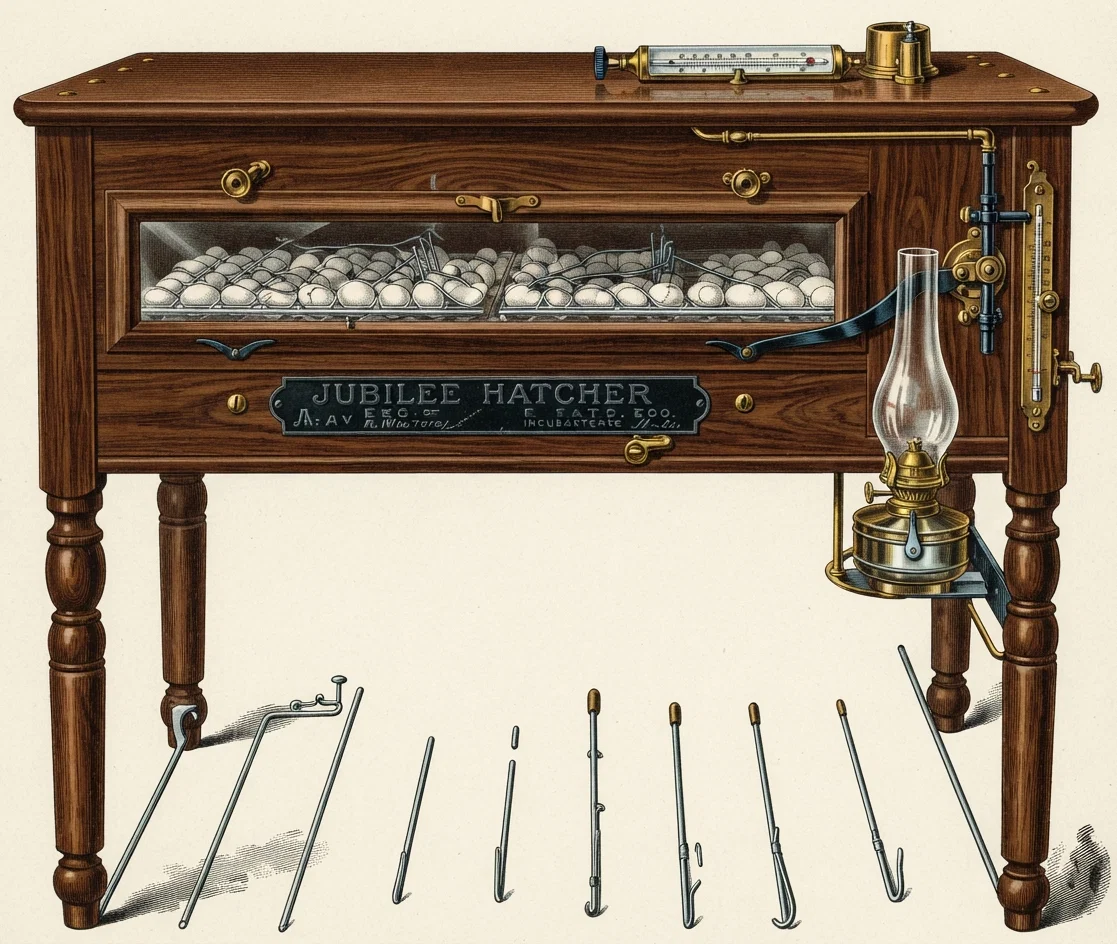
Incubators are a fraud just because you bought a cheap-john machine that was absolutely no good. Ninety per cent. of our customers are dissatisfied users of other makes. We make a specialty of repairing the hurt feelings of those who were afflicted with "Non-Hatchers." The results of the first hatch with a Jubilee will act as a powerful tonic on your system, and you will champion the cause of the best of incubators. The treatment is not as expensive as patent medicine, and you will not regret the expenditure. If you are ailing on the Incubator question and desire a remedy, write for our catalogue.
JUBILEE INCUBATOR CO.
517 Thirty-second Street — Oakland, Cal.
Subscription and Order Instructions
By Editor
1. REMIT by P. O. Money Order, Express Order, or Bank Draft on New York, Chicago, or San Francisco.
2. If paper money or silver is sent, register the letter.
3. Orders and Drafts should be made payable to the PACIFIC PRESS PUBLISHING CO., or to SIGNS OF THE TIMES.
Postage-stamps.—Please do not send postage-stamps, as they are liable to stick together, and are useless in this condition.
Foreign Money.—Do not send any.
Receipt.—No formal receipt is sent unless by special request. The address label on your paper will indicate the time to which your subscription is paid. In case of non-receipt of papers, or any other irregularity, please notify us immediately.
Expiration of Subscription.—All papers are discontinued at the expiration of the time paid for. Notification will be sent several weeks before date of expiration, thus enabling you to renew in ample time to secure unbroken files. Please be prompt, as we can not always furnish back numbers.
Change of Address.—When ordering change of address, please give both the old and the new address.
Important.—Use a separate sheet for SIGNS orders, separate for other papers, separate for books, for tracts, etc., and if you address the editor, use a separate sheet. All can be sent in one envelope, and the money all sent in one order, but write each kind of business on a separate sheet. In this way each order can be handed to the proper clerk and filled at once.
Articles Desired.—Those which set forth in the Spirit of Christ the great saving truths of God, short and to the point. It is better to treat one important truth clearly, in a short article, than many points vaguely in a long one. We desire no caustic, critical productions, which might minister to personal pride or pleasure, but can not save souls.
TO CONTRIBUTORS.
By Editor
THE SIGNS OF THE TIMES is a purely missionary enterprise. For this reason it has felt free to ask for contributions from its friends. It pays nothing for contributions, either prose or poetry, unless solicited by the editor, and then the fact is stated when the articles are asked for. This is a plan rarely followed, but sometimes deemed expedient.
How Prepared.—Write plainly, with typewriter or ink, with wide space between the lines, to freely admit of editing, writing of subheads, etc. Write on one side of the sheet only. Sign the name to the manuscript, as it becomes oftentimes separated from accompanying letter. Anonymous contributions are not used, whatever their merit. If the writer does not wish his name to appear, let him furnish a pseudonym for the public. But we wish the name.
Manuscript Returned.—We will return all unused manuscript desired if stamp and directions are inclosed. We are forced sometimes to return good manuscript mainly for three reasons: (a) Sometimes the articles are too long; (b) sometimes we have a number on the same subject; (c) sometimes our plans are such that an article can not be used till it is out of date. We therefore hope that no offense will be taken by those who have freely contributed their best thought if their productions are returned. When we receive so much matter, we can not use all.
NOTE.—We wish those who ask questions to take particular notice: (1) Only such questions will be answered here as we believe to be of general interest and information. (2) We can not undertake to explain from four to a dozen scriptures, as in one sentence we are often requested to do. (3) Do not ask to "explain" a certain text or passage. State clearly the point in question. (4) Give full name and address, not for publication unless desired, but as evidence of good faith, and to give us the privilege of replying by letter if deemed best. (5) Unsigned communications of any kind find the quickest way to the waste-basket. (6) It is always well to inclose stamp. (7) "Foolish and unlearned questions avoid," also those that minister to mere curiosity. (8) Study the Scriptures yourselves.