AMONG many names and many varieties of doctrine how may the true church of Christ be known? What test may be applied to discover that body of which He is the Head?
There is implied in the question the thought that possibly none of the professed churches are the true church. Certainly not all can be, for the head would not have many bodies. Neither can all be reckoned as perfect members, because there are divisions and strifes and schisms and opposing doctrines.
The Preeminent Test.
If, in our test, we apply that which will be the test of the final estimate of men's lives, we should name first the law of God, which the apostle James specifies as the perfect "law of liberty," the Ten Commandments, by which all shall be judged. James 2:12. That is, the true church under such test would be the church whose creed, if it possessed one, or whose form of doctrine would conform perfectly to this great standard. Not only so as to the body, but the members in particular of this body would possess characters able to stand the application of the test, for the true church must be composed of true, loyal members.
That we are justified in selecting the law of God—the Ten Commandments—as the standard, is also witnessed by a further Bible fact. John, in vision on Patmos, saw the remnant church as it will stand in the final hours of the present age. He specifies this church thus: "Here is the patience of the saints; here are they that keep the commandments of God, and the faith of Jesus." Rev. 14:12.
The Test Is Spiritual.
Here is the whole thing in few words: The church, as saints, will keep the "commandments of God, and the faith of Jesus." There is no conflict between the commandments of God and the faith of Jesus, and it is very evident that the law of Ten Commandments is referred to, tho there are many who do not like to join the two. They ask, Why make this matter of test one of legality? why not a purely spiritual matter?
It is wholly a matter of spiritual test, indeed, that is to be made, for the entire proposition, law and all, centers in Christ Jesus, the Head of the church, and His righteousness. He "is the end of the law for righteousness to every one that believeth." Rom. 10:4. The law is described as a righteous, holy, just law, and the righteous character demanded by it in order to stand its test is the character of God in Christ only. Its fulness is summed up and perfectly expressed in Christ's glorious life.
Then in every one who truly believes in Him is the righteousness of the law manifested, and that not by works of one's own intentions or promises, but by simple faith in the efficacy and power of His life. This kind of legality is highly desirable.
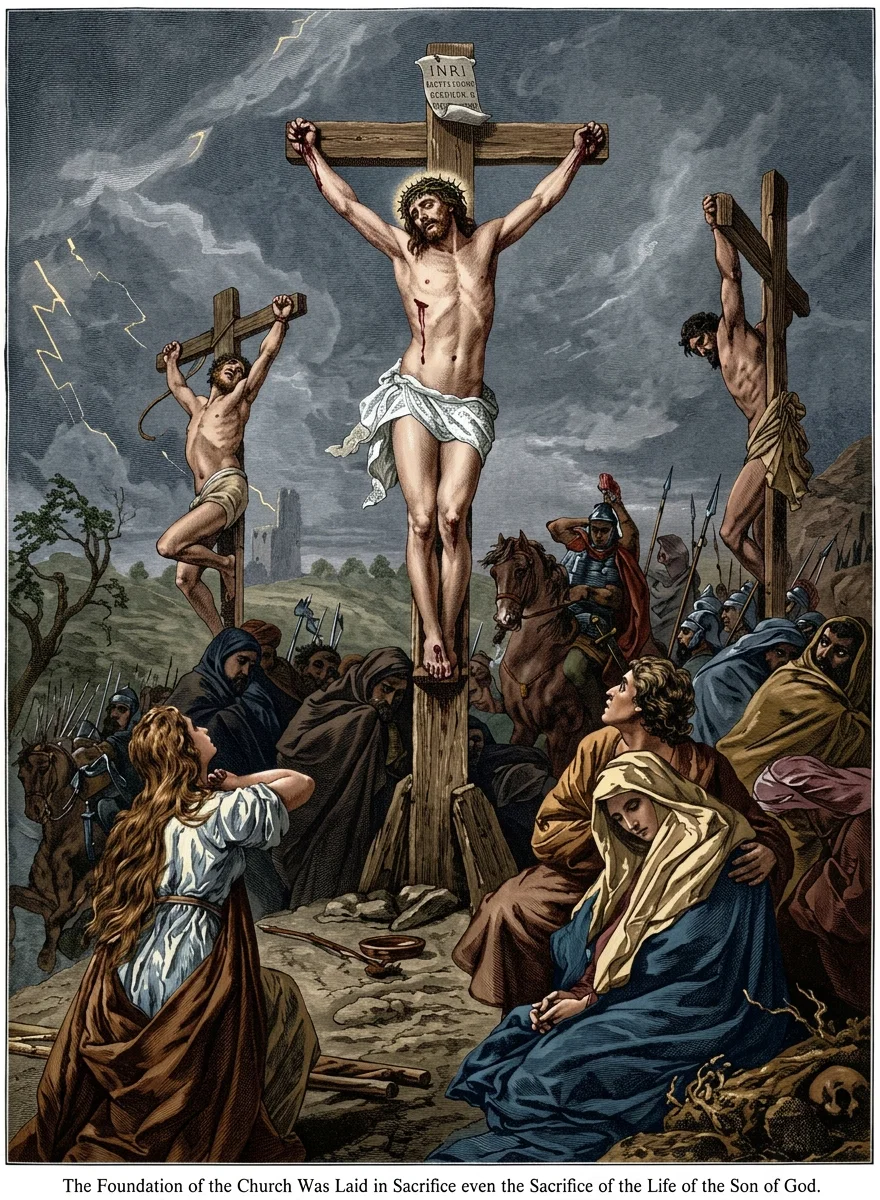
The Foundation of the Church Was Laid in Sacrifice even the Sacrifice of the Life of the Son of God.
What Is the Faith of Jesus?
Then the "faith of Jesus" is the faith of the One who permitted God to work in Him and thru Him the fulness of almighty power to reconcile the world unto Himself. And having performed this great work thru One Man, He would do the works of His good will and pleasure thru and in the flesh of each one of us by virtue of that other work thru the One. We, being dead in trespasses and sins, are made alive by resurrection power. We, while living a natural life, by reason of the virtue of the life of that other One and following in His footsteps, die daily,—are crucified daily,—in order that His everlasting life may be continually manifested in our mortal flesh. This is the faith of Jesus.
But more,—and yet not more, but merely the unfolding of the thought in the word,—this faith of Jesus is His whole life in His word of doctrine, His life of action, His great mission with its glorious hopes. Surely there is no one who will hesitate to let the test be applied to his own profession and life to determine whether he is a member in particular of the body of Christ—the true church.
Having now found and investigated briefly the test and somewhat of its scope, let us notice a few items embraced in it, in order that the application may become more localized, with a view to enabling us to determine more readily our own standing; for there are many who profess Christ with the lips and yet deny Him in practise. It may require some of the details of "the commandments of God, and the faith of Jesus" for this determining.
Possessing Patience.
1. Preeminently, above all, the true church of Christ will be "saints," holy ones, for this was the word to John. They possessed "patience," and "kept"—possessed in their characters—the righteousness demanded by the law in the only possible way to have that righteousness. And they "kept," besides, the "faith of Jesus," with all that that faith embraces.
An Everlasting-Covenant Church.
2. Preeminently, therefore, the true church of Christ will be a new or everlasting covenant church. They are saved by grace; it is the free gift, this salvation; it is not earned by works, nor by promises of their own. They have been made willing by His grace to crucify "the flesh, with the affections and lusts," and have yielded their "members servants to righteousness unto holiness." And He, after this, without one promise of their own, has recreated them into blessed life in the covenant of His grace.
The New Earth Home.
3. The true church, therefore, will be one that is looking with every confidence to the fulfilment of the rest of the everlasting covenant promises,—the establishing of the everlasting home, the earth made new, and the near coming of their Saviour Himself to complete His work.
Important Doctrines.
4. As a part of the consummation of the conflict between righteousness and sin, this church will hold to the Biblical doctrines of the priesthood of Christ under the new or everlasting covenant: the judgment; the resurrection of the dead, both of the just and the unjust, the final destruction of the wicked and the end of sin; and the triumph and everlasting reign of righteousness.
The Sure Word of Prophecy.
5. This hope of the final annihilation of sin and the establishing of the eternal home of righteousness will not rest on mere report, but on the "more sure word of prophecy," which indicates the proximity of the end of the present age and the ushering in of a better age. The true church will therefore6be students and believers of prophecy.
6. This is why the true church will be "built upon the foundation of the apostles and prophets, Jesus Christ Himself being the chief Corner-stone," because all the prophets foretold Him who was to come, and the prophecies of all ages center in Him and His mission.
Their Confession.
7. Very naturally, therefore, the members of this church will confess "that Jesus Christ is come in the flesh,"—in their flesh,—and the confession will be witnessed in the life.
The New Commandment.
8. It will be a church that keeps, necessarily, the commandment of Christ, even His "new commandment," which is, "Love one another; as I have loved you, that ye also love one another." John 13:34. And this is the perfect keeping of the perfect law of liberty, by which we are tested, because "love is the fulfilling of the law."
As Jesus Kept Them.
9. Then it follows that this church will keep the commandments of God as Jesus kept them, for He passed on to His followers that which He had received from the Father, and He did nothing, said nothing, that was not received from the Father. John 8:26, 28; 12:49, 50; 14:15, 21, 24. It seems necessary to mention specially one of these commandments that was kept by Jesus, and which ever abides a part of the law and was confirmed by Him even in His death, but which is somehow regarded by many as of small consequence, tho the rest are highly honored. This is the fourth, or Sabbath, commandment. And by this test we discover that the true church will be a seventh-day Sabbath-keeping church. In saying this, reference is not necessarily made to one or more than one so-called sect that now keeps the seventh-day Sabbath. It is a characteristic of the last and true church.
Discerning Baptism.
10. It will be a church that discerns the deep significance of baptism and applies it, and that honors the other simple and few ordinances established by Christ unto His second coming. See 1 Cor. 11:23-30 and John 13:14-17.
They Teach It in All the World.
11. It will be a church whose members will go "into all the world, and preach the Gospel to every creature. . . . And these signs shall follow them that believe: In My name shall they cast out devils; they shall speak with new tongues; they shall take up serpents; and if they drink any deadly thing, it shall not hurt them; they shall lay hands on the sick, and they shall recover." Mark 16:15-18. Not necessarily that these signs shall accompany every believer; but they will be seen with the remnant church in greater manifestation of power than in the early church.
The Manifestation of Gifts.
12. Not alone will the acts just enumerated be evidenced as "signs," but there will be manifested in this church other gifts of the Spirit, embraced in the "faith of Jesus;" namely, apostles, prophets, evangelists, pastors, teachers, miracles, healings, helps, governments, diversities of tongues, interpretation of tongues, the word of wisdom, the word of knowledge, faith, discernings of spirits, charity, which is love, and every other good and perfect gift within the possession of Him who worketh all in all for the perfecting of the body of Christ. And so, as touching the "signs" that were to follow, and will follow, not every member will possess every gift—so teaches the word. To each one severally will be given whatever gift the Spirit wills. See Ephesians 4 and 1 Corinthians 12.
Two Every-Day Tests.
Having enumerated thus far,—and the specifications might be amplified,—there are given us two every-day tests, virtual epitomes of the foregoing, for the discerning of false prophets and false doctrines:
1. "By their fruits ye shall know them." Matt. 7:20. Profession is well, and necessary, but is worthless unless the right kind of fruit follows. Therefore one might confess with his lips that Jesus Christ has come in the flesh, might acknowledge Him as of God, and the only Saviour of mankind; but if in the actual demonstration of the life the character of Christ is denied, the professor is an unsafe man to follow. Time, required to ripen every fruit, will surely reveal the kind and quality of every tree, if it can not be determined in any other way.
2. "To the law and to the testimony; if they speak not according to this word, it is because there is no light in them." Isa. 8:20. Here is the method for testing doctrines. Not only to the law of Ten Commandments, but to the testimony and teaching of the word respecting the doctrine. As applied in Isaiah, it quickly defined the status of professed revelations from the dead. The deception might not always be revealed so quickly, but the fruits will appear in due time. One can afford to wait, if necessary, for the development of whatever is mysterious or strange. But how essential it is that one shall be thoroly familiar with the word and its teachings!
Do Not Pronounce Judgment.
In the application of this test, great wisdom should be exercised. It is not ours to pronounce judgment upon individuals, even tho error be firmly pointed out. The element of love, essential attribute of "the law," will lead to patient education of the one who may be beholding error, to reveal to him truth. And, the seed having been planted, condemnation will not be pronounced if the fruitage of truth does not appear immediately. God is long-suffering, patient. The true church, the remnant, will reveal His attributes in their characters.
From every nation, kindred, tongue, and people God is calling the members of the church of Christ. Many now dead in trespasses and sins will have an awakening by the creative word of the Gospel; many in the dark ways of heathen lands will respond to the call when the light breaks in. The members of this church are scattered here and there, in this denomination and that, in high walks and in low walks, some acquainted with a little truth, others having greater knowledge, ready to respond when the fuller light shines and the blessed news of a soon-coming Saviour is sounded in their hearing.
Does the true church of Christ now exist? Search and see. Apply the tests in detail. Apply them first to yourself. Become educated. The time is short. And this is the sign of the remnant church: "Here are they that keep the commandments of God, and the faith of Jesus."
Some Great Movements and Their Significance
By William M. Healey
WE are living in an age of great and wonderful developments; in a time when intensity of power is moving all things from above and beneath.
General Conditions.
Conditions exist in the political, financial, social, and religious worlds, so strange, so wonderful, that no human eye, unaided by divine revelation, can see what will be the end of these things.
At the present time the political bodies of earth are assembled by representatives in The Hague, Holland, for the avowed purpose of bringing universal peace on earth. Who, from a standpoint of man's vision, can foretell the result? Such a condition of peace is most desirable for all, and by the fact of the assembling of this congress, it appears to be sought by an overwhelming majority of earthly powers.
A Prophet.
Shall we rejoice in a pleasing prospect of peace? God has not left His children in darkness; He has spoken to them, and told them the truth of the outcome of all these things. Micah 4:2, 3 reads, "And many nations shall come and say, Come, and let us go up to the mountain of the Lord, and to the house of the God of Jacob; and He will teach us of His ways, and we will walk in His paths; for the law shall go forth of Zion, and the word of the Lord from Jerusalem. And He shall judge among many people, and rebuke strong nations afar off; and they shall beat their swords into plowshares, and their spears into pruning-hooks; nation shall not lift up a sword against nation; neither shall they learn war any more." Notice "many nations" say this. And the first verse of this chapter says they say it "in the last days."
In the third chapter of Joel, verses 9-13, the Lord speaks of this same time (see verse 13), the reaping-time, when "the harvest is ripe." And He says, "Prepare war, wake up the mighty men, let all the men of war draw near; let them come up: beat your plowshares into swords, and your pruning-hooks into spears." Thus the Lord tells us to expect, and prepare for, just the opposite of what "many nations" say they are going to bring to us.
What Followed the First Peace Congress.
Our first peace congress of "many nations" was called and convened at the request of the Czar of Russia, who seemed especially desirous to promote some system to bring peace to the world. That congress was immediately followed by the czar and his government being engaged in one of the most bloody wars of the world's history. Man's efforts fail, but the word of the Lord standeth true.
There is a general movement to ferret out and put away the theft and bribery which has so long been common among the officials of almost every department of civil government. This is deceptive and will not produce the desired end. This we know, for God has said, "Evil men and seducers shall wax worse and worse, deceiving, and being deceived." 2 Tim. 3:13.
Religious Combines.
The Christian church has partaken of this same spirit of striving to bring about a different condition of things. This has led to the great movement of uniting all orthodox Christian churches into one great combine, a vast federation, that their powers shall be more effective for carrying out their will and purposes.
What shall we expect when so many millions of the great and influential men of earth unite their strength for one end? From a human point of view it may seem that much good will follow.
It is true God desires His people to be one, to "be of one mind." Let the believer in God's word pause and consider what this movement professes to be, and then what God has said concerning it.
This movement does not aim at obtaining a united faith. The Baptist and the Presbyterian are expected to continue their faith and practises as before, and so with all others. They are not organizing for the purpose of putting away differences. But there are certain points upon which there is a general agreement, and to enforce these is the object of the federation. These leading points are "Marriage and Divorce," and "Sabbath Desecration."
Both of these institutions were ordained of God before sin had entered the world, hence belong to a state of purity, and against these Satan has aimed his worst darts of delusion and perversion, until sin has nearly overwhelmed and destroyed the true spirit and observance of these institutions among mankind. There is need of reform. Will it come thru this vast aggregation of power?
A Better Plan Suggested.
Were this a move to seek for light and truth, that all might "see eye to eye" with the Lord, that all errors might be put away, and all unite upon His pure word, it would be different. The federation is not to seek power from God to change the hearts of men, but it is to unite their own power to bring it to bear with greater force on human authority in earthly governments that by and thru these powers laws may be made to compel others to do their way. This is emphatically true on the two leading propositions—marriage and Sabbath observance.
As marriage is a civil contract, it may properly be regulated by civil laws. But the Sabbath is in no sense an institution to be regulated by civil laws; it is purely a matter of faith, and hence is between the individual and God. If the so-called reform on this were to be brought about by changing the hearts of men, there would be no need of the combine, as it gives no more men for the work. But by this union they can pledge more votes to move the politician's heart.
Not Enforcing the True Sabbath.
While it would be wrong to attempt to enforce the true Sabbath upon any, these efforts do not have even that excuse of enforcing the Sabbath of the Lord on man. On the contrary, they are trying to enforce the sabbath of man upon the Lord and His people. God's Sabbath is the seventh day, while the purpose of this movement is to enforce the first day, resting wholly upon human authority.
In 2 Tim. 4:1-3, the Lord by His servant Paul speaks of His coming and charges to "preach the word," saying in verse 3, "For the time will come when they will not endure sound doctrine; but after their own lusts shall they heap to themselves teachers." In James 5:3, we read of the wicked in the "last days" that they have "heaped treasure together." This has been fulfilled in the great trusts and combines in the business world. But here it is said the professed people of God are to "heap" their teachers together. This is fulfilled in this great religious trust, this vast confederacy to carry out, like the business trust, by force, their wishes. The commercial trust says, Do our way, or we will break up your business. This religious trust will say to the candidate for office, Give us what we want, or we will defeat your election.
The Confederacy Foretold.
There is a prophecy that covers this work at this time, in Isa. 8:9-17. "Associate yourselves, O ye people, and ye shall be broken in pieces; and give ear, all ye of far countries; gird yourselves, and ye shall be broken in pieces. Take counsel together, and it shall come to naught; speak the word, and it shall not stand; for God is with us. For the Lord spoke thus to me with a strong hand, and instructed me that I should not walk in the way of this people, saying, Say ye not, A confederacy, to all them to whom this people shall say, A confederacy; neither fear ye their fear, nor be afraid. Sanctify the Lord of hosts Himself; and let Him be your fear, and let Him be your dread." Verses 9-13. In verse 16 the Lord commands, "Bind up the testimony, seal the law among My disciples."
The seal of God's law is in the Sabbath commandment. It shows from whom the law comes, the Creator of heaven and earth, and thus establishes His power and right to give the law. The substitution of the first day does not point to the Creator, and never had any place in the law of God.
Thus the Lord has warned against a confederacy that is not restoring the seal to His law among the disciples, that has a "heap" of teachers of which He says in 2 Tim. 4:4, "And they shall turn away7their ears from the truth and shall be turned unto fables."
May the Lord reach down in love and tender mercy, saving all who are willing to walk with Him, forsaking this great delusion and snare, this false hope, this error of mind if not of heart, of so many for whom Christ died.
Study God's Word and Prophecy
By Ellen G. White
Those who will devote their powers to the study of God's word, and especially to the prophecies referring to these last days, will be rewarded by the discovery of important truths. The last book of the New Testament Scriptures is full of truths that need to be understood.—Mrs. E. G. White.
“Head Over All Things to the Church.”
AND” He “put all things in subjection under His feet, and gave Him to be Head over all things to the Church, which is His body, the fulness of Him that filleth all in all.” The foregoing words are the concluding verses of the first chapter of Paul’s letter to the Ephesians. They are full of meaning to the one who reverently studies the word of God.
The Church is “His body,” that is what the text plainly says. And while the body can never be the head, and can never usurp the functions of the head, yet it is always, if normal, in harmony with the head,—it will always obey the will and commands of the head, and do it without murmuring.
Every person that becomes a part of Christ’s body is thereby made a member of His Church. And the process by which we become members of His body is learned only by a study of His word and by receiving that word into the heart and life. The word thus received into the life, being clothed with living energy thru the agency of God’s Spirit, becomes a transforming power, building our characters into the perfect likeness of the character of Christ. The living word of the living God takes the perfect character of the Son of God and actually grows that character into the members of His body, the Church.
It will readily be seen, then, that actually to be a member of the body, or the Church, of Christ is much more than a mere profession; it is much more than merely having the name enrolled on some church book. It means to be connected with Christ as the body is connected with the head, so that just as the head directs all the movements of the body, even so are we to be directed by Christ, we are to learn to accord the same prompt obedience to Him that the hand or the foot yields to the head. And this wonderful result of being connected with Christ so that we have and live His character is all accomplished thru faith by the power of His word.
Actually to receive and live the real Christ-life is a thing that multitudes of professing Christians do not take into serious account. They seem to think that having their names on the church book is all they need for a passport into heaven. They want some kind of a religion “that will enable them to go to heaven when they die.” If they did not expect to die sometime, they would not trouble themselves about church matters at all. They have not found the joys of Christian living; they are concerned only with the terror of having to die at some future day, and so they join the Church “in order to be prepared to die.”
This accounts for the fact that so many persons are church-members without being real Christians. They belong to the visible, outward Church without being made a part of the body of Christ. They have not allowed themselves to become connected with Christ, the living Head of the Church, and so He has no power to direct their lives in harmony with His divine will. They are not connected with Him except by the mere formality of taking His name thru joining the Church. It is a vastly different thing to comply with the formality of merely taking the name of Christ by joining some church, than to become in reality a part of His spiritual body, the real spiritual Church, thru a close, living connection with Him.
“I am the true Vine, and My Father is the Husbandman. Every branch in Me that beareth not fruit, He taketh it away; and every branch that beareth fruit, He cleanseth it, that it may bear more fruit. Already ye are clean because of the word which I have spoken unto you. Abide in Me, and I in you. As the branch can not bear fruit of itself, except it abide in the vine; so neither can ye, except ye abide in Me. I am the Vine, ye are the branches: he that abideth in Me, and I in him, the same beareth much fruit: for apart from Me ye can do nothing. If a man abide not in Me, he is cast forth as a branch, and is withered; and they gather them, and cast them into the fire, and they are burned. If ye abide in Me, and My words abide in you, ask whatsoever ye will, and it shall be done unto you. Herein is My Father glorified, that ye bear much fruit; and so shall ye be My disciples. Even as the Father hath loved Me, I also have loved you: abide ye in My love. If ye keep My commandments, ye shall abide in My love; even as I have kept My Father’s commandments, and abide in His love. These things have I spoken unto you, that My joy may be in you, and that your joy may be made full.” John 15: 1-11.
The foregoing scripture so wonderful for its beauty, and so satisfying and helpful in the wealth of its promises, is the Master’s presentation of the living connection that exists between Himself and each member of His Church. He is the Vine. He supplies the life and the power that directs and keeps us in righteous living. But that righteous living all depends upon our perfect connection with the Vine. We must be a branch; we must be a living part of the “true Vine.” “Abide in Me, and I in you. As the branch can not bear fruit of itself, except it abide in the vine; so neither can ye, except ye abide in Me,” “for apart from Me ye can do nothing.” There is no right thing that we can do apart from the life of the Master—apart from the living connection of the branch to the vine.
Then there is a far deeper significance to church-membership than merely to have the name on the church book. The church membership that Christ, the Head of the Church, recognizes is a perfect union with Him. Anything short of this does not make us a part of the real Church of Christ, no matter how indelible may be the ink with which our name has been enrolled on some church register, nor how prominent may be our professions and pretensions.
Let us study, then, to be connected with Christ in reality, rather than to be merely a part of the outward profession that has none of the indescribable joys of real Christian living in it. For there is a joy in living the life of the Christian, and this joy is too full and complete to be described in words. It must be tasted, it must actually be experienced in order to be understood and rightly prized.
In the Valley of Decision.
Friend, How Are You Deciding?
EIGHT centuries before Christ, God gave to one of His servants a vision of the far future. To the prophetic ken came the condition of his own generation, sinful and barren, and the judgments of unerring justice because of the sin, loved and long persisted in. The conditions then were typical of far future conditions. The judgments then were typical of the great final judgments. The latter rains of his own land became the type of the abundant outpouring of the Spirit of God in the last days. The last-day preparations for war among all the nations are vividly portrayed; and the prophecy clearly indicates that this preparation occurs just before the great harvest of God, the end of the age, the second coming of Christ. (Compare Joel 3: 9-12; Matt. 13: 39; Rev. 14: 12-14.) At this time God sits "to judge all the nations;" "for their wickedness is great."
Then, preliminary to the execution of judgment, the prophet sees "Multitudes, multitudes in the valley of decision! for the great day of Jehovah is near in the valley of decision."
The time of the fulfilment of the prophecy is abundantly shown to be the last days: (a) It is a time when God sits in judgment upon the nations. (b) It is when the harvest of the earth is ripe for the wine-press of wrath. Rev. 14: 14-19. (c) It is at a time when the great day of God is near, and probation shall be forever closed; for that day to earth is "a day of wrath, a day of trouble and distress, a day of wasteness and desolation, a day of darkness and gloominess." Therefore God thus exhorts His people:
"Gather yourselves together, yea, gather together, O nation not desired; before the decree bring forth, before the day pass as the chaff, before the fierce anger of the Lord come upon you, before the day of the Lord's anger come upon you.
"Seek ye the Lord, all ye meek of the earth, which have wrought His judgment; seek righteousness, seek meekness; it may be ye shall be hid in the day of the Lord's anger." Zeph. 2: 1-3.
That decree is God's declaration that all has been done that could be done, and humanity must be left to the characters they have forever chosen:
"He that is unjust, let him be unjust still; and he which is filthy, let him be filthy still; and he that is righteous, let him be righteous still; and he that is holy, let him be holy9still. And, behold, I come quickly; and My reward is with Me, to give every man according as his work shall be." Rev. 22: 11, 12.
Just previous to this awful declaration is the time of the fulfilment of the prophet's vision, when "multitudes" are seen "in the valley of decision." Why is this? The answer may be found in the fourteenth chapter of Revelation, which we have before shown is a supplement to this prophecy in Joel. Verses 6 to 12 present before us their messages, sometimes denominated the first, second, and third angel's messages, but in reality, one great Threefold Message, going to all peoples, nations, languages, tongues, and kindreds, the last phase of the everlasting Gospel, announcing the impending judgment of God.
The first of these messages calls from the fear of all things earthly to the reverent fear of God; from giving glory and honor to man to rendering to God that which is His due; from the worship and service of the creatures to the worship or service of the Creator. All this must include faith in Jesus Christ, the Saviour of men, and obedience to every precept of God. This is clearly evident from the twelfth verse, which describes the class of people developed by the heeding of the message: "Here is the patience of the saints, they that keep the commandments of God, and the faith of Jesus." Such are the characteristics of the remnant Church which shall greet the Lord when He comes.
The second part of this message declares that Babylon, the great, confused mass of creeds and associations of human origin, is fallen. The third forces us to the conclusion that because of the rejection of the first message the religious world has turned from the power of God to the power of men, and thus formed a union of Church and State identical with the beast and its image of chapter thirteen. Against yielding to this union the solemn voice of the third angel is lifted. The alternative is presented of temporal gain and ease in the service and sin of the beast, or the worship and service of God with temporal persecution and loss, but with eternal triumph in the world to come. Rev. 15: 2, 3. The two ways are set before the entire world as never before; and the prophet, seeing the time, declares, "Multitudes, multitudes in the valley of decision; for the great day of the Lord is near in the valley of decision."
Dear soul, you are one of the multitudes. You can not remain neutral. You must decide either for God or against Him. Nay, more; you must decide for yourself or against yourself. Your eternal interest and eternal destiny are involved for weal or wo. Why not "fear God, and give glory to Him"? Why not "worship Him," the great Creator? Why not look to the judgment of God rather than the judgment of men? Why not accept Jesus Christ as your complete Saviour, His example of perfect obedience to the commandments of God as your example? What is all the world with its blandishments, its pleasures, its gains, compared with one moment with God in eternity? Why not be ready to face the great day of God, with its awful burden of wrath and judgment, knowing that you have a mighty Friend who is able to save you and will save you to the uttermost? May you be among those who shall decide for God.
The Original Home of Man.
“The Lord God planted a garden eastward in Eden; and there He put the man whom He had formed.” Gen. 2: 8.
Another translation reads:
“The Lord God had planted a paradise of pleasure from the beginning: wherein He placed man whom He had formed.”—Douay Version.
“This is called Eden, which signifies a place of pleasure. In the Septuagint it is rendered ‘paradise,’ denoting a park, or a place of trees.”—“Pulpit Encyclopedia,” p. 54.
Josephus, the Jewish historian, says: “God planted a paradise in the East, flourishing with all sorts of trees; and . . . when He had brought Adam and his wife into this garden, He commanded them to take care of the plants.”—“Antiquities,” book 1, chap. 1, par. 3.
Doctor Smith, LL.D., says: “EDEN. 1. The first residence of man, called in the Septuagint paradise. The latter is a word of Persian origin, and describes an extensive tract of pleasure-land, somewhat like an English park, and the use of it suggests a wider view of man’s first abode than a garden.”—“Smith’s Bible Dictionary,” art. “Eden.”
Doctor Fausset, M.A., writes: “Eden was but a temporary nursery for the human family: thence men, had they remained innocent, would have spread out in every direction till the whole earth became the garden of the Lord. God’s purpose, tho deferred, will in His own time be realized by the Second Adam, the Lord from heaven.”—“Bible Encyclopedia,” art. “Eden.”
“Ask Whatsoever Ye Will.”
THERE is a plan by which we may have anything we ask from the Lord. That plan is clearly set forth in the following words of the Saviour: “If ye abide in Me, and My words abide in you, ask whatsoever ye will, and it shall be done unto you.” John 15:7.
We may ask whatsoever we will, “and it shall be done” unto us. This is the direct promise and decree of the Lord Himself. But we must not fail to observe the conditions. “If ye abide in Me, and My words abide in you,” says the Master, then “ask whatsoever ye will, and it shall be done unto you.” The abiding of the individual in Christ and the abiding of the words of Christ in the individual states the plan or the conditions upon which the Lord bestows the great gift of unqualified answer to prayer.
God answers right prayers. Any one can see that it would be ruinous for Him to answer wrong prayers. It is God’s good pleasure to answer us when we ask for things that are right. He who gave the father and the mother all the instincts of pleasure that come in giving good gifts to our children has those joys of giving to His children in an infinite degree Himself.
But our heavenly Father is not indulgent with wrong-doing. He knows perfectly what wrong-doing will result in, and so He will not grant us wrong things, even tho we urge the request upon Him ever so strongly. Children are apt to tease their parents for things that they want, and frequently the parents will allow their judgment to be overruled by the importunity of the child, and things are granted that are not for the best, yes, things are allowed that are positively wrong and hurtful. But the Lord is willing only to bestow that which is good. He wants us to have what is right, and only that, and the right is always the best.
Then we may ask whatsoever we will and receive it, provided we ask for right things. And, to know how to ask for right things, it is necessary for us to abide in Christ, and to have His words abide in us. It is a plain, simple plan, and there is no real pleasure in following any other. But there are infinite pleasures in following God’s way that pass beyond the powers of description.
T.
The Cry of the Poor
“Whoso stoppeth his ears at the cry of the poor, he also shall cry, but shall not be heard.”
Where This Garden of Eden, Paradise, Is Said to Be Now.
By Arthur L. Manous
The apostle Paul says: “I knew a man in Christ above fourteen years ago; . . . such an one caught up to the third heaven. And I knew such a man . . . how that he was caught up into Paradise.” See 2 Cor. 12: 1-4.
Esdras writes, saying: “Behold, the time shall come, that these tokens which I have told thee shall come to pass, and the bride [evidently Paradise, 2 Cor. 12: 1-4] shall appear, and she coming forth shall be seen, that now is withdrawn from the earth.” 2 Esdras 7: 26.
Mr Kurtz, the historian, says: “The true Paradise is now translated to the invisible world. At least a symbolical copy of it, established in the holy of holies in the tabernacle, was granted to the people of Israel after the pattern which Moses saw in the mount (Ex. 25: 9, 40); and the original itself, as the renewed habitation of redeemed man, will hereafter descend to the earth. Rev. 21: 10.”—Quoted in “Daniel and the Revelation,” p. 351.
Another author says: “The pure and lovely Garden of Eden, from which our first parents were driven, remained until God proposed to destroy the earth with a flood. God had planted that garden and especially blessed it, and in His wonderful providence withdrawn it from the earth, and will return it to the earth again, more gloriously adorned than before it was removed from the earth. God proposed to preserve a specimen of His perfect work of creation free from the curse wherewith He had cursed the earth.”—“Principles of True Science,” p. 48.