The Youth’s Instructor, Vol. 49, No. 26.

THE KING OF FISHERMEN

The Youth’s Instructor

Jun 27, 1901

Review and Herald Publishing Company · Battle Creek, Mich. · Jun 27, 1901

THE KING OF FISHERMEN
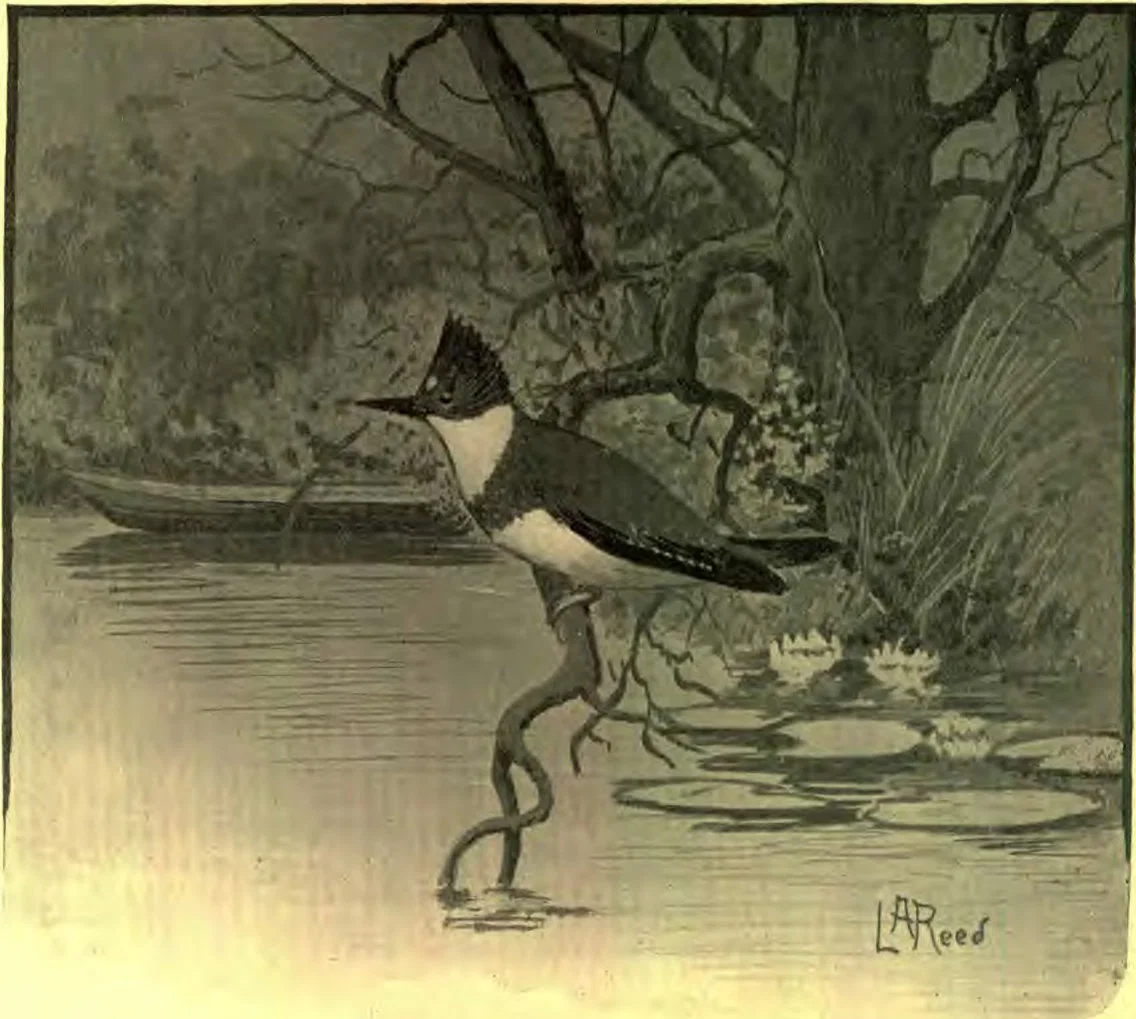
The Belted Kingfisher is a sprightly creature. He is not above making some noise, and his movements are as swift as they are certain. His note is very peculiar, and he certainly can not be offended with us if we term it a rattle.
He is ever on the watch for food, and he needs but the glint of a shining fin, or the flash of scales just beneath the water, to make his silent, headlong plunge. In another moment he emerges from the water with the fish in his bill, shakes the water from his plumage, and with victorious shout, or rather rattle, flies away to some favorite perch.
THE HAUNT OF THE KINGFISHER
In our illustration we see him in a common position. His favorite haunt is the shores of a wooded stream or lake or pond. Here, perched on some limb which overhangs the water, he silently waits for fish or foe. It may appear that he is looking straight ahead; but do not be deceived by him. He is looking down at the surface of the water, on the watch for some unsuspecting fish. Besides, he is on the alert for any danger that may threaten him. Try him once, and you will see.
Paddle toward him now, as quietly as you please. Just as you are near enough for what he thinks is danger, he drops from his perch, and with a loud, rattling cry, flies on ahead. Paddle toward him again if you wish. When you think you are in fair sight of him, away he flies once more; and so it continues until he has gone quite a distance, when he will make a detour, and return to the spot whence he started.
You will find his nest, if you are shrewd enough, built in a hole in the bank, where, early in May, his mate lays from five to eight white eggs. The birds use their feet as trowels in excavating these holes in the bank of earth. It has been said that they are about three weeks in excavating their nest. Sometimes they dig a tunnel over five feet long; and the male bird has been known to burrow a second hole over three feet deep, in which to sleep. You see he believes in having a bedroom all his own. The young, when first hatched, have no feathers, and remain in their nests for several weeks.
The Kingfisher does not confine himself to a diet of fish. Though he is the king of fishermen, he eats crustaceans, grasshoppers, crickets, June bugs, and beetles with relish if opportunity offers; and in Arizona, where rivers are scarce, and the country largely desert, he lives principally on beetles, grasshoppers, and lizards.
Though naturally very crafty and timid, he becomes quite tame if well treated. Miss Merriam says that at Lake Placid, when moored in a boat alongshore, she has had one perch almost over her, and dive so near that the water spattered her paddle.
The Kingfisher is certainly a very interesting bird, and well worthy of study.
L. A. REED.

THE HOME OF “MOTHER CAREY’S CHICKENS”
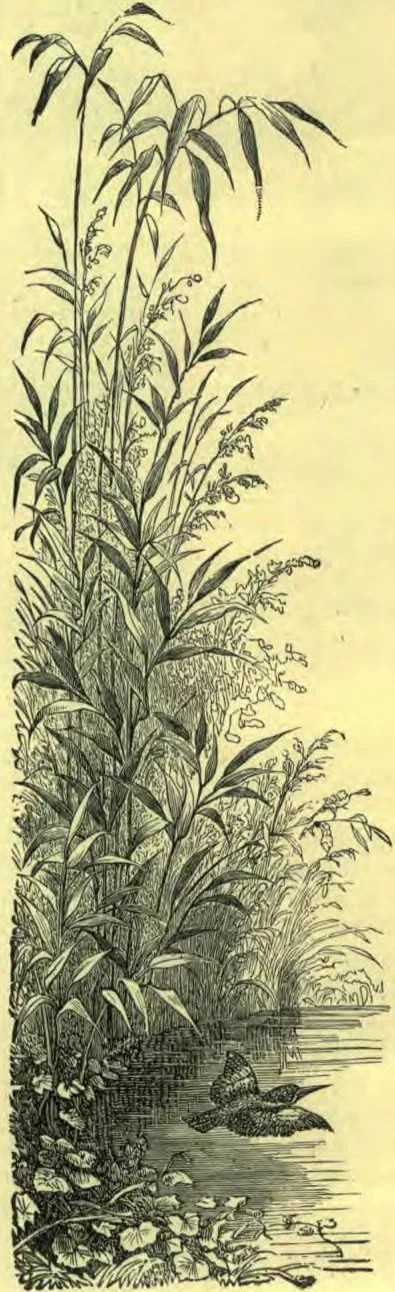
A STRANGE little bird, about as large as a swallow, with long wings, and sooty in color, except for a band of white on its back, has been named by the sailors after an imaginary old witch. “Mother Carey’s Chickens” know nothing about coops and hen-roosts. Most of the year they have no home but the heaving billows. They patter with their little black feet over the ocean floor, seeming to walk upon the water. So they have been called “petrels,” after Peter. But their wings move all the time, and really they are flying. They have to sleep sitting on the water, and when the wind makes the waves break, they keep flying day and night until it is calm again.
Sometimes they get tired out. During an October hurricane I was on Cape Cod watching the surf, and saw a poor petrel washed ashore and lie fluttering on the beach, all bedraggled and too weak to rise.
I find great fun, when far offshore in a fishing boat, attracting the petrels. If there are none in sight, I throw out a piece of cod liver as we sail along. By and by I see a petrel away astern, hovering over one of the bits. Soon it overtakes the smack. Then another comes, and before long there are perhaps a score about us. I toss out more liver alongside, and they come up so close as almost to feed out of my hand. In this way I once caught one alive.
Yet, after all, these little wanderers have a real home for part of the year. As they can not hatch their young on the ocean, in May they seek out some lonely island, and this is their nursery till September. I have visited a number of these places. The most interesting that I know of is Seal Rock, twenty miles off the coast of Maine.
One bright day in June a friend and I engaged a schooner to take us to this wild, lonely retreat. The captain landed us with a dory, and sailed away, leaving us there till night. We scrambled up the slippery rocks, and found in the top a grassy slope about a mile long. There was not a bird in sight, but in the turf at our feet were many little burrows, like rat-holes. Choosing one, I tore up the sod for about two feet, and then I found what I was after. In a little round hollow lined with dry grass sat a mother petrel on a single white egg. She did not try to escape, but when I took hold of her, she squirted out from her strange, tube-like nostrils some yellow oil that had a disagreeable smell. Next, bird, egg, and all smelled of it.
Then I opened my hand to see what she would do. The sudden strong light must have almost blinded her, for she made off in an irregular, zigzag flight down to the water, and away out over the ocean. There were thousands of these holes all about the island. The birds never show themselves in the day, but at night father and mother petrel change work. One comes in from the sea to sit on the egg, and the other wanders off, far away, to get food.—Selected.

A BIRD SONG

I HEARD a song sparrow this morning; Its burden of melody thrilled As if the great joy of its spirit The whole world of sadness had stilled. And yet it was cloudy and ugly And chilly and damp out of doors. I listen: again the wee songster His bosom of rapture outpours!
’Tis a whole loyal heart packed with praises, As if the All Father above Had touched its bird spirit with gladness, From out of his heaven of love. Hark! hear o’er the meadow and pasture The little one trill as it sings,— The gladdest of all the vast army Of singers with feathery wings.
I heard it; it filled me with sunlight; For weary this morning I was So busy with work, thought, and hurry. I scarcely was willing to pause. But birdie, small birdie, glad birdie, Your rapturous song of delight Filled the depths of my spirit with visions That made the dark morning grow bright.
If a little song sparrow could do it,— Bear a message of joy from above,— Could a heart, could your heart, O my brother! Bear to sorrow a message of love? For the world is so sad and so burdened, With a sense of its toil and its care, That it needs a sweet bird song of gladness, Of rapturous joy, everywhere.
So the birds have hailed morn since creation With melodious matins of praise; In the gloom, or the burst of the sunlight, They have welcomed all manner of days. Then, my heart, take their chorus and sing it,— Your bird song,— while ever above The angels shall hear the far echo Respond to their harpings of love.
B. F. M. SOURS.

“GRIND IT INTO THE WOOD”

“Don’t have your sections wet; dip the point of your knife in honey, and having placed your piece of comb foundation smoothly in your section, grind the edge of it into the wood.”
This was the carefully worded instruction that I received from my brother when being initiated into the mysteries of bee-keeping.
“Grind it into the wood.” It looked easy enough as I watched him go through the process.
I placed my clean, white bass-wood boxes in a convenient row, put in the comb, and went to work. “Try them: pull on them—so,” he said, when I had finished the lot.
I gently pulled at each piece, and nearly every one came off. It was discouraging. “You didn’t grind them into the wood,” was his not very comforting explanation. “This must be done, or the warmth and weight of the bees, when they hang in a cluster on your comb in the hive, will pull the pieces loose, and they will fall to the bottom of your sections. You will get no honey that way.”
I tried again, and was more successful; but many times since, in taking off my cases in the fall, I have found now and then among the well-filled boxes one or two that had nothing in them but an ugly-looking lump of wax.
What was the trouble?—My work had not been well done; hence the consequent loss and vexation.
It pays to be careful; to do whatever we do faithfully. Nothing is ever gained by being in a hurry, or by slighting one’s tasks. Not to do work well is not only to rob ourselves in a pecuniary way, but also of character. It makes us slipshod in principle. From being careless about our own work, we come to be careless about how we do that of others, and defraud them by taking wages for that which we have not done.
The weeds are left in the corn-hills; the corn is not properly thinned; seeds are half covered; bundles of wheat and oats so loosely bound that they fall to pieces in handling; wheat- and corn-shocks so poorly put up that they tumble over, and the grain is spoiled. Putty and paint are but half put on; mud wasp-nests are painted over; the piece of furniture is poorly put together, and badly varnished; the garment is slighted in making; the clothes are left mottled with dirt-stains by the washerwoman.
Grind it into your hearts, young people, that all work must be perfect when it comes from your hands.
If you cheat in sewing, in picking berries, in tidying up the stove-room, in piling wood, you will be sure to try to cheat God. No person will be faithful to him, who is not faithful to man. And it is just as true, too, that one who is unfaithful to God will not be faithful to man.
“Whatsoever ye would that men should do to you, do ye even so to them,” is the law that binds you to faithful work. Keep it, and you will find success and abundant blessing.
MRS. S. ROXANA WINCE.

GOD A BENEVOLENT BEING

THE heathen philosophers inferred from the mere light of nature that God must be good. One great moralist of ancient times wrote: “The first act of worship is to believe the being of God; and the next, to ascribe majesty or greatness to him, and to ascribe goodness, without which there can be no greatness.”
We have proofs of God’s goodness in the adaptation of the physical creation to the promotion of human happiness. There was no necessity that God should paint the sky, the fields, and the forests with the most agreeable of all colors to the natural eye; that he should perfume the air with fragrance, and spangle the earth with flowers; that he should give the atmosphere power to fall upon the ear in such sweet and rich harmony of sounds; that, in short, he should make —
“All nature beauty to the eye, And music to the ear.”
Yet God has filled creation with beauty, and glory, and wonder; he has lavished the treasures of his wisdom in multiplying sources of enjoyment on every hand; and then he has hidden in the human soul a deep fountain of feeling, a susceptibility of emotion, from the presentation of such objects. Having drawn across that sacred harp the tender strings of taste, sentiment, and love of the beautiful, he has given to nature the power to awaken, from that harp, tones of the sweetest music.
We see another illustration of the benevolence of God in still other sources of happiness provided for his intelligent creatures,—in the pleasures of thought, of memory, of the conscious power to rise above a physical world into regions of truth, and hold communion with the great Author of all being.
Let him who doubts whether God is benevolent take his position, at some hour of the morning, upon the banks of a stream, beneath the overhanging foliage, as the sun awakens the tide of life, and then decide the question, as to the goodness of God. Beneath him the fish are leaping up from their native element in sportive enjoyment; around him are innumerable tribes of happy insects, rejoicing in their being; above him the trees are full of warbling birds, and the whole forest is vocal with sweetest music. The air, perfumed with flowers, is wafted to him; and as his soul drinks in the full tide of beauty, music, and love, his heart, too, must overflow with love and gratitude to God.
In contrast with all this, there may seem, to a superficial observer, to be a darker shade to the picture — as in the lightnings and storms, the raging of the elements; in the sickness, disappointments, and trials incident to human existence even in its best estate.
But as the raging of the elements, the lightnings, and the storms purify the atmosphere from noxious vapors, and render it healthful, so the trials, disappointments, and sorrows of life are far from being unmixed evils. They are disciplinary in nature, and are sent in love to develop in us noble, upright, sympathetic characters.
JOSEPH S. JOHNSON.

The Value of Cheerfulness

No one can be sad where cheerfulness reigns. Then let us all try to be cheerful, so that none of our companions will ever have occasion to be sad.—Boys’ Lantern.

THE BLUE ABOVE

THERE was never a day so misty and gray That the blue was not somewhere above it; There is never a mountain-top ever so bleak That some little flower does not love it.
There was never a night so dreary and dark That the stars were not somewhere shining; There is never a cloud so heavy and black That it has not a silvery lining
There is never a waiting time, weary and long, That will not sometime have an ending; The most beautiful part of the landscape is where The sunshine and shadows are blending.
Into every life some shadows must fall, But heaven sends the sunshine of gladness; There are rifts in the cloud, and we may, if we will, See the beautiful blue through the sadness.
Then let us hope on, though the way be long, And the darkness be gathering before us; For the turn in the road is a little way on, Where the home-lights will ever shine o'er us.
—Selected.

STUDIES IN THE CHRISTIAN LIFE

“Steps to Christ,” Pages 7–16
(June 30 to July 6)
One of the first things to do in studying a lesson is to find the principal thoughts, and learn them. In any well-written piece of prose, these will shine out as the colors of the rainbow, and unless we are color-blind, we ought to be able to see them. The rainbow is a good example of one of the “unnumbered tokens” of the love of God, as revealed in nature. It is round, it has no end. So God’s love encircles the earth, and is limitless. The seven colors blending together beautifully symbolize the character of God; and as the rainbow was given to remind us of his mercy, so Christ is a pledge of the same.
The principal thoughts of this chapter are these:—
  1. Nature has unnumbered tokens of God’s love for man.
  2. The word of God also reveals it.
  3. Satan has blinded men’s eyes so that they can not see it.
  1. Christ came to remove the shadow: every act of his life was full of love.
  2. Nothing less than this sacrifice could express God’s love for us.
  3. Result: we are called the “sons of God.”
This last thought is the climax. God’s love so impressed the apostle John that he could not describe it; and in thinking upon the high calling of men, he wrote, “Behold, what manner of love.”
It will require repeated study to get what a lesson contains. As the important thoughts begin to linger in the mind, collect them together in the same order as written, and give a summary. Very few persons can do this. Sometimes in Sabbath-school the request is made, “Give a synopsis of our lesson,” and it is difficult to find one who can do it. This was one of Professor Bell’s chief methods of study; and, although both in day-school and Sabbath-school it is not developed as it should be, still it is just as important as ever. Summarize the lesson often, repeating it aloud, so that, if called upon to answer in public meeting, you can do so “distinctly, and give the sense.”
This first chapter of “Steps to Christ” has one object in view—a glimpse of the love of God. We are pointed to three witnesses of his love,—nature, the word, and Christ’s life. Can you see it?—Yes, you can, but do you? Let this question be in every mind. As we walk from one place to another, why not hunt for the “unnumbered tokens” of it?
Always search for promises in such a lesson as this. There is a very important one in the last paragraph of the chapter; what is it? Surely such a promise should stir every soul to think upon the love of God.
In reading over the lesson, what impressive quotations do you find? Mark them, memorize them, and learn to find them readily. If you should ever canvass for “Steps to Christ,” this will help to make you successful. Here and there in the chapter stand out divine commentaries on certain texts of Scripture. Record these in your Bible, not so much for your own sake as for the sake of others who may be puzzling over some of these very texts. Point them to the explanation, and in so doing you will be able to fulfill the very object of Testimony study—to make the Bible plain.

QUESTIONS FOR STUDY

  1. What is there in nature to show God’s love for us?
  2. What chapter in the Bible especially portrays his character? Notice the one mentioned in our lesson, and then find others.
  3. What difference is there between the revelation of God’s love in nature, and the manifestation of it in Christ? Compare pages 9 and 16.
  4. What caused this difference?
  5. In what special ways did Christ reveal God’s love for men?
  6. What was it that made him cry, “My God, my God, why hast thou forsaken me?”
  7. What inspired commentary is given on John 3:16?
  8. “Therefore doth my Father love me, because I lay down my life.” What in this verse shows God’s great love toward us? Consider page 14.
  9. Why is Christ the only one who could make manifest the love of God?
  10. How completely has God given his Son?
  11. What exalted conception of God’s love toward us had the apostle John?
  12. What value does this place upon man?

A GOOD MEETING

KNOWING that the young people everywhere are glad to know what others are doing, and how the Lord is blessing them, we take pleasure in giving a brief account of an interesting meeting held by the Battle Creek young people, Sabbath, June 15.
Following the opening songs and prayer, the president read John 3:1-10 and Gal. 5:22-26, concerning the new birth and the fruits of the Spirit. The connection between these scriptures is plain, since the fruits of the Spirit follow the new birth.
Several persons, previously invited, then spoke about three minutes each upon these different virtues; and between these talks, short, pointed testimonies were given upon each subject.
From these three-minute talks we glean the following:—
Love: God, through Christ, has been giving his life for us through all the ages of this world's history, and his holy angels are continually ministering for those who shall be heirs of salvation. In giving his Son, God gave his own life. He is the embodiment of love.
Joy: The word says: “Fulfill ye my joy,” and, “These things have I spoken unto you, that my joy might remain in you, and that your joy might be full.” A distinction is made between the joy of Christ and that of the world. We are told that “our Saviour’s joy was in the uplifting and redemption of fallen man;” and it therefore follows that if we are clothed with his righteousness, and filled with his joy, we shall do the same work that he did. “The effort to bless others will react in blessings upon ourselves. This was the purpose of God in giving us a part to act in the plan of redemption. He has granted men the privilege of becoming partakers of the divine nature, and, in their turn, of diffusing blessings to their fellow men. This is the highest honor, the greatest joy, that it is possible for God to bestow upon men.”
Peace: The peace of God is freely offered us to-day, and the possessing of a tranquil mind and heart lies in our accepting it. No experience, condition, nor walk in life, is so adverse that at the same time we can not be at peace with God. But in order to enjoy this peace, we must receive it. “Peace I leave with you, my peace I give unto you: not as the world giveth, give I unto you.”
The remainder of the time was allotted to Brother H. R. Salisbury, who gave a short, helpful talk upon How to Study the Word of God. His remarks were well put to the busy class of young people who assemble weekly at our meetings. Those who work from morning till night, and are often physically and mentally wearied with care and responsibility, are apt to say, “I am too tired; I have no time to study God’s word.” But these, by keeping their eyes open to see the goodness of God, and their ears open to hear his voice speaking to their hearts, may become acquainted with the truths of his Holy Book. In this connection he quoted the following wonderful words from “Desire of Ages:” “When you are studying God’s word, and there comes a thrill of joy and longing in your heart to be more like him, it is the Lord Jesus Christ with you, as he was with the two going to Emmaus.” We can not thrust at God the excuse that some eminent scholar has hours for study daily, while we have not. God requires of us only the faithful use of what he has intrusted to us; he will never demand at our hand what he has given to another.
Moses, when commissioned to bear a message to the haughty Egyptian king and his proud people, was only a humble shepherd, one of a class despised by the learned Egyptians. His instrument for accomplishing so many mighty works was his simple shepherd’s rod. When God says to us, as he did to Moses, “What is that in thine hand?” let us respond as nobly as did the prophet of old, with willing service, bringing into action any means or talent that lies within our reach, be it nothing more than the humble tool of our daily labor.
Just before the close of the meeting, Elder Spicer related a little incident which has a certain significance for each one of us. A day or two before, he met a young man whom he had known ten years ago as a promising young Christian. Upon inquiring after the young man’s spiritual welfare, it was found that he had “grown up out of the truth.” His principal excuse for the position he had taken was “the inconsistencies of Christians.” We were exhorted to watch for these straying ones, and by loving words endeavor to bring them in. And may we not add, Let us, as young Christians, guard against “inconsistencies” in our daily lives, that we may not cause a weaker one to turn away from Christ and his work? Our youth does not excuse us from responsibility; with the young man Timothy we are each exhorted to be “an example of the believers” in all the graces that win souls to the Master.
CARRIE HATHAWAY, Sec.

OUR YOUNG PEOPLE’S WORK

In this paper we have our first official Young People’s Department. As has been explained in the two preceding numbers, it was decided by the committee having charge of the work to provide in the INSTRUCTOR, from week to week, something that would be at least suggestive to companies of young people in conducting their regular meetings. Plans for practical work, short missionary studies, reports of experience in working for others, etc., will also be given.
In considering this matter, the committee recommended that until the taking up of the Berean Library lessons in October, “Steps to Christ” be used as a basis for study. This little book is in nearly every Seventh-day Adventist home, and ought to be read and read again by every young Christian. In it the fundamental truths of repentance, conversion, and Christian growth are so simply set forth that the youngest and weakest can grasp something of their beauty; while at the same time the book is so comprehensive in its scope that the most earnest Bible student can never “outgrow” it.
“I have never gone beyond this little book,” said a member of the committee; “indeed, I have found that it covers every phase of Christian experience.” And that is the testimony of many others.
Miss Grace Amadon, an efficient teacher and thorough Bible student, has consented to write these lessons; and in order that she may know how they are studied, she asks that after you have studied the lesson, and are familiar with the truths it brings out, you write the answers to the questions, with any suggestions or queries that may occur to you, and send them to the INSTRUCTOR. This will not only serve to fix the points of the study more firmly in your own mind, but will also be a help to her. Remember that this department is opened, and will be conducted, for you, and that to make it of the highest usefulness, it needs your active, hearty co-operation.
Those who take up these lessons, and master them, devoting a set portion of time to their study regularly, and then carrying out their practical lessons in the daily life, will find their hope and courage and faith growing stronger and brighter day by day. May this be the experience of many of our young people.

HOW DO YOU REGARD TRIALS AND DIFFICULTIES?

“THE thorn and the thistle—the difficulties and trials that make his life one of toil and care—were appointed for his good, as a part of the training needful in God’s plan.”—“Steps to Christ,” page 8. The greatest blessings do not necessarily come to us on the “Mount of Transfiguration.” Frequently some “Garden of Gethsemane,” where, forsaken of men, our hearts are crushed because of the agony that weighs upon them, and our courage grows faint, is the very experience that brings an angel to our side to strengthen us.
We know that “all things work together for good to them that love God.” The trials and temptations that even the wicked man has to pass through are the best experiences the Lord can trust him with, but he sees in them only disadvantages and obstructions, and becomes more embittered by them; while the righteous man knows that they are sent for his good, to help bring out some trait of character that has before lain dormant. “Occasions of stumbling; . . . it must needs be that the occasions come; but woe to that man through whom the occasion cometh.” Matt. 18:7, R. V.
In his gymnastic training the athlete has hurdles placed before him, to test his ability to leap over them. They are necessary for his development. In the same way, God permits stumbling-blocks to be put in our way, simply to develop our spiritual muscles. They must “needs be.” When we have acquired the strength and ability and moral courage to surmount the highest one that the devil can invent, the Lord will say, “It is enough; come up higher.”
May we all be able to say, with Paul, “But I would ye should understand, brethren, that the things which happened unto me have fallen out rather unto the furtherance of the gospel.” Phil. 1:12. DAVID PAULSON, M. D.

TRANSFORMED

A LITTLE naked thought was mine; Nor form nor hue it had; Nor could the passing throng discern If it were good or bad.
I clothed my thought in glowing words; Rare beauty it displayed; But few inclined their ear to hear, Few, few, their steps delayed.
Into my little thought I breathed A loving, helpful deed; And lo! it stood a living text, That every one might read.
ELIZABETH ROSSER.

Hope of Souls Won to Heaven

“Perchance, in heaven, some day to me Some blessed saint will come and say: ‘All hail, beloved; but for thee My soul to death had fallen a prey;’ Then O! what rapture in the thought One soul to glory to have brought.”

HEALING THE NOBLEMAN’S SON

III
“He Was at the Point of Death.”—It is remarkable that most of Christ’s miracles were wrought upon cases that were, from a human point of view, well-nigh hopeless. He did not work miracles to save people the trouble of taking baths, or the inconvenience of having broken bones set, or to deliver them from having a sour stomach when they had committed some error of diet. The nobleman’s son was at the point of death when Christ restored him. There is no real healing apart from Christ; and yet divine restoration is not always of that extraordinary type we call miraculous. The fact that his son was so dangerously ill appears to be the great reason for the nobleman’s seeking Christ, and for his persistency in urging the Master to intervene, and save the child.
“Then Said Jesus unto Him, Except Ye See Signs and Wonders, Ye Will not Believe.”—Jesus spoke these words of warning and rebuke because of the nobleman’s request that he “come down” and heal his son. The Master detected on the part of the nobleman a desire to see outward manifestations in the healing of his child, and therefore rebuked him. The Saviour undoubtedly saw that there would be a disposition on the part of the people to center their attention upon miracles. In passing through Samaria, on his way to Cana and Jerusalem, it is recorded of the Samaritans that they believed his word. Now the nobleman comes imploring the Saviour’s help, and Jesus answers: You will not believe unless you see signs and wonders.
The greatest hindrance to the nobleman’s faith was that it sought for miracles, for signs and wonders; and so it is with the faith of many to-day. Unless they can see some remarkable demonstration, some peculiar manifestation; unless they can undergo some singular experience, their faith is slow to grasp the promises of God. They have it fixed in their minds just how they or their loved ones should be healed, either physically or spiritually; and they are slow to believe that God can perform the work in any other way. One of the greatest dangers to our faith is that we become victims of that doubting desire to see signs and wonders, or that we become careless in recognizing the hand of God in the daily providences about us; and thus in times when our faith should be bright and glowing, it is allowed to smolder and grow dim.
On the other hand, the greatest evidence of the strengthening of a weak faith is the willingness of the individual to yield implicit obedience, even as the nobleman, when Christ had spoken the words, “Thy son liveth,” started on the homeward journey without further question or delay. This is evidence that he believed, in reality, in the truthfulness of the words of Christ. The nobleman’s urgent request that Christ should “come down” ere his child die, implies that his faith was not of that strength which enabled him to believe that Christ could raise his son from the dead. It is apparent that the nobleman thought that Christ’s services would be of no use unless he reached Capernaum before the child’s death.
“Jesus Saith unto Him, Go Thy Way; Thy Son Liveth.”—“He sent his word, and healed them.” This truth expressed by the psalmist was what the Saviour wished to impress upon the nobleman, and, through him, upon succeeding generations. The Master desired to teach that his personal presence is not necessary for the healing of either soul or body; that he can simply send his word, and heal them. The divine word was enough to effect the healing of the nobleman’s son; and this same word also evidenced his power on the nobleman. It is written, “He believed.” He went his way in confidence; took a night’s rest, and began his homeward journey on the morrow. According to the Saviour’s promise and the nobleman’s faith, the healing word had truly been sent by the divine Healer to the bedside of the languishing son. Let us learn to take the Master at his word, in simple faith perform his bidding, and eventually we shall receive the reward of the righteous and the crown of the faithful.
“The Man Believed the Word That Jesus Had Spoken unto Him.”—One of the most commendable features of the nobleman’s faith was that finally he came to the place where he believed the Master’s word. In spite of all his former unbelief, blindness, and wrong ideas about divine healing, he grasped the Master’s promise; and his subsequent course indicates with what peace of mind and perfect trust he took up the homeward journey. The leisure with which he traveled shows the growth of his faith, and the entire confidence he had in the words of Jesus, “Thy son liveth.”
We should recognize the word of God as spoken to us personally, whether through the pages of revelation, in the vast realm of nature, or by his Spirit in the deep recesses of the heart. The nobleman believed the word that was spoken to him: he acted on it, and was wonderfully blessed in so doing. Whether our sick ones recover in a moment, or whether their return to health occupies a day or a month, we should still recognize that their recovery is due to the fact that God has healed them, and give him the praise.
W. S. SADLER.
(Concluded next week.)

WILLING HORSES

One of the judges at a horse show made a shrewd criticism, which has a broader application than he gave it.
Four high-bred carriage horses were on view. “I see no difference between them,” said an unskilled looker-on. “They seem to me to be equals in blood, beauty, and training.”
“No,” said the judge. “This horse,” touching one of them, “is incomparably the finest. He is of a better breed than the others, his temper is good, and he is stronger than any of them. But I would not buy him. He will be short-lived. The others will outlive him by years.”
“Why? What is wrong.”
“He is too willing a horse. Look! He pulls for both himself and his mate. He shoulders the whole weight, and the other simply trots alongside. There are many such horses. They use up their vitality before middle age.”
It occurred to one of the bystanders that there were also many such men and women.
In almost every family there is some unselfish, energetic draught-horse who draws the load of the others. It may be the old father, plodding at his desk the year round, while his wife and daughters are idling; or it may be the fast-aging farmer’s wife, who keeps house, and cooks, and irons, and sews, while the girls are busy in their clubs or entertaining their friends. Often it is a homely old spinster aunt or sister.
As a rule, nobody notices these willing drudges until they drop suddenly in the harness, worn out by pulling the load which belonged to those who were dear to them—son, wife, or brother.
If, as is usually the case, they have made those about them idle, incompetent, and selfish, have they done well? Are they, in fact, good and faithful servants?—Selected.

TEN LITTLE SERVANTS

Ten little servants Johnny has, That know but to obey; And to his slightest beck and call They never answer nay. They never argue nor reply, Nor vexing questions ask; But with a good and hearty will Do their appointed task.
Of different size and different strength, Yet willing all and true, And glad to give each other aid In everything they do. Five on his right, five on his left, And each one has his pair, Which matches him in size and form Exactly to a hair.
In every duty of the day, Each nobly bears his part; At school or home, no matter where, In labor or in art. And Johnny never speaks his wish; He only needs to think, And straight these servants do his will, As quick as you could wink.
And should these busy brothers work A single deed of shame, Not theirs the fault; you may be sure That Johnny is to blame; And so are you in the same case,— All children and all men,— For who has fingers strong and well Can count his servants ten.
— Selected.
Continue reading: QUEEN ROSE