If I should ask you which you think the sweetest and loveliest of all the fair flowers, most of you would agree with me in giving the crown of honor to “sweet Queen Rose.”
We might almost say that all that is beautiful in flower life meets in this crowning wonder, which seals up the sum, “perfect in beauty.” The purity of the lily and the snowdrop; the fullness of the peony and the hyacinth; the perfect shape and delicate molding of the lilac and the Egyptian lily; the exquisite colors and shading of the sweet pea, the petunia, and the pansy; the richness of the gladiole and the geranium; the precious fragrance of the violet, the wallflower, and the mignonette,—all the virtues which distinguish the different flowers are combined, bound up, and sealed, in this “perfection of beauty,” which stands as the type of all.
Now we are going to talk about that flower in the King’s garden which he calls “the bond of perfectness,” and so we have taken the rose as the fit emblem of it. Can you tell what it is?
Do you remember that we said last week that each of the commandments of God is a divine seed from the Father’s own heart, which he plants in the heart gardens of his children, to bring forth the fragrant flowers of his own lovely character? But there is one word that sums up all the commandments, and has in it the grace of every one of them. It is love; “for all the law is fulfilled in one word, even in this; Thou shalt love.”
And so God says that love is “the bond of perfectness.” As the rose, the emblem of perfection, is the queen of the flowers, so love, “the bond of perfectness,” reigns in the King’s garden, and gathers up and seals within itself the graces of all the fair flowers that bloom there.
Each of the commandments contains some special grace of God, that it may be unfolded and revealed in the hearts of men. But in love, the crowning grace, or rather the summing up of all the graces, “all the fullness of God” shines forth; for “God is love.”
IN THE KING’S GARDEN
The rose seems to us the summing up of all that is beautiful in nature; and Christ, who is “the One altogether lovely,” calls himself, “The Rose of Sharon.”
Since God is love, and the seeds of all that is fair in his garden come from his own heart, they must all spring from love, and show to us its different characteristics.
You know that there are different families of plants, and the plants belonging to each family are known by their likeness to one another in some particular. Now the family name of all the plants in the King’s garden is love, from which they all spring.
As we walk in the garden, and examine the flowers, we shall find many different plants,—Worship, Holiness, Obedience, Faithfulness, Kindness, Purity, are names of some of them,—but we shall know by their fragrance that they all belong to the one family of Love. For it is love that is the life of every virtue; it is this that breathes its sweet odor over the whole garden, and makes of each flower a censer in which holy incense is offered to the King. This fragrance is not something put on from outside, as we might sprinkle scent on an artificial flower; it is the life of love within, breathing itself out.
Do you think that the King would be pleased with worship, if such there could be, that did not spring from love? Do you think he would accept the forced obedience of fear, or the gifts of self-interest?—No; the King wants no scentless flowers in his garden for the sake of appearances, but only such as breathe out the sweet fragrance of love.
But when Worship is the expression and offering of love; when Obedience is love hastening to fulfill his slightest wish; when Kindness is love pouring out its treasures in his service,—this is “an odor of a sweet smell, a sacrifice acceptable, well-pleasing to God.”
And so in its fragrance as in its beauty, the rose is a fit symbol of the love of God, which he plants in the hearts of his children.
The fragrance of the rose can not be separated from its petals; it keeps its sweetness, even in death. To the one who crushes and bruises it, it but yields a sweeter fragrance, even as Christ, the Rose of Sharon, showed the full strength of his love when “it pleased the Lord to bruise him.” Then Love poured itself out, a willing offering, that we might receive it into our hearts, and so be able to offer to God the sweet incense of loving service that would be acceptable to him.
So each of the King’s gardens may be to him “a sweet savor of Christ,” his beloved Son, who said: “I delight to do thy will, O my God: yea, thy law is within my heart.”
May the sweet Rose of Sharon, which, in his heavenly courts,—
“Unfolds its heartsome bloom,
And fills the air of heaven
With its ravishing perfume,”
bloom also in each “little corner” of the King’s garden on earth, until it shall shed its fragrance over all the wide world.
EDITH E. ADAMS.
JUDGE NOT
“O MAMA!” cried Jack, running into the sitting-room, where his mother was sewing, “Sidney is breaking a commandment,—‘Thou shalt not steal,’—and I should think he’d be ashamed of himself.”
“Why, Jack,” said his mother, in surprise, “what can you mean?”
“He is, truly, mama,” said Jack, hopping about on one foot, and seeming rather to enjoy the fact. “I saw him getting sugar out of the sugar-bowl, and you know you told us not to.”
“O—h,” said mama, in a tone of relief, “that’s it, is it? Come here, Jack,” and taking her little boy’s hand, she drew him to her side. “Do you think it such a dreadful thing to break a commandment, dear?”
“Why, yes, mama, of course,” answered Jack, surprised that his mother should ask such a question.
“You would not do it?”
“No, indeed, mama.”
“Then you think you are very much better than Sidney?”
Jack hung his head at that question, but did not say no.
“Now, Jack, I want you to see how mistaken you are. You think you would not break a commandment, but because you are so able to believe evil of your brother, you are really breaking the command which says, ‘Thou shalt not bear false witness.’ Do you know what that means, Jack?”
“Yes, mama, you said it meant saying what was not true about any one; but Sidney was stealing, for I saw him.”
“He was taking sugar, Jack, but are you sure he was stealing?”
“Yes,” answered Jack, “and now I s’pose he’s going away to eat it.”
At that moment the door opened, and Sidney came into the room, his bright, manly little face not looking at all as if he had been doing something to be ashamed of.206
“Here is the sugar for Dickie, mama,” he said, slipping the lump between the wires of the cage, “and here’s a letter for you. I saw the postman coming, and waited a minute for him.”
“Thank you, dear,” said mama, smiling at him, and then turned and looked at Jack.—Sunbeam.
The Wheat Plant
By A. W. Kelley
The grain-bearing, or corn, plants are called cereals, from Ceres, whom the ancients regarded as the goddess of corn and harvests. Formerly that one of the grains upon which any people depended chiefly for food, was called by that people “corn;” as wheat in England, oats in the north of Scotland, rye on the southern shores of the Baltic, and maize, or Indian corn, in North America.
The cereals comprise one of the largest and most important of the natural orders of the plant kingdom; this order is known in botany as the Gramineae, commonly called the “grass family.” This department of the plant kingdom is too vast to be explored in a single study, but it is of interest to form a slight acquaintance with at least some of its members. It is from this family that not only the human family, but a large number of animals, are supplied with food. “Our daily bread” is derived from the cereals. All the plants in this order are readily recognized by their strong family resemblance; first, by their leaves, which are for the most part long and grass-like, with parallel veins; that is, the veins all run lengthwise of the leaf.
The botanic name of common wheat is Triticum vulgare,—triticum signifying “to grind into flour.” Wheat is both annual and biennial, having the culm (the name given to the stems of grasses) round and smooth, from three to five feet high, bearing a head, or spike, at the top. The spike is more or less four-sided, and is crowded with spikelets, which usually bear from two to five flowers, and which contain the grains, or kernels, of wheat, although not often more than two perfect kernels are developed in a spikelet.
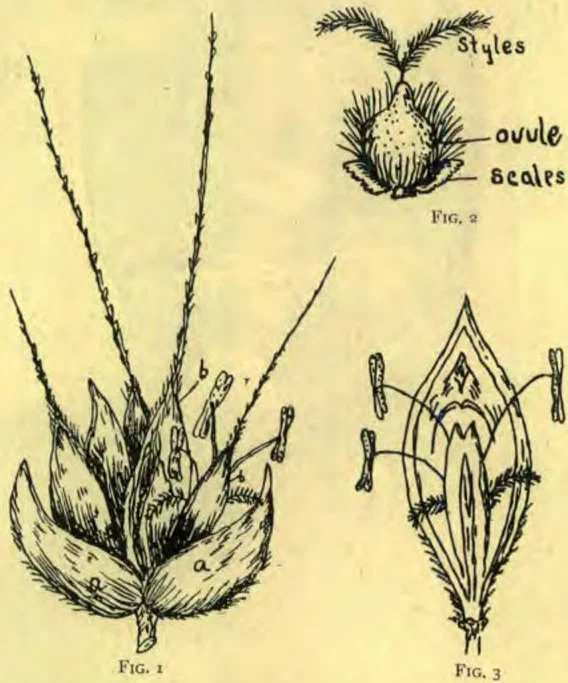
If we examine a head of wheat carefully, we shall find at the base of each spikelet two husks, or scales of chaff. (See Fig. 1, a.) These are called “glumes.” After the glumes we find that each separate grain is also inclosed in chaff. These are called “paleæ.” (Fig. 1, b.)
FIG. 1; FIG. 2; FIG. 3
Should we examine the wheat when it is in full bloom, we would discover that it has beautiful blossoms. On each little spikelet the glumes and paleæ open; and from beneath, three thread-like stamens protrude; on the end of each is suspended the silver-white anther loaded with pollen, with which to fertilize the ovule through the feather-like style, which rises from the top of the ovule (Fig. 2), and which also protrudes from beneath the paleæ. Fig. 3. It will be noticed that the flower has no corolla; nor is it needed, the glumes and paleæ serving the same purpose.
Summer wheat, commonly called “spring wheat,” which is sown in early spring and harvested the same season, is less hardy than winter wheat; the head is more slender, and its glumes are usually provided with much longer awns, or beards. Fig. 1.
As all farmer boys know, winter wheat is sown in early autumn. It lives through the winter, and ripens its seed the following summer. There are over seventy varieties of winter wheat, such as bearded, beardless, white-chaff, red-chaff, etc. Many of them are much alike, differing only in color and form, or in time of ripening; some, being more hardy, are better adapted to colder regions than others.
There is also a kind of wheat called “mountain spelt wheat,” grown in mountainous regions where common wheat will not ripen. It is a very early variety of spring wheat, but the grain is shrunken and light, yielding but little flour, and that of a very poor quality.
Wheat straw is much used in the manufacture of straw hats. The best straw for this purpose is obtained from the chalky lands of Italy. The famous Leghorn hats are made from straw of a bearded variety of wheat, which grows only about fifteen inches high, on the poor, sandy soils along the River Arno; the wheat is pulled green, and afterward bleached.
The culture of wheat is a most important one over a large area of the north temperate zone, and affords an excellent subject for study and observation during its whole life-history, from the time of sowing till it reaches our table in the form of bread or other food.
A. W. Kelley.
MOTHER'S BIRTHDAY
It came in the summer, right in the hot and busy season; and when I began first to remember, it was always made a festival. Father used to give mother some little gifts, and usually took a half-holiday, at least, and we had a ride or some little outing. As the years rolled on, there came a change; the family was larger, cares were greater, and there always seemed too much to do to celebrate. Expenses were heavier, and consequently extras, like birthday gifts, were crowded out; only I remember mother used always to plan somehow to get something for all the rest when their birthdays came.
After a time, when her birthday came around, there was an unusually good dinner prepared for the family, and an extra loaf of cake for supper; and if there were remarks about the good fare, as there generally were, some one would say, “Oh, it must be mama’s birthday;” and we would feel ashamed we had not remembered it.
This had occurred several times, and we had come to look for it. I well remember her the last year. It had been a very hot and busy month, and mother had seemed unusually tired and weak; and on that day, after we were seated at the table, a passing mention was made of the day of the month, and some one spoke up, saying, “Why, isn’t this mama’s birthday?”
Mother looked up with tears in her eyes, and said: “Yes, dear, it is; but mother was too tired to do anything extra to-day. I meant to have given you a nice little treat, but had to give it up.”
There was a hush; all seemed to have lost their appetites; bitter thoughts were the food we had. Not one of us had remembered the day of the month. We had passed it by without even a thought of the patient, worn-out, sick mother, who never forgot one anniversary where others were concerned; not one little gift. We could at least have given her an entire holiday from work and worry, seated her in the parlor, and waited on her as an honored guest.
We did try to atone for our want of thought, by ushering her into the cool, shaded sitting-room after her dinner was finished, and after a needed rest, helping her to put on one of her pretty home dresses.
Then for a little surprise, we invited in mother’s dearest friend; and while they visited quietly and happily, we girls prepared a nice, holiday tea, with plenty of flowers, for mother was so fond of the delicate beauties. After tea, father took them both driving; and when she arrived home, mother found several pretty gifts awaiting her.
As we were separating for the night, mother kissed us as usual, and said, “This has been a very happy birthday, girls. I thank you so much for your thoughtful love for me.”
It made us both glad and sorry—glad for that day, and sorry for so many others we might have brightened for her, instead of her always doing for others and herself, too.
Dear girls who read this, don’t you think we promised ourselves to be thoughtful and ready next year? Ah! when next year came, we had not the opportunity: mother’s tired hands were folded; her true, patient, loving heart had ceased to beat.
Girls, isn’t there a little hint for each of you here? Not one of you but has a great, loving heart; add to that thoughtfulness, tact, self-sacrifice, and then look out for mother.—Selected.
PETROLEUM
By W. S. Chapman
The name “petroleum” signifies “rock-oil,” and the existence of this oil has been known as far back as history extends. Herodotus wrote of the springs of Zacynthus, and Arabs and Persians, of the fountains of Hit. Pliny and Dioscorides mention the oil of Agrigentum, while the earliest records of China contain accounts of the petroleum springs existing in that country.
Petroleum was discovered in North America as early as 1629, but no practical use was made of it until after the report of Prof. B. Silliman, of Yale College, on some specimens of oil sent him from Titusville, Pa., when a company was organized in New Haven, Conn., and a representative was sent to Oil Creek to prospect for oil. He was much hindered and delayed by quicksands and water in digging his well; and, as an experiment, drove down an iron pipe. This not only proved successful, but later in the day fell suddenly six inches into a “pocket” about thirty feet in the ground, where it was left until morning, when it was found to be filled with oil. This was the beginning of the “piping for oil,” now so well known. Many other wells were immediately sunk in the vicinity, and it was soon discovered that the oil was to be found in regular courses, or streaks, and was not diffused generally under the surface. This was the origin of the method of “exploring” now in use.207
An analysis of petroleum shows that its constituents are equal atoms of carbon and hydrogen. Some oils have impurities containing nitrogen; others contain sulphur and oxygen. The origin of petroleum is conjectural. It has no organic structure, like coal, for instance; hence it can not be proved that it is of organic origin, yet only French chemists have, as yet, asserted that petroleum is of chemical origin. When shale, coal, peat, wood, or animal matter—any recent organic substance—is subjected to destructive distillation at low temperature, there is finally evolved an oily fluid, which chemistry shows to consist chiefly of the same compounds of carbon and hydrogen found in the Pennsylvania petroleum. Observed facts would lead to the conclusion that these oils found in the earth are products of the indigenous limestone in which they are found.
In new territories, the first step is to drill a test, or “wild-cat,” well. If oil is found, the surrounding territory is soon occupied. Wells are sometimes drilled by owners of the land, but generally under leases. Under the leases, the usual stipulation is that a certain part, from one tenth to one fourth, shall be paid to the owner of the land. One well to five acres is considered as many as will be profitable. The average duration of the profitable working of a well has been estimated at five years.
In Burma and other Eastern countries, oil is carried from place to place in flasks and jars. In the United States, it was for years distributed in barrels, but now it is transported in lines of pipes to refining stations. When oil is received from a well into a pipe-line, a receipt is given the owner for it, less three per cent to cover loss and for handling. This receipt is called a “certificate;” and when such a receipt, or “order,” is accepted by an officer of the company, it becomes negotiable equally with a bank check. As the “exchanges” deal only in certificates of one thousand barrels, they are always made of that amount when practicable.
In its crude state, petroleum is used in connection with other oils, tallow, lead, soap, graphite, etc., to make lubricating oils. When crude oil is too thin for lubricating purposes, it is reduced to the proper consistency by evaporation by heat, or exposure to the sun in shallow pans.
As an illuminating oil, petroleum has superseded all other material in nearly all the civilized portions of the world. In Great Britain, it is called “paraffin oil;” on the Continent, “refined petroleum;” and in the United States, “kerosene.” In refining petroleum, the crude oil is first distilled, this process being continued until only a kind of coke remains, the vapors arising being condensed by the usual worm-pipe arrangement. The oil thus condensed is green in color, and called “once-run oil,” also “green oil.” It is separated, by repeated washings with sulphuric acid and caustic soda, and by further distillation, into gasoline, naphtha, burning oil, etc.; there is also a residue called “heavy oil,” used for lubricating purposes.
W. S. CHAPMAN.
KEEP BUSY
By Frank Walcott Hutt
Make some endeavor every day,
No matter what the idlers say;
Go forth, and meet the strong.
Be sure, my boy, no matter who
Finds fault, finds little work to do—
Keep busily along.
Keep on, no matter whom you meet
Upon the road in full retreat;
Yours is the better way.
Keep on; let every effort tell—
Beginning well, and ending well—
Keep busy every day.
1. Why did the Lord desire a sanctuary built? Ex. 25:8.
2. For what purpose did he wish to dwell among his people? Note 1.
3. How many rooms, or apartments, were in the earthly sanctuary?
4. How often were services performed in the holy place? Heb. 9:6; 10:11.
5. What was the daily work of the priest? Why? Heb. 5:1.
6. What offering was made every day for the people of God? Ex. 29:38–43; note 2.
7. By making these offerings, what did the priest do for the people? Lev. 15:31, first part.
8. After the people had thus been separated, what did the priest do for them? Lev. 9:22; Num. 6:23–27.
9. Instead of blessing, what came to one who did not put away sin? Num. 19:20.
10. How did the constant service for putting away sin affect the sanctuary? Note 3.
11. What was it therefore necessary to do? Heb. 9:23, first part.
12. Of what was all the service of the earthly sanctuary a type, or figure? Heb. 8:5.
13. What is the work of Jesus, our High Priest? Acts 3:26; note 4.
14. As we offer the blood of the Lamb of God, what becomes of our sin? 1 Tim. 5:24; note 4.
15. What blessing does our High Priest pronounce upon us, when our sin has been separated from us? 1 John 1:9.
16. What will come to those who neglect to have their sins carried into the heavenly sanctuary? Ps. 37:9; note 5.
17. Because sin is being carried into the heavenly sanctuary, what will it finally be necessary to do? Heb. 9:23.
NOTES
1. We have already learned that God’s reason for wishing to dwell among his people is that he may dwell in them. But he can not dwell where sin is found, and so, in order that God may find a dwelling-place in the hearts of his people, it is necessary to have all sin put away. The Lord dwelt in the sanctuary, therefore, to help his people get rid of their sin. The sanctuary building covered the glory of the Lord, and kept it from destroying the people while God worked for them.
2. Sacrifices and offerings of many kinds were made every day in the year. But though there were so many different kinds, they all were for the purpose of taking away sin, and bringing the people to God. The offerings provided a way for removing sin from the children of God into the sanctuary, where God could destroy it without destroying the sinners. When one had done wrong, he brought his offering, and confessed over it his sin. By doing this, his sin was removed from his heart, from his life, to the life of the offering; and God counted the offering as the sinner. Thus when its blood was shed, and carried into the holy place, the sin of the man was carried in, and placed before the Lord, where it remained until the end of the year. There were two rooms in the sanctuary, the holy and the most holy. The first, or holy place, was the one in which the priests served every day, where all sin was taken and left before the Lord. There were two ways in which sin was carried into the holy place,— by taking in the blood, and sprinkling it before the Lord, and by taking in part of the flesh of the sin-offering, and eating it before the Lord. Both were done by the priest.
3. The Lord counts all sin as unholy, unclean. Therefore, though the sin was carried in only in figure, the sanctuary was defiled by it, and needed to be cleansed. We must not suppose that any physical uncleanness was to be found in the sanctuary, for everything was kept very clean, not even a particle of dust being allowed on the priest when he entered.
4. The whole work of Jesus, both on earth and in heaven, is to save people from sin. So long as he is in the sanctuary, his life will be spent in separating his children from their sins. By faith we confess our sins, and our great High Priest, by his own blood, carries them into the heavenly sanctuary, and places them before God. The Lord sees them, then, not in us, but as in heaven, waiting for final destruction. The sinner has sent them beforehand to judgment; he is separated from them, and stands “pure in heart” before the Lord.
5. Those who did not put away their sins while the sanctuary was upon earth, were “cut off” from the people of God. Thus it will be in the service of the sanctuary in heaven. Those who cling to sin, who neglect to transfer it from themselves to Jesus, must be destroyed with the sin.
Mother
The house is wrapped in slumber deep,
And only one is not asleep;
She sits below. ’Tis hard to sew
When weary; none can ever know
How hard it is but mother!
The lamplight flickers; tired out,
The toiler dreams of rest, no doubt;
But every little head abed
To-morrow, next day, must be fed—
This thought gives strength to mother!
At last the drowsy clock strikes one,
And that day’s work is almost done!
Some basting threads to take away—
The love sewed in will always stay.
The holiest thing on earth to-day—
The unselfish love of mother!
—Selected.
BOYS WANTED
As agents to sell a small article that is needed in every household. Make money during vacation and after school hours. Only a few cents needed to start. Send five cents for sample and terms. Address A. Mallett, 710 E. 171st St., New York City.
GRAND TRUNK R'Y. SYSTEM.
By W. C. Cunliffe
Taking Effect June 2, 1901.
Trains leave Battle Creek.
WEST-BOUND.
No. 9, Mail and Express, to Chicago — 12.15 P. M.
No. 7, Limited Express, to Chicago — 7.00 A. M.
No. 1, Chicago Express, to Chicago — 9.23 A. M.
No. 3, Lehigh Valley Express, to Chicago — 3.50 P. M.
No. 5, International Express — 2.17 A. M.
No. 75, Mixed, to South Bend — 7.30 A. M.
Nos. 9 and 75, daily, except Sunday.
Nos. 1, 3, 5, and 7, daily.
EAST-BOUND.
No. 10, Mail and Express, East and Detroit — 3.45 P. M.
No. 8, Limited Express, East and Detroit — 4.50 P. M.
No. 4, Lehigh Express, East and Canada — 8.22 P. M.
No. 6, Atlantic Express, East and Detroit — 2.10 A. M.
No. 2, Express, East and Detroit — 7.00 A. M.
No. 74, Mixed (starts from Nichols yard) — 7.15 A. M.
Nos. 10 and 74, daily, except Sunday.
Nos. 4, 6, 8, and 2, daily.
W. C. CUNLIFFE, Agent, Battle Creek.
Our Premium Testament
By Editor
As an aid to daily Bible study, and to memorizing the Scriptures, there is nothing better than a pocket-edition. We have secured a beautiful Vest-pocket New Testament, size 4 x 2¾ in., that we offer, postpaid, with the INSTRUCTOR one year, for only $1.00. Well printed, in ruby type, as shown; Flexible Covers, Round Corners, Red under Gold Edges,—a splendid little book.
ST. MATTHEW, 13.
42 The queen of the south shall rise up in the judgment with this generation, and shall condemn it: for she came from the uttermost parts of the earth to hear the wisdom of Solomon; and, behold, a greater than Solomon is here. 43 When the unclean spirit is gone out of a man, he walketh through dry places, seeking rest, and findeth none. 44 Then he saith, I will return into my house from whence I came out; and when he is come, he findeth it empty, swept, and garnished. 45 Then goeth he, and taketh
50 For whosoever shall do the will of my Father which is in heaven, the same is my brother, and sister, and mother.
CHAPTER 13.
3 The parable of the sower and the seed; 13 the exposition. 24 The parable of the tares, 31 of the mustard seed, 33 of the leaven, 44 of the hidden treasure, 45 of the pearl, 47 of the draught. 53 Christ is contemned of his own countrymen.
THE same day went Jesus out of the house, and sat by the sea side. 2 And great multitudes were gathered together unto him, so that he went into a ship, and sat; and the whole multitude stood on the shore.
This offer is made to both renewals and new subscribers. Address—
THE YOUTH'S INSTRUCTOR,
BATTLE CREEK, MICH
Rarama: Fijian Mission Paper for Native Readers
THE INSTRUCTOR has received a copy of a little eight-page sheet published by our missionaries in Fiji, called Rarama, meaning “light.” As there are about eighty inhabited islands in the Fijian group, with a population of something over one hundred thousand natives, besides many others who speak their tongue, this little light-bearer has a wide field before it for doing its part in the work of gathering out some of the precious jewels that shall make up the Master’s kingdom. Let us not forget our faithful workers in these distant fields, but pray that their health may be precious in God’s sight, that they may have wisdom and strength for the difficulties and perplexities they must meet, and that souls may be saved as a result of their work. And if we faithfully remember them in our prayers, we shall also be glad to do our part to help them in other ways.
Below is given a verse of Scripture in the Fijian language, just as it looks in the little paper. I am sorry I can not tell you what verse it is, but there is no one here who can read the language well enough to give the reference:—
“A sa kaya ko Samueli, Sa vinakata li ko Jiova nai soro kama kei nai madrali, me vaka na talairawarawa ki na domo i Jiova? Raica, sa vinaka na talairawarawa, ka ca nai soro; sa vinaka na vakarorogo, ka ca na uro ni sipi tagani.”
LABORERS TOGETHER
Did you ever share the doing of a piece of work with some one who thought and acted as if anything that would “do” was “good enough;” who didn’t “see the use of being so particular;” and whose motto in life seemed to be, in all things requiring the least expenditure of personal effort, “Let it slide”? And all the time you were doing your very best to reach that standard of perfection that admits of no such weak, qualifying word as “nearly” or “almost,” and must yet fail because of that other’s neglect. Not at all a pleasant experience, was it?
It is not enough for you, is it? that it shall be “fairly well” swept and dusted—that room you are tidying up?—No, indeed; it must be thoroughly swept; dust in the corners and on the picture-frames and moldings, cobwebs on the ceiling—all must be removed. The whole place must be as fair and dainty and sweet as it can be made before you are satisfied to leave it. But you are not working alone; you have an “assistant”—one who has been given her share to do, and who is depended on for it. And her only care in the matter is to get it quickly off her hands. She goes about it with the “ends of her fingers;” and so, though you do your best, the effect is spoiled.
And those dishes you washed with such painstaking care, and which, properly dried, should have shone like mirrors—was it not trying to have them dim, and streaked, and linty through the carelessness of your helper?
“Nobody will notice.” That is what was said when you lamented the bungling work on the dainty garment you had planned and cut, basted and fitted, with such care!
And often it is not the careless work, the low standard, the indifference to striving always for the best results, that is hardest to bear; but the distressing, complacent satisfaction with imperfection.
Reflecting on these things the other day, a new thought came about that old verse which says that “we are laborers together with God.” Not perfect workers, by any means; no, indeed! often not even willing; but still “chosen” and “appointed” to be “laborers together” with him. Alas, how faithless and grudging and indifferent our service! Our earthly work—yes, of course we take pride in doing that well. Why?—Oh, because—well, answer, honestly. But this other work we shirk and slight, and would often escape altogether if we could.
Yet it is a wonderful work,—so important that Jesus gave his life that it might be carried forward; so beautiful that the angels rejoice to have a part in it, by ministry,—this work of saving souls from sin and death to an endless life of perfect happiness. But not even the angels has he chosen, in one sense, to the position of honor that he has given his disciples, who, by their personal interest and love and influence may comfort those who mourn, and lead those who are straying in the mazes of sin back to the fold of the true Shepherd.
What infinite painstaking and constant watchfulness are incumbent upon those who are “workers together” with him in this high office of winning souls! One harsh, unkind word, a single yielding to temptation, and who can tell the influence on some tempted one, the awful result on the great work in which we each have a part?
We are “laborers together;” we can not, if we would, escape the responsibilities laid upon us by this appointment. But it is ours to choose whether our service shall be such as will gladden the loving heart of the Master, or whether he shall have the grief of seeing his precious work marred and ruined in our hands because we are too indolent, too self-satisfied, too apathetic, to give it our very highest and best efforts.
Shall we not, O beloved fellow “laborers together”! strive so to do our share, our part, of his great work as to please and glorify him?
FOR EVERY DAY OF THE WEEK
Sunday:
Learn to live, and live to learn;
Ignorance like a fire doth burn;
Little tasks make large return.
—Taylor.
Monday:
“Salvation is going to Jesus for what he can give us,—adoption, forgiveness, strength,—and then going into the world with what he gives, to live his life and do his work.”
Tuesday:
“An arm of aid to the weak,
A friendly hand to the friendless;
Kind words so short to speak,
But whose echo is endless.
The world is wide, these things are small;
They may be nothing, but they are all.”
Wednesday:
It is while you are patiently toiling at the little tasks of life, that the meaning and shape of the great whole of life dawns upon you. It is while you are resisting little temptations, that you are growing strong.—Phillips Brooks.
Thursday:
“Hold yourself responsible for a higher standard than anybody else expects of you. Demand more of yourself than anybody else demands of you. Keep your own standard high. Never excuse yourself to yourself. Never pity yourself. Be a hard master to yourself, but lenient to everybody else.”
Friday:
O listening Christ! give hourly grace
To keep us when temptations come
In meetings of the market-place,
Or the sweet liberty of home;
That we may serve and please thee still,
And speak as thou wouldst choose to hear,
With patient kindliness of will,
With cheerful faith and holy fear.
—Isaac O. Rankin.
Sabbath:
“But I keep under my body, and bring it into subjection; lest that by any means, when I have preached to others, I myself should be a castaway.” 1 Cor. 9: 27.