The Youth’s Instructor, Vol. 27, No. 22.

A BRIEF HISTORY OF BELLS

The Youth’s Instructor

Jun 4, 1879

S. D. A. Publishing Association · Battle Creek, Mich. · Jun 4, 1879

A BRIEF HISTORY OF BELLS.

BELLS are instruments of great antiquity, being spoken of in the book of Exodus as an appendage to the sacred dress of the high priest. It is thought that the word bell is derived from the old Saxon word bellan, which in that language meant to bawl, or bellow. The most joyous and the saddest feelings of mankind are very closely associated with bells.
The praises of this musical instrument have been repeatedly celebrated in both poetry and prose. Who has not heard the familiar lines of Moore,—
“Those evening bells, those evening bells, How many a tale their music tells”!
It has been conjectured that the oldest bells in existence are those that were discovered by Mr. Layard in the ruins of Nimroud, Assyria. It is also interesting to add that when Columbus was at Cape Honduras, a trading canoe of the Indians had on board some small bells; and they also have been found in the tombs of the old Peruvians.
The ancient Persians had bells attached to their royal costumes, and in later times the Goths suspended them to their garments. In Egypt, and in some other countries, the girls wore strings of little bells attached to their ankles, as is common in Cairo at the present time. To this singular custom the prophet Isaiah doubtless refers in chap. 3:18. Among the old Greeks, a bell was sometimes hung on the neck of a malefactor on his way to execution.
A silver bell was the prize frequently run for at a race; hence the expression, “Bearing away the bell.” The Greeks and Romans attached bells to the necks of their cavalry horses to accustom them to noise, so they might not be affrighted at the horrid din of battle.
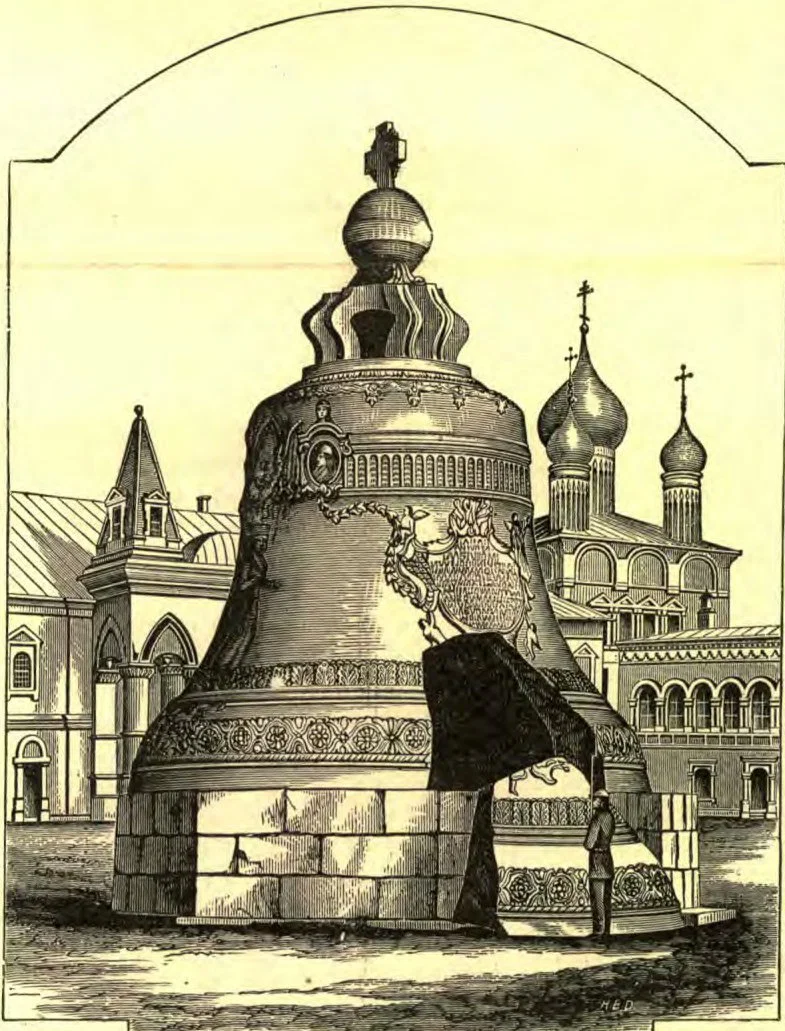
THE “GREAT BELL OF MOSCOW.”
As a signal, to call the people together for some concerted action, the bell has been in use from remote times. Even in China, according to some, bells were used for religious purposes 2000 years prior to the Christian Era; this, if true, would take us back to the days of Abraham, and even much farther! All nations, with the exception of the Turks, have a mutual admiration for bells, one quaint writer even seriously maintaining, in a large volume upon the subject, that the employment of the blessed in Heaven would principally consist in the ringing of bells!
Associated in various ways with the ancient ritual of the church, bells seem to have naturally acquired a kind of sacred character. In early times in the Roman Church, for a long period it was the priest’s office to ring the bell. Bells also were washed and named and even blessed. The ceremony was called, “The Baptism of Bells.” As might be supposed, bells were early used in the Christian church; but it is not positively known who was the first to introduce them into the buildings. Some maintain that Bishop Paulinus, of Nola, a city in Campania, was the first to use bells in churches. Whether this be true or not, in some of the languages of Europe, bells are still called by the names Nola and Campania.
In the tenth century, Pope John XIII. named a large bell after himself—JOHN.
In the Middle Ages bells had attained a very prominent position. An old writer describes their three-fold use as follows:—
“To call the fold to church on time, We chime. When joy and mirth are on the wing, We ring. When we lament a departed soul, We toll.”
Many of their special uses were designated by the names given to certain bells. Thus, the Ave Maria, or Pardon Bell, was tolled at certain hours, when every one was enjoined to offer prayer to the Virgin Mary.
The Vesper Bell was the call to evening prayer.
The Sanctus Bell was rung at the words in the service, “Sancte, sancte, sancte, Deus Sabaoth,” i. e., “Holy, holy, holy, Lord of Hosts,” and every one on hearing it was expected to prostrate himself.
The Passing Bell was so named as being tolled when any one was passing from this mortal life.
The Curfew Bell (from the French couvre feu, or, “cover the fire,”) was a signal for the inhabitants who lived in wooden houses to put out the fires, and retire for the night.
The Toesin, or Alarm Bell, was sounded from castles and fortresses to announce the approach of an enemy. In the year 610, when Sens was besieged, the bishop of Orleans ordered the bells of St. Stephens to be rung to intimidate the enemy, and as late as 1457, Pope Calixtus III. employed the same device as a protection against the Turks, who with a strange superstition regarded bells as their most dangerous foe.
The modern Fire Bell is well described by the American poet, Edgar A. Poe:—
“Hear the loud alarum bells,— Brazen bells! What a tale of terror now their turbulency tells! In the startled ear of night, How they scream out their affright! Too much horrified to speak, They can only shriek, shriek, Out of tune, In a clamorous appealing to the mercy of the fire, In a mad expostulation with the deaf and frantic fire.”
But any history of bells would be far from complete without reference to the great bells of the world. In respect to these, Russia far surpasses all other nations.
In the city of Moscow, alone, before the great revolution, there were no less than 1706 large bells.
But the “Great Bell of Moscow,” or Czar Kalokol (i. e., the emperor of bells), is most noteworthy. Its weight is about 440,000 pounds, being a little mountain of metal. The cost of the bell metal alone is estimated at upwards of $300,000, to which, reliable writers say, $1,000,000 more was added in jewels and plate by the nobles at the time of casting. The dimensions of this monster bell are about 21 feet in height, 22 feet in diameter, and 40 feet 9 inches in circumference. Its sides are 16½ inches thick. It is ornamented on the sides by figures of Christ and the apostles and the Virgin Mary; also one of the Empress Anne, by whose order it was cast. The bell was originally suspended from beams, which being destroyed by fire in 1737, permitted the heated bell to fall to the ground and break, since which time it has remained dumb. The Emperor Nicholas had it raised in 1837, and placed upon a low, circular wall in the Kremlin. It is now consecrated as a chapel, the opening in its sides being large enough to admit two men standing abreast. The bell is carefully guarded, as we see in the engraving, and the Russians will not allow a single particle of the metal to be taken away. The piece which is broken out, is of triangular shape, being 6 feet high, and 7 feet at the base. Its estimated weight is 11 tons.
There is another monstrous bell in the cathedral of Moscow, weighing 120,000 pounds. This bell is suspended in the tower of Ivan Velik, and when it is rung, which is but three times a year, all the other bells are silent. Its mighty voice is said to produce a tremulous effect throughout the city, and a noise like the roaring of distant thunder.
G. W. A.

CLOUDS AND SUNSHINE.

THERE'S never a day so sunny But a little cloud appears; There's never a life so happy But has had its time of tears; Yet the sun shines out the brighter When the stormy tempest clears.
There's never a way so narrow But the entrance is made straight; There's always a guide to point us To the “little wicket-gate;” And the angels will be nearer To a soul that's desolate.
—Sel.

LEND A HELPING HAND.

Do you ask, “Who is in need of help?” we answer, You cannot go amiss of a field of labor. The world at large is needy. Every soul is burdened with its own sorrows. Thousands of the human family are crushed with a weight of grief for the want of a few words of sympathy and consolation. We meet these individuals in the street, and often associate with them in their homes, yet they are not benefited by the interview. Why is this?
We are so selfish and indolent we don’t want to bother with other’s trials, and we make the excuse that we will leave the work for those better acquainted with the human heart. Thus it happens that the work which belongs to all is taken hold of by none, leaving broken hearts perishing all around us.
Let us receive instruction from the example of Job, who was eyes to the blind, and feet to the lame; who was a father to the poor, and who caused the widow’s heart to sing for joy. He did not wait for them to come and ask for help, but mark his own words,—“The cause which I knew not, I searched out.”
We can learn our best lesson from the life of Christ, whose abode was with the poor and humble, who ministered consolation to all in distress, carrying their burdens for them.
Yes! we are our brother’s keeper, and it belongs to us to search out the cause of his sorrow and distress. We should watch for chances,—not to find fault, or to find something to talk about that would be hurtful, but to do good to every one. We should have kind words for all. No matter if they do look sulky and cross; they need the sunshine which our words will impart, and their good effect will gladden our own lives.
Especially should we acquaint ourselves with the spiritual interests of all, and exhort and help each other to come up to the standard of a perfect character in Christ Jesus.
Dear young friends, lend a helping hand. Don’t go about dreaming and caring for just your individual self, but watch
“To do some loving thing; Leave footprints on the sands of time, Where blessed fruit may spring.”
M. J. C.

ARE YOU READY?

ARE you ready for the coming of the Lord? The day of his coming and of the resurrection of all who sleep in him, will be a glad day to those who are ready for it. Scarcely one will say, “I am all ready.” It is felt by most, even old professors, that there is something still to do; and often the resolve is made to renewed consecration and diligence in the cause of the Lord.
The love of Christ which has been shown toward us is a motive which ought to stir our hearts. Said an apostle, “We love him because he first loved us.” If you reflect much on the love that has been shown towards us by both the Father and the Son, it certainly will move you to love them in return. You should think much of this; for without love, or charity, which is the same, all we may do will be of no account. Read 1 Cor. 13.
Love is the first and best motive to move us to activity; but the Lord has set before us other motives. The second coming of Christ and the great reward that he will give at that day to all who love and obey him, is a Scriptural motive. Do you know that his coming is near? You should read the Bible and study to learn the truth concerning this. Can you not find time to do this? Your time will be occupied with that in which you are most interested. Is it not so? Read up, and have a faith that will not shrink in the fiery trial that is before you.
Fear of losing eternal life, and of having a part with the wicked, the enemies of the Lord, is another motive. Says an apostle, “Let us therefore fear, lest a promise being left us of entering into his rest, any of you should seem to come short of it.” Heb. 4:1. What a sad thing it will be to come short! Then, my dear reader, improve the precious time which remains in getting ready for the great event.
R. F. COTTRELL.

TIME

Some boys—and girls too—think because they have plenty of money they need not be careful of time. It seems that King Alfred of England thought differently. He was so anxious to spend his time well, and to “leave England better, wiser and happier in all ways than he found it,” that he divided the days into portions, and for each portion chose a certain work. There were no clocks in Alfred’s time, so, to be accurate, he made wax candles with notches at regular distances; he kept these constantly burning, and so divided the day by burning away of the candles from notch to notch. To prevent the air making them flare and run, he put these candles into cases made of wood and white horn; these we are told, were the first “lanthorns” (or lanterns) made in England.

LESSONS FOR CHILDREN.

LESSON XXII.—SAMSON.

Before Jephthah went to battle, he made a vow that if the Lord would give him victory over his enemies, he would offer for a burnt-offering the first thing that met him when he came home. Now Jephthah had one child, a daughter, whom he dearly loved; and when he came in sight of his house, she ran to meet him.
Jephthah judged Israel six years. After the death of Jephthah, Ibzan was judge seven years; Elon, ten years; Abdon, eight years.
“And the children of Israel did evil again in the sight of the Lord; and the Lord delivered them into the hand of the Philistines forty years.”
For the first part of this forty years’ bondage, the Israelites had no judge but Eli, the high priest, but for the last twenty years some of the tribes were judged by Samson.
Samson was a very strong man. The Lord raised him up to deliver his people from the Philistines; but Samson would have his own way sometimes, and so got into trouble. It is quite probable, too, that he trusted too much in his own strength.
Instead of marrying one of his own nation, he married one of the Philistines, who were wicked idolaters, and the enemies of Israel.
When Samson was married, a great feast was made, and thirty young men of the Philistines were invited. On the first day of the feast, Samson put forth a riddle, with the understanding that if the young men guessed it during the seven days of the feast, he was to give them thirty sheets and thirty garments; but if they failed to guess it, they were to give him thirty sheets and thirty garments.
When the young men found they could not guess the riddle, they threatened to burn Samson’s wife and her father if she did not persuade Samson to tell her the meaning of the riddle. So day after day she tried to get Samson to tell her; and at last, when he did so, she went immediately, and told the young men.
When the young men guessed the riddle, Samson knew that his wife had told them, and he was very angry, and went down to Ashkelon, where he killed thirty men of the Philistines, and gave their garments to the young men who had guessed the riddle.

QUESTIONS.

  1. What vow did Jephthah make before he went to battle? Judges 11:30, 31.
  2. Who met him on his return? Verse 34.
  3. Did Jephthah keep his vow? Read verses 35–40.
  4. How long did Jephthah judge Israel? Ibzan? Elon? Abdon?
  5. Repeat Judges 13:1.
  6. Who was the only judge of Israel for the first part of this forty years?
  7. Who judged some of the tribes during the last half of this forty years?
  8. For what was Samson noted?
  9. For what purpose was he raised up?
  10. Why did he fail to accomplish this purpose?
  11. Whom did he marry?
  12. What kind of people were the Philistines?
  13. Who were invited to Samson’s marriage feast? Judges 14:11.
  14. What riddle did Samson put forth to the young men? Verse 14.
  15. What was he to give them if they guessed the riddle?
  16. What were they to give him if they could not guess it?
  17. How did the young men find out the meaning of the riddle?
  18. Why did she tell them?
  19. How did Samson obtain the garments which he had promised to give the young men if they guessed the riddle?

BIBLE LESSONS FOR YOUTH.

LESSON XLVIII.—KORAH, DATHAN, AND ABIRAM.

1. WHAT is recorded in the sixteenth chapter of Numbers?
2. By whom were they joined in their rebellion?
3. What did these men say when they gathered themselves together against Moses and Aaron?
4. What did Moses say to them?
5. What kind of spirit did these men manifest?
6. Of what did they accuse Moses?
7. How did Moses propose to have the difficulty settled?
8. What did he tell the men to do on the next day?
9. What did the Lord say to Moses and Aaron when these men had come up to the tabernacle, with their censers, and all the people had gathered about?
10. What did this cause Moses and Aaron to do?
11. What command did the Lord give after Moses and Aaron had prayed for the people?
12. What did Moses say when the people had withdrawn from the tents of these wicked men? Verses 28-30.
13. What came to pass when Moses had made an end of speaking? Verses 31-33.
14. What was the fate of the two hundred and fifty men that offered incense?
15. What commandment was given in regard to their censers?
16. Why was this to be done?

SYNOPSIS.

The sixteenth chapter of Numbers contains an account of the rebellion of Korah, Dathan, and Abiram. These men were joined by two hundred and fifty princes of the assembly, famous in the congregation, men of renown. “And they gathered themselves together against Moses and against Aaron, and said unto them, Ye take too much upon you, seeing all the congregation are holy, every one of them, and the Lord is among them: wherefore then lift ye up yourselves above the congregation of the Lord?”
Moses reproved these men sharply. He said they ought to be content with the honors God had conferred upon them, and not be seeking to obtain the priesthood also. But the men were very bitter, and said that Moses had brought them up out of a land flowing with milk and honey to kill them in the wilderness, unless he could make himself altogether a prince over them. Moses told them that the Lord would show who were his. He said Korah and all his company, with Aaron also, should come to the tabernacle the next day, each bringing his censer with incense in it.
So on the morrow, when they had come to the tabernacle, and all the congregation had gathered about, the Lord spake unto Moses and Aaron, saying, “Separate yourselves from among this congregation, that I may consume them in a moment.”
Then Moses and Aaron fell upon their faces, and prayed for the people. “And the Lord spake unto Moses, saying, Speak unto the congregation, saying, Get you up from about the tabernacle of Korah, Dathan, and Abiram.”
When the people had withdrawn from the tents of these wicked men, the earth opened, and swallowed up Korah, Dathan, and Abiram, with their tents, and all that appertained to them. “And there came out a fire from the Lord, and consumed the two hundred and fifty men that offered incense.”
The Lord commanded that the censers used by these men, should be made into broad plates for a covering to the altar, that whenever the people should see them, they might remember that none but the seed of Aaron should offer incense before the Lord. G. H. BELL.

HOW TO HAVE GOOD LESSONS.

THE main reason why so many fail of having good lessons, is because they do not begin in season. Sabbath afternoon is none too soon to commence learning the lesson for the next week; and, in most cases, it can be completely mastered before the day closes. Yet, how often it happens that the lesson is put off from day to day, thinking that there is “time enough;” but, as Sabbath draws near, this or that unlooked-for circumstance comes in to hinder—perhaps a friend calls just at the very time you had set apart to study your lesson, or it may be you are needed to go of an errand—and so one opportunity after another is lost, till the Sabbath arrives, and your lesson is imperfect.
But, if you should succeed in learning your lesson at the close of the week, you are liable to be sadly disappointed when you come to the recitation, by finding that you have forgotten some point in the lesson, and cannot possibly recall it. You think you know it perfectly—you recited it, perhaps, just before you left home—yet you cannot think of it.
Now the reason of this is, that the thoughts had not had time to take root in the mind, and a very slight brush of the wing of time swept them away.
I know some children who have not had an imperfect lesson for a long time. They are very ordinary children; but they have succeeded by observing the following

RECIPE FOR PERFECT LESSONS.

  1. Learn your lesson the first of the week, commencing with the earliest opportunity.
  2. Keep your Bible near you, and improve every spare minute in study.
  3. Review the lesson one or more times every day during the week.
Try this recipe, and see if it is not infallible.
G. H. BELL.

HINTS TO TEACHERS.

Study the lesson to present it as a whole.
Study it thoroughly, and let it stand out in your mind as a picture. Then you will have unity, simplicity, vividness.
Have a clear analysis of every lesson, one of your own making, if possible.
Have a distinct and direct aim in studying and teaching each lesson, and then hit the mark.
Let your class see that you are on fire with the lesson subject, and you will easily kindle them to enthusiasm.
Give pains to the art of questioning, and stir up your scholars with bright, thoughtful questions that are full of meaning. But remember that no surface study will enable you to do this.—Baptist Teacher.

YOU DO NOT KNOW.

ONE of the English princesses, when her tutor, a bishop of the church of England, said to her, “I find that my instructions have made you but little better,” replied, “Ah, but! my lord, you do not know how much worse I might have been without them.” When tempted to think, teacher, that the children in your class are not any better through your instructions, ask yourself the question, “How much worse would they have been without them?”

PANSIES

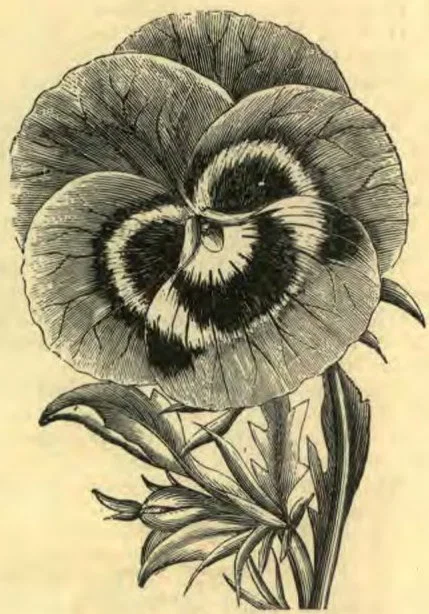
Oh, the golden-hearted pansies! Oh, the velvet-petaled pansies! With their shining faces lifted upward in the morning cool. Oh, the beauty of the pansies, And the blooming of the pansies, Like a group of rosy children with their faces washed for school.
Oh, the budding of the pansies, And the blossoming of the pansies, Filling all the air around with the faintest of perfume, Make me sure that purple pansies— Yellow pansies—velvet pansies— Are the favorite flowers of all that in the Father's garden bloom. —Sel.

DO YOU LOVE BACK?

BACKWARD and forward in her little rocking-chair went Alice Lee, now clasping her beautiful waxen doll to her bosom, and singing low, sweet lullabies; then smoothing its flaxen curls, patting its rosy cheeks, and whispering softly, “I love you, pretty dolly;” and anon casting wistful glances towards her mother, who sat in the bay window, busily writing. After what seemed to be a very long time to the little daughter, Mrs. Lee pushed aside the papers, and, looking up, said pleasantly, “I am through for to-day, Alice; you may now make all the noise you choose.” Scarcely were the words uttered ere the little one had flown to her, and nestling her head on her loving heart, said earnestly, “I’m so glad! I wanted to love you so much, mamma!”
“Did you, darling?” and she clasped her tenderly. “I am very glad my Alice loves me so; but I fancy you were not very lonely while I wrote; you and dolly seemed to be having a happy time together.”
“Yes, we had, mamma; but I get tired after awhile of loving her.”
“And why?”
“Oh! because she never loves me back.”
“And is that why you love me?”
“That is one why, mamma, but not the first one or the best.”
“And what is the first and best?”
“Why, mamma! do n’t you guess?” and the blue eyes grew very bright and earnest. “It’s because you loved me when I was too little to love you back; that’s why I love you so.”
“We love Him because He first loved us,” whispered the mother; and fervently she thanked God for the little child-teacher.
Reader, God loves you; do you love back?—Sel.

OUR BELL CUTS.

GRATEFUL thanks are hereby tendered to Messrs. MENEELY AND KIMBERLY, of Troy, N. Y., for the privilege of using the nice bell cuts in this number and the one following. It is also but just to add that the article accompanying them is largely drawn from their catalogue. Meneely and Kimberly are bell founders, a very old firm, of world-wide celebrity, whose sweet-toned bells, in all lands, daily celebrate the praises of their manufacturers. The excellent bell in the Battle Creek Tabernacle was purchased of this company. A.

MEASURING TIME.

The people of the East measure time by the length of their shadow. Hence, if you ask a man what o'clock it is, he immediately goes into the sun, stands erect, then looking where his shadow terminates, he measures the length with his feet, and tells you nearly the time. Thus the workmen earnestly desire the shadow which indicates the time for leaving their work. A person wishing to leave his toil says: “How long my shadow is in coming.” “Why did you not come sooner?” “Because I waited for my shadow.” In the seventh chapter of Job we find it written, “As a servant earnestly desireth the shadow,” etc.

HOW MANY WERE THERE?

HENRY, upon being asked in a letter from his absent aunt how many boys were in his Sabbath-school class last Sabbath, replied: “If you multiply the number of Jacob’s sons by the number of times that the Israelites compassed Jericho, and add to the product the number of measures of barley which Boaz gave Ruth; divide this by the number of Haman’s sons; subtract the number of each kind of clean beasts that went into the ark; multiply by the number of men who went to seek Elijah after he was taken to Heaven; subtract from this Joseph’s age when he stood before Pharaoh; add the number of stones in David’s bag when he killed Goliath; subtract the number of furlongs that Bethany was distant from Jerusalem; divide by the number of anchors cast out at the time of Paul’s shipwreck; and subtract the number of people saved in the ark, the remainder will be the number of boys in the class.” How many were there? —Advance.

“READ; TRY.”

SOMETIMES little boys and girls tease their mothers when they are busy, by asking questions. There was once a very little boy who used to ask his mother a great many questions; and how do you think she answered him? “Read, and you will know,” said she; and she would give him books, where he found all he wished to know. Sometimes, too, this little boy used to wish that he could do this difficult thing, or that difficult thing; and instead of discouraging him, this good mother would say one little word, and that word was “Try.” The little boy was Sir William Jones, afterwards one of the most learned men that ever lived.

A Child's Little Cross and Work of Praise

THERE'S not a child so small and weak, But has his little cross to take, His little work of praise and love Which he may do for Jesus’ sake.

LETTER BUDGET.

We have so many letters from our little friends, and so little room for them this time, that we must forego the pleasure of a chat with them. May it be the highest aim of our little letter writers to be good, and to do good.
Lawrence, Mass.
Dear Editors: I am a little boy ten years old. I have three sisters and two brothers. I take the Instructor, and like it very much. I like to read the letters in the Letter Budget, also the stories. I subscribed for the Instructor of a deaf and dumb man, and he gave me a little book of poems. I live in the city of Lawrence, Mass., and go to church once on Sunday, and twice to Sabbath-school.
I must close, so Good-bye, Yours truly, Carl O. Smith.
Trenton, Mo.
Dear Editors: This is the first letter I ever wrote for the Youth’s Instructor. I am eleven years old. I live in the country. I am not able to attend Sabbath-school very often, but I get my lessons at home. My parents are not Adventists, but they like to read your papers. I have taken the Instructor since Christmas. I am trying to do right, so that I may be happy here and at last be saved with the good. Yours truly, Ida A. Baker.
Utica, Wis.
Dear Editors: I am ten years old. I have not learned to write very well yet, but I hope you can read this, for I want to tell you how glad I am that we can have the Instructor every week. I took the monthly last year, and I sent them to a friend in Illinois who would like to take it, but does not have the privilege. I learn all the Sabbath-school lessons in the paper, and I mean to remember that God sees all my thoughts and acts. Etta Palmer.

You have reached the end of this edition.

The Youth’s Instructor · Jun 4, 1879