Your ShelfYour Projects

The Youth’s Instructor, Vol. L., No. 19

Facing the Orient

The Youth’s Instructor

May 8, 1902

Review and Herald Publishing Company · Battle Creek, Mich. · May 8, 1902

Facing the Orient
II
The trip from Honolulu to Yokohama required about twelve days, including the fictitious day dropped at the “day-line,” and was uneventful throughout. The second day out we became aware that our little son, Stanley, had chickenpox, and we were immediately quarantined. Our boat was scheduled to stop two days in Yokohama, and we had written to Brother F. W. Field at Tokyo, stating that we would spend that time with the workers there; but after an apparently grave consultation, the five Japanese doctors who met the ship at the quarantine station outside the harbor decided that we could not be allowed to land on Japanese soil. In fact, they seemed inclined to quarantine the vessel, and detained it four hours waiting the arrival of a higher official from the city. It was a real disappointment; but my sister, together with Dr. Rosa Palmborg, of the Seventh-day Baptist mission at Shanghai, China, went up to Tokyo; and before we left, all our American workers called to see us.
Yokohama, with a population approaching two hundred thousand, is the seaport of Tokyo, the capital of the empire, contains a population of one and one-half millions, and is one of the leading commercial centers of the East. The two cities are united by an interurban steam-car line. Merchant vessels and war-ships of all nations are always present in the harbor, and the bay literally swarms with smaller crafts.
The curious little sampans, propelled by a single oar from the rear of the boat, may be seen darting about in every direction, seeking to catch patronage in passengers or freights from the larger vessels. These boats often supply not only the means of livelihood to whole families, but afford homes as well; for with a piece of old sail, oilcloth, or other available material patched together to form a tent over the rear end of the boat, and a kettle of coals over which to thaw numb fingers and to boil their rations of rice and fish, the household is provided for.
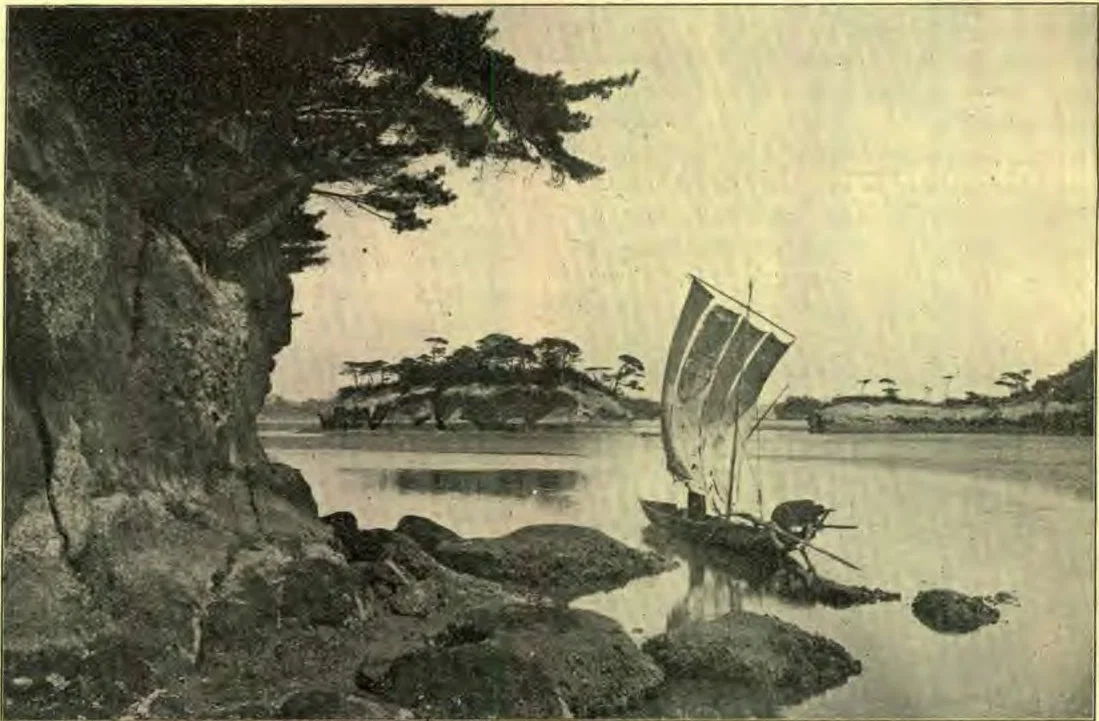
Sabbath morning we left Yokohama, and Sunday afternoon arrived in Kobe, on the south of Nippon, the largest of the three thousand islands comprising the Japanese empire. Tuesday morning we arrived in Nagasaki, on the southwest of the island of Kiusiu. This was the pleasantest part of the voyage,—down the coast of Japan; out and in among the little islands, in full view of the graceful outlines of snow-capped Fuji Yama, rising twelve thousand three hundred feet above the sea-level; through the still waters and delightful scenery of the far-famed Inland Sea. These cities are among the principal commercial cities of the empire, and were the only points in Japan at which our boat stopped.
Contrary to our fears, the quarantine was raised at Kobe, and we were allowed to land.
Kobe is finely situated on a good harbor at the gate of the Inland Sea. At a distance of about one mile rises a range of hills, some of which attain an altitude of twenty-five hundred feet, whose steep sides are partly covered with pines, and where irrigation is possible, with terraces for the cultivation of rice and vegetables. The city lies along this narrow strip of land between the hills and the sea. It is especially noted for its manufacture of, and trade in, fine porcelains. The shops are built like booths, opening full front onto the narrow walks bordering the comparatively narrower streets. Everywhere are exposed for sale beautifully wrought cloisonnes, charmingly decorated satsuma, and porcelains in endless variety. The city is apparently given up to catering to the caprice of the world in this art; and if one may judge of its life by the appearance of its streets, it is reaping accordingly. Groups of richly attired women, with stiffly oiled hair and highly vermilioned cheeks, crowd the busy streets, keeping time with their chatter to the clack of their wooden shoes on the cobblestone pavement.
MATSUSHIMA — THE INLAND SEA
Nagasaki is the only place in Japan where the manufacture of real tortoise-shell is carried on to any considerable extent. The factories are not large, but quite numerous. Usually the first floor of the shop is fitted up for a workroom, while the show-room occupies the second floor. The work is done largely by hand. The Japanese also are very skillful in carving ivory and wood. This city is coming to be quite a summer-resort for Europeans, and would afford an excellent location for a sanitarium.
Our slight acquaintance of only six days, and that only with the coast towns, naturally most influenced by Western ideas, would scarcely warrant us in drawing definite conclusions of the Japanese people. What we did obtain might better be called impressions of them as clever in imitating, sharp at bargaining, energetic in business, patriotic and progressive, but fickle and unstable. The empire is in a state of transition, and the government welcomes anything that promises benefit to its people. There certainly can be no more favorable time for the message to work in Japan than the present, and scores of laborers should enter now.
MRS. J. N. ANDERSON.

The Chinese Portion of San Francisco

As the “gateway to the Orient,” California naturally contains a larger number of Chinese than any other State. The strictly Chinese portion of San Francisco is known as Chinatown. It has a population of about twenty thousand. To one visiting this part of the city, it is not at all difficult to imagine that he is walking the streets of some densely populated Oriental city.
Their temple, or joss house, is resplendent with peculiar and costly decorations. Hideous-looking objects of worship are plentiful. It seems strange to meet such sights on the shores of this so-called Christianized America. Those denominations which have considerable difficulty in raising money to maintain their church expenses, could certainly learn a humiliating lesson by observing at what enormous expense the Chinese carry on their heathen devotions.
During the summer a large number of Chinese men go to Alaska or elsewhere to engage in fishing and various other occupations; but during the winter they flock back to San Francisco, and swarm around their lodging-houses in amazing numbers, by some device or other succeeding in storing themselves away in these ramshackle dwellings. All the Chinese, however, are not by any means in a poverty-stricken condition. Many of them are wealthy merchants, engaged in extensive commercial business enterprises.
Typical Chinese opium-dens may be found in some of the lodging-houses. The sight of the drunkard should arouse a feeling of pity in our hearts, but it is difficult to conceive of anything more pathetic than a typical opium fiend. Few appreciate the startling inroads this terrible habit is making all over the country. Often physicians prescribe opium for the purpose of deadening some trifling pain; frequently the patient continues to take it on his own responsibility; and soon the unfortunate victim is fastened in the vise-like grip of the opium habit.
As a class the Chinese are industrious and economical to a fault. Consequently they become a serious competitive force to the American laborer, who must necessarily live more expensively.
One successful Chinese restaurant that I visited is owned by eight partners. They have a unique method of preventing any one of the partners from robbing the other members of the firm. The safe that contains their money has eight different locks, and each partner carries the only key for one lock, thus making it impossible for any one of them to open the safe unless all are present.
Chinatown has its own theaters, which are well patronized. Its daily newspaper is printed in the peculiar Chinese characters. Many of the Chinese have strong gambling instincts, and gambling-houses doing a flourishing business are abundant on every hand.
Although efforts are being made in a small way to invade this heathen portion of San Francisco with the gospel, yet they are altogether too meager to make their influence felt to any great extent. As I saw large numbers of Chinese children playing on the streets, growing up with no knowledge of the sweet and satisfying truths which we enjoy, or at any rate may enjoy, I felt more thankful than ever that I learned to pray when a mere child in just as familiar a way to my Heavenly Father as I address my earthly father.
DAVID PAULSON, M. D.

A Touch in Passing

“It’s queer the way different people make you feel,” the girl said, thoughtfully. “I don’t mean people you know or love, but people that you just brush up against. The other day, for instance, when I went over to see Helen, Sadie Graves was there calling. She stayed an hour or more, and the whole time she talked about nothing but style. Now, usually, you know, the clothes question doesn’t bother me a bit. I like to be well-dressed, of course; but I don’t worry over it, for there are always so many better things to think about. But it was two whole days before I could shake off Sadie Graves, and then it was only because somebody else helped me. I just lived and breathed clothes, fretting over dresses that were made last year, and planning how I could fix them over, and longing for all sorts of new things; it seemed to me that I must be stylish; that I couldn’t stand it not to be. Sadie made me feel as if it were the one thing in the world that a girl should live for. “But the second evening Uncle James had a caller, and I happened to be in the parlor. After the first greetings, they didn’t notice me at all, and I just curled up in my corner and listened. Uncle James had been reading Mr. Riis’s ‘Ten Years’ War,’ and he and father had talked it over a good deal. That had been intensely interesting, but this man had lived it and helped. O, if you could have heard the things he told!” All my little, selfish, contemptible thoughts about clothes, and what people thought of me, just shriveled up and blew away. I had got back to the real ‘worth whiles,’—the being glad and grateful for all the rich things one has in one’s life, and the trying to help wherever one can. It didn’t seem as if I ever could be small again. And yet I suppose I should be,—if I were with Sadie Graves. I wish I might never meet her again, until I’ve grown big enough in my thoughts not to care!”
Was not the little experience a mighty argument upon the choice of companions and conversation?—Well Spring.

Know What You Want, and Do It

THERE is nothing more important in the business of life than to know what you want, and then to go after it with all your might.
In the business world, what enthusiasm, what perseverance, what dogged determination, are shown by those who seek for earthly treasure. Early and late, and by every possible means, men and women strive to obtain the object of their ambition. No place on earth contains, in proportion to its size, so much push and energy as Wall Street, New York City, where capitalists gather in a wild struggle for gold.
It need not be asked why they almost trample one another underfoot, to accomplish their purpose. They are men of wonderful ambition. They all have it fully settled that they must have and control the millions that the earth has produced. And so, knowing what they want, they stop at nothing which holds within it the least promise of success. Nothing is too hard, too irksome, too tedious. They serve the god of this world with all their heart, with all their soul, with all their strength, and with all their mind.
Why should God’s people be any less faithful than the children of the world? It is only good sense that if one is going to do a thing, he should do it with all his might. And of course it is necessary that there should be first a choice,—a whole-hearted choosing of a life-work; for it is plain that he who lives without a life-purpose, who one day tries one thing, and another day another, will never succeed anywhere. He is double-minded, and unstable in all his ways. He never knows whether to put his time and strength into what he has in hand; for possibly it may be the other thing that should receive his most earnest attention. But whenever any one does not put all his love, all his soul, all his strength, all his heart, into what he does, he might better stop before he begins. A grand principle of prosperity is stated in the words, “Whatsoever thy hand findeth to do, do it with thy might.”

Choose To-day

What is your work? Have you made a choice? I do not mean that you must necessarily know whether you are to be a doctor, a mechanic, a preacher, and then work with all your might to be a doctor, a mechanic, or a preacher. However, if God has revealed the specific calling of your life, why, work with all your might in that. The things between which we are all to choose, and to choose now, and every day, with all the will we have and that God can give us, are the service of God and the service of Satan. It is as true now as in the days of Elijah, that “if the Lord be God, follow him; but if Baal, then follow him.” But by all means get down off the divide; no longer halt “between two opinions.” Make a choice! Let not another day pass before you settle the question as to who shall have your life service. No greater mistake can be made than to be everlastingly undecided, constantly losing both for time and for eternity.
Dear young friend, you profess to be a Christian. That is right. But are you a Christian? Have you fully decided that to be a Christian is your life-work? Perhaps you remember the words of Joshua, when, after telling the people to choose whom they would serve, he added: “As for me and my house, we will serve the Lord.” O, choose Christ! And in your choice see to it that everything of value in your life is put into your work. The reason so many make a failure of their Christian experience is that they give to it only a part of their life. They reserve some of it for other pursuits. Thus one day they do well, the next day they fail, and eventually they come out openly and fully for the world.

A Secret of Success

It is said of Joseph that on the way to Egypt he was transformed in one day from a petted child to a noble man of God. And the reason was that in his own heart he formed the high resolve to be true to God under all circumstances. That resolution he carried out with all his might. In Potiphar’s house he was loyal; in prison he was loyal; circumstances never mastered him. As the sturdy oak that takes the full force of the blast is made stronger by the ordeal, so Joseph developed in righteousness by the assaults of the devil. Never did he allow that purpose to drop out of his reckoning or out of his practice. Thus it was with Daniel, and thus it must be with all who are successful in God’s service.
From the very beginning of Christ’s earthly career his choice was fully made. He knew and loved his Father’s will. And knowing that God’s will should be wrought out in and through him, he chose the will of God to be his own will. He knew what he wanted, and set his face “like a flint” to carry out his purpose. To right or left he never turned. With his eye fixed on the goal of his hopes, he pressed forward, and overthrew every obstacle. Nothing in line of duty or privilege was too small for him to take up, nothing too great for him to do. Personal likes and dislikes had no place in his life; his humanity was ever made to serve his divinity. Principle triumphed over every passion, and his intelligent zeal, like a burning fire shut up in his bones, urged him ever onward. And he succeeded. He could say, “I have finished the work which thou gavest me to do.”

How We May Succeed

And we may succeed as did he. Our Father’s will is made plain, so that we may make it our own. The same word that wrought so wonderfully in the Saviour is still with men, the same blessed hope, the same glorious work, the same eternal results. It only remains for us to choose as Jesus chose. Will we set our faces like a flint? Will we so throw our lives into the work of our choice, into the thing we know we want,—will we be so diligent, so faithful, that we shall attain what we set out to win?
Ah, if we will but follow his example, we shall be “more than conquerers”! We shall pray with all our might, study our Bibles with all our might, work for others with all our might. With a supreme object to gain, we shall make supreme and untiring effort, complete and perfect sacrifice. We shall long for the baptism of trial, that the purpose of God,—and our own purpose, too,—may be realized.
O, let us now give ourselves entirely into the hands of God! Let us leave behind all half-hearted ways, and be wholly on the Lord’s side. It is high time to awake out of lethargy and sloth, and go forth to the fight, to remain right at the front until the last enemy has been destroyed.
C. L. TAYLOR.

The Knight of To-Day

BRAVE causes numberless has time afforded, And braver wars on many a battle-field, Where bravest men and heroes, unrecorded, Have dared their lives to yield.
In every age the willing crowds have parted, And strong their cry goes out to clear the way, When giants, stout of limb and stouter-hearted, Have won the victors’ bay.
But heed ye well, O far-discerning sages! That earnest youth in knightly, brave array, Who, with the strength and purpose of the ages, Goes forth to meet To-day.
FRANK WALCOTT HUTT.

Anemone Nemorosa

Wood-Anemone, or Windflower
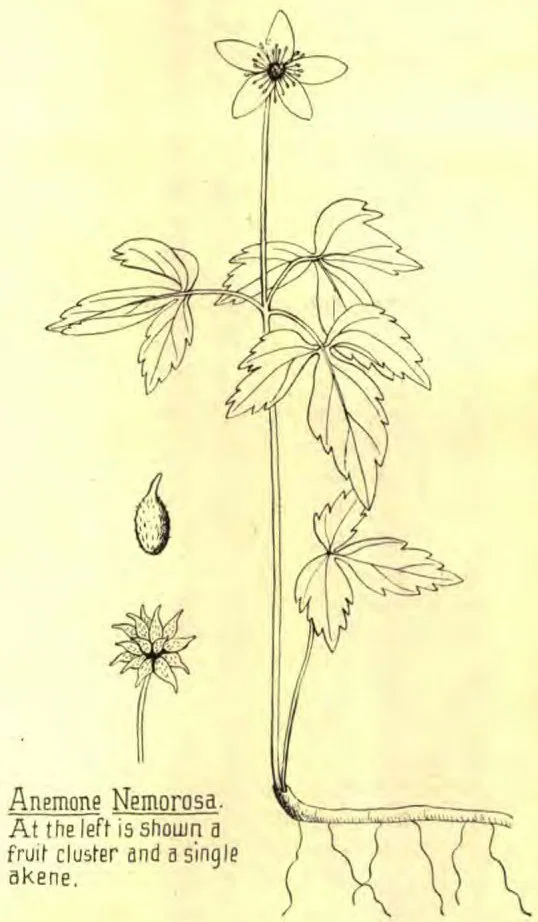
The word “anemone” comes from a Greek word meaning “wind,” and was given to the different species of anemones, perhaps because they grow in windy places, or blossom during the windy season; possibly because the flowers were formerly supposed to open only when the wind was blowing. The anemones are often called “windflowers.”
In the days of early spring, when the trees present to sun, dew, and rain their tender, half-grown, half-transparent leaves, and the shade cast by their foliage is thin and “spotty,” the Wood-anemone may be found scattered here and there over the forest floor, or growing along the country roadside. In the mountains and in high altitudes, where the season is unusually late, the plant of course does not appear as early as in lower altitudes.
Anemone Nemorosa.
At the left is shown a
fruit cluster and a single
akene.
Anemone Nemorosa. At the left is shown a fruit cluster and a single akene.
The stem is slender, and from four to ten inches high. A short distance below the blossom are three leaves, which are attached in a circle around the stem. Leaves arranged in this way beneath a flower or cluster of flowers, constitute what is known as an “in’vo-lu’cre.” An involucre may be formed of large leaves of the ordinary kind, as in the case of the Wood-anemone, or of small leaves resembling scales, and known as “bracts.”
The leaves of the Wood-anemone are compound with three or five delicate, wedge-shaped leaflets, and are attached to the stem by rather long petioles, or leaf-stalks. In addition to the leaves forming the involucre, there is often a radical leaf, which has the same form as the other leaves. A radical leaf is one which apparently comes from the root, but really from the base of the stem.
The corolla is absent, but the calyx is present, and closely resembles a corolla, consisting of four or more sepals, which are usually white or delicate crimson-pink, but sometimes of a purplish color. The flower is solitary, and borne on a short, upright peduncle, or flower-stalk.
The stem springs from a slender creeper growing just beneath the surface of the soil. This is quite well shown in the illustration. From its lower surface, roots are given off which fasten it to the soil. A stem of this kind, lying flat upon the ground and partly covered with the soil, or growing beneath its surface, is known as a rootstock, or rhizome. In most cases a rhizome resembles other stems in consisting of a succession of joints, and in bearing leaves and buds, though the leaves are small and scale-like. This resemblance is not so great in the Wood-anemone as we shall find it to be in some other plants.
Many plants spread rapidly by means of these underground stems, and at intervals send up branches into the air.
The rhizome is a sort of humble missionary. While it keeps out of sight itself, and makes no great parade of buds and leaves and blossoms, it is the channel through which nourishment is carried to the upright branches that spring from it. We may not all be preachers, or physicians, or teachers, or prominent leaders among men, but we may all be used as channels through which comfort, hope, and strength shall be ministered to those who are bearing heavy responsibilities.
The botanical terms used in this study, with which the reader should become familiar, are the following:—
Involucre: a circle of leaves below a flower or cluster of flowers.
Bract: a scale-like leaf.
Petiole: leaf-stalk by which the leaf is attached to the stem.
Radical: apparently springing from the root.
Peduncle: flower-stalk by which the flower is attached to the stem.
Rhizome, or Rootstock: a stem growing partially or entirely under the ground.
The terms corolla, calyx, petals, and sepals, have been used at different times in our past studies, and the reader should be well acquainted with them by this time. But if not, a dictionary should be consulted, so that when these terms are used again, there will be no difficulty in understanding what is meant.
B. E. Crawford.

Master of His Craft

AMONG the immigrants awaiting examination at Ellis Island was a tall young fellow with a little black bag under his arm. He was a Pole, about twenty years old, and his admission was a pleasing and dramatic incident. The lesson it teaches is as good for native Americans as for immigrants.
When the young man’s turn came to answer the inevitable question, “How much money have you?” he smiled, and answered, frankly, “None.”
“But don’t you know you can’t come in here if you have no money, and no friend to speak for you? Where are you going?”
“To Fall River first. I have a friend there. Then I shall see the whole country. You will hear of me.”
The inspector proceeded, rather sharply: “How will you get to Fall River? Where will you eat and sleep to-night?”
“I shall be all right,” replied the young fellow, confidently. “With this”—tapping the black bag—“I can go anywhere.”
“What is it?”
The Pole laughed, and opening the bag, took out a cornet. It was a fine instrument, and gave evidence of loving care.
“Can you play it well?” asked the officer, more kindly.
In answer the young Pole stepped out into an open space, and lifting the horn to his lips, began the beautiful intermezzo from “Cavalleria Rusticana.” At the very first note every one in the great building stood still and listened. The long lines of immigrants became motionless. The forlorn waiters in the pit looked up, and their faces became tender. Even the meanest among them seemed to feel the charm of the pleading notes.
When the music ceased, there was a burst of applause. Shouts of “Bravo!” “Good boy!” “Give us some more!” came from every side. The physicians, who had a few moments before made their hurried and not over-gentle examination, joined in the applause. The officer who had questioned him so sharply slapped him on the back. The commissioner himself had come up from his office at the sound of the horn, and asked for the particulars.
When he had heard them, he turned to the agent of the Fall River boats, and said, “Give this fellow a passage, including meals, and charge it to me.”
“I will charge it to myself,” said the agent, and he took the young Pole by the arm and led him away.
The incident was a sermon on competence, a lesson on what it means to be a master. The trade may be music, or farming, or bricklaying—it does not matter. The man who has conquered it, who knows it root and branch, can point to it as confidently as the Pole pointed to his cornet, and say, as he did, “With this I can go anywhere.”—Scribner’s Magazine.

Paul's Chief Ambition: That I Might Know Him

PAUL'S chief ambition was expressed in these words: “That I might know him.” Dare we aim at less?

Old and New

A CLOD of earth, from whose dark mold A seed full rich, with perfumed power, Breaks forth in mystic white and gold,— And lo! we see a queenly flower.
A heart of earth, with base design, Is touched by seed from heavenly fields; There comes to light a purpose fine,— A poor, base life all richness yields.
— Hunter Davidson, in S. S. Times.

A Little Help

THERE'S help in seeming cheerful When a body's feeling blue, In looking calm and pleasant, If there's nothing else to do, If other folks are wearing, And things are all awry, Don't vex yourself with caring; 'Twill be better by and by.
There's help in keeping tally Of our host of happy days. There's never one that dawneth, But it bringeth cause to praise The Love that ever watcheth, The Friend that's ever near. So, though one tryst with sorrow, One needs must dwell with cheer.
When troubles march to meet you, Salute them at the door. Extend both hands to greet them, Their worst will soon be o'er. Beat down their stormy bugles With your own rejoicing drums, And, mailed in lofty courage, Accept whatever comes.
—Margaret E. Sangster.

Service in the Young People’s Societies

I RECENTLY attended a Sabbath afternoon meeting of a Young People’s Society having an enrollment of about forty members. The theme of the program was an intensely interesting one, but an additional burden was imposed upon the leader because of the absence of several who had been depended upon to take part in the exercises, and who had failed to send in any excuse for their absence. The query arises, Why should the per cent of attendance be small at these important meetings? The fact that one has voluntarily enlisted in the movement to evangelize the world in this generation, implies earnest, consecrated service for God in the saving of humanity. And the purpose of the Young People’s Society should be to awaken a deeper interest in the salvation of men, and to give to its members a more thorough preparation for the work.
These meetings are not for entertainment. They are for the training and educating of gospel workers. And why should not every member be enthusiastic in his desire to attend every meeting, and to take an active part in the same? In arranging the program, much time may be given to thought and earnest prayer, that the spiritual benefits sought for may be realized. But what a disappointment to all present when those who have consented to assist are absent. The chief loss, however, is sustained by the one who fails to do his duty.
Perhaps the thought may suggest itself, “I can not do as well as some other one.” If so, surely you should not fail to make the attempt. Do not rely upon self. Rely upon God, and he will help you to do every duty that comes to you, in a way that will be acceptable to him. “I can do all things through Christ.”
My young friend, if you are not a Christian, listen to the Voice that calls you, and accept his invitation, which is yours to-day.
Young Christian, if you are not a member of the Young People’s Society, become such at the first opportunity. If you are a member, let it be your aim to attend every meeting of the Society, and cheerfully to accept every duty that comes to you as an opportunity for improvement and to help others, and perform the same to the best of your ability.
God wants minute-men. And those who eagerly press into service now, making the most of every opportunity to become efficient workers, will be ready to respond, whenever God shall call, “Speak, Lord; for thy servant heareth.”
“It may not be on the mountain’s height, Or over the stormy sea; It may not be at the battle’s front My Lord will have need of me. But if by a still, small voice he calls, To paths that I do not know, I’ll answer, dear Lord, with my hand in thine, ‘I’ll go where you want me to go.’”

Battles between Truth and Falsehood

Lesson VI—Property Rights

(May 14–17)
HOW TO STUDY THESE LESSONS.—(1) Read the lesson story; (2) try to recall or find scriptures in proof of each statement; (3) study the texts; (4) see how many missing links you can supply; (5) give the lesson to some one else. You will keep only what you give away.
The law of God is right. None of its rulings are arbitrary. They are founded upon the eternal principle of happiness. The religion of the Bible is the most reasonable thing in the world. Study the first prohibition given to man. God had given man all things that could make him happy. He had not withheld any good thing. To test man’s love and loyalty he reserved one tree for himself. He told man to leave it alone. Property rights lie at the foundation of all human happiness. If these rights are disregarded,—if that which belongs to you can be taken at will by any one who has the power or the inclination,—you can not be happy. Knowing this, God would teach men this foundation principle. Satan succeeded in getting man to rob God. Man thus became the slave of Satan. His property went into the hands of this tyrant. Jesus bought back man and his possessions. Now, the earth is the Lord’s. He rents it to men. He claims one tenth of all. He is anxiously watching to see who will learn to regard property rights as sacred. Would you leave God’s tree alone, if you were placed in the garden? Then you will not rob him now. The earth will be given to those who have proved that they can be trusted.

Outline

  1. The statutes of the Lord are right. Ps. 19:8.
  2. God says, “Come now,” be reasonable. Isa. 1:18.
  3. God told man to leave his tree alone. Gen. 2:17; 3:3.
  4. Man obeyed Satan, and robbed God. Gen. 3:26.
  5. Man thus became Satan’s slave. Rom. 6:16; John 8:34; 2 Peter 2:19.
  6. Man’s property was lost. Luke 4:6.
  7. Jesus redeemed man. 1 Peter 1:18, 19; Isa. 52:3.
  8. He bought back all that was lost. Eph. 1:14; Luke 19:10.
  9. Now the earth is the Lord’s,—the land, the money, all things. Ps. 24:1; 1 Cor. 10:26; Lev. 25:23; Haggai 2:8; Hosea 2:8, 9.
  10. He claims the tithe as his. Lev. 27:30–34.
  11. Whoever keeps any of the tithe robs God. Mal. 3:8–10.
  12. The earth will be given back to the faithful stewards. Luke 16:1–12.

Young People's Society Organized at Du Quoin, Illinois

A YOUNG People's Society of twelve members has been organized at Du Quoin, Illinois.

Sending Sabbath-school Reports to the Secretary

IN sending reports for this page, the better plan is to send them to the Secretary of the Sabbath-school Department, at the general office, 705 Northwestern Building, Minneapolis, Minn. The advantages of this plan are that by it delays are avoided, and the secretary is kept in closer touch with the work being carried on in the different societies. Where the plan has been followed, it has worked so well that all are advised to take it up.

Preserve Missionary Magazine Issues for Mission Studies

We would call attention again to the merging of the Missionary Magazine into the Review, and urge our readers to preserve, at least from month to month, their copies of that periodical, in order to have on hand the material upon which the monthly mission studies will be based. A part of this material will also hereafter be found in the INSTRUCTOR, so the copies of this paper should also be carefully kept for reference from month to month. In order to have the second Sabbath program result in a live, bright, interesting meeting, it will be necessary, among the first things, to have the material on hand with which to prepare the program. Therefore we say again, Save your papers!

Atlanta Young People's Society Reports Revival Through Work

NOTICE the excellent report from Atlanta this week. The writer says: “We have never had such a revival in the Atlanta church.” And this good word follows a recital of work actually being done by the twenty members of the Society. God says, “Blessed are they that do;” and it is a real blessing always that follows real work for the Master. The pages of God’s word record many examples of this truth—wherever his people have “had a mind to work,” his blessing has crowned their efforts. Such reports as this make our hearts rejoice. Wherever a Young People’s Society is organized, it should result not only in blessing to the individual members, and even to the community at large, but in revivifying, re-energizing, and truly reviving every member of the church. When this is so, there will come from every company those who are ready to work wherever the Master calls.

Young People's Society Work in Atlanta, Georgia

From Atlanta, Georgia

We have been so greatly encouraged with the results of our Young People’s Society that I felt constrained to send a report to the INSTRUCTOR, thinking perhaps some would be glad to know what we are doing in Georgia. Our Society was organized two months ago. The average attendance is about twenty.
A club of one hundred copies of the Gospel Herald is used each week, also many copies of the Signs, Life Boat, and other periodicals. The Soldier’s Home is visited every Sabbath afternoon. The old Confederate veterans are indeed grateful for the papers. Their Bibles and other books were burned with their Home a few months ago. They often request our workers to pray with them. An effort is being made to supply them with Bibles.
Our older members visit the city stockade and jail every Sunday, where the papers are eagerly taken and read. The children sell papers, having regular readers each week. We have a large field before us in this city.
We have never had such a revival in the Atlanta church. This is not due to any great effort, as we have not had a minister with us in many weeks; but there is a quiet moving of the Spirit of God on the hearts of both old and young to work for the salvation of our fellow beings. It is our desire that not only may earnest, faithful workers be developed for the home field as a result of our thus banding together in the Master’s service, but that workers may be fitted up to go to the regions beyond. Mrs. C. F. Curtis.

Religion in the Countenance

CARRY your religion in your heart first of all, and your face will take care of itself. Business may press, and worldlings may oppress, but the God of peace will as surely write his new name of love upon the face as upon the heart, and not a moment quicker in the one than the other.
Some one tells a story of a poor, little street girl who was taken sick one Christmas, and carried to a hospital. While there, she heard the story of Jesus’ coming into the world to save us. It was all new to her, but very precious, and the knowledge made her very happy as she lay upon her little cot. One day the nurse came at the usual hour, and “Little Broomstick” (that was her street name) held her by the hand, and whispered:—
“I’m having real good times here—ever such good times! S’pose I shall have to go away from here just as soon as I get well: but I’ll take the good time along—some of it, anyhow. Did you know ’bout Jesus bein’ born?”
“Yes,” replied the nurse, “I know. Sh-sh-sh! Don’t talk any more.”
“You did? I thought you looked as if you didn’t, and I was goin’ to tell you.”
“Why, how did I look?” asked the nurse.
“O, just like most folks—kind of glum. I shouldn’t think you’d ever look gloomy if you knowed ’bout Jesus bein’ born.”
Dear reader, do you know “’bout Jesus bein’ born?”—Selected.

— Thomas Tapper

Mathematics

FOUR times two, or one plus one, These are easy sums. The first means all my fingers, The second all my thumbs.
But ten times two! Now there's a sum Not every person knows. To find the answer, here's the rule: Count fingers, thumbs, and toes.

— Thomas Tapper

Continue reading: Ikie's Rocky Fords