ONE spring morning, when Ikie's mama was ready to drive to town, he climbed into the buggy, and whispered, coaxingly, “Get me a little hoe, please, mama, and a little rake. I need them so bad.”
When she returned with the desired tools, he went out into his garden on the other side of the grape arbor, and worked diligently for some time. By and by he came hurrying in, saying, “Mama, my garden is all made, and I want some seeds to plant.” So she placed in one chubby little hand some round, flat seeds, and in the other a number of slender, yellow seeds, telling him to plant them in different places, and in little hills, with four or five seeds in each hill.
Ikie had heard his father talking about Rocky Ford melons, and he was anxious to raise a fine crop of them to sell to passers-by.
When several days had passed, he called his mother out to see how nicely his Rocky Fords were growing. “Why, Ikie,” she said, when she saw the large, spotted leaves, “those are not muskmelons: they are the sweet pumpkins that I gave you.”
“No, mama,” said Ikie, positively, “I know they are the Rocky Fords, ’cause I planted them right here!”
Mama only smiled, and said, “Well, we'll see when they get larger.”
As the days passed, Ikie grew more and more enthusiastic over his Rocky Fords. He had one chum, a curly brown dog, whose name was “Sneezer.” Sneezer would allow Ikie to put a harness on him, and hitch him to his red wagon. The little boy spent many happy hours in this way, hauling in the kindling-wood for mama, gathering up the wheat that the farmers spilled while unloading, shoveling it into the little wagon, driving around on the scales to have it weighed, and then receiving blank checks in payment from his father, who always had time to do business with this little man.
When the “Rocky Ford” vines were quite large, Ikie went with his mother for a long visit in Michigan; and when he returned, late in the summer, he hurried out to his melon patch the first thing. He opened his big blue eyes in surprise; for his “melon vines” had spread all over the garden, and here and there were large, golden pumpkins, which turned their fat cheeks smilingly to the sun.
“Oh,” he said, disappointedly, “I won't have any melons to sell now.”
“Never mind,” said mama. “I'll buy the pumpkins from you.”
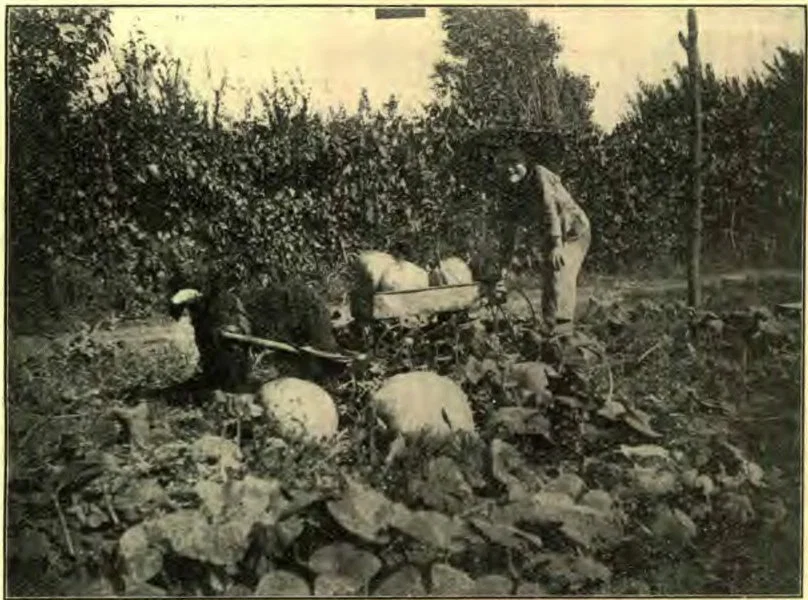
So Ikie waited contentedly till they were ripe, and then hitched Sneezer to his cart to harvest his crop. He placed them in the cellar, and they lasted till Thanksgiving. Sneezer had his share of the pies, and Ikie had a handful of pennies to take to Sabbath-school.
What he had done with the Rocky Ford seed, neither he nor mama ever knew; but he learned from his garden, that whatever a little boy sows, that shall he also reap.
EFFIE NORTHRUP.
Johnny Burns Himself without any Fire
By Eyes Right
JOHNNY found a big brass button one day, and set to work to make it shine by rubbing it on a piece of cloth.
“Isn't it bright?” he said, admiringly, after working a while. “Just like gold.”
Then he rubbed away again as hard as he could. Finally, to brush off some chalk dust that clung to the button,—for I had told him to chalk the cloth to make it brighten the button quicker,—he rubbed the button on the back of his hand.
“Ow!” he cried, dropping the button.
“What's the matter?” asked Fanny, who was looking on.
“It burnt me. It was hot.”
“Hot!” echoed Fanny. “How could it be hot?”
“I don't know,” said Johnny. “Anyhow, it burnt me.”
IKIE GATHERING HIS PUMPKINS
“Nonsense! it's as cold as anything,” said Fanny, picking up the button, and feeling it. “It may be cold now; but it was hot—very warm, any way.”
“What a silly boy! You just imagined it. One day you thought the gate-latch was hot, and it was freezing cold.”
Seeing that they were likely to do as a great many older people have done, dispute about what neither understood, I took the button, rubbed it smartly on my coat-sleeve, and then put it to Fanny's cheek.
“There!” exclaimed Johnny, as Fanny cried “Ow!” and put her hand to her cheek.
“I should not have thought your arm could make it so warm,” she said.
I rubbed the button on the carpet, and placed it once more against her cheek, saying, “It couldn't have been my arm that time.”
“Of course not,” said Johnny.
“What did warm it?” Fanny asked, her interest fully aroused.
“That's a good puzzle for you to work at,” I replied. And they did work at it a long time, rubbing the button on a great number of things, and finding that it always became warm.
“May be the heat comes out of our fingers,” Johnny suggested, at last.
I thrust a stick through the eye of the button, so that it could be held without its touching the hand, rubbed it on the carpet, and soon it was hotter than ever.
“I can't understand it,” said Fanny.
“I guess it's just the rubbing that heats it,” said Johnny.
“A very good guess indeed!” said I; “that is precisely where the heat comes from.”
“How?” Fanny asked.
“That is not so easy to explain to little people like you. Perhaps it will be enough for you to remember, just now, that rubbing causes heat. When you are older, I'll try to make it clear to you.”
“So there are two ways to get heat,” said Johnny, “fire and rubbing.”
“And from the sun, too!” suggested Fanny.
“And that's all,” observed Johnny, very positively.
“How do you keep warm in the night, and away from the fire, then?” I asked.
“The bedclothes keep me warm,” said Johnny.
“Is the bed warm when you first get into it?” I asked.
“Bur-r-r!” cried Johnny, with a shiver. “Not in weather like this.”
“Then you must warm the bed.”
“That's so!” assented Johnny.
“But where does the heat come from? and how does it get into me?”
“That's another thing that you'll have to wait till you're older before you can understand. Your little body can get heat out of bread and butter just as well as the stove can out of burning coal; but how it does it I couldn't make clear to you if I tried.”
“I thought heat always came from fire,” said Fanny.
“Don't you remember the day when the workmen made mortar for the new house over the way? They poured water over quicklime, that hissed, and sent up great clouds of steam. Here is an oyster-shell which I burned in the stove for quick-lime to use in making some cement. See, when I pour water on it, the lime drinks up the water, and grows hot.”
“But who'd have thought of water setting anything on fire!” said Fanny.
“Very great heat comes from mixing things sometimes,” I said. “Bring me a glass of water, and I'll show you one way.”
While Fanny was gone for the water, I took from a cupboard a bottle of watery-looking stuff, poured a little into another bottle, and gave the bottle to Johnny to hold.
“Is it warm?” I asked.
“No; quite cold,” was the reply.
“How does it feel when I pour in this water?”
“Warm—warmer—hot! Take it quick, somebody. I can't hold it.”
Neither Fred nor Fanny would believe that adding ice-water to anything could heat it, until they tried; but they were soon satisfied that the mixture was hot,—too hot to allow them to hold it long in their hands.
“That's just magic,” said Fred. “But what was in the bottle first?”150
“Sulphuric acid. Run and ask Mary for a piece of ice,” I added, “and I'll show you something more wonderful than that.”
When Mary came with the ice, I took from my cabinet a tiny vial with a small bead of metal at the bottom covered with naphtha.
“Is it lead?” asked Johnny.
“It is potassium,” I replied, “and I'm going to set the ice on fire with it. Stand back, all of you! there may be a small explosion.”
“Wonderful! wonderful!” Mary cried.
“Splendid!” said Fanny.
“Why—how——?” asked Fred.
And Johnny said?—not a word for two minutes; then he turned to me, and remarked, admiringly, “You can do anything, can't you?”
“No, Johnny; there are very few things that I can do, as you will find out in course of time. But now that we are talking of heat, let me show you another way of warming things. Please fetch me a flat-iron, Mary, while Johnny brings me his little hammer. Thank you. Now watch me when I pound this piece of lead, and put your finger on it when I stop.”
Johnny was quick with his finger, and as quick to take it away, and put it into his mouth.
“Awfully hot!” he said, as soon as he could speak.
“Did the hammering heat it?” Mary asked.
“Yes; I've seen a blacksmith pound a piece of cold iron, until it was hot enough to set wood on fire.”
“I've read of savages making fire by rubbing sticks together,” said Fred. “I tried it once, but couldn't do it at all.”
“An Indian showed me how long ago. He took a stick of hard wood, and plowed it up and down in a groove in a piece of soft wood, this way,” I said, rubbing the end of a penholder up and down a groove in a piece of soft pine. “I never could work it just right; but when he did it, the fine wood-dust at the bottom of the groove soon began to turn black, and to smoke, and finally took fire. I have done better with the fire-drill that other savages use. There is one that was brought from Australia, I believe. When I press the spindle against a piece of soft, dry wood, and make it spin rapidly,—so,—the spot first smokes, as you see, then takes fire. But that is too tiresome a way, when one can buy a dozen boxes of matches for a penny.”
“I understand now,” said Fred, “what it was that set a wagon-wheel on fire one day in the country. The driver said it got hot because it wasn't well greased. How could grease prevent fire?”
“Grease would have lessened the friction, and so kept the hub from heating.”
“I didn't think of that,” said Fred.
“We get fire, too, by rubbing, don't we, when we strike a match?” Mary asked.
“Certainly. The secret of friction matches is to have their points charged with something that takes fire easily, or at a low heat.”
“What is on them?” Johnny asked.
“Phosphorus, mixed with something to keep it from lighting too easily. Here is some pure phosphorus in this bottle. You rub the button, Johnny, while I take some of it out on the point of my knife. See! the button is hot enough to set the phosphorus on fire. We might kindle our fires that way; but it is easier and safer to put the phosphorus on the end of bits of wood, mixed, of course, with what will prevent its taking fire when we do not want it to.”
“I read a good story once about a traveler who was stopped somewhere in Asia by a barbarous people who knew nothing of matches. They would not let him go through their country, and set a guard to watch him, while the chiefs debated whether they should kill him or send him back.”
“While waiting for their decision, he had occasion to light a match; and taking one from his pocket, he struck it on the sole of his boot, and thought no more about it. To his surprise, the people who were watching him ran off in hot haste, and soon there was a great commotion in the village.”
“He had not long to wait before the chief men came back to him, this time paying him the utmost reverence. Slaves brought him food and fresh horses, and the chiefs begged him most politely to pursue his journey in peace.”
“What was the reason?”
“They had seen him, as they thought, draw fire from his foot with his finger, and they feared that such a great conjurer might burn them all up if they offended him.”
“That was a lucky match for the traveler,” said Fred.—Eyes Right.
THE INTERMEDIATE LESSON
VII — Sun, Moon, and Stars
(May 17)
“AND God said, Let there be lights in the firmament of the heaven to divide the day from the night; and let them be for signs, and for seasons, and for days, and years: and let them be for lights in the firmament of the heaven to give light upon the earth: and it was so. And God made two great lights; the greater light to rule the day, and the lesser light to rule the night: he made the stars also. . . . And the evening and the morning were the fourth day.” Gen. 1: 14–19.
“The heavens declare the glory of God, and the firmament showeth his handiwork. Day unto day uttereth speech, and night unto night showeth knowledge. There is no speech nor language, where their voice is not heard.” Ps. 19: 1–3.
“He telleth the number of the stars; he calleth them all by their names.” Ps. 147: 4.
“Ye are the light of the world. . . . Let your light so shine before men that they may see your good works, and glorify your Father which is in heaven.” Matt. 5: 14, 16.
(The Scripture texts are the lesson to be studied. Go over these carefully every day, until you know just what each one teaches. Then the following notes will help to a fuller understanding of the lesson. Read them carefully several times. Lastly go over all the questions, and be sure you can answer each one in the words of Scripture.)
God had made the darkness and the light to give day and night to the earth. He had spread out the clear firmament as a tent. He had gathered the waters together, and made the dry land151bring forth grass, herbs, and trees for beauty and fruitfulness. This was the work of the first three days.
And now on the fourth day he glorified the firmament of heaven with lights, which were to rule the day and the night, and make the earth bring forth its bounties at regular seasons.
God made the sun to be the glorious king of day, whose rising and setting should mark the morning and the evening, and divide the light from the darkness.
And when the sun’s shining face should no longer shed its bright light over the earth, God made the silvery moon, to walk in brightness through the heavens, still reflecting the sun’s light upon the world. For the moon and the planets have no light of their own, any more than our earth; they only reflect the sun’s glory.
But the sun has really no light of its own, any more than the moon. All the light that it sheds upon the world comes from the Father of lights. For the heavens declare the glory of God. To “declare” is to show forth. So all that the sun, moon, and stars can do is to show forth the glory of the Lord.
So the light, the warmth, the beauty, and the fruitfulness, that the earth receives through the sun,—we owe them all to God, the light of whose face shines upon us in the glad sunshine. “Truly the light is sweet, and a pleasant thing it is for the eyes to behold the sun.”
Lift up your eyes on high on a clear night, and behold the host of stars shining in the clear firmament. Some of these are suns many times larger than our sun, which is more than a million times larger than the earth. And round these suns are other worlds revolving, as our earth revolves about the sun that lightens it.
But the stars that we see are only a little portion of God’s great flock, which “can not be numbered for multitude.” Yet he tells their number, calls each by its name, and guides it in its path through space. Not one can escape from his keeping, nor fall from his mighty hand.
Yet he who is so great in might and strong in power that he gives light and life to unnumbered suns and worlds, at the same time numbers the hairs of our heads, and watches over the little sparrow. He gathers the lambs with his arm, and carries them in his bosom.
Jesus is the great Light of lights, and the sun, moon, and stars are his light-bearers. He is the Sun of righteousness, the Light of the world, and he wants us to be his light-bearers,—to shine as lights in the world with the glory that he sets on us. His own perfect life of righteousness lights the world with its glory; and by his Holy Spirit he fills all those who will let him with his own holy life, that men may see their good works, and glorify their Father in heaven.
Questions
What did God say at the beginning of the fourth day?
What did he place in the firmament of heaven?
What did he call these lights?
What did he say they were to do?
What special work did God give to the sun?
What did he say the moon should do?
What do the heavens, with all their hosts, declare?
Then whose glory is it that we see in the sun, moon, and stars?
Can any one tell how many stars there are?
What does God know about each one?
What keeps them all in their places?
Who is the true Light, the Father of all lights?
What is he able to make us?
Where are we to let our light shine?
What are men to see?
What will they do when they see our good works?
Have we any light of our own to let shine?
Then can the good works come from us?
Who must work in us, if we are to be the light of the world?
What was made on the first day? the second? the third?
The Square Braid
HORSEHAIR may be braided flat, round, or square; but the square braid is the most effective, and the one generally used. For a flat braid an odd number of strands, preferably five or seven, will be required. The braiding is similar to that done with three strands; and as it is so little used, no further explanation need be made here. A round braid may be made with four strands, but it will be too rough for our use. If eight, twelve, or sixteen strands are used, and braided around a cord as large as their aggregate size, the braid will be both round and smooth. But the braiding in this case will be exactly the same as for the square braid, and the result identical except in shape.
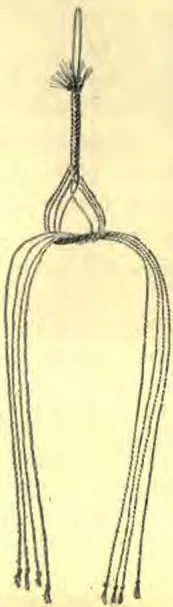
For the square braid eight strands will be required, though twelve or sixteen may be used. They may be all of one color, or half may be black and half white. Bind the necessary number together by tying a string around one end of the bunch. The knots on the ends of each strand, or thread, will keep it from slipping through the string, even though it is subjected to quite a pull. The ends of the string must be left long enough to form a loop by which the work may be held in some convenient manner while the braiding is being done.
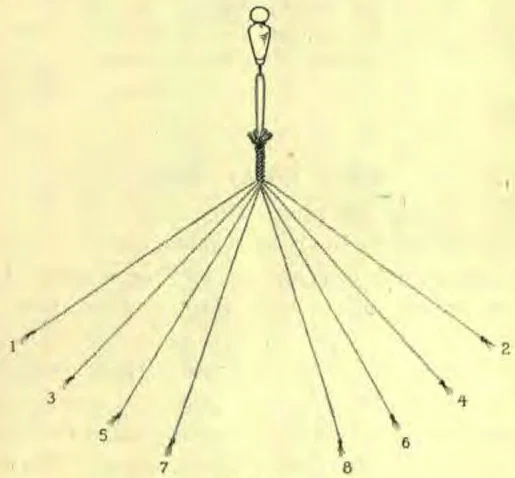
By referring to Fig. 2, you will see braid just fairly begun, with the strands of the unbraided part widely separated, and numbered for the sake of more ready identification. The strands are numbered in just the order they are to be used, and when each has been used once, all will be back in the same position that they now occupy.
FIG. 2
To proceed with the braiding, grasp the strands on the right—the even numbers—between the thumb and forefinger of the right hand; and with the left hand take number one, and pass it down under the others till it can be held between the middle and forefingers of the right hand. Now take the three strands remaining on the left, the odd numbers, between the thumb and forefinger of the left hand, release numbers eight and six, and bring number one up between four and six, over six and eight, and back to its own side in front of seven. This will crowd seven back to the place that five occupies in the illustration; five will take the place of three; and three will occupy position number one. Next take number two, pass it under and up between five and seven (it would be between three and five as the illustration now stands, but you will remember that one has been placed in front of seven), then across seven and one to position number eight. Numbers three, four, five, etc., are next used in their turn until the braid is finished. This may seem rather complicated when you read it, but once you get to work, it will be found quite simple.
If the strands get out of place, after a braid is started, it is often quite difficult to straighten them out again. For that reason a braid should not be left unfinished unless the right and left strands are tied in such a manner that there will be no danger of their becoming mixed. A
J. EDGAR ROSS
By J. Edgar Ross
FIG. 3
Simple and effective method of accomplishing this is shown in Fig. 3.
Where black and white strands are used in the braid, their arrangement may be varied to secure different effects. When the black and the white come alternately, or in pairs, the resultant braid will show their arrangement in a similar manner. But if white is placed on one side, and black on the other, the braid will show two white and two black stripes running lengthwise.
J. EDGAR ROSS
VII — The Coming Deliverer
(May 17)
MEMORY VERSE: “There shall come out of Zion the Deliverer, and shall turn away ungodliness from Jacob.” Rom. 11:26.
LESSON SCRIPTURES: Same as inserted in Synopsis.
LESSON HELP: “Patriarchs and Prophets,” page 137.
Synopsis
The first announcement of the gospel (Gen. 3:15) brought hope to our first parents,—the hope of a coming Deliverer. Rom. 11:26. He was to be the seed of the woman, which should bruise the serpent’s head. Eve comprehended this promise, and upon the birth of her first son, she evidently thought that the Deliverer had come, for she said, “I have gotten a man from the Lord,” or as it reads literally, “I have gotten a man, the Lord.” Gen. 4:1.
But Cain was not the promised seed; a long, long time was to pass before the second Adam should appear. The first Adam was human; Christ, the last Adam, was both human and divine. 1 Cor. 15:45. Of his divine nature we are to be partakers according to God’s exceeding great and precious promises. 2 Peter 1:4. As we have borne the image of the earthly, we shall also bear the image of the heavenly. 1 Cor. 15:49.
The sacrifices given to Adam and his family pointed to just such a Saviour; Abel saw it, and faith in this Saviour made his offering more excellent than Cain’s. Heb. 11:4. This same faith translated Enoch (verse 5), and brought to Noah the experience of righteousness. Verse 7. On the other hand, it was the rejection of this hope that led to the corruption of the sons of God and the daughters of men, so that the image of God was defaced in the human race, and the divine nature was lost. Gen. 6:1, 2.
To Abraham this same gospel was preached. Gal. 3:8. He was living among idolaters (Joshua 24:2) in a far-off land, but the promised blessings led him out of his country to look for that city whose builder and maker is God. Heb. 11:10. To him God made a promise which involved the coming of Christ, the seed. Gal. 3:16. By faith Abraham saw Christ’s day (John 8:56),—it was when he offered Isaac, and he said, “God will provide himself a lamb.” And truly, the Lamb of God is God himself,—God manifest in the flesh.
God’s promise to Abraham also involved the restoration of the earth to man for an everlasting possession. Rom. 4:13. Abraham said to the Lord, “Whereby shall I know that I shall inherit it?” and the Lord condescended to enter into a covenant with his servant, employing such forms as were customary among men for the ratification of a solemn engagement. See Gen. 15:9–12, and “Patriarchs and Prophets,” page 137. “About sunset he sank into a deep sleep; and, ‘lo, an horror of great darkness fell upon him,’ The voice of God was heard bidding him not to expect immediate possession of the promised land, and pointing forward to the sufferings of his posterity before their establishment in Canaan. The plan of redemption was here opened to him, in the death of Christ, the great sacrifice, and his coming in glory. Abraham also saw the earth restored to its Eden beauty, to be given him for an everlasting possession, as the final and complete fulfillment of the promise.”
In this experience it was distinctly stated that the promises would not be fulfilled during the natural lifetime of Abraham (Gen. 15:15), and they, therefore, included the resurrection of the dead. This was the “hope of the promise” spoken of by Paul (Acts 26:6–8), and included the coming of the Lord and the new earth. 2 Peter 3:9–13.
Questions
What hope was the central thought in the first promise of the gospel?
At first who was thought to be the Deliverer?
What name shows the relation of the promised One to humanity?
What is the nature of this last Adam?
How can we share this nature?
What did Adam and his family learn from the sacrifices?
What made Abel’s offering so excellent?
What did this same faith do for Enoch and Noah?
What was the condition of the world just previously to the flood? What was the cause of this?
Where was Abraham when he received the first gospel call?
With what object in view did he leave his country?
What assurance did God’s promise give him concerning Christ?
What experience led Abraham to see this promise “afar off”?
What did this promise involve concerning the earth?
What question did Abraham ask concerning the promised inheritance?
How did the Lord confirm Abraham?
What did the Lord reveal to him during that “horror of darkness”?
What did the Lord say would come to Abraham before the promise would be fulfilled?
What, therefore, did the fulfillment of the promises include?
How did Paul speak of this to Agrippa?
What other events are inseparably connected with the fulfillment of the promises to Abraham?
Shorthand by Mail
YOUR spare time can be well improved by studying shorthand, and this may be done at small expense to you by taking a mail course at your home. We are using “The Rogers Compendium of the Graham System of Shorthand,” a method arranged especially for home study, and giving an epitome of a system of shorthand acknowledged to be the best, the briefest, and the most complete. The only presentation of Standard Phonography in which all shorthand outlines are written as first learned, thus greatly abbreviating the work on the part of the student. A complete course in thirty lessons, illustrated by facsimile notes, with key. The correction of all students’ papers given special attention by experts. Reasonable tuition rates. If interested, write for full particulars. Practicing stenographers wishing to prepare for rapid reporting work should secure the last twenty lessons.
FIRESIDE CORRESPONDENCE SCHOOL, Battle Creek, Mich.
SOLID THROUGH TRAINS OF WIDE VESTIBULE COACHES and PULLMAN SLEEPING CARS BETWEEN
Battle Creek and Chicago, Buffalo, New-York, Philadelphia, Toronto, Montreal, Boston
For time-tables, descriptive matter, and information, apply to any representative of the company.
The Twelve-Year-Old
By M. Bessie De Graw
TAKE it the wide world over, you will not find very much in print concerning twelve-year-old boys and girls. But the Bible is one great exception to this rule. In biographies of men of God, the boy of twelve is often mentioned.
What has been done by boys of twelve? Moses was about this age when he left his mother's home, and entered the Egyptian court to receive a training that would prepare him to sit on the throne of the greatest kingdom of the world.
Samuel was a twelve-year-old boy, so the Jewish legends say, when he entered the temple service under the direction of Eli. What twelve-year-old boy living to-day would not be pleased to serve in the presence of God, and to hear the voice of God calling him by name?
A boy is not obliged to wait until he is a man grown, in order to be a follower of Christ. It would seem that the first vivid ideas of life-work, the first opportunity to choose a career for the future,—in a word, the first unfolding of the spiritual nature,—come at about this age.
The boy David, at the age of twelve, was feeding the sheep on the hills of Bethlehem. It was a child heart that awoke to the promptings of the Holy Spirit, and led God, who looked upon that heart, to choose and anoint him as the future king, and to make him the father of Christ.
We can go even further; for the Bible gives us a glimpse of the child life of Christ himself, bringing him at the age of twelve into bold relief, and then casting a veil over his history for almost a score of years.
It was at the age of twelve that Jesus made his first visit to Jerusalem. He stood as any other boy of his age might have stood, watching the work of the white-robed priests. A lamb was slain and placed on the altar; the smoke ascended toward the sky; and into the heart of that little boy came the thought: “Thou, Jesus, art my beloved son.” He had often heard the story of his birth and mission as told by his mother; he had listened often to her readings from the Old Testament Scriptures; but never until that moment had he sensed so fully that God had brought him into the world for a purpose, and that he could not be like other boys. He stole away that he might be alone.
Jesus prayed, and told his Heavenly Father that he would do whatever work he had for him to do. The next view we have of him he is in the synagogue school, listening to the doctors as they taught other Jewish boys. He questioned these teachers, and answered questions put to him, in a way that showed his connection with heaven. And yet he was only a boy—a boy of twelve years.
If Jesus, and David, and Moses had a work to do when only twelve, what does God expect of children to-day? Can they excuse themselves with the thought that they are only twelve?
When each of these boys I have mentioned was twelve, there were other boys of their age who did not do a work for God; but that did not keep Jesus from his work, it did not make David careless or neglectful of his duties.
In the sale of “Christ's Object Lessons” there is a work which can be done by the children. Every child should have an opportunity to work, and in the sale of this book every child is invited to do something. Some children have done nothing, but others have worked with marked success. One of the churches in Wisconsin reports that two little girls, five and nine years of age, are canvassing, and both are determined to sell their share. They have already sold four books. Other children are doing a similar work; what have you done?
The INSTRUCTOR would be pleased to receive letters from all its children readers who have had an experience in working for “Christ's Object Lessons.” Tell us how you worked, and the results. These will be published.