The Youth’s Instructor, Vol. 47, No. 47.

THE RIVER THAMES
Earlier text: THE RIVER THAMES

WHY LEAVES FALL

I DO not know that I can explain to you much about this mystery of the fall of the leaf, for mystery in a large degree it is; but I will try.
You will know, if you stop to think, that a tree or plant obtains its moisture from the soil through its roots. This water, drunk up out of the soil by all the tiny rootlets, passes into the roots, and up the stem or trunk to all places where it is needed; and in time much of it passes out of the leaves in their breathing process. When the weather is right, this inflow and outflow of water is perfectly balanced, and the plant keeps moist inside, and fresh and green to the eye.
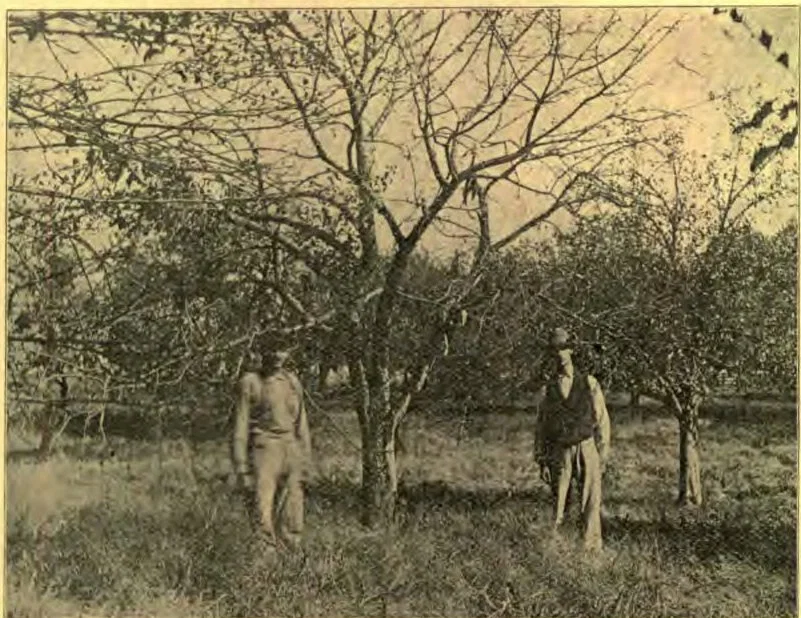
APPLE-TREES IN AUTUMN.
But when the weather grows colder, the roots become apparently chilled, and do not drink up water fast enough. But the water in the tree passes out through the leaves just as fast as ever. You can see that the tree would soon dry up at this rate, if something did not happen: but something does happen.
The leaves can not pull themselves off the tree; but as they are losing more water than the tree is able to get, they must be got rid of. As if the tree knew this was all going to happen, sometime beforehand a little something begins to grow at the place where the leaf is fastened to the tree. It grows right across the stalk and separates it, or cuts it quite in two. I can not make you realize how strong this little layer of cells is, that it can grow this way, and cut the petiole, or leaf-stem, in two.
But now that the petiole is cut in two, it hangs ever so lightly. If the wind blows, or the tree is shaken, down comes the leaf; but if no wind blows, the leaf will fall, after a while, of its own weight.
The place where this separation takes place looks as if the stalk had been cut through with a knife. In some trees it takes but a few days for this operation to take place; in others it may take a number of weeks.
It is also worth mentioning that in some trees the leaf-fall begins at the top of the tree, and gradually proceeds downward; in others, it is quite the contrary. In ashes, beeches, hazels, and some others, the apexes of the branches are leafless when the lower parts are still covered with foliage; in willows, poplars, and pear-trees, on the other hand, the lower portions of the branches lose their leaves early in the autumn, the loss of the leaves extending gradually toward the top.
Thus the tree gets rid of its leaves; and now, since but little water is lost, the roots, though in the cold they are not able to work as actively as in the summer weather, are able to keep the tree supplied with what little water it may need. In fact, the tree needs but little at this time.
It is true that some plants, like corn and wheat, die when they have lived a year; but not so with the oak and the maple and many other plants and trees. These do not die when winter comes, but they do go to sleep. Like bears and some other animals, they sleep through the cold months.
If you look at a tree at such a time, it appears dead. Its branches are all bare; it seems to have no life. But there is life there, and next spring will prove that the tree was not dead, but only asleep. During the winter the sap no longer flows in the stem. The little rootlets do not gather water for the sap now; they are quiet; they, too, have gone to sleep. There are buds all over the tree, but they are closely wrapped in warm blankets, and are all fast asleep. The winds rock them back and forth in their winter cradles, but they never wake till the warm spring sunshine calls them from their winter beds.
“How much life there is asleep in that tree! The buds are all there, which are to make all that you will see on it next summer. They are covered up snugly from the cold in their winter coats. The little things are very still, but they are alive. They only want a warm sun to make them show it. As soon in the spring as they feel the warmth through their coats, they begin to swell, and soon open their coats, and go to work to make leaves, and flowers, and fruits. A great work they do after their long winter sleep. Look up into a tree in summer, and see how these leaf-buds have filled every branch with leaves. You can hardly believe that it is the same tree that you saw so bare in the winter.”—Hooker, pages 132–133.
If we would know how much life there is covered up in the earth in winter, we have only to watch the opening spring days. The things that come then in so short a time,—the plants that spring out of the earth and flower so speedily, the leaves that cover the trees so thick and green,—all this life was not dead, it was only asleep, and needed but the touch of the sun, warm and tender, to call it all forth.
L. A. REED.

LONIDAW, “QUEEN OF THE WOODS”

About sixty-one years ago, when the Pottawattomi Indians were driven from the northern part of Indiana and the adjacent country to the reservation beyond the Mississippi River, occurred the birth of a remarkable Indian maiden, whose simple, quiet life and charming gifts won the admiration of all her tribe. As General Tipton with his soldiers surrounded the Indian village of Menominees, the villagers gathered at their churchyard, and, bidding a sorrowful farewell to their departed friends, were driven from their homes, never to return.
A few made their escape into the woods, among whom was an Indian woman, who fled by night into a desolate swamp. There she sought shelter from the storm in the hollow of a fallen sycamore-tree, amid the howling of wolves and screaming of panthers. The next morning little Lonidaw came to be her comfort. At the end of a week the mother carried the child to the wigwam of an old trapper, where both were kindly cared for. After many months the father, who had been driven away, wandered back and found them. Because of the suffering and cruelty he had endured, he became so disheartened and discouraged that he gave himself up to the terrible curse of strong drink, and finally died as a result. Lonidaw and her mother then obtained their support by making baskets and various kinds of fancy work.
This little child of the forest loved to spend much of her time out in the woods alone with the birds, squirrels, and beautiful flowers. While she was watching in some hazel brush one bright morning in spring, a robin came and lighted above her, pouring forth its song of praise, so close that she could plainly see every motion of its bill and swelling throat. Unconsciously she began to sing its warbling song. She learned the wild birds’ songs of love, their cry of alarm, their shout of defiance when attacked by birds of prey, their calling chirp, when their young had left them, and their plaintive song when deserted. Thus she became familiar with the language of all the birds of the forest, and with the chatter of the squirrels and other wild animals. At her call they would flock about her in great numbers. When the child was only five years old, a hunter saw her, her dress decked with fern, a wreath of trailing arbutus on her head, and a string of berries about her neck, playing “haw, haw, haw,” with the crows, by which she was surrounded in great numbers. The birds were making a terrible uproar, as if attacking a bird of prey.
One day as she was roaming through the woods, she startled a white deer, which ran away, leaving her new-born fawn. Lonidaw reared the fawn on pony’s milk, and he became her fondest pet and constant companion. Playful as a kitten, he was still her stanch defender. She was always safe from harm with him at her side. When she went out in the early morning to gather sweet grasses and other materials for her fancy work, he always followed. Jealous of the pony that nursed him, he drove her away, because Lonidaw sometimes petted her. When Lonidaw was married, the deer became so enraged to see another take his place at her side that he ran away, and never returned.
Lonidaw became the wife of Simon Pokagon, the last chief of the Pottawattomis. On the morning of their marriage they started on their bridal tour through the woods. He had heard of her power, and wished to know the secret of it. This she had never revealed to any one else, but she told him how she joined in the various songs and chattering of bird and beast. Naturally, he asked to see her display her power; so, finding a clear spot of ground, and sprinkling some salt thereon, she decked her husband and herself with evergreen boughs. Then they sat down on a log, and she began her musical chatter. In a few moments they were surrounded by vast numbers of pigeons, a sight beautiful to behold.
Lonidaw never allowed any harm to befall the innocent creatures that came at her call. She believed that this gift was from Ki-ji Manitou, the Great Spirit, and that should she injure them, or permit any harm to come to them, her gift would be taken from her. Her heart was filled with the spirit of love and tenderness for the creatures of nature that characterizes their Creator.
Her pet and faithful dog, Zoan, seemed to acquire, from his association with her, a love for the beautiful. One of his tasks was to carry her flower basket; and sometimes he would go out into the woods alone, and bring it back filled with flowers. He delighted in swimming out into the lake to gather water-lilies to lay at her feet. At Lonidaw’s death the faithful creature followed Pokagon to her burial, sympathetically licking his hand, and trying to wipe away his tears. Then he ran to the lake, and brought back lilies, one by one, until he had nearly covered her grave.
Thus closed a life whose knowledge of God came not from the living teacher, nor from a study of books, but from God’s revelation of himself in nature,—a life that sent out a breath of fragrance and purity to all around it.
Lydia E. Kynett.

A PERFECT DAY

FAIR was the blue sky overhead, Fair was the earth below; Soft as an infant's breath, the wind Went wandering to and fro.
The creeping grasses clad the earth In garniture of green; A summer day more fair, more sweet, The earth has never seen.
Yet something still it seemed to lack To satisfy my heart; Lovely, but lifeless as a thing Created by some art.
But lo! I heard a gush of song, The whirring of a wing, And into happy, joyous life The whole world seemed to spring.
— Selected.

A LITTLE LAD’S ANSWER

Our little lad came in one day With dusty shoes and tired feet; His playtime had been hard and long, Out in the summer’s noontide heat. “I’m glad I’m home,” he cried, and hung His torn straw hat up in the hall; While in the corner by the door He put away his bat and ball.
“I wonder why,” his auntie said, “This little lad comes always here, When there are many other homes As nice as this and quite as near.” He stood a moment in deep thought, Then with a love-light in his eye, He pointed where his mother sat, And said: “She lives here, that is why.”
With beaming face the mother heard; Her mother-heart was very glad. A true, sweet answer he had given,— That thoughtful, loving little lad.
And well I know that hosts of lads Are just as loving, true, and dear; That they would answer as did he: “’Tis home, for mother’s living here.” — Christian Advocate.

(December 9, 1899)

SABBATH-SCHOOL LESSON.—NO. 10

(December 9, 1899)

SIGNS OF CHRIST'S SECOND COMING

Memory Verses.—Mark 13: 35–37.
Time: A. D. 31. Place: Mount of Olives.
Persons: Jesus, disciples.

QUESTIONS

1. What did Jesus say would come to his people after the destruction of Jerusalem? Matt. 24: 21. Unless the Lord should interpose, what would be the result? V. 22; note 1.
2. As persecution would be stopped, what plan to destroy God's people would Satan then adopt? Vs. 23, 24. Against what special deceptions does Jesus warn us? V. 26. By what truth relative to Christ's coming may we test the false claims of men? V. 27.
3. What events did Jesus then point out as positive signs of his coming? V. 29. What would next take place? Vs. 30, 31; note 2.
4. What parallel does Jesus draw between the fig-tree in nature and the signs mentioned? Vs. 32, 33. How definitely is the time fixed for the complete fulfilment of all he has said? V. 34; note 2. What positive assurance is given that his word will not fail? V. 35.
5. Though we may know his coming to be near, what does Jesus say to all who would endeavor to set a time for his coming? V. 36; note 3. What time and facts are pointed out as illustrative of conditions in the last days? Vs. 37–39. Showing that men will not know the exact time, what is further said by the Saviour? Vs. 40, 41.
6. What, therefore, should all do? For what reasons? Vs. 42–44. What should now be the position and work of the true child of God? V. 45. What blessings are in store for the faithful, watching ones? Vs. 46, 47. What may the unfaithful servant be expected to say and do? Vs. 48, 49; note 4. What terrible fate awaits him? Vs. 50, 51.

NOTES

1. This period of “great tribulation” is that of the twelve hundred and sixty years of papal persecution, foretold by Daniel (Dan. 7: 25), extending from A. D. 538 to A. D. 1798. Unnumbered millions of God's people were put to death for their faith in Christ, in ways almost too terrible for description. So bitter was the persecution, and so general, that there would have been none of the “elect”—the saints of the Lord—spared, had not God, by his providence, cut the trouble short. This he did about 1770–76. It is a striking coincidence that at the time the Declaration of Independence was given in the New World,—1776,—the hand of persecution was lifted from the people of God in the Old World. The persecution ended before the close of the 1260-year period. But this is just as the Saviour said it would be. Mark 13: 24 says, “In those days, after that tribulation.” Thus we see that the tribulation would be ended before the days were closed. The persecution ended 1770–76; the sun and the moon were darkened in 1780; the days ended in 1798. Thus it was “in the days,” but “after that tribulation,” that the sun was darkened.
2. As the bursting forth of the new leaves is certain evidence that summer is near, so the appearance of the signs is a sure testimony that the coming of Christ is “at the door.” See margin of Matt. 24: 33. This is definite. But to make it even stronger, Jesus adds, “This generation shall not pass, till all these things be fulfilled.” Allowing the greatest possible time to a generation, time can not continue much longer, and God's word still be true. But the word is true; therefore the time is exceedingly short. Oh, that every young man and woman could see this, and shape his life accordingly! We should then do as the Lord has said we must do,—“make a rush for the kingdom.”
3. Since 1844 no one has been led of the Lord to set time. The day and hour of his coming are in the mind of God, but have not been revealed to man. The Scriptures are silent upon this point. The Lord would have his children burdened with the thought that the end is near, yet with a world to be warned. Therefore instead of studying about the day and hour, the followers of Christ will be working to prepare men for the coming King.
4. Mark the words, “Shall say in his heart.” He does not express the thought with his lips, but it is in his mind, and works out in his life in evil deeds. He still professes to love the appearing of Jesus, and counts himself one of the waiting people of God. His name may still be on the book of the church. But he is an “evil servant,” deceiving and being deceived. His life is a flat denial of his profession. It is impossible long to hide an evil principle. May an abiding love for Christ's coming be cherished in our hearts, to be breathed out, acted out, in the prayer, “Come, Lord Jesus, come quickly.”

THANKSGIVING

THANKSGIVING! Thanksgiving! November is here, The beautiful crown of the wonderful year! Like doves to the windows, from east and from west The children come back to the cosy old nest.
Thanksgiving! Thanksgiving! the old folks at home Are so glad by the fireside to see them all come; Though the forties and fifties are silvering their hair, They are boys yet and girls to the good people there.
Thanksgiving! Thanksgiving! sit down by the fire; Talk over old times with the happy old sire; Tell the mother, whose hair is like new-fallen snow, That you love her no less than in days long ago.
Oh, the home—the old home! The new may be sweet, But 't is not like the old to the world-weary feet; Be it long ere the hearth-light shall fade from its walls, And the cheerful old love-light go out in its halls.
— Union Signal.

Do We Want Work or Only Wages

“Do we really want work, or do we only want wages? Are we offering the world a life, to be spent in unreserved service? or are we asking it for all that we can persuade it to give us in return for the least possible expenditure on our part? The world wants workers, wants them badly, and it will never let them lack for reward; but it has no special need of people who only want wages.”

STEPPING-STONES TO SUCCESS

Have a definite aim.
Go straight for it.
Master all details.
Always know more than you are expected to know.
Remember that difficulties are made only to be overcome.
Treat failures as stepping-stones to further efforts.
Listen well; answer cautiously; decide promptly.

DOING MORE THAN OUR DUTY

THERE are certain people who always do their duty. They meet their engagements to the minute. They meet their obligations to the cent. They may be counted upon to do just what they say they will do. They are an admirable people. May their tribe increase!
“Yet I show unto you a more excellent way;” that is, to do more than your duty. “If ye salute your brethren only,” said Christ, “what do ye more than others?” No man deserves credit for doing his simple duty. It is in the work of supererogation that the aroma lies. “Let scientific charity look after the worthy poor,” the late A. J. Gordon used to say; “my mission is to the unworthy.”
If we desire to touch hearts for Jesus, we must be willing to go out of our way to do it. There lies the power of the cross.—William Ellsworth Bryce.

Christ Our Saviour...

Gives a graphic description of the birth, early training, baptism, ministry, death, resurrection, and ascension of Christ our Saviour. The book contains 160 pages, profusely illustrated, handsomely bound in three styles of binding.
Prices, $1.25, 75, and 50 cents.
We offer this book, post-paid, to INSTRUCTOR subscribers at the following rates:—
Cloth back, board cover, for three new yearly subscriptions, at 75 cents each; or with the INSTRUCTOR one year for $1.00.
Fine English cloth, for four new subscriptions, at 75 cents each; or with the INSTRUCTOR one year for $1.25.
Presentation edition, for five new yearly subscriptions at 75 cents each, or with the INSTRUCTOR one year for $1.50.

Self-Pronouncing S. S. Teachers’ Reference Bible.
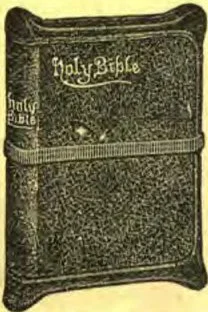
CONTAINS the celebrated Teachers’ Helps, comprising nearly 400 pages. Also a complete series of fifteen new maps.
Description.—Imperial Seal Binding, Tuck Edges, known as “Divinity Circuit,” Rounded Corners, Full Red under Gilt Edges.
We offer this Bible, post-paid, for only SIX NEW YEARLY SUBSCRIPTIONS at 75 cents; or TWELVE NEW SIX MONTHS’ SUBSCRIPTIONS at 40 cents.
We will also send it, post-paid, with the INSTRUCTOR one year for $2.25. For 20 cents extra we will stamp your name in gold upon the cover.

TAKE THE Canadian Pacific Railway

for . . . CHATHAM, LONDON, WOODSTOCK, PORTLAND, OTTAWA, GALT, TORONTO, and MONTREAL, QUEBEC, BOSTON,
All points in New England, the Maritime Provinces, Great Britain, and the Continent.
Illustrated literature, time-tables, and full particulars, upon application to—
J. FRANCIS LEE, GEN. AGENT,
Passenger Dep't. 228 SOUTH CLARK ST., CHICAGO
Branch Offices: 76 Ottawa St., Grand Rapids, Mich.; Room D, Chamber of Commerce, Cincinnati, Ohio; 315 Chestnut St., St. Louis, Mo.

Cincinnati Northern Railroad Co.

TIME TABLE NO. 3.

IN EFFECT SEPT. 24, 1889.
Trains Pass Battle Creek, as follows:

WEST-BOUND.

No. 21, Mail and Express .................... 6.58 P. M.
No. 23, Accommodation ........................ 2.07 P. M.
No. 27, Local Freight ........................ 8.25 A. M.

EAST-BOUND.

No. 22, Mail and Express .................... 8.25 A. M.
No. 24, Accommodation ........................ 1.45 P. M.
No. 28, Local Freight ........................ 5.30 P. M.
Direct connections are made at Toledo with all roads diverging. Close connections for Detroit and Cincinnati.
J. L. READE, Ticket Agt., Battle Creek.
E. R. SMITH, City Pass. Agt., 6 West Main St.

GRAND TRUNK RAILWAY SYSTEM.

Time-Card in Effect October 9, 1899.

C. & G. T. DIVISION.

WEST-BOUND FROM BATTLE CREEK.

No. 9, Mail and Express, to Chicago........................ 12.15 P. M. No. 1, Chicago Express, to Chicago.......................... 9.00 A. M. No. 3, Lehigh Valley Express, to Chicago.................... 3.40 P. M. No. 5, Pacific Express, to Chicago, with sleeper............ 1.10 A. M. No. 75, Mixed, to South Bend................................. 8.20 A. M. Nos. 9 and 75, daily, except Sunday. Nos. 1, 3, and 5, daily.

EAST-BOUND FROM BATTLE CREEK.

No. 8, Mail and Express, to Pt. Huron, East, and Detroit ... 3.45 P. M. No. 4, Lehigh Express, to Port Huron, East................... 8.27 P. M. No. 6, Atlantic Express, to Port Huron, East, and Detroit.... 2.25 A. M. No. 2, Leh Exp., to Saginaw, Bay City, Pt. Huron, and East... 6.50 A. M. No. 74, Mixed, to Durand, (starts at Nichols)................ 7.35 A. M. Nos. 8 and 74, daily, except Sunday. Nos. 4, 6, and 2, daily.
A. S. PARKER, Agent, Battle Creek.
GEO. T. BELL, 1st A. G. P. & T. Agent, Chicago, Ill.

“Beautiful Joe.”

An Autobiography
By
Marshall Saunders.
Beautiful Joe is a real dog, and “Beautiful Joe” is his real name. He belonged during the first part of his life to a cruel master, who mutilated him in the manner described in the story. He was rescued from him, and is now living in a happy home, with pleasant surroundings, and enjoys a wide local celebrity.—Author’s Preface.
This story awakens the interest of the reader in the first chapter, and sustains it to the end. It must make an impression for good, and in the interests of kindness and gentleness, upon all who read it.
The book is well bound in cloth, with gilt side-stamp; 304 pages; illustrated. Price, 75 cents. Bound in paper, 50 cents.
It will be sent, post-paid, for four new yearly subscriptions to the YOUTH’S INSTRUCTOR, at 75 cents each; or with the INSTRUCTOR one year for only $1.25. In paper covers, with the INSTRUCTOR one year, for $1.00.

“Dickey Downey.”

By
Virginia Sharpe Patterson.
This little volume is charmingly written, its object being to teach the children to love and protect the birds. That it is interesting, the following selected chapter-headings will abundantly show:—
The Orchard.
Dickey Downey’s Meditations.
Dickey’s Cousins.
A Winter in the South.
The Prison.
The Hunters.
Polly’s Farewell.
The book is bound in cloth, and contains 192 pages, with four beautiful colored plates. Price, post-paid, 60 cents.
We offer this book, post-paid, for three new yearly subscriptions to the YOUTH’S INSTRUCTOR, at 75 cents each, or with the INSTRUCTOR one year for only $1.15.

Making Home Happy.

By Mrs. L. D. Avery-Stuttle.
This subject is presented in an interesting story form, and every reader will feel inspired to strive to make his home cheerful. Happy homes are needed everywhere, and “Making Home Happy” is a good little book to help bring about this result.
The book contains 206 pages, with four full-page illustrations, besides smaller ones. Price, bound in cloth, 50 cents.
We will send it, post-paid, for three new yearly subscriptions to the INSTRUCTOR at 75 cents each; or with the INSTRUCTOR one year for $1.00.

Making Home Peaceful

By Mrs. L. D. Avery-Stuttle.
A Happy Sequel to Making Home Happy.
The purpose of the author has been to show the reader, by means of a happily conceived object-lesson, how the true Christ-love can be given tangible expression in every-day home life, and how the incoming of that love will transform a joyless abode into a happy home.
The book is uniform in size and style of binding with “Making Home Happy.” Price, bound in cloth, 50 cents; in paper covers, 25 cents.
It will be sent, post-paid, for three new yearly subscriptions to the YOUTH’S INSTRUCTOR; or with the INSTRUCTOR one year for only $1.00.
Continue reading: To Reach BATTLE CREEK