It must ever be borne in mind that for one to get a clear idea of what he is studying, he must talk much of what he is studying. The words of our mouth and the meditations of our hearts would be purer if we talked more of what we were studying in God’s great nature book, and less about our neighbor’s affairs. Another great lesson to be learned is that of accuracy in every detail in our description. The majority of people fail in the affairs of life because they are not attentive to details—minute particulars. And yet it is these same minute particulars which make up the whole. In the study of a plant, for instance, every particular must be noted, and in a very careful manner.
While in the study of physical and chemical laws much experimentation is necessary, yet much can be observed without experiments. Seeing an apple fall, and thinking about what he saw, was what led Newton to discover his great laws of gravity and falling bodies, with many other related subjects. Notice that it was not simply seeing the apple fall, but it was thinking about what he saw, that led him on.
The subject of heat presents a field of interesting studies. Light and heat are closely related. There are, indeed, no forms of light that do not produce some degree of heat. Heat is energy. Energy is the power of doing work. Accordingly heat actually does work. We can see this working power of heat manifested commonly and plainly in the freezing, melting, and boiling of water. Here the changes are marked and rapid. But it works in everything that exists; and this great force comes directly from God.
In this subject, as in all nature, are presented many problems for our solution. Nearly every child knows that a tub of water placed in a root-cellar will keep the roots from freezing quite as much as will a pot of coals. The water will freeze, but the roots will not. This is known by many who do not stop even to inquire how it can be—why it is so. The explanation is not far to seek, when we stop to consider that water, in freezing, gives off many degrees of heat. Heat is caused by the vibration of the minute particles, or molecules, as they are called, of matter; and that “matter” may be the air, or it may be iron. This vibration began in the beginning, when the Spirit of God moved upon the face of the waters which covered the earth. This moving, or vibration, brought all the forms of life into existence, and it is still going on in all forms of life. The theory has been advanced by men who have studied deeply into natural laws, that every molecule of matter in the universe is in some degree of vibration or motion. I use the words vibration or motion as meaning the same, but in one sense they do not. For when anything vibrates, it plays back and forth over the same path; while a thing may be in motion and not go over a path, the second time. These wise men, in their theory of the constant vibration of the molecules of all matter, are undoubtedly correct, but they leave out the beauty of it all when they fail to teach that it is the Spirit or life of God that causes this vibration. But this beauty can only be realized by one in whom this Spirit of life is moving,—not alone in the physical being, but in a higher and truer sense, in the mental and spiritual elements of his life. When this is true, he can then11hold communion with the various forms of nature. When the vibrations of the molecules of water are great, it passes off in steam. Steam rises because the particles of water, through their vibration, have become lighter than the air, and are lifted up by the heavier air pressing under them, in the same way that the water, heavier than the wood which has been thrown into it, will press under and lift it up. The reason that water freezes is that the vibrations of the molecules of water are so small, that the molecules become so compact as to present a solid appearance. The thermometer will aid in interesting children in the study of heat.
That heat is able to perform work is hard for them to realize. The fact, however, that heat, continually passing into a vessel of melting snow or ice, does not raise the temperature while the ice is melting, is enough to set them to thinking on the subject in an intelligent way. The uniform temperature of water after it has been raised to a boiling point, even when heat is continually added, is a further manifestation of the same law. The question which naturally rises in the mind of the child is, What becomes of this excess of heat which is passing into the water when either boiling or melting? The answer is not a hard one to find. The child can hardly go wrong if properly directed. Help him to search for it.
Heat is thrown from bodies of matter in two ways,—by radiation and reflection. The radiation of heat is noticed from the hot iron when held near the face or hands. Heat which strikes a body and is then thrown back is said to be reflected. When any body is held near a warmer one, it becomes warmer. Anything so warmed is said to get its heat by absorption.
I want now to ask a few questions, to assist in the study of this subject: Are those objects which are good reflectors also good radiators? Are good radiators good absorbers? Is a window-glass a good absorber? Is it a good radiator? Is it a good reflector? Which of these qualities should a stove possess? Does color affect the result in the matter of these qualities? When an opportunity offers itself, spread two small squares of cloth, one white and one black, upon the snow in the sunshine, and note the results in the melting of the snow under each one. Try different materials of each color and of different colors. Is the rate of melting dependent upon the color or material and texture of the cloth? From these experiments can you learn anything definite as to the best material and color of cloth to wear at different seasons of the year? Why does the earth become cooler after sunset? Which becomes cold faster, land or water? Why? Why is it that dew forms at nightfall? Why is the formation of dew dependent upon the clearness of the night?
I have asked these questions simply as suggestions. Teach the children to see that the things themselves ask the same questions. This last idea is a great step in learning—to let the objects ask the questions as they naturally want to. Or putting it in another way, teach the children to ask intelligent questions about what they see. This is quite as important as to answer the questions which others have asked.
So. Lancaster, Mass. FREDERICK GRIGGS.
THE HONEST BOOTBLACK.
“Shine, sir?”
“Yes, I want my boots blacked.”
“Then I would be glad to shine them, sir,” said the boy.
“Have I time to catch the Hudson River train?”
“No time to lose, sir; but I can give you a good job before it pulls out. Shall I?”
“Yes, my boy; don’t let me be left.”
In two seconds the bootblack was on his knees and hard at work.
“The train is going, sir,” said he, as he gave the last touch. The man gave him a half-dollar and started for the train. The boy counted out the change and ran after his patron but was too late, the train had gone.
Two years later the same man, on coming to New York, met the bootblack, but had forgotten him. The boy remembered his former customer, and asked him,—
“Didn’t I shine your shoes once in the Grand Central depot?”
“Some boy did,” said the man.
“I am that boy; and here is your change, sir.”
The gentleman was so pleased with the lad’s honesty that he went with him to see his mother, and offered to adopt him, as he needed such a boy. The mother consented, and the honest bootblack had after that a good home. He was given a good education, and when a man became a partner in his friend’s large business.—Selected.
BOOK NOTICES.
“MORTON’S ADVANCED GEOGRAPHY.” Butler, Sheldon & Co., Philadelphia, New York, Chicago, and Boston. Price $1.20.
One of the most interesting studies to the generality of youth is geography, the study of the face of the earth on which we live. For the word “geography” comes from two Greek words,—ge, the earth, and grapho, to write. A geography is a writing about the earth, and, more exactly, about the face or surface of the earth. The study of the interior of the earth more properly belongs to geology; yet most of the geographies assume to teach more or less of geology, the most uncertain and contradictory teaching ever palmed off upon a credulous world as science.
Before us is the work named above, which aims to teach geography,—to tell the student facts concerning this earth and its surface, and to awaken within him desires and ambitions to know a great deal more.
Some of its special features of superiority are: (1) Its mechanical execution. Its binding and stock are excellent. Its illustrations, largely half-tones, many from actual photographs, are very fine. (2) Its maps are the best we have seen. They show the physical features of the country, yet clearly define all political boundaries. Names are not hidden underneath masses of color or mountain ranges. (3) It is strictly up to date, containing the latest information, even to the federation of the Australian colonies in the present year. (4) The treatment of the Dark Continent and the Philippine Archipelago is up to date. (5) The industrial and commercial features are of special value. Striking contrasts are furnished in the illustrations between the new and old. In short, it is the best-finished product by an enthusiastic teacher of large experience. It is helpful to the student, and suggestive in many ways to the live teacher. It is a good school-book; it is a good home book; it is a good book for the student who is getting his own education. May it have the abundant circulation it deserves.
“MORTON’S ELEMENTARY GEOGRAPHY.” By the same publishers. Price 55 cents.
In its grade it has all the excellences of the “Advanced Geography” noticed above. We could only wish that it were in every home where children are, and in every school. These geographies are both the freest from error and the fullest of facts of any published.
“THE NEW CENTURY HOME BOOK.” By Frank A. De Puy, A. M. Illustrated, 400 pp. Eaton & Mains, New York.
This little volume has the pre-eminent mission to be helpful, and it seems to us that it has made a goodly success. Its aim is to cover in clean, helpful suggestions all the varied phases of home life. Its first division, “Happiness in the Home,” pours out12upon us a veritable swarm of good home bees, as follows: “Be Cheerful, Be Considerate, Be Courteous, Be Patient, Be Helpful, Be Clean,” etc., etc. Other divisions are, “Study in the Home,” “Books in the Home,” “Conversation,” “Exercise,” “Fresh Air,” “Rest,” “Children,” “The Nursery,” “Mechanics,” “Dress,” “Sewing,” “Plants and Flowers,” “Birds and Fish,” “Pastimes,” “Illness,” etc., all in the home. “Furnishing the Home,” “Before the Doctor Comes,” “Learning Another Language,” are other subdivisions. Many interesting facts in science, invention, history, and commerce are given. The book would have been helped if it had left out some of its games and candy recipes.
“PITFALLS OF THE BALLROOM.” By George F. Hall, evangelist. Illustrated; 240 pp.; cloth-bound, price not given; paper covers, 25 cents. Laird & Lee, Chicago.
This book is a clear, strong, presentation of the evils of modern dancing. It is pure in tone, reasonable in argument, and convincing, to one who wishes to do right. It would do every father and mother good to read the book, who are training children. It speaks where many ministers dare not. It holds back nothing for fear of offending. It ought to have a wide circulation, and would do great good were its influence not nullified by a worldly church. But this makes the need of the book greater.
“THE MIRACLES OF MISSIONS.” Fourth series. By Arthur T. Pierson, D.D. Illustrated, 12mo., cloth, price 90 cents, net; postage, 11 cents. Paper binding, 30 cents, net; postage, 8 cents. New York and London. Funk & Wagnalls Company.
“The Miracles of Missions,” so-called, is a series of very brief narratives of facts, written with, as far as possible, absolute accuracy, which both demonstrate and illustrate the perpetual presence of the supernatural factor in all true mission work. The word “miracles” is designedly used in order to bring out the unmistakable divine working, and the great variety of facts presented, the triumphs of the Gospel in all lands, and among all classes of people, has the effects of strands braided into a rope. Any one narrative might be insufficient to be the basis of a safe induction; but when all this testimony is combined, a candid mind can not resist the evidence that the Gospel is more than human; it is the power of God unto salvation to every one that believeth. This volume is the fourth of Dr. Pierson’s valuable series. The preceding volumes are uniform in size and binding, and sell for $1.00 per volume in cloth binding, and 35 cents in paper. This fourth volume is issued under the rules of the American Publishers’ Association as a “net” book. The price, therefore, is lower than that of the preceding volumes, being 90 cents net in cloth binding, and 30 cents net in paper binding. Its scenes are laid in all parts of the earth.
“WHAT A YOUNG WIFE OUGHT TO KNOW.”—$1,000 prize book. By Mrs. Emma F. A. Drake, M.D. 288 pp. Vir Publishing Co., 1131 Real Estate Trust Building, Philadelphia, Pa.
This is another useful, helpful volume of the Self and Sex series. It takes the subjects concerning which young women everywhere are so ignorant, and lifts them into the exalted place they must ever hold in the minds of the intelligent and pure. No other class are so entirely without information as most brides, young wives, and young mothers. Three thousand years ago the inspired writer declared, “the people are destroyed for lack of knowledge,” and the statement is still true to-day. This book to young wives and mothers should have been written centuries ago. It tells every young wife just what she needs to know, and saves from the blind, blundering, and sad mistakes which have wrecked so many lives. It equips the young wife to discharge intelligently the duties of her responsible and sacred relation. Its chapters are ennobling and uplifting; it places the whole subject in the realm of pure and sacred thought and contemplation. This is the eighth volume in this splendid series. For it the writer received a prize of $1,000. Yet the knowledge it contains is within the reach of every young woman.
“THE LIVER AND KIDNEYS, WITH A CHAPTER ON MALARIA,” by Susanna W. Dodds, M.D., is the title of a common-sense pamphlet of 50 pages, published by the Health Culture Company, 481 Fifth Avenue, New York. Price 25 cents.
The writer teaches that assisting nature by right living and careful diet of fruit and grains is better than all drug medication. Quinine is set down as an evil, and physicians are coming to know it.
EDELWEISS
By Ola Moore
[The edelweis is a beautiful white blossom which grows on the highest peaks of the Alps. The word itself means “honor white.”]
GOD loves His mountains; on the height
The day dawns first,
When from the ebon cave of night
The sunbeams burst,
And there, in amethyst and gold,
The dying lights
Fall softly when the day is old;
God loves His heights.
Last touch of beauty, there He set
His edelweiss,
To gem some mountain minaret
Of snow and ice;
So near the stars these rugged crests
Have dared to rise,
Perchance the blossoms on their breasts
Fell from the skies.
Tho life be often bare and bleak
With sacrifice,
God grant to us, as to the peak,
His edelweiss;
Some starry blossom in the snow
That chills us here,
By whose white token we may know
His skies are near!
—Ola Moore.
THE HONEST OLD GERMAN.
A VERY good illustration of sterling honesty is given by J. H. Worcester, Jr., as follows:—
Some years ago, a certain Mr. S., being desirous of obtaining a loan, applied to a friend of his, an old and prudent German, to indorse his note, assuring him it would be promptly paid at maturity, and that he should be caused no uneasiness on account of it. The German accepted his statement without distrust and signed his name. The note soon passed into other hands, but when it became due, the original maker was either too poor or too dishonest to pay it.
Great was the consequent surprise of the German at discovering that the indorsement of the note was something beyond the empty form he had supposed, and that Mr. B., the innocent holder into whose hands the note had passed, expected him to pay a sum which he had never intended to pay, and for which he had received no equivalent.
Reluctant to part with his hard-earned capital, and indignant at the deceit practised upon him, he at once sought counsel of an eminent lawyer, in whose hands he placed his cause, determined to resist the collection of the note to the utmost. Judge Blank promised to investigate the case, and bade his client call again in a few days.
Returning at the appointed time, he was met with the assurance, in the most cheerful tone,—“My dear sir, this note is worthless. You can not be compelled to pay it.” And the lawyer went on to show that for the lack of some technicality demanded by the law of the State, the promise was not worth the paper it was written on. The German’s face lighted up.
“What is that you say? I shall not have to pay the note?” “No.” “And S., he will not pay it?” “No.” “And Mr. B., he won’t get his money?” “No, the note is legally void.”
For a moment a look of triumph could be read on the German’s wrinkled features. But it was instantly succeeded by a more sober expression.
“You say Mr. B. won’t get his money?” “No,” repeated his counsel. “Then I will pay the note. I must die sometime.”
“I must die sometime.” Would to God it were written over every desk in the counting-room, over every page of the ledger and the face of every draft, and across every bill, “I must die sometime!”
What a new world it would make, if in all our borrowing and lending, in all the relations of this most complicated thing that we call trade, in which all of us are in some way involved, our hearts might hourly admonish us, “I must die sometime!”—The Lookout.
Purity Books
The way to purity is through knowledge.
The Self & Sex Series
has the unqualified endorsement of Dr. Joseph Cook, Rev. Chas. M. Sheldon, Rev. F. B. Meyer, Dr. Theo. L. Cuyler, Dr. Francis E. Clark, Bishop Vincent, Anthony Comstock, “Pansy,” Frances E. Willard, Lady H. Somerset, Eminent Physicians and Hundreds of Others.
BOOKS TO MEN. By Sylvanus Stall, D.D.
What a Young Boy Ought to Know. What a Young Man Ought to Know. What a Young Husband Ought to Know. What a Man of 45 Ought to Know.
BOOKS TO WOMEN. By Mrs. Mary Wood-Allen, M.D.
What a Young Girl Ought to Know. What a Young Woman Ought to Know. $1000 Prize Book, by Mrs. Emma F. A. Drake, M. D. What a Young Wife Ought to Know.
Price, $1 per copy, post free. Send for table of contents.
Vir Publishing Company, 1063 Real Estate Trust Building, Philada., Pa.
MEXICO AND ITS RELIGIONS.
By E. J. Burnham
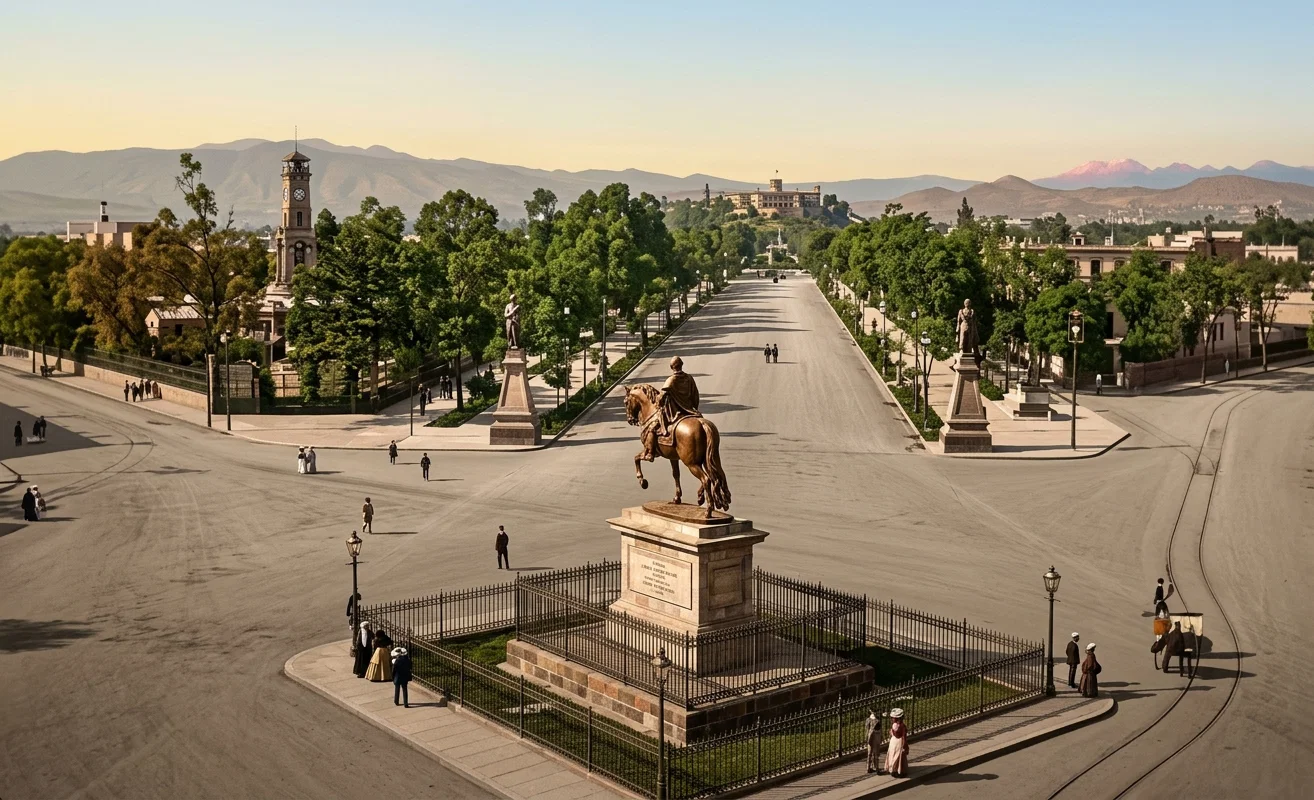
In 1519 Cortez, with six or seven hundred Spanish followers, landed on the coast of Mexico. He founded the city of Vera Cruz; and here he left part of his soldiers, while with the remainder, and six thousand Mexicans who had joined his train, he made his way to the city of Mexico, the Aztec capital. Like another Venice, the city rose from the bosom of the lake, and, again like Venice, many of its streets were waterways.
Porfirio Diaz, President of Mexico.
The Principal Drive in Mexico.
The invaders were surprised at the architectural skill displayed in its public buildings, palaces, and temples, and perhaps not less so at the royal gardens, where unnumbered flowers bloomed, and “all kinds of birds and beasts were kept in well-appointed zoological gardens.” In the immediate neighborhood were hanging gardens and floating islands, terraced rocky hills with their stone aqueducts, and the stately Chapultepec, its rocky walls two hundred feet high and palace crowned. On every hand were evidences of the wealth and skill of the natives. Very fair was their city in the eyes of the Spanish adventurers, whose interest was not lessened by a rumor that had reached them that here Montezuma reigned over an extensive empire; “that thirty vassal chiefs, called caciques, obeyed him; and that his riches were immense and his power absolute.”
There were many native tribes in Mexico; but the Aztecs were the dominant race. The Aztecs had a literature of their own, including poetry, which they expressed by picture-writing. Their laws were humane, and they were skilful in many lines of industry; but they were warlike cannibals. Other sacrifices were offered; but “the type of a religious function was a sickening butchery, followed by a cannibal feast.” The victims were captives taken in their numerous wars.
The principal temple was in the heart of the city, in a plaza nearly a quarter of a mile square. In the center of the plaza was a pyramid 375 by 300 feet at the base, rising by five terraces to the height of eighty-six feet. On the platform that surmounted it were several temples, and before that of the war-god was the green stone of sacrifice, where human beings by tens of thousands met a horrible death, their funeral wail the fearful sound of the great snake-skin drum, which could be heard several miles.
For some reason the water has receded, and the city is now more than two miles from Lake Tezcuco. And where once stood the great pyramid, with its altar for human sacrifice, now stands the largest and most magnificent cathedral in America, built at a cost of $2,000,000. The plaza has decreased in size, so that it now covers only about fourteen acres; but from it still radiate the principal thoroughfares of the city.
In 1521, by war and treachery, Cortez had effected the conquest of Mexico, and from that time until 1821 it remained a Spanish colony. The Spaniards brought their religion with them, and plenty of priests; and the Mexicans soon adopted, in name at least, the religion of their conquerors. The state of affairs under the rule of Spain and the church is thus described:—
The Indians were reduced to peonage on the great estates of the Spanish planters. Foreign bishops amassed fortunes, while the lower clergy of the priesthood were allowed a pittance. Immense estates were gathered into the hands of the church, which finally became the chief creditor of the nation. By deed or by mortgage a third of all real property was thus held, and the nation came under the thrall of the church.—Encyclopedia of Missions, vol. 2, p. 92.
The Indians of that early day very naturally bore a grudge against the “conquering and oppressive Spaniards”; and this prejudice even extended to the “fair-faced queen of heaven.” But the resourceful Catholic Church, whose strong point is becoming “all things to all men,” contrived to produce a Virgin Mary for the Mexicans of their own dusky race, and that, too, by a miracle. Surely it was a miracle. Did not the beautiful lady appear to a Mexican? And was not the “good bishop” fully convinced that the picture of the dusky virgin was supernaturally impressed on the man’s coarse tilma? That was in 1531, and the picture has ever since been worshiped by the Mexicans as the Lady of Guadalupe. Hers is the “holiest shrine in all that vast land of ‘shrines and images.’” A lady who visited this church thus describes it and the scene:—
It was on the morning of a day that was full of light and color that we went to Guadalupe—blue sky, white awnings and adobe walls, lava rocks and red rebozos, white pantaloons and swarthy faces and gleaming white teeth, naked babies and black-robed priests, groups of tortilla-makers and pottery-sellers, and rows and rows of improvised tents and shelters, in the shade of which all the gambling devices known to savage, semi-civilized, and cultured minds were skilfully carried on.
Stepping through the little door of the darkened vestibule, we emerge underneath the blue, star-sprinkled vaulted roof of Guadalupe’s new home. The great interior, flooded with light strained through a thousand tinted panes, opens before us like a dream. Only the sculptured urns of holy water stand near the entrance, and then the vista leads away to the white marble altar, against whose classic background stands the picture. Surrounding it, and up and down the marble steps, and along the high-hung balcony that leads to the choir, is a polished railing containing twenty-six tons of solid silver. The picture hangs fifteen or twenty feet above the floor; but it is difficult to guess accurately as to height beneath a roof that seems to be a part of the sky.
On our return to the city, a sound of rude music reached us, and there, marching straight toward their Mecca, was a band of Indians, probably fifty in number, ending a pilgrimage of many days from the country beyond the mountain range. Their leader played on a small piping instrument, but with high enthusiasm, and his soiled and travel-worn blanket was filled with roses, an offering to the virgin. It was nearing the great annual feast-day of the 12th of December, the anniversary of the miraculous appearance of the picture on the tilma, and the Indians were gathering in from all directions. One by one, in Indian file, with springing step they crossed the heavy threshold bar of the church; turning neither to the right nor to the left toward the gala sights and sounds about them, every face looking heavenward and every hand making the sign of the cross, they entered in, and were lost to our sight.
Spanish rule in Mexico ended in 1821; but the people were still in the vice-like grip of church domination. It was not until religious liberty was proclaimed in 1857 that its power began to be broken. At this time the city of Mexico “might almost have been said to be a city of convents.” The people were corrupted by the clergy, of whom it is said, “The licentiousness of their lives was scarcely disguised; and their exactions for the performance of the marriage ceremony were so oppressive that to a large extent the masses dispensed with the sacred rite altogether, and with the poor, concubinage became the rule.” And the people were not allowed the Bible. If found in their possession, it was burned.
Since 1867 it has been the aim of the government to promote religious liberty; but tho its legal power has been broken, the church still holds the great mass of the people in bonds of ignorance and superstition.
E. J. BURNHAM.
TRACT TALK.
It is said that one of the wealthy merchants of New York City always kept a supply of tracts on his desk; and when he wrote a business letter, he slipped in a tract. When a friend asked his reason for doing so, he replied that he wanted some fruit in the world to come. Just before Mr. Moody went into evangelistic work, he used to sell shoes, and God showed him so much the importance of the work for souls that he would tie up tracts in bundles of shoes for his customers. We have heard of a poor woman in the almshouse, who was one day sorting over her tracts to be given out, and when asked what she was doing, said she was “sorting out her ammunition.” We once heard of a penny13tract, sent by a little girl to Africa, which was the means of the conversion of an African chief, and he was the means of bringing the whole tribe to give up their idols and embrace Christianity. “Blessed are ye that sow beside all waters.”—Selected.
EXPECTATION
By Isaac Ogden Rankin
[Isaac Ogden Rankin, in Christian Endeavor World.]
Never, tho years are lonely, need hearts be sad;
For deeper than grief is the blessing that makes life glad;
To peace that flows as a river is there anything deeper to add?
Tho the world is ever changing, yet all its changes tend,
Under the love that leads us, on to a destined end,
Where the worker shall find his task, and the friend shall hold his friend.
Nothing shall thwart God's purpose: nothing shall rob man's heart,
In that ultimate joy of living, of his allotted part,
Save faithless days, and cruel pride, and the tempter's hateful art.
To share in the children's mirth, to strengthen hearts that grieve,
To give of the bounty of God, and with grateful love receive,
To search with eager eyes, yet with quiet heart believe;
Unspoiled by love of earth, to count God's presence best,
Yet taste life's pure delights with fresh, unwearied zest,
This is the favor of God, that deepens on toward rest.
Welcome is mirth and singing, but ever the heart returns
To the joy of its expectation, the peace it after discerns,
Where the light of love for the creature in the face of the Maker burns.
Our Work and Workers.
Twenty-three church-schools are already organized in Wisconsin.
Three converts are reported at Culpeper, Va., by Brother B. F. Purdham.
The Eastern Union Conference is now in session at South Lancaster, Mass., to close December 5.
At Cooranbong, N. S. W., four candidates were recently baptized by Brother E. H. Gates, and added to the church.
The meeting in Philadelphia that was to have been held November 20-24, has been postponed to December 6-10.
The brethren at Blue Lake, Humboldt County, Cal., are raising funds for the erection of a new church building.
A branch of the St. Helena Health Food Company's establishment has been set up in Salt Lake City, with Brother W. J. Felt as manager.
At the last quarterly-meeting of the church at Janesville, Wis., four names were added to the roll. Brother C. W. Olds officiated on the occasion.
Brother John Isaac, of Wisconsin, has been assigned to labor in the interest of the German population in Ontario, with present headquarters at Berlin.
The Sabbath-school donations in the Australasian Union Conference for the present quarter are donated to the work among the Maoris of New Zealand.
At Murfreesboro, Tenn., Brother B. Hagle has the free use of the court-house for meetings. He recently reported to the Watchman five applications for baptism.
The Record informs us that a lot has been purchased for a new church-building in Adelaide, South Australia, and the work of building is to be pushed as fast as possible.
Under date of October 20, Brother D. P. Ziegler writes that he was just closing a series of tent-meetings at Springfield, Mo., and that eleven persons had begun the observance of the Sabbath of the Lord. He also says that the church-school there is doing well under the management of Sister Annie Nordlind.
On the 7th inst. Sister Ellen G. White, accompanied by Sister Sara McEnterfer, took an overland train direct for New York City, where she will labor for a few weeks.
The addition of four members to the church at Bozeman, Mont., and $500 toward a new house of worship is the visible result of labor by Brethren J. C. Foster and W. A. Gosmer.
A church was organized at Guerneville, Cal., October 19. Brother H. F. Courter had been laboring there for some time, and Brother J. N. Loughborough assisted in the organization of the church.
Brother E. S. Ballenger, until recently connected with Healdsburg College, and superintendent of church-school work in California Conference, has been transferred to Southern California Conference.
Four converts to the faith at Hollister, Cal., are reported by Brother A. J. Morton. A Sabbath-school has been organized there, and Bible work is being continued by Brother C. N. Miller and wife.
The Wisconsin Conference Committee have voted to pay Sister Ida Thompson's expenses to China instead of to Brazil, if she prefers to go to that field to labor instead of going to Brazil, as was voted at the last annual conference.
In the Missionary Visitor Brother J. L. Wilson reports four converts at Anacortes, B. C., together with a liberal sale of books. After the Seattle camp-meeting he went to Cumberland, B. C., to complete the organization of a church.
Brother J. W. Bagby, reporting to the Pacific Union Recorder, notes the addition of four new members to the Tulare church, three to the church at Hanford, Cal., four to the Lemoore church, and two to the church at Grangeville.
Brother G. W. Reaser and family arrived in Natal Harbor, South Africa, August 27, after a journey of 17,000 miles on fifty different conveyances, from Walla Walla, Wash. Their address is Beulah, Bulwer Road, Natal, South Africa.
Brother S. M. Cobb, president of West Virginia Conference, reports to the Monitor that eight persons at Elk Garden recently covenanted to keep “the commandments of God and the faith of Jesus.” He also reports the baptism of four persons at Hagerstown, Md.
The Avondale Press, connected with the school at Cooranbong, N. S. W., has issued its first book. It is a volume of Bible studies in the Fijian language, and the Record says it presents a very creditable appearance. Of the Joyful Tidings, printed at the same institution, 20,000 copies of the September number were issued.
The highest military court in Germany has affirmed the sentence against one of our brethren of twenty-three days' imprisonment for not serving in the militia on the Sabbath. Thus the military authority of Germany is reckoned superior to the law of God. But it would be the same in any of the so-called Christian nations, were a like test made. In most of the States in our own country the Sunday laws are held to be above the law of God.
The church at Eureka, Cal., has outgrown the house of worship, and contemplates building a new one, and using the old house for school purposes. Brother C. M. Gardner notes the baptism of eight souls, with some others who contemplate a like step. He also reports the baptism of five candidates at Pepperwood, where the public school was dismissed in order to allow the pupils to witness the scene, the ordinance being administered in the Salmon River.
Here is a good report from Brother A. G. Haughey, president of Ohio Conference, in Welcome Visitor: I spent Oct. 19-21, with the company at Waterford. While there I held seven public meetings, baptized twelve adults, and organized a church of seventeen members. Four others are keeping the Sabbath, and many more are interested. Some arrangements were made to erect a church-building and to organize a church-school. A lot was donated, also material for the building. The house will be built with a room for a church-school. This result followed the labors of Brethren M. C. Kirkendall, J. H. Smith, and W. W. Miller.
Lands in Virginia and Elsewhere.
THERE are land agents and land agents. There are real estate men and real estate men. It is always well to be sure before one acts. For instance, a brother, whom we are assured is reliable, writes us from Skippers, Virginia, that he wishes to guard our readers against deception in buying farms in Virginia. In speaking of a certain class, he says:—
Land is bought here by just such parties for $1.50 to $2.00 per acre, and sold for $15.00 to $30.00 per acre. This is a fraud, and should be exposed. Good homes can be bought for $4.00 to $10.00 per acre in small lots. We want our people to come here and hold up the light of truth; for there is a great work to be done; but we do not want them deceived. Come and get acquainted with the people, but beware of agents. All letters sent to me with enclosed stamp, asking questions the people may wish to know, will be answered till March 1, when I expect to change location.