ONE evening, while sitting in front of our house, reading, we heard a great wailing in the courtyard adjoining. Two or three old women were running about, crying, “Laoho lai kia, Laoho lai kia.” We found that one of the boys of the family was sick. His name was Laoho. The two words—lai kia—mean, “Come home.” Although the sick boy was lying on the ground before them, yet they were calling for him to come home. He had just had an epileptic fit, and was in the deep stupor, or epileptic sleep. These poor people thought an evil spirit had snatched his soul away, and was making off with it, and this was why they were calling him home.
They continued their wailing for some time, and, as the boy seemed to be getting worse, as a last resort they called for the foreign doctor. There was very little that could be done. Hot and cold applications to his spine revived him quite a little, and I told them he would waken in a few hours, and be much better. I prayed earnestly that the Lord would bless the little that I had done, so that the people might listen to the “true doctrine;” this is the name the Chinese give to our teaching.
This same idea is held by the Chinese in regard to practically all their diseases. They attribute their sickness to the evil spirits and demons, and this is why their worship is one of fear, and not of love. They worship these evil spirits in order that they may not be afflicted with sickness, and that their live stock and crops may not be destroyed. This fear of evil spirits plays an important part in the lives of the Chinese.
Although Satan, in the form of a dragon, is the national emblem of this empire, being found on the flag and on all the coins, postage-stamps, etc., yet they live in constant terror of demons and evil agencies. This fear is so great that in the household no member of the family is allowed to mention the name mo quei—devil—during the early morning hours, for fear of the bad influence it will have on the day’s work.
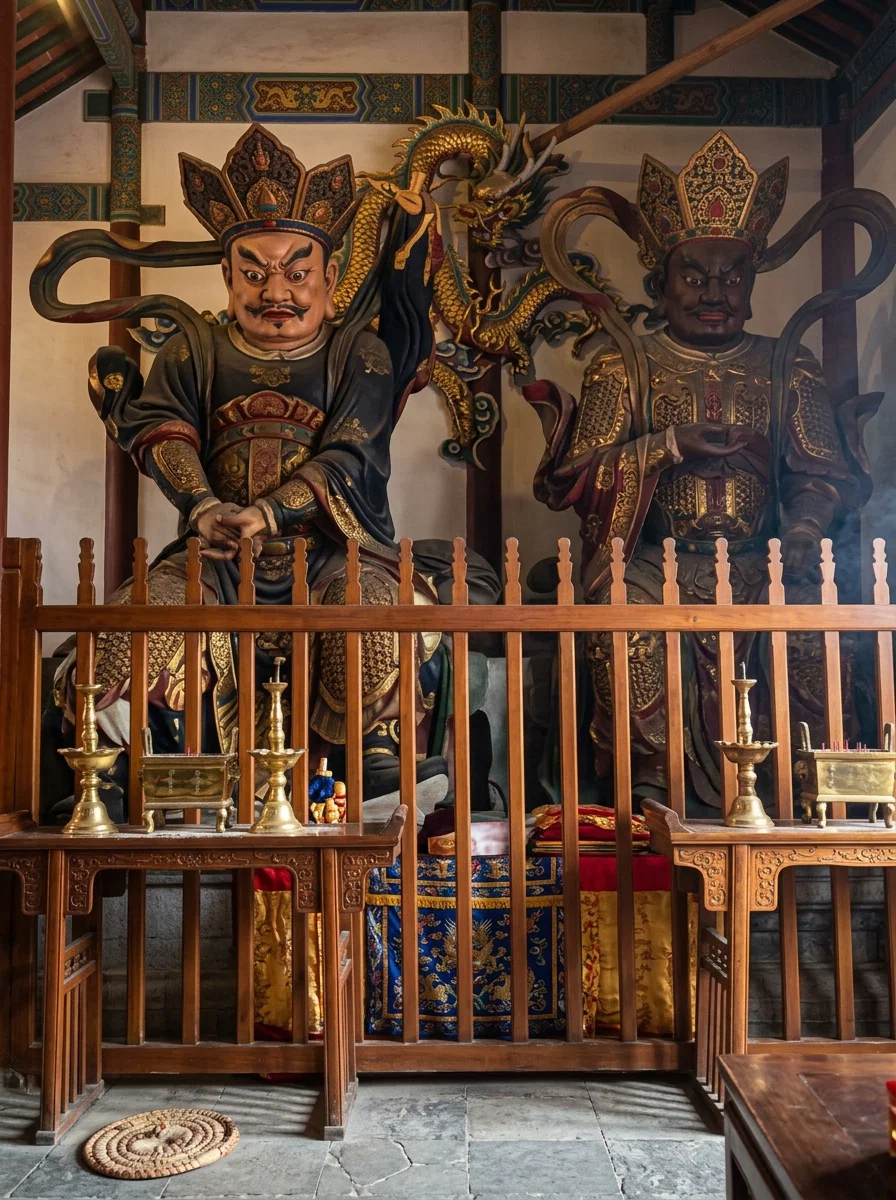
They use many resources to protect themselves from these influences. At new-year’s time the door of every Chinese home has pasted on it a picture of a very fierce-looking warrior, and long strips of perforated paper are pasted up over the door, and left to hang down in the entrance. The warrior is intended to frighten away the evil ones. And should they try to enter, they would become entangled in the perforated papers.
The crookedness of roads and streets, which has been mentioned by every one who has visited China, is not an accident, but is the result of this same purpose.
It is to be noticed, in naming their children, that the boys are always given names which signify very common and undesirable things; while the girls are given very pretty names, as of flowers and precious stones. They regard the boys as of far greater worth than the girls; yet they believe that by giving them very common names, the devil will be deceived, thinking they are of no value, and will let them alone. On the other hand, they do not care if he does take the girls, so they give them very nice names.
SOME CHINESE GODS
Near by our station I noticed a young peach orchard, which had just been set out. On the side of every one of these trees was a long white mark that had been put there to keep evil spirits out of the tree. Another method they have of accomplishing this same object is to stretch a cotton string around the orchard. The Chinese boy differs very much, in at least one respect, from other boys, for he rarely, if ever, throws a stone or a clod of earth. He does not throw a stone or a ball, because, if he did, he might hit one of the spirits in the air, possibly the spirit of one of his ancestors. While repairing one of our houses, we attempted to buy two small logs which were in an adjoining courtyard. We found that the owner could not be induced to sell them; for they had been lying in his yard many years, and he did not know but that the spirit of his old father had taken up its abode in one of them.
One can hardly imagine a religion better suited to the plans and purposes of the great enemy of all truth than this religion of the Chinese people. Nothing but the true Light can pierce the midnight darkness of this land. When Christ entered Capernaum, then was fulfilled the prophecy in Isa. 9: 2: “The people that walked in darkness have seen a great light: they that dwelt in the land of deep darkness [margin], upon them hath the light shined.” My brother, will you, as Christ’s ambassador, help in the work of holding up the Light in this land of great darkness?
The East German Conference
By Ludwig Richard Conradi
L. R. CONRADI
The East German Conference had its annual meeting in the capital of the German empire, Berlin, a city which, with its suburbs, contains about three million people. Until last November there were in this great city five distinct churches, with a combined membership of two hundred and fifty. It was very hard to secure suitable meeting halls, and the brethren were paying about one thousand dollars for rent, heating, and lighting in the local meeting places they were occupying. Upon occasions when we desired a general meeting of all the believers in Berlin, it was very difficult indeed to get a place for their proper accommodation. We studied over the problem quite a while. We thought of renting a lot and building a chapel, but this would have involved a large outlay of means. We finally found, right in the center of the city, a building which had been erected for a synagogue, and rented to a Jewish congregation; as their contract had expired, and they wanted the owner to cut down the rent, the owner was pleased to have us take the place for one thousand dollars per annum. He was willing to partially fix up the chapel for us, but on our part we bargained to put in the seats, a baptistery, and make some other minor changes, involving an expense of seven hundred dollars. This money was raised among the members and by donations. The building seats nearly five hundred. At the time of this meeting, all these churches were united into one church, which now numbers about three hundred. These, with the delegates from the East German churches, and the outside attendance, filled the chapel to overflowing each evening.
The East German Conference has shown an excellent growth during the past year. They were able to baptize two hundred and nine members, and receive seventeen by vote, making their present membership nine hundred and ninety-eight. Their tithe has also materially increased. In 1903 it was $8,165, while for 1904 it was $8,714. The offerings in 1904 were $2,151; 1903 they were $1,608. The net increase is much larger than would at first appear, as the Prussian Conference was not formed until the third quarter of 1903, and thus its tithe was counted in with the tithe of the East German Conference. New churches and companies in Silesia, Pomerania,13Posen, and Saxony were received into the conference at this meeting.
Brother E. Enseleit was ordained to the ministry, so that there are now five ministers in the East German Conference. Each of these ministers has been placed in charge of a province. This enables the president, who is located at Berlin, to devote more time to lectures during the winter months. Brethren Schuberth and Boettcher assisted us in these meetings. The interest created by these lectures will be followed up. The canvassing work showed a good increase in this field, especially in the provinces of Silesia and Posen.
The conference could audit all the accounts of its laborers for the past year, and pay two tithes to the German Union, and still have a surplus with which to begin the new year. They will therefore be able to increase their corps of workers, which they intend to do as soon as the proper persons can be found.
The East German field has the largest population of any of the German Conferences. It surely seems to be a promising part of the Lord’s vineyard. On Sabbath twelve were baptized in the baptismal font, and still others offered themselves, and will go forward in this rite later on. Elder Frauchiger was re-elected president for the coming year.
While here, it was necessary for me to call upon a leading official in the government with reference to some of our books; for we have again had difficulty in various parts of the empire, where the sale of our paper and some of our books has been prohibited to the canvassers. The laws of Germany are exceedingly strict; and if any one complains against a book or paper in any part of the German empire, as being obnoxious, this complaint is recorded; and if no one appears in defense of the paper or book in question before a certain time, the complaint is forwarded to headquarters, where are prepared the lists of such publications as are excluded from the colporteur. These lists are sent to every part of the country. Our canvassing work is a very important factor of the third angel’s message in Germany, and our canvassers have to be very careful as to how they perform their work, so that they may give no just reason for any one to object to them or to the periodicals or books they are circulating.
In all the deliberations of the East German Conference the greatest harmony and union prevailed, and our people were much encouraged, and returned to their homes with the determination to press forward in the work of God.
A Word From Nyassaland
By Thomas H. Branch
THOMAS H. BRANCH
When Elder Hyatt was here in July, he advised that out-schools be started. Accordingly, we sent a boy to Masinjere, six miles away, to ask the people if they would like the mission to start a school there, and if so, if they would be willing
to build the house. They answered, chief and people, by promptly building a neat little schoolhouse, and thus far show their good faith by father, mother, and children all attending school. Our picture shows the schoolhouse with the pupils. The man in white, at the left, is the teacher. Next to him stands the chief. This is the first out-school of the Nyassaland Mission. The teacher is one of the mission boys, Johan Mbendela, who has been with us ever since we came to this station.
THE MASINJERE SCHOOLHOUSE AND PUPILS
It is now the rainy season, and I am busy putting in the mission crops. I am thankful to report to you that the Lord is blessing our work here, and we can see in their Bible studies that the boys are beginning to see and understand more of the truths of God. A number will even come at night after we have retired, to ask concerning some Bible questions which they have been studying. I deem it a pleasure to go with them to their room, and have a short study with them. The natives are very inquisitive; and when they see or hear you speaking to other boys, they will gather around to listen. This I am always glad of when they have a Bible question under consideration. Our school and work are encouraging. I have no help on the farm but schoolboys; but in the time of taxes we have to see that the people in the villages on the mission land get their tax money. Then we give them work for one month. This is a provision of the government. The village children attend school well. These children are very earnest in their daily and Sabbath-school lessons. The Sabbath-school is still one of our most interesting meetings. It has grown until we have six native teachers helping us. O, how they love to sing! My wife and daughter have charge of this department. While these people are slow to take hold of the truths of God, there are evidences that the Spirit of God is moving upon hearts, and our earnest desire is that there will be an abundant harvest for the Master.
I am glad to say that we have not had any serious sickness or deaths during this past year at the mission. For this we all praise the Lord. I am striving to carry out all the plans that Brother Hyatt and I decided would best advance the cause at the station, that by a patient, careful training of those in school, the third angel's message may reach those who are still in darkness. We are trying to teach the boys to be workers and teachers. You quite understand that these people of these dark regions are not in love with work. I teach them that it is a duty, as well as a privilege, to engage in honest manual labor. I assure you this is no easy task. But by the help of Him who first gave man his work, we are succeeding slowly, though I must hold many meetings with them to explain why they must work with their hands.
We as workers are certainly anxious that the power of God shall be made manifest in these boys, for the glory of him for whom we are doing all that we can that they may thoroughly understand the message for this time. The message never seemed plainer to me, and I rejoice for the blessed privilege of giving it to those who have sat so long in darkness and the shadow of death, and of telling them that Christ, their light, has come, and is seeking to save the lost. I realize that the time is short, and that all are required to work with diligence. I desire to do well my part. Sometimes the work goes hard; yet we try to be faithful, and all pull together. We are all of good courage, and are still working at the language, and are getting along very well.
Missionary Newspapers in Africa
A MONTHLY newspaper has made its appearance at Majam on Mt. Kilimanjaro, in German East Africa. It is called Mbuya ya vanda vuu, which may be interpreted "Friend of the Black Folk." The language is a little mixed, as the articles are some in one and some in another dialect of the Chagga tribes. Of course none but missionaries would plan and publish it. They are missionaries of the Leipzig Society. Another African missionary newspaper is one just established by the Church Missionary Society's mission at Cairo. It is called Orient and Occident, and is printed in Arabic and English. As the Arabic reads from right to left, the two languages naturally have their front pages at opposite ends of the paper, and meet about the middle of it.
River Plate Conference
By J. W. Westphal
The work in this conference is onward. The young men who have gone out from our school to labor as ministers or canvassers are having success. Brother Louis Ernst went to the Chaco to follow up an interest that had been created there, two or three having already begun to keep the Sabbath. The result was that a few weeks later, when Dr. Habenicht returned from Missiones, he could baptize eight souls. Through these an interest sprang up in the province of Corrientes, and Brother Ernst went there to labor. Before leaving, twelve had accepted the truth. Thus the work has for the first time obtained a foothold in this province. Everything possible was done to hinder the work, the police coming several times to take Brother Ernst, but each time he happened to be away. He has now gone to Paraguay, his future field of labor, and he reports one family interested in the truth.
Several of the canvassers went to Concordia, in the eastern part of the province of Entre Rios, to labor, not simply to sell books, but to do personal missionary work. I have visited them once, and found some keeping the Sabbath, and others interested. The last reports tell us that six families have accepted the message, and still others are interested. Dr. Habenicht will go there at once to assist in the work. Concordia is at the head of navigation on the Uruguay River, and is an important center for northeastern Entre Rios, eastern Corrientes, northwestern Uruguay, and southwestern Brazil.
At Bahia Blanca, in the southern part of the province of Buenos Ayres, where Brother Paul Bonjour is canvassing, one brother has accepted the truth, and others are interested; brother Santiago Mangold has gone to assist in the work there. At Lehmann, where our last conference was held, ten have recently begun to keep the Sabbath, and at San Geronimo, where our conference was held last March, several will be baptized soon, and a church organized. Thus the work is moving on, for which we thank God, and take courage.
J. W. WESTPHAL.
Southern Jamaica
By Hubert Fletcher
AT our last conference, held January 1-5, it was decided that Brother Hubert Randle and the writer make the parish of St. Elizabeth their field of labor, and engage in tent work. January 11, I started from Kingston, via the parish of St. Anns, at which place I was instructed to visit the companies. I spent two very profitable weeks there, and the Lord richly blessed us in our meetings.
I arrived at Southfield (St. Elizabeth) on the twenty-ninth, and met Brother Randle and his family, who had arrived four days before. The church at this place was much in need of help, so we spent the time with them while looking up a location for the tent, and homes for our families. Finally we succeeded in renting a spot for the tent in the district of Top Hill.
The people of this parish are very irreligious. It is here that the light of the third angel's message needs to shine, and we deem it a privilege to be entrusted with so important a commission.
Since we began meetings, the Lord has truly been blessing us. The attendance is from one hundred to two hundred and fifty. We have a twenty-by-thirty-foot tent, which is too small. We can accommodate only a portion of our congregation. There is a very good interest here. We find the people quite congenial and friendly. Though assured that we would be molested and stoned, yet those who attend say they are pleased and satisfied with the truths presented.
The Lord is surely leading, and we are expecting to see a goodly company from this place keeping the commandments of God. Several are deciding to obey the Lord. Pray for the work.
HUBERT FLETCHER.
Hayti
By Henry Williams
THE good work is continuing here. As a result of daily Bible readings, by Brother Michel Nord Isaac with his home students, one young man has fully accepted the truth, and desires to be baptized. Brother Isaac is giving Bible talks to the public on Sabbath evenings. In one of the meetings were to be seen pastors, doctors, magistrates, lawyers, and professors of schools. A doctor wrote Brother Isaac last week, asking him to continue his lectures. Another doctor, in conversation with him, frankly acknowledged the seventh-day Sabbath. One of Brother Isaac’s teachers, a Baptist, has also decided to observe the Sabbath.
Brother Isaac went twenty-four miles last Sunday with five of his students, and returned Tuesday. He preached twice on Sunday to a large gathering, in a Baptist chapel. He also held house-to-house Bible talks, and was given earnest attention on every occasion; even the presentation of the true Sabbath caused no opposition, as nearly all had their Bibles to verify passages as he cited them. They promised to study the subject, and when he returns, they will have a better understanding of it.
It was a surprise to find so many Protestants, with a still larger number farther in the interior, and chapels scattered everywhere, in which services are conducted by native preachers. These are principally of the Baptist belief. I was greatly cheered and refreshed in spirit by the rehearsal of the experience of a pastoral tour by the Baptist minister of this town a while ago. He said he met an aged couple who were the only Protestants in that community. It made me think of our experience two years ago, when my wife and I, aged sixty-five and sixty-seven years respectively, were the only Seventh-day Adventist witnesses in Hayti. There are now nine of us who meet on Sabbaths for worship.15I believe now more firmly than ever, that our emphatic motto is, “There shall be delay no longer,” and it was also stated that the year 1905 would be a missionary period in a special manner. We are under much anxiety, and in great expectation to see this part of the harvest-field share proportionately in the missionary plan contemplated by the different conferences. Four desire baptism, and are awaiting the coming of a minister that they may receive the ordinance.
HENRY WILLIAMS.
Central America
By I. G. Knight
Bocas del Toro.— We returned to the Panama field the first of March, and feel glad to be home again. We are preparing to push the work vigorously. We had expected to open our first tent effort in Port Limon ere this. I left Bocas last week for that port, intending to get the tent up, and my wife was to join me the next week, to assist in the meetings; but when I arrived there, I was taken out to the quarantine station. This is a little cay, or island; there I had to remain for four days. When released, I found the tent had not yet come, although shipped from Topeka, Kan., the sixth of February. So I returned to Bocas until such time as the quarantine shall be raised, when we shall return and hold a series of meetings.
We sail for St. Andrews Island tomorrow, March 29, expecting to remain there some weeks. St. Andrews is where Brother Stuyvesant is located. There is an interest in two other islands near there, Old Providence and Corn Islands, and we intend to visit both these places before we return to Bocas. We also want to visit Bluefields, where there is an interest. We will report our experience when we return.
I. G. KNIGHT.
Notes From College View
By R. D. Quinn
THE revival and reformation in College View is going forward with greater power and intensity each day. Nightly meetings are held, in which scores are seeking God for a new and living experience for themselves. Hundreds have surrendered their lives into God's hands, and have claimed victory by faith, and are going forward. The meetings have been honored with the presence of the Holy Spirit. The services are usually opened with an earnest season of prayer, after which a very short study on the definite message of complete consecration is given. The rest of the time is given to the people for a real living experience meeting. In a recent Testimony, from which we will quote, we are given an outline of the work that is now meeting its fulfilment: “God will use ways and means by which it will be seen that he is taking the reins in his own hands. The workers will be surprised by the simple means that he will use to bring about and perfect his work of righteousness. Let me tell you that the Lord will work in this last work in a manner very much out of the common order of things, and in a way that will be contrary to any human planning.”
One of the most encouraging features in these revivals is the hearty co-operation of the ancient men before the house. Without a single exception so far, the leading men and old warriors see that the appointed time has come, and that prophecy is being fulfilled. The time of our final deliverance has come. The Lord has faithful servants, who, in the shaking, testing time will be disclosed to view. Let them now come forth and come into line. “Let those who are loyal to the commandments of God and the testimony of Christ now take their position.”
R. D. QUINN.
Ceylon
By Harry Armstrong
COLOMBO.—I have just returned from a meeting which I conducted in a bungalow about one mile from my home. We had about twelve persons present. They were deeply interested, and we hope to see some from this meeting take their stand for the truth of the third angel's message. I also visited a planter to-day. He has attended our bungalow meetings for a few weeks, and is thoroughly convinced that God has given us a special message to prepare a people for his soon coming. He sees the light on the Sabbath truth, and to-day told me that he was seriously considering how to relate himself to what he sees and knows to be right. He returns on Monday to his estate, and I pray that the Lord may early strengthen him to be loyal in deciding for the truth. He has asked me to conduct a weekly service on his estate for the good of all his coolies and laborers.
Some of the ministers here are beginning to oppose our work, and are warning their people against our meetings and our literature. This is an evidence that the truth is touching their borders, and making itself felt among them. We much regret that we can not publicly, in a more aggressive way, proclaim these precious truths. However, we are determined to do what we can in sowing the seed and in bringing home to the hearts of the people the truth for this time. We love the work, and have nothing else to live for than this blessed truth. We fully believe that we shall live to see this work close in this generation, before many years have passed away. The Lord can do a quick work as soon as his people get into right relationship to him. I have been much comforted and strengthened in reading the recent Testimonies, and believe that God is speaking now to his people with no uncertain sound.
Elder R. D. Quinn, of Australia, called to see us last Sabbath. He spent the day with us, and led in the study of the Sabbath-school lesson. We spent a blessed time together, and were refreshed by his visit. He was much pleased with the outlook here, and said that he looked upon this island as a most favorable place for an important center for our work in the East.
All that we have is bound up in this message, and we would not have it otherwise. HARRY ARMSTRONG.
Grenada
By W. A. Sweany
ST. GEORGE.— We reached this place a short time ago, and are comfortably settled, and ready to take up the work here which was begun by Elder Kneeland, who was transferred to British Guiana about a year ago.
Grenada is the most picturesque and beautiful of any of the islands we have yet seen. There is no church here. We find about six persons professing to believe, and at least partially obeying, the truth, and others who are interested; so we hope ere long to see the message firmly planted here. This is a stronghold of Catholicism, and immorality, superstition, and ignorance of the Word of God abound, although nearly every one belongs to some church. We will report more fully of the work here as it develops.
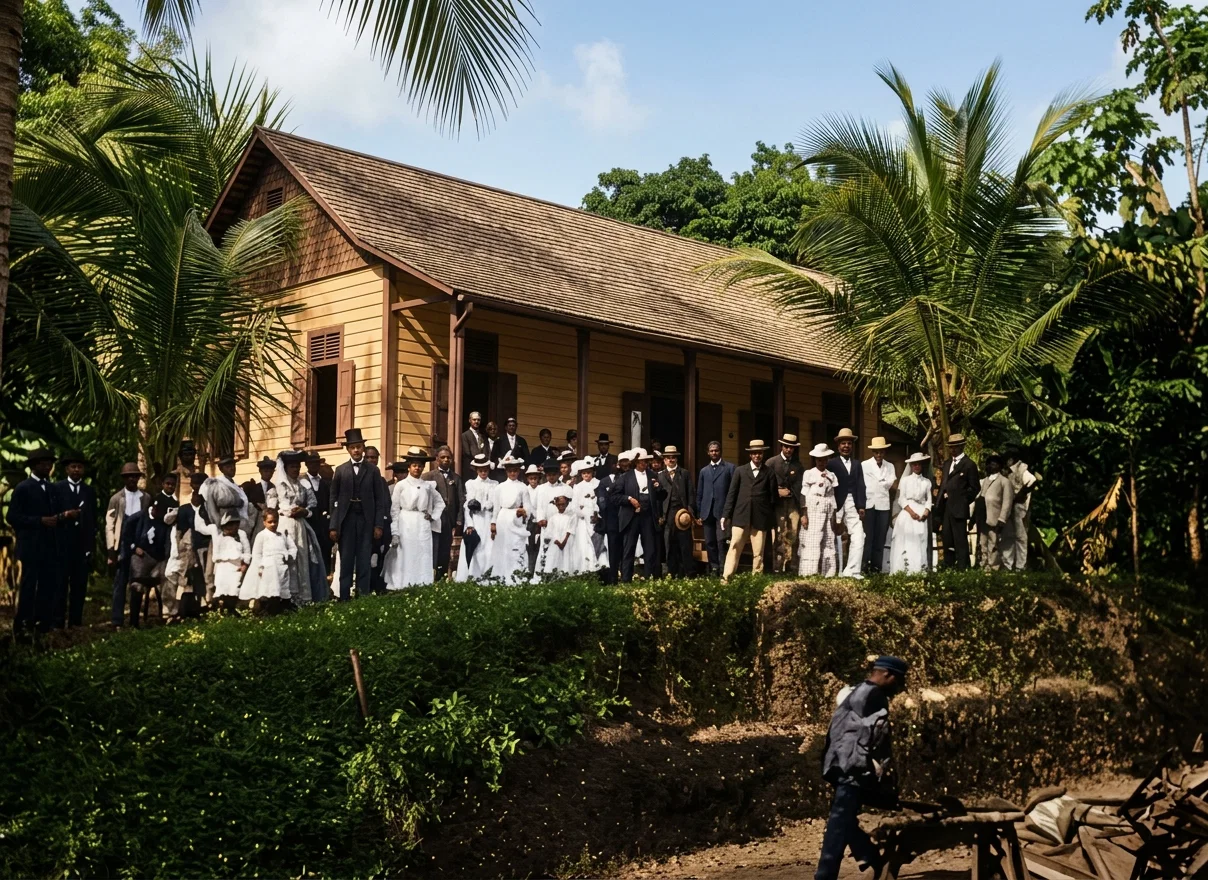
DEDICATION DAY, ARIMA CHURCH
We are exceedingly thankful to be able to report that before leaving Arima, Trinidad, we succeeded in organizing a church of twenty-five members. Eight of these were baptized just before we left. Others had been previously baptized, while some joined by letter. We were also enabled to complete and dedicate a neat, comfortable church building. The lot, seventy by ninety feet, worth one hundred and fifty dollars, in an ideal location, was given to us by friends of the cause who are not Adventists. The building, twenty by forty-four feet, with open porch full length on each side, cost four hundred and seventy dollars, including seats, lamps, and ordinance utensils, with individual communion service. A library was also provided, to which books will be added from time to time. About one hundred days' work was donated by about thirty persons, no money being paid for labor. The building contains two rooms—one twenty by thirty-two feet, with seats for one hundred and twenty-five persons, for meetings, and one twelve by twenty feet, for school and other purposes.
We were in Arima just a year, leaving there January 25. But only half of this time was actually spent in that place, as the work elsewhere called me away frequently, thus breaking into my labors in Arima. However, we believe the work is firmly established there, and that more will be added to the church from time to time, as the interest was good up to the time of our departure.
From friends in the States we received about sixty dollars. The remainder was raised in this field, mostly among the laborers of the conference. We are well, and of good courage, and ask for the continued interest and prayers of our people for our new field of labor.
W. A. SWEANY.
Victory in Massachusetts
By Lee S. Wheeler
WE know that the readers of the REVIEW will be glad to learn of the salvation that has come to us here on the old battle-ground of liberty.
Notwithstanding our watchfulness for dangerous Sunday legislation at this time, we were aroused not long ago by a report in the Boston Globe that a Sunday bill of the most threatening character had been reported to the State Senate by the Committee on Probate and Chancery.
Upon visiting the State-house, I learned that the bill was to come up in the Senate that afternoon, and I hastened home and addressed notes to as many of the senators as time would allow, and returned with them to the Senate. I also enclosed with each note a copy of the “Open Letter” tract, to which I called attention. These notes petitioning them to oppose the bill were immediately distributed by the messenger to the various senators.
Other matters then came in, causing the bill to be delayed until a later meeting, which gave opportunity to address most of the other senators upon the subject.
When the bill was to come up for its third reading, there was, to our joy, a movement to postpone action upon it for one week. At first this seemed unsuccessful, but when it was urged that many desired to further investigate the character of the measure, it prevailed. It seemed as if angels of God were present at this time, and we were strongly impressed that the Lord was holding the matter, that we might work. We accordingly addressed to each senator copies of the Religious Liberty Leaflets, marking the title page with blue pencil, and calling attention to certain pages. Meanwhile we prayed, and awaited the outcome.
Thursday, April 6, the time appointed for the third reading, when we went to the State-house, we found that the bill was exciting unusual interest in the Senate, and that Mr. Kneeland, the lobbyist, was very busy. We were therefore somewhat apprehensive, but when the question was called on the bill for the third reading, it was opposed by an overwhelming vote, notwithstanding a strong speech in its favor, and the fact that it was strongly recommended by the committee and urged by the clergy.
The Senate acted under the influence of our literature; the committee acted without it. The effect was manifest; and we can never know to what extent our salvation at this time is due to its enlightening, educating influence upon these men. Let these leaflets be placed in the hands of public men everywhere.
LEE S. WHEELER.
33 Magnolia St., Malden, Mass.
Nebraska
The workers of the Nebraska Conference recently held a three days' meeting at College View, at which plans for the local work for the coming season were considered. Among the resolutions adopted, as reported in the conference paper, are the following:—
“That the State camp-meeting be held in Omaha. First choice of time, August 3-13; second choice, August 10-20.
“That a tent-meeting be held in Falls City, and that the workers for that effort be Elder R. F. Andrews, Brethren A. D. Gilbert and Merton Farnsworth, Mrs. E. M. Peebles, and Miss Lizzie Lockwood.
“That a local camp-meeting be held in District 2, at such time and place as may be deemed advisable by the conference committee and the laborers and the leading brethren in the district.
“That G. Mathiesen, G. H. Smith, O. E. Jones, Harvey Morley, and Esther Smith be recommended to labor in District 2, and that Brother N. S. West be invited to continue his colporteur work in that district.
“That G. P. Loy and those already connected with the work in Omaha, except Brother C. H. Miller, remain in that city to follow up the work.
“That Brother William Batterson and Brother Walter Rich connect with Elder L. E. Johnson in District 4, and that, if deemed advisable, a local camp-meeting be held at Mason City.
“That Brother W. J. Wilson be invited to labor with his colporteur outfit in District 4, unless he prefers to work nearer his home, in which event he should feel perfectly free to do so.
“That Brother C. H. Miller connect with Brother J. W. Beams in District 5, and that they be recommended to make a strong tent effort at Wayne, and if thought advisable hold a local camp-meeting at that place later in the season.
“That we recommend to one another the good, old-time plan of keeping on hand, in connection with our camp-meetings, a good supply of our books, pamphlets, and tracts, and that we put forth special efforts to sell large numbers of these publications among the people.
“That, whereas the tremendous growth and development of the work in foreign lands call forth from the Mission Board most urgent appeals for the assistance of our conference, in carrying the heavy financial burden of the foreign mission work, we earnestly admonish one another to practise the strictest care and economy in the matter of traveling, tent-meeting, and other expenses, that shall be in keeping with the work in which we are engaged; and that we faithfully instruct the people among whom we labor, concerning the Christian duty and obligation of paying a full and honest tithe, and adopting the ten-cent-a-week plan for the support of foreign missions.
“That we recognize the noble pioneer work being done by our canvassers, and that we encourage suitable men and women to take up this line of self-supporting missionary work.
“That this meeting express its appreciation of the steps that have been taken to bring the work of the Nebraska Sanitarium into closer relationship with the Nebraska Conference, and that we, as laborers, seek in every way to bring the work of the sanitarium to the favorable notice of the people of Nebraska.
“That this workers' meeting recommend the holding of an institute for the benefit of our church-school teachers; that as much time as possible during the State camp-meeting be devoted to preparatory work of the institute, and that ten days following the camp-meeting be devoted to regular institute work; that this ten days' institute following the camp-meeting be held in College View.”