It is in looking upon our sinful condition, and talking and mourning over our wretchedness, that distress becomes more keen, and pain accumulates. Let the sinner arise in the strength of Jesus, for he has no strength of his own, and let him assert his liberty. Let him believe that the Lord has spoken truth, and trust in Him, whatever may be the feelings of the heart. Let the sinner say, I will look away from my own misery, from the wound of the serpent, to the uplifted Saviour, who has said, "Him that cometh to Me I will in no wise cast out." Look upon Jesus. "Behold the Lamb of God, which taketh away the sin of the world."
Let no one make his feelings his idol, and bow his soul down to worship and serve his sensations. "Thou shalt worship the Lord thy God, and Him only shalt thou serve." It is your privilege to believe that Christ has borne your sins; for God hath laid on Him the iniquity of us all. You are under the shelter of the sure refuge, under the cover of the atoning blood of the acceptable sacrifice.
All legalism, all the sorrow and wo by which you may encompass yourself, will not give you one moment of relief. You can not rightly estimate sin. You must accept God's estimate, and it is heavy indeed. If you bore the guilt of your sin, it would crush you; but the Sinless One has taken your place, and tho undeserving, He has borne your guilt. By accepting the provision God has made, you may stand free before God in the merit and virtue of your Substitute. You will then have a proper estimate of sin, and the godly sorrow of true repentance will take the place of hopeless discouragement and grief, for you will turn from sin with grief and abhorrence.
The Friend above All Others
Jesus says, "Come unto Me, all ye that labor and are heavy laden, and I will give you rest." Do not think for an instant that any human being has a more loving heart, and a more tender compassion for you, than He who died on Calvary to save you. Do not turn from the divine to the human. The human messenger may bid you hope, on the ground that God's Word bids you hope. Your heavenly Father invites you to come to Him as a little child to a loving parent, and say, Thou hast said: "Ask, and it shall be given you; seek, and ye shall find; knock, and it shall be opened unto you. For every one that asketh receiveth; and he that seeketh findeth; and to him that knocketh it shall be opened. If a son shall ask bread of any of you that is a father, will he give him a stone? or if he ask a fish, will he for a fish give him a serpent? or if he shall ask an egg, will he offer him a scorpion? If ye then, being evil, know how to give good gifts unto your children: how much more shall your heavenly Father give the Holy Spirit to them that ask Him?"
Christ is the friend of sinners. When the scribes and the Pharisees accused Him of eating with publicans and sinners, Jesus said, "I came not to call the righteous, but sinners to repentance." If you feel yourself to be the greatest of sinners, then Christ is just what you need; for He is the greatest of Saviours. Lift up your head, and look away from yourself, away from the poisoned wound of the serpent, to the Lamb of God, who taketh away the sins of the world. What will all your groaning and the torturing of your soul avail? You may entertain thoughts that condemn you, but in them there is no salvation. Put away your thoughts, and receive the thoughts of God, through which your mind may be elevated, your soul purified and uplifted. The Lord says: "For a small moment have I forsaken thee; but with great mercies will I gather thee. In a little wrath I hid My face from thee for a moment; but with everlasting kindness will I have mercy on thee, saith the Lord thy Redeemer." Why will you carry your burden of sin, when Christ has come to be your burden bearer? Roll your sins at the foot of the cross. Unload! unload! He takes away the sins of the world. "I, even I, am He that blotteth out thy transgressions for Mine own sake, and will not remember thy sins."
You have been pronounced a sinner, and Christ has announced Himself a Saviour. Accept the remedy God has provided for you in a sin-pardoning Saviour. How would you have felt had you been in the camp of Israel and seen the people groaning and shrieking in distress because of their swollen and painful wounds, when the brazen serpent was uplifted, and when by one look they might be healed? Would you not have exclaimed: "Why do they not look at the uplifted serpent? How strange it is that they do not perform the one simple act by which they might receive healing?" But is it not as inconsistent for you to refuse to look at the crucified Saviour? Heed the invitation: "Seek ye the Lord while He may be found, call ye upon Him while He is near: let the wicked forsake his way, and the unrighteous man his thoughts: and let him return unto the Lord, and He will have mercy upon him; and to our God, for He will abundantly pardon."
Hope in His Mercy
Why should the repenting sinner forsake his thoughts?—It is because they are not in accordance with truth. He is tempted to believe that because of his sins, God has given him up to the will of his enemy, and that there is no pardon for so great a sinner as he. But all these thoughts are dishonoring to God, because man is God's possession, both by creation and redemption. "God so loved the world, that He gave His only-begotten Son, that whosoever believeth in Him [as his personal Saviour, and accepts Him as the only provision whereby he can be saved] should not perish, but have everlasting life." You are one of the whosoever that may believe. But while you cherish unbelief, and permit feeling to govern you, your case will look hopeless to yourself. Forsake these unbelieving thoughts. God says: "For My thoughts are not your thoughts, neither are your ways My ways, saith the Lord. For as the heavens are higher than the earth, so are My ways higher than your ways, and My thoughts than your thoughts."
"God so loved the world, that He gave His only-begotten Son, that whosoever believeth in Him should not perish, but have everlasting life." Poor, doubting, discouraged soul, I would address you as one of that world for whom God gave His Son. He loves you, and will save you if you will but receive the gift of His only-begotten Son. Moses prayed that God would show him His glory, "and the Lord descended in the cloud, and stood with him there, and proclaimed the name of the Lord. And the Lord passed by before him, and proclaimed, The Lord, The Lord God, merciful and gracious, long-suffering, and abundant in goodness and truth, keeping mercy for thousands, forgiving iniquity and transgression and sin, and that will by no means clear the guilty." This is the character of the God in whom you are to put your trust. "God is love." Repeat this sentence whenever temptation presses upon you. Remember that He is just and merciful, true and gracious, and will by no means clear the guilty. God can be just, and yet be the justifier of him that believeth in Jesus. He will accept you just as you are; for there is no hope of your becoming better until you come to Jesus for pardon and sanctification. Mourning and weeping will not purify you. You may mourn your life away in unbelief, and in bitterness of soul, but the power to cleanse the vilest sinner is vested wholly in Him who can save unto the uttermost.
"Nothing in Me"
By Flora E. Warren
By Flora E. Warren
"The prince of this world cometh, and hath nothing in Me." John 14:30.
The prince of this world came to Jesus,
The Man of all sorrow and grief,
And sought, with pierced gaze, to find something
To give his vile heart some relief;
He sought in the life of the Master,
And found naught that sin could endure;
He followed those steps to entrap Him,
But all of Christ's doings were pure.
The prince of this world came to Jesus,
And day after day did he come,
Close watching His words and His actions,
E'er hoping perchance to find some
Slight cause for His great condemnation—
Some selfishness lurking within;
The prince of this world came to Jesus,
And found not a shadow of sin!
The prince of this world cometh daily
To all who profess Jesus' name,
And watcheth each soul, to find something,
Compared with his blackness the same.
O, joyful the souls at his coming
Can say, "He has nothing in me"!
Thrice glad, they will hear Jesus saying,
"Come, child, for My likeness I see."
Sentiment Must Become Practical
By Baptist Chronicle
We need not spend so much time working up sentiment alone. Sentiment without something practical and helpful, being alone, is dead.—Baptist Chronicle.
The Men the World Trusts
“THERE are men who are always absolutely on time; they are the men the world trusts and believes in.”
Grace in Daily Work
By Amos R. Wells
It is easy to say, "Let God's grace into your life," but it is not so easy to do. God's grace will not live in the same house with sloth or pride or selfishness or disobedience. If you really want to be a gracious worker, you must yield yourself in glad compliance to what you know to be God's will for you; that is all there is to it, but that is much. And then, how you will sing at your tasks! How faces will light up at the sight of you! And how your power will grow, and your joy will grow, "from grace to grace," even to the perfect day! — Amos R. Wells.
Fruits of Sunday Legislation
By K. C. Russell
By K. C. Russell, Secretary International Religious Liberty Association
IN THE CHAIN-GANG IN DAYTON, TENNESSEE, 1895
"By their fruits ye shall know them." This language primarily defines the infallible test of character. It will apply with equal force to the character of organizations, religious, legislative, and otherwise. We judge of the character of any movement by its effect for good or evil upon the people. In view of the prominence that is given to the question of Sunday legislation in California and other States, it would seem to be a very proper thing to inquire as to the character of the fruit or results that are borne.
Among the many evils which are the direct result of Sunday laws are the following:
They are in direct opposition to the law of God, enforcing upon people a rival to the Sabbath which was made by Jehovah at the close of creation week, and which is embodied in the bosom of the moral law and observed by Christ and His disciples.
Making Criminals and Hypocrites
Sunday laws result in making a class of citizens criminals for doing on Sunday acts which on other days of the week are considered noble and praiseworthy; for instance, the farmer who tills the soil, the mechanic, and those engaged in other noble and dignified pursuits, are regarded guilty of a heinous crime in pursuing their industries on Sundays.
Another result of enforcing Sunday laws is the making of hypocrites; for many are compelled to observe Sunday laws outwardly, who are not Christians, and have no spirit nor heart in any religious requirements. Of such a class, Christ says, "Wo unto you, scribes and Pharisees, hypocrites! for ye make clean the outside of the cup and of the platter, but within they are full of extortion and excess." Matt. 23:25.
Spies and Prosecutors
Sunday laws result in transforming citizens into a class of spies by their effort to detect their neighbor who may be discovered violating the Sunday prohibition.
Such laws result in a flagrant violation of the Golden Rule, which says, "Therefore all things whatsoever ye would that men should do to you, do ye even so to them: for this is the law and the prophets."
Disastrous to Church and State
History, both ancient and modern, unmistakably shows that the result of such laws has been disastrous to the best interest of both the church and the State. This is demonstrated by the fact that in the nations where they have had the greatest number of and the severest Sunday laws, there followed the greatest example of national disintegration and ruin.
As illustrative of the fruits of Sunday laws in our colonial history, enabling the reader to see the spirit which has prompted those who have been responsible for their existence and enforcement, we refer to the first Sunday law ever enacted in the United States,—that of Virginia, 1610, reaching the very limit of severity. It provided:
"Every man shall repair in the morning to the divine service and sermons preached on the sabbath day, and in the afternoon to divine service and catechizing, upon pain for the first fault to lose their provisions and allowance for the whole week following; for the second, to lose the said allowance and also to be whipped; and for the third, to suffer death."
More Modern Examples
Some may say that society has outgrown such drastic laws, and that there is no danger of such legislation's being enforced at present upon American soil. The facts, however, of more recent history demonstrate that the same evil spirit that prompted the enactment of these laws still lurks in many of the States of the Union. Within the last quarter of a century, under the revival of Sunday laws, over one hundred conscientious, God-fearing Christians in the United States, besides some thirty in foreign countries, were prosecuted for doing quiet, inoffensive work on Sunday, resulting in fines and costs amounting to $2,269.69, and imprisonment totaling 1,438 days, and 455 days' service in the chain-gang. In at least fifteen States prosecutions of this kind have taken place.
Among the number of those referred to as having been persecuted for a violation of the Sunday law, was a consecrated Christian man in a Southern State. He was a farmer by occupation, and the particular offense was that of pursuing his ordinary calling on Sunday, the first day of the week. The work he performed was done in a quiet and inoffensive manner. For this so-called offense he was tried, convicted, and fined. But rather than tacitly to acknowledge his guilt by paying his fine, he submitted to going to prison and the chain-gang. While confined in a loathsome prison cell, he contracted a disease which terminated in his death.
The reader should not forget that every State which enacts a Sunday law makes such results possible.
Criminals for Religious Differences
From these more recent examples showing the terrible fruits of Sunday legislation, it ought to be clear to every liberty-loving and patriotic citizen of this country that such legislation is dangerous in the extreme. It must seem incredible that in this enlightened age, God-fearing Christian men and women would be haled before the courts, tried, fined, and persecuted, not because of any offense against the peace of society, but because their ideas differ from those of the majority as to the day that should be regarded as the Sabbath.
The strong effort which is now being made in the State of California for a Sunday law is only a part of a program that is being carried out by a certain class of religio-political reformers in other States throughout the Union. It may be surprising to the reader to learn that within the past quarter of a century no less than seventy religious measures have been introduced into the national legislature, fifty-five of which have been Sunday11bills, thirty-nine for the District of Columbia.
To the praise of Congress, she has not yet yielded to the demand for a Sunday law. In refusing this demand, she is maintaining the noble principle of a total separation between the church and the State, which was incorporated into the Constitution by the father of our country.
K. C. RUSSELL.
The Individual
By C. L. Taylor
By C. L. Taylor
It is a beautiful truth that God thinks of us individually. He knows us by name. Ex. 33:12. He knows each one who belongs to Him. 2 Tim. 2:19. His eyes scan the great field of earth, that He may find and help those whose hearts are perfect toward Him. 2 Chron. 16:9. His great heart reaches out in sympathy and succor to all mankind, but He saves only individual men. He takes "one of a city, and two of a family," and brings them to Zion. Jer. 3:14. He is "no respecter of persons." He loves all, and desires to save all; but only one here and one there respond. So it is verily true that "in every nation he that feareth Him, and worketh righteousness, is accepted with Him." Acts 10:34, 35.
Let It Be God's Way Still
And when Jesus has found a willing heart, and the mighty work of grace has been begun, no one should attempt to modify or limit that work. To the poor, despondent, discouraged cripple, the word of faith, of love, of healing, of command, had come. His whole being had responded, and joyfully he bore his cot away from the scene of his suffering. And when the jealous, unbelieving teachers of Israel forbade him, saying, "It is not lawful for thee to carry thy bed," he could only reply, "He that made me whole, the same said unto me, Take up thy bed, and walk." John 5:10, 11. O, blessed individual help, healing, hope, obedience! Could the delivered have done less or more than obey his Deliverer? It was his divine right and divine duty to obey, whether or not his action met the approval of fellow churchmen or kin.
Like the healing in the wilderness, so with the healing of God's word. Each serpent-bitten man was obliged to look for himself. By his own will and choice, independent of and regardless of others, he directed his eye to the uplifted serpent, and directly to him, in response to his own faith, came the individual gift of life and joy and peace.
Steps toward Religious Legislation
A Series of Dates of Interest to Those Who Wish to Study the Question
JANUARY 6, 1890, the Breckenridge Sunday bill for the District of Columbia was introduced to Congress.
July 19, 1892, Congress ordered the gates of the Chicago World's Fair closed on Sunday, and decided that Sunday is the Sabbath of the Decalogue.
March 1, 1900, the appropriation of five millions for the Louisiana Purchase Exposition at St. Louis was made conditional upon Sunday closing of the gates during the exposition.
April 6, 1904, a Sunday bill for the District of Columbia passed the House of Representatives.
June 21, 1906, Congress appropriated $250,000 for the Jamestown Exposition, and conditioned it upon Sunday closing.
June 11, 1906, Wadsworth District Sunday bill passed the House of Representatives.
In the two years of 1907 and 1908 there were no less than ten bills for Sunday observance introduced during the first session of Congress.
May 15, 1908, the Johnston District Sunday bill was passed by the Senate.
March 22, 1909, the Johnston District Sunday bill was reintroduced in the Senate. The same bill was introduced again in 1910, January 17. The Johnston District Sunday bill passed the Senate January 27.
January 28, 1910, it was introduced in the House.
April 6, 1911, the same bill was introduced in special session of Congress.
May 22 it was favorably reported by the Senate District Committee.
May 16 the Mann bill for the observance of Sunday in post-offices was introduced in the House of Representatives.
During the last two years there has been legislation, or agitation, in not less than sixteen States, — New York, Ohio, Pennsylvania, Idaho, California, Arizona, etc., etc., and the countries of England, Canada, Russia, Spain, Switzerland, Italy, Portugal, Japan, and China. Surely these things mean something.
Father Curran and Colonel Roosevelt
The Wilkesbarre, Pennsylvania, "Record" of March 22, 1912, notes a special meeting between the Rev. J. J. Curran, pastor of the Holy Saviour Church (Roman Catholic), and Col. Theodore Roosevelt. It would not discuss the object of the meeting, but stated that they had been intimate friends for years, and that when Mr. Roosevelt occupied the chair of President, no visitor was more welcome at the White House than Father Curran; and the Wilkesbarre Record intimates that the priest has been summoned to New York for political purposes, especially regarding the field in which Father Curran lives.
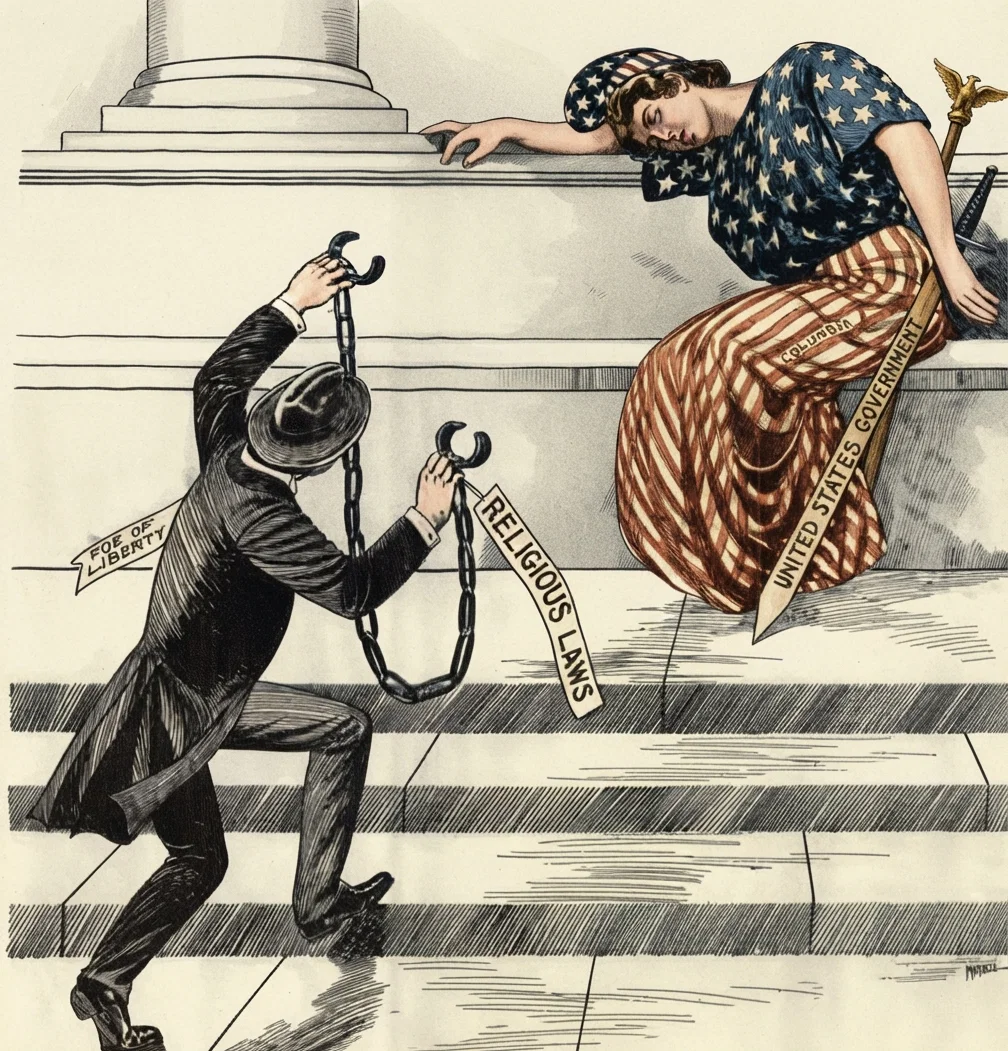
Awake, Fair Liberty!
Adapted from L. O. Emerson, in "Songs of Freedom"
She sleeps, she sleeps, fair Liberty,
While Peace keeps watch from sea to sea,
The bugle's blast, the cannon's roar,
Resound through hill and vale no more.
But hark to the voices that fill the air,—
"She's never a Christian, tho grand and fair.
She sleeps, she sleeps, she sleeps, she sleeps;
We'll bind her with creeds while slumb'ring
there!"
The drums are still, the sabers rust,
The slain have moldered back to dust,
And Peace keeps watch from sea to sea;
She sleeps, she sleeps, fair Liberty.
Awake, awake, fair Liberty!
Behold the chains they forge for thee;
The hammers click, the anvils ring,
With link, and lock, and key, and spring.
Their subtle amendments that seem so fair
Are fetters for Conscience to groaning wear.
Awake, awake, awake, awake,
For God, and home, and freedom's sake!
With speech, and song, and plaintive prayer,
They're forging chains for thee to wear;
Ere friends, misguided, fetter thee,
Awake, awake, fair Liberty.
Beware! Look back to ages when
The State enforced the creeds of men,
When Might rose up against the few,
And sword and flame found conscience true.
Thy grand Constitution proclaims to all
The freedom to worship at conscience' call.
Beware, beware, beware! Away,
Away with the night! 'tis Freedom's day!
O, turn not back to ancient time,
When Church and State were wed in crime,
When millions died for conscience' sake!
Awake, fair Liberty! awake!
America's Fight for Religious Freedom
We have enjoyed religious freedom so long in this country that comparatively few people realize the struggle that it cost.
Previous to the founding of this nation, with but one exception every country on the earth, and during all past time, had been cursed by a State religion. And at the time of the formation of this Government, the world was everywhere impregnated with the idea that it was fatal for the State not to have an established form of religion. Men must be compelled not only to pay a tax to support the State Church, but they must be compelled also to attend its services.
It may seem strange to some of us that such sentiments could ever have prevailed. But they have prevailed, not only in the past, but they are gaining ground so rapidly in the present as to constitute a great menace for the immediate future.
Madison was one of the greatest champions of religious freedom at the time of the founding of this republic. Some of his most striking utterances when discussing the subject are the following:
"The original colonial polity of Virginia had been founded in that mistaken connection of Church and State which was then the universal practise of all nations and of all religious parties."—Page 41.
"In Virginia the colonists were enjoined by the mother country to administer its functions of religion so as to provide that the service of God and the Christian faith be preached, planted, and used according to the doctrine and rites of the Church of England."—Page 42.
"Union of religious sentiment begets a surprising confidence, and ecclesiastical establishments tend to great ignorance and corruption, all of which facilitate the execution of mischievous projects."—Page 43.
"Religious bondage shackles and debilitates the mind and unfits it for every noble enterprise, every expanded prospect."—Page 54.
The foregoing quotations are taken from "Life and Times of Madison," by Rives.
Madison's memorial against establishing the Episcopal as the State Church of Virginia contained the following:
"Religion, or the duty which we owe to our Creator and the manner of discharging it, can be directed only by reason and conviction and not by force or violence."
"Who does not see that this same authority which can establish Christianity to the exclusion of all other religions, may establish with the same ease any particular sect of Christians in exclusion of all other sects?"
"Because experience witnesseth that ecclesiastical establishments, instead of maintaining the purity and efficacy of religion, have had a contrary operation."
"In no instances have religious establishments been seen as the guardians of the liberties of the people."
These statements were sound in that time, and they are just as sound to-day. Careful thought should be given them, for the religious combines being formed show that history is seeking to repeat itself by giving the church power to dominate the State. The open avowal is made by many leaders in church federation movements, that all the religious people should combine in such a way as to compel lawmakers to respect the wishes of the church. The menace of church domination is just as real and fully as great to-day as at any time in the history of the world.
T.
Liberty to Believe or Not to Believe
THE absolutest and fullest freedom to believe or not to believe the Gospel of Christ is accorded by Christ Himself. "If any man hear My words," He says, "and believe not, I judge him not: for I came not to judge the world, but to save the world." John 12:47. In this is proclaimed a Gospel totally free from coercion. Love, and love only, is to be the drawing, persuading, impelling power to bring the sinner to salvation. Threats, trusts, boycotts, sneers, slights, pharisaical righteousness, and human laws, have no place whatever in the redemptive work. "I judge him not;" that is, try, condemn, punish him not. Force does not save. Majorities do not count in the processes of the Word of life. Only right decides. And one of the glorious facts of the kingdom of God now is that, tho men possessed of a spirit from beneath may resort to all these worldly and oppressive measures in their mistaken zeal to force upon others their dogmas and views, yet they can not enter that spiritual realm and can not disturb the soul in its privileges there against its will. There the soul may revel in God-given freedom from sin and all its attributes, and live above and beyond the tribulations of the flesh.
Not Institutions, but Men
ONE of the objects of the Christian Citizenship movement, the American Sabbath Union, the National Reform Association, and other "religious combinations" now existing "to effect a political purpose," is to protect, or to promote, or both, certain religious institutions, among which is the so-called "American Sunday," or "American sabbath," tho what there is about it exclusively or particularly American no one has ever told us. In other words, it is the church Sunday. But herein these organizations are opposed to true Americanism and genuine liberty; for the true province of civil government is to protect, not institutions, but men—to protect men in their equal rights. As Thomas Jefferson expressed it, "Equal and exact justice to all men, of whatever State or persuasion, religious or political." This is the true principle of liberty in government.
A Wrong Way
If the church is ever to purify and elevate the State, the object will be accomplished, not by assuming the functions of the State, but by regenerating human nature. Society is the aggregation of individuals, and as these individuals are intelligent and moral, so will be its government. No fountain can rise higher than its source, and no social democracy can call into existence a higher standard of life than the average of its constituents. The present movement to organize a Christian State is in method, tho not in purpose, a retrograde step in human progress.
The Inevitable
Put Him Out of a Job
It is sometimes said that the Men and Religion Forward Movement is not political; but Dr. Smith, the leader of that movement, said in San Francisco, February 22, 1912:
"I tell you men if we can ever get the forces of God once organized so they will move together, we can put every dirty dog out of a job in the political world. . . . We have the forces; we have the men. Wo betide these cheap devils when we once get organized."
What will then result? Every man who will not bow to the mandates of a few demagogs in the religious combination will be counted a "dirty dog," a "cheap devil" in politics, and be "put out of a job." But every truly self-seeking politician, who has not the manhood to stand against church-and-state government, will swear that he is head and wimple with such a movement, that he is converted to it through and through, and he will be placed in office. The result will be a reign of intolerance and hypocrisy.
Some Pertinent Questions
By Editor
The secretary of the Lord's Day Alliance of America is Dr. Grannis, of New York, and the secretary of the Lord's Day Alliance of California is Dr. G. L. Tufts. These men are especially active in endeavoring to secure a law for California, which will doubtless be presented this coming autumn, under the Initiative. Dr. Grannis has done very much in securing rest for men who have hitherto labored on Sunday. One of the special victories which he secured was in Pittsburg, in relieving iron-workers, or "slaves," as he termed them, from seven days' work a week, and lessening their hours a day. And he did all this without the Sunday law, for Pennsylvania has a strong Sunday law, but seemingly it did not operate in Pittsburg.
Here are some questions for our Sunday-law agitators:
1. If a Sunday law will secure to men the right to rest, as Dr. Grannis and Dr. Tufts claim, why did not Pennsylvania's stringent Sunday law secure relief for the thousands of "slaves" in the iron industries around Pittsburg?
2. In helping those workers, why did not Dr. Grannis appeal to the State Sunday law instead of resorting to moral suasion and personal influence in securing relief for the toilers? Pennsylvania is the headquarters of the National Reform Association, and Pittsburg is the headquarters in that State of that association.
3. If a Sunday law did not secure to men the right to rest in Pennsylvania, what hope is there that it would do just the opposite in California?
4. If a six-day work and twenty-four hour rest law, which Dr. Grannis contended for in New York, is, or would be, sufficient to protect men in their right to rest, why is not a similar law, now on the statute-books of California, sufficient?
5. But why did Dr. Grannis contend for another law in New York, when there is already a strict Sunday law on the statute-books of that State?
6. How many subsequent enactments does it take to make the first effective?
Mrs. Pankhurst and Militant Suffrage
By Editor
Mrs. Pankhurst, the militant suffragist of London, was tried in the Old Bailey May 21, and sentenced to several months' imprisonment. She endeavored to secure from the court recognition as a political offender, and not a criminal one. When sentenced, she posed as a martyr, and declared that she was suffering in a just cause. But however just the cause, it certainly did not employ just or legal methods in destruction of property and violence to persons. Every manifestation of mob law, nearly, is claimed to be, by the mob, just, but its methods are grossly criminal, and so with Mrs. Pankhurst's.
L. & M. ALEXANDER & CO
$30 Will Buy a Rebuilt
Standard $100
TYPEWRITER
Remington No. 6, or Smith Premier No. 2
We Rent All Makes of Typewriters
L. & M. ALEXANDER & CO
Exclusive Dealers
L. C. SMITH VISIBLE Ball Bearing Typewriter
512 Market St., San Francisco, Cal.
Phone Douglas 677
Liberty
By Editor
The "James Madison" and "Religious Garb" Number
In the words of Jefferson, "The last hope of human liberty in this world rests on us."
Join the International Religious Liberty Association by subscribing for this illustrated quarterly magazine for one year (25 cents), and signing its "Declaration of Principles."
A Few Features
Cover Picture of Madison's Home; Religious Garb in United States Indian Schools; Why the Jew Hates "Christianity;" The Moral Condition in California; California and the Sunday Law; A City without a Sunday Law; Governor Foss Resents Cardinal's Arrogance; Rome's Insult to America's Marriage Laws; Rome's Interference with the Rights of Citizens; Religious Liberty in Portugal under the Monarchy and the Republic; Restrictions upon the Religious Liberty of Public-School Teachers in the Philippines; Madison the "Father of the Constitution."
Stands for the complete liberty of every man and woman in the world, whether Protestant, Catholic, Jew, or infidel.
Special Offer on Ten, One Year
Ten copies, one year, to one address, or to ten separate addresses, only $1.50, or 15 cents each. Sender may include his own name as one of the ten. This number should be placed in the hands of every editor, attorney, clergyman, city and county official, and public-school teacher in your county. We can furnish the names and addresses.
Liberty, Washington, D. C.
Protestant Magazine
By Editor
"Rome and Marriage" and "Catholic Prisons" Number
Supply of previous numbers exhausted!
Recent despatches and interviews published in the leading American dailies, show that Rome's eye is upon the "Protestant Magazine."
A letter from Rome to the New York Sun, July 11, 1892, reveals the plan of the Papacy for America: "What the church has done in the past for others she will now do for the United States."
Partial Contents
Double Frontispiece — Photograph of Holy Cross Church Baptism Certificate (Perth Amboy, New Jersey), Showing Rome's Insult to American Marriage Laws; A Girl's Escape from a "House of the Good Shepherd;" Rome and Marriage Laws; The Mediation of Christ; Reply to Attack by "Catholic Truth Society" upon This Magazine; Chillingworth's Famous Statement; The Privilege of Peter; The Pope's Decree Forbidding Catholics to Sue Criminal Priests; "Another God upon Earth;" Rome Capturing America; Is America to Become Catholic? Protestantism in the Sixteenth Century; and other timely articles, news notes, etc.
Special Offer on Ten, One Year
Ten copies, one year, to one address, or to ten separate addresses, only $1.50, or 15 cents each. Sender may include his own name as one of the ten. This number should be placed in the hands of every editor, attorney, clergyman, city and county official, and public-school teacher in your county. We can furnish the names and addresses.
The Protestant Magazine, Washington, D. C.
Prophecy
By Editor
A small work which you will appreciate as a help in the study of the prophetic Word is "The Sure Word of Prophecy," by Pastor M. H. Brown. Primarily it deals with the prophecies of the book of Daniel and their fulfilment, shedding forth the light that this book contains upon present-day movements and conditions. Price, 10 cents. This office.
Whether fully acquainted, or partially so, with the history given in Daniel 7, you will find its careful outline in "Waymarks to the Holy City" intensely interesting. It is what its name suggests, a tract pointing out the events which are truly waymarks of prophecy. Single copy, 2 cents, post-paid; $1.00 a hundred. This office.