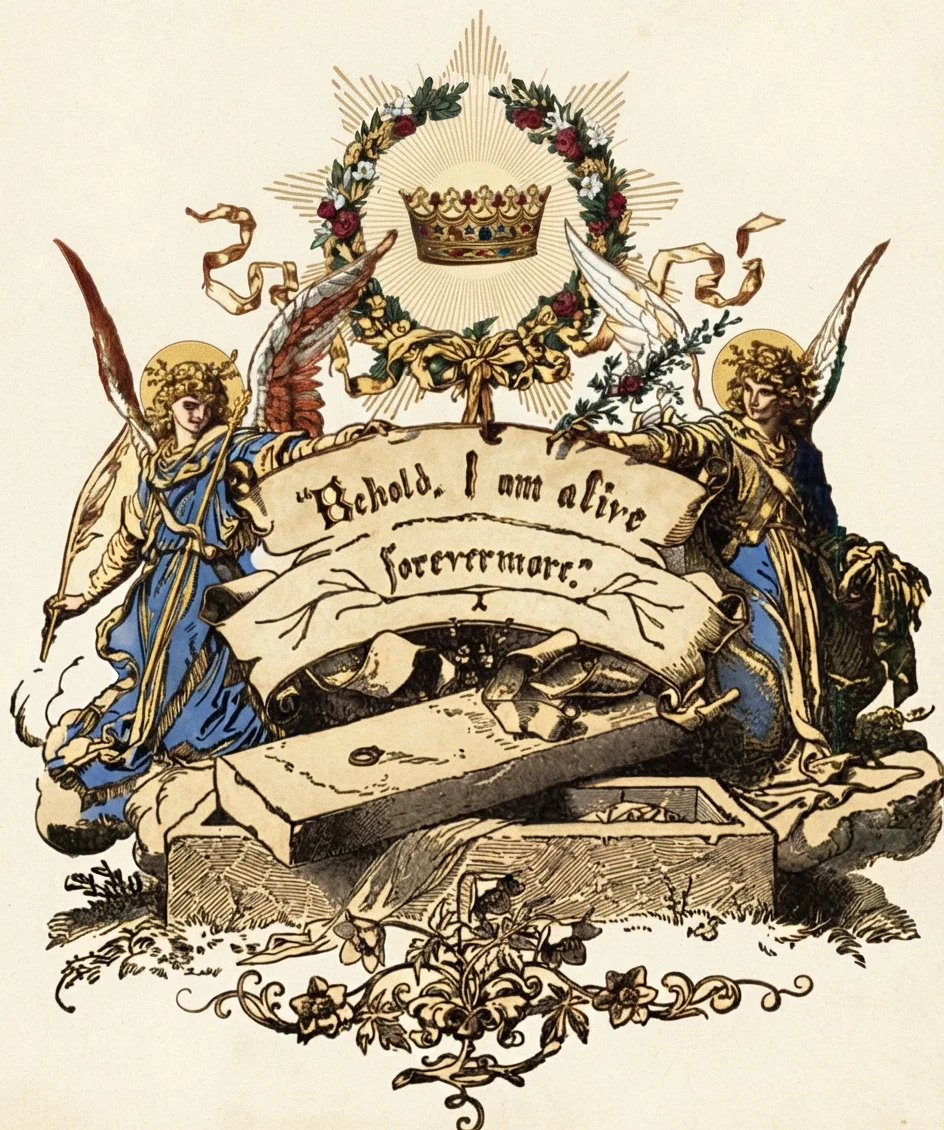
"In the beginning was the Word, and the Word was with God, and the Word was God. The same was in the beginning with God. All things were made by him, and without him was not anything made that was made. In him was life; and the life was the light of men. And the light shineth in darkness; and the darkness comprehended it not. . . . And the Word was made flesh, and dwelt among us (and we beheld his glory, the glory as of the only begotten of the Father), full of grace and truth." These ringing words come sounding down the line to our time. They are full of assurance; for John meant every word that he uttered. Inspired by God, these words possess a power that none can estimate who does not believe in Christ as his personal Saviour. They have a deep meaning, and a broad compass, and are eternal truth to all who believe them.
John is calling the attention of the world to Christ as the life and light of men. Life and light, possessed by no other being that has ever breathed, are found in Christ. A human being lives, but his is a given life, a life that will be quenched. "What is your life? It is even vapor, that appeareth for a little time, and then vanisheth away." But Christ's life is not a vapor; it is never-ending, a life existing before the worlds were made.
Adam was a created being, dependent upon the tree of life for his existence. Through his disobedience, he forfeited the precious privilege of eating of this tree, which was to perpetuate the life breathed into him by God, and for which he was dependent on God. After disobeying God, the precious gifts and endowments which he derived from God were no more his. Adam's disobedience to God's commands brought the human family under the death penalty. "In Adam all die," and eternal death, not eternal life, is the final punishment of all who continue in transgression.
But Christ said, "I will take the penalty of Adam's transgression." In Eden the first Gospel sermon was preached. God said to the serpent, "I will put enmity between thee and the woman, and between thy seed and her seed; it shall bruise thy head, and thou shalt bruise his heel."
And "when the fulness of the time was come, God sent forth his Son, . . . to redeem them that were under the law, that we might receive the adoption of sons." Christ died in behalf of the human family, giving men a probation, that they might have opportunity to see the evil of sin, and to choose as their leader, either the apostate who was expelled from heaven, or the Prince of Life, who gave himself as an atoning sacrifice, that all might return to their loyalty.
Christ's suffering and death have placed life in and through him upon an eternal basis of security. He took human nature. He became flesh even as we are. He was oft hungry, thirsty, and weary. He was sustained by food, and refreshed by sleep. He had natural affection; for we see him weeping in sympathy with the sorrows of others, and lamenting over the retribution coming upon Jerusalem because of her impenitence. While in this world, Christ lived a life of complete humanity in order that he might stand as a representative of the human family. He was tempted in all points like as we are, that he might be able to succor them that are tempted. As the Prince of Life in human flesh, he met the prince of darkness, and, passing over the ground where Adam fell, he endured every test that Adam failed to endure. Every temptation that could be brought against fallen humanity, he met and overcame.
Had he not been fully human, Christ could not have been our substitute. He could not have worked out in humanity that perfection of character which it is the privilege of all to reach. He was the light and the life of the world. He came to this earth to work in behalf of men, that they might no longer be under the control of Satanic agencies. But while bearing human nature, he was dependent upon the Omnipotent for his life. In his humanity, he laid hold of the divinity of God; and this every member of the human family has the privilege of doing. Christ did nothing that human nature may not do if it partakes of the divine nature.
During Christ's life, the warfare between him and the enemy was constantly going on. Every movement of his life was watched. Satan strove to gain the victory; he sought to ensnare Christ, and lead him into temptation. Satan was once an exalted, holy being, in office in the heavenly courts. But he became disloyal, a transgressor of the law of Jehovah. He aimed to be the highest power in the universe. His sin is unexplainable. If it could be explained, there would be an excuse for sin. It is the mystery of iniquity, without any cause.
After receiving baptism at the hand of John, Christ was led by the Spirit into the wilderness. Here he was severely tempted by Satan. But he yielded not. He withstood every assault, every deceptive influence, every temptation. Had he yielded in the slightest degree, the human family would have been under the control of the power of Satan.
The battle going on in this world was witnessed by the heavenly universe, and by the worlds unfallen. They saw the purposes of hate cherished by the wily foe against the only-begotten Son of God. Satan's enmity against truth and righteousness was seen. By his treatment of Christ, Satan demonstrated the falsity of his own attributes, and of his deceiving, crooked pretensions as the friend of God. He showed himself to be the enemy of God and of man. The sacrificial offering upon the cross of Calvary sounded the death knell of Satan and of all who choose him as their leader. He fell forever from the sympathy of the heavenly angels.
When Christ, dying upon the cross, cried with a loud voice, "It is finished," Satan and the angels that sympathized with him in heaven, and fell with him, were vanquished. When Christ proclaimed over the rent sepulcher of Joseph, "I am the resurrection and the life," man was placed on vantage ground. The matter was worked out. The mystery of godliness was victorious. Through Christ, man was severed from the slavery of the hateful apostate. For all who believe in Christ a victory was gained. They would no longer be counted as sinners, sons of rebellion, but as sons of God, through their acceptance of the righteousness of Christ.
As Adam lost the gift of life and immortality by his disobedience, so all born of Adam forfeit this gift. That one transgression opened the flood-gates of wo upon our world. Adam had no power in himself to redeem the past, or to win back the gifts bestowed by Christ. But by his incarnation, Christ was made fully competent to place man where he would no longer be an outcast, excluded from the tree of life. Christ himself bore the penalty of sin, that he might bring life and immortality to light.
If man will coöperate with God by returning willingly to his loyalty, and obeying the commandments, God will receive him as a son. Through the provision Christ has made by taking the punishment due to man, we may be reinstated in God's favor, being made partakers of the divine nature. If we repent of our transgression, and receive Christ as the Life-giver, our personal Saviour, we become one with him, and our will is brought into harmony with the divine will. We become partakers of the life of Christ, which is eternal. We derive immortality from God by receiving the life of Christ for in Christ dwells all the fulness of the Godhead bodily. This life is the mystical union and coöperation of the divine with the human.6As children of the first Adam, we partake of the dying nature of Adam. But through the imparted life of Christ, man has been given opportunity to win back again the lost gift of life, and to stand in his original position before God, a partaker of the divine nature.
"As many as received him," writes John, "to them gave he power to become the sons of God, even to them that believe on his name." "He that hath the Son hath life; and he that hath not the Son of God hath not life." "I am come," said Christ, "that they might have life, and that they might have it more abundantly."
"As in Adam all die, even so in Christ shall all be made alive." And the life which Christ offers us is more perfect, more full, and more complete than was the life which Adam forfeited by transgression. Mrs. E. G. White.
CITIZENSHIP.
By M. S. Babcock
THE question of the citizenship of the Christian, and his rights, privileges, and duties in respect to earthly governments, press forward these last days for discussion and decision with unyielding persistency. As might be expected, the "religious press" especially displays a lively interest in these matters; scarcely an issue appears therefrom that does not contain one or many ingenuous and well-written articles in support of what is denominated "Christian citizenship," and in favor of installing Christ as king of this nation by the hand of professed Christians "through the gateway of politics," advocating the enthronement of Christ politically in this nation, and the recognition of his professed followers, as such, in public affairs, together with the official recognition of their alleged right to control the nation by means of laws passed and enforced, as a result of "Christian votes" cast for the "regeneration of the state," as an "applied science of righteousness."
The questions involved are not new questions. Almost two thousand years ago, when personally present on the earth, they were forced upon the Master himself for settlement. The theater of action is changed from the hills of Judea. America is again the center of the controversy in this nineteenth century, as she was in the eighteenth. The decision rests with us, and not with him or them, only as he energizes us; that is essentially all the difference. They are incased in some new settings, it is true, but come up with all the more vigor and vim for that reason, to the casual view, thereby presenting the appearance of newly-mined gems.
New or old, formerly and now, the right solution of the questions raised involves not merely the civil liberties of men, but what is more, the Christian life and the making of individual Christian character.
They must be solved correctly in the sight of God and agreeably to his Word, for Christ to dwell "in you the hope of glory," that ye may be witnesses for the truth among all nations, and kindreds, and tongues, and people, individually "overcome," and be clothed in "white raiment," in that great day when the Master shall make up his "special treasure."
No doubt the fact of the great importance of these problems is generally perceived and appreciated, especially by students of the signs of the times, and much that has been written, in certain quarters at least, with such marked earnestness by way of instruction and advice, has been prompted by a lively sense of the danger covertly concealed within them. Consideration, without controversy or contention, in order that those who will may come to the "unity of the faith," is a prime necessity, and with this understanding, the thoughts and suggestions herein are prayerfully offered.
Do these people who advocate "Christian citizenship" and allied doctrines, in a limited sense, even, go too far, or are they wrong wholly and fundamentally? Grant a single basic premise assumed by them, and their conclusions inevitably follow. If "there is not a religious quality of right distinct from a political or economic quality of right;" if "the history of these centuries has been the political coming of Christ;" if "the mind of Christ shall become the creative spirit of political action and express itself in the statutes of the State;" if "the realization upon the earth of the kingdom of heaven, in the light of whose truth the nations shall walk and the people grow in knowledge, will be [is] the fundamental idea of the evolution of the Christian State;" if "we had best find our divine place and work in the millennium that has begun, and lift up our eyes to behold the King who is in his abiding kingdom and eternal kingship;" if "Christ’s kingdom is of this world;" if any one of these premises is true, then are Christians—true followers of Christ—of this world also; here, as such, they belong; "here they are citizens—‘Christian citizens’—and have urgent need to bestir themselves, take an active, lively interest in public affairs politically, in order to purify the putrid pool of politics, and ‘regenerate’ a Christian nation."
"To the law and to the testimony; if they speak not according to this word, it is because there is no light in them." "My kingdom is not of this world," says Jesus; "if my kingdom were of this world, then would my servants fight," contend, contest with the world, and, if necessary, fight with opposing powers in the world for supremacy over the world and her "camps and courts," pit might against might, and hold the prevailler right. But "now is my kingdom not from hence." "The weapons of our warfare are not carnal, but mighty through God [politics?] to the pulling down of strongholds." "What agreement hath the temple of God with idols? for ye are the temple of the living God; as God hath said, I will dwell in them, and walk in them; and I will be their God, and they shall be my people. Wherefore come out from among them, and be ye separate, saith the Lord, and touch not the unclean thing; and I will receive you, and will be a Father unto you, and ye shall be my sons and daughters, saith the Lord Almighty." "Come out," that is the condition precedent to being accepted as sons and daughters, followers of Christ, "Christians."
Naturally, as sons of the first Adam, all men are born in some sort subjects, citizens of this world, citizens of some earthly government, subjects of the prince of force (Rom. 3:23; 2 Peter 2:19; Rom. 6:16; Eph. 2:2; 2 Cor. 4:3, 4); for example, citizens of these United States, if born within her accredited territory and jurisdiction, of native parents. As subjects and citizens naturally, all of right can claim the benefits and may exercise the privileges and perform the civil duties given, granted, guaranteed, and imposed by the laws in force of the country to which they each respectively owe civil allegiance, while the "power," or genius of order, of all governments is given of God, ordered of him for the protection of the individual, in the exercise of civil and religious liberty, without regard to citizenship. The drawing of love, the "power" of God, so long as it can work in the hearts of men and rulers, and through these express itself in government and order and system versus anarchy and disorder and confusion, "ordains," orders, orderly action in the affairs of men and nations. This is the best that Love can do for natural, carnal, sinful man, overruling in this way to the "praise of them that do good" and to the working of "wrath" upon them that do evil.
In the Scripture this natural man also is called the "old man," the "man of sin," "Satan incarnate in the flesh." He can see the earth kingdoms, but "except a man be born again he can not see the kingdom of God." Born, "not of blood, nor of the will of the flesh, nor of the will of man, but of God," Christ born in you "the hope of glory," Christ incarnate in the flesh. Here is a "new creature," a "new creation" (2 Cor. 5:17, R. V., margin); "old things are passed away; behold, all things are become new." To the man born in Christ there dawns a new revelation, there opens a new life. Dead to the world and alive to God.
"Buried with him by baptism into death, that like as Christ was raised up from the dead by the glory of the Father, even so we also should walk in newness of life." Rom. 6:4.
"Brethren, I count not myself yet to have apprehended; but one thing I do, forgetting the things which are behind, and stretching forward to the things which are before, I press on toward the goal unto the prize of the high calling of God in Christ Jesus. . . . Brethren, be ye imitators together of me, and mark them which so walk even as ye have us for an example. For many walk, of whom I told you often, and now tell you even weeping, that they are the enemies of the cross of Christ; whose end is perdition, whose god is the belly, and whose glory is in their shame, who mind earthly things. For our citizenship [commonwealth] is in heaven; from whence also we wait for a Saviour, the Lord Jesus Christ." Phil. 3:13-20, R. V.
While alive, the "old man," the "natural man," is a citizen of the "natural world,"—under sin a carnal world,—a realm of force. By faith this man dies and is buried. He was born from beneath, of the will of the flesh. He died that a new man might be born in his stead, of the spirit, from above; "not of blood, nor of the will of the flesh, nor of the will of man, but of God."
This new creature thus begotten in the place of the old creature, by the will and accepted energy of God, according to divine promise, secures rights and privileges, abiding in the fadeless kingdom of light, the kingdom of his birth. The Father "hath delivered us [him] from the power of darkness, and hath translated us [him] into the kingdom of his dear Son" (Col. 1:13), into a realm of love. Heir now to an inheritance incorruptible and that fadeth not away, eternal in the heavens, a child of the second Adam, he seeks "those things which are above, where Christ sitteth on the right hand of God;" "for whom," says Paul, "I suffered the loss of all things, and do count them but refuse, that I may gain Christ." God hath translated us—hath done so, not will do so—and by faith we know that it is so. Here occurs an actual, literal, spiritual birth, but "it is God who brings the bud to bloom, and the flower to fruit;" "first the blade, then the ear, after that the full corn in the ear." For a time while growing, the roots of the new plant may rest in the old seed, buried in the earth and passing away, yet "as the branch can not bear fruit of itself, except it abide in the vine; no more can ye, except ye abide in me." "Things seen are temporal, but things unseen are eternal." How great is this mystery! "Spiritual things are spiritually discerned." "The natural man receiveth not the things of the Spirit of God." The difference in the two men is a difference in character. By their fruits (works) ye shall know them. Where force once ruled in theory and act, love holds sway and regulates the life.7"Ambassadors for Christ," beseeching and praying in Christ's stead to be reconciled to God, who "hath committed unto us the word of reconciliation." "Ambassadors for Christ"—let us not be confused here. No language can convey a perfect and full idea, nor is there an exact earthly parallel. However, mark this well: to whom or what an ambassador is accredited, whether to a nation or individuals, or what his duties may be in behalf of his principal, the government which he represents, in no respect, directly or indirectly, tends to confer or create citizenship upon or for him, anywhere, for any purpose whatever. His letters of credit are issued to him by the government wherein he is a citizen; for that, being otherwise qualified, he is a citizen thereof. Mark this, further: no one can consistently claim to be a citizen of more than one country at one and the same time; most emphatically so where the principle and law and procedure of the one are the exact opposite of the other. The ambassador of Christ receives his letters from Christ, because he has become a citizen of Christ's kingdom, now unseen, but to be revealed in the last days. John 14:1-3; 2 Peter 3:13. Christ lives in him with the same purpose, and works through him in manner and method the same as when with "bruised feet" he trod the hills of Judea, fulfilling the perfect law of love. Gal. 2:20; Heb. 13:8. Therefore his position then, concerning earthly governments, is necessarily the position of his ambassador now. He is a stranger and pilgrim on the earth (Heb. 11:13; 1 Peter 2:11, 12; 1:17-19, 23), is not of this world (John 15:18, 19; 17:14; 1 John 2:15-17; 3:1). "Ye are the salt of the earth," "the light of the world;" retain your savor; let your light shine, and thus in that manner enrich the world, bless mankind, and lead men "to glorify your Father which is in heaven." Matt. 5:13-16.
Daniel was a pilgrim and stranger on the earth, and a captive in Babylon. Three times daily, with his face toward beloved Jerusalem, in prayer he sought the God of his people for their and his own deliverance. The God of heaven richly endowed him above all his fellows, and the kings of Babylon in later years found him an exceedingly wise, faithful, and valuable servant in all matters not involving disloyalty to his God. Personally, however, in the thought of both Nebuchadnezzar and Cyrus, Daniel was an alien, a Jewish captive of war in exile, praying for deliverance and for the kingdom of God to be set up over all the world through the coming of the promised Messiah, the Seed of Abraham.
The service performed for the kingdom by Daniel was highly honorable in the sight of men, and put in use ability and traits of character not possessed by any other known person in the realm. But so far as citizenship in any sense is concerned, such a thing was unknown back there with them, while to have attended to the cutting of the wood, or finding the fuel for the use of the king's cooks, would have suggested and implied that Daniel was a citizen of Babylon as fully as what he did do did or could.
Finally, "whatsoever things were written aforetime were written for our learning," but God "grant you to be like-minded one toward another after the example of Christ Jesus," not after the example of Daniel, Paul, or any other; for Christ suffered for you, leaving you "an example [model], that ye should follow his steps." "If ye know that he is righteous, know ye that every one that doeth righteousness is born of him." Otherwise another power worketh in you, "according to the course of this world, according to the prince of the power of the air, the spirit that now worketh in the children of disobedience." M. S. BABCOCK.
Annapolis, Ohio.
THE GIFTS OF THE HOLY SPIRIT.
By H. F. PHELPS
WHEN Christ ascended up on high, he "gave gifts unto men." Eph. 4:8. And what were these gifts? The answer is also at hand, for verse 11 reads: "And he gave some, apostles; and some, prophets; and some, evangelists; and some, pastors and teachers." Therefore, it is a fact that at the ascension of Christ the gifts of the Holy Spirit were given to his church. Christ had made choice of the twelve apostles; but now he gives "apostles." Prophets had lived, and as a legacy they left the God-breathed words as an inheritance to the church. But even this was not enough. Christ now makes a gift to his church in addition to "apostles," and that gift was "prophets." And not only does he now mention that which had been in the church before, but as now being given in an especial manner, while he also gives "evangelists," "pastors and teachers."
Why Were They Given?
Evidently because they were needed in the church. But we are not left in doubt; for he has given the answer to our query. Listen! "For the perfecting of the saints." Verse 12. Then the saints were not yet perfected, and they needed all these gifts in order to come to the perfect state. Nor is the church yet perfected; and so the need of these gifts is just as great as ever, and even more so as the perils of the last days increase. Did the church at that time need evangelists, and pastors, and teachers? They also needed prophets as well. And does the church need evangelists, and pastors, and teachers now? So also does she need prophets as well. Nor is this the only object of these gifts, tho this of itself would be enough. But notice! They were "for the work of the ministry, for the edifying of the body of Christ." Did the ministry at that time have need of these gifts, the gift of prophecy as well as that of apostles and evangelists? The church has need of these more to-day than ever before. Are the church and the ministry of to-day so complete that there is no need of these gifts of the Holy Spirit, gifts of Jesus Christ? The world has its same alurements; Satan has his same temptations, to which is added the fact that he has come down with "great wrath, because he knoweth that he hath but a short time." Human nature is the same deceitful nature as ever; and if ever these gifts were needed in the church, they are the more needed to-day. Are the ministry and the church so fully equipped for the closing work of the Gospel that there is no need of the gifts of the loving Saviour? The language of many is, "Rich, and increased with goods, and have need of nothing;" while Christ says, "Wretched, and miserable, and poor, and blind, and naked." Knowing the need of a church in the midst of a perishing world, Christ gave these gifts to that church, and no man can put them out of his church.
But Are These Gifts Enduring?
Again the answer is forthcoming: He gave gifts unto men "till we all come in the unity of the faith." There is but one faith. Eph. 4:5, 13. That faith is "the faith of Jesus." Rev. 14:12. Then it is a fact that we need as much as ever, teachers, and pastors, and evangelists; and shall we here cut the list in twain, and say that we do need these last, but do not need apostles and prophets? Who has received authority from heaven thus to do? Let them show their credentials.
The apostleship was not confined to the twelve that were chosen of Christ. Matthias was chosen as an apostle. Paul was chosen as the great apostle to the Gentile nations. Barnabas and Epaphroditus were apostles. An apostle is one chosen of God and sent on a mission. Who will say that Martin Luther was not the apostle of the Reformation? Or who will say that the Wesleys were not apostles of the truth of sanctification through faith in our Lord? Was not William Miller the apostle of the great reformation concerning the soon coming of the Lord which so greatly stirred the religious world in 1844? And Joseph Bates and James White were the apostles of the Sabbath reformation that is now going to the world, which is the fulfilment of Rev. 14:6-12.
Another thing must not be overlooked in this connection: The church needed the gift of apostles and prophets just in proportion as there was a need of evangelists and pastors and teachers. Has any one the authority to take the gift of apostles and that of prophets out of the church, and relegate them to the former dispensation, closing with the days of the apostles of the Lord? If any are inclined to think thus, let such remember that there were prophets in Paul's day (see Acts 11:27, 28); and that Peter and Cornelius each saw visions (Acts 10:3, 19.)
Despising Prophesying.
It is well also to remember that Paul, in writing to the Thessalonian church in the year A.D. 54, gave counsel upon this very gift of prophecy. "Quench not the Spirit. Despise not prophesying." 1 Thess. 5:19, 20. This epistle was not addressed to that church alone, but to the last church on earth as well. In regard to the second coming of Christ he says: "That we which are alive and remain unto the coming of the Lord shall not prevent them which are asleep." "Then we which are alive and remain shall be caught up together with them." Chapter 4:15, 17. Thus it is that in the verses before quoted he tells the church of the last days that they should not despise prophesying. Now prophesying is expressive of present time—a work now being performed. Prophesying will therefore be a characteristic of the true church in the last days, because it was given to the church by the divine Builder of the church, and placed there "till we all come in the unity of the faith." Therefore, as the gift of prophecy will be a gift in active operation, the injunction is, "Despise not prophesying." And these admonitions are so closely connected that it is utterly impossible, without doing violence to the language, to separate them. "Quench not the Spirit. Despise not prophesying." To despise prophesying would be to quench the Spirit of God, because the Holy Spirit is the agency in the manifestation of the gift of prophecy. In despising prophecy, one would thus cut himself off from the influence of that Spirit. Therefore, let us beware, lest we should sever the divine cord that binds to the throne of God through the gifts of the Spirit of God. H. F. PHELPS.
Nobles Financially Interested in Drink Traffic
It is said that there are 10 Scottish dukes, 5 marquises, 20 earls, and 5 barons who have a direct financial interest in the continuation of the drink traffic. In England and Wales the names of no fewer than 172 members of the upper house appear as owners of one or more licensed places.
THE CHURCH AND REVIVALS.
By Editor
MR. MOODY'S method of labor has come under the criticism of the press, notably the Independent. That journal of May 27 contains an article by E. H. Johnson, D.D., professor of theology in Crozer Theological Seminary, Chester, Pa., in which the writer contends that formerly Mr. Moody preached for the conversion of sinners with great success, but that of late he in his own words aims "to reach the church-members and through them to reach the unconverted outside." He pleads to the church to receive the "Holy Ghost power." And whether Mr. Moody has accepted the "Second Blessing" theory or not, Mr. Johnson thinks that his teachings and exhortations are along that line, and that by this he loses; for "his insistence that Christians must gain by special prayer a 'Holy Ghost power' which they do not yet possess, is an insistence which the average Christian can not distinguish from teachings which the great mass of Christians reject; and so his appeal remains fruitless."
The Independent thinks that Mr. Moody demands "more of the Christian church now before it can be successful in converting sinners than he used to expect in his earlier and more successful campaigns, and he somewhat more vigorously assails the worldliness of the church and the sins which exist in it, as if they stood in the way of the power of the Spirit of God in conversion."
This last the Independent does not think to be true, and says that "too much has been made of the story of Achan." It further says:—
"In our own belief it is extremely unwise to get into the way of dwelling upon the shortcomings of professed Christians, and declaring that it is their sins that withstand the Spirit of God."
But this expression is that of the spirit of apostasy. So Israel talked in the days of Isaiah, Jeremiah, and Ezekiel. The problem is not in the mere awakening of sinners; it is not in the obtaining of so many new converts, the experience of whom must all be more or less superficial. It is not so difficult to do this.
But of what use to obtain a thousand young converts, with no experience or knowledge of the way of God, and then ask a cold, proud, world-loving, pleasure-seeking church to care for them, and bring them up in the nurture and admonition of the Lord? The simple fact is that it is only a little time when the converts are just where the church is, changed in name, but not in character. What is the use of putting young and eager children to the breast of a diseased and dying mother? Doubtless Mr. Moody sees this. If he does, it furnishes a sufficient excuse as to why he should preach to the church, and endeavor to persuade her to cut loose from the world. It is the law of God's messages of reform to begin where his judgment does, "at the ancient men which were before the house." Eze. 9:6; Joel 2:1.
The Outlook
By Editor
"I will stand upon my watch, and set me upon the tower, and will look forth to see what He will speak with me."
The Crisis.—He looks indeed with careless eye and thoughtless heart who does not see the rapidly-approaching crisis which is coming upon the world. Intensity is taking hold upon all phases and conditions of life. In the nations and governments of earth we see fulfilling before our eyes the very things that Jesus predicted should herald his second coming—"upon the earth distress of nations with perplexity." See Luke 21:25-27. "Perplexity" regarding finance, regarding preparations for war, regarding war itself, regarding the power of trusts which defy all law, regarding the religio-political, social, and anarchistic propagandas going on in their midst, and undermining all confidence in government. There is perplexity everywhere. "Distress" because of inequality between man and man, distress because of poverty, famine, and pestilence, distress because of oppression of the poor. And yet there is plenty in the world, as never before. The Protestant church has departed from the principles which gave her her life, and now clings to tradition, and pleads for the aid of the State instead of the help of God. Men solace themselves that all this will "turn out right in some way," but they know not how. They are buoyed up by a false hope. So men have thought in other ages. Nebuchadnezzar thought that Babylon would stand forever, but she lives only in the record of her folly and disaster and in the wine of her fornication with which other nations are drunken. Romans thought that the iron empire would stand forever, but the same causes which now operate through the world caused it to crumble and fall. We are living the life of the Roman republic and empire over again. The only hope of the world is radical reform at heart, but this the truth of all history and the prophetic Word forbid. The only hope of the world is in Jesus Christ. The only kingdom to which one can look with hope is his coming kingdom. In that and in that alone is stability.
FULFILMENT OF PROPHECY.
IN a recent speech in the national House of Representatives, Mr. Wheeler, of Alabama, uttered the following words:—
“The trouble is, Mr. Speaker, that the country has changed. From 1776 to 1865 the dominant spirit which controlled in this republic was one of honor, glory, chivalry, and patriotism. The dominant spirit of to-day is the pride of gold, of palaces, of marriage alliances with dukes and princes and counts, and an exercise of the whole power of the government in the interests of money changers, millionaires, and monopolies, and this, too, whether they are Astors, Vanderbilts, or Rockefellers of America, or Barings and Rothschilds from across the sea.”
This sounds very much like the prophecy of Thomas Jefferson, spoken in the beginning of our national history:—
“The spirit of the times may alter, will alter. Our rulers will become corrupt, our people careless. A single zealot may commence persecution, and better men be his victims. It never can be too often repeated that the time for fixing every essential right on a legal basis is while our rulers are honest, and ourselves united. From the conclusion of this war we shall be going down-hill. It will not then be deemed necessary to resort every moment to the people for support. They will be forgotten, therefore, and their rights disregarded. They will forget themselves, but in the sole faculty of making money, and will never think of uniting to effect a due respect for their rights. The shackles, therefore, which shall not be knocked off at the conclusion of this war will remain on us long, and will be made heavier and heavier, till our rights shall revive or expire in a convulsion.”
RELIGION IN PUBLIC SCHOOLS.
By Editor
JUDGE CARPENTER, a circuit court judge of Michigan, has decided that "Readings from the Bible" may not be read in the public schools of Michigan, as the reading of these selections are for a religious purpose, and hence contrary to the constitution of the State. These are the sections of the constitution of Michigan which are held to be against the reading of the Bible:—
"SECTION 4. Every person has a right to worship Almighty God according to the dictates of his own conscience; and no person can of right be compelled to attend, erect, or support against his will, any place of religious worship, or to pay tithes, taxes, or other rates for the support of any minister of the Gospel or teacher of religion."
"SECTION 6. The civil and political rights, privileges, and capacities of no individual shall be diminished or enlarged on account of his opinion or belief concerning matters of religion."
Judge Carpenter holds that one who pays taxes to support a school where the Bible is read as a religious book is "compelled" to "support," and, in case objection is made, "against his will," a "place of religious worship." The case may be appealed from his decision to the Supreme Court. The Independent, from which we get the above information, well remarks:—
"We have long held and argued that the public schools are no place to teach religion, to the injury of Jew, Catholic, Protestant, or Atheist, and this decision seems to us to be in accordance with the principles of American religious freedom. Of course, this does not apply to localities in which no objection is made to the reading of the Bible or to prayer. In that case no one's rights are invaded. The church and the family are, however, the proper custodians of religious instruction. For a similar reason we heartily approve the late decision of the superintendent of public instruction for this State [New York] that a distinctively religious garb must not be worn by teachers in the public schools, in case any objection is made."
Christ’s Building Requires Contentment
“If you would be a part of Christ's building, you must be content with Christ's hewing.”
Smiles Are Cheap as Sunshine
"SMILES are cheap as sunshine, and they do their silent, healing work beautifully, as the sun does."
Do Good While You May
By Francis Asbury
O, LET me do good whilst I may! Time is short. How my friends waste away! Yet I live. Let me live every moment to God.—Francis Asbury.