The Youth’s Instructor, Vol. 32, No. 29.

A LEAF FROM LITTLE PILGRIM'S DIARY

The Youth’s Instructor

Jul 16, 1884

S. D. A. Publishing Association · Battle Creek, Mich. · Jul 16, 1884

A LEAF FROM LITTLE PILGRIM'S DIARY.

I THINK Aunt Harriet is splendid, but I do wish she wouldn’t look at me so. It’s such a cool, calm, superior kind of a face when I get to running on, that it drives me nearly wild. Of course, I know she wouldn’t burn the strawberry syrup, and stick up her bare arms and dress, and pour a few boiling-hot drops on one foot, as I did. She would walk into the kitchen with calm dignity and a spotless white apron, which she would never soil in the least; and she would wave round those capable arms of hers a few times, and walk out, leaving ever so many cans of splendid-looking fruit on the table. Ah me!
“She came in about three o’clock, and asked me to take a drive. If I only could have! But I thanked her, and said mamma had one of her frightful headaches, and I couldn’t leave her, and, besides, I had been driving ever since I got up, and felt like those Roman pictures where the charioteer leans forward to urge on his six horses.
“‘What was it to-day?’ she said, looking that way at me, and petting Gyp, who always jumps into her lap.”
“‘Oh, it was papa’s breakfast, and the children to send to the picnic with clean faces and hands, and a handkerchief and a lunch-box apiece.’”
“‘And you couldn’t go!’”
“‘Why, of course not,’ I said.”
“‘Then two pecks of strawberries came that had been ordered yesterday, and they are just done. And mamma has been alone a long time.’”
“She didn’t speak right away, and that look all went out of her face.”
“Finally she said, ‘The little pilgrim finds her road hot and dusty to-day.’”
“‘I would have given my new kid gloves to cry, only I knew there was nothing to cry for. Father might have cried, with all his business worry—and mamma. By the way, I felt sure it was the business that got into mamma’s head; but why should I cry because I had to take mamma’s place a single day?’”
“‘Come sit by me, little girlie. Why not? I want to tell you about the shady places and springs of water provided for pilgrims.’”
“‘I shall cry, if I come; and I won’t cry,’ I said. And then I did cry with all my might. But, somehow, she wrapped me up in her big arms so comfortably that I could stop very soon.”
“‘Tell me about the shadow and the springs, auntie,’ I said.”},{
“‘Because Thou hast been my help, therefore in the shadow of thy wings will I rejoice. And the Lord shall guide thee continually, and satisfy thy soul in drought; and thou shalt be like a spring of water, whose waters fail not.’”},{
“‘But, auntie,’ I said, and stopped.”},{
“‘Yes?’”},{
“‘Those verses are ever so nice, but I don’t feel any cooler.’”},{
“‘You haven’t stepped into the shadow; you have only looked at it. Just as your mother watches and cares for little Joey, your heavenly Father has this day cared for you.’”},{
“‘To-day?’ I said, wonderingly. I had not thought of that.”},{
“‘To-day. Sometimes Joey has to pick up his playthings. What a grievous, pitiful, heart-broken time it is, until his face lights up, and he says, “Mamma does love Joey.” He has stepped under the shadow of her wing then.’”},{
“Then Aunt Harriet told me how sure she was that God was watching over the business troubles and mamma’s headache and us just here and now. And I did feel cool and refreshed.”},{
“‘I think mamma’s nurse is ready for her now,’ she said, as she rose to go.”},{
“‘Yes,’ I said, ‘I don’t feel like the charioteer any more. The drive is gone out of me,—and I guess Satan, too,’ I couldn’t help adding. And that brought back the look again. It almost drove me out of the shadow, but I would not go. And I have been so happy ever since. Mother’s head is better, the children are home and put to bed, and I don’t feel nervous, only tired and quiet.”
“He giveth His beloved sleep.”—The Well-Spring.

Honest Labor and the Worth of Working Hands

HARD, horny hands, embrowned by the sun and roughened by labor, are more honorable than white ones that never reached out to help a fellow-creature, or added a dollar to the world's wealth.

A SUMMER DAY.

O perfect day of summer time! I see the purple shadows climb The peaceful hills, as down the west The sun goes journeying to his rest; While all the valley at my feet Is wrapped in calm as deep and sweet As that which in my fancy lies About the peaks of paradise; And softly to my heart I say, Is heaven more fair than earth to-day?
The wind is sleeping on the hill, The robin carols softly still, But far away, as heard in dreams, His mid-day song of gladness seems. Beside his nest he rocks and swings; While, thinking of the folded wings Beneath her breast, his brown wife broods In the green maple’s solitudes, So near, and yet so far away As things of which we dream to-day.
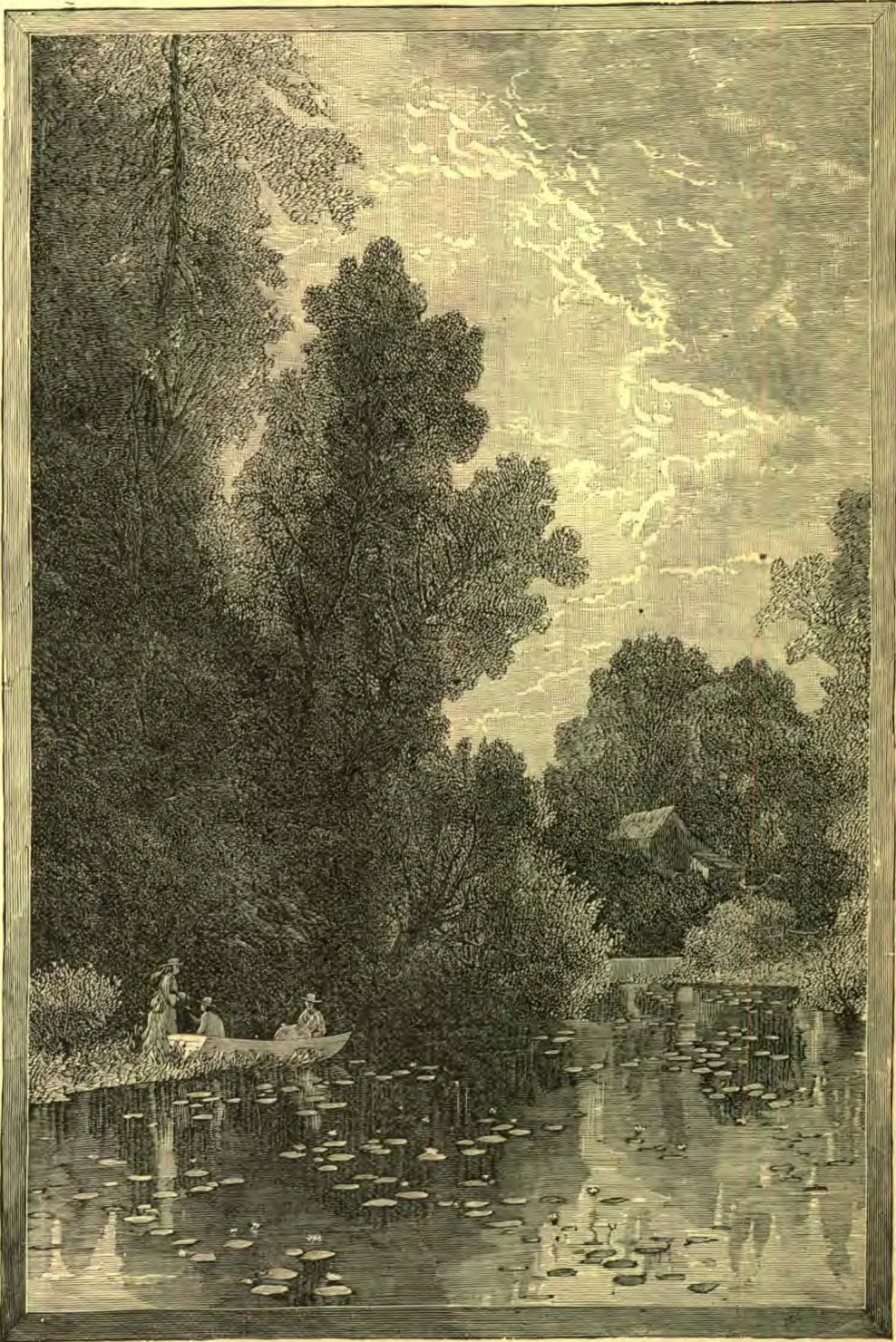
The river’s voice is low and sweet Where lily leaves, a fairy fleet, Are rising, falling, by the shores— Life-boats adrift with idle oars. I see the water-fairies dance Among the rushes on the banks, Where, crowned with plume, and armed with lance, The tall reeds stand in stately ranks, And fancy that some Pan to-day Is fashioning pipes whereon to play.
All day the elfin sprites have swung The lily-bells the grass among, And filled the air with melody Like that which comes in dreams to me,— Sweet airs from Elfland, vague as sweet, That only those who dream can hear When rest is round us, to complete The happy day that crowns the year,— The happy day when life to me Is dream, and dream reality.
The sky has seemed, the whole day through, Like a great violet overturned, With sunshine filtering through its blue; While idle, dreaming, unconcerned, I lay among the grass and heard The cricket chirp, and talk of bird, And saw the clouds sail softly by Between me and the great, clear sky, Like argosies our heart sent out To find the treasures dreamed about.
Strange things has Nature to me told! The secret of the sunshine’s gold; The mystery of the growing corn; How roses break apart at morn; What the wind whispers to the pine— Ah, all these mysteries are mine. But I may never tell to you What I have heard. Your ear must be Laid close against her heart so true To understand each mystery.
— Eben E. Rexford.

BAD BOOKS.

It is often worse to read bad books than it is to keep company with bad boys. Actions grow out of our thoughts, and a bad book can, in a few minutes, damage us forever.
One of England’s greatest and best men says that when a boy, another boy loaned him a bad book for just fifteen minutes. He never could get away from the vile impression made upon his mind by that book in so short a time. He shed many bitter tears over it, and tried to forget it, but the shadow lingered. God forgave him, but he could not tear from his soul the memory of that evil book.
My young friends, if you will hear the voice of age and wisdom, do not read bad, trashy books and papers. They feed unholy, lustful thoughts and lure to dark deeds. They poison the mind, and corrupt the morals. They are worse on the soul than liquor is on the brain. If you fill your mind with the rubbish of nonsense and the filth of vile thinking, there will be neither room nor relish for the choice gold of truth and the diamond dust of pure thought. In the Bible you will find the loftiest sentiments expressed in a clear, captivating style. It is a fountain of pure thought and clear English. Read it much, love it more, and live out its blessed teachings forever.—Pacific Methodist.

EDITOR'S CORNER.

In our talk with you last week, we called your attention to the advantages of the Sabbath-school, and to the good which might be accomplished through it to those unacquainted with the word of God, if they could be persuaded to attend. We know some of you are already engaged in gathering new ones into the schools, and that the fruits of your labors more than pay you for your efforts; but the full quota of good which may result from such labor will not be known in this life; for the influence of each faithful act will extend on and on while time continues. To encourage you in the work of gathering recruits for the Sabbath-school, we give you the following extract from the Child's Paper:—
“Some years ago, a superintendent of a Sunday-school asked that each scholar should try to bring a new one to the Sunday-school the next Sunday. Some thought they could not do it, while others expressed themselves as willing to try. Of the latter class, one boy went home to his father and said,—
“‘Father, will you go to the Sunday-school with me next Sunday? The superintendent asked us each to bring some one with us.’
“‘Why, my son, I can't read,’ said the father, with a look of shame and mortification at his ignorance.
“‘Our teachers will teach you, dear father,’ said the little fellow, with respect and feeling in his tones.
“‘Well, I'll go,’ said the father, touched, as he was, by the winning earnestness of his little son, and desiring to gratify him.
“He went, was most kindly received, in a little while learned to read, and in a little while sought and found the Saviour; and at length became a colporter in the employment of a society in a western State. Years passed on, and that man, as the report of the Society states, had established three hundred and ninety four Sunday-schools, into which nearly thirty-five thousand children were gathered, to be instructed in the word of God.
“So much for one little boy's effort, which seemed but like a little rill; but as the rill swells into the brook, and the brook by and by increases to a river, so his endeavor to bring another to the Sunday-school was, under the blessing of God, the means of the conversion of his father; and the father, being converted, was the means of establishing so many Sunday-schools, in which thousands of children were taught the way of salvation through Christ.” M. J. C.

MORE ABOUT ROME

FOREIGN TRAVEL.—NO. 11.

MORE ABOUT ROME.

This city is a place so full of interest that we must take a little more space to notice it. Volumes could not give all the interesting particulars.
Among other places, we visited the Pantheon, the “only ancient edifice in Rome which is still in perfect preservation as regards the wall and vaulting.” It was a temple for all the gods, and was built B. C. 27, by M. Agrippa, son-in-law of Augustus. It was consecrated to all the saints A. D. 609, by Pope Boniface IV. The ancient statues of the gods were removed, and those of saints have taken their places. Probably to the true God the worship of the one was as acceptable as the worship of the other. The building is circular, the height of the dome and the diameter of the building being equal,—140 feet. Its walls are 20 feet thick, and it has no windows, the light coming wholly from a circular aperture at the top. Formerly it was reached by several steps; now the streets are higher than the entrance.
Capitol Hill is one of the greatest points of interest in Rome. This is one of the smallest of the “Seven Hills,” but, historically, the most important of them. Romulus is said to have founded his asylum here; and here was located the temple of Jupiter and Juno. There now stand on the hill two palaces, containing a large amount of ancient and modern statuary and many paintings. The ancient statues have been discovered in the rubbish and in various other places, and are kept here on exhibition. There are chambers filled with the statues of the philosophers, emperors, and gods of ancient Greece and Rome. A student of history will find this place full of interest. Here are the heads of Socrates, Demosthenes, Cicero, and other notable personages, carved in marble. Some of the countenances are very fine, but the most of them are not, those like that of the tyrant Nero being anything but lovely in expression. They are not as white as modern statues, but they are wonderfully well preserved after two thousand years’ exposure. Many of these monuments were once covered with gilt. In the open space at the summit of the hill are several very large equestrian statues.
Of course we visited St. Peter’s church, one of the most remarkable buildings in the world; we cannot attempt to give any idea of its wonders, so we will merely give a few particulars. The cathedral is situated on the right bank of the Tiber. The territory about it was not included in ancient Rome. But the emperors had gardens in this part; and here was a circus, where Nero showed such cruelty to the early Christians, and where some of the earliest martyrdoms took place. For this reason the associations connected with it were very sacred to the early church, and at an early date a church was here erected to the honor of St. Peter. A citadel was built here, making it a place of safety at the time when the barbarians so often attacked the city. This, after many years, became the Castle of St. Angelo, the strongest fortress of the city.
The bridge of five arches crossing the Tiber is ornamented by the statues of ten gigantic angels. We pass the castle of St. Angelo, which is connected with the Vatican by a covered causeway, so the pope can flee to it for protection in time of danger. St. Peter and the Vatican are close beside each other. The Vatican is the largest palace in the world. The pope has kept himself shut up here since his temporal dominion has been taken away from him, so as to show his displeasure. He makes no public appearance as formerly. But the world seems to go on just as well without it. The Vatican contains a vast number of works of art.
The court in front of St. Peter’s is very fine. It is, in length, 1110 feet, in breadth, 780, in the form of an ellipse; and it has two of the most beautiful fountains I ever saw. The sides of the cathedral are formed by imposing colonnades supported by four series of huge columns, forming three passages underneath the roof, the middle of which permits two carriages to drive abreast. Out of this court we ascend by steps to the church. A large Egyptian obelisk stands in the middle of the court. The cost of this court was about $1,000,000.
The outside of St. Peter’s is not so fine as some buildings I have seen. But as soon as one enters it, he is lost in wonder and admiration. The foundation was laid 1506, and it was consecrated 1626, being one hundred and twenty years in building. It cost about $50,000,000. It is the largest cathedral in the world. Its length, including the portico, is 696 feet. It is in the form of a cross, and is 450 feet in the widest part. The height of the nave is 150 feet, and that of the dome up to the lantern is 403 feet; and to the summit of the cross, 435 feet. The diameter of the dome is 138 feet. The church contains twenty-nine altars and one hundred and forty-eight columns.
Beneath the dome rises the imposing bronze canopy, borne by four richly gilded spiral columns. It is 95 feet in height, and weighs about 93 tons. Under this canopy is the high altar, where only the pope reads mass upon great festivals. Beneath it is said to be the tomb of St. Peter and St. Paul. We descended to it by marble steps; a gilded door is opened, and in a gilt box, one or two feet square, their bones are said to repose. Whether the bones are theirs or some other person’s is a matter we will not attempt to decide. It really makes little difference, provided the credulous Catholics only think they belong to the apostles.
The magnificence of the interior of this church is indescribable. One can easily believe the prophet’s words, which declare that the kings and the great men and rich men of the earth have supplied great Babylon with her merchandise and precious things. Read Revelation 18. On every side are statues of popes, with the keys and the triple crown, and the high-sounding title “Pontifex Maximus.” Statues of angels and saints, in the finest marble, abound everywhere.
One of the most remarkable features is the pictures in mosaic. They are made of very small pieces of stones of different colors, put together in such a way that at a little distance they look like a very fine painting. But there is no paint whatever about them. They are all stone, and so will endure for ages without change. Some of these pictures are 12x20 feet, representing Bible scenes, and they are very beautiful. There are thousands of square feet of this kind of work in St. Peter’s, made of these little pieces of stone with a surface of perhaps one-fourth of an inch square, all combined into these great pictures, looking like the finest paintings. What an immense amount of labor this must have cost!
But the effect of all this magnificence upon my spirits was to make me feel very sad. What was it all for?—To glorify the Catholic church, to hold the admiration of the masses, and to rivet the superstition and homage of the masses to the apostate church which has corrupted the pure religion of Jesus. Here was a bronze image, which they call the image of St. Peter. However, it does not look at all like their own pictured representations of the apostle; and the best evidence goes to show it is an old statue of Jupiter, a heathen god. I saw scores of fine-looking people come up and kiss the foot of this image, and bow their heads down upon it with the greatest reverence. That foot has been kissed so much that the metal is kept constantly bright, and is considerably worn away by the friction of human lips. What a commentary on Romanism! We were never more thankful for God’s pure and holy truth than when we left the magnificent St. Peter’s, with its heathen worship.
UNCLE IDE.

Longfellow Verses on Noble Deeds and Thoughts

WHENE'ER a noble deed is wrought, Whene'er is spoken a noble thought, Our hearts in glad surprise, To higher levels rise.
Honor to those whose words or deeds Thus help us in our daily needs, And by their overflow Raise us from what is low!
—Longfellow.

IMPORTANT BIBLE SUBJECTS.

LESSON 3.—SECOND ADVENT.

[NOTE TO THE STUDENT.—Do not consider the lesson learned until you can give at least the substance of every text, with the correct reference for each. The references in black letters indicate those texts that should be committed to memory. A little diligent application each day will enable you to do this.]
“AND as he sat upon the Mount of Olives, the disciples came unto him privately, saying, Tell us, when shall these things be? and what shall be the sign of thy coming, and of the end of the world? And Jesus answered and said unto them, Take heed that no man deceive you. For many shall come in my name, saying, I am Christ; and shall deceive many. And ye shall hear of wars and rumors of wars; see that ye be not troubled; for all these things must come to pass, but the end is not yet. For nation shall rise against nation, and kingdom against kingdom; and there shall be famines, and pestilences, and earthquakes, in divers places. All these are the beginning of sorrows.” Matt. 24:3-8.
“And when ye shall see Jerusalem compassed with armies, then know that the desolation thereof is nigh. Then let them which are in Judea flee to the mountains; and let them which are in the midst of it depart out; and let not them that are in the countries enter thereinto.” Luke 21:20, 21.
“As therefore the tares are gathered and burned in the fire; so shall it be in the end of this world. The Son of man shall send forth his angels, and they shall gather out of his kingdom all things that offend, and them which do iniquity; and shall cast them into a furnace of fire; there shall be wailing and gnashing of teeth. Then shall the righteous shine forth as the sun in the kingdom of their Father. Who hath ears to hear, let him hear.” Matt. 13:40-43.

QUESTIONS.

1. What did Jesus say to his disciples as they were at one time pointing out the splendor of the temple? Matt. 24:1, 2.
2. What questions did they ask him? Verse 3.
3. Did he rebuke them for making such an inquiry? Verse 4.
4. Why were they to be so careful? Verse 5.
5. Did the Lord encourage his disciples to expect his coming immediately? Verse 6.
6. What terrible things did he say must first come? Verse 7.
7. Would these calamities indicate that the end was at hand? Verse 8.
8. What else did he say must be done before the end would come? Verse 14.
9. When did he say that those which were in Judea should flee to the mountains? Verses 15, 16.
10. What is meant by the abomination of desolation standing in the holy place? Luke 21:20, 21.
11. When they saw Jerusalem surrounded with armies, what were they to know? Ib.
12. Then to what did Jesus have reference in Matt. 24:15?
13. What had Jesus, on a previous occasion, said should take place at the end of the world? Matt. 13:40-43.
14. At the destruction of Jerusalem, did the angels cast all that did iniquity into a furnace of fire?
15. Were the righteous made to shine as the sun in the kingdom of God?
16. Then can it be that the destruction of Jerusalem was the “end” to which Christ and the apostles referred?
17. To what did he say his coming would be similar? Matt. 24:27.
18. Following the destruction of Jerusalem, what did he say there would be? Verse 21.
19. How great would the tribulation be?
20. What would be the result, if those days were not shortened? Verse 22.
21. For whose sake were they to be shortened? Ib.
22. If some of the elect were to be saved in consequence of the shortening of those days of trouble, who were they that were to suffer that great tribulation?
23. Who are meant by “the elect”? Acts 10:35.
24. What were the people of God commanded to do when they saw that the destruction of Jerusalem was near? Luke 21:20, 21.
25. If all the Christians left Jerusalem before it was destroyed, could any of them have suffered in the siege?
26. Then can the tribulation of Matt. 24:21, 22 be limited to that at the destruction of Jerusalem?
27. Was a time of trouble for the saints of God foretold in prophecy? Dan. 7:25.

NOTES.

Josephus informs us that there were many who pretended to divine inspiration; who deceived the people, leading out numbers of them into the desert. “The land,” says he, “was overrun with magicians, seducers, and impostors, who drew the people after them in multitudes into solitudes and deserts, to see the signs and miracles which they promised to show by the power of God.” Among these are mentioned particularly Dositheus, the Samaritan, who affirmed that he was Christ; Simon Magus, who said he appeared among the Jews as the Son of God; and Theudas, who persuaded many to go with him to the river Jordan, to see the waters divided. The names of twenty-four false Messiahs are recorded as having appeared between the time of the Emperor Adrian and the year 1682.—Barnes’s Notes.
It is said that the Christians, warned by these predictions [those of Matt. 24:15-18], fled from Jerusalem to Pella, and other places beyond the Jordan; so that there is not evidence that a single Christian perished in Jerusalem.—Barnes.
There should no flesh be saved.—Since only “the elect” were to be benefited by the shortening of the tribulation, it is evident that they only must have been the subjects of that tribulation. We must therefore conclude that the term “no flesh” is limited, having reference simply to those called the elect. In Joel 2:28 we find a similar instance. There it is stated that before the great and terrible day of the Lord, the Spirit of God would be poured out upon “all flesh,” and that certain ones would dream dreams, see visions, and prophecy. Now it is evident that the “all flesh” in this case refers only to the righteous; for we cannot imagine the Spirit of God being poured out upon the wicked in such measure as to give them the gift of prophecy.
But for the elect’s sake.—The elect means those who are chosen, those in whom God takes pleasure. Enoch walked with God, and had the evidence that he pleased God. We read in the first chapter of Malachi of some who dishonor God, and despise his service. To them the Lord says (verse 10), “I have no pleasure in you.” But in Mal. 3:3, we read of some who will offer unto the Lord an “offering of righteousness;” of their offering it is said that it shall be “pleasant unto the Lord.” So the elect, the beloved of the Lord, are those who delight to serve him. God is no respecter of persons; i. e., he does not esteem and choose one person above another on account of any natural qualification that he may possess; but he is a respecter of character. “In every nation he that feareth him, and worketh righteousness, is accepted with him.” Acts 10:34, 35.

God's Tools for Polishing His Jewels

God hath made many sharp-cutting instruments and rough files for the polishing of his jewels; and those he especially loves, and means to make the most resplendent, he hath oftenest to use his tools upon.—Leighton.

Additional Notes on Sabbath School Department

For additional Notes, see S. S. Department in Review for July 15.

PURITY OF CHARACTER.

ONCE a little girl thoughtlessly held a lighted candle under a corner of a nice linen table-spread to see the threads turn brown. She did not mean to injure the spread, but she held the candle there till the threads were scorched, and began to crack away. She was very sorry when she saw the mischief she had done, and wished so many times that she could make it whole again. But she could not do that, and in a little while the brown spot became a hole. As she grew older, that hole in the spread often made her think of that thoughtless act, that, no matter how bad she might feel, she could never make right again. The hole could be patched, but the cloth could never be what it was before.
So it is in childhood and youth; there is a purity of character, which, once destroyed, is gone forever. You may be forgiven, but you cannot be what you were before. You may think that just for once there can be no harm in yielding to temptation; but one sin causes a stain, one impure thought cherished in the mind soils its purity.
O children! guard well your thoughts, have none but pure, good, noble thoughts; for they leave their mark not only upon the heart, but even your face shows out the thoughts within. Your conversation, too, will show what is in your thoughts; for the Bible says that it is out of the abundance of the heart that the mouth speaketh.
Shun evil companions; and if you at times are thrown into the company of those who use bad language, close heart and ears, and think of that which is pure and lovely.
Jesus said, “Blessed are the pure in heart; for they shall see God.” What a privilege this will be, to enter in through the pearly gates of that beautiful city, and to walk the golden streets, and to know that we can always dwell with pure and holy beings!
This life is given to us to prepare for that life which is to come. Jesus is ready to help us battle against every sin. And those that have in them this hope,—the hope of one day dwelling with Jesus in his beautiful kingdom,—“purify themselves even as he is pure.”
MRS. E. D. ROBINSON.

MARK AND I.

I have found it at last. I mean the place in the Bible where it tells about two boys who were like Mark and me. But I may as well begin at the beginning, and tell all about it.
Mark Adams is my brother. I am Wesley. Mark and I were having a jolly game this afternoon. Mother was in the house making short-cake for supper. Pretty soon we heard her say, “Boys! boys!” I thought she was calling for Mark, so I waited to let him answer, because it isn’t polite to reply when some one else is spoken to. Mark did not speak, and in a minute she called louder, “Boys! bo-oys!”
We could tell what it meant. There was an errand to do. What’s the use of so many errands, I wonder? Grandpa says most of them are to get something for boys to eat. If I was a woman, I would have my errands done sometime when boys didn’t want to play. Mother asked the other day when that would be.
But it was this particular errand I was going to tell about. When mother called the second time, Mark answered. Sure enough! somebody must go to the store for strawberries. Mark tried to beg off. We were having such a good time, he didn’t want to leave. Mother looked sort of worried, and said it was easier to go for anything herself than to make one of us go. Grandpa told her she was not half strict enough with us.
I happened to be behind the woodshed; but mother saw me. “Wesley,” she said, “you ought to do this. All these things come upon Mark.” I told her of course I would go. I had no idea she wanted me, or I should have offered long ago. I thought Mark ought to be ashamed of himself for being unwilling to do such a little thing.
She didn’t praise me as I thought she would, but went into the house, and I went back to play. Mark was not there, but some other boys were, and I thought I would wait a few minutes before going to the store. In a few minutes I could not get away, and pretty soon I forgot all about it.
The next thing was the supper bell. I felt bad then. I remembered about the berries, and I felt afraid we couldn’t have short-cakes. But what do you think? There sat Mark, his fingers all stained with strawberry juice! He had been to the store, and picked the berries all over besides, while I had been playing!
Nobody spoke about it till after supper. Then mother said, “I have been reading about you to-day, Wesley.” I wondered what she meant. “Take this Bible. Turn to the twenty-first chapter of Matthew, and see if you can find what I read,” she went on. When I tell you that there are forty-six verses in that chapter, you will not wonder that I felt a little bit as if she meant to punish me. But Mark said he would help, and we found it at last. I will not tell you what it is, for I want to see if you know. But Mark looked real sober when he read it. “I think,” he said, “the first boy would have pleased his father better if he had gone to work without saying, ‘I will not.’”
Mark is a good boy, but he does have some queer ideas.—S. S. Advocate.

Letter Budget.

Minnie Beaman writes from Marion Co., Iowa. She says: “I am ten years old. It is eight miles to Sabbath-school, so we cannot go very often. We have not been taking the Instructor for a few months, but papa has given me some money, and I now send for it. I think it is a nice paper. I am trying with my papa and four sisters to keep the Sabbath. I want to meet my dear mamma and all the Instructor family in heaven.”
Bertie F. Craig, of Madison Co., Neb., says: “I am nine years old. I like the Instructor very much. We have Sabbath-school at our house. I study Book No. 2 now. There are a few trying to keep the Sabbath here. I have no brothers, but I have three sisters. Two of them are twins. They have all been baptized. I hope to be sometime. My father is a blacksmith and wagon-maker. This is my first letter to the Instructor.”
Florence E. Gilchrist writes from Clay Co., Kan. She says: “I have taken the Instructor since last fall. My teacher got it for me for learning the ten commandments. This is the first time I have written for it. I go to Sabbath-school every pleasant Sabbath. It is held in the school-house, about one mile from our home. I am eight years old. I have a sister, sixteen years old; and a brother, four years old. I send my love to all the Instructor family, especially the editors for making such a nice paper.”
Ralph Turner writes from Tuscola Co., Mich. He says: “I am eight years old. I have no brothers or sisters. I like the Instructor so well I would not know what to do without it. After I get quite a number, my ma puts them together in a book. I have thirteen books now. I went to school last winter, and studied reading, spelling, and arithmetic. This summer I study geography also. I have a good teacher. I have no one to play with at home, so I am piecing a quilt. My ma writes this for me. It is my first letter to the Instructor.”
Walter M. Burkey, of Mercer Co., Mo., writes. He says: “This is the first time I have tried to write for the Instructor, which I like very much. I am eleven years old. I go to Sabbath-school with pa and my sisters. We have had several Bible Readings. As our dear editor wanted to know if we helped our parents in their work, I can say, I help pa grub brush, plough, make fence, milk the cows; and I get firewood for ma. I want to be a good boy so that I may be found among God’s people when the Saviour comes. Ma helped me write this.”
Here is a letter from Zua and Paul Daniels, of Kent Co., Mich. They say: “This is the first time we have written for the Instructor, which we love so much. I am twelve years old, and my brother Paul is eight. Our little sister Beulah is six years old. We have all learned the commandments, the beatitudes, the names of the apostles and the patriarchs, the names of all the books of the Bible; and Paul and I have learned the seven graces in 2 Pet. 1:5-7, the fruits of the Spirit in Gal. 5:22, 23, and the first, twenty-third, and the one hundredth psalms, besides the following scriptures on the Sabbath: Gen. 2:1, 2, 3; Isa. 56:1, 2, 6; 58:13, 14; 66:22, 23; Mark 2:27, 28; and we tell where they are all found. When papa is at home, he questions us on the Bible every morning and evening, and we enjoy it very much.”

SOMETHING HE FORGOT.

A LITTLE boy named Frederick, One day not long ago, Sprang brightly up at peep of day, With rosy cheeks aglow. He felt so happy, well, and strong, So fearless, and so free! A braver boy than Frederick You would go far to see.
He washed his face, he combed his hair, His coat he buttoned tight, And forth he strolled with merry steps, A valiant little knight. And all day long he meant should be Without a stain or spot; Alas! this little Frederick Had something quite forgot.
And so, for all his brave intent, The day went wrong with Fred, And folks were cross, and blame was poured Upon his youthful head. He failed in school, he failed at home, His heart grew very sad, And up to bed at night he crept, A mournful little lad.
I wonder what the reason was? Perhaps the angels knew, Who watched him with their loving eyes, When sleep came soft as dew. “Our Father” by his bed said, Because the dark was nigh, And in the dark who does not need The gracious Friend on high?
Ah, well! ’tis not at night alone We need our Father’s care! How can we meet the busy day Without a word of prayer! ’Twas this our little Frederick In morning’s prime forgot, And this that dimmed the happy day Where humble prayer was not. —Margaret E. Sangster.

You have reached the end of this edition.

The Youth’s Instructor · Jul 16, 1884