WHAT was the object of His death? Was it to release humanity from moral obligation? Was it to release the one who had transgressed God’s law from obedience to that law? We hear sometimes of the “deadly doing” in order to win salvation; but is there not a doing which is not deadly? The angel said when Jesus was born, “Thou shalt call His name Jesus; for He shall save His people from their sins.” Not in their sins, not that they may continue in sin, but FROM their sins; and the apostle Paul enlarges upon the same thought when he tells us, “Who gave Himself for us, that He might redeem us FROM ALL INIQUITY, and purify unto Himself a peculiar people, zealous of good works.”
Jesus Christ died to save men from sin, from the transgression of the law. In other words, He died to make the disobedient obedient; the sinful righteous, the rebel loyal; the heart that delighted in doing its own way, a heart that delights in the law of God. If this be not the mission of the Lord Jesus Christ, surely His work is a failure and the world is no better. But thanks be to God He is a Saviour of the sinner, and a Saviour from sin. Not only is the righteousness of God imputed to us through Him for past sins, but the power of His endless life is imparted to the believer in order that he may not sin.
The Sabbath and Its Need
We are often told by advocates of Sunday laws that the Sabbath is needed. Even the higher critics, who favor Sunday laws, contend that the testimony of medical men demonstrates that the Sabbath is needed; that the observation and experiences of those who employ great numbers of men demonstrate the same thing. Granted. But if it be true that the Sabbath is needed and was needed and has ever been needed by mankind, why not admit that God gave it coeval with man, instead of leaving man to find it out in the dense ages of idolatry? And if it be true that the Sabbath is and has ever been needed by mortal man, why not connect that with the law which God has Himself given regarding the Sabbath and uniting man with it for all time? More than that, God is not the author of confusion. The same logic which would demand that He should supply man's need, would also demand that He should make that Sabbath a definite day. Men are endeavoring to do that now through human law. Why not admit that God knew the necessity of this in the very beginning, and therefore did make the Sabbath a definite day as His word declares?
Still further, if men had been left to choose the day, there would have been constant disagreement and disorder. Why not again admit that Infinite Wisdom knew best what day of the septenary cycle to choose, and that He chose, as the Bible preeminently reveals, that day around which cluster the great facts of Creation; namely, the seventh day, the one only day which was fitted to be a Sabbath? How much it would save the entire world, and especially the religious world who profess to follow God's word, if they would take that simple word in regard to the Sabbath. They would escape innumerable inconsistencies. They would receive the double blessing which God has pronounced upon the day.
May We Know the Day?
WHY not? Adam knew it when God appointed it to his use. Gen. 2: 1-3. Our first father could make no mistake. Toward three millenniums later the people of God knew it again. They heard God’s voice proclaim the law of the Sabbath from heaven amid such grandeur as earth has never known. Ex. 20: 8-11. They had in the fall of the miraculous manna a manifest threefold weekly demonstration that but one day of the week was the Sabbath; namely, the seventh. See Ex. 16: 23-30. This threefold weekly miracle demonstrated the true Sabbath day for forty years. Surely Israel knew the day. Verse 35.
When our Lord Jesus Christ came, the Power of God, and the Wisdom of God, He who made the Sabbath, He knew the day and observed the day. Luke 4: 18; Mark 2: 27, 28. And Inspiration tells us that the Sabbath day was the day just before “the first day of the week.” Matt. 28: 1; Mark 16: 1, 2; Luke 23: 56; 24: 1. Since that time there has been no mistake made in the reckoning of the days of the week. Commerce, astronomy, history, and religion identify the week then and now as the same. The seventh day now is the Sabbath of the Lord.
Singing Without Thought
There is a good deal of singing of hymns that is after the same character as the following anecdote indicates. A bishop heard a cook singing a hymn one morning and congratulated her on her love of Christian hymns. The cook explained that she sang that hymn always when she boiled the eggs. Four verses for hard-boiled and three verses for soft. There are many who sing to time and tune without any thought of the words they are singing. The singing in the worship of God ought to be as intelligent and as truly spiritual as is the preaching or the praying. All of them, it is sad to say, become largely form with many.
The English Political Situation
By M. Ellsworth Olsen
A Lesson for National Reformers
(From Our Own Correspondent)
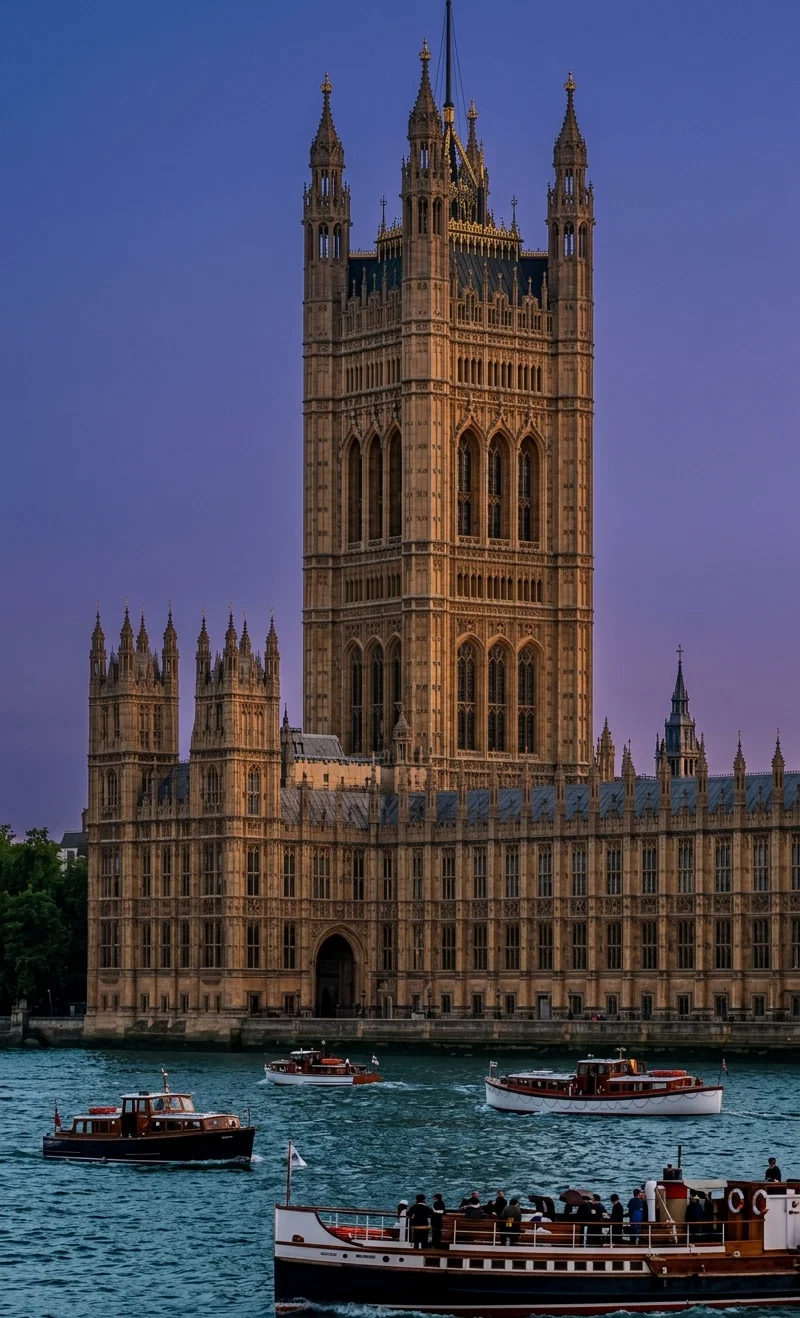
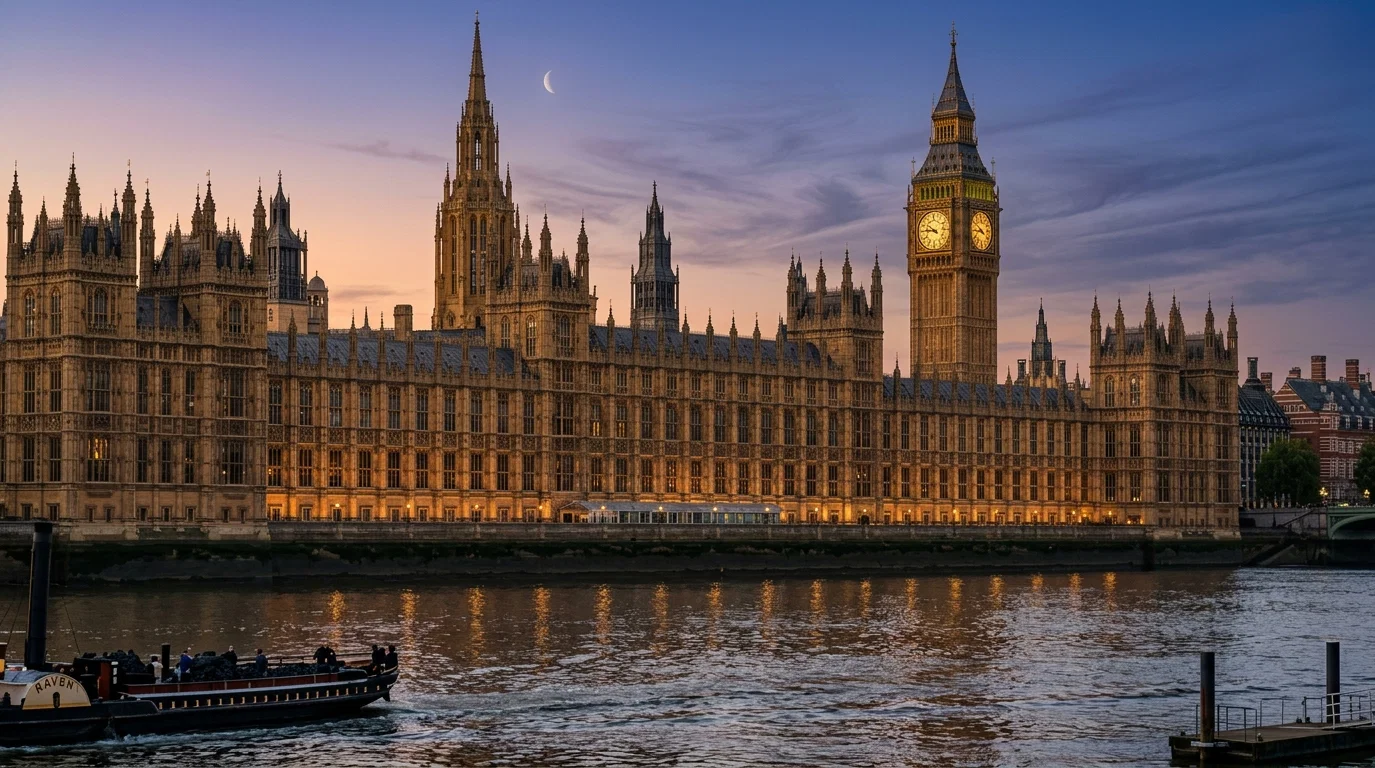
Houses of Parliament from the Thames.
The present situation in English politics is peculiarly interesting and significant. In some respects it is without parallel in English history. The Liberals have now been in office some four years, and have had the advantage of a very large majority in the House of Commons, and yet they have not been able to carry a single party measure of first-class importance. Their Army Bill was of a non-controversial character; so also the Old Age Pensions Bill, prominent conservatives, among them Joseph Chamberlain, having advocated such a measure for years past. The other legislation which has been enacted has been either unimportant, or of a non-partisan nature.
The two first-class measures which this Parliament was elected to put on the statute-book, they have utterly failed to pass. And why? The answer will be, Because the House of Lords has stood in the way. But the real reason lies deeper. The Peers agreed to old age pensions, not because they really favored the bill, but because they knew the people wanted it. They have thrown out the Education Bill and the Licensing Bill because they do not believe the country as a whole favors these measures. Moreover the heads of the present government are not sure that the people will back them up in these reform measures; therefore they are unwilling to appeal to the country. They have boasted great things against the hereditary chamber, but they have actually done nothing, and the House of Lords has not weakened but has gained strength and prestige as a result of its successful defiance of the lower house.
The Churches in Politics
“But how is it possible,” some one will ask, “for the hereditary body to represent the people more than the present House of Commons, elected by popular suffrage?” The answer lies in a proper understanding of the election of four years ago, which was notable in two ways. While it was in progress the Non-conformist clergy took a more prominent part in politics than clergymen either of the establishment or of the dissenting churches ever had done before. When it was over, it was found that there was an unusually large proportion of Non-conformists on the benches at Westminster. It was said at the time that it might be called a Non-conformist Parliament.
It is not my intention to find fault with the mere electing of an unusually large number of dissenters as members of Parliament. It is the way in which this was brought about that is significant. In the election that placed the present government in power, the clergymen were not active merely in their capacity as citizens; but in one way and another they used the influence attaching to men who are regarded in a special sense as messengers of God, to forward political ends. For the time being the preaching of the cross was put aside as of less importance, and the leading divines scoured the country in motor cars denouncing not the sins of mankind, but the sins of the Conservative government, and making use of language in no respect marked by its sobriety and strict accordance with truth. Not only did the preachers go on extensive political tours, and preach the advantages of a liberal government with far greater enthusiasm than they had ever preached the Gospel of peace, but the rank and file of the Non-conformist churches rose en masse and gave their votes for a new government. Church organization was utilized to the full, churches and chapels were employed for electioneering purposes, and no pains spared to rout the Conservatives.
It is only fair to state that the Anglican clergy did not at that time show anything like the same activity in working for the interests of their natural allies, the Conservative party. Their turn came later, as I shall presently show.
Class Legislation
The new members took their seats, then, with very lively feelings of gratitude toward the Non-conformist churches. They knew who had sent them to Westminster, and what they were there for. They had been well instructed. Their first important piece of legislation was a drastic Education Bill, which the House of Lords refused to pass except with such wholesale changes that it would entirely lose its character. So it had to be abandoned, and later attempts to solve the question have been abortive.
Why did the Lords dare to oppose a bill backed by the largest government majority of modern times? Because they regarded it as a piece of class legislation, got up for the special benefit of Non-conformists. Furthermore, about this time the bishops and other clergy of the Anglican Church, following the example set by the Non-conformists, began to make themselves felt as a political power. They held enormous mass-meetings in the cathedrals and churches, and pointed out in the strongest terms the moral danger that confronted the nation if the new system of education were to pass into law.
A Religious Issue
What was the real situation? Simply this: English education as it now stands and has stood for a long time past, is more or less permeated with the principles of the Anglican Church. Non-conformists do not have equal rights with Anglicans. But neither do Non-conformist churches enjoy the financial support given the state establishment; neither do their leading clergymen sit in the House of Lords as do the bishops of the Anglican Church. To Americans, who are accustomed to consider the public schools as quite apart from religious or sectarian associations, the situation may seem anomalous; but it must be remembered that in England there is a union of church and state, and this union affects the system of education. The English political constitution as we see it to-day is a compound of modern and medieval ideas; and the same is true of English social and religious life. This becomes evident when we realize that both Non-conformists and Anglicans wish to have religion taught in the public schools. The only question is as to the particular brand. The Non-conformists say it should be of a non-sectarian character, but their opponents reply11that that is equivalent to making it essential of the Non-conformist type.
So we have in reality a struggle between the two chief religious bodies of England, as to which shall put its stamp upon the rising generation. The Non-conformists have gained in numbers and influence in the last half century or so, and now represent something like half the population. The Roman Catholics have in this matter, however, thrown their influence on the side of the Anglicans. Thus the two forces are about equally matched, with perhaps a slight advantage on the side of the Anglicans. The English people, furthermore, are at heart Conservatives, and judging by the results of by-elections, if there should be an appeal to the country to-day, the Liberals would have to give way to their rivals, and then there would be no more talk of reforming the House of Lords.
What Has Been Gained?
What is the lesson to be drawn from the present situation? The answer in one word would be, that nothing is gained in the long run by a church entering politics.
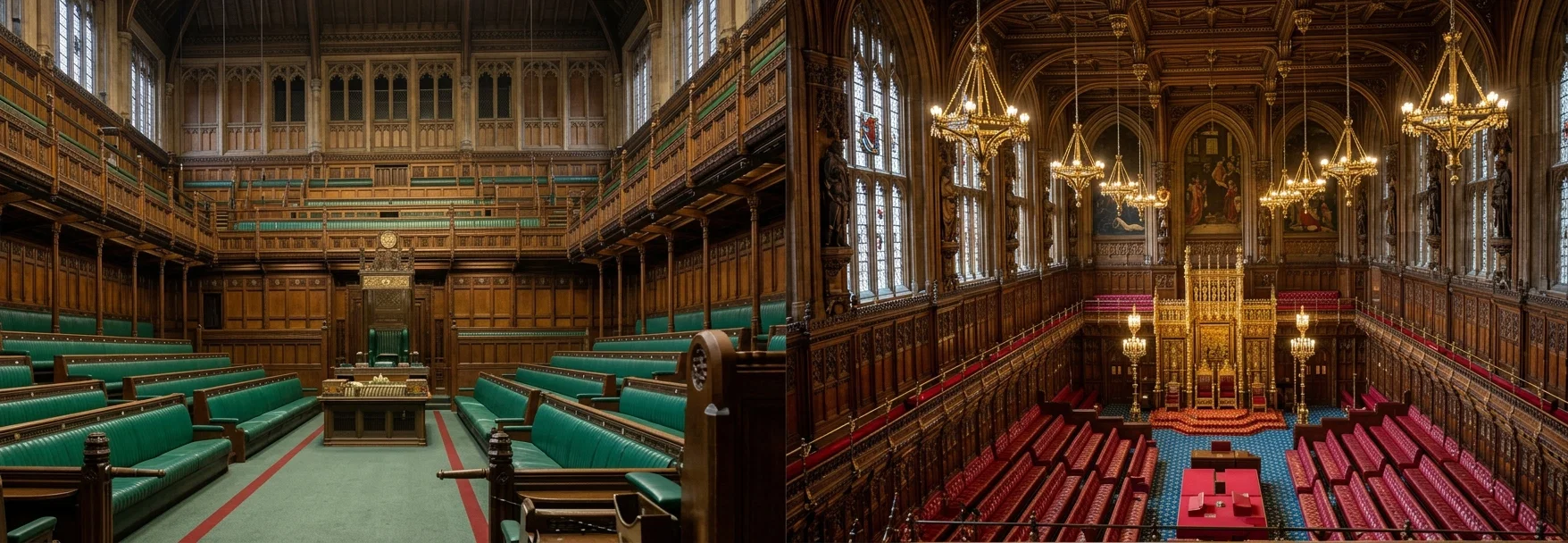
House of Commons. House of Lords.
The Non-conformists undoubtedly had a real grievance in the old Education Bill passed by the Balfour government, but it was a grievance which to some extent naturally grew out of the fact of a state church. Had they recognized this and employed moderate and legitimate means, there is little doubt but that they would in time have secured relief. But when their preachers took to the stump and elected a House of Commons which felt in duty bound to pass a radical bill, they roused the clerical party of the other side, and opened the way for the House of Lords to throw out the bill as a form of class legislation.
The Licensing Bill
The case is much the same with the Licensing Bill. That the country would profit by a strong temperance measure few right-minded men will deny; but many think that the country is hardly ready for it. Moreover, there is honest difference of opinion as to what form legislation should take to accomplish the most good. The country needs to be educated. To work up enthusiasm for a new set of men at Westminster is not very difficult when politicians and clergymen set out together to do it; it is quite another thing to educate public opinion by meetings and the spreading of suitable literature, and then leave it to make itself felt in electing the right men for Westminster; this, however, is the way to accomplish permanent reforms.
In the United States, too, the churches are forming a federation in order that they may make themselves a power in politics. They may in time devise as perfect a political machine as the Free Church Council showed itself at the English election of four years ago, but their efforts permanently to affect the laws of the country are likely to prove as abortive as those of the Non-conformists in England. The reason is that moderate men of all parties strongly dislike to see religious bodies fighting for political power. The minister of the Gospel undoubtedly has political rights and duties as an individual; but his relation to his flock is wholly spiritual. The pastor of a church is not in the remotest sense the political leader of that church. When he poses as such, he is denying his divine calling, and rendering himself unfit to lead his congregation in spiritual things.
History shows that great and beneficent reforms have not come through religious bodies entering the realm of politics. The church will become an increasing moral force in a community not as she endeavors to pull the political wires, but as she keeps absolutely aloof from them in her corporate capacity.
M. ELLSWORTH OLSEN.
In the Philippines
THE Protestant school-teachers in the Philippines do not always meet with fair treatment, according to the Philippine Christian Advocate. While no teachers have been removed because of attendance at Protestant religious services on Sunday, a number of them have met with considerable opposition where the District Superintendents are Catholics. Teachers who have assisted in religious services, entertained Bible workers, or conducted Bible studies at their homes, have been compelled to discontinue such services. This has been done, and the teachers and other Protestant workers have not complained, as it is according to the law. But it is reported that Romanist teachers doing similar things have not been disciplined.
The account is given of a certain American Romanist school-teacher who took occasion to inform his pupils, in a Friday-afternoon program, that Mary was the mother of Christ and therefore the mother of God, and that it would be possible for them to obtain salvation and a home in heaven by praying to Mary, as they could not pray directly to either God or Jesus. An exhorter-student followed him; neglecting his own subject, he “proceeded to answer the principal, stating very clearly that he was reading his Bible, and that he had learned from it that if he wished to be saved, he must believe in Jesus Christ as the only mediator between God and man, and that he could not find a command obligating him to worship the Virgin Mary in order to be saved.” “At the close of the program,” the Advocate states, “he was informed by the principal that he had no right in the school, and that he was very rude to speak as he did about the Roman Catholic Church. He was also informed that if he continued in this attitude, he would one day leave the school never to return, and he would find it difficult to enter another school.”
Impractical Education
President Hadley, of Yale, is quoted as saying recently that, “our tendency to early specialization has resulted in making college boys narrowly expert to the exclusion of leading ideas and principles needed at every stage of their careers;” and he gave as an example: “Professional men who do not happen to be physicians and are without general information of the recent developments in medicine may in sickness resort to patent medicines or the latest faith cure.” Upon this a newspaper remarks: “Some of the most educated men we know are the most ignorant men we know. Some of them are at the mercy of any promoter and have used up their own and their wives’ money.” President Hadley remarks that “the ideal college education is one where the student learns things that he is not going to use in after life, but by methods that he is going to use.”
Summer Session at the University of California
The Summer Session of the University of California has become an interesting and striking feature of the great university. This year the scope of the subjects has been widened. Admission is granted to all persons, teachers, and others who are able to profit by the exercises of the session. No formal examinations are required for entrance, and the tuition fee, regardless of the number of courses taken, is $15.00. This entitles the student to admission to the series of evening lectures and musicales in Hearst Hall, to the full privileges of the university library, and to medical advice and hospital care without extra charge in case of illness brought on while the student is there. Instruction will be given not only by members of the regular university faculty, but by a number of distinguished men of letters and science from Eastern universities and Europe. Outside of the regular university courses special attention will be given to agriculture, household economics, and other things that are of intensely practical use in country home life. The evening lectures are considered to be of almost as much educational value as work in the class-room.
Impure Milk
“Two dead, two dying, and two others dangerously ill as a result of drinking milk from a sick cow,” is the tenor of a news note in the papers a few days since. All were stricken immediately after drinking the milk. Doctors were called, but could do but little. The increasing frequency of such cases will surely put every user of milk on guard. Cows apparently well are often affected; the only sure way to know is to have the milk analyzed. The milk of one diseased cow in a herd will of course infect the milk of all.
Five Miles of Panama Canal Open
Five miles of the Panama Canal is open to navigation. Two American steamships were recently allowed to pass through the channel, which is 440 feet wide for the first mile and 500 feet wide for the remaining four miles. Most of the channel has been excavated to a depth of fifty feet at mean tide. This is on the Pacific end of the canal.
From Singapore to Sumatra
By J. E. Fulton
The writer left Singapore for Sumatra December 12, and for the first time in his life was compelled to travel by a steamer owned by a company who do not use the English to any extent. The name of the company betrays its foreign speech: “Koninklijke Packetvaart Maatschappij.” One fears to attempt to speak even a part of the name lest his tongue get into a hopeless tangle. But these are among the easy words; when one strikes the “g” and “ch” sounds in Dutch, he wonders where they are coming from. They are guttural, we are told, and we are sure they must be, but the throat has seemingly to make such an awful effort to produce them that we almost wonder at its endurance as it continues constantly to use them. Suffice it to say that we did not appear over-sociable on the trip.
Javanese Meatseller.
Chinese Girl born in Padang.
Orders at the table had to be given to Malay-speaking waiters. But having acquired a small stock of Malay, I got on fairly well in ordering, especially when, under the stress of circumstances, I used the index finger. The food on the ships is liberal, but as foreign as the language. I think if I had the powers to digest what they seem to expect one to eat, I would certainly become as corpulent as some of the owners of these ships. One scarcely knows what food to try, and when he has tried something he is sorry that he didn’t try something else. After having taken some rice and a certain vegetarian-appearing sauce, I spent the rest of the meal sipping ice-water to cool my tongue. Hot peppers enter into many of their mixtures. But I got on better than I at first expected, and found many of the officers agreeable men, and ready to give information. Most of them speak English. On this trip I traveled on four steamers, and have had an abundance of experience, all of which has not been unpleasant by any means.
The trip from Singapore to Padang, Sumatra, was made by way of Batavia, Java. Batavia was reached in three days, stopping on the way at an island by the name of Riouw. Here the natives swarmed about the vessel while we were discharging cargo. Batavia is the capital of the Dutch East Indies and contains a population of about 180,000 souls, the Malays, who have settled along the coast of most of the Indian Islands, constituting the chief part of population. There are also a large number of Soendanese, Bantamese, and Javanese, all inhabitants from different parts of Java. Batavia is a very interesting place in many respects, and we have no doubt that it will play an important part in the work in the Dutch East Indies. For the student of the earlier history of these islands there are a number of old buildings, forts, etc., which are of interest in and about Batavia.
Leaving Batavia by another steamer, we were four days on the way to Padang, Sumatra. The first day out from Batavia brought us to the island of Krakatau, which contains the famous volcano by that name. The sun was just setting behind this huge, barren mountain island as we approached, and the clouds were lighted in the most gorgeous colors, as tho to remind us of the awful fire which belched forth from this monster volcano on Aug. 27, 1883, repeating the experience of Pompeii to the inhabitants of the village Sebesi. And not only that, but the tidal wave that accompanied it, sent forth wide-spread destruction and misery for many miles abroad. This fearful tidal wave rose to the height of seventy-eight feet, carrying a steamer at anchor two miles inland. On the coast of Java over 36,000 people were swept away by this awful besom of destruction.
As we passed along we came to Benkulen, a town dating back to the British occupation of Sumatra, and which still in architecture, pavements, and parks betrays its English origin. A high range of mountains at the back, the lower lands covered with tropical vegetation, and the white sand beach, make a pleasing picture from our ship. One of the peaks, Kaba by name, sends forth vaporous clouds at intervals of about every ten minutes. The open roadstead with the heavy swells coming from the Indian Ocean, make Benkulen a difficult and unpleasant landing. None of the harbors were good till we reached Emma Haven, the port of Padang.
Padang is the chief city of the West Coast, and the residence of the governor, and this is the place of greatest interest to us because our mission is located here. It was first maintained under the charge of Pastor Munson, and later under Pastor Wantzlick. On arriving at Emma Haven, Brother Wantzlick was on hand, and very soon I was conducted to his hospitable home, where I spent a most pleasant time with Brother and Sister Wantzlick, and Theodore, their little son. We visited some places of interest, counseled over the work, and held a few meetings. Thus the time passed too quickly, but we had an interesting and we trust a profitable time. The city of Padang has a population of about 30,000, nearly two thirds of which are Malays, 10,000 are Chinese, and about 2,000 are European. We like Padang much. It is nicely situated, and altho so nearly under the equator, has a pleasant climate, and in point of health much better than many cities in the East Indies.
We thought that we detected a certain degree of fierceness in the natives, so foreign to the humbler appearing Javanese. But as Padang is related to the Malays, we think that it presents great opportunities for labor. From here we can reach into the far-distant interior where some of the inhabitants are wild, warlike, and many not yet brought under subjection to government.
Sumatra has a population of about133,000,000. The people of Acheen, the far northwest of Sumatra, have really never come under Dutch rule, and they have given much trouble. Of late they have been unusually restless and warlike. The Bataks of the interior country of Sumatra are a very interesting people. They were formerly a very wild and ferocious people, cannibalism being common among them. Under the German missionaries many of these heathen people have become Christians, and have been taught many useful trades. A few have been led to the observance of the Bible Sabbath. Many of them show a characteristic independence of mind. We are hopeful soon to have some literature in the language.
At Padang we visited a Mohammedan mosque. We desired to enter and were informed that we were welcome to do so if we should take off our shoes. This we did, not out of respect to Islamism, but because it was the toll, and we were anxious to see what was inside. But there was little there to see. It is a large, square building without any seats, only as the cement floor furnished them, and there were of course no pictures to ornament the great high walls. There were within a few apparently reverent worshipers, bowing down in old-fashioned style. Mohammedanism has apparently a strong hold upon the inhabitants of Sumatra. May the beauties of the Gospel in the preaching of the third angel’s message be made so manifest here that the power of this false and blasting doctrine may be broken in the sight of all!
J. E. FULTON.
The Soldier’s Prayer
By Max Hill
The bravest soldier of the cross
Shirks not the fray of battle din;
For tho to-day he suffer loss,
The cause of right will some day win.
He fears no earthly foe to meet,
Nor prison-bars with all their gloom;
His soul will never know defeat,
E’en tho his prison be his tomb.
But while the Master gives him breath,
He waits to hear his Leader’s call;
His prayer is not, Keep me from death,
But, Let me in the battle fall.
MAX HILL.
Our Work and Workers
THREE young men, students of Emmanuel Missionary College, Berrien Springs, Mich., were recently baptized.
ABOUT sixteen have accepted present truth through the labors of Brother W. C. F. Ward at Cornelius, Ore. Twelve of these are heads of families.
THREE new churches have been organized in the New Jersey Conference since the beginning of the year, the last being at Woodbury, N. J.
RECENTLY Brother S. A. Wellman spent some time laboring at Kingston, Jamaica. Ten gave their hearts to the Master through the efforts put forth.
AT the close of a four-weeks' meeting held by Brother A. R. Ogden, eight persons — four adults and four youths — united with the church at Utica, Mo.
BROTHER R. B. CLAPP is conducting house-to-house Bible studies at Prattsburg, N. Y. Eight have signified their determination to obey the commandments, and fully a dozen more are deeply stirred.
BROTHER and Sister John H. Weeda, who are laboring at Keokuk, Iowa, have a class of ten deaf mutes to whom they are teaching the truth by the use of the sign language and a blackboard. They manifest a deep interest in the studies.
NUMBER 1 of Volume 7 of the Caribbean Watchman, which is the March number, comes out in sixteen-page magazine form, with cover. This journal is now printed at Cristobal, Canal Zone, Panama. It is an able representative of the truth for that great field.
BROTHER F. I. RICHARDSON reports the baptism of eleven, on March 21, at San Diego, Cal. Several more are on the point of deciding to “keep the commandments of God and the faith of Jesus,” as the result of house-to-house Bible work done since January 1.
A VERY successful Bible Institute was held in Fresno, Cal., March 26 to April 4. Brother and Sister S. N. Haskell conducted the services and trained the workers, assisted by Brethren J. O. Corliss and S. G. White. Part of the time was spent in study, and part in missionary work in the city.
“ZAMAN P'NGHABISAN” is the name of a little four-page publication gotten out by our workers in Singapore, G. F. Jones being the editor. Being unable to read it, we can only guess that it is in the Malay language. It is a representative of Gospel truth, we are sure, and we wish it success.
The April Number of the Signs of the Times Monthly Is Pleasing the Workers
It has a Beautiful Resurrection Cover Design, and its timely articles and prophetic studies can not fail to be appreciated
In ordering 200 copies, one lady who began work with the March issue, writes:
“From my experience this month, working steadily with the Signs Magazine, getting customers that I may do a follow-up work every month, I feel I would be lost doing anything except this work.”
Another new agent refers to her experience:
“I enjoy the work very much, and get acquainted with a great many people who seem to be hungry for Bible truth.”
Have you thought of spending at least a little time in this kind of missionary work? Your first order need not be large. Twenty-five, or even ten copies will give you a start. Twenty-five cost only $1.00.
Order of your Tract Society, and ask for copy of the “Signs Worker,” a little paper containing helpful thoughts for workers.
Orders in Central and Northern Union Conferences now filled very promptly from stock in Kansas City, Mo.
SIGNS OF THE TIMES, Mountain View, California
An Important Gathering
THE next session of the General Conference of the Seventh-day Adventists is to convene in Washington, D. C., May 13, and continue to June 6, 1909. On account of the many special features of this most important assembly of the leading workers of this denomination, that will be of vital importance to all believers, a daily Bulletin will be issued and promptly sent out to all subscribers. There will be about twenty-five numbers, containing from sixteen to thirty-two pages of the most interesting matter that could possibly be printed for those who are interested in the special work of this denomination. Each daily issue will contain reports of the proceedings of the previous day’s session, and continue to the close.
In many respects this session of the General Conference of this body will be the most important religious gathering ever held in this country. Representatives from all the foreign fields operated by the denomination will be present, and will make large demands upon the denomination for means and workers for their respective fields. This denomination is now operating missions in nearly every country on the globe. The home fields will receive their due consideration. These fields are making large demands on the General Conference. Altogether, the immediate future is destined to be made very active by this people.
No denomination has been more active during the past four years in mission work than the Seventh-day Adventists. No denomination has given more donations per member during the past four years to home and foreign fields. Their faith in the soon-coming of Christ, therefore, is thus practically demonstrated. Without question, the coming issues of their daily Bulletin will be of very thrilling interest to all. Price, 50 cents for the session. Address the General Conference Bulletin, Takoma Park, Washington, D. C.