At the last session of the General Conference it was voted to raise three hundred thousand dollars for the purpose of erecting schools, printing-houses, and homes for workers in several of the great missionary countries of the world. There is little need for me to relate the reasons for our building these homes; nor can the donors to the $300,000 Fund, who have made these homes possible, realize, without experiencing the situation before we had them, how imperative they are to the health of our laborers and the upbuilding of the Lord’s work in this field.
In China we have not been able to erect our much-needed printing-house because we could not get a deed to the property we had purchased. Up to the present time we have not been able to get the Chinese authorities to stamp our deed, though we have paid the full purchase price of the land. The consul assures us, however, that the deed will be stamped in due time, and that we can proceed without embarrassment. The revolution, coming on as it did, also somewhat delayed our building work.
At the present time we have succeeded in erecting four cottages in China and one in Korea. Two of these Chinese homes are shown in this article. The cottage in Korea appeared in the REVIEW of February 22. The Chinese cottages are located at Weichow, in the province of Quang-tung, and are occupied by the families of Brethren J. P. Anderson and S. A. Nagel. Weichow is the center of our work for the Hakka people, of whom there are more than ten million, and among whom we have a good work started. It is about two days’ ride by steamboat from Canton, the nearest place where we have other foreign workers stationed. These two houses are in a good location, on a side-hill, where they have excellent drainage.
One house cost $950, and the other $1,050, and the land on which they stand, including grading and other improvements, cost a little over $500. We made earnest endeavors to keep the cost of the houses within $850 each, but found this to be impossible.
Both these cottages are built in one compound, in order that the women may be near each other when their husbands are absent, as they must often be away many weeks at a time.
HOMES OF TWO OF OUR MISSION FAMILIES IN CHINA
At Chang-sha, in Hunan, we also have two cottages completed. We had hoped to build after the Weichow plan, a two-story building, but found the cost above what we could afford; so built two bungalows, which answer our purpose well, and provide comfortable quarters for our workers. These houses are very pleasantly situated, being on an island in the midst of the river. We have no good picture of these little homes; and as our workers are not there, we have no way of supplying one for this article. Elder R. F. Cottrell is in charge of this mission field, and Chang-sha will be the center of our work for some forty-eight million people.
Our workers in Korea are now looking for a location in Seoul, our headquarters, where we can erect a printing-house, and suitable homes for the workers. As soon as we find a good site that we can afford to buy, we expect to undertake this work. The price of land is so high in Seoul that it is difficult to get what we need with the funds that have been placed at our disposal.
We are indeed grateful that we have been able to make a beginning in providing homes for our workers in the East. To be sure, it is only a beginning, but it gives promise of better days for our workers, and longer service in the cause of God. The price of these homes will soon be more than saved in the extra time the laborers can remain at their work each year. Other homes will be provided as soon as funds are available. Our workers are pleased with their homes, and are most grateful to our brethren and sisters in the home land, who by their self-sacrifice have supplied means with which to erect the buildings.
Shanghai, China.
Education in the Philippine Islands
By A. Carter
A. CARTER
THE message from heaven as given by the angel to John was, “Thou must prophesy again before many peoples, and nations, and tongues, and kings.” Rev. 10: 11. The way in which the Lord is preparing the world for the hearing of his last message is of thrilling interest to us who are to “prophesy again,” or teach “many peoples.” A very interesting example of this is now to be seen in the Philippine Islands.
This group consists of more than twelve hundred islands, with seven million inhabitants, who are divided into two hundred tribes. If the Bible and the books our canvassers are selling had to be translated into these two hundred languages, the task would indeed be a slow and laborious one. But the Lord is preparing the way for the gospel to go to these people more speedily. It is good to see how eager the natives are to learn. American school-teachers are doing a great work among them.
From a newspaper published in Manila last June, we learn the following interesting facts: More than half a million schoolchildren have been enrolled. Mr. Frank R. White, director of education, “is greatly encouraged with the bright prospects for a most successful year.” He reports that the last nine years have shown wonderful development of the school system in the Philippines, and that every year the teachers and pupils are becoming more efficient, and are realizing the benefits of the public-school system.
“The teachers of the educational bureau,” he says, “are more heartily in sympathy with the work than ever before, and have especially shown enthusiasm in the industrial and agricultural branches of the schools.”
Ten years ago there was not one Filipino teacher; now there are 8,170. The enrolment of schoolchildren in 1901 was less than 100,000, while to-day it is over 500,000. There is less need every year for a compulsory system of education, “as the Filipino has rapidly come to realize the advantages of the present system, and has himself compelled his13children to attend the schools.” The industries being taught are weaving, lace making, domestic science and housework, carpentry, and agriculture.
I wish to draw special attention to the fact that this large number of native children are being taught in the English language, and every year there will, therefore, be an increased number of teachers and scholars who will be able to read our books and magazines. How necessary, then, that such good literature as we have be placed in their hands.
Thousands of customers for our publications now await our canvassers, and five hundred thousand persons are being so instructed that they will soon be ready to receive the gospel truth for these days.
Three New Conferences in the German Empire
By Louis Richard Conradi
L. R. CONRADI
As early as 1860 some Baptists in western Prussia began to keep the Sabbath, simply from reading the Scriptures. In the beginning of the seventies, Elders J. N. Andrews and J. Erzberger visited these Sabbath-keepers, and Elder Erzberger began a course of lectures in the city of Solingen. Sixteen adults took their stand, and on Jan. 8, 1876, our first baptism in Germany took place, eighteen being baptized at that time. But for some reason, the work in Germany was not followed up, the Sabbath-keepers were left to themselves, and not until 1889 was the work definitely started in the German empire, the city of Hamburg being chosen as the new center. In 1898 the first conference was organized; in 1902, the work in Germany having made rapid progress, the union conference was organized. In January, 1908, the Russian Union was set off; in 1909 the German Union was divided into the East and West German Unions. At that time there were ten self-supporting conference organizations in the two unions. In 1909 and 1910 four more organizations were formed.
However, this winter the work throughout the German empire has advanced rapidly, and men have been developed, so that we could organize three new conferences, bringing the total up to seventeen, among 65,000,000 people. These three conferences are well distributed over the different portions of Germany. The Wurtemberg Conference was organized in the south, the Hessian Conference in the west, and the Warthe Conference in the east of Germany.
The South German Conference met from January 3 to 7 in the city of Heidelberg, about 300 of the 900 members of this conference being in attendance. An excellent spirit prevailed throughout the meeting. The South German Conference once embraced all of southern Germany, with about 13,500,000 people; but in 1910 all of Bavaria, except the palatinate on the west of the Rhine, with about 6,000,000 people, was set off as a conference. This time the kingdom of Wurtemberg, including the principality of Hohenzollern with about 2,500,000 inhabitants, was separated, under the name of the Wurtemberg Conference. This new conference has 350 members; its strongest churches are at Stuttgart, with about 110 members; at Ulm, with about 50; and at Heilbronn, with about 35. Elder E. Gugel was unanimously chosen president of the new conference.
The South German Conference in future includes the grand duchy of Baden, Alsace-Lorraine, the Bavarian palatinate, and the provinces of Starkenburg and Rhenish Hesse, of the grand duchy of Hesse, with nearly 600 members. The good spirit of this meeting showed itself in the fact that when we spoke of raising the free-will offerings to ten cents a member, not less than $1,200 was pledged and given to raise this amount during 1912. One minister was ordained at this meeting.
Elder D. P. Gaede was again chosen president of the South German Conference; but he and his father are both willing to return by July to their native land to strengthen the weak force of workers in the great Russian empire.
The next great change took place at Kassel, where the West German Conference met from January 17 to 21. The West German Conference has already been divided several times, but in order to avoid confusion in names between the West German Conference and the union, it was decided to drop this name entirely as a conference term. In its stead the remaining portion of it will be called the Westphalian Conference, while the new conference organized at this time was called the Hessian. Westphalia, with the few small principalities that are attached to it, has about 4,000,000 people, and the membership remaining is about 400; while the Hessian Conference takes in the province of Hesse-Nassau, Ober-Hessen of the grand duchy of Hesse, and some other small territories, with a total population of about 3,000,000. This field has also nearly 400 members. The largest church in the Hessian Conference is at Frankfort, with 160 members; then Kassel, with 63. Here our meeting was also very well attended, and an excellent spirit prevailed. Three ministers were ordained, and $700 was given toward the ten-cent-a-week fund. For the present, Elder J. G. Oblaender, who is located in the Hessian Conference, will take charge of this field.
The third organization took place in the East German Union, at Kottbus, a city south of Berlin, from January 24 to 28. The writer assisted only the first two days, until the conference was organized; the remainder of the week he attended the North German Conference at Bremerhaven. Quite a number of minor changes took place to round off the territories of our different conferences, part of these being due to the formation of the new unions. Thus, the Vistula Conference released the province of Posen, with about 2,000,000 people, and the Oder Conference released the government district of Frankfort-on-the-Oder, with 1,500,000 inhabitants, to form this new conference, called the Warthe Conference, after its principal river. It will have about 350 members. Elder C. Bruck has been elected president. A goodly number of our people came to this meeting, and about $400 was pledged toward the ten-cent-a-week fund. While Elders H. F. Schuberth and G. Dail—and at two of the meetings Elder J. T. Boettcher also—assisted in the six meetings in the eastern union, Elders Oblaender and Erzberger and I, with other workers, attended the six meetings in the west. At all these twelve conferences the presence of the Spirit of God was manifest, perfect harmony in all our deliberations existed, and there was a manifest liberality in supporting our missions.
Though all these conferences already give twenty-five per cent of their tithe, yet they unanimously voted to turn over all their surplus to the European Division of the General Conference.
Including the district meeting of the West German Union, not less than $5,000 was raised for the ten-cent-a-week fund in that one union; and after the union had settled with its workers, and given its five missions a little financial help for 1912, they were able to turn over $7,000 as surplus money to the European Division for its missions. At nearly all these meetings we rented good halls in the centers of the cities, and had a fair outside attendance. Quite a number took their stand, and a few ministers were ordained, and new workers installed.
The following is our situation in the German empire for the year 1912: There are now seventeen self-supporting organizations, and for some time there have been no mission fields in this territory. In these seventeen organizations, there are now about 10,600 members, so that Germany ranges next to the United States in its number of adherents to the Seventh-day Adventist faith. All these organizations turn over twenty-five per cent of their tithe, besides their surplus, to the European Division of the General Conference. Though earning considerably less than our brethren in the States, the members are fast coming up to the ten-cent-a-week standard, and their average tithe is steadily increasing, fluctuating in the various conferences from seven dollars to fifteen dollars a year.
As we review the growth of the work during the last twenty-three years in the German empire, in spite of all its difficulties, we can indeed say that the Lord is once more doing a mighty work in the land of the Reformation, not only in stirring up this empire itself, but in making it the second strongest factor in the world in carrying the truth to regions beyond. May the good work grow still faster to the honor and glory of God.
Hamburg, Germany.
Do Not Delay Christ
By C. F. Seitten
There are multitudes who have added to their many sins the saddening sin of saying “not now” to Christ when the pressure of his claims were lying heavy upon them.—C. F. Seitten.
“Let There Be Light”
By J. F. Coon, M. D.
J. F. COON, M. D.
The decadence of health and physical vigor in the human family is painfully in evidence in the present generation, despite the fact that it is an age of boasted enlightenment and intelligence. Added to this is the fact that, though the force of medical doctors of to-day far outnumbers that of any previous age in the world's history, chronic invalidism was never so prevalent as at the present time. It is also a fact that this condition is much more in evidence in communities where a doctor is obtainable at a moment's notice.
To the thinking mind is suggested the possibility that much of this lingering chronic illness is traceable to the fact that those who suffer from it are reaping the result of a protracted course of mineral and vegetable poisoning, administered under the direction of legalized medical practitioners. Proof of the correctness of this conclusion is by no means wanting to him who diligently seeks for it. In fact, such cases are of frequent occurrence. As an illustration of this, I cite a case that came to my knowledge while I was riding on the boat from Riparia to Lewiston a few years ago. On the trip I became acquainted with a farmer who took the boat at one of the stations along the way, and in the course of our conversation the subject of drug medication was discussed. This man gave me the benefit of his experience, which I shall relate.
During the early nineties he was located at Moscow, Idaho, and was engaged in the livery business. As times were very hard, many of the farmers were forced to sell their homes at a great sacrifice, the purchasers being capitalists from the East. Naturally these men employed a livery team, and as this man was well versed in the condition of many of the farmers and knew who wanted to sell, his services were in good demand by the prospective buyers.
His wife, who was a large, vigorous woman, in excellent health as a rule, was feeling somewhat indisposed one day, and suggested that a doctor be called. This suggestion was acted upon, and her case was undertaken by a prominent doctor of the place. Little improvement seemed to follow as a result of the treatment, and that was soon lost sight of in a change for the worse. This condition continued, and month after month passed with marked evidence that the patient was gradually and surely failing. By the end of two years her condition had become critical, and she required the constant attention of the physician. Her life was despaired of, and all the sorrowing husband could look forward to was the fatal termination of the case almost any moment.
About this time a wealthy doctor from Illinois was there, who was enabled to make many excellent purchases by the aid of the liveryman. One day the woman was very ill, and the doctor in charge of her case having been called out of town, there seemed to be no one to give her the desired attention. In this emergency the doctor from Illinois was called in and was asked to give relief until the return of the regular physician. After a careful investigation of the case he said to the husband: “I am not at liberty to practise in this State, but I will tell you what to do to save your wife. She is dying of drug medication, and will not last long if left where this doctor is. If you want to save her, take her away where he can not quickly reach her, and she will get well.”
Acting on this suggestion, he immediately closed out his business and moved down on the Snake River, twenty miles from her physician. The result was very striking. In a short time she was rapidly recovering. In a few months her health was restored; and though several years had elapsed between her recovery and the time when this was related to me, she had not had occasion to call for medical aid.
As a further illustration of this principle, I cite a case that came under my own observation in Walla Walla. The patient, a woman, was taken sick on the fifth of July, and the family physician was called at once. He had charge of the case until she was so low that her life was despaired of. For weeks she had been turned on a sheet, and was so wasted and emaciated that there seemed no ground for hope that she could ever be any better. The medicine was being frequently changed, until at last there was more than a bushel of bottles from which scarcely anything had been taken out. The anxious friends at last pressed the doctor to express an opinion as to the probability of recovery, and were told that there was no hope.
At that time I was called on the case, and though it looked so hopeless, proceeded to do the best I could under the circumstances. All medicines were discontinued, and in their stead rational methods were introduced. In less than a week the patient was able to turn over in bed without assistance, and within two weeks could sit bolstered up in the bed. A rapid and complete recovery crowned the effort, and the patient, who is now sixty-nine years of age, is still alive and well. This occurred about three years ago.
To this might be added scores of similar cases, but this must suffice, for it serves as an illustration of the principle in question.
Walla Walla, Wash.
(To be concluded)
The Benefits of Fruit Culture
By Daniel Nettleton
DANIEL NETTLETON
OUR Heavenly Father desires the health and happiness of his people. He desires that they should prosper and be in health. He is interested in our physical and mental as well as in our spiritual health.
When the Lord made man, he purposed that man should enjoy himself. He knew the quality of his food would have much to do with his happiness, so he gave him his bill of fare. He said: “Of every tree of the garden thou mayest freely eat.” “Behold, I have given you every herb yielding seed, which is upon the face of all the earth, and every tree, in which is the fruit of a tree yielding seed; to you it shall be for food.15These health- and strength-giving trees, God placed there, and said man might freely eat of them. In a flesh diet, we have our food only at second hand. The animal gets it first from the grains, vegetables, and fruits. Why should not we eat first-class food? The beautiful garden, man’s first home, contained no butcher-shops nor places for the selling of flesh for man to eat. These places are symbols of pain and death. It is unnatural and out of harmony with God’s original plan for man to slay in order to eat.
The advantages of a fruit diet are numerous. In the first place, fruit is a germ killer, a disease destroyer,—a medicinal food. It has been demonstrated that it is impossible for typhoid fever germs to live in lemon-juice. If people would only live on a liberal fruit diet which would destroy fever and other germs, there would be far less sickness and consequently less sorrow.
Fruit culturalists are benefactors and physicians of the people. The substitution of the orchard for the slaughter-house would contribute much to the public health, and since health brings happiness, a fruit diet would be certain to result in much greater happiness for those who adopt it.
The moral influences of fruit culture are also obvious. Our environment has much to do with our character building, for by beholding we become changed.
What a dreary world this would be without trees. How much happier and better men are by the cultivation of trees, vines, and flowers. Man’s employment in his sinless state was to cultivate the trees and flowers that God had planted, and after the fall he was sent forth to till the ground and earn his bread in the sweat of his face. This was not a curse, but a blessing.
There is a refining and uplifting influence in the society of beautiful trees and plants, especially fruit-trees. Their beautiful blossoms making the air fragrant with heavenly perfume, their rich, growing fruits in bright clusters bending, tend to restrain in man that which is rough and cruel, and encourage him to cultivate kindness and gentleness. The cultivation of fruit-trees, vines, and flowers helps to make gentle men and lovely women.
Children who receive their first and most lasting impressions surrounded by cattle yards and pig-pens, who have to listen constantly to the squealing of pigs, do not have the elevating and refining influences that those do who come from sweet, clean homes surrounded by green grass and blossoming trees, among whose leafy boughs happy birds build their nests, rear their young, and warble their sweet melodies.
That there is no employment more healthful than fruit-growing, all who study the health question will admit. The pale-faced men and women of our cities pine for the green fields and groves of the country. Many of the great commercial class, herded in crowded cities, love to think and sing:— “How dear to my heart are the scenes
of my childhood,
When fond recollection presents them
to view,
The orchard, the meadow, the deep-tangled wild-wood,
And every loved spot that my infancy
knew.”
The cities are not the best places for developing strong men and sweet, loving women. The noise and confusion of the street do not refine and develop the moral qualities of men as do the fields of golden grain, blooming trees, and fruit-laden orchards.
Man’s new and everlasting home will be adorned with trees and flowers. “The glory of Lebanon shall be given unto it,” says the prophet, “the excellency of Carmel and Sharon.” The glory of Lebanon was its trees; the excellency of Carmel, its flowers. We are told of one tree in the midst of the paradise of God, bearing twelve manner of fruit and yielding its fruit every month, and “the leaves of the tree were for the healing of the nations.” Therefore let us make our homes beautiful and happy by planting and cultivating fruit-trees and flowers. Let us seek to make our present earthly home as nearly as possible like man’s first Eden home; and by so doing we shall help to make ourselves and others fit to enter in and enjoy our home in the earth when it is made new.
Fort Townsend, Wash.
The Happy Heart
A LAUGH is just like sunshine:
It freshens all the day;
It tips the peak of life with light,
And drives the clouds away;
The soul grows glad that hears it,
And feels its courage strong.
A laugh is just like sunshine,
For cheering folks along.
A laugh is just like music:
It lingers in the heart;
And where its melody is heard,
The ills of life depart;
The happy thoughts come crowding
Its joyful notes to greet.
A laugh is just like music,
For making all life sweet.
—Selected.
A Drinker's Warning to Young Men
COULD the youth to whom the flavor of the first wine is delicious as the opening scenes of life or the entering of some newly discovered paradise, look into my desolation, and be made to understand what a dreary thing it is when he shall feel himself going down a precipice with open eyes and a passive will; to see his destruction, and have no power to stop it; to see all goodness emptied out of him, and yet not be able to forget a time when it was otherwise; to bear about the piteous spectacle of his own ruin,—could he see my fevered eye, fevered with the last night's drinking, and feverishly looking for to-night's repetition of the folly; could he but feel the body of this death out of which I cry hourly, with feebler outcry, to be delivered, it were enough to make him dash the sparkling beverage to earth, in all the pride of its mantling temptation.—Charles Lamb.
A Sure Cure for Constipation
By H. F. Rand, M. D.
ONE of the common causes of the clogging of the system with impurities is constipation of the bowels. And many of the stomach disorders and many of the other diseases with which people are afflicted are due to this cause.
In handling a great number of these cases during the past twenty-five years, I have found that the following simple methods, conscientiously adhered to, will conquer the most stubborn cases:—
One of the things that gives the greatest relief is whole wheat, cooked for four or five hours in a double boiler. I have seen cases of over twenty years’ standing, in which all the laxatives have been used to no effect, respond to this treatment in a few weeks’ time. Some of the wheat prepared in this way should be eaten with each meal.
Another great help is to take a glass of water as soon as one wakes in the morning. In about ten minutes take another, repeating this three or four times, if possible, before breakfast. In case the water can not be taken alone, the juice of a lemon or an orange may be added.
An exercise of great value in these cases is to lie on the floor or something equally firm, before the body is clothed in the morning. Raise the limbs at right angles with the body, taking five seconds to raise and lower. Raise first one limb, then the other, then both together. Keep up this exercise for four or five minutes. This will strengthen the muscles of the abdomen, and is one of the very best of exercises.
Deep-breathing is also excellent, especially if conducted in the open air.
These are some of nature’s simple remedies; and their continued practise will give relief. You will readily see that they could not possibly inflict upon you injury. Of course, if the patient is in such a weakened condition that he can not follow such directions, he should see his family physician before entering upon this program.—H. F. Rand, M. D.
Skimmed Courtesy
“If you are going to give a pan of milk, don’t skim it first,” our dear old grandmother used to say; meaning, if you are going to do a favor, don’t spoil it by an ungracious word or manner.
Have you never noticed how much of this “skimming” goes on in ordinary family intercourse?
“Another errand? I never can go down-town without half a dozen commissions!” complains Bob, when his sister asks him to bring a book from the library. He never refuses to oblige her; he does not really count it an inconvenience; he only takes the cream off his kindness.
“Those gloves ripped again!” exclaims Mary, when John wants her to take a few stitches. “It seems to me they always need mending when I am in a hurry with something else.”
The children follow the fashion. Tommy shuts the door at Bridget’s request, but he grumbles at having to leave his top. Susie goes to the door when she is sent, but she departs with a protest that it is Tommy’s turn. Thus all day long people who love one another skim the sweetness from every service they render.—Selected.
Avoid the Blues
THE temptation to yield to the blues often assails people when they are weak in bodily health. Frequently it attacks them when they are encumbered with mental troubles. A wise elderly woman once said to a young girl: “Anybody can cope with real trouble. It is the vague, intangible trouble that gets the better of one, and clouds the gay spirits until one walks in the blackness of a fog.” Whether trials are real or simply imaginary, a good rule for every one is to seek the sunshine.—The Christian Herald.
The Bible: The Christian’s Standard
AFTER ten years of patient work, experts in London have finished what is said to be the most perfect yardstick in the world. It is made of platinum and iridium, and is designed to be used as the standard of the British government. Every year for ten years it will be examined, and if it varies by a millionth of an inch, it will be rejected. The Bible is the Christian's standard for his rule of conduct. Its principles never change. “The law of Jehovah is perfect.”—Sunday School Times.
Canvassing Work in East Pennsylvania
By J. H. McEachern
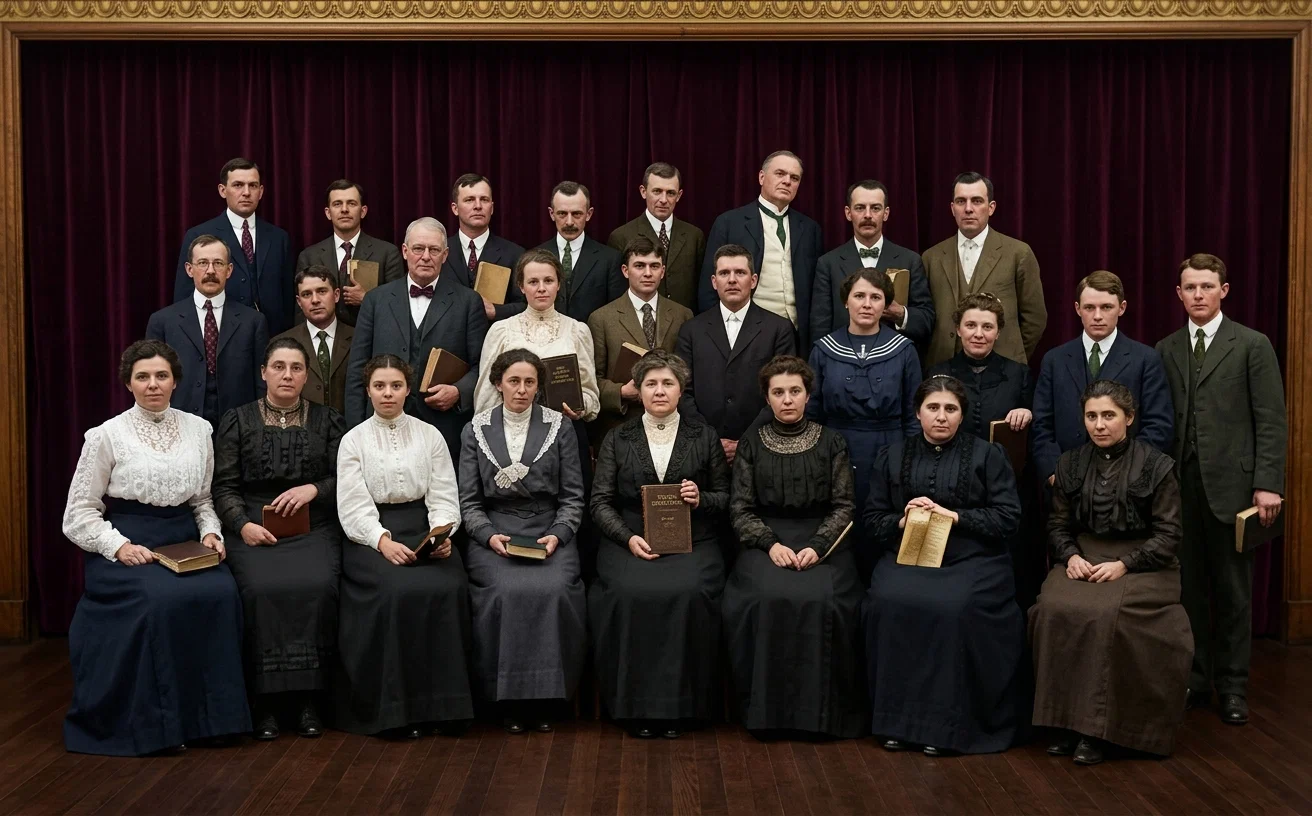
THE canvassing work in the Eastern Pennsylvania Conference is onward. Our president, Elder W. H. Heckman, is giving this department his hearty support. His practical talks given at the institute held in Reading from February 20 to 29 gave prestige to our work and courage to the workers. The efficient help of Elders I. G. Bigelow and R. E. Harter and Brother A. J. S. Bourdeau contributed much to the success of the institute, and to the spiritual uplift of the Reading church. As a result of the evening meetings and the personal work of the canvassers, some have already accepted the truth, and request baptism.
EASTERN PENNSYLVANIA CANVASSERS' INSTITUTE, READING, PA., FEB. 20-29, 1912
There were in attendance at the institute twenty-three promising workers. These all intend to devote considerable time to the sale of our literature. Seventeen signed contracts to begin work within a few weeks: one with “Heralds of the Morning,” two with “Practical Guide to Health,” four with “Daniel and the Revelation,” five with “Coming King,” and five with “Great Controversy.” A cut of these workers accompanies this article.
I praise God for this band of self-supporting missionaries. Their faithfulness will mean much to the unwarned people of Pennsylvania. The work of the canvasser-evangelist is fraught with wonderful possibilities for good. In a special sense he fulfils the commission: “Go out into the highways and hedges, and compel them to come in.” Only those who are connected with God and who feel a burden for souls can be truly successful. To such, divine aid is promised.
As the canvasser meets the people, he finds that the Lord has prepared their hearts. “Behold,” says Jesus, “I stand at the door and knock.” Then as the worker sits by his customer showing the wonderful truths of his book, the Divine Canvasser pleads with that soul, saying: “I counsel thee to buy of me gold tried in the fire, that thou mayest be rich; and white raiment, that thou mayest be clothed; . . . and anoint thine eyes with eye-salve, that thou mayest see.” Thousands have already been made truly rich through the influence of our literature. Many who read this article can testify to the blessings brought to them by the canvasser. The books they purchased contained the “eye-salve” which opened to their understanding the beauties of the “everlasting gospel.” Millions of others are still in darkness. “Pray ye therefore the Lord of the harvest, that he will send forth laborers into his harvest.”
J. H. McEACHERN.
The Florida Sanitarium
By R. W. Parmele
THREE years ago last fall, on the fifteenth day of October, the Florida Sanitarium at Orlando formally opened for the reception of patients. From the first, the blessing of God has attended the work of the institution, and the wisdom of the move has been evident. The first year it lacked about $500 of earning its running expenses, the second year it made a gain of about $100, the third year showed a gain of about $1,300, and the present year bids fair to do as well.
The influence for good that the institution has exerted can not be estimated. Quite a number have accepted the truth as a result of their stay at the sanitarium, and an influence in favor of our work and message has gone out to all parts of the State. One noticeable feature in our work is the length of stay of those who come as patients. Some patients are in the institution now who have been there for a year or more, and a number of them are spending their second winter with us. This gives an opportunity for them to become fully informed on the principles of the message, and is a great advantage. At the present time the institution is filled to overflowing, and a good spirit prevails. Bible studies are held in the morning and in the evening, in which many of the patients take an active part. A nurses' training-school is conducted; and although the classes are small, there being only ten persons in training, good work is being done. The institution has an exceptionally loyal and faithful corps of helpers.
During the past summer two thousand dollars was donated to us by the business men of Orlando toward the erection of a new main building, which is greatly needed. The building is now in process of erection, but the work is progressing very slowly on account of lack of funds. We have never received any funds from outside the Florida Conference, and our constituency being so small, the sanitarium enterprise is a heavy load for us.
We now have about fifty acres of land, one building containing nine patient's rooms, parlor, medical office, operating-room17treatment-rooms, kitchen, and dining-room; we have seven small wooden cottages, and two cement-block cottages. There are two lakes on the premises, one of which furnishes an abundance of good water for all purposes, and the other is used for boating, bathing, etc. We have cows, horses, farm utensils, and an automobile. Altogether, the assets amount to about $25,000, with a net present worth of approximately $10,000. If this institution could be freed from interest-bearing debts, it would soon become a source of financial strength to the cause of present truth in this field.
Roused by reports of our success, a stock company of the most prominent and wealthy business men in Orlando, headed by the county physician, who is also the president of the County Medical Society, started a sanitarium in the city of Orlando, and have attempted to imitate our methods of treatment. They have named their institution the Orlando Sanitarium. So all mail addressed to the Orlando Sanitarium is delivered to them. Our brethren frequently address our institution in this way, but we wish to call especial attention to the fact that the Seventh-day Adventist sanitarium in Florida bears, and always has borne, the name of the Florida Sanitarium. We would appreciate it if all would make a note of this fact, and help us in correcting the mistake.
Several years ago, in writing of the Florida Sanitarium, Sister White said that she hoped it would “become an important center of influence, from which many well-trained medical missionaries will go forth to the unworked parts of the Master's great harvest-field.” Under the blessing of God, we believe this hope will be realized. But in order that it shall, we need the hearty cooperation of our brethren throughout the entire field, and we solicit the interest of our people in the North as well as in the South.