Your ShelfYour Projects

Review and Herald, Vol. 89, No. 15.

God’s Mercy

Review and Herald

Apr 11, 1912

Review and Herald Publishing Association · Takoma Park Station, Washington, D. C. · Apr 11, 1912

God’s Mercy

SWEET is Thy mercy, Lord; Before Thy mercy-seat My soul, adoring, pleads Thy word, And owns Thy mercy sweet.
My need and Thy desires Are all in Christ complete; Thou hast the justice truth requires, And I Thy mercy sweet.
Light Thou my weary way, Lead Thou my wandering feet, That while I stay on earth I may Still find Thy mercy sweet.
Thus shall the heavenly host Hear all my songs repeat To Father, Son, and Holy Ghost; My joy, Thy mercy sweet.
— John S. B. Monsell.

“Rome and Marriage” and “Catholic Prisons” Number

An Arsenal of Information

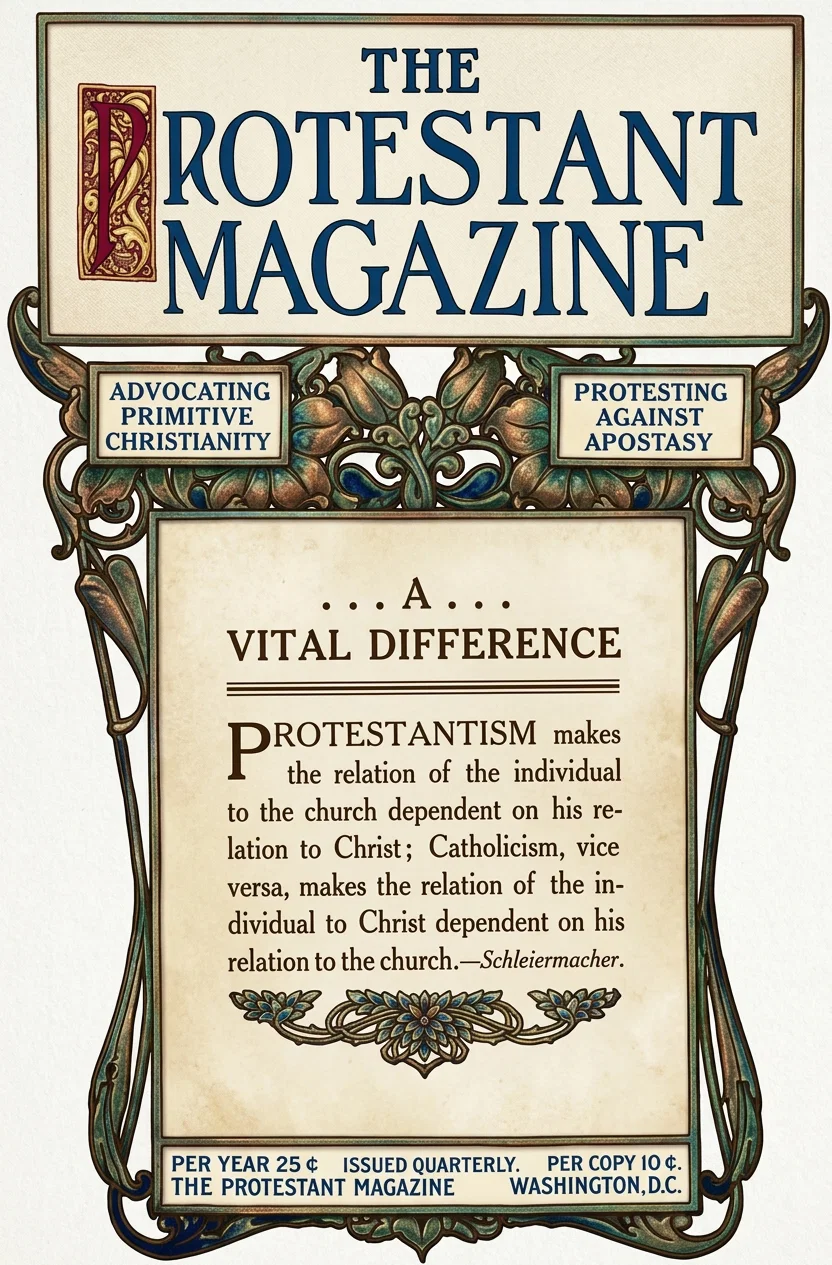
Recent despatches and interviews published in the leading American dailies, show that Rome’s eye is upon the “Protestant Magazine.” She fears our fearless yet dignified propaganda.
A letter from Rome to the New York “Sun,” July 11, 1892, reveals the plan of the Papacy for America: “What the church has done in the past for others SHE WILL NOW DO FOR THE UNITED STATES.”

PARTIAL CONTENTS

Double Frontispiece — Photograph of Holy Cross Church Baptism Certificate (Perth Amboy, N. J.), Showing Rome’s Insult to American Marriage Laws. Protestantism and Catholicism (cover). A Girl’s Escape From a “House of the Good Shepherd.” Rome and Marriage Laws. The Mediation of Christ. Reply to Attack by “Catholic Truth Society” Upon This Magazine. Cardinal O’Connell Above Governor Foss? Chillingworth’s Famous Statement. The Privilege of Peter. The Pope’s Decree Forbidding Catholics to Sue Criminal Priests. “Another God Upon Earth.” Rome Capturing America. Is America to Become Catholic? Protestantism in the Sixteenth Century, and — Other timely articles, news notes, etc.

SPECIAL OFFER ON TEN, ONE YEAR

Ten copies, one year, to one address, or to 10 separate addresses, only $1.50, or 15 cents each. Sender may include his own name as one of the ten. This number should be placed in the hands of every editor, attorney, clergyman, city and county official, and public-school teacher in your county. We can furnish the names and addresses.

Order Through Your Tract Society

If you do not know your Tract Society address, send to “The Protestant,” Washington, D. C.
Cover Design in Two Colors

A GOOD PROPOSITION FOR AGENTS!

PRICES: 25 cents a year, 10 cents a copy; 5 to 40 copies, 5 cents each; 50 or more copies, 4 cents each. Send 10 cents for sample copy. Better still, send $1.00 for 20, or $2.00 for 50. Discount to agents on yearly subscriptions.
A few of the following bound volumes are for sale: Vols. I and II (1909-10), in one, cloth covers only, each, $1.75; Vol. II (1910), paper covers only, each, 50 cents; Vol. III (1911), cloth, 90 cents, paper, 50 cents. All post-paid.

THE MAY NUMBER OF LIFE & HEALTH NOW READY!

“California’s Big Trees” Cover, in Three Colors

Sixty-Seven Articles

Over 40 Illustrations

An intensely practical as well as a beautiful and instructive number. Its articles are VITAL TO HEALTH!
Questions and Answers.—In this new and popular department the editor replies to questions asked by subscribers. SUBSCRIBE NOW. Send $3.00 for 5 years; $2.00 for 3 years; or $1.00 for one year.

PARTIAL CONTENTS

Frontispiece, Avalon, Santa Catalina Island, California.
God’s Great Out-of-Doors, by George Wharton James.
Bournville, the Garden Village, by G. H. Heald, M. D.
How to Escape the “White Plague,” by A. B. Olsen, M. D.
Keeping Young in Looks, by William J. Cromic.
Faulty Foot-Wear, X-ray photographs of normal and of deformed foot.
Nuts and Nut Foods, by George E. Cornforth.
Typhus and Typhoid.
“Prohibition Does Not Prohibit.”
Questions and Answers.—Sour-Milk Tablets—Yeasts and Ulcers—Exercise for the Voice—Cold-Sores—Water Test—Flies and Typhoid—Tuberculosis, Human and Bovine—Ivy-Poisoning—Pimples—Hookworm Treatment—Greasy, Falling Hair.
Current Comment.—“Personal Liberty”—Contaminated Oysters—Overeating Menaces the Race—Smallpox and Vaccination, etc.
The Saloon and Insanity.
Treatment of Simple Catarrh.
Diseases in Public Roller-Towels.
Leprosy in New York, and many other articles.
Single bound volumes for 1908, 1909, 1910, and 1911, half leather covers only, Each, post-paid........$1.75

Send All Orders Through Your Tract Society

If you don’t know your Tract Society address, ask “Life and Health,” Washington, D. C.
Cover Design Printed in Three Colors

EARN YOUR OWN SUBSCRIPTION

By sending us two new subscriptions at $1.00 each, you may earn your own yearly subscription.
Send $2.00 for 50 copies; sell 20 to get your money back; then sell or give away the other 30 copies in the interests of true health reform.

PRICES

$1.00 a year, 10 cents a copy; 5 to 40 copies, 5 cents each; 50 or more copies, 4 cents each.

The Need of Missionary Effort

MRS. E. G. WHITE
With every age God's plan deepens and widens to embrace the world. God's instrumentalities, his light-bearers, are to adjust their movements to his progressive plans. They are to embrace new territory. The churches are to be wide-awake, moving with the force of Omnipotence because they move in harmony with God's purpose. A spirit of greater devotion must be shown by the churches.
They must labor with greater zeal for the promulgation of the last message to be given to the world. They are to seize every opportunity for blessing a world in darkness.
Missions at home and missions abroad demand far greater consideration than has been given them. While the church, in comparison with the past years, has made some advance, yet in comparison with what she should be, in comparison with the great sacrifice made in Gethsemane and on the cross of Calvary, she is far behind in the greatest work ever given to mortals.
Christ came to our world to teach us the importance of missionary effort. The world was his field of missionary toil. He came from heaven to take his position at the head of a fallen race. Humanity and divinity united in order that all might be done that was essential for the complete recovery of sinners. The reproach of indolence will never be wiped away from the church till every one who believes the truth is willing to labor as did the self-sacrificing Redeemer.
Christ's work is an example to all who go forth as missionaries. It is the model for all missionary endeavor. It calls for unreserved surrender, for the consecration of time and talents. It demands that we return to God the goods he has entrusted to us, with the interest that has come to us as we have traded upon them. All is to be put into the cause to advance the work Christ came into this world to do.
It is impossible for the man who believes in Christ to see the work that needs to be done, and yet do nothing. Daily we are to receive from heaven the healing balm of God's grace to impart to the needy and suffering. Christ's followers are to learn of the woes of the poor in their immediate vicinity, and seek to bring them relief. Those who have a dark and disagreeable life are the very ones whom we should bid to hope because Christ is their Saviour. Are there not those who can go from house to house, from family to family, and repeat the A B C of true Christian experience?
Let Christ be your text. In all your labor, let it appear that you know Jesus. Present his purity and saving grace, so that those for whom you labor may, by beholding, be changed into the divine image. The chain that is let down from the throne of God is long enough to reach to the lowest depths of sin. Hold up a sin-pardoning Saviour before the lost and lonely, for Jesus has made divine intercession in their behalf. He is able to lift them from the pit of sin, that they may be acknowledged as the children of God, heirs with Christ to an immortal inheritance. They may have the life that measures with the life of God.
If all would work in Christ's lines, much would be done to change the conditions that now exist among the poor and distressed. Pure and undefiled religion would shine forth as a bright light. It would induce its advocates to go forth into the highways and byways of life. It would lead them to help the suffering near by, and enable them to go forth into the wilderness to seek and to save the lost.
We need men who will become leaders in home and foreign missionary enterprises,—men whose sympathies are not congealed, but whose hearts go out to the perishing. The ice that surrounds souls needs to be melted, that every believer may realize that he is his brother's keeper. Then men and women will go forth to help their neighbors see the truth and serve God with acceptable service.
In helplessness and disappointment men and women are fighting the battles of life, and the Lord designs that as his sons and daughters we shall help one another. This is to be a part of our Christian experience. Who is your neighbor?—The one who most needs your help. Your brother, sick in spirit, needs the experience of one who has been as weak as himself, one who can sympathize with him and help him. Let it not be that the sympathetic chords, which should be quick to vibrate at the least touch, shall be unresponsive.
O, what treasures of wisdom are to be opened up for the view of the world! Every divine resource is placed at the disposal of man in order that he may become a colaborer with God. Nothing has been withheld. When God gave his only begotten Son to our world, he gave all the treasures of heaven. What power.what glory, was revealed in the life of Christ! In his name I ask, Why is it that with his power at their command, God's people do not awake to their duty? Why do they not do the work that the time demands, first giving themselves and then their talents of means and ability for the enlightenment and salvation of those who are in darkness?
The work is fast closing, and on every side wickedness is increasing. We have but a short time in which to labor. God is not willing that any should perish. He has provided abundant means for the salvation of all who accept him. The Lord pities that part of his vineyard which has not been worked. His heart of mercy is filled with compassion for the thousands who are in ignorance of the truth. He is sparing the world, that increased light may come to it. Why do not those to whom God has committed great light move out into new places? They will have to do this, whether they wish to or not; for God will scatter them into many places. If God's people had gone forth as they should, giving the invitation to others, many souls would have been added to the church.
The world is looking on with gratification at the disunion among Christians. Infidelity is well pleased. God calls for a change among his people. Agents of mercy are needed, not merely in a few places, but throughout the world. Men and women in this field should be preparing for service in distant lands. From every country is heard the cry, Come over and help us! Rich and poor are calling for light. Money and workers are needed.
We need to humble ourselves before God because so few of the members of his church are putting forth efforts that in any wise compare with the efforts that the Lord desires them to put forth. The privileges he has given them, the promises he has made, the advantages he has bestowed, should inspire them with far greater zeal and devotion.
We need the vitalizing power of his Spirit,—the strong cry of a church traveling to bring forth souls. There is need of more earnest wrestling with God for the impartation of his Holy Spirit. Eager, earnest, importunate prayer is needed. There is efficiency in prayer. In answer to fervent prayer, God can turn the thoughts and hearts of men as he turns the water of the sea.
God forbid that our churches and institutions shall be content to leave untouched the fields still unworked. The Saviour is saying to us, “All power is given unto me in heaven and in earth. Go ye therefore, and teach all nations, baptizing them in the name of the Father, and of the Son, and of the Holy Ghost: teaching them to observe all things whatsoever I have commanded you: and, lo, I am with you alway, even unto the end of the world.” We are to teach them,—not merely to preach a discourse now and then, but teach them how to find the way to heaven.
In every age, but never so much as now, this has been the work of church. Dare any one withhold a jot of the influence that should be exerted for the recovery of the souls that are out of Christ? Dare we work out our ambitious projects and satisfy our selfish desires, and then bring to God's altar the fraction that remains of our time and our means? Think you that God will accept such an offering?

A Prayer

MRS. L. R. REYNOLDS
LORD, make my mind broad as thy world is wide, And untrammeled by human creeds; Then give me a heart that is willing and kind, To feel humanity’s needs.
Lord, make me as stanch and as firm as the hills, To stand for the right against wrong; Then give me a heart that is gentle and meek, As I journey life’s pathway along.
Lord, make me as brave as the martyr who dares For conscience to yield up his life; Then make me as swift as a bird on the wing, To flee from all envy and strife.
Lord, make me unswerving and true as the sun When it shines in the power of its might; Then make me as peaceful and calm as the moon When it glides through the heavens at night.
And when I am firm, and brave, and true, There’s a purpose that reaches out still; Then give me a heart consecrated to thee, And glad to perform all thy will.
Wichita, Kans.

The Nature of Man and the Fate of the Ungodly

MRS. M. E. STEWARD
“What is man, that Thou art mindful of him? and the son of man, that thou visitest him?” Ps. 8:4.

HAS man natural immortality?—

1. “Dust thou art, and unto dust shalt thou return.” Gen. 3:19.
2. “In the day thou eatest thereof, thou shalt surely die [“dying thou shalt die,” margin].” Gen. 2:17. It is a fact that the moment one begins to live, he begins to die; his every motion causes death of particles in his tissues.
3. Man is to “seek for . . . immortality.” No sane person seeks for anything which he already possesses. Those who “by patient continuance in well-doing seek for glory and honor and immortality” will have “eternal life.” Rom. 2:7. Consequently, none have it naturally.

Man's condition in death:—

1. “His breath goeth forth, he returneth to his earth; in that very day his thoughts perish.” Ps. 146:4.
2. “The dead know not anything, . . . their love, and their hatred, and their envy, is now perished.” Eccl. 9:4-6. What is a mind deprived of thoughts, reason, and all the emotions?
3. Without a resurrection, the dead “are perished.” 1 Cor. 15:13-18. By the power of God alone man lives again. Eze. 37:5-10.

Destiny of the wicked:—

1. They shall be punished with “everlasting destruction.” 2 Thess. 1:9.
2. They shall “be as though they had not been.” Obadiah 16.
3. The ungodly will be consumed in “the lake of fire.” Rev. 20:15.

The wicked recompensed in the earth:—

1. The lake of fire is this world being “melted with fervent heat.” 2 Peter 3:10. “The righteous shall be recompensed in the earth: much more the wicked and the sinner.” Prov. 11:31. God's people are with him in heaven during the thousand years; but the wicked never leave the earth. “Yet a little while, and the wicked shall not be: yea, thou shalt diligently consider his place, and it shall not be.” Ps. 37:10. The last place of the wicked is in the lake of fire. By the hand of the wonderful Creator, the lake of fire becomes the new earth. “Behold, I make all things new.” Rev. 21:5. Those who are cast into the lake of fire are tormented day and night. When the new earth appears, “there shall be no night there.” Rev. 22:5. Hence the wicked cease to exist before the earth is created anew.
2. During the thousand years the wicked are judged from records that angels have kept of their lives, in the books of heaven. Revelation 20. It is at this time that, as Paul foretold, “the saints shall judge the world.” 1 Cor. 6:2. In union with Christ they compare the acts of the wicked with the statute-book, the Bible, and decide all cases “according to their works.” Rev. 20:13. The book of life is also consulted: “And whosoever was not found written in the book of life was cast into the lake of fire.” “Death and hell [Hades, grave] were cast into the lake of fire.” “This is the second death,” not the one inherited from Adam. From the second death there will be no resurrection, which is represented by the grave being cast into the lake of fire. Here, then, will be the eternal end of sinners. Sin will be no more; God's entire universe will henceforth be holy. Every living being will be in perfect harmony with the law of God, so that Christ will rule over free subjects, all walking at liberty, while the Lord will be “all and in all.”
3. “Behold, now is the accepted time; behold, now is the day of salvation.” Dear sinner, hear the pleadings of infinite love: “Why will ye die? . . . I have no pleasure in the death of him that dieth, saith the Lord: wherefore turn yourselves, and live ye.”
Sanitarium, Cal.

In the Light of Jewish Customs

F. C. GILBERT
It is very clear from the Scripture that the apostle Paul introduced among the Gentile Christians a number of customs that had been in vogue among the Jews, to illustrate certain truths of the gospel of Christ. Some of these customs were introduced for the carrying forward of the work of God, since they were so strongly established among the Jewish people, and since there was much in them which God knew could be utilized for the advancement of his work.
Several centuries before the advent of Christ, there arose among the Jews the custom of providing for the needy poor at Jerusalem. It came about something as follows: When the Jews entered the seventy years’ captivity in Babylon, many of them were scattered in different parts of that great empire. When the time came that the Lord desired the children of Jacob to return to their own land, he so overruled that the kings of Media and Persia issued a decree to facilitate their return, and did all they could to assist the Jews in restoring their worship at Jerusalem.
But from the Bible record we know that all the Jews who went into captivity did not go home to their own land. We find thousands returning to Palestine at the time of the command of Cyrus, king of Persia, and this was equally true when Darius and Artaxerxes issued their decrees.But many thousands of Jews still remained in the countries whither they had been scattered. This is evident from reading the books of Esther, Jeremiah, Zechariah, and Haggai. It is made clearer still by a reading of the second chapter of Acts, the first eleven verses.
During the several centuries before the advent of Christ, hundreds of thousands of Jews flocked to Jerusalem, and the holy city contained more Jews than it could well support. Frequently there were insurrections, pillages, and other causes of devastation, until thousands of the Jews of the land became poor, and were greatly in need of assistance.
Then, again, many thousands of Jews would make pilgrimages to the city, and not infrequently large numbers of these would remain in Jerusalem. This, too, naturally added to the poverty of the people, until there were large numbers of the children of Abraham who were destitute. Several times a year thousands of Jews from these other lands would come to Jerusalem to worship before the Lord. Many of these tourists were wealthy, having established large business interests in these Eastern lands. When they came into the holy land, and saw the poverty of many of their brethren in the flesh, they realized that something ought to be done in order to assist them in their need.
So there was instituted a systematic method of helping these poor Jews in Jerusalem. The Jewish brethren in the foreign lands decided that they would set aside a certain amount of money each week for these poor Jewish brethren, and then when some of the merchants would go to Jerusalem on business, or when some of the people would go to the city to worship, or when some of the proper persons would come from Jerusalem to visit their brethren in these different lands, this money was sent to their poor Jewish brethren in Jerusalem.
At the time of the advent of Christ, this had become an established custom, and in this way thousands of the poor Jews were greatly helped during their poverty and their distress. The rabbis had taken up the matter, and had systematized it in such a way that the Jews in all the lands well understood the method which had been adopted to assist the poor Jewish brethren. During the year, the rabbis would send duly constituted authorities to collect this money, and these funds were known as the money for the poor Jews at Jerusalem. After Christ had come and had declared his gospel to men, a bitter prejudice arose among many of the Jews in Jerusalem, as well as out of it, against all who accepted the teachings of the Nazarene. In fact, the time had come when any person who would accept the Saviour was anathematized, and cast out of the synagogue. To the Jew this meant social ostracism; but those having means of their own were not seriously affected by it from a financial standpoint. However, to the Jew who was poor, especially to the one who was dependent upon the gifts of his Jewish brethren, this worked a great hardship, for we know that the Saviour preached the gospel to the poor, and there were many of his followers from among this class of people. But Jesus never left those who trusted in him.
He had made provision for the poor, and told his followers that they had the poor with them always, and they could help as they desired. But we read that there came a famine in Jerusalem. It was predicted by the prophet Agabus. The apostle Paul, knowing the custom which was in vogue among the Jews to help their poor Jewish brethren, suggested, through the influence of the Holy Spirit, that this plan be carried out to help the poor brethren in Christ at Jerusalem. Therefore we read: “Upon the first day of the week let each one of you lay by him in store, as he may prosper, that no collections be made when I come. And when I arrive, whosoever ye shall approve, them will I send with letters to carry your bounty unto Jerusalem.” I Cor. 16: 2, 3. So it became part of the gospel plan that every person should lay by himself at home every First-day morning a certain amount of money, according to the manner which God had prospered him during the previous week. If he had been blessed of God abundantly, then when he considered his financial standing on the First-day morning, prior to the beginning of his labors for that week, he should deal with the poor Jewish brethren as God dealt with him. If he had been prospered much, then he should impart much.
I well remember, when at home in the early years of my life, how my father followed this custom regularly and methodically, for the same plan is still followed by some orthodox Jews the world over, to support the poor Jews at Jerusalem. Many a time have I seen my father early Sunday morning take account of the amount of business he had done during the previous week, and then he would take some of his money and deposit it in a tin box. This box had an opening in the top of it, and upon the face of it was placed a label written in Hebrew and reading thus: “Alms for the Poor Jews at Jerusalem.” When friends call at the house who do not live in thickly settled Jewish communities, they are invited to share the blessings of giving to their poor brethren. But the regular, pious, orthodox Jews attend to this matter most generally as the first item of business after they have conducted their worship on the morning of the first day of the week.
Periodically the Jews send a certain delegated individual who bears the credentials of the synagogue or council having this matter in charge, and the matter is attended to by him. He takes this money with him, leaves a receipt for the same, if the person desires it; if not, he goes on his way, and the money is sent to the poor Jews at Jerusalem.
Thus we can see how the apostle Paul introduced this custom in the early Christian church, that the poor brethren in Christ might be assisted; and that, not as something newly thought of, but merely as an adaptation to the work of the Christian church of a Jewish custom of long standing. In the light of this fact, it can readily be seen that there is absolutely no foundation in this scripture for the idea that the first day of the week had taken the place of the Sabbath of Jehovah, and that the people were, through this instruction, to take up collections in churches on that day. It rather taught the members of the early Christian church what was to be their first item of business on the first working-day of the week.
South Lancaster, Mass.

Be Strong

L. N. MUCK
The life we live is far from reaching that high standard of Christian perfection exemplified in the life of our Saviour. It is impossible for us in our own strength to reach the ideal set before us by our Master; but by taking Christ as our example, our friend and elder brother, we shall be able to put away everything that hampers the Christian growth.
Ask what you will, and it shall be done unto you. The asking must be done in faith. Man is as the grass of the field; it may flourish in the sunlight of to-day, and to-morrow wither and die; so with the most beautiful and fragrant flowers. The life of each human being is just as uncertain as that of the grass or flowers. The individual has no life of himself. We live, move, and have our existence because the Lord is long-suffering. He has not cut us off in our sins, but he has made it possible for us to make our calling and election sure. Notwithstanding the fact that we are creatures of uncertainty, we have an anchor for the soul that is sure and steadfast. No matter how high the billows may roll, no matter how dark the clouds may seem, no matter how fiercely the storm may rage, our anchor holds. “Trust ye in the Lord forever: for in the Lord Jehovah is everlasting strength.” Isa. 26:4. To trust Jehovah means that we shall build on the Rock, and with Christ for our rock foundation, we shall withstand the fiercest storms of life.
“Come unto me,” says Jesus, “and I will give you rest.” Blessed promise! There is no rest for the soul separated from righteousness. There is no rest for the sinner separated from Christ, for he is like the billows of the sea. There is rest for the weary. There is life everlasting for every one who will seek refuge in Christ.
Be strong, not in yourselves, but in God. “If ye abide in me, and my words abide in you, ye shall ask what ye will, and it shall be done unto you.” John 15:7. To abide in Christ and to have his words abide in us means that we shall bend our will to his blessed will, and that we shall give our assent to everything that is good and pure. “Through the right exercise of the will, an entire change may be made in yourlife. By yielding up your will to Christ, you ally yourself with the power that is above all principalities and powers. You will have strength from above to hold you steadfast, and thus through constant surrender to God you will be enabled to live the new life, even the life of faith.”
Unless we study the Word of God, we can not know its meaning. “Study to show thyself approved unto God, a workman that needeth not to be ashamed, rightly dividing the word of truth.” 2 Tim. 2:15. To know God means that we shall trust him, and we can not trust him unless we first learn to love and obey him.
Prayer is the avenue through which we can approach God. He invites us to come boldly to the throne of grace. We can do this only through prayer. Only those who have had their sins purged will be able to trust in him and look up to him in that day when the opening heavens shall reveal the Saviour of the world. Learn to trust God now while the sea of life is calm. If we fail to make our anchor sure now, it will not hold when the billows are high.
We need to be concerned about our souls. It is important that we know for a certainty that our sins have been forgiven. If we have been redeemed and can stand before the world testifying to the power of the gospel, our hearts will not be troubled. If the Lord is our shepherd, we shall not be afraid at his coming, because we shall know his voice and he will know his sheep.
If led by this Shepherd, though we walk in darkness and through the valley of the shadow of death, we need fear no evil, because the Lord is by our side to quiet all fears and to calm the storm. Let us then ask the Saviour to lead us all the way.
Are you ready to meet the Lord when he comes? Is your heart beating in anticipation of the pleasures which you will be permitted to enjoy in those heavenly mansions? If so, let us say with the revelator, “Even so, come, Lord Jesus;” but if not, let us flee to Christ where there is full forgiveness.
College View, Nebr.

The Triumphant Life

ALLEN WALKER
DURING the closing days of the apostle Paul’s life, he could look back over the hardships and trials through which he had passed, and could say: “I have fought a good fight, I have finished my course, I have kept the faith: henceforth there is laid up for me a crown of righteousness, which the Lord, the righteous judge, shall give me at that day: and not to me only, but unto all them also that love his appearing.” 2 Tim. 4:7, 8. His was the triumphant life. And only those who can say, as did the apostle, “I have fought a good fight,” “I have kept the faith,” will be entitled to the “crown of righteousness.” By following the instruction given us in God’s Word, it is possible for every child of God to live the same triumphant life that the apostle Paul lived.
In 1 Cor. 11:1 we find the secret of his successful Christian career: “Be ye followers of me, even as I also am of Christ.” Paul followed Christ. His life was copied after the divine Pattern left us by our Saviour. Herein lay his success, and the success of all who have lived and are living a life worthy of the crown of righteousness. “He that saith he abideth in him ought himself also to walk, even as he walked.” 1 John 2:6. This is what Paul did, and those whose Christian lives are not in harmony with this instruction have yet to “come up higher” in order to be included among those who enter the pearly gates.
By abiding in Christ it is possible for every child of God to “walk, even as he walked.” Christ bids us follow him. He says: “If any man will come after me, let him deny himself, and take up his cross daily, and follow me.” Luke 9:23. If we are not doing this, we are living below our possibilities. It is possible for us to follow Christ and walk even as he walked, through the strength which he imparts to us. We know it is possible because the Saviour would not ask us to do something which it is impossible to do. And we know it is possible because Paul tells us that he followed Christ. We should ever bear in mind that when the Saviour began his life here, which was to be our example, he partook of our nature, and was in all points tempted as we are, “Forasmuch then as the children [we] are partakers of flesh and blood, he also himself likewise took part of the same.” Heb. 2:14. Had he not done this, his life would not have been a perfect example for us; because it would have required us to do something in our fleshy nature which he did in his divine nature. But the Captain of our salvation did not do this. “For verily he took not on him the nature of angels; but he took on him the seed of Abraham.” Thus his nature was no stronger to resist temptation than is ours. He said, “I can of mine own self do nothing.” And yet it can be said of him that he “did no sin, neither was guile found in his mouth.” 1 Peter 2:22. And he “was in all points tempted like as we are, yet without sin.” Heb. 4:15.
Now the question is, Can we live the same triumphant life which the Saviour lived? Can we live this same perfect example of “holiness, without which no man shall see the Lord”? In answer to these important questions, we are assured that, in the strength of God, we can. In “Desire of Ages,” page 25, we find these words: “Therefore Jesus was ‘in all points tempted like as we are.’ He endured every trial to which we are subject. And he exercised in his behalf no power that is not freely offered to us. As man, he met temptation, and overcame in the strength given him of God.” How full of courage are these words! What wonderful possibilities are ours! Surely the eternal God is our refuge, and “underneath are the everlasting arms.” Jesus says, “Without me ye can do nothing.” As he depended upon his Father for strength to meet temptation, even so must we depend upon Jesus every moment for strength to enable us to conquer Satan. We must “let this mind be in” us “which was also in Christ Jesus”; and we must “let Christ dwell in our hearts richly by faith.” Then when Satan comes with his temptations, no matter how severe, he will find Christ in our heart, who is the “same yesterday, and to-day, and forever,” who has never yielded to a single temptation, and who is as strong to resist temptation to-day as when he was so strongly assailed by the enemy in the wilderness. It will be impossible for him to cause us to yield, because “greater is he that is in you, than he that is in the world.”
Let us grasp with all our heart the fact that it is impossible for Satan to cause us to yield to a single temptation without our consent; for the Scripture says: “There hath no temptation taken you but such as is common to man: but God is faithful, who will not suffer you to be tempted above that ye are able to bear; but will with the temptation also make a way to escape, that ye may be able to bear it.” 1 Cor. 10:13. How grateful we should be that it is possible for us, like Paul, to live after the example left us by our Saviour! And day by day as we live this life, how strong and far-reaching will be our influence for good! “Now unto him that is able to keep you from falling, and to present you faultless before the presence of his glory with exceeding joy, to the only wise God our Saviour, be glory and majesty, dominion and power, both now and ever. Amen.”
Orlando, Fla.

The Great Commandment

C. M. FRENCH
MANY quote Matt. 22: 37-39 with an air of considerable satisfaction, teaching that Christ, by giving these two commandments, intended to convey the idea that these two new commandments, as they term them, took the place of the entire law, and therefore the ten commandments were “done away.” But waiving the point that this does away with the law too soon, for these same ones say that the law was “done away at the cross,” we are at a loss to know how we are to love the Lord our God with all the soul and with all the mind if we do not keep the first four commandments, in fact, the whole law; and how we can prove that we love our neighbor as ourselves if we do not keep the last six of the ten.
Verse 40 explains the matter perfectly: “On these two commandments hang all the law and the prophets.” Without the first four commandments we can not have the “first great commandment,” and without the last six we can not have “Thou shalt love thy neighbor as thyself.”
Alamosa, Colo.

Be Yourself

“To pose or pretend makes you a hypocrite. Be yourself even if you have only one leg.”
Continue reading: Editorial Correspondence