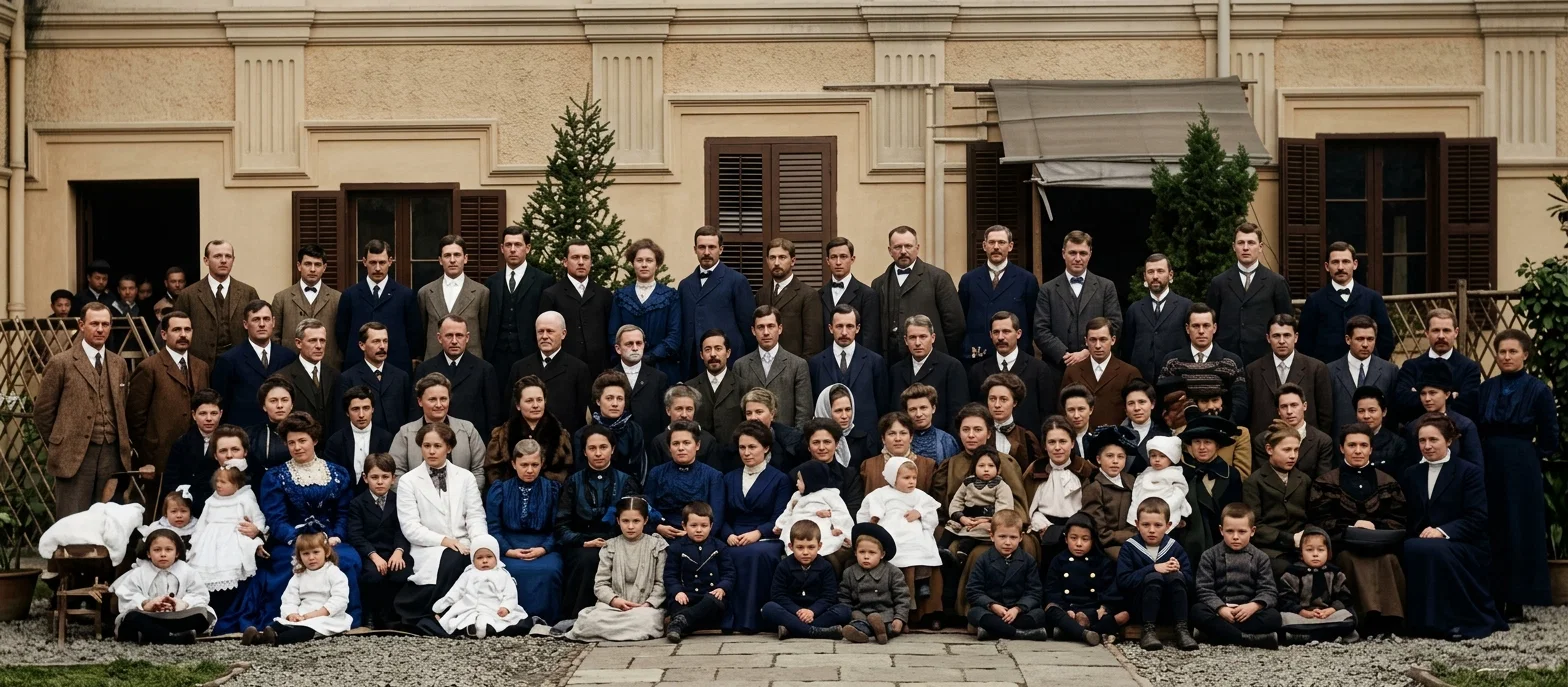
All but two of the foreign workers engaged in our denominational work in China, with their families, were present at the opening service of our general meeting, held in Shanghai from Jan. 25 to Feb. 10, 1912. In addition to the workers for China, there were present from other fields, Elder and Mrs. F. H. De Vinney, from Japan; Elder C. L. Butterfield, Dr. Riley Russell, and Brother H. A. Oberg, from Korea; Elder and Mrs. G. F. Jones, from Singapore; and Elder and Mrs. L. V. Finster, from the Philippines. The total number present, including the families of the workers, was eighty-nine.
From the very first, the workers took a deep interest in both the Bible studies and the devotional exercises. A full program was carried out, with a devotional meeting, two Bible studies, and a sermon each day. The rest of the time was devoted to business.
This has been the best meeting ever held for our workers in the East. All seemed anxious to get right with God and with one another. Often the Spirit of God was very manifest, and courage and renewed consecration came into the hearts of all.
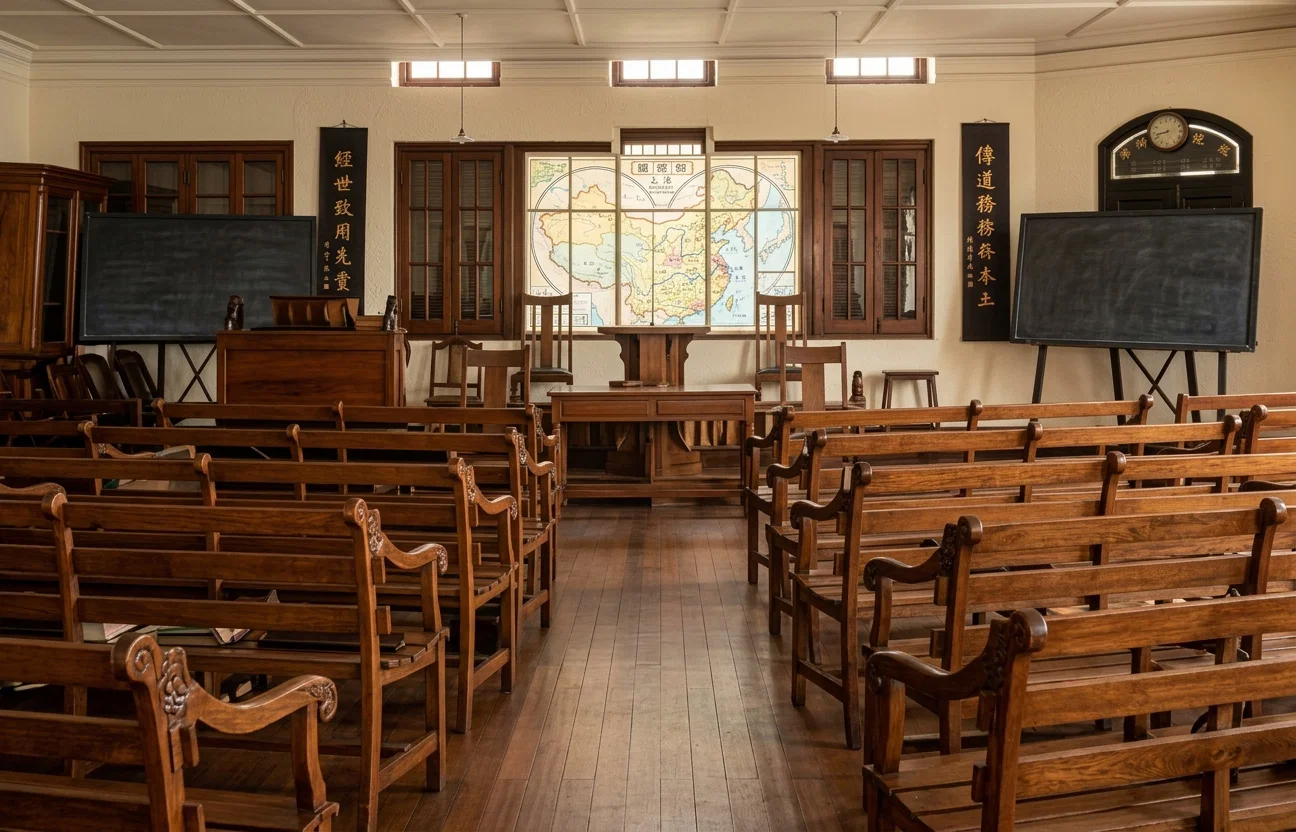
CHAPEL IN SHANGHAI, IN WHICH THE GENERAL MEETING WAS HELD
Most of our men are planning to return to their fields before the country is in a settled condition, trusting the Lord to protect them. It will not be possible, however, for all the women to leave the treaty ports at the present time. We are constantly hoping for peace, and each day's paper holds out promises that the future government in China will soon be settled, the country freed from its numerous bands of robbers, and quiet reign again in the land of Sinim.
It was voted at this gathering to hold a general meeting three years from this winter, 1914-15, which all foreign workers in the Asiatic Division may have the privilege of attending. It is hoped that the president of the General Conference and other laborers can be with us at that time. All feel that it will be a great uplift to the workers in the whole field to have the blessings of such a meeting.
Resolutions were adopted recommending the purchase of a site for our China Union Training School, during this coming year, and the erection of suitable buildings, provided peace is restored and the building operations can be proceeded with. It was further voted that the necessary buildings for the printing-plant for our work in China be erected at once. Several homes are also required to protect the lives of our workers, and it was voted that some of these be built this year.
During the entire meeting the weather in Shanghai was especially pleasant, a fact which contributed much to the comfort of our brethren from other places. The warm, well-lighted meeting-hall which we had been able to secure also added to the enjoyment of the meetings.
The superintendents of the mission fields in China reported concerning their respective fields. Our membership during the past year has increased in China about one hundred per cent. The tithes and offerings from our native brethren have about doubled. Openings were reported which seemed to indicate that the Lord has gone before the workers to prepare the people for the reception of the message. The superintendent of the South Central China Mission read letters received during the meeting from two different places in the province of Hunan where more than two hundred persons have attended our meetings. A very earnest call came from these people that a man might be sent to teach them the third angel's message. In one community, thirty-seven families signed a petition requesting that an evangelist be sent them, and offering to provide a place of worship and bear all the expense of the station, if we would only supply a worker. Surely these wonderful calls from this heathen land must indicate that God is preparing a people to receive this message. We seem paralyzed for the lack of workers. If there were only one hundred men where we now have one, each worker would be supplied with a field so vast that it would then seem overwhelming. In vain we tried to send one worker into a new province. Brother J. J. Westrup had been praying for months that he might be sent to Shan-tung, one of the most healthful and densely populated provinces in China; but when we came to locate our workers, it was impossible to open up a new station, because of lack of help12in fields already entered. It truly seems pitiful that in this last generation, when the King of glory is about to come, these poor heathen can not have the Word of God taught them by a living teacher; that the Macedonian cry is given in vain. One community pleaded earnestly for help, and offered the use of their village temple as a place where the Word of God could be taught. They broke the idols of their former worship, and pleaded that some one might come to them and teach them the Word of God. Trouble is now threatening these poor people because of this action on their part, and we have not a man to step in and instruct them. Is it not time that God's people everywhere earnestly pray that the Lord of the harvest will send forth reapers into his harvest?
WORKERS AND THEIR FAMILIES AT SHANGHAI GENERAL MEETING
Several meetings of the Asiatic Division Committee were held, and plans were laid and recommendations adopted for the unifying of our work in this division. Surely, when we think that in this generation more than six hundred million heathen are to be warned of the soon coming of our Lord and the close of probation, the work seems beyond the power of man to accomplish. In many of these great fields, there is not a worker, nor even a single believer in the last message. Some countries have not even been touched; and in many places where there are scores of millions of human beings, there has never been even one believer in the third angel's message. The lands of Siam, Tongking, French Indo-China, Cochin China, and Cambodia have never yet had a worker. Here are more than twenty million human beings perishing for the light and knowledge of the third angel's message. Siam seems especially ready for our work, as the country is very favorable to Christianity. Surely a great work remains to be done in searching out from these millions the honest-hearted. We all consecrated our lives anew at this meeting; and we believe that the future will see many souls brought to Christ.
Shanghai.
Almost Here
By L. D. Santee
L. D. SANTEE
LIFE’S glad morning is almost here;
Sweet is the news of the Saviour near.
Though shadows darken and round us fall,
Christ has been tempted, and knoweth all.
In redemption’s story we act a part;
And he takes us close to his pitying heart.
Pray, and that heart will hear your call,
And guarded by him, you will never fall.
Life’s fair morning is almost here,
And we’ll reach the end of the desert drear;
The pearly gates will their joys unfold,
And the children walk on the streets of gold.
Love’s sweet music will then be heard,
With the gladness of heaven each heart be stirred.
We’ll be taken away from earth’s toil and strife,
And will sweetly rest in the land of life.
Life’s fair morning is almost here;
Christ and the angels are drawing near,
Coming to take the children home,
Coming to say to the blessed, “Come.”
Hopes long cherished will then come true,
When Jesus the Saviour comes for you.
Then we’ll forget the lonely years,
The days of trouble, the nights of tears.
Life’s fair morning is almost here;
In the gold and crimson will Christ appear.
Dreams, long cherished bring endless joy,
Bliss eternal, without alloy.
Though he may tarry, the morn will break.
Carry your burdens for his dear sake;
Pray, and the Saviour will hear your call;
Guarded by him, you will never fall.
Moline, Ill.
The Panama Canal
By H. Louie Mignott
H. LOUIE MIGNOTT
“THE Canal Zone contains about 448 square miles. It begins at a point three marine miles from mean low-water mark in each ocean, and extends for five miles on each side of the center line of the route of the canal. It includes the group of islands in the Bay of Panama, named Perico, Naos, Culebra, and Flamenco. The cities of Panama and Colon are excluded from the Zone, but the United States has the right to enforce sanitary ordinances in those cities, and to maintain public order in them in case the republic of Panama should not be able, in the judgment of the United States, to do so.”
The digging of the Panama Canal is, indeed, one of the greatest and most stupendous undertakings attempted by modern men. When completed, it will stand at the head of twentieth-century accomplishments. It will be a greater feat than any that has been achieved by the ancients. The cutting through of the Suez Canal was a great undertaking; but the building of this great waterway, connecting the waters of the Pacific with those of the Atlantic, will be a greater work. The following gives us an idea of the dimensions of this great waterway and the passage of ships:—
“The entire length of the canal, from deep water in the Atlantic to deep water in the Pacific, is about fifty miles. Its length from shore-line to shore-line is about forty miles. In passing through it from the Atlantic to the Pacific, a vessel will enter the approach channel in Limon Bay, which will have a bottom width of five hundred feet, and extend to Gatun, a distance of about seven miles. At Gatun, it will enter a series of three locks in flight, and be lifted eighty-five feet to the level of Gatun Lake. It may steam at full speed through this lake, in a channel varying from one thousand to five hundred feet in width, for a distance of twenty-four miles, to Bas Obispo, where it will enter the Culebra Cut. It will pass through the cut, a distance of about nine miles, in a channel with a bottom width of three hundred feet, to Pedro Miguel. There it will enter a lock and be lowered thirty and a half feet to a small lake, at an elevation of fifty-four and two-thirds feet above the sea-level, and will pass through this for about one and one-half miles, to Miraflores. There it will enter two locks in series and be lowered to sea-level, passing out into the Pacific through a channel about eight and one-half miles in length, with a bottom width of five hundred feet.”—“Official Handbook,” page 5.
We hope to see the foregoing plans worked out. One can not fully understand the magnitude of the work unless one is able to be an eye-witness. The writer has had the privilege of walking through several miles of the canal, where some of the great wonders are performed in the matter of excavations and the construction of the locks. Nothing but master minds could have devised such things.
He has also visited several of their mechanical shops and gazed in wonder at the inventions there seen.
“Through the labor and quarters branch there have been brought to the Isthmus 43,432 laborers, of whom 17,797 came from Europe, 19,448 from Barbados, the balance from other islands in the West Indies, and from Colombia. No recruiting is required at present, the supply of laborers on the Isthmus being ample.”
The United States plans to have this great waterway opened in a short time. Then her ships of war will not need to go around Cape Horn in passing from one coast to the other, but they will be able to steam through the canal in a few hours' time.
For the completion of this canal, every available steam-shovel and steam-engine, and all the implements are kept at work.
There is a lesson in all this that we may learn. We have the greatest of all works, ancient or modern, to be accomplished in the earth at this time. The13digging of the Suez Canal was a great work; the digging of the Panama Canal is a greater work; but the giving of the great threefold message to all the world is the greatest of all works. Every available equipment should be at work in carrying forward God's message for to-day, and this “to make ready a people prepared for the Lord.”
After the finishing of the canal, those who have been engaged as laborers in its construction will have to seek employment elsewhere. But when this message of God shall have been finished, Jesus will come with his reward for every faithful worker, which means an inheritance in his eternal kingdom. So we need not be discouraged in the prosecution of our Master's work. In the digging of the canal there are many obstacles in the way; there are great mountains to cut through; yet with men and means, America is of good courage. She expects to succeed. She has no power on which to lean save her men and her money. But we have the mighty One of Israel on whom to lean hard; and all the stumbling-blocks and the mountains of difficulty before us shall be as nothing, for God leads the way. ‘Who art thou, O great mountain? Before Zerubbabel thou shalt become a plain.’ And how is that to be performed? ‘Not by might, nor by power, but by my Spirit, saith the Lord of hosts.’
The greatest mountain that looms up before us at present in this field is the lack of men to gather the harvest of souls. It can indeed be said of our field that ‘the harvest truly is plenteous, but the laborers are few.’
Empire, Canal Zone.
Canary Islands
By B. B. Aldrich
B. B. ALDRICH
BROTHER and Sister T. M. French arrived here February 22. Their visit was a blessing in many ways, and we enjoyed having them with us.
There is some beautiful scenery here. In the far distance are several large mountain peaks, with the snow-capped cone of Pico de Teyde (12,192 feet) towering in the sky, and near at hand every conceivable shade of green in the luxurious products of this garden of the islands.
A succession of shades and contrasts is presented to the eye of the admiring beholder from a near-by mountaintop. At our feet lies the ancient capital of the Canaries, La Laguna, with churches four and five centuries old, and old Spanish tile-roofed houses and narrow streets.
The climate grows more and more delightful as the rains become less frequent, and as the sun gradually approaches the northern limit. I found very little sickness. The climatic conditions for maintaining health are of the best.
From Spain I received about three hundred Spanish tracts, also some Spanish papers. I sold all of them in about three weeks, in La Laguna, Santa Cruz, and the country near by. I found one great man reading the King James Version of the Bible in Spanish. He wanted to learn. I shall visit him again and try to interest him further in Bible study. Some whom I have since seen distributing the tracts seem to be interested, and I am hoping they may study further.
The people in the country nearly all are illiterate. A large percentage of the population can neither read nor write.
Our landlord appears to be a very intelligent Cuban, and we earnestly hope that he may become sufficiently interested to study the Bible systematically with us. He is very kind to us. We pray that as we mingle with these people we may influence them for the truth.
I think the sale of health literature will be the best means to start the work here. The power of the priests is very strong; the people are ignorant and superstitious, and it is a great problem to know how to reach them with God's great truth for to-day. But he has promised to give us wisdom for the work. Remember us and the work here in prayer, that the Lord may enable us to lead some honest-hearted ones into the light.
La Laguna, Teneriffe.
Our Korean Training-School at Soonan
By Howard Lee
HOWARD LEE
THE name of our school here at Soonan is Eui Myung Hakio, which means, as nearly as I can make out, “The brightness of the truth.” The Koreans gave it this name, and the school is known by it among the natives. Its object is the same as that of our schools in general, —to teach our own young people the Bible and other branches of learning, and also to be the means of bringing others into the truth and making workers of all.
Soonan is a county seat, and the magistrate’s offices are here. There are about three hundred houses in the village, with nearly one thousand inhabitants. It is on the railroad, fifteen miles north of Pieng-yang. We have three trains a day each way. Also the post-office, with telephone and telegraph, is here at our command. Each Sunday about two hundred natives attend services at the Presbyterian church. Most of these believers live out in the country villages. The Japanese have a public school here for the Korean boys, and before long will have compulsory education laws.
Our school property is located on a hillside overlooking the town. Our buildings are a schoolhouse, boys’ dormitory, barn, tool house, three Korean mud-wall houses, which we use at present for the girls. We hope this summer to build a dormitory for them.
The schoolhouse is twelve feet wide and sixty feet long. We have three rooms in it. Its framework is of heavy timbers. The walls are made of mud, plastered over corn stalks, which are tied to cross-pieces of timber with straw rope. The walls are papered white inside, and plastered with lime outside. The roof is made of Korean tile. The floor is heated by fires underneath. We also use stoves, as it is too cold, even though the floor is warm. We have no seats nor chairs. This building is the schoolhouse for the boys, and our church building. Our numbers fill it, and we must soon add more room.
The boys’ dormitory is half Korean style, with tin roof, the other half cement and stone. The floors are heated by the fires which cook the food. Each room does its own cooking in kettles provided for it. The students eat rice, millet, and beans, cooked together. This is the main dish. Aside from this, they must have something to make the “pap” go down. They will not eat if there is no chilki, or side dish. This is usually pickled turnips, bean juice (that to me is very unsavory, but to them has a fine flavor), perhaps broiled fish that has been sun-dried, seaweed, beans made up into a curd looking like nuttolene and tasting good to a foreigner, and other things. The general diet, however, is pap (rice, beans, and millet), with turnips and bean juice. In the summer they eat three times a day, the noon meal being the cold food left from breakfast. In winter they eat two meals, one in the morning, the other at evening. There is very little if any variety to their food; but still they look fat and plump, especially in the face.
The girls are divided into three groups, and each group does its own cooking and buying of food. We pay them for their work, or give them a certain amount of money, and they look out for themselves as far as buying and preparing their food is concerned. It is far cheaper for the school to let them do their own cooking and buying, and in a way is more satisfactory to them, as they can regulate their expense and save a little money for shoes, etc. Then, too, it is pretty hard for a foreigner to buy their food and suit them. They all sleep on the warm floor, rolled up in blankets full of cotton, which keep them quite warm.
Three men teachers live in the boys’ dormitory, and a woman teacher lives with the girls. The board of one student runs from $1.25 to $2 a month, depending on the amount of rice eaten. This past term it has cost them about $1.50 a month, rice and millet being now more expensive.
Our students come from the poor class of people. Many of them are believers in Christ, and so are their parents. About one third of our students have been baptized, and are members of our church here. Some of the students come from heathen homes. On their return home, the influence of the school is felt in the family, leading others to the truth. This spring I expect to see quite a number baptized.
The ages of the boys vary from fifteen to twenty-five years. The girls are somewhat younger, from ten to twenty years of age. The past term we had about thirty-five boys and fifteen girls living in the school buildings. Outside students amounted to twenty-five or thirty, making, in all, eighty students.14
The school owns about forty acres of land, divided into small fields. We have wet-land rice-fields and dry-land rice-fields, and raise rice, millet, beans, Kafir corn, buckwheat, cotton, barley, wheat, turnips, and cabbages. The hoeing is nearly all done by hand, and in this work many of the students are useful.
The boys do whatever we can find for them to do. As yet there is not much for the girls to do, except what we foreigners give in the way of housework and sewing. We try to keep every one busy, and that keeps us busy, too.
The school work is carried on the same as at home. We begin at eight o’clock in the morning with chapel exercises for one-half hour, followed by recitations till one o’clock. After dinner they work from half past one until half past five o’clock.
The girls’ school does primary work, having six grades. They study Bell’s “Bible Lessons” (translated), arithmetic, Korean geography and history, Chinese characters, the Korean characters, hygiene, Japanese singing, and drawing.
The primary boys’ school is the same as the girls’. Most of our boys, and all who are in the dormitory, are in the middle school, corresponding to high school at home. We do four years’ work, the studies being Bible, arithmetic, algebra, geometry, Chinese, Japanese, English, geography, physical geography, zoology, botany, chemistry, physics, book-keeping, commercial law, general history, physiology, drawing, and singing.
There are four Korean teachers and one Japanese teacher who teach the boys. I teach Bible, bookkeeping, English, and singing. In the girls’ school Miss Scott teaches Bible and arithmetic. There are two women teachers to help. The boys’ Chinese teacher and the Japanese teacher also teach in the girls’ school.
The students are quite intelligent, and ask many questions. They want everything well explained, and are not very good at thinking a thing out for themselves. Most of them are quite good students, and do well in examinations. They are anxious to learn, and memorize almost everything.
We have a Friday evening prayer and social meeting, in which they take quite an active part. Sabbath-school and church are well attended. When school is in session, we have about one hundred forty members in the Sabbath-school.
We also have a missionary society, and the members do what missionary work they have time for on Sabbath. Most of our students, I think, will make good workers. They have done what they could in selling the special number of our Korean paper, and are willing to do anything asked of them. With the blessing of the Lord, we trust this school will accomplish all that is purposed for it.
The Devil's Kindling-Wood
THIS is what Rev. C. M. Southgate, of Worcester, calls cigarettes, and the term is none too strong. In one of his admirable sermons, entitled “A Plain Talk With the Boys,” he says in regard to smoking:—
Do you want to know where a boy usually begins to be fast?—With a cigarette. It is the lad’s first step in bravado, and in resistance of sober morality; it is a bold step in disobedience. Just now take the matter on the scientific side.15
Tobacco blights a boy’s finest powers, wit, muscle, conscience, will. Nations are legislating against it. Germany, with all her smoke, says, “No tobacco in the schools.” It spoils the brains of the youth, and makes them too small in stature for soldiers. Knock at the door of the great military institutions of France, —“No tobacco” is the response. Try West Point and Annapolis,—“Drop that cigarette” is the word. Indeed, smoking boys are not likely to get as far as that. Major Houston, of the marine corps, who is in charge of the Washington navy-yard barracks, says that one fifth of all the boys examined are rejected on account of heart-disease, of which ninety-nine cases in one hundred come from cigarettes. His first question is, “Do you smoke?” “No, sir,” is the invariable reply. But the record is stamped on the very body of the lad, and out he goes. Apply for a position in a bank. If you use tobacco, beer, cards, the bank has no use for you.
Business life demands fine brain, steady nerve, firm conscience. Watch the boys. See one sixteen years in age, twelve in size, twenty in sin, and he smokes, probably chews and drinks. Babes of seven or eight are at it. The vice increases. I could pile up statistics by the hour, testimony from the highest medical authority, of the misery preparing and already come. The use of cigarettes not only increases enormously, but it also increases the use of stronger tobacco. In August, 1889, sixteen million more cigars were made in this country than in the year before, and the firm that made this statement credits the increase to the cigarette, and the fault to careless parents.
Tobacco is murdering many a lad. Where they do not fairly kill, cigarettes are the devil’s kindling-wood. They start a craving for stimulants that liquor is the quickest to meet. And why is it that “fancy” pictures go with them as prizes, unless licentiousness comes next? By the time tobacco has killed a few more generals like Grant, and a few more emperors like Frederick the Noble, and a few more business men and bright boys, a smart boy may get it through his head that it doesn’t pay. And not till the smart boys quit, will the poor and the dull let it alone. The highest style of man does not smoke, will not submit to its slavery, nor be responsible for the example.— Congregationalist.
The Home Influence
By Mrs. Mary. C. Hanson
Its Effect Upon the Salvation of Our Children
We often hear men and women speak of what home influence has done for them. Some give it credit for their success in life; while others trace their failures back to the influence of their early training.
By the influence of the home we may lead our children to love and obey their Creator, and to shun the evil of the world. It is of the greatest importance to know how so to conduct ourselves in our home that our daily life may be a gathering, rather than a scattering, one.
When a family has been established, a new government has been set up. An altar should be erected, around which all the members of the family should be gathered every day. The children should be taught to pray,—the need of prayer, how to pray, and the proper attitude in prayer. It will be a source of strength and comfort for them in after-years to have daily communion with their Maker, pleading for protection from the snares of Satan, and strength and wisdom to do God's will.
Experience has taught us that the human mind learns what it sees and hears. Therefore our daily life and conversation should be of a nature that will lead the young minds in the paths of nobility and truth. In order for this to be the case, we must guard against speaking of our neighbor's faults, especially in the presence of our children. Satan is constantly seeking to fill our minds with criticism and faultfinding. It was this medium through which Lucifer instigated the rebellion in heaven which resulted in the loss of his home and his place as covering cherub; and that same spirit, if cherished in our hearts, will forever bar heaven's portals against us, and deprive us of our inheritance on the new earth.
If parents are always kind and polite to each other as well as to their children, the young minds will soon catch the same spirit. Still we should guard carefully lest the love for our children lead us to indulge them. A Christian mother once said: “The so-called tenderness, the coaxing and indulgence, used toward youth by parents and guardians is the worst evil that can come upon them. Firmness, decision, positive requirements, are essential in every family.” We should be firm in dealing with our children. They should be taught to respect their parents and superiors, and to show respect for other people's rights. A child who has been taught these principles at home, will easily learn to respect God and his Word. If the people of Bethel had not neglected this part of their children's education, they would not have been visited by that awful judgment spoken of in 2 Kings 2.
Children who are taught to obey their parents will find it much easier to serve the Lord and obey his commandments than those who have been allowed to grow up always having their own way. A home where love, order, and obedience are found, is a place where angels desire to dwell. The influence of such a home will follow our children through life.
Fathers, mothers, we have been entrusted with a most solemn work. Let us guard well our words and deeds, so that when our little ones shall have grown to manhood and womanhood, they may look back to the days which were spent at home as a strength in after-life, when temptations have grown harder; and at last, when gathered around the great white throne, they can thank God for the lessons he taught them through their earthly parents.—Mrs. Mary. C. Hanson.
Mother
THE silvery hairs are weaving
A crown above her brow,
But surely mother never seemed
One half so sweet as now!
The love-light beams from out her eyes
As clear, as sweet and true
As when, with youthful beauty crowned,
Life bloomed for her all new.
No thought of self doth ever cast
A cloudlet o'er the light
That shines afar from out her soul,
So steadfast, pure, and bright.
Her love illumines the darkest hour,
Smooths all the rugged way,
Makes lighter every burden,
Cheers through each weary day.
More precious than the rarest gem
In all the world could be,
More sweet than honor, fame, and praise,
Is mother's love to me.
— Selected.
Forget Hate
By E. A. Steiner
FORGET hate, and in its place put peace, the love of God, and good will for all on earth.—E. A. Steiner.
More Workers for Africa
By L. R. Conradi
As the Lord has opened up a wonderful field for us on the east side of Victoria Nyanza, equal in importance to Uganda in the north, and of even more promise, we have been pushing in quite a number of workers, both in the northern English portion and in the southern German. Thus far the German government has been by far the more favorable to our work, and has even offered a number of stations to us, though the Catholics are trying hard to push their missions in that territory. On Sabbath, March 9, we had a farewell service in the Hamburg church for the German missionaries who are starting for that field. The young people had another farewell meeting for them on Tuesday, and the “Windhuk” will carry four more missionaries to Africa,— Brother and Sister F. Bornath, Brother R. Munzig, and Brother Schurig. Brethren Bornath and Munzig, after being graduated from the school in Friedensau, took a six months’ course at the Hamburg Colonial Institute, and have acquired considerable knowledge of the Swahili. Brother Schurig is a nurse, and Sister Bornath has had three months’ training in medical work in Friedensau.
We expect that on April 19 three missionaries will sail from England for the English portion. They are Brother and Sister F. Spearing, who have been attending the school in Watford, and who have also been out in the field as missionary workers, and Brother L. Lane, who has been employed in the publishing house. Brethren Spearing and Lane have had a three months’ course in medical work, at the Livingstone College in London. We are very happy indeed thus to be able to send out in a short time several new missionaries to Africa. We are now selecting an equal number to attend the schools in London and Hamburg, and to be ready to leave by October. The news from Africa is encouraging. L. R. CONRADI.
New Victories in Spain
By Frank S. Bond
CARTAGENA.—“For I will take you from among the heathen, and gather you out of all countries, and will bring you into your own land. Then will I sprinkle clean water upon you, and ye shall be clean: from all your filthiness, and from all your idols, will I cleanse you. A new heart also will I give you, and a new spirit will I put within you. . . . And ye shall keep my judgments, and do them.” Eze. 36: 24-27.
God is gathering out a commandment-keeping people in Spain to-day. Lives here are being cleansed by his truth. Idols are being torn down, and vices given up. In John 15:3 Jesus says, “Now ye are clean through the word which I have spoken unto you.” There is cleansing power in his word.
Last week I spent a few days with Brother Lope Nicolas, our Bible worker who is laboring in the city of Murcia and its vicinity.
I was much pleased with the interest manifested on the part of a goodly number of persons. One man was keeping a saloon when the truth was taken to him, but he was soon willing to give up that soul-destroying business, and began to walk in the light of God’s Word. About three years ago this man purchased a Bible from a Bible society colporteur. The installation was then made, and now the light has been turned on. What an important part the great Bible societies have taken and are still taking in preparing the way in all lands for the presentation of “this gospel of the kingdom” in this generation!
While calling at the home of one of our sisters in Murcia a few days ago, I was forcibly impressed as she related some of her experiences. She spoke of having visited at the home of a relative some time before learning this truth. While there she heard him read from a large book. Among the things he read was this passage: “And this gospel of16the kingdom shall be preached in all the world, for a witness unto all nations, and then shall the end come.”
One day our Bible worker was trying to dispose of some Gospels to some of the neighbors of this woman, and as he called their attention to the statements in Matt. 24: 14, from a distance she overheard his remarks, and her heart was filled with joy. She remembered what she had heard read from that “big Book.” Now she had the opportunity to get the Gospel for herself. And she did get it, and was soon walking in the light. I had the privilege of baptizing this sister last spring, and it is encouraging to see with what firmness she is following on to know the Lord. Murcia is considered one of the most fanatical cities of all Spain, but God’s truth is penetrating the strongholds of Romanism to-day, and is gathering out the honest in heart. Four new believers in Murcia expect to go forward in baptism soon.
We are now in the midst of the second series of meetings in the city of Cartagena. The attendance is good, but as a rule these people are very slow to accept new ideas. We are well aware that the only power which can convict them of their sins, and convince them of the importance of obeying this message, is God’s Holy Spirit. Our aim is so to live that all our efforts may be accompanied by the Holy Spirit’s power. A few new believers in Cartagena have begun to keep the Sabbath. We desire an interest in the prayers of God’s people everywhere. FRANK S. BOND.
The Awakening
By Edw. J. Urquhart
EDW. J. URQUHART
The stream of time moved slowly on,
The changing seasons came and went.
Three thousand years the records held
Of battles fought and kingdoms rent:
While Greece 'held universal sway,
Then vanished with the passing years;
While the “iron monarchy” of Rome
Knew triumph, reigned, and disappeared.
The world knew freedom but to feel
The iron hand of a mightier foe.
But why should I the records trace
And tell the tale of tears and woe?
Suffice to say that while the years
Brought changes to the Western world,
Till light shone through the darkened years,
And freedom’s banners were unfurled,
The Tartar kingdom of the East
Through fleeting years no changes knew;
Sealed in by walls and mountains high,
It slept the passing ages through.
But years ago God’s prophet true
Declared that in the end of years
The voice of God would bid them wake
And change their pruning-hooks to spears.
Deep lesson here by God is given
To all, the greatest and the least,
For Armageddon’s bugle-note
Sounds through this mustering of the East.
Fernie, British Columbia.
Sorrow as God’s Messenger
THE time of the first sorrow is to every life a most critical point, a time of great danger. The way is new and untried, one over which the feet have never passed before. . . . Many lives are wrecked on the hidden reefs and the low, dangerous rocks that skirt the shores of sorrow's sea. . . . It should be received as God's own messenger; and we should welcome it, and listen for the divine message it bears. . . . If we are wise, we shall give sorrow as cordial a welcome as joy; for it is from the same loving hand, and brings gifts as good and golden.—Rev. J. R. Miller.