THE words “Loma Linda” are from the Spanish,—the language of the people who first discovered this valley and settled in it many years ago,—and mean “Hill Beautiful.” The word “Linda” is very strong and expressive, being usually applied to things possessing rare beauty. A more appropriate name could scarcely be found for this charming sanitarium site, for the testimony of all who visit it is, “The half has never been told.”
Those who have visited the sanitarium write as follows: “Southern California teems with fragments of fairyland, ideal vales, wherein nature and man have clasped hands to produce wonders in landscape effects; yet we venture to say that not one of them outrivals the valley of San Bernardino, where, added to the above attractions, are an indescribable blue sky, soil astonishingly fertile, and climate almost without fault, and on all sides great mountains, ever telling their thrilling tales of the past.
“Loma Linda, or ‘Hill Beautiful,’ is an imposing elevation about one hundred fifty feet in height, rising near the center of the far-famed valley, which gives it an altitude of about thirteen hundred feet. It is situated on the main line of the Southern Pacific Railway, four miles west of Redlands, sixty-two miles east of Los Angeles, five miles west from San Bernardino, and eight miles from Riverside. The attractions of the place begin the moment the train stops. The visitor finds himself at the entrance of a broad driveway arched over by grand old pepper-trees, whose ruby berries and fernlike sprays almost sweep the ground.
“Far up the northern crest of Loma Linda, amid a splendid ornamentation of lawns, trees, shrubs, and flowers, amid a labyrinth of shaded walks and graded driveways, with orange groves but a step from the door, stands the sanitarium, the center of an entrancing scene, one replete with interest and cheer for the invalid, one in which the student of nature must ever find delight. On every side extends the wide, radiant valley, rich in scenic charms, affluent in fruits and grains, rimmed in by high hills and towering mountains.
“Now to all this scenic beauty and faultless altitude add the powerful influence of the subtle, life-giving atmosphere for which the location is famed, and one can scarcely imagine a spot more perfectly adapted for sanitarium purposes. Where, if not here, can the feeble, the worn, the weary, renew the forces of life? From the broad balconies and bountiful windows of the sanitarium the guests look out upon delightful vistas of mountain, valley, and matchless blue sky, and upon charming garden effects at their very doors.”
“Health and beauty go hand in hand in Southern California, but their home is at Loma Linda. My travel on four continents has shown me not a spot more favored.”
“It affords me great pleasure to commend most highly the Loma Linda Sanitarium of Southern California, its management, and its treatments. The location is ideal, the climate is excellent, the buildings are good, substantial, neat, and well located, the table is well kept. The institution is well equipped for treatments. My wife has spent two winters in this institution, and so great has been her improvement, and so pleasant the time spent there, that she will return this winter, and probably other winters following.”
“Loma Linda is not a city or village, but now stands for the well-equipped country sanitarium, with its private railway station, livery, dairy, poultry yards, bakery, farm, orchards, gardens, parks, and pleasure grounds. The estate consists of one hundred ten acres of fertile land, the main sanitarium building, seven cottages, recreation and school building, besides barns and other buildings.”
Possibly most of the readers of the REVIEW have heard of Loma Linda because of the special providence of the Lord that gave it to this people at less than one third of its original cost and real value; but probably only a very few have had any definite knowledge of those wonderful providences that led to securing it, and the great beauty of the place. We have therefore published a small pamphlet giving an account of a few of the many special providences connected with its purchase, and extracts from special Testimonies concerning it, also a beautiful colored postal-card booklet, which we will mail to any reader of the REVIEW who will send us his address.
The institution has now been opened to the public a little over two years, and has enjoyed a growing patronage, especially from Eastern people acquainted with our principles, a number of whom have returned each fall to stay with us during the winter months. Those having friends in the East who visit California could not do them a greater favor than to put them in touch with Loma Linda. We will gladly forward them literature if their addresses are furnished us.
From the time that Loma Linda was first secured, we were instructed that this should become an educational center. This instruction has led to the organization of the Loma Linda College of Evangelists, which gives a very thorough course for the training of nurses and physicians for evangelistic medical work. Those interested in this particular phase of the work would do well to send for a catalogue of the school.
At present, the Loma Linda family consists of forty patients, forty helpers, and about eighty students. An excellent influence is going out to the surrounding towns and cities through the medical missionary labor of the students and faculty. A large number have become deeply interested in our principles, and quite a number have taken their stand for the truth. The influence of the medical missionary work has opened up the field in such a way that the Bible readers find more to do than they can possibly attend to. The providences of the Lord that led to the securing of this place have gone before our workers in a remarkable way. The field certainly was ripe for the planting of the standard of the truth at this time.
LOMA LINDA (CAL.) SANITARIUM
We are very much in need of an elevator, as the building is three stories high, and we often have patients unable to climb the stairs, and it is difficult and embarrassing to carry them up and down in chairs. If any who read this article feel that it would be a pleasure to assist us in securing this much-needed facility either by donations or by loans, we will appreciate their assistance, and assure them it will be a great blessing to the cause and to the many sick ones who come here for treatment.
J. A. BURDEN.
Findings
Dr. J. J. Bell, of Rostrevor Hills (Ireland) Sanitarium, is spending part of his vacation in South Africa.
Elder J. L. Shaw, superintendent of the India field, writes: “Our need now is for medical workers among the native people. We need doctors who will go out as evangelists among the people and preach the truth to them, and use their medical knowledge as opportunity shall afford. There is a large field of effort for this kind of help, not so much in the large cities as in the country districts where there are no government hospitals, and the people are in need of the medical help which we are able to give. To be successful in such work in India, a doctor should be an evangelist.”
Medical Missionary Department
Conducted by the Medical Department of the General Conference
W. A. GEORGE, M. D., - - - Chairman
W. A. RUBLE, M. D., - - - Secretary
Current Mention
— In the recent elections local option has succeeded to a certain extent in three States. In Michigan fourteen counties voted on the question, and nine of them voted to prohibit the sale of intoxicants. But one county had previously declared for prohibition. It is reported that the vote in Illinois will close fully 1,000 saloons, and nine of the ninety counties of Nebraska have now declared for prohibition.
— Advices from General d’Amade, the commander of the French forces in Morocco, report that a small detachment of cavalry has been surprised by 300 tribesmen, and suffered the loss of eight men killed, including two officers, and twelve wounded. From the interior it is reported that an army of 5,000 men in service of the sultan, Abdul-Aziz, with twenty pieces of artillery, on April 4 began its march on Fez, which at present is in the possession of the adherents of Mulai Hafid, the usurping sultan of the south.
— Columbian troops have occupied the town of Jurado which is in Panama territory about twenty-five miles from the border. Some indignation is expressed by Panamans because of the reported deeds of the troops who say they are acting under instructions of President Reyes, who, in turn, claims that he is acting in accordance with the knowledge of Secretary-of-State Root. The government of Panama has instructed its representative at Washington to suspend further action toward a treaty with Columbia, until the settlement of the question at issue.
— Following the recommendation of Governor Hughes that the legal protection of gambling at race-tracks in the State of New York be abolished, bills to this effect have been introduced in both houses of the legislature. The house bill passed, but the vote of the senate was a tie, with the president of the senate unwilling to cast the deciding vote. Although thus defeated for the present, friends of the measure, including the governor, promise to continue the agitation, and hope for success a little later. There is likewise before Congress a bill to stop race-track gambling in the District of Columbia. The bill has passed the House, and is waiting in the Senate committee, to which it was referred.
— Because of the continued shipment of liquors into prohibition States and counties that have voted against intoxicants in local option territory, many bills looking toward remedying this evil have been introduced into Congress. As these bills involve the question of the right of the federal government to interfere in such matters, they have all been referred to sub-committees of the judiciary committee. The Senate committee had finally agreed to report a bill which provides that there shall be no “collect on delivery” packages of liquor shipped in interstate commerce; and that the name of the consignor and consignee shall be plainly marked and not fictitious. The latter provision is intended to prevent the express companies from acting as agents, and disposing of the liquor to any one who will pay the express charges. As some members of the committee think all such laws are unconstitutional, and will likely make a minority report, there is prospect that the measure will meet much opposition on the floor of the Senate.
— The boycott against Japanese goods instituted as a result of the “Tatsu Maru” incident is spreading in China. Merchants in many cities are ordering their agents not to ship goods in Japanese vessels. Thus far the boycott is peaceful, as every effort is being made to prevent anything that would give Japan a chance for governmental interference. It is reported that there is a movement on foot to continue the boycott until the loss to Japan amounts to at least $300,000,000.
— An employers’ liability bill has passed both houses of Congress which is expected to meet the objection of the United States Supreme Court to the common carrier law of 1896, recently declared by the court to be unconstitutional. The bill holds that railroads engaged in interstate commerce are responsible for personal injuries received by employees in such service. It changes the strict common law rules of liability which makes contributory negligence of the injured party or a fellow servant a defense for injuries, and makes each party responsible, and requires each to bear the burden of his negligence. In other words the injured party can not recover in full for injury, if his own negligence was partly responsible for the injury; neither can the railroad wholly escape responsibility because of such negligence.
— Serious election riots occurred in different parts of Lisbon, Portugal, on April 5, during the counting of the ballots. The balloting was done quietly, the churches being used, in accordance with ancient custom, as polling-places; but during the counting of the votes contention between the tellers spread to the crowds; and before the soldiers had restored order, seven persons were killed, and about one hundred seriously injured. The election returns indicate a complete victory for the monarchists, although the number of republicans in the parliament is increased from two to twenty. Although the city of Lisbon was practically under martial law for a few days, it is generally conceded that the sweeping victory of the royalists at the polls throughout the country has greatly strengthened the monarchy.
— Dr. Lee de Forrest on March 31 conducted the final test of his wireless telephone system in the Eiffel Tower of Paris. Messages were satisfactorily exchanged with the government wireless stations throughout France. It is said that the system will soon be tested by the Italian navy. It has been proposed in the French Academy of Sciences that the Eiffel Tower be equipped with apparatus of sufficient force to send the Hertzian waves entirely around the world. By means of a prearranged signal all ships equipped with wireless apparatus would receive, once in twenty-four hours, the exact Greenwich time, thereby being able to tell their longitude without taking observations by the sun. Experiment will first be made with the French ships in the Atlantic and the Mediterranean. Eminent scientists, including Simon Newcomb, regard the proposal with favor.
Early Experiences in the Publishing Work—No. 1
In the printing and publishing work it is essential not only that we have something of importance to communicate to the people, but that we also have means whereby it can be printed for circulation. The desire to print, and the possession of thoughts which ought to be printed, will not alone furnish money for the purchase of paper, and meet the printer’s bills.
Those who first accepted the Sabbath truth under the message of the third angel (Rev. 14:9-12) were largely those who had invested their all in the proclamation of the first and second messages. So with them the printing of the newly received light was an undertaking of no small magnitude; for they had not the money with which to pay the bills.
Elder Joseph Bates, of New Bedford, Mass., was the first among this people to take hold of printing the Sabbath truth. Before accepting the advent message, he had followed the sea for fifty years, acting first as cabin boy, rising from that position to master and part owner of vessels. When he retired from the sea, he sold his interest in a ship for eleven thousand dollars. During his seafaring life he had been among icebergs, and in about every vicissitude of sailor life, as well as being impressed as a seaman into the British service, and imprisoned for many weeks in Calcutta because he refused to serve under British rule.
His experience had developed in him stability of character, and a disposition to stand firmly for what he deemed to be right. One circumstance connected with his experience while preaching the first angel’s message in Maryland, will serve to illustrate this characteristic.22
He and Brother Heman Gurney, a singing evangelist, were holding meetings during the time of the January thaw. The roads were very muddy. Great interest was manifest in their meetings; but Satan was enraged and stirred up “the baser sort” of the town to mob these servants of the Lord. The leader of the mob sent a message to Brother Bates, saying that “if he and Gurney did not leave the town within the next twenty-four hours, they would ride him out of town on a rail.” Brother Bates read the message, and said to the man who brought it, “You tell your leader that it is exceedingly bad walking through all this mud. Of course it would be much better riding than walking. His proposition is all right, if he will only remember to put a saddle on the rail.”
The leader of the mob was compelled to admire the man who would venture such an answer, and he restrained his followers from any molestation of these brethren in their work. Such a courageous man was needed to lead out in the work of establishing Sabbath-keeping companies, and to begin the work of printing the Sabbath truth. He had the courage and faith to venture upon what he saw must be done, fully expecting to see the Lord prosper the same, even though he could not see just how all was to be accomplished.
This pioneer laborer started out to give the message without one printed page of any kind, aside from the Bible, to place in the hands of his hearers. After he had spoken till nine o’clock he was probably occupied for one, two, or three hours in answering questions and objections. No wonder he thought it would be an excellent help if he had some reading-matter to hand out to the people to aid them in investigating the truth. Seeing, as he prayed over the matter, the practical utility of the enterprise, and yet not knowing where the money was to come from to accomplish his purpose, only as the Lord should specially provide, he took his Bible, concordance, pen, and paper, and entered upon his task.
He had been thus occupied not more than an hour when Mrs. Bates came into the room, and said, “Joseph, we have not flour enough to make out the baking.” “Well,” said Brother Bates, “how much do you lack?” She replied, “About four pounds.” “Well,” said the elder, “I will get it for you.” Then she mentioned some other articles which she needed. Brother Bates saw that it was going to take the last money he had, twelve and one-half cents, to buy what she wanted. After Mrs. Bates retired from the room, he took a six-quart milk pan, and went to the provision store, bought their four pounds of flour, and the other articles desired, spending the last of his money. Having set the articles on the table, he went again to his writing. Soon Mrs. Bates came in, and seeing the little batch of flour and the other articles on the table, she said, “Joseph, where did that flour come from?” “Why,” said Brother Bates, “is there not enough to make out your baking? You said you wanted four pounds.” Let it be noted here that Mrs. Bates had no idea that they had come to the end of their money. She persisted in asking, “Where did you get it?” As she afterward said, she supposed he had been out and borrowed four pounds of flour from some of the neighbors. He calmly replied, “I bought it.” This aroused her pride, and she said, “You, Captain Bates, who have sailed vessels all over the world, have been out and bought four pounds of flour!” She looked upon it as a very humiliating episode for a great sea captain’s family. Brother Bates of course had now to inform her of the real situation. He calmly said, “Wife, for those articles on the table I have paid out the last money I have on earth.”
Amid her violent sobs and tears, she said, “What are we going to do?” He stood and said, with all the dignity of a captain commanding his ship, “I am going to write a book on the Sabbath question. I am going to get it printed, and I am going out to give the third angel’s message to the world.” Almost blinded by her tears, Mrs. Bates replied, “Yes, but what are we going to live on?” He then replied, “The Lord will provide for that.” “Yes,” said she, “that is what you always say.” And she retired to her room to weep, while he, a penniless man, seated himself at the desk to resume his writing of the first Sabbath tract ever issued by Seventh-day Adventists.
J. N. LOUGHBOROUGH.
The Publishing Work
Conducted under the auspices of the General Conference Publishing Department.
C. H. JONES - - - - Chairman
E. R. PALMER - - - - Secretary
H. H. HALL - - - - Assistant Secretary
Canvassing,— A Sevenfold Good
By E. R. P.
1. In circulating our books the canvasser is engaging in a pioneer work.
2. Statistics show that more people have been brought to a knowledge of this truth by reading our literature than through any other means.
3. The canvasser produces his own wages, and can “make good money without working on the Sabbath.”
4. He is not dependent upon any of our institutions, and instead of taking money out of the cause for his support, he is bringing money into it.
5. He is co-operating with our publishing houses and tract societies in the production and distribution of literature.
6. He carries the truth into thousands of homes where prejudice or love of the world forbids our ministers and Bible workers to enter.
7. Going from door to door, he comes into the closest touch with the people and their needs, while his own heart is ever kept warm and glowing in the knowledge that the Saviour is soon to return.
E. R. P.
Montana Canvassers’ Institute
By A. V. OLIVER
THE General Canvassers’ Institute for Montana will be held at the Mt. Ellis Academy, near Bozeman, April 20 to May 6, 1908. At this institute the principles of Christian salesmanship will be thoroughly studied. How to gain entrance to the home and the heart of your prospective customer at the same time, will be especially dwelt upon. Daily instruction will be given in “Great Controversy,” “Daniel and the Revelation,” “Heralds of the Morning,” and “Home and Health,” as well as the best methods of presenting these books. Our conference president, Elder R. D. Quinn, will conduct a series of special meetings and Bible studies, while Brother C. E. Weeks, the North Pacific Union Conference agent, and other experienced laborers, will have charge of the general institute work. All those in this conference who have a desire to enter this part of the Master’s work should attend the institute if possible. Especially do we invite our old canvassers to be present. Board and room will be provided free. Dear brother, dear sister, do you not feel that the Lord is calling you to take an active part in closing up this last message of warning? If you have a desire to work for the Lord, and are planning to attend the institute, or even if you think you can not attend it, please write me without delay at Missoula, Mont., so we can plan with you.
A. V. OLIVER,
Field Agent.
The Naval Edition of the Signs
By Editor
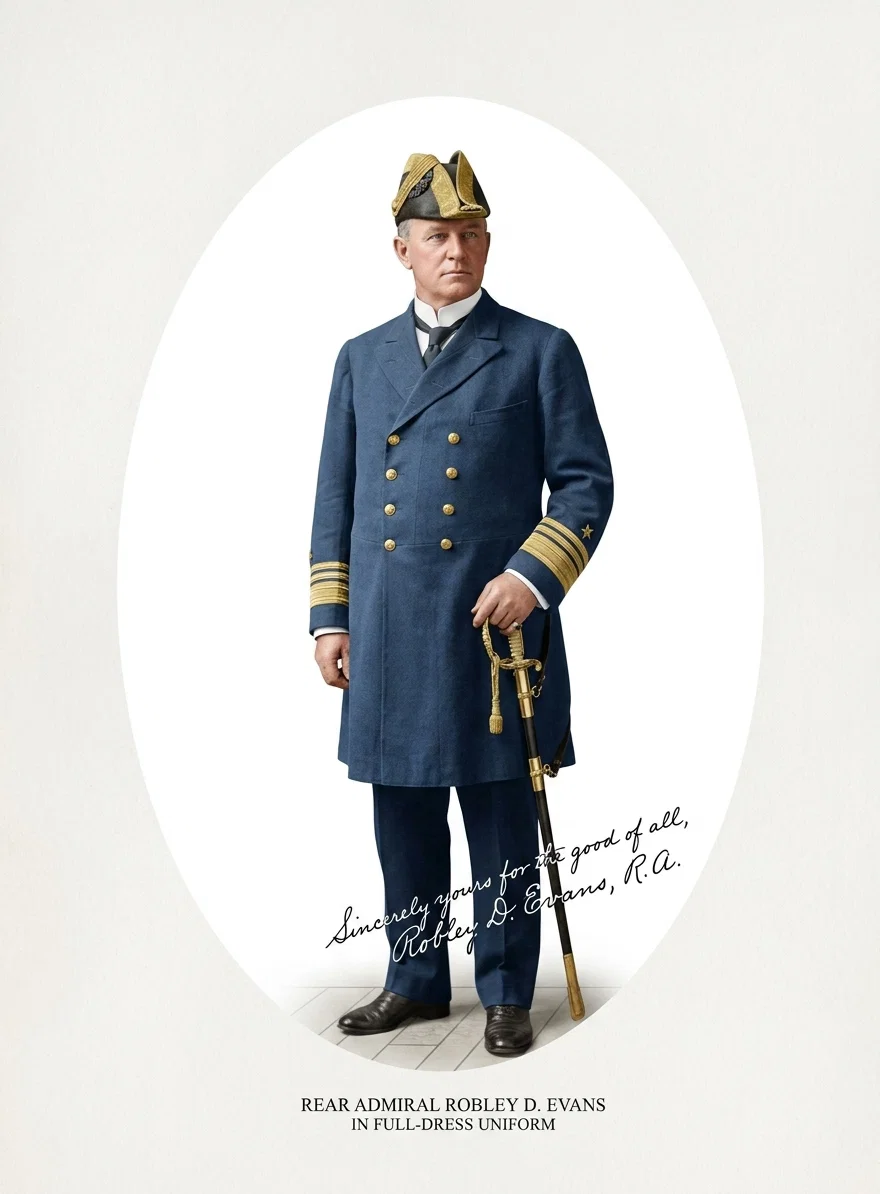
ATTENTION has already been called to the fact that the Signs of the Times under date of May 13 is to be a “Naval Number” with illuminated cover. On the first page there will be a portrait of Rear Admiral Evans, commander of the fleet, in full-dress uniform, surrounded by an emblematical border.
REDUCED FACSIMILE OF FIRST PAGE OF NAVAL EDITION
On the last page of the cover there will be a large half-tone engraving of the entire battle-ship fleet, with the flag-ship “Connecticut” in the center. The cover will be printed in photo-brown ink, and will present a very attractive appearance.
Many will purchase this number just for the beautiful engravings it contains; but they are not the most important part of the paper by any means, for its pages will be filled with soul-stirring truths for this time, presented in the most forceful and attractive manner, and it is hoped that a spirit of inquiry will be awakened in the hearts of many which will lead them into the truth.
The third page of the cover will contain advertisements of our leading books, pamphlets, and tracts, so that those who wish to read further on any subject will know where to send.
Every one seems to be enthusiastic over this forthcoming number. We quote the following from a letter just received from Elder W. B. White, president of the North Pacific Union Conference:—
“I am interested in your ‘Naval’ edition of the Signs of the Times. Have written an article concerning it for the next issue of our union conference paper. I hope that a large number of these papers will be sold in the North Pacific Union Conference during the month of May. Surely it was a happy idea that came to you of issuing a ‘Naval’ edition; and I am sure it will sell well; and thus be the means of bringing much truth before the people.”
The California Conference alone expects to23sell from forty to fifty thousand copies of this number. This great “Naval” edition presents another opportunity to place the truth in the hands of the people in an attractive form.
Prices of the Naval Number
Single copies ............ 10 cents
25 to 100 copies ........ 3 “
100 copies and over ..... 2½ “
Five or more copies mailed direct from the office of publication to individual names and addresses furnished, four cents a copy.
Regular subscription price, 1 year, 52 numbers, including all special numbers, $1.50.
Address your State tract society, or Signs of the Times, Mountain View, Cal.
NOTICES AND APPOINTMENTS
By D. D. Fitch
Notice!
BEING now convalescing from a surgical operation, and wishing to employ my time to the best advantage for a few weeks pending return to normal activities, I suggest a helpful plan to the managers or matrons of our institutions. If there is sent me, accompanied by letter stamp, the name of your cook, chef, or steward, he will, in return, receive recipes and culinary suggestions well worth the investment. Please enclose one of your menus. Participation in this depends on an early response, since the offer holds good only while I am indisposed. Suggestions and recipes which might be added to those already in mind will be gladly received.
D. D. FITCH, Chief.
Glendale Sanitarium, Glendale, Cal.
Names for Missionary Purposes
Any one desiring for missionary purposes, a list of names of persons, interested in at least some phase of the truth, can get the same by addressing the writer. We are planning to have our canvassers make a note of all such cases, giving enough additional information so that the correspondent can address the interested person intelligently. Any one wishing such names will please let us know about how many are desired. Address R. I. Keate, Marlow, Ala.
Business Notices
THIS department is conducted especially for the accommodation of the Seventh-day Adventist readers of this paper.
Brief business notices will be published subject to the discretion of the publishers, and on compliance with the following—
Conditions
Display advertising, and advertisements which call for agents, will not be accepted, nor do the publishers solicit advertising of any kind for this paper.
Any person unknown to the managers of this paper must send with his advertisement satisfactory written recommendation. Such recommendation should come from one of our ministers, or from the elder of a Seventh-day Adventist church. It is not enough to refer to some individual by name. Secure his recommendation in writing and send it.
We open no accounts for advertising, and cash must accompany each order.
A charge of one dollar will be made for each insertion of forty words or less. Each additional word, initial, or group of figures in excess of forty, will cost three cents.
No discount for several insertions.
WANTED.—A woman forty-three years old would like to sew for and have the care of a family of children, or the place of a housekeeper, or the care of an invalid. Address Mrs. M. T. Houston, Ludowici, Ga.
WANTED.—Work on farm with Sabbath-keepers for a sixteen-year-old boy, bright, quick, worked on farm before; also work for another, aged eighteen. Address C. W. Weber, 1019 N. Halstead St., Chicago, Ill.
FOR SALE.—Cooking Oil, best grade. Freight prepaid between Colorado and Ohio. 5 gal., $4; 10 gal., $7.75; 15 gal., $11. Other States, please ask for prices. Address R. H. Brock, 404 North Second St., Arkansas City, Kan.
NOTICE!—Small company of Seventh-day Adventists going to New Mexico to engage in farming, can accommodate few more. $10 per acre—terms. Send for literature. Address W. A. Ross, 1537 Wrightwood Ave., Chicago, Ill.
THE OTTER LAKE (Mich.) Medical and Surgical Sanitarium makes a specialty of the care and treatment of insane and nervous cases, in addition to its general line of work. All insane cases treated during past two years have recovered. Chronic invalids cared for. Low rates.
ROYAL PEANUT BUTTER is all that we claim for it. Made only from No. 1 Spanish peanuts, carefully selected, and everything objectionable removed. Southern California Extracted Honey in convenient packages. Write for prices. Address Cleveland Health Food Co., Cleveland, Ohio.
FOR SALE.—A deal would have been consummated one year ago through the medium of this paper, but sickness, combined with other causes, prevented compliance with pledge advertised. Therefore, I offer again the machinery of my factory known as “Battle Creek Bakery,” and solicit correspondence, also personal inspection of plant. Address Joseph Smith, 157 West Main St., Battle Creek, Mich.
FOR SALE.—Peanut Butter, 10 cents a pound; Olive-oil, $2.50 a gallon; 50 pounds Cocoanut Oil, $7; Vegetable Cooking Oil, 10 pounds, $1.10; 50 pounds, $6. Cash with order. All absolutely pure. Address Vegetarian Meat Company, Washington, D. C.
FOR SALE.—House and lot at Takoma Park, D. C. Ten minutes’ walk from Review Office. Near famous Takoma spring. Convenient. Water, sewer, gas; bath in house, which is new. Near church-school. Address L. M. Spear, Twenty-fourth Ave. North, Nashville, Tenn.
FOR SALE.—160-acre farm, 90 cultivated; 60 acres pasture; 2 good wells; 600 golden willows; house 22 x 22; barn 28 x 32; granary, 14 x 20; buildings new and painted. Coal mine close by; 10 miles to county-seat, Minot. For further information and terms, address J. N. Peterson, Minot, N. Dak.
FOR SALE.—Strawberry plants by the hundred. Warfields, 35 cents; Senator Dunlap, 35 cents; Bederwood, 35 cents; Pride of Michigan, 60 cents; Sample, 40 cents; Parson’s Beauty, 45 cents. One dollar for 500 Warfields. Send for free catalogue. Geo. Jorgensen & Son, Box 10, Poy Sippi, Wis.
FOR SALE CHEAP.—Forty acres: 2¼ black raspberries, 1½ blackberries, ¾ red raspberries, 1/3 strawberries; 150 grape-vines, 50 plum-trees, 20 apple-trees, all bearing, and in excellent condition. Fair improvements. Mail route and telephone. Church and church-school privileges. Good markets. Reason for selling, too much land. Address C. C. Johnson, Mankato, Minn.
Obituaries
LONG.— Died at Kearney, Kan., Feb. 22, 1908, of scarlet fever, Anna G. Long, aged 9 years, 6 months, and 22 days. Little Anna loved the appearing of our dear Saviour; and we know that when he comes, we shall meet her again. E. F. LONG.
REED.— Died at his home in Omaha, Neb., Feb. 17, 1908, Lewis Reed, aged 71 years, 1 month, and 20 days. He is survived by his wife and daughter, who are members of the Seventh-day church in Omaha. At the time of his death Mr. Reed was not identified with any church; but before his death he acknowledged Jesus as his Saviour. Words of comfort were spoken by the writer, from Job 22: 21. C. A. BEESON.
LAUCK.— Died May 30, 1907, in Auburndale, Kan., John A. Lauck, aged 71 years, 5 months, and 29 days. He was born in Germany, coming to this country when twenty years of age. Five sons and five daughters survive him. Though suffering great pain in his last days, he was patient, and expressed a desire that his last breath should praise his Saviour. Words of comfort were spoken by Elder L. F. Trubey. J. M. FLETCHER.
COLE.— Died Feb. 26, 1908, of pneumonia, Sister Louise S. Cole, of Sand Lake, Mich., in the forty-sixth year of her age. Sister Cole embraced the truth in the fall of 1895, at a tent-meeting held near Trufant, Mich. She was an earnest and consistent Christian. A husband, two sons, an aged father, and other relatives are left to mourn. Words of comfort were spoken by the writer, from 2 Sam. 14: 14. W. R. MATTHEWS.
OWEN.— Died at her home on Long Prairie, in Tillamook Co., Ore., Feb. 16, 1908, Mrs. Mary Gibson Owen. She was born in Quebec, Canada, Jan. 12, 1836. At the age of fifteen Sister Owen became a Christian, and kindness, sincerity, and good deeds characterized her life. She was loved and respected by all who knew her. Although a sufferer for years with paralysis, she was always patient. Besides her husband, there are left two children,—a son and a daughter,—also one adopted son. Services were held at the house, and also at the Adventist church, Rev. Rosebraugh (United Brethren) officiating; text, John 14: 1. *
MILLS.— Died at the home of her son, Wm. H. Mills, of Emporia, Kan., March 1, 1908, of pulmonary la grippe, Sister Mary Ann Mills. She was born in Canandaigua, N. Y., Dec. 8, 1818, and was therefore in her ninetieth year at the time of her death. Sister Mills was one of the pioneers of the advent message, having identified herself with it fifty-two years ago. During all these years she has been firm in her belief, and consistent in her practise of every principle of the message. She was the mother of four children, two of whom survive to mourn. Services were conducted by the writer, assisted by Elder B. W. Brown. We believe the benediction of Rev. 14: 13 rests upon her. CHAS. THOMPSON.
ANDERSON.— Nora Haysmer was born of Adventist parents in Montcalm Co., Mich., Oct. 31, 1867. Died at the Plumstead Sanitarium, Plumstead, South Africa, Feb. 4, 1908. Nora never remembered the time when she did not love this truth and keep the Sabbath. She grew as a child in the message. At the age of nine she requested baptism, but on account of her tender years was advised to wait. It was not until she was eleven years old that the rite was performed, and she united with the church in Bushnell, Mich. She entered Battle Creek College at the age of sixteen, to fit herself for the work of God. For lack of means, she was able to remain but one term. Then began a struggle for an education. By teaching, canvassing, and housework she earned enough to return to college in 1891, and graduated in the class of 1893. While in the college she joined the Students' Volunteer Band, and consecrated her life to the work in the foreign mission field. In October, 1893, she was married to the writer. We returned to the college soon after our marriage, and remained until the Mission Board called us to assist in opening the work among the natives in Matabeleland, South Africa. We sailed from New York, April 10, 1895, and arrived at Bulawayo on July 26, after a long journey by sea, train, and ox wagon. Her life was identified with the work at the Matabele Mission for the next nine years. Through war, famine, pestilence, hardship, and death of fellow workers, she bore her burdens faithfully and without a murmur. Then work beyond her strength, an impoverished diet, and an enervating tropical climate, forced her from the field. In 1904 we went to America for a year of rest. We returned the next year to open the work in Barotseland. Here again were the hardships, privations, and difficulties of pioneer work. She struggled with them bravely; and just when the struggle was over, when the privations were past, when the hope of a comfortable home had been realized, she passed away. On Nov. 24, 1907, she had an attack of black-water fever. I nursed her one week, and then took her to the hospital in Livingstone. She made a partial recovery, and then came on to the sanitarium at Plumstead. Here her progress was slow, but she seemed to gain steadily. She was bright and cheerful, and was beginning to talk of the time when she would go back to the work she loved so well. When we thought that all danger was past, she had a relapse, and soon passed away. The best medical skill, trained nurses, kind hands, and loving hearts did all that could be done, but to no avail. Not for her were the comforts of this life, the companionship of friends and loved ones, the pleasures of home and the home land. She gave them up gladly, joyfully, willingly, that the heathen might hear the message. She poured out her strength unto death, that they might have life. Our house is desolate, our home lonely, our child an orphan. But we sorrow not as those who have no hope. Only a little longer, and He who shall come will come, and will not tarry. Then we shall have the home we have so longed for here. Then sorrow and crying will be no more. We shall see the fruit of our labors, and be satisfied. Funeral services were conducted by Elder W. S. Hyatt, assisted by Elders I. J. Hankins and E. R. Williams. W. H. ANDERSON.
Elder Teasdale Returns from Java
By invitation of the General Conference Committee, Elder George Teasdale, of Australia, who was stopping with his wife’s people in Alabama, has come on to Washington to attend the council. We were glad to greet him last week. He has for some time been laboring in Java, East Indies, where the mission workers recently passed through a severe experience of illness, in which Brother and Sister Teasdale lost one of their children. On account of the health of his wife and family, Brother Teasdale has accompanied them to this country to leave them for a time, expecting shortly to return to Java.