Your ShelfYour Projects

Signs of the Times, Vol. 31, No. 12.

Pacific Press Address
Earlier text: EVOLUTION AND GEOLOGY

The Happiness of Being Busy

"It is almost the beau ideal of happiness for a man to be so busy that he does not know whether he is or is not happy."

Free Discussion and Truth

WHOEVER is afraid of submitting any question, civil or religious, to the test of free discussion, is more in love with his own opinion than with the truth.—Bishop Watson.

CHRISTIANITY'S OPPORTUNITY IN CHINA.

THE missionary work in China affords full scope for every diversity of talent. Educators may contribute to the establishment of a national system of education in a land where scholarship has always been ranked as the highest of human attainments. Those who possess literary ability may gain the attention of multitudes of scholars, as is shown by the fact that the names of some missionaries are known to Chinese students throughout the empire, and that their books are read almost as widely as the Chinese classics themselves. We look, too, for scholars from the West who shall interpret more clearly than has yet been done the true meaning of Chinese literature, philosophy, and history, showing the relation between these and the revelation of God in Christ.
To the Christian physician doors are ever open, and his work, as the expression of Christian love, does much to win the confidence of the people. The training of Chinese medical students, as well as general hospital work, is also urgently needed.
To the educated women of the West, work among the women and girls of China offers a wide field. Chinese women are, to a large extent, untaught and neglected, and thus China is deprived of what should be the most potent factor in her elevation and advancement.
The establishment and development of the Chinese church, which involves the presentation of the Gospel to all classes of minds, the selection, training, and supervision of native workers, the adjustment of church regulations to native customs and beliefs, and the promotion of self-extension, self-government, and self-support, demand wide diversities of thoroughly trained and statesmanlike leadership.
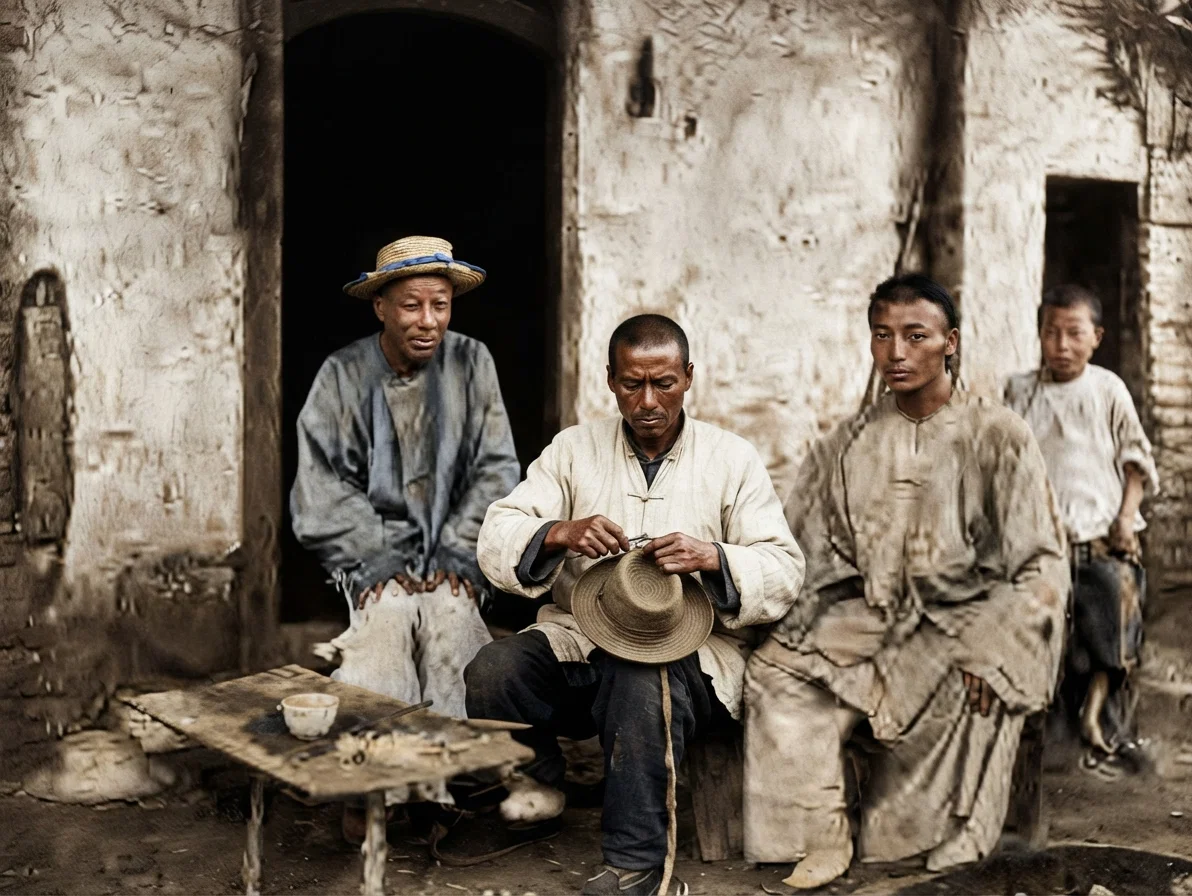
A Chinese Hatter, Plying His Trade in the Street,
We firmly believe that nowhere in the world can a Christian man of sound learning and humble spirit more easily discover his special bent, and, having discovered it, whether as preacher, teacher, or author, physician, administrator, or philanthropist, find more ample scope for his activities than among the missions of the Christian Church in China.
But in whatever direction we look, the problem is primarily a spiritual one. We do not aim to produce mere intellectual adhesion to the truths of Christianity, nor admiration of its moral teaching, for these can not save the race. We seek to lead individuals and communities to such an experience of the power of Christ as shall arouse the heart and conscience, and transform the whole life. In order to accomplish this end the leaders of the church in China should be men of mental culture, but the essential qualification is faith in God.
—Message of Student Volunteers in China.

INDUSTRIAL MISSIONARIES.

BISHOP INGHAM, in a recent paper, vigorously advocates this form of missionary work. He defines his own terms, however. He does not mean by industrial missions the establishment of big mission trading factories, like some on the gold coast, which are open to the charge of secularism and unspirituality. He asks that men and women go out, qualified and enabled to show in practical ways how the faith they preach should operate, so that converts may learn to do their duty in that state of life unto which God pleases to call them. He thinks that even the most theological teachers may be practically equipped like Paul.
In West Central Africa he finds great need of such missions. There is a condition of tyranny and bondage which can not longer find markets in other lands. The success of the evangelist and teacher is his greatest difficulty. Here are peoples who have been bullied into hard labor from time immemorial. They have counted it a virtue to hide from task-masters. To come to them with a book and a cloth is to foster the notion that honest toil is menial and degrading, which is helped by their superstitions. Here is a country with no real industries, the people naturally distrustful and lazy. To put among such people a mission equipped with Bibles and other books, and periodical boxes of clothes from home lands, does harm. Boys and girls thus taught and clad foster a discontent with their surroundings, and try to ape foreign customs, and be "readers" and well clad. Chiefs learn to fear missions that alienate their own subjects from the life of their own land. To see the Alake of Aberkuta buying plows at an agricultural show gave the bishop much encouragement. Merchants deprecate mission work that ruins the labor market, and sensible observers think mission methods a ludicrous failure that produce a too one-sided development. Missionaries should be prepared to train converts to meet the actual needs of their communities.
A People in Great Need of Industrial Missions.
The Bishop of Mombasa likewise praises the works carried on by the Basel German Mission as creating something better than mere "née Christians." In India, industrial missions are taking a rank unknown before—both fitting converts for definite work, and finding such work for them. From China comes a cry for aid in enabling converts to do carpentry or other work so that they need not compromise themselves with idolatrous customs in seeking a livelihood.
Many missions in India, Malaysia, and Australasia as well as those in Africa, are working along industrial lines.—Missionary Review.

A WORLD TO COME.

THEY say there is a "world to come," More fair and bright than this, Where storm and night are never known, But all is calm and peace; That hill and plain to either shore Are spread with changeless green, And never, 'mid its lovely bowers, A fading flower is seen.
And living streams, as crystal clear, In tuneful murmurs flow, And trees whose leaves the nations heal Beside those waters grow. Ah, they are like the angels made Who gain that blissful shore, And never sigh or weep again— And they can "die no more."
And all the goodly things it bears They say for all are free; That every ear its music hears, And all its beauty see. There none in lonely exile pine, Or strangers weary roam; One family, they gather there, Within one happy home.
A glorious city, too, is there— It needs not eve's pale lights, Nor yet the sun's bright golden ray Gleams from its dazzling heights; But One is there whose smile is light, And glory decks His brow, While willing nations 'round His throne In love's sweet homage bow.
But, O! they say that none shall dwell In that fair "world to come" But they, the pure and lowly ones, Who here as pilgrims roam; That only those who now endure In meekness, grief, and shame, Shall enter, through its gates of pearl, The New Jerusalem! —Mrs. E. Roberts.

Faith, the Handle of Truth

"FAITH forms the handle to every tool of truth in the divine worship."

OUR WORK AND WORKERS.

FROM the southern frontier of Chile, word comes from Brother H. F. Ketring, that five converts had been baptized, and that several more were asking for baptism.
A CIRCULAR from the mission board announces that, "notwithstanding the awful times in Russia, the native Russian membership has doubled during the year."
REPORTING to the Southwestern Union Recorder, Brother T. W. Field mentions that four church-school pupils at Edgewood, Texas, were candidates for baptism. He also notes that the brethren at Hutchins have built a new house of worship.
JANUARY 21, a Danish church of thirteen members was organized at Ute, Iowa, and nine others were reported to be keeping the commandments of God in the community. This result was the fruit of labor by Brethren N. C. Bergensen and P. E. Brothersen.
NEAR Hartford City, Ind., a Sabbath-school of nineteen members was organized February 11, by Brother U. S. Anderson, and the next Sabbath there were thirty present. A lot and some money has been offered toward the erection of a house of worship.
OUR Australian namesake publishes a little monthly chat with its patrons and fellow-workers called Good Cheer. In the February issue it gives a record of the paper's weekly increase in circulation. From November 1 to February 1 this increase was 937 copies. This is really encouraging, and we hope it may still increase in even greater ratio.
IN the West Michigan Herald of March 1 we note a list of fifty-four churches, of which every family enjoys the weekly visits of the Review, our excellent church paper, now published at 222 N. Capitol Street, Washington, D. C. Evidently the "good old Review" is not losing any prestige in the vicinity of its old home by being removed to the national center.
FROM La Ceiba, Spanish Honduras, under date of February 22, Brother A. N. Allen writes: "God is blessing the work here. A Spanish lawyer and his wife have begun the observance of the Sabbath. Our little Sabbath-school is very interesting, as we are obliged to teach in Spanish and English at the same time. A good day-school has also been opened. Pray for the work in Spanish Honduras."
THE initial number of the Home, Farm, and School, published by Emmanuel Missionary College Press, Berrien Springs, Mich., is at hand. It is a three-column eight-page journal, "devoted to the science and art of Christian education." This new candidate for public favor is the successor of the Advocate of Christian Education, which was issued in magazine form. The new journal presents a neat appearance, and is in every way worthy of success. Monthly; 50 cents a year, in advance.
WE acknowledge receipt of the "Seventh Annual Announcement of Bethel Industrial Academy." This prosperous institution is located at Bethel, Wis. Its educational board is presided over by Brother Wm. Covert, and Prof. A. W. Hallock is principal of the faculty. The spring term opens April 5. The pamphlet is neatly printed, handsomely illustrated with views of the academy buildings and premises, and contains the information needed by prospective patrons. Address the principal.
THE March number of Life and Health is "one better." The first article is "General Hygiene," by Mrs. E. G. White. This is followed by an article on "Colds," by Frederick M. Rossiter, M.D., and another general article on "Revolutionary Dietetics." The department, "The Medical Missionary at Work," is a compilation of interesting reports from the world-wide field. A very practical department is that of "Questions and Answers," conducted by George A. Hare, M.S., M.D. The magazine is published monthly, by the Review and Herald Publishing Co., 222 N. Capitol Street, Washington, D. C. Subscription price 50 cents a year.
THE question of a future probation, or a probationary age after death, or after the coming of the Lord, is one that agitates many minds. People who are most concerned about it are those who would like an excuse to postpone the cross as long as possible and still be saved. We have just issued a new tract, Bible Students' Library, No. 190, entitled, "Future Probation," by T. E. Bowen, secretary New York Conference. In this tract the subject is treated quite fully and conclusively, and those who are interested, either for themselves or for others who are troubled over the matter, would do well to read it.
32 pages; price, 2 cents, or $1.40 per 100. Address any of our publishing houses or tract societies.
WE take the following from a letter to the Welcome Visitor, by Dr. H. W. Miller, of Shan Tsai Hsien, Honan, China: "We constantly set before the Chinese a narrow door, and contrast the results, upon entering it, with that of the broad door. A Chinaman can be a Catholic, and change very little from his former belief, and also have government protection, as the Catholics have the mandarins in China so frightened that they are afraid to punish a member of their church, no matter what the crime may be. God is giving power to this Gospel, and it must go to China. When we consider the number of years some of the early missionaries spent in China without a single convert, and contrast it with the number of inquirers coming to us since we came here, we are greatly encouraged. We can point to little that has been done on our part, but God is at work. As we can utilize native help in treating the sick, it has thus enabled us to occupy more stations during the past year, and each station is a center of light in the interior of this heathen land."

Catcher's Mitt FREE!

Perfectly made, extra large. Best gray tan leather. Careful double sewing all around, strengthened by rivets. Lacings for thumb and ball pocket. Raised heel and double palm. Wine color leather back. Made of leather throughout, stuffed with curled hair. Very thick. Send name and address for 20 packages of BLUINE to sell at 10 cents each. Everyone will buy of you for every housewife uses BLUINE. On the receipt of your $2.00 we will send the mitt just as shown and described here, express charges paid by us. With this mitt you can catch twice as well; we also give a first-class fielding glove for selling 20 packages more. Write today. We guarantee satisfaction.
BLUINE MANUFACTURING COMPANY, 16 Mill St., Concord Junction, Mass. (The Old Reliable Firm.)

AFRICAN SLAVE WOMAN.

A SLAVE woman named Ogunro living in the Ilale country west of the Niger longed for freedom, and worked hard until she secured it. Then she traveled to another region to enjoy life. There she was converted to Christ. This gave her a new longing. What she now longed for was to tell the Ilale people, among whom she had been a slave, what good things she had learned. She went back to Ilale, worked hard, earned money, got a church built, and late in 1903 she placed the church at the disposal of the nearest Christian pastor. The Church Missionary Intelligencer now reports that five young men from Ilale have been baptized through these efforts of the ex-slave. It seems that Anglo-Saxons have no monopoly of the strenuous life. The Christian name given to Ogunro in baptism was the appropriate one of Dorcas.—Selected.

WANTED FOR MISSIONARY WORK.

(Always prepay postage.)
SIGNS, tracts, and any other of our missionary literature. Address Mrs. Addie Draper, Claremore, I. T.

SOUTHERN CALIFORNIA CONFERENCE OF SEVENTH-DAY ADVENTISTS.

THIS conference will be held at Fernando, Cal., April 11-16, 1905. Fernando is a small town twenty-one miles north of Los Angeles, on the Southern Pacific Railroad.
This is not a camp-meeting, but a conference for the election of officers and the transaction of all conference business.
Delegates will be elected as follows: One delegate for each church, without regard to numbers, and an additional delegate for every twenty-five members.
Officers of churches will please see that the delegates are elected, and the names sent to Edward Treganza, Fernando, Cal. CLARENCE SANTEE, Pres. So. Cal. Conference of Seventh-day Adventists.

NOTICE OF ADJOURNMENT.

OWING to the meeting of the Healdsburg College and Pacific Educational Association having been set for March 20, 1905, the annual meeting of the Sanitarium Food Co. will be postponed to March 27, 1905, at Sanitarium, Cal. Let all interested kindly bear this change in mind. E. E. PARLIN, Secretary.

Vegetarian Cook Wanted

WANTED.—An experienced vegetarian cook. Apply to M. T. Madsen, 214 Union Street, Seattle, Wash.

Lamp Chimneys and Chimney-Money

It takes a good dealer to sell right lamp-chimneys when wrong ones pay so much better.
MACBETH.
The Index tells you, in ten minutes, all you need to know for comfort with lamps and the saving of chimney-money; sent free; do you want it?
MACBETH, Pittsburgh.

Three Keeping the Sabbath in Martinsville

Writing to the Indiana Reporter, Sister Florence Niehaus mentions that three persons are keeping the Sabbath in Martinsville, through her labors as a Bible-worker.

BAROTSELAND—OUR NEW MISSION IN AFRICA.

FROM an appeal to the brethren of Ohio, in the Welcome Visitor, by Brother W. H. Anderson, we take the following:
The time is near for us to return to Africa. We are to go five hundred miles farther into the interior. A new "Memorial for God" is to be established. Another country is to hear the Third Angel's Message. One more light is to be kindled in "Darkest Africa." Another outpost will be planted in "the regions beyond." More souls are to be plucked as brands from the burning. Ohio has an interest there. The Young People of the State support a native worker in that field. The Young People of Columbus are planning to support another. Will we permit the young people to excel us in well doing? Ohio is already doing much for missions. We must do more. We are not to stop until the work is finished. This message must be preached to all the world for a witness.
I appeal to you in behalf of the benighted in Africa. Compare your homes with their hovels, your hope with their despair, your light with their darkness. Then read Luke 10: 25-37.
Listen to the young man's appeal for help. He wants his people to hear the truth. Give them a chance to enter the kingdom. Rom. 10: 13-15. Whose heart will not be touched by the broken-hearted child? His mother died. He asked, "Will I ever see my mother again?" She never heard of Jesus. She did not know He died for her. She perished in her sins."
Let us rise as one man and finish the work God has given us to do. Already over $100, has been given. Can not that sum be raised to $1,000? I believe it can. Let us try. Send all money to your state treasurer stating that it is for Barotseland. Let there be no delay.

HOME TRAINING.

"I DECLARE, Burton has gone and cheated himself," said Mrs. Drake to her sister, as she unrolled and measured a piece of ribbon she had purchased during that morning. "I thought it looked long for three yards, and I only paid him for three yards, but he has cut four, that's certain."
"Well, you can pay him for the extra yard when you are that way," said her sister Mary, who lived with her.
"Not I. I shall keep it. He makes plenty out of me in the course of a year," replied Mrs. Drake, as she rolled the ribbon about her fingers and passed out of the room.
It was a surprise to her five-year-old little boy, Charley, who, tho playing unobserved with his toys in the corner of the room, heard every word as distinctly as if his mother had spoken to him. It did not seem to correspond with what she had taught him about truth and honesty. But his faith in his mother was such that for the time he felt she would be sure to do the right thing. Had his aunt uttered any further reproof of her sister's conduct, she might have helped him to feel the wisdom of being honest in trifles. But she was one of those who are more ready to go with the stream than incur any trouble in opposing public opinion, and so she had unconsciously helped to bias the boy's mind in the wrong direction without suspecting it.
A few days after, Charley heard his mother say, "I did not give up my railway ticket this morning. It will do again."
"How was that?" asked her sister.
"The collector was too busy to notice me, perhaps."
"But why did you not stop him and give it him, mama?" asked Charley.
"Because it was his duty to look after it himself," replied Mrs. Drake, who felt rather uncomfortable at such a question from her little boy, so she added, to cover her annoyance, "It will teach him to be more careful in the future."
Charley was silent for a moment, and then said, "But he won't know anything about it, mama."
"O, you are too sharp!" exclaimed his mother with a laugh. "I was not talking to you about it at all."
"But little pigs have great ears," said Aunt Mary, as she also tried to laugh the impression away.
So the subject was pushed aside, neither the mother nor aunt thinking for a moment that the bright and truthful boy they loved so tenderly had received another lesson in dishonesty, never to be forgotten. But so it was.
Not long after, while Charley was again building his house of bricks, he heard the remark, while his mother was counting the money in her hand, "Let me see, one, two, three, four. I gave him a half-sovereign, and the things came to six and sixpence. He has given me sixpence too much change." Then, in a tone of satisfaction, she added, "I am sixpence richer than I thought I was."
Aunt Mary smiled, but said nothing; but Charley took it all in, and thought the more when he heard his mother add:
"I think we will have a cake for tea at—at Brown's expense."
"That's too bad," said Aunt Mary, as she shook her head, and pointed to Charley.
But the words had gone deep down into his nature, and again his perceptions of right and wrong were obscured and dimmed.
This was seen a short time after, when he came running into the house with an orange in his hand, saying, "Look what I've found."
"Where, my dear?" asked his mother.
"A woman let it fall from her basket. She didn't see it, but I did, and picked it up."
"But why didn't you run after her, and give it to her?" asked Aunt Mary.
"Because I wanted it myself. She dropped it and I picked it up."
"But you ought to have given it to her."
"I don't know where to find her now," said Charley, evasively.
"Then mind and not do it again," added his mother, not feeling satisfied with his conduct, and yet being a little amused at his cuteness, as she called it to her sister.
In this way his education in crime was begun. His mother's motto, "He cheated himself," became his maxim as he grew older and understood its application more clearly. True, his mother never meant to train him to be mean, selfish, or dishonest, but she sowed the seed by her own conduct. Evil seed must produce evil fruit. "As the twig is bent, the tree is inclined." The real quality of an act lies in the intention. She never realized, however, that the fine lady who keeps the ribbon she is not entitled to, or the change which does not belong to her, tho given in error, is as criminal as the thief who steals a coat, or anything else he can, when he has the chance.
She found it out in time, to her sorrow, when she stood, almost broken-hearted, in the police court, and heard her son, when just budding into manhood, sent to prison for robbing his employer. And while he was thrust into the van and conveyed to the gaol, she was taken fainting to her home, to mourn too late her folly and sin in training up her child in the way he should not go. Mothers and fathers, ever remember, example is more powerful than precept; and if you want your children to be saved from ruin, let your prayer be, "May the words of my mouth and the acts of my life ever be governed by a desire to do what is right and good and true."—John W. Kirton, LL.D.

A WIZARD OF THE ORCHARD.

If reward is to be measured by service, then Luther Burbank of California deserves more at the hands of his fellows than any martial hero or captain of industry. Mr. Burbank is a "wizard of horticulture." He experimented with potatoes with the result that the potato industry has been revolutionized. He turned his attention to plums, and produced a finer flavored and larger fruit than any yet grown in America. South Africa is dotted with orchards of "Burbank plums." Now he has perfected a prune so large that it makes the average prune look like a dried raspberry, and so sweet that it needs no sugar when prepared for the table. He has grown a thornless raspberry and now he has grown a thornless cactus that bids fair to restore the desert places and make them habitable for man and beast. Luther Burbank has added millions to the productive value of orchards and vineyards, and has done so without shedding of blood or doing violence to any man. Is not such a man more worthy of homage than martial heroes or "captains of finance" who profit by special legislation?—The Commoner.

LOVING WORDS.

LOVING words are rays of sunshine, Falling on the path of life, Driving out the gloom and shadow Born of weariness and strife. Often we forget our troubles When a friendly voice is heard; They are banished by the magic Of a kind and helpful word. Keep not back a word of kindness When the chance to speak it comes; Tho it seems to you a trifle, Many a heart that grief benumbs Will grow strong and brave to bear it, And the world will brighter grow, Just because the word was spoken; Try it—you will find it so. —Selected.

THE DISTILLER AND HIS SON.

In the first of my ministry there occurred an incident within the bounds of my congregation which a half-century has failed to efface from my memory. At that early day the cause of temperance was gradually spreading its influence through our country, and we thought it well to organize a temperance society in our community. In my congregation there was a gentleman thirty-one years of age, of more than ordinary intelligence and business activity. It was desirable that he should join our new society, and I did my best to bring him to that point, but without success. On one occasion, when trying to persuade him to connect himself with the temperance movement, he said to me, "I never expect to be a member of a temperance society, and yet I rejoice at their existence. Not on my own account, but for the sake of that boy," pointing to his little son of four years. "When he has grown to manhood he will be under better influences than those which have surrounded his father. He will have temperance men for his companions—drinking usages will then have ceased."
I replied in most serious tones, "Mr. S—, whatever effect temperance societies may have on the community at large, one thing is certain, which is, that the destiny of your little son is in your hands, more than with all others; that such is your influence on that boy that it may well be expected that his future will be shaped by you, more than by the whole outside world."
I regret that my words were too prophetic! In about two years after the above-mentioned interview I was called to bury that dear boy. He was burned to death! His father had a small distillery on his farm. One evening, while engaged in removing some apple-brandy from the "receiver" into a cask, the boy standing by with lighted candle, the liquor was ignited, an explosion followed, and both father and son were covered with flames! The father was taken to his bed, and slowly recovered after weeks of suffering. But where was the son, who was to live and grow up under the happy influence of a temperance community! where was he? On the day of the funeral, as I entered the chamber of the suffering father, he turned his face to the wall, and raising his wounded hand as if to shun my sad look, exclaimed in agony, "O, I know what you are going to say!"—Selected.

LESSON 1.—APRIL 2.—JESUS THE GOOD SHEPHERD.

Lesson Scripture, John 10: 1-18, A. R. V.
Golden Text.—"I am the good Shepherd; the good Shepherd giveth His life for the sheep." John 10: 11.
(1) "Verily, verily, I say unto you, He that entereth not by the door into the fold of the sheep, but climbeth up some other way, the same is a thief and a robber. (2) But he that entereth in by the door is the shepherd of the sheep. (3) To him the porter openeth; and the sheep hear his voice, and he calleth his own sheep by name, and leadeth them out. (4) When he hath put forth all his own, he goeth before them, and the sheep follow him; for they know his voice. (5) And a stranger will they not follow, but will flee from him; for they know not the voice of strangers. (6) This parable spake Jesus unto them; but they understood not what things they were which He spake unto them.
(7) Jesus therefore said unto them again, Verily, verily, I say unto you, I am the Door of the sheep. (8) All that came before Me are thieves and robbers; but the sheep did not hear them. (9) I am the Door; by Me if any man enter in, he shall be saved, and shall go in and go out, and shall find pasture. (10) The thief cometh not, but that he may steal, and kill, and destroy: I came that they may have life, and may have it abundantly. (11) I am the good Shepherd; the good Shepherd layeth down His life for the sheep. (12) He that is a hireling, and not a shepherd, whose own the sheep are not, beholdeth the wolf coming, and leaveth the sheep, and fleeth, and the wolf snatcheth them, and scattereth them; (13) he fleeth because he is a hireling, and careth not for the sheep. (14) I am the Good Shepherd; and I know Mine own, and Mine own know Me, (15) even as the Father knoweth Me, and I know the Father; and I lay down My life for the sheep. (16) And other sheep I have, which are not of this fold; them also I must bring, and they shall hear My voice; and they shall become one flock, one Shepherd. (17) Therefore doth the Father love Me, because I lay down My life, that I may take it again. (18) No one taketh it away from Me, but I lay it down of Myself. I have power to lay it down, and I have power to take it again. This commandment received I from My Father."

SUGGESTIVE QUESTIONS.

(1) In explanation of the parable of the sheepfold, what does Jesus say of Himself? Verse 7. Note 1. (2) What does He say of all pretenders? How do the true sheep regard them? Verse 8. Note 2. (3) Then what assertion does He repeat? What does He say of those who enter by that Door? Verse 9. Note 3. (4) For what purpose does the thief come? To what end did Christ come? Verse 10. Note 4. (5) What other office does He fill? What constitutes a good shepherd? Verse 11. Note 5. (6) What does Jesus say of one who is a mere hireling? What is the result of such unfaithfulness? Verse 12. Note 6. (7) Why does the hireling flee when he sees the wolf coming? Verse 15. Note 7. (8) What claim does the Lord then repeat? What proof does He give of this statement? Verse 14. (9) To what extent is this mutual knowledge recognized? Verse 15. Note 8. (10) To what further mission did Jesus refer? Verse 16. Note 9. (11) What does He say of the Father's feeling toward Him? For what special reason? Verse 17. Note 10. (12) Was Christ's death the result of His being overcome by the enemy? What power did He confidently assert? From whom did He receive commandment? Verse 18. Note 11.

NOTES.

1. The parable of the sheepfold had just been spoken by Jesus to His disciples; but they did not understand it, and He proceeded to explain it further. The door is the means of entrance to the fold, where there is safety and care. Jesus is that Door, because He is the "way" of salvation. He imparts the new life which makes one a member of the true flock of God.
2. "All that came before Me," refers to such as have claimed to be the Messiah; or such as have devised or advocated other means of salvation. Thieves gain their booty by crafty devices, and robbers boldly use the force of organization and various overpowering influences. But the real sheep, those who are keen to discern the Door, find their way into the true fold.
3. The door is not only a means of admittance, but it is also a barricade against enemies of the flock. Those who enter the fold through faith in Christ, and remain faithful to His Word, shall be safe from deceivers who seek to destroy. Whether in communion together, or abroad in the field of labor, they will feed on the Word of God and be assured of His protection.
4. Verse 10 shows the marked contrast between all human schemes of salvation and the plan offered by Christ. The former lead to death and destruction, while the latter, and that only, is the way of eternal life.
5. Of Christ, the good Shepherd, the prophecy had said, "He will feed His flock like a shepherd, He will gather the lambs in His arm, and carry them in His bosom, and will gently lead those that have their young." Christ's giving His life for His people is too often limited to His expiation on the cross. That was but an incident in His life. From the day that He consented, or volunteered, to become the sinner's substitute, He has been giving His life for the sheep. He was slain "from the foundation of the world," and He is yet giving His life for the sheep, pleading His blood before the throne of Judgment in behalf of all who will "come unto God by Him."
6. The Hireling.—Canon Tristram says: "The shepherd in the East is usually the owner, or the son of the owner, of the flock, tho sometimes an agent, whose salary is a fixed proportion of the produce, as Jacob, under Laban. The hireling is the man who happens to be hired for fixed wages, merely for the day, and has no further interest in the flock." The Wolf.—Dr. Sadler says: "The wolf is the enemy of souls in any of his manifold disguises, as not only persecution, but heresy, worldly living, or a low standard of faith and morals."
7. "Because he is a hireling," such a shepherd will sacrifice the sheep for his own interest or safety, but he never will sacrifice himself for the sheep.
8. The bond of union between the sheep, the Shepherd (who is the Son), and the Father, is of the closest possible nature. It is expressed in the Lord's prayer to His Father for all His prospective disciples, "that they may all be one; even as Thou, Father, art in Me, and I in Thee, that they also may be in us; that the world may believe That thou didst send Me. . . . I in them, and Thou in Me, that they may be perfected into one." John 17: 20-23. The sheep know the Shepherd through His Word.
9. "Other sheep" are those whose hearts are known to the Lord, that they will become His disciples when the Gospel shall have been preached to them. He does not mention another fold, but "other sheep."
10. The good Shepherd did actually lay down His life, and take it again, that He might destroy the enemy of His flock and deliver the victims of his wrath. See Heb. 2: 14, 15.
11. Christ did not lay down His life because of any power the enemy had over Him. His death was part of the process of overcoming the enemy. When He came out of the tomb, He brought the keys with Him (Rev. 1:18), proving His ability to unlock the grave for others, thus destroying "the works of the devil." 1 John 3: 8.
Continue reading: Sabbath-School Lesson Quarterly