A MAN is always better for having a standard to attain, and that standard is never so effective as when it is fixed for him by his wife. The plane on which a home rests at the very outset has a very important bearing on its future.
The desire to be of actual help to a husband in his daily life is generally one of the keenest and earliest desires of the young wife, and she vaguely wonders how she can help him. This can be done by love and sympathy, purely and mainly. The greatest power to a man in the outer world is the love that he gets from his wife in his home. The greatest help he receives in his work is her honest sympathy in his interests. That may not seem like doing anything actual to the young wife. But it is actual. A man was made to work, and he can stand a goodly share of it when his home is made happy for him, and when he knows that loving sympathy awaits him at the close of the day. It may not seem like taking a tangible share in a man's work, but it is.
I confess I am not enthusiastic over a wife's actual part in her husband's business. There are undoubtedly instances where this is wise and necessary. But where conditions are favorable to a possible division, it is wiser that each should remain in his and her own sphere. And I am inclined to believe, if we all regarded housekeeping as the fine art that it really is, that this division of labor would seem more natural.
Intelligent Companionship
Such spare time as she may have from her household duties she will be wise if she devote to her self-advancement. For no wife starts aright if she becomes, at the very beginning, a slave to her household god, with no time for her mental and spiritual improvement. Her husband, by reason of his daily touch with the outer world, unconsciously absorbs and naturally learns. He broadens the scope of his horizon constantly. His wife must keep pace with him. There is no sight quite so sad and so certain of future estrangement as to see a husband advance in the world, with his wife either standing still or lagging behind. Intelligent companionship is a great source of strength in happy married life. A woman can make the four walls of a home a prison or a university. If she excludes everything from her mind except her pans and kettles, she becomes a drudge. But if she reserves to herself a part of each day for her self-improvement, as it is possible to do if she will but manage aright, and as it is the duty of every woman to do, she is truest to herself and to her husband.—Ladies' Home Journal.
Pitfalls for the Young
By C. M. S.
C. M. S.
WHILE the great deceiver of souls is focusing his powers upon the people of this generation, the means which he employs can not be looked upon with complacency by the guardians of the young. We may rest assured that no power Satan can employ to delude and ensnare the young will be left unemployed. There are but two great powers in the world, the power from above and the power from beneath; and while we know that God will use every agency possible to save souls, we know also that “a power from beneath” has taken hold of this generation with all the fury of the kingdom of sin.
That power has filled the land with a class of reading that is educating souls away from God and all that is good and substantial, putting fanciful ideals in the place of all that is real and true, and begetting in the heart a strong distaste for the Word of God. In the case of those strongly addicted to the reading of novels, the plainest and most precious truths fall upon leaden ears. The pyramid is inverted—the novel is real, and salvation is a fancy.
Another soul-benumbing influence is the cigarette, which is searing the heart, callousing the brain, and making the soul a barren waste, where the seeds of God’s truth can not grow.
There are Christian Science, theosophy, spiritualism, and pantheism, all armed with the poisoned darts of error, all setting their snares for young and old, and each one setting up in the soul of the deluded one a bulwark of defense against the truth.
In company with all these, and working to the same end, is hypnotism. The satanic purpose of this also is to weaken the mind and the will power, and dull the conscience and the desire for righteousness. In very many cases persons who have submitted themselves to the will of the hypnotist have been unable to throw off the spell entirely, have not really been in their right mind after the experiment. A large number of traveling hypnotists are going through the country giving exhibitions of their powers, generally choosing the young for their demonstrations, and then using the power which they gain for purposes that are not good.
Says the editor of one of our exchanges:—
“We have several times known and more frequently read of the utter breaking up of the morale, and sometimes the morals, of girls who went night after night and were plainly infatuated, some with being hypnotized and others with the hypnotizer.”
A case of this kind came to public notice a few weeks ago. Two girls who had just been graduated from a high school attended the performance of a “professor of hypnotism.” They appeared to be greatly impressed with the hypnotizer’s power. The day after the “professor” and his two musicians left the place, the girls seemed to be uneasy, and disappeared after the close of the Sunday-school, which they attended. Finally they were found under compromising circumstances at the place to which the hypnotizer had gone. Similar incidents are not of infrequent occurrence, and prove that the influence emanating from such demonstrations is demoralizing in its tendency; that the power which actuates the performer is the “power from beneath.”
Concerning such work our contemporary adds:—
“Parents should see that their boys and girls are not allowed to submit themselves as subjects in public, and we doubt if minor children should be permitted to attend such performances.”
But this does not go even half-way. There is as much danger in submitting to hypnotic influence in private as in public—nay, more. The children should be so educated upon this point that they will not submit to the will of the hypnotizer either in public or in private; and as for minor children only being excluded from such performances, that, too, is a dangerous mistake. It virtually says to the older children that they can attend in safety. We have never known of any good coming to any one from attending such demonstrations; we have known of much evil resulting, both to minors and to those who were not minors.
He who abdicates the throne of the mind to another has placed himself in a position where Satan can use him as he will. It is safe to say that not without a struggle will Satan ever retreat from such vantage-ground.
There can not be too great intimacy between parents and children upon these matters. Help the children to understand the danger that threatens in all these traps set for their unwary feet. It is high time that there was a turning of the hearts of the parents to the children and the hearts of the children to the parents along such lines. Children have a right to a protection which only the parents can give. Deprived of it, a terrible responsibility rests upon the parents. Some children appear not so susceptible to divine things as are others; but how much less susceptible will they be if these pitfalls are allowed to entrap them! The child who is not educated in this school of parental advice and close, sympathizing intimacy, has no shield of defense.
The Norwegian Conference
By Guy Dail
GUY DAIL
The twentieth annual session of the Norwegian Conference convened in our pleasant and commodious chapel in Christiania, June 6-11. Of the twenty-three churches, sixteen were represented by seventy-two delegates, and in all, over three hundred and fifty attended the meetings. Greetings and well wishes were exchanged between their newly elected king and the conference.
The gospel services and the business sessions were all characterized by that spirit of love and brotherly deference one for the other which we should see among Christians. Effective help was rendered by Elders Conradi, Hansen, Ostlund, Raft, Johnson, and Dr. J. C. Ottosen. On Sabbath, God blessed the people with a Sabbath-day's blessing. The baptism of eleven at the afternoon service was a pleasing scene, and that the more because two of the candidates were children: “Suffer little children to come unto me and forbid them not: for of such is the kingdom of heaven.” We can but rejoice to see so many promising youth among the believers here; and most of these young people are engaged in some department of our work. At the close of the presentation of missions in Africa, on Sunday, after it had been decided that the Norwegian First-day offerings should be dedicated to opening a mission in Abyssinia, several of these young workers volunteered for service in the foreign field. The collection at this meeting amounted to nearly twenty-nine dollars.
HAMMERFEST, NORWAY
During the twelve months ending Dec. 31, 1905, one hundred and one were received into the conference by baptism and confession of faith; this is thirty-nine more than were accepted the previous year, and it has raised our membership from eight hundred and eight at the beginning to eight hundred and forty-seven at the close of the year. The tithe amounted to $4,977, the offerings to $659, and the book sales to $6,674 for 1905; this shows an increase of nearly $570 in the tithe, and a loss of about $200 in gifts and $600 in book sales, if compared with the previous year. Lack of suitable literature is thought to quite largely account for the falling off in sales; but as we are now getting out the book on Revelation, and will publish “Ministry of Healing” by the first part of next October in the Danish-Norwegian, we expect better sales this year. The gifts in 1904 were raised so high by one single donation that was made to foreign missions; hence the decrease in gifts for 1905. Our Christiania Health Home had a gain of nearly one hundred and twenty dollars last year. The Book Mission about made its way.
Brother O. J. Olsen has opened successful treatment rooms in Bergen, and at the same time carried on public meetings that have been blessed of God to the salvation of souls. Brother Angell, of Hamar, is still successfully operating his bathrooms. He has been made happy by the donation of the electric-light bath formerly used in our Christiania work, and this has very materially helped him. God's blessing is with him, and his work continues to grow, although it is bitterly opposed by some of the physicians. The four church-schools (in Christiania, Hamar, Lille Vandve, and Hadsel) have an enrolment of sixty-eight, and are doing well. They prove a blessing to the field.
The financial depression that has had such a deleterious influence upon the country for the past five years, seems to be gradually lifting. During the whole of this period, there has been no really favorable season for the farmer; and, as if in harmony with the saying that calamities never come singly, the Norwegian fisheries have more or less failed. This spring the cod fishing industry started in well, and the hopes of the fishermen were high—all to be blasted by the unusually stormy weather which prevailed for weeks, making it impossible for the small boats to put to sea. Thus the country was once more deprived of a part of the income that would have been realized by a favorable season. Of late, copper and iron have been discovered in the northern parts of Norway, and this will be of benefit to the country financially. The lawmakers, however, are finding it necessary to protect the lumber industry by enacting laws14against the ruthless destruction of native forests by foreign investors, who care nothing for the good of the country, but are anxious only to make as much money as they can in the shortest time possible.
The educated classes of Norway are to some extent drifting toward higher criticism. An effort is being put forth by the religious element of the Lutheran State Church, to separate church and state in Norway, because the strictly “orthodox” element of that church has been unable to prevent the authorities from appointing on the university faculty some professors who are tinctured by the more “modern” ideas. The noted author, Bjornstjerne Bjornson, also took part in the discussion, and wrote an excellent article advocating separation of church and state.
One of our own canvassers related an experience he had had in the far north, where he found himself among a number of infidels, who said that it was a humbug to think that the Lord created the heavens and the earth in six days, and made a man and a woman who brought sin into the world, or that the Bible is an inspired book. He found the people so opposed to all religion that it was necessary for him to show up more particularly the historical side of the book he was selling, and by doing this, he was successful in placing many books in the homes of these people.
Another queer manner of opposition was manifested against us in Trondhjem, where the papers reported that we were Mormons. Our minister wrote a reply, but the papers would not accept it for their columns. But what seems not a little strange is the fact that the Mormons themselves went around privately among the people, and stated that we were a sort of Mormons—more like them than any other denomination in the world. In this underhand manner they sought to throw suspicion on our work the whole winter, but in spite of this, eighteen or twenty were baptized, and when we had to leave there for work in another field, there was a better interest than there had been at the beginning, and a number of others were right on the point of deciding for the message. The church there will look after those interested, and ere long it is expected that others will be added.
The following officers were chosen for the coming year: President, O. A. Johnson; other members of committee, N. P. Nelsen, J. M. Naerem, H. Z. Johansen, H. J. Hansen; Treasurer, A. C. Christensen; Secretary, C. B. Jensen; Sabbath-school and Missionary Department, John Nielsen.
Ministerial credentials were granted to O. A. Johnson, N. P. Nelsen, O. P. Nordehus, A. Sevaldsen; licenses to Edw. Iversen, A. O. Naerem; missionary credentials to Julie Lycke, Johanna Björkelund, Christian Tobiassen. These workers, and the brethren who were present, go forth to enter upon the work of the new year, among the two million five hundred thousand people of Norway with strong hearts and renewed courage, trusting that soon the time may come when this gospel of the kingdom shall have gone to all the world.
Hamburg, Germany.
The Bermuda Islands
By M. ENOCH
M. ENOCH
About seven hundred miles from New York, in a southeasterly direction, is situated the Bermuda Islands, with about sixteen thousand inhabitants, two thirds of whom are colored. Hamilton, a city of about three thousand people, is the capital. The climate is semi-tropical, as the islands are about half-way between the cold regions of the north and the hot climate of the West Indies. June, July, August, and about one half of September are the hot months, though the thermometer seldom registers more than eighty-six degrees in the shade, and it does not often go lower than fifty above zero in the winter, so that frost and snow are unknown here. The winter is much like the Indian summers of the North. This makes Bermuda a favorite winter resort for thousands of Americans, and many remain all winter in this “land of the lily and the rose.”
Flowers bloom the year round, and the crops are raised mostly in winter. There is no miasma, though it is rather damp for consumptives, and there is no malarial fever such as is found usually in the West Indies.
It is now nearly fourteen years since my wife and I came to Bermuda, strangers in a strange land, and among a strange people. There was then not a single native Sabbath-keeper. Brother Frank Pogue and his brother Marcus, who had preceded us only a few days, remained about four or five months, canvassing for “Bible Readings,” leaving about six hundred copies in different parts of the islands. Through the reading of this book, the distribution of reading-matter, and personal efforts several began keeping the Sabbath.
When Elder A. W. Bartlett and his wife were here, about five years ago, a church of eight members was organized, and the number has considerably increased since the arrival of Brother and Sister Morrow three years ago. Brother Bartlett made several faithful attempts to secure a hall in Hamilton, but failed, and Elder Morrow has done no better. Thus we have been forced to follow out the Lord’s direction, “Arise and build.” We have had no place where we could invite any one, and we have been obliged to tell the tourists who come into our place of business and ask where our church is, that we have none. The natives are very loath to worship in a place not dedicated to the worship of God; and through the spirit of prophecy the Lord says, “Wherever a company of believers is raised up, a house of worship should be built.” Fully believing the words, “Arise and build,” I visited Brother C. W. Swan, a successful fisherman whom Brother Morrow had caught in the gospel net, and together we read Matt. 18: 19 and 1 John 3: 22, also pages 100-103 of “Testimonies,” Vol. VI, and we decided to move out by faith, starting a subscription paper with five pounds each. It was indeed a matter of faith, as all our people here are poor. Then others, and some not of our faith, signed the paper, and we were thus enabled to purchase a lot about one hundred and forty feet from the city limits, for four hundred and seven dollars. We were fortunate to buy then, as we would now have to pay six hundred dollars for it.
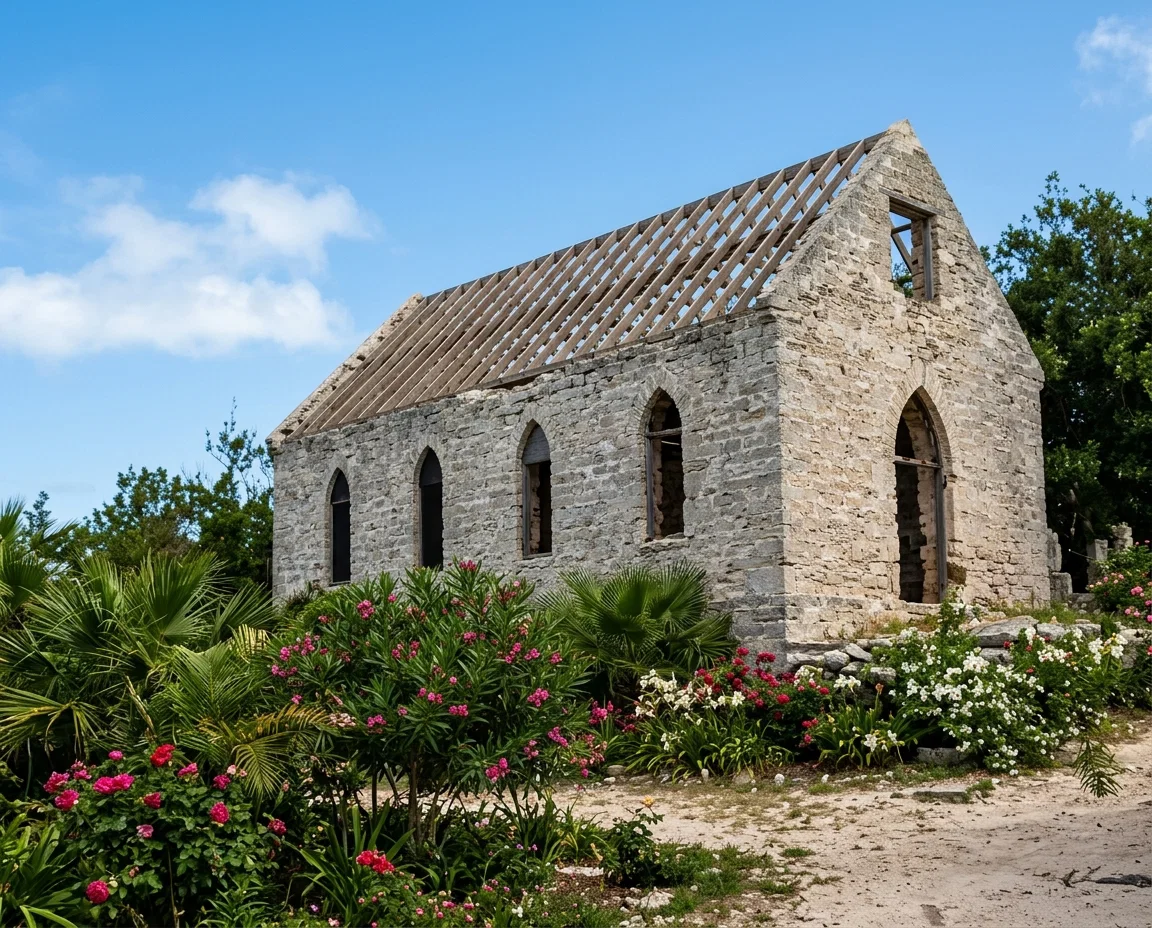
THE UNCOMPLETED BUILDING
In the “Testimony” above mentioned, we are also told, “In some cases it is better to hire some money than not to build.” So I felt free to make an effort for a building, and I found a gentleman who was willing to lend us nine hundred and sixty dollars. In order not to burden the brethren and sisters here, three of us have assumed the responsibility of this debt, and another and myself will pay the interest. This of course is with the understanding that all will do what they can to help liquidate the debt. In the “Testimony” from which I have already quoted, are these words: “Every week endeavor to lay aside something for this object, something in addition to your tithe money,” and so a plan has been adopted to lay aside one penny (two cents) a day for six days in the week, and lately it was decided that we offer to God a thank-offering each month as soon as we go into the new building; so far thirty have decided to pay one shilling (twenty-four cents) each a month; this amount is to go toward the indebtedness.
The accompanying picture shows our building in course of erection. It is forty-six feet long and twenty-four feet wide, outside measurements. As we are15also admonished to build solidly, we decided to make our building of concrete blocks one foot in thickness, which are composed of one part Portland cement and four parts sand. This is the second building of this material in Bermuda, and it is pronounced one of the best buildings here. It will cost less than it would had it been built of the coral stone. The roof is also made very strong, having eight principal rafters which sustain the main common rafters, covered with spruce pine.
Since starting our building, five months ago, the Lord opened the way for Brother Morrow to labor among the Portuguese, of whom there are several hundreds here. Like the woman’s leaven in the measure of meal, the truth has worked until at least twenty adults have accepted it, some of whom were Roman Catholics. Five of them have been baptized. These, with their children, have so increased our numbers that we feel we have built none too soon.
Quite a number in the States and some in Canada have sent us help, for which we are very thankful. We still need about four hundred dollars besides the nine hundred and sixty dollars we have borrowed, in order to finish our building. About three hundred dollars is for the lumber, such as the roof, floor, and ceiling, and one hundred is for incidentals which I need not enumerate. Thus we have done all we could. I am writing this through urgent requests from the United States that we make our needs known to our brethren and sisters in other parts of the world. I believe I can safely say that our brethren and sisters in Bermuda, though poor, have nobly responded to calls for help from other fields, and we expect still to help all we can. May the Lord move upon the hearts of our good brethren and sisters to help us in this our time of need. Right here at the capital of this colony we need a memorial, a sign of the true Sabbath, a place where our congregation of from fifty to eighty or more can worship God according to the dictates of their own conscience. How we did long for a place where we could tell the people the meaning of the California earthquake when it happened, that is, in a public way, but nothing could be done in that way, for there is not yet a Seventh-day Adventist church building in Bermuda, besides this one we are now erecting. We do not know how soon these islands will sink out of sight, and we need several such places where the third angel’s message can publicly be brought to the attention of the people.
Drafts on New York are good here, also post-office orders, and there is but little discount on them. Should any prefer sending express money-orders, we can use them. Any amount may be sent directly to me, or to the General Conference, Washington, D. C. Letter postage to Bermuda is five cents a half ounce or fraction thereof.
Hamilton, Bermuda Islands, via New York.
The Georgia Camp-Meeting
By K. C. Russell
THIS meeting was held at Marietta, Ga., August 2-12, in a pleasant and shady grove near the edge of the city. Marietta has a population of some five thousand inhabitants, and is located near the Kennesaw Mountain, where the celebrated battle of Kennesaw was fought.
This camp-meeting was the largest one which has been held in the Georgia Conference for a number of years. The outside attendance at the evening services and on Sunday afternoons was excellent. The Spirit of God was present in power on both Sabbaths of the meeting, and many hearts were subdued. Eight persons were baptized. The preaching in the evenings was largely of a doctrinal character, as is the usual custom at such gatherings.
One evening of the meeting was devoted to Bible temperance. A special invitation had been extended to the members of the W. C. T. U. of the place, to which they responded, and the president of the association took part in these services. This feature of the service came about as the result of some work which had been done with the association by Brother J. A. Starr, and his wife, Dr. Mrs. Starr. We believe that this meeting resulted in disarming prejudice among the citizens of this place.
Besides the local laborers of the conference, there were in attendance during a portion of this meeting Elders G. I. Butler, R. M. Kilgore, E. H. Rees, Prof. J. E. Tenney, Brother I. A. Ford, and the writer. The Lord gave freedom to the laborers in the preaching of his precious word. Elder G. W. Wells was unanimously elected president of this conference for the ensuing year.
It was gratifying to see the spirit of liberality which characterized those in attendance at this meeting, not only for their own work, but for the work in the world-wide mission field.
The camp-meeting will be followed by a series of tent-meetings, which will be held on a desirable lot which has been secured near the center of town, by a competent corps of workers.
It was voted by the conference to begin preparatory work in the city of Atlanta, Ga., by the circulation of our literature in view of the contemplated series of tent-meetings which will be held in that city next season by the Southern Union Conference. We believe there are better days in store for this conference. K. C. RUSSELL.
Prince Edward Island
By J. Greer Hanna
CHARLOTTETOWN.—At our conference committee meeting in the spring, my wife and I were recommended to return to this place from Halifax, Nova Scotia. In company with Brother Floyd E. Gibson and his wife, of Ohio, we opened a series of tent-meetings in Charlottetown on the first day of July. The attendance was fair, and on Sunday nights we had between two hundred and three hundred in attendance. When the testing truths were presented, our audience diminished, as usual. Five or six have about decided to obey, and others are interested. Including ourselves, we shall have as a nucleus a little company of about twelve Sabbath-keepers on the island. We shall continue to labor with the interested ones, and endeavor to persuade them to obey. We have a large field to cover with so few laborers, and the spiritual condition of the people is so lethargic that we must move slowly.
There are some parts of the island where a large supply of literature has been circulated by an isolated sister, and we intend to make our next effort in that neighborhood, and endeavor to cultivate the seed which has been sown.
We need the prayers of God's people for wisdom and guidance in carrying the message to this people. When the message gets into their hearts, those who obey will be staunch and true. This is evident from the persistent warfare which they have waged against the liquor traffic for many years, until this year witnesses the whole island under a prohibitory law. As we are in favor of prohibition, we can co-operate with the temperance organizations, and we have already made a number of good friends among them.
We are of good courage in the work, and hope to win many souls for the Master from among these people.
J. GREER HANNA.
W. C. HANKINS
By W. C. Hankins
China
AMOY.—The outlook for the present year is bright, in spite of the troublous times. The enemy of souls is seeking to create as much disturbance as possible in China, but God's cause is sure to triumph.
When we were preparing the candidates for baptism, we gave them a lesson on tithing. During the lesson Elder Keh made a few remarks, which I thought so good that I will pass on what I can remember of them. He said, in part:—
“The Lord does not want us to look upon the paying of tithes as a duty which we must perform in order to be saved, and which we would avoid, if we could. He does not need our money, for he is rich, and has need of nothing. But he had a good reason for instituting the plan of the tithes and offerings, and that reason was that he desired us to receive a great blessing. He knew that if we put all our money into the things of this earth, our hearts would be fixed upon this world, and that we would be in great danger of losing a part in the world to come. So the Lord instituted a plan whereby we could lay up treasure in heaven; for he knew that where our treasure is, there will our hearts be also.”
If our brethren in America would be as faithful in tithes and offerings as are these native Christians, there would be no lack of funds in the Lord's treasury16for carrying forward this work. How little our people realize what they miss when they use for their own selfish purposes money that belongs to God! If our people desire a revival and a baptism of the Holy Spirit, they will get both when they lay aside their selfishness, and begin laying up treasure in heaven.
One of our sisters recently removed to To Kang, where there is no Sabbath-school. Before she left, she deposited with Elder Keh a string of one thousand cash, to be used in making Sabbath-school donations for her. This woman's husband gets a salary of $7.50 a month, and they have a family of five children, and yet he willingly pays his tithe, and offers his donations to the Lord. A thousand cash is not a large sum of money, but it meant more to her than a thousand cents would to most of our brethren in America, and more than a thousand dollars would to many; for, like the widow in Scripture, she gave her all.
W. C. HANKINS
Western Pennsylvania
By W. F. SCHWARTZ
At our camp-meeting council in June, it was decided to pitch a tent at East Clearfield, to bind off the interest awakened, and to warn East Clearfield with the third angel's message. On June 10 the opening service was held in the tent; every evening in the week, and on Sunday afternoons, we found ourselves with a fair audience, with the exception of two nights, when the storms were too severe to allow any one to come out. We had rain almost every day for nearly three weeks.
July 12 we baptized two persons, and on Sabbath, the fourth, we took six into the church; on the twenty-first we took three more into the church, and in closing our tent effort, we had the privilege of baptizing five more adults. August 11 we took six into the church.
The meetings closed August 12 with a good interest, and many were sorry to see us leave. We all can see that it was a wise move in bringing the tent here for this short effort, which has proved a blessing to the church, in binding off the work, and warning this part of the field.
As to the expense of this effort, it has cost for freight on goods, lot rent, and lumber, also necessary advertisements to make the meetings a success, the sum of $43.24. Donations were received to the amount of $16.50, leaving an expense of $26.74, which is money well spent, seven souls having been baptized and nine having taken a stand for the truth while the tent was at this place. A full corps of officers was elected.
As an item of interest, we can say that the missionary spirit has been kept alive in the church and the Young People's Society while the tent has been here, and they have sold books and papers to the amount of $206.56.
The tent was shipped to Duncansville, Pa., where another interest will be awakened. We thank you for your prayers, and hope that we may still have them in this new effort.
W. F. SCHWARTZ.
Ecuador
By Thomas H. Davis
GUAYAQUIL.—I have just returned from a trip to the interior, a region known for its fanaticism. The head priest of Ambato had preached against my books, so it was hard to deliver them. One man who had subscribed for “Patriarchs” took the book. Soon his sister came in, and snatching the book, ran out, declaring that she would burn it. She gave me strict orders never to return, but her brother tried to excuse the circumstances, and asked me to visit him again. I left them quarreling over the book.
MT. CHIMBORAZO IN THE DISTANCE
From Ambato I went to Riobamba for the first time. This is a beautifully located town of about twenty-five thousand inhabitants. It is in a beautiful valley, surrounded with mountains, several of which are covered with perpetual snow. Mt. Chimborazo, twenty-two thousand feet above the sea-level, is the highest, and is about twenty miles from Riobamba.
The ride from Ambato on horseback was quite tiresome, but with fasting and prayer, the Lord gave me twenty orders for the first day’s work for Spanish “Patriarchs.” I had the pleasure of meeting two professors of the English language. Although they did not speak very plainly, I admired their effort to try. One of them invited me to spend the evening with him, meeting him at his home at half-past seven. As he did not speak very good English, I understood him to mean that he would see me at my room. So we both waited for each other in our respective rooms. This will show you how they speak English. One of the professors seemed anxious that I should stay and teach him, but this was impossible, as my work is to get the reading-matter before the public.
Here is a great field open for self-supporting missionary work. Why could not several teachers be sent here, as they are being sent to Peru? They surely would have their hands full. Brother Casebeer offers his nice little home to such free, until they can get well started. The interior of Ecuador, with a continual spring climate all the year round, would be a pleasant place for some good young teacher to locate at once. May the Lord pick out the right ones and send them soon, is our prayer. THOMAS H. DAVIS.